
What are Sewn Open Mouth PP Bags?
In industrial logistics, Sewn Open Mouth PP Bags function as robust, textile‑like containers manufactured from woven polypropylene fabric. Their geometry is straightforward: a factory‑closed bottom, a filling top that stays open during dosing, and a post‑fill closure performed by sewing. Why does this basic geometry persist? Because it solves three stubborn problems simultaneously: resisting mechanical abuse, managing powder behavior, and running efficiently on open‑mouth filling lines. Simple in theory, proven in practice.
At filling, the open mouth pairs cleanly with spouts and clamps; after dosing, a sewing head folds the top and stitches a tight seam. The resulting package behaves like a textile under load yet can be tuned, layer by layer, to emulate film‑like barrier performance. In powder packaging, where one batch may be coarse and the next exquisitely fine, such tunability is not a luxury; it is survival.
- Sewn Open Mouth Bags
- Sewn Open Mouth Woven Sacks
- PP woven open‑mouth bags
- SOM polypropylene bags
- Open‑mouth woven PP sacks
Where do Sewn Open Mouth PP Bags sit among alternatives? Between multiwall paper sacks and fully welded film systems. Paper prints beautifully but weakens in humidity and struggles with abrasive products. Mono‑film tubes seal perfectly but can crease, slip on pallets, or require higher capital expenditure for form‑fill‑seal lines. Sewn Open Mouth PP Bags occupy the pragmatic middle ground: grippy like textiles, configurable like composites, forgiving on varied filling equipment.
Material architecture of Sewn Open Mouth PP Bags
Behind the familiar silhouette hides a layered architecture. Think in subsystems: the woven fabric for strength, coatings and laminations for barrier control, liners for moisture and cleanliness, and seam components that determine leakage and tear‑out resistance. Alter one layer and the bag behaves differently; alter two or three, and you have effectively designed a new package while keeping the proven core.
Fabric begins as PP resin pellets, extruded into flat tapes and stretched to align polymer chains. Woven either as tubular sleeves or flat panels, fabric mesh often spans 9×9 to 12×12 while GSM ranges from 60 to 120 g/m² for typical chemical duties. Higher mesh refines print surfaces and reduces powder sifting; higher GSM improves puncture and tear resistance, at a cost in tare weight.
Coatings bridge the weave: a 17–30 g/m² PP/PE extrusion layer raises moisture resistance and graphic fidelity. Laminations step further, with 10–21 µm BOPP on the outside for premium print and additional barrier. For extreme climates or long dwell times, multi‑layer stacks (PP/PE/foil or PP/PE/PA) can be specified, though these are reserved for niche chemical or food‑adjacent powders where shelf life is paramount.
Liners, typically 40–80 µm PE, shoulder the primary barrier load for hygroscopic powders such as sodium bicarbonate or certain additives. The woven shell protects the liner from puncture and adds the friction needed for stable stacking. When the liner is heat‑sealed before the outer mouth is sewn, a hybrid closure is created: inner seal for barrier, outer seam for mechanics. Clean, dry, secure.
Threads and tapes seem minor, yet needle size, stitch density, and over‑tape width are decisive for leakage. In dust‑hazard zones, anti‑static threads and coatings help maintain safe surface resistivity. In sun‑exposed yards, UV‑stabilized masterbatch protects fabric from photodegradation.
- Polypropylene has global supply depth; woven conversion is mature and efficient, often achieving lower polymer mass than thick mono‑film alternatives at equivalent load capacity.
- Where powders enter food, feed, or pharma chains, contact‑approved resins and inks are selected. Mono‑material PP constructions improve recycling pathways.
- Trade‑offs are explicit: barrier gains can add cost and alter folding behavior; strength upgrades can increase tare weight but reduce field failures.
Key features that distinguish Sewn Open Mouth PP Bags
Features explain adoption. For Sewn Open Mouth PP Bags, four attributes dominate procurement decisions: structural strength, tunable barrier behavior, compatibility with open‑mouth filling lines, and high information density through print. Each attribute is a spectrum, not a binary choice, allowing tailored combinations for specific powders.
From pellets to pallets: production process of Sewn Open Mouth PP Bags
Consistent performance does not happen by accident. It is the cumulative effect of raw‑material verification, stable conversion on best‑in‑class equipment, and routine destructive testing. The following chain describes how Sewn Open Mouth PP Bags reach the loading dock without surprises.
- Raw material selection and testing: PP resin (for tapes and coatings), PE/PP (for coatings and liners), inks, threads, and tapes are qualified for melt flow, density, additive packages, and mechanical strength.
- Tape extrusion and stretching: tapes are oriented for tensile performance; draw ratios define strength, elongation, and stability in weaving.
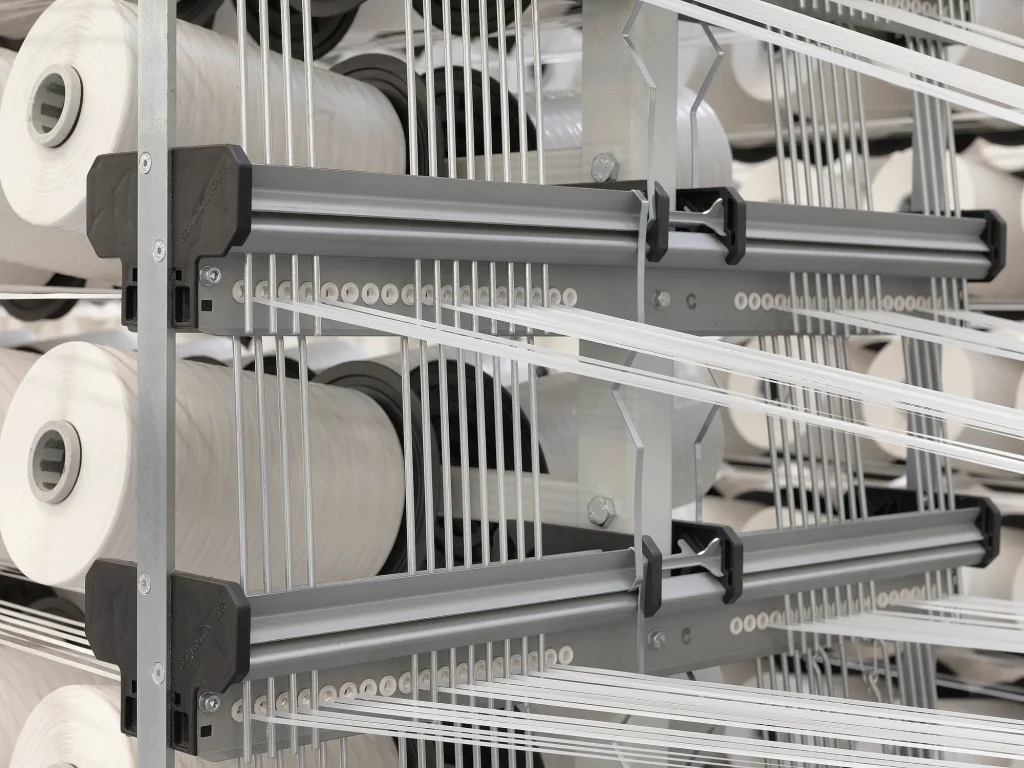
- Weaving: circular or flat looms set fabric width, mesh, and GSM. Tight loom control reduces variability that would otherwise surface as seam failures or print misregisters.
- Coating or lamination: extrusion coaters apply PP/PE; lamination bonds BOPP for barrier and print. Coating weight and adhesion are checked continuously.
- Printing: flexible, high‑contrast graphics and compliance panels are applied while managing ink laydown to avoid cracking at folds.
- Cutting and gusseting: bag length, width, and gusset depth are trimmed to spec; accuracy matters for automated pick‑and‑place equipment.
- Bottom closing: factory sewing defines base integrity; plain‑sew or tape‑over‑sew is chosen according to product behavior and load.
- Mouth preparation and liner integration: heat‑cut edges resist fraying; liners are inserted and optionally heat‑sealed before outer sewing for a hybrid barrier‑plus‑mechanics closure.
VidePak runs Austrian Starlinger and German W&H platforms across extrusion, weaving, coating, lamination, and printing. These lines are built for narrow tolerances, high uptime, and repeatability. In packaging, that pedigree translates into fewer misfeeds on filling lines, cleaner seams, and steadier print registration—small effects individually, but compounded across millions of bags.
- Dimensional checks (length, width, gusset), fabric GSM/mesh verification, and coating thickness confirmation.
- Seam tear‑out and tensile tests, using ISO/ASTM/EN/JIS methods where applicable.
- Drop and stacking trials to expose edge tears, seam splits, or base abrasion.
- Dusting and leakage assessments, WVTR sampling where liners or high barrier are specified.
Where Sewn Open Mouth PP Bags excel: application map
The footprint of Sewn Open Mouth PP Bags spans commodity inorganics, specialty minerals, organic powders and resins, fertilizers and agrochemicals, pigments and additives. Each domain pushes on different constraints—hygroscopicity, abrasiveness, toxicity, and sometimes explosion risk. The bag family adapts by swapping coatings, adjusting GSM, inserting liners, and refining mouth design.
| Powder scenario | Indicative configuration | Why this works |
|---|---|---|
| Fine, hygroscopic salts (e.g., sodium bicarbonate) | Coated fabric + 60 µm PE liner + tape‑over‑sew mouth | Liner blocks moisture; tape bridges needle holes; coated fabric suppresses dusting. |
| Abrasive minerals (silica, titanium dioxide) | Higher GSM + coated fabric + optional BOPP lamination | Added puncture/tear resistance; smooth exterior for printing and handling. |
| Fertilizer blends exposed to weather | Coated fabric + optional liner + UV‑stabilized yarns | Resists caking and sunlight; maintains legibility in yards. |
| Organic powders with dust hazards | Coated fabric + anti‑static elements + liner + tape‑over‑sew | Controls static accumulation and dust escape while preserving strength. |
Because Sewn Open Mouth PP Bags run on open‑mouth lines, they fit both semi‑automatic cells and fully automated presenters, allowing SKU diversity without total line replacement. Changeovers are tractable; learning curves are short; maintenance is predictable. In short: less drama per ton shipped.
Quality assurance at VidePak: how guarantees are made real
Guarantees mean little without mechanisms. VidePak’s quality model rests on four pillars and ties specification to measurable outcomes.
System mapping: turning powder risks into bag specifications
To choose wisely, convert powder risks into bag levers. Start with the powder’s behavior (hygroscopic, abrasive, toxic, explosive), add environmental exposure (humidity, UV, temperature swings), then overlay logistics stress (clamps, drops, stacking height). Each risk maps to a lever: mesh/GSM for strength, coating/lamination for barrier, liner for moisture and cleanliness, stitch density and over‑tape for leakage, UV stabilizers for sunlight, anti‑static aids for ignition control.
| Risk driver | Primary levers | Secondary considerations |
|---|---|---|
| Hygroscopicity | Liner thickness and seal strategy; coating weight | Pallet wrap selection, warehouse humidity control |
| Abrasiveness | GSM increase; BOPP lamination | Corner protection, clamp pressure policy |
| Dust explosion potential | Anti‑static threads/coatings; leakage suppression | Grounding, air exchange, housekeeping practices |
| Outdoor exposure | UV‑stabilized fabric; laminated exterior | Pallet cover, stacking geometry, shift frequency |
If powder loss through seams costs only 0.2% per shipment, does it matter? Multiply by thousands of tons, add cleanup labor, add safety incidents, add rejected pallets. Suddenly, the payback for tape‑over‑sew or a slightly heavier liner looks immediate. A specification is an economic instrument, not just a technical memo.
Comparing formats: where Sewn Open Mouth PP Bags fit
To avoid category mistakes, compare apples to apples. Multiwall paper excels in print and renewability but suffers in humidity and clamp handling. Valve bags and tubular FFS films hit extreme speeds but demand dedicated machinery and tight powder behavior windows. FIBCs move bulk efficiently but do not suit 25–50 kg deliveries. In this landscape, Sewn Open Mouth PP Bags balance strength, adaptability, and line friendliness. They rarely win every metric, but they often win the project.
Design workflow: from discovery to locked specification
A mature workflow converts uncertainty into documented choices. Begin with discovery interviews (powder behavior, logistics, regulatory context). Follow with lab testing (dusting, WVTR, tensile) and pilot runs. Iterate dimensions, GSM, coating weight, liner thickness, and sew strategy until the data converge. Lock the spec; attach drawings; define acceptance tests; archive golden samples. Then—and only then—scale.
- Visual and dimensional inspection (L×W×G, print register, mouth fold).
- Seam tear‑out strength test at defined stitch density.
- Drop test at specified mass and height; pass criteria tied to no leakage or seam failure.
- Dusting test and powder sifting examination after vibration.
- WVTR sampling for liner‑integrated designs; optional oxygen transmission for oxidation‑sensitive powders.
Related formats and cross‑applications
Packaging seldom operates in isolation. Breathable woven formats can enhance waste management streams—see an overview on collection and storage. For graphic‑rich, moisture‑managed sacks, BOPP‑laminated woven solutions align performance with regulatory demands; further details are summarized in this analysis. Food industry crossovers remain instructive: poly‑paper hybrids for ingredients are discussed here. Square‑bottom PP valve formats can amplify brand impact in retail contexts; the global brand note is available here. Finally, tubular woven bags designed for FFS systems demonstrate what tight integration with automation looks like; a technical tour is presented here.
Phrase bank: practical long‑tails for clarity and searchability
When drafting specifications, consistent phrasing reduces ambiguity. The following formulation bank offers practical long‑tails that align with how buyers and engineers actually search and speak. Use them verbatim in RFQs, SOPs, and artwork notes to keep everyone synchronized.
- Sewn Open Mouth PP Bags for chemical powder packaging with liner‑seal and outer tape‑over‑sew mouth
- Sewn Open Mouth PP Bags coated fabric 25–50 kg with anti‑static thread and UV‑stabilized yarns
- Sewn Open Mouth PP Bags BOPP‑laminated exterior for premium print and abrasion control
- Sewn Open Mouth PP Bags high‑mesh, medium GSM for fine powder sifting suppression
- Sewn Open Mouth PP Bags hybrid closure (liner heat‑seal plus external sewing) for hygroscopic salts
- Sewn Open Mouth PP Bags optimized for open‑mouth high‑speed filling and automated sewing
Paper delights designers, film delights sealers, Sewn Open Mouth PP Bags delight operators. One slips in rain, another skids on pallets, the third just works. Choose the tool that respects your constraints.
Extended parameter tables for practitioners
Numbers matter. The following tables consolidate frequently requested ranges. They are not prescriptions; they are conversation starters that shorten the path to the right design.
| Parameter | Typical range | Engineering note |
|---|---|---|
| Capacity | 25–50 kg (up to 100 kg engineered) | Verify clamp policy and stacking height before finalizing. |
| Fabric mesh | 9×9 to 12×12 | Higher mesh reduces sifting and improves print. |
| Fabric GSM | 60–120 g/m² | Increase for abrasive or long‑haul logistics. |
| Coating weight | 17–30 g/m² | Affects WVTR and print fidelity; watch fold behavior. |
| BOPP lamination | 10–21 µm | Premium print and abrasion control; adds stiffness. |
| Liner thickness | 40–80 µm PE | Thicker for long storage or high humidity lanes. |
| Stitch density | 2.5–4 stitches/cm | Balance seam strength with fabric perforation. |
| Over‑tape width | 50–70 mm | Key to bridging needle holes on fine powders. |
| Powder profile | Bag configuration |
|---|---|
| Hygroscopic and fine | Coated fabric + medium liner + tape‑over‑sew hybrid closure |
| Abrasive and dense | Higher GSM + coated or laminated exterior; robust seam design |
| Outdoor stored fertilizers | UV‑stabilized fabric + optional liner; consider pallet covers |
| Dust‑hazard organic powders | Anti‑static aids + leakage suppression via over‑tape |
Interlocking constraints: a short rhetorical sequence
Stronger fabric invites tighter sewing. Tighter sewing invites over‑tape. Over‑tape invites better dust control. Better dust control invites higher cleanliness grades. Are these steps optional, redundant, extravagant? Only until a pallet fails a quality gate, only until a forklift test breaks a seam, only until a customer rejects a lot. The logic is not dramatic; it is cumulative.
Closing note on vocabulary
Consistently employ the exact product name—Sewn Open Mouth PP Bags—across drawings, purchase orders, and artwork. Use synonyms for readability, but anchor the specification to the canonical term. Precision in words leads to precision in manufacturing; precision in manufacturing leads to fewer defects; fewer defects lead to safer, cleaner, more economical logistics.
- What are Sewn Open Mouth PP Bags?
- Material architecture of Sewn Open Mouth PP Bags
- Key features that distinguish Sewn Open Mouth PP Bags
- From pellets to pallets: production process of Sewn Open Mouth PP Bags
- Where Sewn Open Mouth PP Bags excel: application map
- Quality assurance at VidePak: how guarantees are made real
- System mapping: turning powder risks into bag specifications
- Comparing formats: where Sewn Open Mouth PP Bags fit
- Design workflow: from discovery to locked specification
- Related formats and cross‑applications
- Phrase bank: practical long‑tails for clarity and searchability
- Extended parameter tables for practitioners
- Interlocking constraints: a short rhetorical sequence
- Closing note on vocabulary
The global chemical industry relies on packaging solutions that balance durability, safety, and customization. Sewn Open Mouth PP Bags stand out as a cornerstone for chemical powder packaging, offering unmatched versatility to meet diverse market demands. With over 30 years of industry expertise, VidePak delivers these bags with 100% virgin PP materials, ISO 9001-certified production, and customizable designs tailored to regional preferences. For instance, our 50kg capacity bags withstand 8:1 safety factor loads, while multi-layer laminations ensure zero leakage for hygroscopic powders like sodium bicarbonate.
1. Why Sewn Open Mouth PP Bags Dominate Chemical Packaging
1.1 Structural Superiority for Hazardous Materials
Sewn Open Mouth PP Bags are engineered with high-tensile polypropylene fabric (80–200 gsm density) and reinforced stitching, ideal for abrasive or corrosive powders. For example:
- Load Capacity: Bags withstand 50–100 kg weights, tested under ASTM D4632 standards for tensile strength (up to 1,500 N/5cm warp/weft).
- Lamination Options: BOPP or PE coatings add moisture resistance, critical for deliquescent chemicals like calcium chloride.
- Safety Features: Anti-static variants (surface resistivity <10^9 Ω) prevent ignition risks in volatile environments.
VidePak’s production leverages Austrian Starlinger circular looms and 30+ lamination machines, ensuring seam precision ≤2mm tolerance.
1.2 Customization for Regional Compliance
Global markets demand localized adaptations:
- Design Flexibility: 1–8 color printing accommodates branding needs (e.g., OSHA-compliant hazard labels in the EU).
- Size Variations: Widths from 30–70 cm and lengths up to 120 cm suit regional palletization norms.
- Regulatory Alignment: Bags meet REACH (EU), FDA (US), and GB/T 8946-2013 (China) standards.
2. VidePak’s Competitive Edge in Global Markets
2.1 Manufacturing Excellence
Founded in 2008, VidePak operates 100+ circular looms and 16 extrusion lines, producing 20 million bags monthly. Key differentiators include:
- Material Integrity: 100% virgin PP resin enhances tear resistance (≥35 N puncture force per ASTM D2582).
- Eco-Friendly Options: Recyclable bags with <5% CaCO3 filler reduce carbon footprints.
- Certifications: ISO 22000, ISO 14001, and Oeko-Tex® ensure safety and sustainability.
2.2 Market-Specific Solutions
- Europe: UV-stabilized bags for outdoor storage.
- Africa: Cost-effective 40 gsm bags for fertilizer packaging.
- Asia: Multi-ply laminations for monsoon-prone regions.
3. Technical Specifications and Customization Options
Table 1: Key Parameters of VidePak’s Sewn Open Mouth PP Bags
| Parameter | Specification |
|---|---|
| Material | Virgin PP woven fabric |
| Fabric Density | 80–200 gsm |
| Lamination | BOPP, PE, or Aluminium foil |
| Load Capacity | 25–100 kg |
| Printing | Up to 8 colors, CMYK/Pantone® matching |
| MOQ | 10,000 bags |
| Lead Time | 15–30 days |
FAQs for Buyers
Q: Can I request samples before bulk orders?
A: Yes, we provide 5–10 free samples with custom artwork.
Q: Do your bags comply with food-grade standards?
A: Our FDA-compliant PE liners are suitable for food additives like citric acid.
Q: How do you ensure consistency in mass production?
A: Automated quality checks (e.g., seam strength testers) and 24/7 production monitoring.
4. Case Studies: Solving Real-World Challenges
- Case 1: A European agrochemical firm needed anti-static bags for ammonium nitrate. VidePak integrated conductive threads (surface resistivity: 10^6 Ω), reducing discharge risks by 90%.
- Case 2: A Southeast Asian client required 70cm-wide bags for automated filling lines. We recalibrated looms within 48 hours, achieving ±1mm width accuracy.
5. Conclusion: Partnering for Future-Ready Packaging
VidePak’s Sewn Open Mouth PP Bags redefine chemical packaging through adaptive design, rigorous quality control, and global regulatory mastery. With $80 million annual revenue and 568 employees, we serve 50+ countries, from pharmaceuticals in Germany to fertilizers in Nigeria.
Explore our BOPP Woven Bags and Custom Solutions for Chemical Products to elevate your supply chain.
References
- Lansu Packaging. (2025). Pp Woven Bags Manufacturer.
- Okorder. (2025). Laminated PP Woven Bags Specifications.
- Changying Plastic Woven Packaging. (2015). Plastic Rice Bag Production.
- VidePak Internal Data (2025).
Contact VidePak
- Website: https://www.pp-wovenbags.com/
- Email: info@pp-wovenbags.com
This article integrates technical insights from industry leaders and VidePak’s proprietary data, ensuring alignment with EEAT principles for authoritative, expertise-driven content.