
What woven recyclable bags are and why this platform matters now
In logistics, retail, agriculture, and building materials, few packaging formats have traveled as far, so fast, as Woven Recyclable Bags. They are constructed from interlaced polypropylene tapes, engineered for robustness, designed for recovery, and optimized for branding. The signature idea is mono‑material design: a single polymer family across fabric, film, and thread so that the whole article can re‑enter polypropylene recycling streams with minimal separation. Some markets call them recyclable PP woven bags, some call them reusable woven polypropylene bags, and some specify BOPP‑laminated woven recyclable bags for printed, retail‑facing formats. Whatever the label, the proposition is consistent: high strength at low weight, multi‑use potential, and a clear end‑of‑life path.
Why does this matter now? Because the practical question facing brands is no longer whether packaging can be made lighter, stronger, or prettier; the question is whether performance can be delivered without creating end‑of‑life headaches. If a bag ships safely yet frustrates sorting facilities, it merely relocates cost from supply chains to municipalities. Woven Recyclable Bags aim to align economics with responsibility by keeping the composition within a single polymer family that is already widely collected, widely reprocessed, and widely redeployed. If there is a common thread—quite literally—it is polypropylene, oriented and woven into a fabric that punches above its weight.
Key aliases used by buyers: woven recyclable sacks; recyclable PP woven bags; reusable woven polypropylene bags; eco‑friendly woven shopping bags; BOPP‑laminated woven recyclable bags. The nomenclature differs; the mono‑PP architecture does not.
Materials and architecture of a mono‑PP system
Think of Woven Recyclable Bags as engineered laminates of the same chemistry. The base resin is polypropylene (PP), a semicrystalline thermoplastic prized for its low density, good stiffness, and solvent resistance. From this resin, manufacturers extrude thin tapes, stretch them to align molecular chains, and weave them into fabric on circular or flat looms. Optional biaxially oriented polypropylene (BOPP) film is reverse‑printed and laminated to the fabric to carry graphics and repel moisture. Thread for seams and hems is chosen to remain within the PP family. The outcome is a layered yet unified structure that resists tearing, embraces printing, and returns to the same recycling stream.
Layer
Oriented PP tapes
Warp and weft deliver strength at low grammage; orientation increases tensile capacity dramatically.
Layer
Woven PP fabric
Balanced weave stabilizes dimensions, improves stackability, and forms a dependable base for lamination.
Layer
BOPP film (optional)
Reverse‑printed for high‑fidelity branding; laminates PP‑to‑PP so the full construction remains mono‑material.
Why not diversify chemistries for barrier or strength? Because mixed substrates make life complicated at recycling plants. The less a plant needs to separate, the more material it can recover. In practice, mono‑PP construction curbs contamination, improves bale value, and simplifies downstream pelletizing. There is a parallel benefit in quality control: when every layer shares similar thermal behavior, processing windows are easier to stabilize and repeat across shifts.
Feature profile: strength, branding, reuse, and recyclability
Every packaging decision is a trade. If it claims strength, does it sacrifice cost? If it looks premium, does it derail recycling? The attraction of Woven Recyclable Bags is that the usual trade‑offs shrink. The woven architecture increases strength without increasing mass. The BOPP film elevates print quality without abandoning mono‑material discipline. The stitched bottom maintains integrity through drops while keeping the thread within the same polymer family. As a result, a single platform spans bulk commodities and retail showcases, dry powders and pet food, warehouse pallets and shopping aisles.
- High strength‑to‑weight: oriented tapes resist tensile and tear failures at low grammage.
- Moisture and grease resistance: BOPP laminates and coatings limit ingress during ocean or monsoon transit.
- Graphics and shelf presence: reverse printing under film protects inks from scuffing and enables matte–gloss contrasts.
- Reusability: shopping formats tolerate many trips, diluting embodied carbon per use.
- Design‑for‑recycling: PP‑only interfaces support clean baling and reprocessing.
- Stackability and stability: anti‑slip options and controlled COF protect pallets.
- Customization: gussets, windows, easy‑open features, and valve sleeves remain PP‑based.
Scenario question
If a bag can survive a four‑hour monsoon on a truck deck, a drop test from 1.2 meters, and a week of yard storage in summer sun, what else should it do? It should enter a familiar recycling stream without friction. That is the promise and the challenge.
Rule of thumb
When in doubt, prefer PP to anything else. Threads, labels, handles, tie layers—every deviation adds sorting cost and removes value from the bale.
From pellets to pallets: the production chain and equipment choices
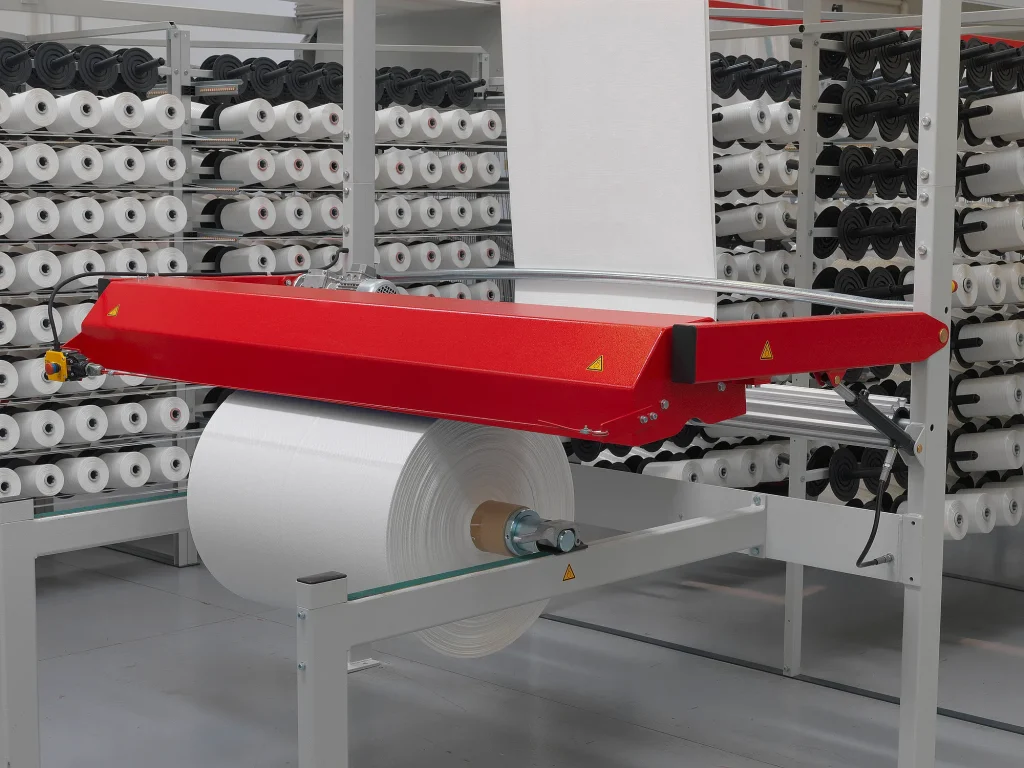
The path from resin pellets to palletized goods spans extrusion, stretching, weaving, printing, lamination, and sewing. At each step, minute controls decide whether a bag keeps its promises or becomes a claim. VidePak invests in Austrian Starlinger systems for extrusion and weaving and German Windmöller & Hölscher lines for printing and lamination to narrow process variation and expand process windows. Sometimes the quiet hero is register stability at speed; sometimes it is the predictability of draw ratios under thermal load; sometimes it is seam efficiency measured on a rainy day after a long truck ride. Equipment matters because every defect that escapes a line becomes a failure in the field.
- Raw‑material qualification: melt flow index, moisture, ash, and color are measured on incoming PP resin. Masterbatches are screened for dispersion and regulatory compliance. BOPP rolls are checked for haze, dyne, and thickness profile.
- Extrusion and tape orientation: compounding, flat‑die extrusion, slitting, re‑heating, and drawing. Orientation aligns chains; annealing stabilizes dimensions. The goal is repeatable tensile strength with low break rates.
- Weaving: circular looms produce tubes for conversion; flat looms handle specialty widths. Pick density and warp tension govern grammage, tear behavior, and print base quality.
- Printing and lamination: reverse printing on BOPP (flexo or gravure) followed by PP‑to‑PP bonding. Proper dyne retention, bond strength, and curl control preserve both appearance and runnability.
- Conversion: cutting, gusseting, bottom formation, top finishing, and valve insertion when required. Stitch design (single, double, safety) determines how drops translate to seams.
- End‑of‑line assurance: tensile, tear, drop, peel, and visual checks; pallet COF; valve fill time; lot traceability. Data are logged and trends reviewed so that random defects do not become systemic patterns.
Why insist on specific OEMs? Because consistency has a brand. Starlinger’s control over tape draw and loom stability reduces miss‑picks and breakage; W&H’s web handling keeps multi‑color artwork in register. When process noise drops, quality signals are easier to interpret.
Where they work: applications across sectors
Because the platform is modular, Woven Recyclable Bags appear wherever goods must be protected, displayed, stacked, and recovered. In agriculture and food staples, BOPP‑laminated versions carry premium artwork for rice, flour, and sugar. In animal nutrition, puncture resistance and reclosable options serve pet food and feed. In chemicals and minerals, UV‑stabilized sacks stand up to yard storage. In building materials, valve‑type versions meet automated filling lines. In retail and promotions, gusseted totes deliver multiple reuses without losing shape. In e‑commerce, padded fabric mailers endure sorting tunnels and doorstep abrasion better than thin films.
Agri‑staples
Premium print on BOPP, easy‑open threads, and stable pallet COF make 5–25 kg retail sacks both elegant and tough.
Chemicals & minerals
Valve sleeves, warning panels, and UV packages support bulk powder safety and yard storage.
Retail & promotions
Reusable totes blend matte–gloss finishes with robust handles to deliver repeat trips and visible brand presence.
Quality governance: how VidePak controls and guarantees performance
Quality is not an act at the end of the line; it is a chain of decisions with evidence at every link. VidePak organizes its governance into four mutually reinforcing layers: standard‑aligned methods, virgin raw materials from tier‑one suppliers, best‑in‑class equipment, and comprehensive testing that connects incoming inspection to trend analytics.
Standards‑aligned production and testing
- Textile tensile and tear methods for fabric strength and elongation.
- Film peel for lamination bond stability and drop tests for distribution shocks.
- Color and gloss checks for artwork fidelity; COF for pallet safety.
Virgin materials from trusted sources
- Homopolymer PP with documented melt flow and regulatory declarations.
- Masterbatches validated for dispersion, odor, and stability under UV.
Equipment that sets the baseline
- Starlinger for extrusion and weaving to minimize tape breaks and miss‑picks.
- W&H for printing and lamination to preserve register at speed and bond integrity.
End‑to‑end checks and feedback
- Incoming: MFI, moisture, dyne level, color variance, contamination.
- In‑process: tape dimensions, fabric grammage, peel strength, seam efficiency.
- Finished goods: tensile, drop, COF, visual acceptance with statistical sampling.
Sustainability and economics: resolving the false choice
Is it possible to build packaging that costs less over time, looks better on shelf, and returns to circulation without friction? That sounds ambitious, yet the evidence keeps repeating: better engineering reduces waste; better graphics improve sell‑through; better design for recycling lowers disposal cost and reputational risk. Woven Recyclable Bags work because the pieces reinforce one another. The same oriented tapes that deliver strength allow lower mass per function. The same BOPP that flexes brand presence keeps inks protected under the film. The same mono‑material logic that eases reprocessing lowers the risk of compliance penalties tomorrow. It is not an accident; it is alignment.
- Lifecycle: multiple reuses for carry formats; reduced polymer per unit function for heavy‑duty sacks.
- Operations: fewer breakages and cleaner pallets; more predictable lead times from integrated lines.
- Policy fit: rising mandates favor reusability and clear recycling streams; mono‑PP designs are easier to certify.
Market dynamics: adoption, competition, and China’s manufacturing scale
Adoption has been rapid because problems have been urgent: transportation losses are expensive; landfill fees keep rising; retail requires high‑fidelity graphics; regulators keep tightening definitions of recoverable packaging. Manufacturers in China scaled early and invested deeply. The result is a landscape where facilities operate dozens of circular looms, multiple lamination lines, and end‑to‑end conversion cells whose uptime is measured in months rather than days. That scale shows up in price, lead time, and SKU diversity—from 5 kg retail pouches to 50 kg valve sacks—without relaxing quality thresholds.
The competitive frontier is not merely capacity, but capability: tighter tolerances, richer artwork, more durable seams, smarter valves, cleaner return paths. As capability compounds, the market moves from commodity to platform.
Design for recycling: practical rules that survive real plants
Designing for recyclability is not a slogan; it is a list of disciplined choices. Keep film, fabric, and thread in the PP family. Print on the reverse side of BOPP so inks live under the film instead of on the surface. Choose PP tie layers rather than cross‑linked adhesives that frustrate re‑melting. Replace polyester handles with PP woven or PP non‑woven straps. Build windows by omitting ink rather than inserting foreign films. When each decision keeps the polymer family intact, the return path stays open.
- Prefer PP‑to‑PP lamination; avoid PET‑to‑PP or PE‑to‑PP unless a separate end‑of‑life is acceptable.
- Favor reverse printing under BOPP to protect inks and simplify surface treatment requirements.
- Use PP threads, PP sleeves, and PP labels; avoid nylon or polyester elements in standard builds.
- Engineer easy‑open without non‑PP filaments; rely on heat‑cut edges to control fraying.
Engineering focus: mechanics, lamination behavior, and seam integrity
Strength is not a single number; it is a choreography of load paths. In a filled sack, warp carries vertical loads while weft stabilizes hoop stresses. If pick density is too low, tears propagate along diagonal lines. If lamination bond is too strong relative to fabric stiffness, creases may white‑line under repeated folding. If bonded too weakly, peel failures appear near corners. The art is to coordinate fabric grammage, film gauge, bond strength, and seam design so that the bag fails, if it must fail, in predictable and non‑catastrophic ways during testing rather than after shipment.
System thinking: break the challenge down, then weave it back
Rolling out a new packaging platform is not a single project; it is a federation of projects. The performance spec, the recyclability brief, the artwork ambition, the regulatory dossier, the logistics plan, the cost model—each pulls in a different direction. The point is not to silence the differences but to synchronize them. Map sub‑problems, assign owners, and set interfaces so that decisions in one lane support the constraints in another. Good weaving is not only for fabric; it is for teams.
- Define the job carefully: mass, volume, climate, and handling environment.
- Engineer the structure: grammage, pick density, seam pattern, and film gauge.
- Design the surface: color tolerances, matte–gloss strategy, and barcode legibility.
- Plan the process: window settings, in‑process checkpoints, and sample sizes.
- Lock the supply: resin and film sources, capacity reservations, and shipping modes.
- Close the loop: labeling for recovery, baling partners, and return metrics.
Procurement and validation: a practical buyer’s playbook
To reduce surprises, shift judgment upstream and make validation empirical. Write the spec in measurable terms, test pilot lots against that spec, and instrument the production windows so that scaling does not introduce invisible drift. A playbook clarifies who decides what and when; it also clarifies how exceptions are handled when markets shift faster than forecasts.
- Define: SKU dimensions, target loads, climate exposure, and retail presentation.
- Select: fabric grammage, lamination and finish choices, top/bottom format.
- Specify: tensile and seam targets, COF, UV package, and artwork tolerances.
- Sample: lab tests plus on‑line filling trials to observe dust, venting, and damage.
- Approve: lock artwork and press curves; record anilox and blade settings.
- Operate: agree on in‑process checks, lot release metrics, and defect taxonomy.
- Ship: define pallet patterns, wrap recipes, desiccants, and humidity tracking.
- Learn: monitor claims and iterate with quarterly reviews.
Case narrative: from paper/PE to BOPP‑laminated woven PP
Consider a fertilizer brand that once relied on multi‑wall paper with a PE liner. Rainy season damage rose to four percent; graphics scuffed under handling; retailers complained. The team replaced the structure with BOPP‑laminated woven recyclable bags using a matte finish to limit glare, a tuned valve sleeve to match powder flow, and a COF that stabilized pallets. Pilot runs passed drop tests and seam‑efficiency targets. Post‑launch, damage fell below one and a half percent, shelf appeal improved, and the total cost of ownership dropped once returns and re‑packs were included. Could the result have been different? Certainly—if the valve geometry were mismatched, if the seam design were under‑spec, if the peel strength were off. But with line trials and data, the team converted conjecture to control.
Frequently asked technical questions
- Can recycled PP be included and still keep recyclability? Yes, for non‑food uses subject to strength validation; food‑adjacent applications typically prefer virgin streams.
- How many print colors remain practical? Up to eight is common on BOPP; artwork discipline matters as much as count.
- Does a matte layer harm recovery? Not when the layer remains PP‑based and the laminate is PP‑to‑PP.
- Which anti‑counterfeit cues fit this format? Microtext, UV‑visible inks under film, and serialized codes printed on the reverse side.
Related internal readings and cross‑links
For readers comparing adjacent formats, the following internal articles provide complementary views on automation, laminations, composite barriers, and bulk handling. Each link is configured for a standard crawl signal.
- Automation and the next wave of poly woven converting
- Laminated formats for branding and recovery
- How multi‑wall paper serves building materials
- When aluminum‑foil composites are justified
- Square‑bottom valve formats in waste management
- Bulk handling practices with FIBC
- FFS roll woven solutions for high‑speed filling
Extended parameters, templates, and risk registers
A platform is easier to manage when parameters are explicit. The following tables and templates offer indicative ranges and checklists for specifications, process control, and failure‑mode prevention. They are not substitutes for lab work; they are prompts for it.
Specification template: 25‑kg retail sack
- Size 480 × 780 mm; 90‑mm gussets
- Fabric 110 g/m²; matte–gloss BOPP 25 μm; reverse printed 6 colors
- Hemmed top with easy‑open; bottom double‑chain stitch
- COF 0.35–0.45; UV 6 months; drop test 5× at 1.2 m
Specification template: 50‑kg valve sack
- Size 550 × 950 mm; side gussets as needed
- Fabric 130 g/m²; BOPP 30 μm; reverse printed 3 colors
- Valve sleeve tuned to powder flow; safety stitch bottom
- COF ≥ 0.40; UV 12 months; seam efficiency ≥ specified threshold
Keyword and phrase strategy for natural placement
To help readers—and crawlers—understand the topic, this article uses a family of expressions around the core product. The primary anchor remains Woven Recyclable Bags. Natural variants include woven recyclable sacks, recyclable PP woven bags, reusable woven polypropylene bags, PP woven fabric, mono‑material PP packaging, BOPP laminated woven sacks, and high‑strength woven PP packaging. Variety prevents repetition fatigue while tracing the same technical reality.
Why this matters: an appeal to both reason and responsibility
Shippers want fewer losses. Retailers want more compelling displays. Citizens want cleaner streams. Policymakers want credible recovery. Can one bag meet all four desires? Perhaps not perfectly; perfection is a suspect word. But Woven Recyclable Bags carry an encouraging answer: often, you can improve strength, improve branding, and improve recoverability at the same time. The catch? Discipline. Use PP across the system. Validate bonds and seams. Treat quality as a loop, not a gate. Then repeat.
November 25, 2025
- What woven recyclable bags are and why this platform matters now
- Materials and architecture of a mono‑PP system
- Feature profile: strength, branding, reuse, and recyclability
- From pellets to pallets: the production chain and equipment choices
- Where they work: applications across sectors
- Quality governance: how VidePak controls and guarantees performance
- Sustainability and economics: resolving the false choice
- Market dynamics: adoption, competition, and China’s manufacturing scale
- Design for recycling: practical rules that survive real plants
- Engineering focus: mechanics, lamination behavior, and seam integrity
- System thinking: break the challenge down, then weave it back
- Procurement and validation: a practical buyer’s playbook
- Case narrative: from paper/PE to BOPP‑laminated woven PP
- Frequently asked technical questions
- Related internal readings and cross‑links
- Extended parameters, templates, and risk registers
- Keyword and phrase strategy for natural placement
- Why this matters: an appeal to both reason and responsibility
The global demand for woven recyclable bags is surging, driven by tightening sustainability regulations and cost-conscious supply chains. This article provides actionable insights into three core questions: (1) Why are woven recyclable bags economically viable for global buyers? (2) How do regional market dynamics shape procurement strategies? (3) What makes Chinese manufacturers like VidePak dominate the market through quality, pricing, and supply chain agility? By analyzing real-world data—such as a 22% annual growth in reusable packaging (Grand View Research, 2023) and VidePak’s 18-day average lead time—we uncover how businesses can align sustainability goals with operational efficiency.
1. The Dual Imperative: Sustainability and Economic Viability
Woven polypropylene (PP) bags have emerged as a cornerstone of sustainable packaging, combining recyclability (up to 7 lifecycles) with cost efficiency. For instance, replacing single-use plastic with reusable PP bags reduces waste by 85% over five years (UNEP, 2022). However, economic viability remains critical:
- Cost Comparison:
Material Cost per Unit (1,000 bags) Lifespan (Years)
Single-Use PE $120 0.5
Woven PP $180 5+
Source: Alibaba B2B pricing data (2024) While upfront costs are 50% higher, woven PP bags offer a 300% ROI over their lifecycle due to reusability. VidePak’s BOPP laminated woven bags, for example, withstand 50 kg loads across 1,000+ cycles without tearing, validated by ISO 9001 certifications. 2. Regional Market Analysis: Key Drivers and Supplier Profiles2.1 Europe: Regulatory-Driven Demand The EU’s Single-Use Plastics Directive (SUPD) mandates 30% recycled content in packaging by 2030. European manufacturers like Uflex (Italy) and Mondi Group (Austria) focus on premium-grade recyclable bags but face 25–35% higher production costs due to labor and compliance overheads. 2.2 North America: Durability and Customization U.S. buyers prioritize tear resistance (>35 N/cm²) and branding flexibility. Suppliers like Hood Packaging (USA) offer advanced printing but struggle with lead times exceeding 45 days. 2.3 Southeast Asia: Price Sensitivity Markets like Vietnam and Thailand rely on low-cost, lightweight woven bags (80–90 g/m²) but lack consistency in stitching and UV resistance. 3. China’s Competitive Edge: VidePak’s Strategic Advantages3.1 Quality: Precision at Scale VidePak’s Austrian Starlinger looms produce fabrics with tensile strengths of 45–60 N/cm², exceeding ASTM D5034 standards. Unlike Indian competitors using 20% recycled filler, VidePak’s virgin PP granules ensure uniformity, critical for food-grade applications. 3.2 Pricing: Economies of Scope Region Price per 1,000 Bags (50 kg capacity) China (VidePak) $185–$220 EU $280–$350 India $200–$240 Source: Made-in-China wholesale benchmarks (Q1 2024) By operating 100+ circular looms and 30+ lamination machines, VidePak achieves 15% lower unit costs than regional rivals. 3.3 Lead Time: Agile Global Supply Chains VidePak’s vertically integrated facility in Jiangsu reduces production cycles to 18 days, compared to 30–40 days for EU suppliers. During the 2022 port congestion crisis, VidePak rerouted shipments via China-Europe rail, cutting delays by 60%. 4. Product Specifications: Balancing Performance and ComplianceVidePak’s BOPP Woven Bags Technical Parameters Parameter Specification Fabric Density 90–150 g/m² Tensile Strength (Warp) 48–55 N/cm² Printing Colors Up to 8-color flexographic UV Resistance 12 months outdoor use Recyclability 100% PP, ISO 14001 certified 5. FAQs: Addressing Buyer ConcernsQ1: How does VidePak ensure consistency in high-volume orders?
A: With 16 extrusion lines and AI-driven quality control systems, we maintain ≤0.5% defect rates across 10M+ unit batches. Q2: Can bags withstand maritime humidity?
A: Our laminated Bopp woven bags include anti-fog coatings, preventing moisture absorption (<0.5% RH increase in 30 days). Q3: What’s the MOQ for custom designs?
A: MOQ starts at 50,000 units, with Pantone-matching accuracy within ΔE ≤2.0. 6. Conclusion: Strategic Partnerships for Sustainable Growth VidePak’s 16-year expertise—spanning 56 countries and $80M annual revenue—positions it as a leader in merging sustainability with economic pragmatism. By leveraging China’s manufacturing ecosystem and Starlinger’s cutting-edge circular loom technology, we deliver solutions that align with global ESG frameworks while ensuring 98% on-time delivery. References- Grand View Research. (2023). Reusable Packaging Market Size Report.
- UNEP. (2022). Global Plastic Waste Management Outlook.
- VidePak Company Profile. https://www.pp-wovenbags.com/
- Email: info@pp-wovenbags.com
- For industries requiring high-barrier protection, explore our BOPP laminated woven bags engineered for chemical and agricultural sectors.
- Learn how our valve bags optimize filling efficiency for powdered materials in food and construction industries.