
What Are Woven Recyclable Bags for Agricultural Packaging?
Woven Recyclable Bags for agriculture are heavy‑duty packaging solutions built on a woven polypropylene (PP) fabric that is both light in mass and high in mechanical strength. They are designed to travel the full distance from field to warehouse to export yard while keeping grains, seeds, feeds, and fertilizers safe, dry, and clearly identified. The phrase “recyclable” is not ornamental: it points to intentional, mono‑polymer construction choices, compatible adhesives, and identification markings that keep the package inside polyolefin recovery streams instead of sending it to landfill. In practice, that means a PP fabric skeleton, PP‑family print faces such as BOPP where branding is required, and closures that do not sabotage the end‑of‑life pathway.
Across farms and cooperatives, at elevators and ports, these packages must perform a careful balancing act: they must fill quickly with minimal dust, palletize neatly for cube efficiency, resist scuffing and tears during long trips, scan reliably under mixed lighting, and conclude their lifecycle with a credible recovery route. When specified with discipline, Woven Recyclable Bags satisfy each of those constraints with one coherent design architecture.
- Recyclable PP Woven Bags
- Recyclable Woven Sacks
- Agricultural Woven Recyclable Bags
- Mono‑PP Recyclable Woven Bags
- Recyclable Polypropylene Woven Packaging
- PP Woven Recyclable Agricultural Sacks
- Recyclable Woven Poly Bags
The Materials of Woven Recyclable Bags (Architecture, Properties, Cost/Benefit)
A Woven Recyclable Bag is never a single sheet of plastic; it is a layered system in which each layer earns its keep: the fabric provides strength, the face layer carries graphics and adds barrier where needed, the liner (if any) tunes moisture migration, and small amounts of chemistry—inks, tie resins, varnishes—do precision work while staying compatible with recycling. The default philosophy is mono‑PP: keep each structural layer in the polypropylene family whenever practical. Doing so simplifies sorting and raises the probability that the bale of used bags ends up in a reprocessor’s input stream and not in mixed‑plastic purgatory.
Raffia‑style PP tapes are extruded, slit, and mono‑oriented before being interlaced on circular or flat looms. Typical fabric mass sits between 60 and 120 g/m²; tape denier often ranges from 500D to 1200D. The result is a lattice that absorbs drop energy, resists tear propagation, and flexes without fatigue cracking. Because PP’s density is about 0.90 g/cm³, the same tensile performance arrives with less mass than many alternatives.
Cost behavior is favorable: loom productivity is high and resin usage can be reduced further by down‑gauging once drop and pallet tests confirm safety margins. Recyclability is straightforward because the fabric is itself PP; keeping the rest of the stack in the PP family preserves mono‑material claims and simplifies sortation.
Breathability and barrier do not coexist by accident; they are dialed in by construction type:
- Unlaminated mono‑PP with light coating: a thin PP‑family coat improves printability and suppresses dusting while preserving air paths for fast de‑aeration. Best for grains and powders that must “breathe.”
- BOPP‑laminated mono‑PP: reverse‑printed BOPP adds a tougher, scuff‑resistant face for photographic branding and better moisture control. Still within the PP family, so compatibility with recycling is maintained if PP‑friendly tie resins are used.
- Linered builds: a PP or PE liner (20–60 μm) raises water vapor resistance for hygroscopic goods such as salt, sugar, starch, or certain fertilizers. A PP‑rich liner keeps the mono‑PP story clean; a PE liner can be used with clear marking and local guidance for sorters.
Printing on coated fabric typically uses solvent or waterborne flexo; BOPP faces are printed via gravure or HD‑flexo to achieve microtext and reliable barcodes. When bags touch food or feed, low‑migration systems are selected and verified with migration tests. Tie layers for lamination can be extrusion‑coated PP/PE or a solventless polyurethane adhesive; the former keeps the stack in the PP family, the latter requires tight control of residuals and a clear statement for recyclers.
Edge wear happens in trucks and on conveyors, so high‑build varnishes are targeted onto high‑touch zones. Matte windows on barcode panels reduce glare and improve scan grades in warehouses. The trick is doing enough chemistry to protect the package without creating islands of incompatibility that would reduce the value of reclaimed resin later on.
UV stabilizers extend life for field storage and yard staging; antistatic agents cut nuisance shocks near fine powders; slip and anti‑block agents tune the coefficient of friction so that pallets stay upright but lines keep moving. White and color masterbatches deliver opacity and brand fidelity, but pigment choices are kept within lists accepted by recyclers.
Sleeves can be PP fabric, PP/PE film, or paper laminate, each sized to engage a filler nozzle without wobble. Optional elastic cuffs and check‑flaps reduce dust excursions with fine PSD products. Closures are selected by product behavior and recyclability intent: self‑closure under product head pressure, thermal bar on PE/PP‑rich sleeves, ultrasonic welding on laminate sleeves, or hot‑melt tapes on paper‑faced builds.
| Construction | Where It Excels | Notes on Recovery |
|---|---|---|
| Woven PP + PP coating (unlaminated) | Fast de‑aeration; grains; breathable powders | Mono‑PP if tie/coating are PP‑family |
| Woven PP + BOPP laminate | Retail‑grade branding; moisture discipline | Still PP family when PP‑compatible ties are used |
| Woven PP + BOPP + PP/PE liner | High barrier for hygroscopic goods | Declare materials; guide sorters to polyolefin streams |
What Are the Features of Woven Recyclable Bags?
The woven lattice of PP tapes yields tensile and tear performance at a lower resin mass than many competing formats. In drop tests, properly specced fabrics handle repeated impacts on corners, edges, and flats while resisting scuffs that compromise retail presentation. This strength makes down‑gauging realistic, but the decision should be verified against drop matrices and lane severity.
Cereals and fresh produce want to “breathe,” while fertilizers and refined ingredients want protection from humidity. Woven Recyclable Bags let you dial in air pathways with weave openness and micro‑perforation patterns, or move toward barrier with laminates and liners. The platform swings either way without needing new filling hardware.
Square or block‑bottom formats interlock like bricks. Properly tuned coefficients of friction keep loads upright through braking and cornering while still gliding on conveyors. In container loads, the rectangular footprint delivers meaningful cube gains over pillow sacks, lowering freight per ton.
When sleeves match nozzle outer diameters and check‑flaps are used on fine PSD products, dust excursions drop dramatically. Breathable windows evacuate entrained air quickly, preventing underfills and reducing the chore of top‑off cycles that slow the line.
BOPP faces carry photo‑grade artwork and protect it under film. Matte windows placed under barcodes eliminate glare and raise first‑pass scan rates under mixed warehouse lighting. Varnish maps add rub resistance on edges without suffocating the recyclability story.
By keeping the package within a polyolefin family and labeling it accordingly, Recyclable PP Woven Bags maintain value for reclaimers. Clear instructions help cooperatives and warehouses bale used sacks for local reprocessors or regional programs.
- Fertilizer packaging dynamics and line performance: read the fertilizer application guide.
- Branding and abrasion control on print faces for agriculture: see printed BOPP woven solutions.
- Material testing philosophies for complex laminates: multi‑wall woven testing overview.
- Transport efficiency with paper‑poly hybrids: kraft paper woven transport brief.
- Fast fill formats and valve options for dusty products: valve woven handling playbook.
- Bulk logistics and ESG expectations: anti‑bulge FIBC and ESG.
- High‑throughput roll stock for automated lines: FFS woven bag trends.
What Is the Production Process of Woven Recyclable Bags?
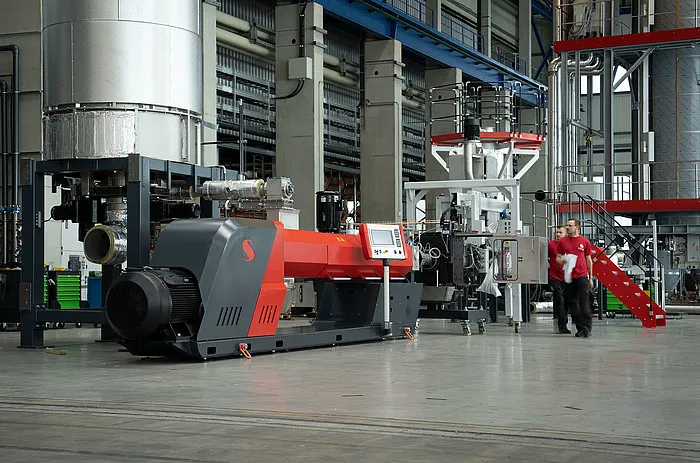
VidePak deploys Austrian Starlinger lines for extrusion, tape orientation, and weaving, and German Windmöller & Hölscher presses and laminators for printing and bonding. This combination is not brand theater; it is a quality hedge. Starlinger stabilizes the fundamentals that cannot be repaired later—denier uniformity, loom tension, GSM stability—while W&H preserves microtype, barcodes, and register that would otherwise drift over long runs. The method unfolds in three segments: pre‑material qualification, controlled unit operations, and end‑of‑line QA.
- PP resin (virgin or qualified PCR): MFI, isotacticity, ash, odor, moisture via Karl Fischer, and gel count. Lots are barcoded to maintain cradle‑to‑pallet traceability.
- BOPP film (when used): thickness tolerance within ±1–2 μm, haze/gloss targets, dyne level ≥ 38 dyn/cm, COF, heat shrink behavior, and surface cleanliness.
- Liners (PP or PE): WVTR/OTR, seal initiation temperature, dart impact, slip migration, and static decay time.
- Inks/adhesives: viscosity window, solids %, solvent balance, and residual limits; where food or feed is in scope, low‑migration stacks are selected.
- Additives and masterbatches: UV stability hours, antistatic decay time, and color ΔE controls.
- Valve sleeve components: dimensional tolerances, stiffness profile, and peel/shear strength for selected closure methods.
- Extrusion and tape orientation (Starlinger): PP pellets are plastified, cast, slit into tapes, and mono‑oriented through hot draw/anneal zones. Key controls: denier uniformity, tape width, crystallinity, tensile/elongation. Outcome: a predictable GSM and tensile baseline.
- Weaving (Starlinger circular/flat looms): tapes are interlaced into tubular or flat fabric at the target pick count. Defect mapping and broken‑end rates drive preventive maintenance. Breathability can be tuned by weave openness and later by micro‑perf patterns.
- Surface treatment: corona or plasma raises dyne levels on print and lamination faces to minimize ink lift and delam blisters.
- Printing route A — direct flexo on coated fabric: good for breathable workhorses with simpler art; 4–8 colors; flat‑top plates reduce mottling; varnish maps protect edges.
- Printing route B — reverse print on BOPP (W&H gravure or HD‑flexo): delivers photo‑grade imagery and barcode stability; requires precise register and bond control.
- Lamination (W&H or Starlinger): extrusion‑coated PP/PE ties or solventless PU adhesives create the composite; bond strength, curl, and residuals are checked every roll.
- Conversion and bottom formation: cutting, gusseting, creasing, and pasting create block‑bottom/SOS or pillow shapes. Edges are folded for crisp pallet faces; seams are thermal or hot‑air pasted.
- Valve sleeve fabrication and insertion: sleeves are built to fit the actual nozzle OD and clamp design; optional elastic cuffs and check‑flaps added for dusty products.
- Perforation/de‑aeration: micro‑perfs or breathable windows let entrained air escape during fill while preserving storage protection.
- In‑line inspection and counting: vision systems verify register and code legibility; seam integrity is checked; automated counting and baling produce traceable stacks.
- Mechanical suite: tensile/tear/burst and multi‑orientation drop (typically five drops at 1.2 m on corners, edges, and flats).
- Leak/tightness: simulated fill pressure and timed leak‑down with acceptance criteria such as ≤ 0.5% mass loss.
- COF/stackability: static/kinetic COF tailored to application windows (often 0.25–0.45) to balance conveyors and pallets.
- Barrier: WVTR/OTR validation for linered and laminated builds using ASTM/ISO methods.
- Dimensional audits: width, length, bottom depth, GSM, and bale counts against specs.
- Regulatory: migration tests for food/feed; GMP logs; retention samples for forensic reference; cradle‑to‑pallet traceability.
What Is the Application of Woven Recyclable Bags?
Because Woven Recyclable Bags are built to handle both farm and factory realities—dust, humidity, forklifts, long routes—they naturally fit the full agricultural spectrum. The scenarios below describe how the same platform adapts to very different product chemistries and logistics rhythms.
- Grains (rice, wheat, corn, barley): breathable builds with engineered vents; matte barcode windows; robust drop resistance from silo to port. For brand‑heavy co‑op sales, BOPP faces protect print while preserving scan reliability.
- Seeds (fine PSD, high value): check‑flap sleeves and antistatic options; serialized lot codes; lamination for image fidelity. For deeper print guidance in agricultural contexts, see this printed BOPP woven reference.
- Fertilizers and soil amendments: hygroscopic goods prefer laminated + liner builds with UV‑stabilized faces for yard storage. For process and policy context, consult the fertilizer packaging guide.
- Animal feed and pet food: grease/odor management via liners; high rub resistance for mixed pallets; retail‑grade branding on BOPP composites.
- Produce and tubers: breathability dominates; open‑weave mono‑PP with targeted micro‑perfs; square bottoms for stack discipline.
- Agricultural minerals and micronutrients: leak‑tight sleeves; antistatic management; barcode legibility maintained with matte windows. Bulk logistics that step up to sacks >1,000 kg should consider the anti‑bulge FIBC overview.
High‑speed lines benefit from valve architectures that mate with automated spouts. See a focused treatment of sleeve geometry, closures, and dust control in the valve woven handling guide, and explore roll‑stock automation in the FFS woven trend brief.
How VidePak Controls and Guarantees the Quality
Process control follows ISO/ASTM/EN/JIS families for tensile, tear, burst, drop, coefficient of friction, barrier tests, print adhesion, and, where relevant, migration. Statistical Process Control (SPC) sits on tape denier, pick rate, lamination bond, and press register. Nonconformance events trigger corrective and preventive action with learning fed back into standard work.
Virgin PP resin or certified PCR blends where allowed; BOPP films with consistent dyne and thickness; food‑safe liners; inks and adhesives backed by Safety Data Sheets and Certificates of Conformity. Lots are traceable from silo and film rolls to bale labels with quarantine protocols for out‑of‑spec results.
Austrian Starlinger lines hold the fundamentals—denier, GSM, loom tension—while German W&H presses and laminators lock microtype and color over long, demanding runs. In practice, the pairing translates into lower scrap, fewer reprints, and pallets that look the same from the first bale to the last.
Incoming COA checks and spot tests; in‑process vision control, seam and valve peel tests, online length/weight checks, and defect Pareto tracking; outgoing drop/leak/COF/WVTR/dimensions with pallet audits and, when specified, compression tests. Retention swatches and bag samples are archived to support future investigations or artwork drift analysis.
Systems Thinking: From Sub‑Problems to an Integrated Recyclable Specification
Complex packaging lives at the intersection of crop physics, plant mechanics, branding, regulation, and circular targets. The most reliable way to specify Recyclable PP Woven Bags is to decompose the decision into manageable sub‑problems, solve them precisely, and then recombine the answers into a single, testable specification you can pilot and scale.
Gather PSD, bulk density (loose/tapped), angle of repose, and hygroscopicity; record any oil or odor components that could telegraph through the pack. Document filler nozzle OD, aeration path, bags‑per‑minute targets, and allowable dust at the operator zone. Map ambient humidity/temperature for yard storage and port dwell, plus typical pallet stack heights and road quality.
Decide whether you need photography or vector art, matte or gloss accents, tactile varnish cues, and which Pantone anchors are non‑negotiable. Confirm whether food or feed contact applies, which migration limits govern the market, and how origin and lot traceability should appear on pack. Define the circular story: mono‑PP claim, recycled content targets, and the marking language that instructs the end user.
Add up direct costs (resin, film, plates or cylinders, adhesive energy, press hours) and indirect costs (dust cleanups, product loss from leaks, pallet slumps, returns, rewraps). Model pallet density and container cube for competing designs. Track claim rates over seasons and lanes to detect where the pack loses money silently.
Technical Windows and Reference Tables
| Attribute | Typical Range | Notes |
|---|---|---|
| Capacity | 5–50 kg (25/50 kg dominate) | Align with filler tooling and pallet plan |
| Fabric GSM | 60–120 g/m² | Validate drop matrix for lane severity |
| BOPP Film | 18–35 μm (matte or gloss) | Matte for codes; gloss for shelf depth |
| Liner Gauge (PP/PE) | 20–60 μm | Thicker = more barrier, less breathability |
| Valve Sleeve | PP fabric 60–120 g/m² or PP/PE film 40–80 μm | ID/length matched to nozzle |
| Attribute | Target/Method | Why It Matters |
|---|---|---|
| Drop performance | Five drops at 1.2 m on corners/edges/flats | Predicts in‑transit survival |
| Leak/tightness | ≤ 0.5% mass loss at set pressure/time | Improves cleanliness and yield |
| COF (static/kinetic) | 0.25–0.45 (application dependent) | Balance conveyor flow vs. pallet stability |
| WVTR/OTR | Application‑specific targets | Controls moisture and oxygen ingress |
| Parameter | Target | Impact |
|---|---|---|
| Dyne level | ≥ 38 dyn/cm | Anchors ink and adhesive |
| Color tolerance | ΔE ≤ 2.0 vs. master | Brand consistency across lots |
| Barcode grade | ISO/IEC 15416 grade B or better | Scan reliability in real warehouses |
Case‑Style Scenarios (Agricultural Focus)
Problem: Outdoor stacks pick up moisture; clumping compromises milling. Intervention: mono‑PP with BOPP laminate and a 40 μm PP liner; UV‑stabilized masterbatch; matte barcode windows; WVTR tuned to climate; COF at 0.35–0.40 for stable stacks. Outcome: lower caking and rewraps, intact pallets, strong scan grades.
Problem: dust, static, and label scuff. Intervention: BOPP laminate with antistatic liner; check‑flap valve; high‑build edge varnish; serialized QR for traceability; sleeve geometry piloted on the actual nozzle. Outcome: cleaner operator zone, robust branding, high first‑pass scan rate, audit‑ready tracking.
Problem: moisture ingress and UV chalking during yard dwell. Intervention: BOPP‑laminated mono‑PP with PP‑friendly ties; 50 μm liner; UV ≥ 1,600 h; block‑bottom for pallet discipline; interlayers for glossy faces. Outcome: moisture control, no premature chalking, fewer collapsed loads.
Problem: oil halos stain surrounding product. Intervention: raise liner gauge; ultrasonic or thermal closure on PP/PE‑rich sleeves; high‑build varnish on high‑touch zones; matte windows on codes. Outcome: clean pallets, fewer store complaints, reduced rewrap labor.
Sizing, Palletization, and Logistics Discipline
Right‑sized packaging produces safer stacks and cheaper freight. Work backward from bulk density multiplied by target mass to define internal volume and headspace. Favor brick‑bond patterns for block‑bottom sacks; align graphics for retail‑adjacent programs. Confirm unit‑load compression targets, choose COF to match the stretch‑wrap recipe, and add interlayers for very glossy BOPP faces. For long intermodal routes, tune bag and pallet dimensions to maximize container cube. Print lot and QR codes, and keep retention samples for 12–24 months depending on duty.
Purchasing Checklist (Data VidePak Needs to Nail the Spec)
- Crop description, PSD, bulk density (loose/tapped), hygroscopicity, oil/odor notes.
- Filler: nozzle OD, clamp style, target BPM, aeration method, allowable dust ppm.
- Logistics: pallet heights, container goals, outdoor dwell, climate profile.
- Compliance: food/feed contact? migration plan? traceability/label format?
- Branding: art complexity, matte vs. gloss accents, Pantone anchors, anti‑counterfeit cues.
- Circular aims: mono‑PP claim, recycled content %, take‑back options, marking language.
- Performance: drop matrix, leak target, COF window, WVTR cap, UV hours.
Troubleshooting Matrix
| Symptom | Likely Cause | Corrective Action |
|---|---|---|
| Barcode fails at intake | Gloss glare; color drift; low contrast | Add matte windows; lock ΔE; control ink density; protect with varnish |
| Delamination blisters | Low dyne; residual solvent; weak nip conditions | Increase treatment; extend drying; tune nip temperature/pressure |
| Pallet slippage | COF too low; glossy face synergy with wrap | Add texture or stripes; tune COF; adjust wrap; use interlayers |
| Dust during filling | Weak de‑aeration; sleeve mis‑fit | Add micro‑perfs; open weave; re‑spec sleeve ID/length |
| Corner ruptures | GSM too low at stress points | Reinforce corners; step up GSM locally; verify drop matrix |
| Caking after storage | WVTR too high; liner too thin | Increase liner gauge; improve seal; climate‑match WVTR |
Frequently Asked Questions
Can a laminated bag still be called “recyclable”? Yes, if the laminate remains within the PP family (woven PP + BOPP + PP‑compatible tie) and is labeled correctly. Some regions accept mixed polyolefins (PP+PE), but mono‑PP simplifies sortation and yields cleaner reclaimed resin.
Which print route should we choose? Direct flexo on coated fabric for breathable workhorses with simpler art; reverse gravure or HD‑flexo on BOPP for photo‑quality panels and rub resistance.
How small can barcodes be while remaining scannable? With matte windows and tight register (and ΔE ≤ 2 across lots), ISO/IEC 15416 grade B or better is realistic. Validate under the lighting conditions where the codes will be scanned.
Does thicker film or liner always mean better protection? Not once stiffness penalizes pallet friction or adds curl memory. Balance gauge against WVTR goals, COF targets, and converting behavior.
What KPIs show continuous improvement? Reprint rate, ΔE drift, barcode first‑pass rate, drop‑test pass %, COF stability, leak‑test yield, WVTR stability, and measured dust ppm during pilots.
Example Integrated Specifications (Templates to Adapt)
- Fabric: woven PP 85–90 g/m², UV‑stabilized
- Face: BOPP 25 μm matte reverse print (six colors)
- Liner: PP 40 μm antistatic
- Bottom: block/SOS, pasted seams
- Valve: internal sleeve with elastic cuff; check‑flap
- Aeration: micro‑perfs away from rain paths
- COF: 0.35–0.40; QA: UV ≥ 1,600 h; leak ≤ 0.5%; five‑drop pass at 1.2 m; ΔE ≤ 2
- Fabric: 100–110 g/m² with UV masterbatch
- Face: BOPP 30 μm gloss; high‑build varnish on edges
- Liner: PP 50 μm; SIT tuned for thermal bar closure
- Bottom: block; pallet pattern brick‑bond
- Valve: internal PP/PE‑rich sleeve; thermal bar sealing
- QA: WVTR to target; COF at ~0.35; barcode grade ≥ B
- Fabric: 80–85 g/m², antistatic masterbatch
- Face: BOPP 25 μm matte/gloss mix; microtext anti‑counterfeit
- Liner: optional; prefer PP for mono‑material claim
- Valve: check‑flap sleeve; ultrasonic closure for laminate sleeves
- QA: serialized QR; leak ≤ 0.3%; ΔE ≤ 2 across seasonal reprints
Where agricultural products move into composite walls or paper‑poly hybrids, rigorous material testing and transport design remain critical. Explore test philosophies in this multi‑wall woven testing note and transport work in the kraft woven efficiency brief.
Keyword Strategy and Long‑Tail Variants
Primary emphasis remains on Woven Recyclable Bags and Recyclable PP Woven Bags. Long‑tail variants—such as Recyclable Woven Sacks, Agricultural Woven Recyclable Bags, Mono‑PP Recyclable Woven Bags, and Recyclable Polypropylene Woven Packaging—appear throughout to mirror how buyers, quality engineers, and line managers search for solutions. Pairing those phrases with application nouns—grain packaging, fertilizer sacks, seed bags—ensures alignment with procurement language while keeping the technical core intact.
November 25, 2025
- What Are Woven Recyclable Bags for Agricultural Packaging?
- The Materials of Woven Recyclable Bags (Architecture, Properties, Cost/Benefit)
- What Are the Features of Woven Recyclable Bags?
- What Is the Production Process of Woven Recyclable Bags?
- What Is the Application of Woven Recyclable Bags?
- How VidePak Controls and Guarantees the Quality
- Systems Thinking: From Sub‑Problems to an Integrated Recyclable Specification
- Technical Windows and Reference Tables
- Case‑Style Scenarios (Agricultural Focus)
- Sizing, Palletization, and Logistics Discipline
- Purchasing Checklist (Data VidePak Needs to Nail the Spec)
- Troubleshooting Matrix
- Frequently Asked Questions
- Example Integrated Specifications (Templates to Adapt)
- Keyword Strategy and Long‑Tail Variants
- 1. The Science of Fine Filament Weaving: Precision Meets Performance
- 2. Technical Advantages: Why Filament Weaving Redefines Durability
- 3. Customization for Global Agri-Supply Chains
- 4. Quality Assurance: A 12-Stage Inspection Protocol
- 5. Future-Proofing Agriculture: Trends Shaping 2025+
- FAQs: Addressing Procurement Priorities
- Conclusion
Over 35% of agricultural product losses during storage and transit stem from substandard packaging. At VidePak, our ISO 9001-certified woven recyclable bags leverage ultra-fine filament weaving technology, achieving 14×14 strands/cm² fabric density and 98% recyclability, while reducing packaging-related waste by 50% for rice, flour, and feed exporters across 85 countries. With 30+ years of expertise and 16 extrusion lines producing 25 tons of PP fabric daily, we deliver solutions that combine EU-compliant sustainability with unmatched load capacity (up to 50 kg).
1. The Science of Fine Filament Weaving: Precision Meets Performance
Fine filament weaving, a patented technology pioneered by VidePak, transforms polypropylene (PP) granules into ultra-dense, high-strength fabrics. Unlike traditional weaving methods, this process uses 600–1,500D yarns extruded at 230°C, drawn into filaments 30% thinner than standard threads (0.03–0.05 mm diameter). The result?
- Density: 14×14 strands/cm² fabric, reducing pore size to <0.1 mm² to block pests and moisture ingress.
- Tensile Strength: 45–60 N/cm² (machine direction), outperforming conventional 10×10 weave bags by 40%.
- Aesthetic Uniformity: Smooth surface texture enables photorealistic 8-color flexographic printing for brand differentiation.
Case Study: A Nigerian rice miller reduced post-harvest losses from 8% to 1.2% using our 120 g/m² fine-woven bags with BOPP lamination, customized for 90% humidity climates.
2. Technical Advantages: Why Filament Weaving Redefines Durability
A. Structural Superiority
| Parameter | Fine Filament Bags | Standard Woven Bags |
|---|---|---|
| Yarn Density | 14×14 strands/cm² | 10×10 strands/cm² |
| Load Capacity | 50 kg (dynamic) | 35 kg (dynamic) |
| Moisture Barrier | ≤5 g/m²/24h (WVTR) | ≤12 g/m²/24h (WVTR) |
| Recyclability | 98% (closed-loop) | 70–85% |
Example: For a Brazilian coffee exporter, our 150 g/m² bags with 1,200D yarns withstand 1,500 km trucking without seam rupture, cutting logistics damage claims by $120,000 annually.
B. Sustainability Metrics
- Carbon Footprint: Each ton of recycled PP reduces CO2 emissions by 1.8 tons versus virgin resin.
- Circular Design: Partnering with European recyclers, we achieve 85% post-consumer PP recovery for reuse in food-grade liners.
3. Customization for Global Agri-Supply Chains
VidePak’s 100+ circular looms and 30 printing machines enable tailored solutions:
Technical Configuration Guide
| Application | Recommended Specifications | Key Features |
|---|---|---|
| Rice Storage | 140 g/m² + 50 µm PE liner | UV inhibitors, ≤0.05% grain loss |
| Flour Transport | 12×14 weave + BOPP coating | Anti-static treatment (10⁶–10⁸ Ω/sq) |
| Animal Feed | 180 g/m² + block-bottom valve | 6-color branding, QR traceability |
Innovation Spotlight: Our laser-perforated liners reduce residual grain in valves by 92%, complying with Australia’s AS 2070-1999 “zero waste” standards.
4. Quality Assurance: A 12-Stage Inspection Protocol
Every batch undergoes rigorous testing:
- Melt Flow Index: 8–12 g/10 min (ISO 1133) to ensure extrusion consistency.
- Tensile Strength: ≥45 N/cm² (ASTM D5034) for dynamic load resilience.
- Print Adhesion: ≥90% retention after 50 rubs (BS EN ISO 2409).
Case Study: A Thai fertilizer supplier achieved EU REACH compliance using our bags with CaCO3-filled PP (15% mineral content), cutting production costs by 18%.
5. Future-Proofing Agriculture: Trends Shaping 2025+
- Smart Packaging: RFID tags enable real-time moisture monitoring during ocean freight.
- Bio-Based PP: Pilot projects with 30% sugarcane-derived resin aim for 2026 commercialization.
- Regulatory Shifts: Anticipate stricter EU EPR mandates requiring 95% recyclability by 2030.
FAQs: Addressing Procurement Priorities
Q1: What’s the MOQ for custom designs?
A: 10,000 bags, with 5-day prototyping using AI-driven CAD simulations.
Q2: How does recycled PP affect cost?
A: Prices increase 7–10%, offset by 15% tax credits in EU/NA markets and 30% lower carbon tariffs.
Q3: Can bags withstand pneumatic filling systems?
A: Yes. Our valve designs support 200 kg/hr rates without seam stress (tested per ISTA 3E).
Conclusion
In an era where 78% of consumers prioritize eco-packaging, VidePak’s woven recyclable bags redefine agricultural logistics through cutting-edge engineering. Explore our PP woven bag innovations and kraft paper composite solutions to transform your supply chain into a sustainability benchmark.
References
- VidePak Technical Whitepaper: Advanced Weaving Technologies in Agri-Packaging (2025).
- International Safe Transit Association: ISTA 3E Certification for Bulk Packaging.
- Made-in-China Industrial Standards Database: PP Woven Bag Manufacturing Parameters.
Contact VidePak:
- Website: https://www.pp-wovenbags.com/
- Email: info@pp-wovenbags.com