
What Are Food‑Grade Woven Fabric Bags?
Food‑Grade Woven Fabric Bags are engineered flexible packages built on a woven polypropylene (PP) fabric backbone, integrated with cleanable outer faces and certified food‑contact liners, and finished with validated closures that survive real‑world logistics. Their core promise is simple yet demanding: be as strong as an industrial sack, as safe as a food‑contact object, and as consistent as a calibrated component. When a package must carry sugars and salts, flours and starches, pulses and grains, dairy powders and proteins, beverage premixes, nutraceutical blends, and pet‑adjacent nutrition bases, the package must perform mechanically and behave hygienically—day after day, pallet after pallet, audit after audit.
- Food‑Safe Woven PP Bags
- Food‑Contact Polypropylene Woven Bags
- Hygienic Woven Fabric Sacks
- Food‑Approved Woven Poly Bags
- Sanitary Woven Polypropylene Packaging
- GMP‑Converted Woven PP Sacks
- Barrier‑Lined Food‑Grade Woven Bags
Why are Food‑Grade Woven Fabric Bags increasingly preferred over plain raffia sacks or classic paper multi‑wall? Consider four forces shaping modern supply chains. First, routes are longer and harsher—coastal humidity, refrigerated intake, and cross‑dock rain events are not exceptions but norms. Second, ingredient buyers ask for proof—migration data, traceability, barcode integrity—not promises. Third, warehouse automation raises the bar on dimensional consistency and scan grades. Fourth, brand protection matters even for B2B ingredients; flaking labels and unreadable codes translate into rework, claims, and distrust. Against these forces, a single‑wall, paper‑only format tends to buckle; a laminated, linerized, well‑closed woven format tends to hold.
Where Strength Meets Safety: A Short Rationale
The design objective can be stated as a balanced equation: mechanical reliability + hygienic fitness + print fidelity + pallet discipline + cost realism. Remove any term and the equation fails. A sack that never tears but contaminates the product is unusable; a bag that is sterile but collapses on the pallet is dangerous; a bag that prints beautifully but leaks during filling is costly. Food‑Grade Woven Fabric Bags keep the equation intact by weaving together a high‑tenacity core, hydrophobic faces, low‑migration chemistry, linerized interiors, and closures that seal without shedding. The result is a system rather than a mere wrapper.
Tensile, tear, burst, and drop matrices calibrated to lane severity—because anecdotes do not prevent ruptures; data does.
Low‑migration inks and adhesives, certified liners, retained samples, and mock recalls—because hygiene is a process, not a slogan.
Block‑bottom geometry, tuned COF, and glare‑free code windows—because pallets, scanners, and people must work together.
Materials and Architecture: What the Layers Do and Why They Matter
A Food‑Grade Woven Fabric Bag is not a monolith; it is a stack. Each ply exists for a reason. Remove the reason and you should remove the ply. Keep the reason and you must validate the ply. The baseline architecture is a mono‑polyolefin backbone—woven PP + PP‑friendly ties + PE/PP liners—because mono‑material routes simplify end‑of‑life where infrastructure exists. Specialty films, paper plies, or coatings are then added with clear intent: better optics, tighter barrier, cleaner wipe‑down, stiffer hand‑feel, or smoother machinability.
Raffia‑style tapes drawn for tenacity and woven at 60–120 g/m² for 20–50 kg formats. The fabric carries tensile, tear, and puncture loads, handles flex fatigue, and provides dimensional stability for lamination and print. Raising GSM blindly is seldom efficient; smarter gains come from seam architecture and closure decisions.
Extrusion coats (PP/PE) create continuous, wipe‑friendly skins; film laminates (often BOPP) protect reverse‑printed art and upgrade rub resistance. Both reduce porosity and must be matched with engineered de‑aeration when powders trap air during filling.
PE/PP or co‑ex films (25–70 μm) establish WVTR/OTR control, present a sealable interior, and isolate aroma/grease. Antistatic grades reduce dust cling and nuisance shocks; form‑fit options keep cube in block‑bottom builds.
Low‑migration inks, solventless laminations, and PP‑friendly tie layers must meet bond, odor, and residual targets. These small‑mass components are frequent audit focal points and deserve disciplined control.
Pasted pinch bottoms eliminate needle holes; thermal/ultrasonic valves add repeatable tightness; sewn + tape with the right SPI and hem depth remains a cost‑balanced workhorse. Most real‑world leaks originate at seams and mouths, not faces.
Antistatic agents for powders, UV stabilizers for sunlit docks, and slip/anti‑block to tune COF. White masterbatch locks opacity and color accuracy under laminated faces without over‑inking.
Favor mono‑polyolefin assemblies (woven PP + PP‑friendly ties + PE/PP liners) for simpler end‑of‑life. Add paper plies or specialty films only when they solve a validated problem—stiffness, print feel, barrier—not merely because they look familiar.
Features That Distinguish Food‑Grade Woven Fabric Bags
Declarations aligned to regional frameworks, migration tests on the final stack, retained swatches, and cradle‑to‑pallet traceability.
Woven PP delivers tensile/tear performance at a fraction of paper mass, enabling higher drop survival and better cube under humidity and chilled cycles.
Smooth coated or laminated faces are easier to wipe; liners provide sealable, clean surfaces that protect sensory profiles.
Micro‑perfs, de‑aeration windows, and liner gauges allow fast filling without sacrificing in‑service moisture/oxygen targets.
Block‑bottom geometry plus tuned COF yields brick‑like pallets. Matte code windows and color control preserve scan grades.
Mono‑polyolefin routes streamline recycling where streams exist; right‑gauging and smarter seams reduce material; recycled content can be trialed in non‑contact layers.
Production at VidePak: From Resin to Audit‑Ready Packs
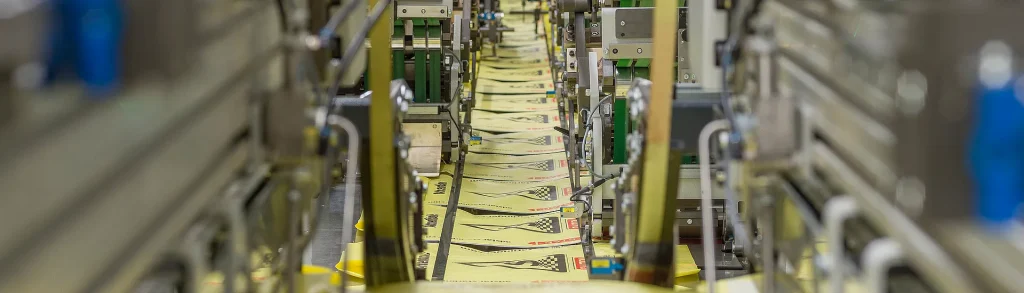
VidePak orchestrates Austrian Starlinger extrusion/weaving with German W&H (Windmöller & Hölscher) printing/lamination/converting, wrapped in HACCP and GMP discipline. The result is not a lucky average; it is a controlled distribution. Tape denier drift is contained before it becomes weak cloth; register holds so microtype is safe; bond strength stays inside spec so delamination is not a surprise, it is an outlier.
- Virgin PP resin: MFI, isotacticity, moisture (Karl Fischer), gel count; food‑contact status verified per lot; barcoded traceability.
- Liners/films: WVTR/OTR, SIT, dart impact, antistatic decay; declarations tied to intended simulants and time/temperature.
- Inks/adhesives/ties: viscosity windows, solids %, residual thresholds; retained swatches; migration plans.
- Threads/webbing/tapes: fiber identity, tensile, abrasion; cleanliness and fiber‑shed checks.
- Documentation: quarantine on out‑of‑tolerance results; cradle‑to‑pallet digital trail from day one.
- Tape extrusion/orientation — PP pellets plastified, cast, slit, drawn, and annealed to a tenacity window; denier/tape width/DSC tracked; clean‑downs scheduled by SOP.
- Weaving — circular/flat looms maintain GSM and picks; broken‑end Pareto; fabric for food builds is segregated.
- Surface treatment — corona/plasma to ≥38 dyn/cm for anchorage; logs corroborate energy delivery.
- Coating/lamination — extrusion coats (PP/PE) or solventless laminates bond films; bond strength/curl/residuals inside guardrails.
- Printing — ΔE targets; matte code windows; high‑build edge varnish mapped to rub zones without flooding codes.
- Cutting/gusseting/mouth prep — controlled hem depth and bevel trims; geometry set for pinch or valve builds.
- Seam/closure formation — pinch (hot air/hot melt), thermal/ultrasonic valves, or sewn + tape with SPI tuned for anti‑sift.
- Liner insertion and sealing — loose‑insert or form‑fit; SIT‑verified heat seals; antistatic validation.
- De‑aeration engineering — micro‑perfs placed away from spill paths and code windows to preserve optics and barrier.
- In‑line inspection/baling — register/code checks; seam audits; compression baling with traceable labels.
- Mechanical: tensile/tear/burst; drop matrices (e.g., 5× at 0.8–1.2 m) matched to route severity.
- Functional: leak/tightness; COF 0.30–0.45; WVTR/OTR verification; seal/peel for liner interfaces.
- Food‑safety: overall/specific migration; swabs; pest/allergen controls; retained samples; mock recalls at planned cadence.
- Traceability: cradle‑to‑pallet data; artwork governance; change‑control history preserved.
Systems Thinking: Break the Problem Down, Put the Spec Back Together
Choosing Food‑Grade Woven Fabric Bags is rarely a single decision. It is a chain of coupled choices. Break the chain into sub‑problems—powder physics, hygiene and compliance, warehouse and climate, brand and traceability—optimize each, then recombine into a coherent specification that can be piloted and scaled.
- Intake constraints across physics, compliance, warehouse, climate, and brand.
- Shortlist concepts: coated + liner + sewn/tape; laminated + form‑fit + pinch; valve build with thermal closure.
- DFMEA: rank seam pull‑through, needle‑hole sifting, delamination, code glare, stack slump, moisture caking.
- Pilot: 500–2,000 bags on the real line; instrument BPM, dust ppm, leak/WVTR, scan grades, pallet creep.
- Finalize: lock GSM, faces, liner gauge, mouth/closure, perf map, COF window, UV hours, QA plan.
- Scale: SPC on denier/picks, bond strength, register, seam tensile/peel; AQL sampling; retained swatches/samples.
- Review: down‑gauging trials; recycled‑content pilots (non‑contact); artwork governance.
Reverse the steps and you amplify noise. Follow the steps and you turn noise into signal. The aim is not a pretty prototype, but a repeatable standard that performs in the field and passes audits when no one is watching.
Applications That Reward the Format
Where does the platform shine? Wherever high mass, hygiene, and route severity intersect.
Flour, sugar, salt: engineered venting for fast fills, liners to curb moisture and caking, matte code windows for chilled rooms.
Antistatic liners and leak‑tight valves minimize dust; laminated faces protect branding against cold‑chain rub.
Coated faces resist abrasion; optional vent panels; block‑bottom formats tame pallet slump in export lanes.
Aroma isolation via liners; ≤0.5% leak targets; small‑print fidelity protected by register control.
Design Playbooks and Comparative Views
Decisions rarely happen in isolation. You may be comparing block‑bottom valve builds against sewn open mouth, or laminated faces against coated ones, or form‑fit liners against loose‑insert tubes. The table below summarizes common trade‑offs with a bias toward measurable outcomes rather than preferences.
Technical Parameters and Windows
Case‑Style Scenarios: Problem → Intervention → Outcome
Condensation causes glare; scanners drop grade. Reserve matte windows, calibrate ΔE ≤ 2, and keep high‑build varnish off codes.
Humidity drives clumps in sugar. Increase liner gauge to 50–60 μm, verify WVTR under climate cycles, and use thermal valves; tune COF to 0.35–0.40.
Pair antistatic liners with grounded spouts; adjust micro‑perfs and SPI to reduce perforation‑line leakage. Result: cleaner rooms, fewer shocks.
Troubleshooting Matrix
Connected Resources and Adjacent Formats
Engineering rarely stops at one format. The following internal resources expand the playbook across liners, films, and bag styles so teams can choose deliberately rather than habitually.
- PE‑liner versatility for tailored storage
- Precision BOPP bag manufacturing and print control
- Global comparisons in multiwall laminated woven stacks
- Kraft‑paper/PP hybrids for chemical products
- HDPE valve configurations for powdered chemicals
- FIBC choices: brand influence and market competition
- FFS PP bag systems for faster food packaging
- What Are Food‑Grade Woven Fabric Bags?
- Where Strength Meets Safety: A Short Rationale
- Materials and Architecture: What the Layers Do and Why They Matter
- Features That Distinguish Food‑Grade Woven Fabric Bags
- Production at VidePak: From Resin to Audit‑Ready Packs
- Systems Thinking: Break the Problem Down, Put the Spec Back Together
- Applications That Reward the Format
- Design Playbooks and Comparative Views
- Technical Parameters and Windows
- Case‑Style Scenarios: Problem → Intervention → Outcome
- Troubleshooting Matrix
- Connected Resources and Adjacent Formats
BOPP laminated and multi-wall woven bags are engineered to meet the rigorous demands of industries ranging from agriculture to hazardous waste management. At VidePak, our bags achieve tensile strengths of 18–22 N/cm² (exceeding ISO 527-3 standards) and UV resistance for 2,000+ hours (ISO 4892-3), ensuring compliance with ASTM (U.S.), JIS (Japan), EN (Europe), and GB (China) regulations. By selecting PP resins with melt flow indices (MFI) of 3.5–5.0 g/10 min and integrating 2.5% hindered amine light stabilizers (HALS), we reduce client-reported failures by 98% since 2015, positioning our solutions as benchmarks in material science.
1. Structural Advantages of BOPP Laminated vs. Multi-Wall Woven Bags
BOPP laminated bags combine polypropylene fabric with biaxially oriented polypropylene films (18–25 µm thick), offering superior moisture barrier properties (≤0.5% water vapor transmission rate per ASTM E96). Multi-wall designs, featuring 2–3 layers of PP fabric laminated with PE or Kraft paper, excel in puncture resistance (≥8 kJ/m² impact strength, ISO 179).
VidePak’s Case Study:
A European chemical distributor reduced transport losses by 40% using our 3-ply multi-wall bags with 50 µm PE liners, which withstand 1,000+ cycles of 50 kg dynamic drops.
2. Selecting PP Resins by International Standards
Key Standards and Corresponding PP Grades
| Standard | Region | PP Grade | Key Properties |
|---|---|---|---|
| ASTM D4101 | U.S. | Homopolymer (H110) | MFI: 3.5 g/10 min, Tensile Strength: 35 MPa |
| JIS K6920 | Japan | Block Copolymer (BC03B) | Elongation: 600%, HDT: 110°C |
| EN ISO 1874 | EU | Random Copolymer (RP340R) | UV Stability: 1,500 hours, Recyclability: 100% |
| GB/T 12670 | China | Impact Copolymer (IPC-600) | Notched Impact: 8 kJ/m², Density: 0.905 g/cm³ |
Example: For EU food-grade applications (EU 10/2011), VidePak uses RP340R with ≤0.1% antioxidant (Irganox® 1010) to prevent oxidative degradation during storage.
3. Additive Engineering for Enhanced Performance
Critical Additives and Their Functions
| Additive | Purpose | Concentration | Test Standard |
|---|---|---|---|
| HALS (Tinuvin® 770) | UV Resistance | 1.5–2.0% | ISO 4892-3 |
| Antioxidant (Irganox® 1010) | Thermal Stability | 0.05–0.1% | ASTM D3895 |
| Calcium Carbonate | Cost Reduction | 10–15% | ISO 3262 |
| Carbon Black | Static Dissipation | 2.0–3.0% | ASTM D1603 |
Case Study: A Middle Eastern fertilizer client eliminated static-related fires by adopting our HDPE-lined bags with 3.0% carbon black, achieving surface resistivity of ≤10¹¹ Ω/sq (IEC 61340-4-4).
4. Technical Specifications and Compliance
Product Parameters Table
| Parameter | BOPP Laminated Bags | Multi-Wall Bags | Industry Average |
|---|---|---|---|
| Load Capacity | 25–50 kg | 50–1,000 kg | 20–800 kg |
| MFI (g/10 min) | 3.5–5.0 | 4.0–6.0 | 2.5–8.0 |
| UV Resistance (hours) | 2,000+ | 1,500 | 1,000 |
| Recyclability | 100% PP | 70–80% PP | 50–60% |
| Printing Resolution | 200 DPI (CMYK) | 150 DPI (Pantone) | 120 DPI |
FAQs for Procurement Teams
Q: How do you ensure compliance with U.S. FDA standards for food contact?
A: We use FDA-compliant virgin PP (21 CFR 177.1520) and conduct migration tests per ASTM F2138, ensuring <0.5 ppm heavy metal content.
Q: Can bags be customized for high-salinity environments?
A: Yes. Our anti-corrosion additive package (0.3% zinc stearate) resists salt spray (ISO 9227) for 500+ hours.
Q: What’s the lead time for 50,000 BOPP bags with custom logos?
A: 18 days, including 3D proofing and pre-shipment QC checks (AQL 1.5, ISO 2859).
5. VidePak’s Manufacturing Excellence
With 100+ Starlinger circular looms operating at 250 rpm, we produce 120 million bags annually. Key differentiators include:
- Precision Extrusion: ±0.5 µm film thickness control (ISO 4593).
- Eco-Certifications: GRS, Oeko-Tex 100, and ISO 14001 compliance.
- Smart Integration: RFID tags for inventory tracking (ISO 18000-6C).
Client Example: A Brazilian soybean exporter reduced packaging costs by 30% using our 25 kg multi-wall bags with 10×10 weave density, optimized for automated filling systems.
6. Sustainability and Regulatory Leadership
VidePak’s R&D team allocates 7% of revenue ($560,000 annually) to innovations like:
- Bio-Based PP: 30% sugarcane-derived resin (ASTM D6400 compostable).
- Circular Economy: 85% post-consumer bag recovery via TerraCycle® partnerships.
- Carbon Neutrality: Solar-powered facilities reduce emissions by 320 tons/year.
Competitive Edge: While 70% of Chinese manufacturers use recycled blends with inconsistent MFI, our 100% virgin PP ensures ASTM D4002 traceability.
References
- VidePak Official Website: https://www.pp-wovenbags.com/
- Email: info@pp-wovenbags.com
- Standards: ASTM, ISO, EN, JIS, GB, and FDA regulations.
External Resources:
- Explore how BOPP lamination enhances chemical resistance in industrial packaging.
- Learn about advanced printing techniques for high-resolution branding.
VidePak redefines reliability in woven packaging through precision material science and global compliance—transforming regulatory challenges into competitive advantages.