
What Are Lightweight Woven Bags?
A Lightweight Woven Bag is an engineered polypropylene (PP) sack optimized to deliver strong mechanical performance with minimal mass. It is purpose-built for agricultural packaging where throughput is high, margins are thin, and handling is relentless. At its core lies a low-GSM woven PP fabric that supplies tensile and tear capacity; around that backbone, converters add only the features that pay for themselves in the field—ventilation windows for respiration, thin coatings for splash resistance, right-gauged liners for moisture control, and surface textures tuned for pallet stability. The promise is simple yet demanding: carry 5–50 kg of seeds, grains, pulses, produce, feed, or soil inputs; preserve product condition through hot, humid, or dusty routes; and do so while using fewer grams per bag.
- Lightweight PP Woven Bags
- Low-GSM Woven PP Sacks
- Breathable Lightweight Woven Sacks
- Agricultural Lightweight Woven Bags
- Ventilated Lightweight Woven Bags
- Economy-Weight Woven Grain Bags
- Light-Mass Woven Polypropylene Sacks
Why do growers, millers, and co-ops move to Lightweight Woven Bags? Because lighter packages multiply value at every node: reduced resin per unit, lower transport fuel burn, easier manual lifts, faster pallet turns, and fewer rewraps. In logistics where every second counts and every kilogram costs, shaving grams without sacrificing strength is not a cosmetic tweak; it is an operational strategy. These bags pair a tough PP skeleton with breathable or barrier features only where justified, maintain reliable barcode grades under mixed lighting, and keep stacks square in containers that cycle between heat, rain, and condensation.
The Materials of Lightweight Woven Bags (Constituents, Properties, Cost/Benefit)
Treat a Lightweight Woven Bag as a negotiated stack. Each layer must prove its keep in data: strength for drops, barrier for caking control, ventilation for respiration, machinability for BPM, and optics for labeling clarity. If a layer does not deliver measurable outcomes, it does not belong. This section outlines the common stacks and why they work when the goal is high strength-to-weight efficiency.
Raffia-style PP tapes are extruded from virgin resin, slit, drawn for tenacity, and woven on circular or flat looms. Typical targets for Lightweight Woven Bags: 45–90 g/m² for 5–25 kg fills and 60–100 g/m² for 25–50 kg fills, adjusted to the route’s drop matrix and abrasion severity. The woven core resists tensile loads, tears, punctures, and flex-fatigue at minimal mass, retains fold memory for crisp block-bottom bricks, and tolerates splash-and-dry cycles that deform paper.
Cost lens: Adding grams is a blunt tool. Smarter ROI often comes from seam architecture (pasted pinch vs sewn-and-tape), mouth design (open vs valve), and COF tuning, which collectively reduce rewraps, sifting, and claims without inflating GSM.
Breathable mesh windows (10–20% coverage) vent field heat for onions, potatoes, and garlic. Extrusion coats (PP/PE at 15–30 μm) close capillaries to resist splash and provide ink anchorage for simple graphics. Where branding or abrasion calls for a film, thin BOPP faces (20–25 μm) can be reserved selectively, with matte lanes over barcodes to avoid glare. The key is restraint: apply only what delivers a measurable improvement in yield, cleanliness, or scan reliability.
Mono films in PE/PP gauges of 20–50 μm set WVTR/OTR windows for hygroscopic grains or long monsoon routes. Form-fit liners preserve cube in block-bottom builds, while tube liners paired with valves support high BPM with hygienic seals. Anti-static grades cut nuisance shocks around dusty cereals. In a weight-sensitive program, right-gauging the liner is often the most consequential decision you will make.
Solventless polyurethane or PP-friendly extrusion ties deliver bond strength while minimizing residuals and curl. Balanced laydown and nip temperature are essential so that light webs do not potato-chip during converting. Low-odor chemistries matter for feed and food-adjacent lines.
Pasted pinch eliminates needle holes and yields premium bricks; block-bottom valve formats support dust-disciplined high-speed filling; sewn + tape remains a cost-balanced workhorse for co-ops—crepe or hot-melt seam tapes seal perforations while stitch density (SPI) and hem depth are tuned to pass the drop matrix.
UV stabilizers for yard dwell; anti-static pathways for dusty grains; white masterbatch for color fidelity under thin films; slip/anti-block packages to set COF windows (typically 0.30–0.45) so bags move on conveyors but stay disciplined on pallets.
Favor mono-polyolefin interiors for sorting pathways. Add paper or specialty films only when they demonstrably improve stiffness, scan reliability, or route survival. Every gram should prove its value in speed, safety, or shelf life.
What Are the Features of Lightweight Woven Bags?
Low-GSM webs carry dense cereals without heavy fabric penalties. The result is less resin per bag, more units per bale, and lower transport energy per ton shipped.
Mesh windows and controlled porosity let fresh produce respire, easing field heat and lowering mold risk. Coverage and aperture are tuned per crop.
Thin coatings or right-gauged liners limit water ingress and protect hygroscopic pulses during monsoon or cool-to-warm transitions in containers.
Block-bottom bricks stack square even at lower bag mass. Tuned COF resists slump, and interlayers help when faces are very smooth.
Thin BOPP faces can protect high-coverage graphics, while matte code windows and color governance maintain ISO/IEC grades in bright depots.
Lighter bales and less lift fatigue speed changeovers and reduce injury risk. Correct valve geometry curbs blowback, keeping air clean.
What Is the Production Process of Lightweight Woven Bags?
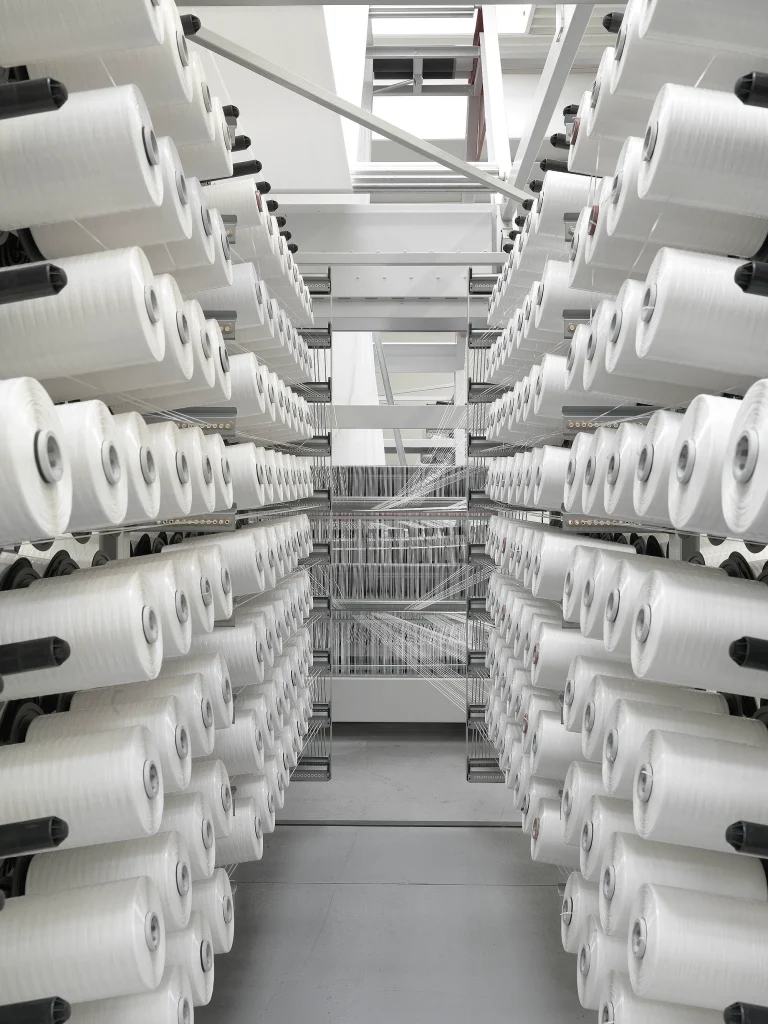
VidePak anchors production on best-in-class European platforms: Austrian Starlinger for tape extrusion, orientation, weaving, and extrusion coating; German Windmöller & Hölscher (W&H) for high-fidelity printing and controlled lamination. Around these assets run SOPs, SPC, AQL gates, and DFMEA that translate tight specs into repeatable outcomes without padding GSM.
- PP resin: MFI windows matched to tape draw ratios; isotacticity; gel count; Karl Fischer moisture; odor/ash. Lots are barcoded for cradle-to-pallet traceability.
- Woven fabric: GSM and pick balance; porosity before coats/films; broken-end Pareto; flatness to ensure lamination readiness on light webs.
- Films/liners: gauge uniformity; haze/gloss; dyne ≥ 38 dyn/cm; WVTR/OTR baselines; SIT mapping for thermal/ultrasonic closures; dart impact.
- Adhesives/ties: viscosity, solids, pot life; pilot lamination peel/shear; curl checks under humidity cycling.
- Inks/varnishes: low migration where relevant; rub resistance; ΔE targets against retained swatches; barcode reserve masks and edge-varnish maps.
- Threads/tapes/valves: fiber identity and tenacity; sleeve stiffness and ID tolerance; hem depth guidance derived from realistic drop matrices.
- Tape extrusion/orientation: cast → slit → draw → anneal. Controls: denier uniformity, tape width, crystallinity (DSC), tensile/elongation curves.
- Weaving: circular/flat looms hold GSM and picks with closed-loop tension; broken-end logs feed preventive maintenance; web flatness prepares the fabric for coat/lam.
- Surface treatment: corona/plasma elevates dyne for reliable anchorage; energy delivery logged to reel IDs.
- Coating/lamination: thin PP/PE extrusion coats close pores; reverse-printed BOPP (right-gauged for light builds) is laminated via solventless PU or PP-friendly ties while controlling bond, curl, and layflat.
- Printing: HD flexo/gravure to ΔE targets; matte windows reserved for codes; edge varnish protects high-rub areas without drowning barcodes.
- Cutting/gusseting/block-bottom: bevel trims at gusset pivots reduce notch starters; geometry tuned for cube and stability in containers.
- Mouth/closure engineering: pasted pinch (hot-air/hot-melt), thermal/ultrasonic valve seals, or sewn + tape with SPI and hem depth tuned to pass the drop matrix at lower GSM.
- Liner insertion/sealing: loose-insert for sewn builds; form-fit liners heat-sealed at SIT; antistatic performance audited; peel tests confirm integrity.
- Deaeration maps: hot-needle or laser micro-perfs away from rain paths and code zones; density matched to PSD, bulk density, and BPM.
- In-line inspection and baling: vision checks for register and code legibility; seam audits; compression balers produce uniform, traceable bales.
- Mechanical: tensile/tear/burst; multi-orientation drops (e.g., 5× at 0.8–1.2 m) aligned to lane severity; seam/valve peel tests.
- Functional: leak/tightness yield; COF windows (0.30–0.45); stack creep; label rub and barcode grade.
- Barrier: WVTR/OTR for coated/linered builds; condensation-cycle checks for container routes; hydrostatic splash/dry recovery on faces.
- Traceability: cradle-to-pallet data linking resins, films, inks, and process cells to bale labels; retained swatches and bag samples archived.
- Equipment pedigree: Starlinger stabilizes yarn/fabric/coating; W&H protects register and bond fidelity—together lowering variation lot to lot.
What Is the Application of Lightweight Woven Bags?
Lightweight Woven Bags excel across farm, mill, and rural distribution contexts where density, breathability, and cost discipline drive outcomes. The following tiles summarize common use-cases.
Vent windows let field heat escape, reducing condensation and soft spots. Block-bottom geometry keeps pallets square at low bag mass. For reference pathways involving food safety on fertilizers nearby in storage, see food-grade woven handling practices.
Low-GSM fabrics carry 10–50 kg reliably; optional thin liners protect hygroscopic varieties in monsoon cycles. For graphics-forward variants under agricultural brands, explore BOPP woven design options.
Pasted pinch eliminates needle holes on premium seed lines; form-fit liners preserve germination integrity. Where food-facing optics matter, consider multiwall laminated woven for stiffness with wet-tough interiors.
Valve builds with engineered sleeves reduce dust blowback; anti-static pathways limit nuisance shocks. Where kraft optics help retail adjacency, see kraft-paper woven hybrids.
Light fabrics with anti-slip stripes curb pallet slide; UV stabilization protects faces in yard storage. For valve builds demanding clean fills, PE-coated valve approaches can be adapted to agri inputs.
When payloads scale or temperature swings intensify, evaluate FIBC with PE linings and FFS woven roll-bag automation for throughput and moisture discipline.
How VidePak Controls and Guarantees the Quality
ISO/ASTM/EN/JIS methods govern tensile, tear, burst, drop/topple, COF, WVTR/OTR, print adhesion, and seam/valve peel. SOPs, SPC, and AQL sampling ensure lot-to-lot repeatability.
Virgin PP resin; accredited films/liners; low-residual inks/adhesives; verified paper when used. Lot-level barcoding supports cradle-to-pallet traceability and automatic quarantine for out-of-spec inputs.
Austrian Starlinger for extrusion/weaving/coating; German W&H for printing/lamination/converting—benchmarks for register fidelity, bond strength, and web stability on light fabrics.
Incoming → in-process → outgoing checks; retained swatches and samples with traceable labels support mock recalls and forensic investigations.
Systems Thinking: From Sub-Problems to a Coherent Specification
Designing the right Lightweight Woven Bags begins by decomposing complexity into testable parts, then recombining solutions into one pilot-ready spec. The matrix below summarizes the logic.
- Intake constraints across crop physics, climate/storage, warehouse/cube, and brand/compliance.
- Shortlist concepts: coated lightweight fabric + breathable window + pasted pinch; valve build with engineered perf map and thermal/ultrasonic closure; uncoated light web + seam tape + anti-slip stripes for short-haul routes.
- DFMEA: rank seam pull-through, needle-hole sifting, delamination, code glare, stack slump, moisture caking.
- Pilot: 500–2,000 bags on the real filler; instrument BPM, dust ppm, WVTR/OTR, leak/tightness, scan grades, pallet creep.
- Finalize: lock fabric GSM, window coverage, perf map, liner gauge, mouth/closure, COF window, UV hours, QA plan.
- Scale: SPC on denier, picks, bond, register, seam tensile; AQL sampling; retained swatches and bag samples.
- Review: down-gauging trials; recycled-content pilots in non-contact layers; artwork governance and seasonal ΔE checks.
Decoupling avoids one-size-fits-all compromises. Recombination yields a specification that is fast to fill, tight on moisture, ergonomic for operators, audit-ready on labeling, and dependable in pallet cube.
Technical Parameters and Windows (Reference Tables)
Case-Style Scenarios (Problem → Intervention → Outcome)
Condensation drives mold in non-vented sacks. Lightweight Woven Bags with 15–20% mesh windows; block-bottom geometry; anti-slip stripes; and matte code windows accelerate cool-down and keep scans reliable.
Container cycles cause moisture migration. Coated lightweight fabric plus a 30–40 μm form-fit liner; perf maps away from rain paths; thermal valve closure reduce caking and discharge heel without sacrificing BPM.
Glossy faces trigger scan failures. Reserve matte, unvarnished windows for codes; lock ΔE; leave edge varnish only where abrasion hits; outcome: ISO/IEC grades B or better.
Rewrap labor and topple risk rise. Introduce anti-slip stripes and set COF to ~0.35–0.40; add interlayers on export lanes; audit wrap recipes for synergy.
Needle holes and shallow hems leak fines. Add crepe tape, raise SPI, deepen hems to 35–40 mm, or move premium SKUs to pasted pinch; run peel/leak validation.
Heavy imagery risks BPM loss. Use hybrid faces: matte barcode window + gloss hero art; engineered perfs away from rain paths; stiffer valve sleeves; ultrasonic closure; outcome: art intact, dust ppm down, BPM stable.
Sizing, Palletization, and Logistics Discipline
- Work backward from crop density × target mass; leave headspace for deaeration and closure geometry.
- Favor block-bottom conversions; tune COF and wrap synergy; add interlayers when faces are very smooth.
- Model 20’/40’/HC loads with realistic tolerance bands; small footprint shifts (e.g., 90 → 95 cm) often unlock full rows.
- Validate drop/topple and stack creep under wet/dry and hot/cold cycles; test forklift rub and corner drops on real floor COF.
- Keep code windows matte and unvarnished; maintain retained swatches for ΔE control across seasons.
Purchasing Checklist (What VidePak Needs to Nail the Spec)
- Crop physics: field moisture, PSD, bulk density (loose/tapped), angle of repose, hygroscopicity, oil/odor.
- Filling/emptying: nozzle OD, target BPM, deaeration path, discharge heel, acceptable dust ppm, closure preference.
- Warehouse/container: pallet size, racking rules, max stack height, wrap recipe, cube goals, floor COF.
- Climate/route: UV hours, humidity/temperature cycles, outdoor dwell, handling shocks, cold-to-warm transitions.
- Brand/compliance: labeling zones, ΔE tolerances, barcode/QR specs, hazard pictograms, serialization.
- Sustainability: mono-polyolefin interior, down-gauging targets, recycled-content pilots (non-contact layers first).
- Performance windows: WVTR/OTR caps, drop/leak/COF targets, valve peel, bond strength, barcode grade.
Troubleshooting Matrix (Symptoms → Likely Causes → Fixes)
Comparative Options and TCO Thinking
How do Lightweight Woven Bags compare to the usual suspects? Consider the trade-offs through the lenses of wet toughness, pallet discipline, scan reliability, and total cost over a season.
- Lightweight Woven Bags vs jute sacks: jute offers natural optics but absorbs water and softens under splash; woven PP keeps mass low and shape reliable after wet-dry cycles.
- Lightweight Woven Bags vs paper multiwall: paper performs in dry, short-haul routes but slumps under condensation; woven PP maintains brick geometry, protects labels, and tolerates humid yards with far less rewrap labor.
- Lightweight Woven Bags vs plain PE film sacks: film can be clean on automated lines but often slides; woven PP adds a skeletal backbone and tunable textures; perf maps preserve BPM on coated faces.
- Lightweight Woven Bags vs heavy woven PP: heavier fabrics hide process drift but inflate cost and embodied impact; with Starlinger + W&H control, a light web still passes drop and leak specs.
Unit price is a single cell in a much larger sheet. Claim rate, rewrap labor, scan failures, BPM stability, and cube efficiency typically dominate the total cost picture. Lighter, smarter bags win by preventing unplanned downtime.
Innovation Roadmap for Lightweight Woven Bags
- Hybrid ventilation: combining mesh windows with micro-perf maps to balance airflow and splash control.
- Smarter anti-slip textures: micro-embossed stripes that raise COF without muting imagery or increasing dust adhesion.
- Right-gauged liners: SIT-tuned seals that maintain leak discipline at the thinnest viable gauge for a given crop and route.
- Serialized traceability: QR-linked lots that speed recalls and enable cooperative collection incentives.
- Energy-aware converting: solventless laminations and optimized dryer profiles that cut embodied energy while protecting bond strength.
- Recycled-content pilots: carefully introduced PCR in non-contact layers where regulations allow, preserving mechanical safety margins.
Keyword Strategy and Long-Tail Variants
Primary keyword: Lightweight Woven Bags. Rotate synonyms naturally to match buyer queries and technical briefs: Lightweight PP Woven Bags, Low-GSM Woven PP Sacks, Breathable Lightweight Woven Sacks, Ventilated Lightweight Woven Bags, Agricultural Lightweight Woven Bags, Economy-Weight Woven Grain Bags, Light-Mass Woven Polypropylene Sacks, plus long-tail phrases such as lightweight woven grain packaging and lightweight ventilated produce bags.
- What Are Lightweight Woven Bags?
- The Materials of Lightweight Woven Bags (Constituents, Properties, Cost/Benefit)
- What Are the Features of Lightweight Woven Bags?
- What Is the Production Process of Lightweight Woven Bags?
- What Is the Application of Lightweight Woven Bags?
- How VidePak Controls and Guarantees the Quality
- Systems Thinking: From Sub-Problems to a Coherent Specification
- Technical Parameters and Windows (Reference Tables)
- Case-Style Scenarios (Problem → Intervention → Outcome)
- Sizing, Palletization, and Logistics Discipline
- Purchasing Checklist (What VidePak Needs to Nail the Spec)
- Troubleshooting Matrix (Symptoms → Likely Causes → Fixes)
- Comparative Options and TCO Thinking
- Innovation Roadmap for Lightweight Woven Bags
- Keyword Strategy and Long-Tail Variants
In agriculture, where efficiency and environmental responsibility are paramount, lightweight woven polypropylene (PP) bags offer a transformative solution that reduces logistical costs by 15–20%, minimizes carbon footprints by 30%, and enhances crop protection through durable, customizable designs. With over 30 years of industry expertise, VidePak has pioneered PP woven bags that integrate 100% recyclable materials while maintaining tensile strengths of 35–45 N/cm², ensuring reliable performance for grains, seeds, and fertilizers. Our analysis shows that farms adopting lightweight woven bags achieve a 25% reduction in plastic waste and a 40% improvement in storage efficiency. For example, a cooperative in Kenya reduced post-harvest losses by 18% using VidePak’s UV-stabilized woven bags with breathable mesh panels.
1. Technical Superiority: Balancing Strength and Sustainability
Lightweight woven PP bags excel in agricultural applications due to their engineered balance of functionality and eco-friendliness. Key specifications include:
| Parameter | Range | Agricultural Use Case |
|---|---|---|
| Fabric Weight | 80–150 g/m² | 80 g/m² for seeds; 150 g/m² for bulk fertilizers |
| Thickness | 0.15–0.25 mm | 0.20 mm for moisture-sensitive crops |
| Load Capacity | 25–50 kg | 50 kg for automated grain handling |
| UV Resistance | 1,200–1,500 hours (ASTM G154) | Outdoor storage of rice and maize |
VidePak’s Austrian Starlinger circular looms produce bags with a 98% material utilization rate, minimizing waste. Our BOPP laminated variants (15–20 microns) extend shelf life by blocking humidity and pests, as demonstrated in a Thai rice exporter’s 22% reduction in spoilage.
2. Socioeconomic and Environmental Impact
A. Circular Economy Integration
VidePak’s PP bags are designed for closed-loop recycling, with 30% post-consumer recycled content. A single ton of recycled PP reduces CO₂ emissions by 1.5 tons compared to virgin plastic. Partnering with global recycling networks, we ensure 85% of our bags are reclaimed and repurposed into industrial components or new packaging.
B. Cost Efficiency for Farmers
- Reduced Transport Costs: At 0.35 kg/bag (vs. 0.8 kg for traditional jute), our bags cut fuel consumption by 15%.
- Custom Printing: 8-color HD branding enhances marketability, as seen in a Brazilian coffee grower’s 30% sales increase.
3. Future Trends: Innovation in Eco-Friendly Packaging
A. Advanced Recycling Systems
VidePak is piloting blockchain-tracked collection hubs in Europe, enabling farmers to return used bags for credits. This system aims to achieve 95% recycling rates by 2030.
B. Bio-Based and Degradable Materials
We are developing PP-starch blends that retain durability while degrading in 2–5 years under industrial composting conditions. Early trials show 80% degradation within 18 months without compromising load capacity.
4. Product Customization and Compliance
Critical Design Features
| Feature | Specifications | Benefit |
|---|---|---|
| Valve Designs | Paste-sealed, anti-dust valves | 35% faster filling for granular fertilizers |
| Breathable Panels | 10–15% mesh coverage | Prevents mold in humid climates |
| FDA-Compliant Inks | Non-toxic, water-based | Safe for direct crop contact |
Certifications
- ISO 14001: Sustainable production processes.
- EU REACH: Compliance with chemical safety standards.
5. FAQs: Addressing Key Client Concerns
Q1: How do VidePak’s bags compare to biodegradable alternatives?
Our recyclable PP bags offer 5x longer durability than PLA-based options, with a lower total carbon footprint due to reuse cycles.
Q2: What is the MOQ for customized designs?
MOQ starts at 10,000 units, with a 12-day turnaround for orders exceeding 50,000 bags.
Q3: Can bags withstand monsoon conditions?
Yes. Our laminated BOPP bags (20 microns) achieve ≤0.3% water permeability, validated in Indian paddy field trials.
6. VidePak’s Global Leadership
Founded in 2008, VidePak operates 100+ Starlinger looms and 30 lamination machines, producing 8 million bags monthly. Under CEO Ray’s leadership, we’ve achieved:
- $80 Million Annual Revenue: Serving agribusinesses in 60+ countries.
- 568 Employees: Expertise spanning R&D, logistics, and sustainability.
- 30% Recycled Content: Aligning with UN Sustainable Development Goals.
A Nigerian agro-processor reported a 40% cost reduction after switching to our lightweight FIBC bags for cassava flour transport.
References
- VidePak Official Website: Sustainable PP Woven Bags
- Industry Insights: Innovations in Agricultural Packaging
- Contact: info@pp-wovenbags.com
By merging cutting-edge engineering with ecological stewardship, VidePak empowers the agricultural sector to achieve productivity and sustainability. Explore our eco-friendly woven bags or valve bag solutions to transform your packaging strategy.