
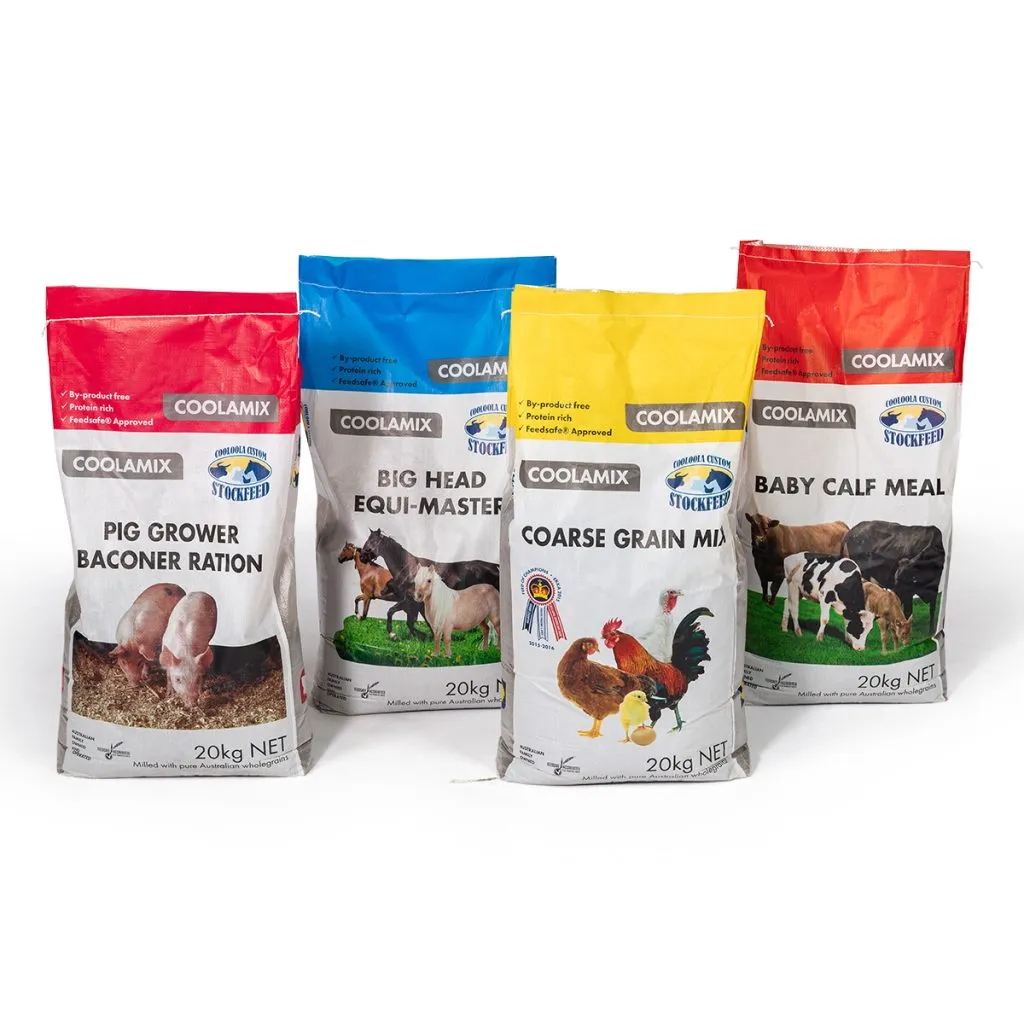
1) What are SOM PP Fabric Bags?
When practitioners say SOM PP Fabric Bags, they refer to sewn open-mouth woven polypropylene sacks engineered for dry, granular, or powdery goods that demand toughness at a competitive unit cost. The structure is simple to describe yet subtle to optimize: a woven PP fabric body, an open mouth for filling, and a stitched bottom. Simple? Yes. But behind the simplicity lies a dense web of materials science, process control, and distribution risk management. These bags are routinely selected for cement, gypsum, mineral powders, resins, fertilizers, sugar, rice, salt, animal feeds, and more. They are filled through the open top and then closed by sewing (with or without filler cords), by tying, or—when a liner is present—by heat sealing the liner and stitching the fabric. The form is familiar to operators, compatible with many existing filling lines, and robust enough for rough logistics.
Why not a different format—valve, pinch-bottom, form–fill–seal? Each has its merits. SOM PP Fabric Bags trade a small increase in closing steps for big gains in seam customizability, cost control, and wide-line compatibility. They sit between retail-forward laminated designs and heavy-duty bulk containers, bridging performance and price. And because they can be built as mono-PP systems, recyclability pathways are clearer than multi-material alternatives.
2) The material system behind SOM PP Fabric Bags
At the heart of SOM PP Fabric Bags is a woven textile built from oriented polypropylene tapes. Around this core, designers add barrier skins, liners, seam consumables, inks, varnishes, and stabilizers. The goal is not mere assembly; it is orchestration. Materials are chosen to meet tensile targets, moisture budgets, sift-proof requirements, and pallet safety in the most economical way possible.
Core substrates and where they live
- Woven PP fabric (primary structure): tape yarns slit from extruded film, stretched to align polymer chains, then interlaced on circular or flat looms. Location: bag body (tubular or flat), bottom fold, top hem.
- Coating or lamination (barrier and printface): extrusion coating (PP/PE) for modest moisture and dust control; BOPP lamination for high-fidelity graphics and improved scuff resistance. Location: outside, inside, or both.
- Inner PE liner (optional): LDPE/LLDPE film, loose or tab‑sewn, for tight moisture budgets and sift-proofing in hygroscopic powders.
- Sewing consumables: PP or polyester threads, crepe tapes, and filler cords—small parts that determine big outcomes at the seam.
- Additives and inks: UV packages (HALS), color masterbatch, anti-block/anti-slip agents, low-VOC inks and over-varnishes compatible with PP after surface activation.
Why polypropylene? Density around 0.90 g/cm³, an attractive stiffness-to-weight ratio, low moisture uptake, chemical resistance to salts and many acids, and excellent fatigue/crack behavior. In short: light yet strong, economical yet durable. In practice, the resin’s melt flow rate (MFR) governs tape drawability and tenacity; homopolymers deliver stiffness, while impact modifiers or copolymers can be used in coatings/liners for toughness and seal range.
Architecture in layers
- Structural textile: warp and weft tapes define tensile backbone and puncture resistance.
- Barrier skin: coating or BOPP lamination tunes water vapor transmission rate and scuff resistance while offering a printface.
- Seam system: bottom single or double fold; chain- or lock-stitch; filler cords and tapes for sift-proofing; open mouth for filling.
- Liner (optional): LDPE/LLDPE for moisture sensitive products.
- Graphics and compliance: text, icons, barcodes, QR traceability, lot codes.
From a cost perspective, virgin PP resin is the prime driver, followed by coating/lamination selections, film/liner thickness, and print complexity. Threads and cords are a small line item but disproportionately influence warranty claims when mis-specified. Thus, the lowest bill-of-materials is rarely the lowest total cost of ownership. The winning spec is the one that reduces field failures and logistics disruptions.
3) Distinctive features that set SOM PP Fabric Bags apart
What makes SOM PP Fabric Bags compelling? A high strength-to-weight ratio due to oriented tapes; abrasion resistance from a textile lattice; configurable moisture protection via coating, lamination, or liners; and robust print options. They are familiar to pack lines, forgiving to manual handling, and adaptable to a spectrum of fills and climates. They can be breathable for grains—or tight for cement. They can be plain for bulk warehouses—or dressed in BOPP brilliance for retail.
- Strength with thrift: equivalent durability at less mass than many alternatives.
- Seam engineering: double folds, filler cords, and stitch density deliver sift-proof performance.
- Moisture management: from uncoated breathability to laminated faces and sealed liners.
- Print versatility: high-clarity graphics with reverse-printed BOPP laminated to the fabric when branding matters.
- Operational fit: integrates with gravity, auger, and impeller fillers; configurable COF for palletizers.
- Recyclability pathway: mono-PP builds simplify mechanical recycling streams relative to mixed-material sacks.
Rhetorical contrast
When the job is to carry powder through rain, rough roads, and stacked warehouses, should the bag be heavy or smart? Should it resist by mass alone, or by the right seam, the right barrier, the right friction window? The smarter answer is usually the lighter, better-tuned SOM PP Fabric Bags.
4) From resin to ready: the production journey
Process is destiny. The performance of SOM PP Fabric Bags is locked in long before a stitch is sewn. The journey begins at the gate with supplier qualification and incoming tests, continues through extrusion, slitting, drawing, weaving, coating/lamination, printing, cutting, forming, and sewing, and ends with quality release and palletization. Each gate is a lever; each lever tightens variability or lets it roam.
Upstream—raw materials and qualification
- Supplier qualification: prefer top-tier PP producers with stable MFR windows; certified ink/varnish systems; hygienic film suppliers for liners.
- Incoming checks: MFR, ash, pellet geometry, moisture (PP); pigment concentration and dispersion (masterbatch); thickness, dyne level, dart and tensile (BOPP); seal curve, COF, WVTR (liners); thread linear density and UV package.
- Documentation: COA, MSDS where applicable, food-contact declarations, and ERP traceability.
Core operations—step by step
- Extrusion: compound virgin PP with color/UV; extrude as film.
- Slitting: convert film to tapes with clean edges.
- Drawing: orient tapes via heated godets/ovens to raise tensile and creep resistance.
- Weaving: circular or flat looms interlace warp and weft; pick density and balance tuned for gsm and strength.
- Coating/lamination: apply PP/PE coat or laminate reverse-printed BOPP; manage nip, tension, and chill for adhesion and surface quality.
- Printing: flexographic or gravure systems lay down brand, regulatory, and handling data; vision systems verify barcodes and register.
- Cutter–former: control cut length, add gussets; prepare bottom folds.
- Sewing: single or double fold; chain- or lock-stitch; insert filler cords/closure tapes; optionally insert and trap liners.
- Finishing: count, bundle, compress bales; palletize, wrap, and label for traceability.
Equipment matters because precision becomes performance. Production on Austrian and German platforms is not a slogan but a capability. High repeatability at the tape line tightens denier distribution; advanced looms stabilize width; coating and lamination units deliver controlled coat weights and clean interfaces; printing units maintain register at speed. The result? Fewer pinholes, stable WVTR, sharp graphics, and seam-ready fabric edges that behave in the folder.
5) Use cases and application patterns
Applications for SOM PP Fabric Bags cluster into a few archetypes: building materials and minerals, chemicals and polymers, agriculture and food ingredients, as well as specialty and by-product streams. In each archetype the design knobs—fabric gsm, seam geometry, barrier choice, liner presence, and film COF—are tuned against the product’s flow behavior, moisture sensitivity, abrasiveness, and branding needs.
- Building materials: cement, gypsum, mortar, tile adhesives—benefit from inside coating, double-fold seams with filler cords, and optional micro-perforations to vent fill air.
- Minerals: calcium carbonate, silica sand, barite—call for heavier gsm and reinforced seams; anti-slip finishes help tall stacks.
- Chemicals and polymers: pellets, additives, fertilizers; liners and COF tuning are routine; UV packages extend outdoor life.
- Food/agri: grains, pulses, flour, sugar, salt—food-contact variants and clean seams; breathable vs barrier choices by product and climate.
- Special flows: fly ash, slag, refractory powders—liner is often mandatory to manage fines and moisture; seam strength is critical for edge drops.
Cross-link for format selection
Considering retail-forward graphics or supermarket display compatibility? Evaluate square-bottom valve formats for point-of-sale or printed BOPP woven options. For construction supply chains, compare kraft paper–woven hybrids and advanced multiwall paper designs. For fully automated operations, study form–fill–seal woven systems. For bulk, note anti-bulge FIBC innovations. And for policy alignment, review industrial woven packaging, policy, and ESG alignment.
6) Quality assurance that customers can audit
Quality is not a department; it is a sequence. An auditable playbook for SOM PP Fabric Bags includes four pillars: build to international standards; buy virgin, top-tier raw materials; run on best-in-class equipment; close the loop with layered inspection. Each pillar reduces variance and aggregates into trust.
- Standards-driven: use established methods for woven fabric tensile, film dart impact, WVTR, COF, and drop performance on filled sacks; maintain calibrations and inter-lab correlation.
- Virgin raw materials: MFR-targeted PP, clean masterbatches, compliant inks and adhesives; gate each lot at incoming inspection.
- Equipment pedigree: Austrian tape lines, looms, and laminators; German coating and printing platforms; the effect is narrow tolerances at speed.
- Layered inspection: incoming → in-process → finished goods → surveillance sampling across seasons and routes.
Callout: what customers actually notice
Fewer sifting claims. Pallets that survive mixed transport legs. Graphics that remain readable. And lower line stoppages because bag friction and stiffness are within a reliable window. In other words: performance that feels ordinary because it is consistently good.
7) Framing the problem with systems thinking
Packaging is a system: product chemistry, climate, logistics, operations, and cost must be solved together. Designing SOM PP Fabric Bags is therefore not about choosing the “best” fabric or the “strongest” seam in isolation. It is about mapping causes to effects. Change the MFR? You alter draw ratios, tape tenacity, loom efficiency. Add a liner? You protect moisture budgets but add a sealing step and change pallet friction. Increase coat weight? You improve barrier but stiffen the bag and possibly shift COF. Every knob has a neighbor, and the neighbors talk.
Sub-problems and their pragmatic cures
- Strength vs weight: balance gsm and tape denier; improve seam efficiency rather than overspec fabric mass.
- Moisture ingress: choose inside coating or liner by climate and hygroscopicity; validate with WVTR targets.
- Sifting at seams: tune stitch type and SPI, add filler cords and crepe tape; verify via dusting and vibration trials.
- Pallet stability: specify COF windows; adjust varnish chemistry or apply antiskid patterns.
- Outdoor storage: UV-stabilize to the storage geography; confirm retention after accelerated exposure.
- Graphics durability: laminate with BOPP and protect with an over-varnish matched to abrasion index.
Blend these cures into an integrated bill of design: fill chemistry → climate → logistics → architecture. That chain is the real spec. It is also why two bags that look identical can behave very differently. The devil is not in the general description; it lives in MFR windows, coat weights, SPI, and COF decimals.
8) Comparative views: where SOM wins and where others shine
Comparison is not condemnation; it is calibration. Valve bags often offer cleaner filling for fine powders, especially on high-speed lines. Pinch-bottom paper or film structures can deliver hermeticity and shelf aesthetics for retail. Form–fill–seal woven formats can remove manual steps in vertically integrated operations. And yet, for many industrial flows, SOM PP Fabric Bags hit the sweet spot: ruggedness, tunability, and cost. The right answer is contextual, not doctrinal.
- Sewn open-mouth: simple closing, seam customization, wide line compatibility; barrier scalable via coat/liner.
- Valve: cleaner filling; requires compatible filling heads and sometimes higher capex.
- Pinch-bottom: premium graphic continuity and tight seals; increased unit cost and sealing hardware.
- FFS woven: automation-ready; dependent on equipment ecosystem and film–fabric synergy.
- FIBC: bulk handling efficiency; not a substitute for 20–50 kg distribution.
9) Colored tables for quick reference
| Parameter | Typical Range / Choice | Why it matters |
|---|---|---|
| Fabric GSM | 55–105 g/m², heavy-duty >110 | Strength, puncture, seam holding; cost trade-off |
| Tape Denier | 600–1200D | Tensile and drape; loom performance |
| Mesh (ends/10 cm) | Warp 40–70; Weft 38–65 | Balance strength, print smoothness |
| Coating Weight | 15–40 g/m² | Barrier vs stiffness and cost |
| BOPP Thickness | 15–30 µm | Graphics, abrasion resistance |
| Seam Type | Single/double fold; chain/lock | Seam efficiency and powder leakage |
| Filler Cord | Yes/No; diameter matched | Blocks needle tracks for powders |
| Liner | Loose/tab-sewn; 25–80 µm | Moisture and sifting control |
| COF (film face) | μs 0.35–0.55; μk 0.30–0.50 | Pallet stability and line flow |
| Property | Typical Method | Purpose |
|---|---|---|
| Fabric tensile (grab) | ISO 13934-2 / analogous ASTM | Textile strength envelope |
| Film tensile (BOPP/liner) | ASTM D882 | Film integrity |
| Dart impact (films) | ASTM D1709 / ISO 7765-1 | Shock toughness |
| WVTR (barrier) | ASTM F1249 | Moisture benchmarking |
| COF (film face) | ASTM D1894 | Pallet/conveyor behavior |
| Drop of filled sacks | ASTM D5276 / ISO 23560 program | Real-world durability |
10) Advanced operations and troubleshooting
An operator sees what a specification hides: a frayed selvedge that becomes a seam start; a low coat weight that becomes a pinhole; a soft film that becomes scuff. The antidote is a living playbook of symptoms, causes, and countermeasures, taught on the line and reinforced by data.
| Symptom | Likely cause | Countermeasure |
|---|---|---|
| Powder trails at seam | Needle perforations unsealed; low SPI | Add filler cord and crepe tape; adjust stitch density and needle |
| Stitch pull-through | Low gsm at fold; coarse thread | Increase fold width/gsm; match thread and needle |
| Delamination at fold | Adhesion too low; coat weight under target | Raise nip/chill; audit coat weight and primer |
| Pallet slippage | COF too low | Add antiskid varnish; specify friction windows |
| Graphics scuffing | Over-varnish insufficient | Upgrade varnish; adjust cure and impression |
11) Worked scenario: cement in tropical logistics (25 kg)
Consider a bag moving from a humid coastal mill to inland construction depots. The fill is abrasive and hygroscopic; the route includes truck–barge–truck; warehouses are warm. The specification writes itself:
- Body: 85 g/m² woven PP; 900D tapes; balanced mesh.
- Barrier: inside PP coat 25 g/m²; outside anti-slip varnish.
- Seam: bottom double fold with chain-stitch; filler cord 2.0–2.5 mm; SPI tuned to gsm.
- Mouth: open, hemmed; optional easy-open tape.
- Liner: 40 µm LLDPE tab-sewn; heat-seal after fill.
- Printing: 6-color flexo; hazard/handling icons; batch QR.
- QC plan: tensile, WVTR, COF, and drop program (flat/edge/corner) per mass.
Expected result: low breakage in mixed-mode transport; reduced sifting; stable 5-high pallet stacks at elevated warehouse temperatures. That is how an engineering sentence becomes a financial outcome.
12) Frequently asked engineering questions
Can SOM PP Fabric Bags fully replace valve bags? Often no, sometimes yes. For ultra-fine powders at high speeds, valve formats can still be cleaner. But with liners, micro-perforations, and tuned filling, SOM designs rival valve performance in many plants while simplifying closing and often cutting costs.
Are laminated SOM bags recyclable? BOPP + PP remains polyolefin; label appropriately for local streams and avoid ink/additive systems that disrupt reprocessing.
What drives most field failures? Under-engineered seams, off-target coat weights/adhesion, and uncontrolled COF. Prevention flows from standards-based tests, virgin inputs, Austrian/German equipment, and layered inspection.
Do higher gsm fabrics always perform better? Not linearly. Seam efficiency and barrier integrity often yield bigger real-world gains than raw gsm increases.
13) Keyword planning for discoverability
- Primary: SOM PP Fabric Bags, Sewn Open-Mouth Woven Polypropylene Bags.
- Near-synonyms: Open-Mouth WPP Bags, Poly Woven Sewn-Top Bags, PP Woven Sewn Mouth Sacks.
- Long-tail: SOM PP Fabric Bags for cement, sift-proof polypropylene woven sacks, BOPP laminated SOM poly woven bags, PP woven bags with PE liner, UV-stabilized SOM woven sacks, anti-slip coated SOM PP bags.
These phrases are woven into the narrative rather than sprayed at random. Variety beats repetition, relevance beats density, clarity beats clutter.
14) Extended engineering appendix
Resin choices: homopolymer PP enhances stiffness and tensile, stabilizing tape draw; impact copolymers or PE blends in coatings/liners expand low-temperature toughness and seal windows. Tape line KPIs—tape width tolerance, denier CV%, and breaks per million meters—predict downstream loom stability. Weaving decisions—circular vs flat, warp/weft balance, pick density—govern anisotropy and print smoothness. Lamination choices—extrusion vs adhesive, nip/chill tuning, register control—decide adhesion and aesthetics. Printing quality rides on anilox/cylinder selection, ink rheology, corona or primer synergy, and defect discipline. Seam design lives in fold geometry, SPI, needle selection, and thread chemistry. Moisture strategy maps to climate; COF management maps to warehouse and conveyors; qualification spans lab, line, and field; acceptance sampling and SPC sustain control; preventive maintenance locks it in. All of it together is how a commodity becomes a craft.
November 26, 2025- 1) What are SOM PP Fabric Bags?
- 2) The material system behind SOM PP Fabric Bags
- 3) Distinctive features that set SOM PP Fabric Bags apart
- 4) From resin to ready: the production journey
- 5) Use cases and application patterns
- 6) Quality assurance that customers can audit
- 7) Framing the problem with systems thinking
- 8) Comparative views: where SOM wins and where others shine
- 9) Colored tables for quick reference
- 10) Advanced operations and troubleshooting
- 11) Worked scenario: cement in tropical logistics (25 kg)
- 12) Frequently asked engineering questions
- 13) Keyword planning for discoverability
- 14) Extended engineering appendix
- 1. Technical Specifications: Balancing Flexibility and Strength
- 2. Anti-Static Technology: Safeguarding High-Risk Environments
- 3. Load Capacity and Structural Reinforcement
- 4. Quality Control: From Raw Material to Finished Product
- 5. FAQs: Addressing Critical Procurement Concerns
- 6. VidePak’s Global Leadership in Sustainable Packaging
- References
In industrial packaging, where material integrity and safety are non-negotiable, SOM (Sewn Open Mouth) PP woven bags stand as a benchmark for durability and precision. With over 30 years of expertise, VidePak has refined production processes that ensure ≤0.1% defect rates, load capacities up to 2,000 kg, and compliance with global safety standards. Our analysis reveals that businesses using SOM PP bags reduce material waste by 18–22%, enhance supply chain efficiency by 30%, and mitigate electrostatic risks in sensitive environments like chemical storage. For example, a German fertilizer manufacturer eliminated static-related incidents entirely after adopting VidePak’s anti-static FIBC bags with 150 g/m² PP fabric and conductive threads.
1. Technical Specifications: Balancing Flexibility and Strength
SOM PP bags are engineered to meet diverse industrial demands through precise control of three core parameters:
| Parameter | Range | Industrial Application |
|---|---|---|
| Thickness | 0.15–0.35 mm | 0.20 mm for agricultural grains; 0.35 mm for construction aggregates |
| Grammage | 80–200 g/m² | 100 g/m² for food-grade packaging; 200 g/m² for hazardous chemicals |
| Size | 50×80 cm to 120×120 cm | Customizable for pallet compatibility and automated handling |
VidePak’s Austrian Starlinger circular looms produce fabric with a tensile strength of 40–50 N/cm², validated by ASTM D5034 testing. For instance, a U.S. logistics firm reduced bag replacements by 40% using our 180 g/m² laminated PP bags with double-stitched seams.
2. Anti-Static Technology: Safeguarding High-Risk Environments
Static electricity poses critical risks in industries handling flammable powders or volatile chemicals. VidePak’s anti-static solutions employ:
- Conductive Yarns: Carbon-coated PP fibers woven into the fabric (surface resistivity: 10⁶–10⁹ Ω/sq) to dissipate charges.
- Groundable Liners: Aluminum foil or PE layers with integrated grounding strips, reducing electrostatic potential to <0.1 kV.
- Anti-Static Additives: Masterbatch compounds blended during extrusion to inhibit charge accumulation.
A pharmaceutical supplier in India reported zero electrostatic discharges after switching to our FIBC bags with dissipative coatings, achieving compliance with IEC 61340-4-4 standards.
3. Load Capacity and Structural Reinforcement
VidePak’s SOM PP bags are designed for extreme weight demands:
| Bag Type | Max Load Capacity | Reinforcement Features |
|---|---|---|
| Standard SOM | 500–1,000 kg | 10 cm seam allowance, cross-stitched corners |
| Baffled FIBC | 1,000–1,500 kg | Internal baffles for load distribution |
| Laminated Jumbo | 1,500–2,000 kg | 200 g/m² fabric + 25-micron BOPP coating |
For example, a Canadian mining company safely transported 1,800 kg of copper ore using our baffled FIBC bags, maintaining a 0.02% leakage rate under ISTA 3A testing.
4. Quality Control: From Raw Material to Finished Product
A. Raw Material Standards
- Virgin PP Resin: Sourced from ISO 9001-certified suppliers, with melt flow index (MFI) of 8–12 g/10 min (ASTM D1238).
- Recycled Content: Up to 30% post-industrial PP, complying with FDA 21 CFR for food-grade applications.
B. Production Monitoring
- Extrusion Control: Real-time tracking of film thickness (±0.01 mm tolerance) across 16 extrusion lines.
- Weaving Precision: 100+ Starlinger looms ensure fabric density uniformity (CV ≤2.5%).
A Spanish agrochemical firm achieved 99.8% batch consistency using VidePak’s ISO 22000-certified production system.
5. FAQs: Addressing Critical Procurement Concerns
Q1: How does VidePak ensure anti-static performance over time?
We conduct accelerated aging tests (1,200 hours at 85°C/85% RH) per IEC 60068-2-67, ensuring surface resistivity remains <10⁹ Ω/sq.
Q2: What is the lead time for custom-sized FIBC bags?
Standard orders (10,000+ units) ship in 10–14 days, with urgent batches prioritized via our 30+ lamination machines.
Q3: Are laminated bags recyclable?
Yes. Our BOPP-PP separation technology enables 95% material recovery for closed-loop recycling.
6. VidePak’s Global Leadership in Sustainable Packaging
Founded in 2008 under CEO Ray’s leadership, VidePak operates:
- 568 Employees: Expertise spanning R&D, logistics, and QA/QC.
- $80 Million Annual Revenue: Serving clients in 60+ countries, including BASF and Cargill.
- ISO 14001 Certification: Reducing carbon footprint by 25% since 2020 through energy-efficient production.
A Brazilian sugar exporter reduced transport costs by 18% using our lightweight laminated PP bags (90 g/m²) with UV-resistant inks.
References
- VidePak Official Website: SOM PP Fabric Bags
- Industry Insights: Advanced Anti-Static Solutions in FIBC
- Contact: info@pp-wovenbags.com
By integrating cutting-edge engineering with rigorous quality protocols, VidePak redefines industrial packaging standards. Explore our anti-static FIBC solutions or custom-sized jumbo bags to optimize your operations. For deeper insights into material innovations, review our technical whitepaper on polypropylene quality control or sustainable FIBC recycling systems.