# Block BOPP Bags — A Systems Playbook for Smooth, Consistent, and Brand‑Forward Packaging
## 1. What are Block BOPP Bags?
**Block BOPP Bags** are engineered, block‑bottom polypropylene (PP) woven sacks laminated with biaxially oriented polypropylene (BOPP) film and converted into a squared, stand‑up geometry. In simple terms: a strong woven textile body (the backbone) is bonded to a printable, scuff‑resistant film face (the billboard) and folded into a rectangular prism (the block‑bottom) that stacks like a brick and displays like a box. The result is a package that runs fast on fillers, looks sharp on shelf, and ships safely through rough warehouse cycles.
Aliases used across markets and RFQs (numbered for clarity):
1. **Block BOPP sacks**
2. **Block Bottom Bags**
3. **Block Bottom Woven Bags**
4. **Block Woven Bags**
5. **Bottom Open Mouth Bags** (often shortened to **Block Bottom Open Mouth Bags**)
6. **Square‑bottom BOPP woven sacks**
Why this specific hybrid? Because it reconciles four pressures that often pull in opposite directions: high strength at low tare weight, moisture moderation for powders and grains, high‑fidelity graphics that resist scuffing, and cube‑efficient stacking that keeps pallets stable. When the same sack must survive conveyors, trucks, humid depots, retail lighting, and customer handling, **Block BOPP Bags** provide a single platform tuned by material thickness, weave density, finish (gloss or matte), and seam/closure format.
—
## 2. The materials of Block BOPP Bags — composition, properties, and cost logic
A **Block BOPP Bag** is a system, not a single substance. Each layer contributes a distinct function and cost share.
### 2.1 Woven PP fabric (structural backbone)
* **Material**: 100% virgin isotactic polypropylene (PP) granules, with validated recycled PP (rPP) where regulations and performance allow.
* **Conversion**: granules → melt‑extruded sheet → slit into tapes → drawn for orientation → woven (circular or flat looms).
* **Properties delivered**: tensile strength in machine/cross directions, tear and puncture resistance, low creep under stacked loads, dimensional stability for conversion.
* **Cost logic**: resin dominates; draw ratio and tape uniformity set yield; pick density (mesh) and loom uptime influence both sifting control and stiffness.
### 2.2 BOPP film lamination (optics, barrier, and brand surface)
* **Material**: biaxially oriented polypropylene (BOPP) film, typically 15–35 μm for sacks (thicker for high‑abrasion SKUs).
* **Role**: reverse‑printing canvas that protects inks under film; boosts moisture resistance; adds gloss or engineered matte for legibility and tactile control.
* **Options**: full gloss for hero imagery; matte panels for dense regulatory text; soft‑touch or micro‑texture to improve grip and pallet friction.
* **Trade‑off**: thicker film increases scuff resistance and barrier but adds stiffness/cost; finish selection influences barcode contrast and COF.
### 2.3 Tie layer / extrusion lamination resin (the bond)
* **Chemistry**: PP‑based melts, optionally with modified polyolefin tie resins to wet the woven surface between tape peaks/valleys.
* **Process levers**: coat weight (~18–30 g/m²), nip pressure, and chill‑roll profile. These set peel strength, flatness for cutting/folding, and long‑term adhesion under humidity cycling.
* **Circularity note**: keeping the bondline polyolefin preserves mono‑material recyclability potential.
### 2.4 Inks and over‑print varnishes (color, protection, compliance)
* **Systems**: solvent rotogravure or HD flexographic sets tailored to reverse printing on BOPP; PP‑friendly OPVs improve rub/scratch and chemical resistance.
* **Targets**: low ΔE color drift for brand accuracy; UV fade resistance for outdoor dwell; migration controls for indirect food contact where applicable.
### 2.5 Additives & masterbatches (function tuners)
* **UV stabilizers** for seeds/fertilizers exposed to sun; **antistats** for powder cling; **anti‑slip** micro‑textures for pallet stability; **color masterbatch** for tapes where fabric is visible.
* **Cost**: small percentage of BOM, large impact on field failure prevention.
### 2.6 Geometry and closure elements (conversion choices)
* **Open‑mouth sewn** for universality and economy.
* **Pinch‑bottom** (heat‑activated) for premium, sifting‑tight retail presence.
* **Valve** sleeves for high‑speed powder fillers.
* **Gussets** to cube‑out on common pallets.
* **Micro‑venting** to evacuate air at speed without dusting.
* **Easy‑open** features for user ergonomics.
**How the stack assembles**: reverse‑printed BOPP is extrusion‑laminated to PP fabric; the composite web is slit/sheeted, then formed into block‑bottom geometry with precision folding and seam energy (heat or stitching), optionally with valve or easy‑open elements.
—
## 3. What are the features of Block BOPP Bags?
1. **Strength‑to‑weight efficiency** — woven PP delivers exceptional tensile/tear at modest gsm; down‑gauging saves resin and freight without risking safety margins when engineered with data.
2. **Moisture moderation and dust control** — lamination plus sifting‑tight seams (pinch‑bottom or tuned stitch) protect powders and grains from caking or leakage.
3. **Photographic branding under film** — reverse‑printed BOPP keeps inks safe from abrasion; gloss for impact, matte for legibility, or hybrid zoning for both.
4. **Square, stable stacks** — the block‑bottom base stands upright, interlocks on pallets, and improves warehouse safety and space utilization.
5. **Filling‑line friendliness** — micro‑vent patterns prevent ballooning; valve or open‑mouth geometries align to your filler; mouth stiffness improves gripper reliability.
6. **Regulatory readiness** — material/ink/varnish selections can be tuned to food‑adjacent or chemical packaging norms; barcodes and QR codes retain contrast under film.
7. **Circularity alignment** — a mono‑polyolefin build (PP fabric + BOPP + PP bondline) supports PP/PE recycling pathways where infrastructure exists; documented scrap recirculation raises ESG credibility.
8. **Consistency by design** — the combination of block‑bottom geometry and BOPP face yields the “smooth and consistent” handling noted by operators: fewer snags, fewer rub‑offs, fewer pallet surprises.
—
## 4. What is the production process of Block BOPP Bags?
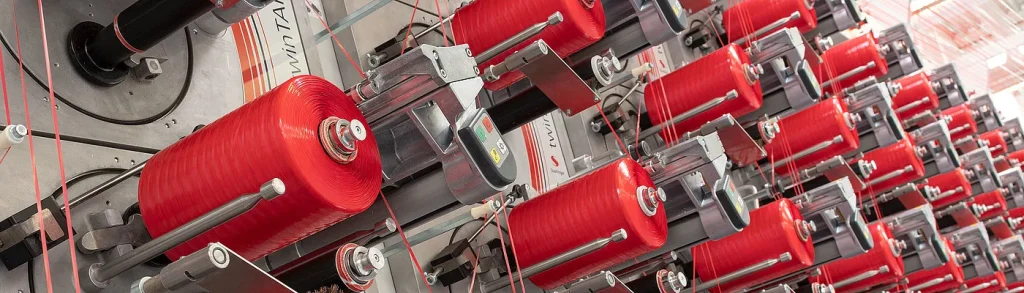
Precision upstream protects productivity downstream. VidePak’s production pairs Austrian **Starlinger** equipment (tape extrusion/draw, circular looms, coating/lamination) with German **W&H** (Windmöller & Hölscher) presses for high‑accuracy reverse printing and converting. The platform stabilizes draw ratios, web flatness, coat‑weight uniformity, and registration—shrinking variance before it reaches your dock.
### 4.1 Upstream: raw‑material selection and testing
* **PP resin**: virgin grades with controlled melt‑flow (e.g., 6–8 g/10 min) for stable tape draw; rPP only where validated for mechanical and migration targets.
* **BOPP film**: 15–35 μm, corona‑treated ≥38 dynes; haze, gloss, gauge variation, and surface energy checked per lot.
* **Inks/OPVs**: adhesion (tape test), rub resistance, ΔE vs. master, VOC profile; UV resistance where outdoor dwell is expected.
* **Additives**: UV stabilizers, antistats, anti‑slip masterbatches; dispersion and performance verified in pre‑production trials.
### 4.2 Core manufacturing flow (Starlinger + W&H)
1. **Tape extrusion & draw (Starlinger)**
Melt → slit → orient; draw ratios raise crystallinity for strength at low gauge. Tight denier windows keep weaving uniform and minimize fabric “gaps” that impair lamination.
2. **Weaving (Starlinger circular/flat)**
Mesh and pick density set sifting control, lamination contact area, and stiffness. Tension parity across looms avoids edge waviness that complicates cutting/folding.
3. **Reverse printing (W&H gravure or HD flexo)**
Registration, viscosity, and tension control lock ΔE and small‑text legibility. Finish zoning (matte vs. gloss) is planned at the artwork stage.
4. **Extrusion lamination (Starlinger)**
A PP‑based tie layer bonds BOPP to the fabric; coat weight, nip pressure, and chill‑roll profile set peel strength and cut flatness; automatic roll change boosts uptime.
5. **Slitting & sheeting**
Tight width and cut‑length tolerances protect fold geometry and seam consistency. Edge trim is recovered into controlled non‑food loops where permitted.
6. **Block‑bottom conversion**
Precision folding creates a true rectangular base; seam energy (pinch‑seal heat or robust stitching) is tuned for sift resistance and drop survival. Options:
* Open‑mouth sewn with easy‑open tape
* Valve sleeve for powder fillers
* Pinch‑bottom heat seal for premium square stacks
* Micro‑venting for high‑speed fillers
7. **Finishing & palletizing**
De‑dusting, metal detection (where required), carton/stack plan, wrap recipe, and label/QR traceability.
### 4.3 Downstream: quality gates and release
* **Incoming QC**: MFR, moisture, contamination (resin); haze/gloss/gauge/dyne (film); adhesion and VOC checks (inks/OPV).
* **In‑process QC**: denier/tenacity, gsm/pick counts, peel strength, COF, print registration/ΔE, fold and seam geometry.
* **Final QC**: seam/tensile/tear; drop/burst; creep under stacked loads; moisture uptake; AQL sampling (e.g., ISO 2859‑1) with defined critical/major/minor defects.
* **Documentation**: lot‑level COAs mapped to ISO/ASTM/EN/JIS; instruments with calibration records; QR‑linked traceability on pallets.
**Why machinery pedigree matters**: The best raw materials cannot rescue a process that wobbles. **Starlinger** stabilizes the substrate and bond; **W&H** stabilizes the image and registration. Together they turn a bill of materials into a predictable, audit‑ready product stream.
—
## 5. What are the applications of Block BOPP Bags?
**Block BOPP Bags** are chosen wherever a squared, stand‑up profile, moisture moderation, and premium print converge with industrial durability.
* **Chemicals and fertilizers**: hygroscopic powders, crystalline products, and blends benefit from sifting‑tight seams, UV‑stabilized films, and clear regulatory text under matte windows.
* **Agriculture**: rice, grains, seeds, animal feed, pet food—applications that punish surfaces with abrasion and seasonal humidity. Hybrid gloss/matte finishes preserve imagery and readability.
* **Building materials**: tile adhesive, gypsum, cement blends; higher gsm and denser mesh resist punctures and drop impacts at job sites.
* **Retail and e‑commerce**: photo‑grade graphics under scuff‑resistant film elevate brands; the block base stands attractively on shelf and in unboxing.
* **Waste and recycling streams**: color‑coded labeling and robust faces survive multiple handling cycles and outdoor storage intervals.
—
## 6. How VidePak controls and guarantees the quality
A four‑pillar system keeps output repeatable across shifts and seasons.
1. **Standards‑anchored design and testing**
Alignment with ISO/ASTM/EN/JIS frameworks (e.g., ISO 527 tensile; ISO 6383 tear; ISO 8295 COF; ISO 1133 MFR; ASTM D1709 dart; ISO 2836 print resistance; ISO 2859‑1 AQL) creates a common vocabulary with auditors and buyers.
2. **Virgin raw materials from qualified majors**
Resin, film, inks, and masterbatches come from vetted suppliers with lot‑matched COAs. Virgin PP is mandated for structural layers; rPP used only with documented evidence where performance and regulations allow.
3. **Best‑in‑class equipment: 100% Starlinger + W&H**
Tape lines, looms, and laminators from **Starlinger**; high‑accuracy presses and converting from **W&H**. Closed‑loop tension, recipe control, and automated roll changes compress makeready loss and process scatter.
4. **Layered inspection**
Incoming → in‑process → final, with containment triggers, CAPA methods, and instrument traceability. Results are bundled per shipment for audit readiness.
Outcome: Instead of catching defects at the dock, VidePak constrains variability inside the window. You receive **Block BOPP Bags** that run predictably on fillers and stack squarely on pallets—again and again.
—
## 7. System thinking — break the constraints, recombine the plan
Packaging problems are mosaics. Improve the tiles, and the picture clears. Below, recurring sub‑problems and the levers that solve them.
### 7.1 Mechanical reliability vs. weight
* **Risk**: over‑engineer (waste resin) or under‑engineer (pay in claims).
* **Levers**: tape denier, fabric gsm, weave density, lamination thickness, seam format.
* **Plan**: run DOE trials; set safety factors to your real stack height/time and drop protocol; down‑gauge where data supports.
### 7.2 Moisture ingress vs. cost
* **Risk**: hygroscopic powders cake; fines sift.
* **Levers**: film thickness, pinch‑bottom vs. sewn OM, valve sleeve fit, micro‑vent density, optional thin liners.
* **Plan**: define moisture uptake targets; validate under humidity cycling; escalate liners only when needed.
### 7.3 Graphics fidelity vs. recyclability
* **Risk**: surface prints rub; multi‑material laminates complicate end‑of‑life.
* **Levers**: reverse‑printed BOPP, PP‑friendly OPVs, mono‑polyolefin bondlines, matte windows for small text.
* **Plan**: keep inks under film; maintain dyne levels; track ΔE with device‑based control.
### 7.4 Line speed vs. sifting
* **Risk**: ballooning on fast fillers; dust escape at seams.
* **Levers**: venting patterns, mouth stiffness, valve geometry, fold precision.
* **Plan**: align geometry to filler; iterate vents and seam energy; measure OEE before/after.
### 7.5 Pallet stability vs. mobility
* **Risk**: slippery gloss stacks or over‑grip that jams conveyors.
* **Levers**: COF band, anti‑slip patches, wrap recipe, pallet interlocks.
* **Plan**: specify COF (e.g., 0.35–0.45); validate with your wrap and stack pattern.
### 7.6 Circularity vs. performance
* **Risk**: aggressive lightweighting or high rPP content undermines strength.
* **Levers**: mono‑material design, controlled down‑gauging, validated rPP grades and percentages, on‑site scrap recovery, energy mix disclosure.
* **Plan**: introduce rPP where trial data supports; document composition/labels; monitor mechanicals quarterly.
Recombination: roll the above into a **living specification**—named BOM, process windows, QA menu, and KPI cadence (breakage rate, filler OEE, moisture complaints, pallet incidents, shelf wear). Update seasonally.
—
## 8. Technical data — typical ranges and what they mean
| Parameter | Typical options / ranges | Practical meaning |
| ———————- | ———————————— | ————————————————————————- |
| Fabric GSM | 55–120 g/m² | Heavier for abrasive lanes or long dwell; lighter for cost‑optimized SKUs |
| Tape denier | 600D–1200D | Higher denier boosts puncture and drop tolerance |
| Mesh (warp×weft) | 10×10 to 14×14 | Denser mesh improves lamination contact and sifting control |
| BOPP film thickness | 15–35 μm | Thicker raises barrier/gloss and scuff life; adds stiffness/cost |
| Lamination coat weight | ~18–30 g/m² | Peel strength and flatness for cutting/folding |
| COF (face/face) | 0.30–0.50 | Tune for conveyors vs. pallets; patches if needed |
| Formats | Open‑mouth sewn; valve; pinch‑bottom | Choose per filler speed and dust control needs |
| UV stability | 6–12 months (with additives) | Required for sun‑exposed supply chains |
| Common sizes | 5–50 kg (up to 60 kg) | Match fill density and pallet scheme |
| Printing | Up to 8 colors (gravure/HD flexo) | Photo‑grade imagery under film, matte for micro‑text |
*Note*: Always validate with your real product. Powder shape, fat content, and moisture history can swing outcomes more than fabric gsm alone.
—
## 9. Design guide — from brand to bag to pallet
### 9.1 Artwork and color management
* Reverse‑print on BOPP with ΔE ≤ 2 against master; lock barcodes/QR quiet zones away from folds.
* Hybrid finish: matte windows for dense text, gloss for imagery; avoid glare on compliance panels.
### 9.2 Structural decisions
* **Valve** for powders, **pinch‑bottom** for premium shelf presence and sift control, **sewn OM** for simplicity and broad line compatibility.
* Gusset depth sized to your pallet (1,000×1,200 mm or 40×48 in) to minimize overhang and “mushrooming.”
### 9.3 Human factors
* Easy‑open tape directionality (right‑handed bias is common).
* Grab notches or die‑cut handles for small consumer sizes.
* Tune pinch folds to reduce sharp corners and injury potential.
### 9.4 Regulatory labeling
* Preflight multilingual panels for minimum x‑height/line spacing; varnish and matte choices verified against rub tests (e.g., ISO 2836).
* Reserve white matte blocks for variable data printing (thermal transfer) on agrochemical SKUs.
—
## 10. Cost engineering — lowering total cost, not just unit price
* **Resin is king**: down‑gauge with data enabled by stable draw control on **Starlinger** lines.
* **Makeready matters**: automated roll changes and closed‑loop tension (Starlinger/W&H) cut waste over the fiscal year more than one‑time price discounts from budget presses.
* **Print economics**: rotogravure for stable, high‑volume SKUs; HD flexo for frequent changes and seasonal variants.
* **Pallet density**: gusset tuning and COF management reduce stretch‑film use and transport damage.
* **Complaint avoidance**: design out moisture ingress and sifting; hidden costs (returns, rework, penalties) dwarf cents saved per bag.
—
## 11. Sustainability and future trends
* **Mono‑polyolefin architecture**: PP fabric + BOPP + PP bondline keeps recycling pathways plausible; reverse printing protects pigments.
* **Validated rPP content**: introduce where migration/mechanical targets allow; document percentages and drift over seasons.
* **Low‑VOC / high‑solids inks & solvent recovery**: tighten air emissions without sacrificing color gamut.
* **Digital modules**: short‑run personalization and regional SKUs without cylinder inventory.
* **Energy mix disclosures**: solar share and kWh/bag; embed into bids for transparent ESG reporting.
* **Labeling that matches collection reality**: avoid claims the waste system cannot honor; align with local EPR frameworks.
Rhetorical check: if a bag is strong but ugly, will it convert? If beautiful but fragile, will it survive? If recyclable on paper but never collected, is it circular? **Block BOPP Bags** succeed when they answer all three—strength, story, and system.
—
## 12. Failure modes & troubleshooting — keep “smooth and consistent” real
* **Symptom**: wrinkled face or bubbles after lamination.
**Root causes**: coat weight too low/high; nip pressure drift; chill‑roll temperature mismatch; film dyne decay.
**Fix**: recalibrate coat weight; restore dyne; stabilize nip/chill; audit storage of printed film.
* **Symptom**: delamination at fold lines.
**Root causes**: insufficient bond at peaks/valleys; over‑stiff film; folding temperature too low.
**Fix**: adjust tie‑layer rheology; raise folding energy; consider thinner or more compliant film.
* **Symptom**: ballooning at fillers.
**Root causes**: too few vents; blocked vent pattern; bag mouth stiffness mismatch.
**Fix**: increase micro‑vent density; ream vents post‑lamination if needed; tune mouth profile.
* **Symptom**: pallet slippage.
**Root causes**: COF too low; smooth gloss everywhere; wrap tension too light.
**Fix**: add micro‑texture or patches; set COF band; re‑tune wrap recipe and interlock pattern.
* **Symptom**: print rub‑off or fading of small text.
**Root causes**: surface printing (not reverse); weak OPV; glare from full gloss.
**Fix**: move artwork to reverse‑print; sharpen OPV; add matte windows for micro‑text.
—
## 13. Five case studies — condensed field narratives
1. **Premium rice (retail)**: moved from paper to **Block Bottom Woven Bags** with matte text windows and gloss imagery; rub complaints fell, barcode reads improved, and shelf appeal jumped.
2. **Fertilizer (summer storage)**: UV‑stabilized film + pinch‑bottom seams cut leakage, fading, and seasonal claims.
3. **Pet food (greasy SKUs)**: reverse‑printed faces resisted abrasion; easy‑open and anti‑slip surfaces stabilized tall stacks; consumer feedback improved.
4. **Cement blends (long dwell)**: heavier gsm + denser mesh prevented punctures/creep; matte windows preserved multi‑language warnings on site.
5. **Waste management (outdoor)**: color‑coded **Block BOPP sacks** with robust faces endured repeated handling; QR labels kept scan fidelity after rain.
—
## 14. Procurement checklist and a starter spec template
### 14.1 Scoping inputs (collect before quoting)
* Product density, moisture sensitivity, grease content
* Filler type and target line speed
* Warehouse climate; stack height/time
* Desired print coverage; matte/gloss zoning
* Regulatory endpoints (food‑adjacent, chemical)
* End‑of‑life labeling and rPP goals
### 14.2 Sample specification (illustrative)
* **Format**: Block Bottom Open Mouth, 25 kg nominal
* **Fabric**: 75 g/m² PP, 12×12 mesh, 900D tapes
* **Film**: 25 μm BOPP, matte windows at legal text
* **Bondline**: PP extrusion, 24 g/m² coat, peel ≥ 3.0 N/cm (ambient)
* **Vents**: micro‑perforation pattern V‑12 for powder fill at 25 bpm
* **COF**: 0.40 ± 0.05 face/face
* **Printing**: reverse gravure, up to 8 colors, ΔE ≤ 2 vs. master
* **UV**: stabilized to 6 months outdoor
* **QA**: AQL per ISO 2859‑1; seam strength ≥ spec; 8× drop @ 1.0 m on actual product
—
## 15. Extended QA menu and acceptance intent (illustrative)
| Test | Method (typical) | Acceptance intent |
| ———————– | ———————————— | ——————————— |
| Melt Flow Index (resin) | ISO 1133 | Keep draw stable across lots |
| Film COF | ISO 8295 | Balance conveyors vs. pallet grip |
| Dart impact (film) | ASTM D1709 | Guard against face puncture |
| Peel strength | 180° peel at ambient + humidity soak | Prevent delamination |
| Tensile / tear | ISO 527 / ISO 6383 | Ensure mechanical floor |
| Seam strength | Sack‑specific joint methods | Avoid split failures |
| Color ΔE | Device‑tracked vs. master | Protect brand fidelity |
| AQL sampling | ISO 2859‑1 | Lot‑level risk control |
—
## 16. Frequently asked questions
**Are Block BOPP Bags food‑safe?**
With appropriate inks/varnishes and GMP, they can be configured for indirect food contact; documentation aligned to target frameworks is provided.
**Do they always need liners?**
No. For many powders the laminate and seams suffice; add thin PE liners only when barrier or cleanliness targets demand.
**Will glossy films slip on pallets?**
COF can be engineered; specify a band (e.g., 0.35–0.45), add micro‑textures or patches, and validate with your wrap recipe.
**Can matte and gloss be combined?**
Yes. Matte preserves small‑text legibility; gloss amplifies hero imagery. Hybrid zones are common on retail SKUs.
**How do Block Bottom Bags differ from standard woven sacks?**
The squared base stands upright and stacks like a brick, improving warehouse efficiency and shelf presence. Moisture moderation and print fidelity also trend higher due to the BOPP face.
—
## 17. Why VidePak — the difference of Starlinger & W&H under one roof
* **Reliability at scale**: high OEE, narrow spec windows, predictable lead times.
* **Graphic excellence**: registration accuracy and ΔE control over long runs protect brand consistency.
* **Process discipline**: ISO‑anchored workflows from incoming resin to final pallet.
* **Sustainability in practice**: mono‑material design, scrap recovery, and energy‑mix transparency.
* **Partnership mindset**: the bag is designed around your line, not the other way around.
—
## 18. Executive snapshot
If you need sacks that carry heavy loads, look premium on shelf, run fast on fillers, and stack with consistent, square integrity, **Block BOPP Bags** are the right geometry and material stack. A woven PP backbone for strength, a reverse‑printed BOPP face for branding and moisture moderation, and a block‑bottom for stability—all built on **Starlinger**/**W&H** precision and governed by ISO‑based QA. Share your product density, target bag size, warehouse climate, and a photo of your filler; VidePak will return two or three spec routes with cost and KPI predictions.
—
### Appendix: quick glossary
* **BOPP (Biaxially Oriented Polypropylene)** — film stretched in MD/TD to raise clarity, stiffness, and printability.
* **PP woven fabric** — textile made from extruded, slit, drawn PP tapes; the structural backbone.
* **Reverse printing** — ink laid on the underside of clear film, protected after lamination.
* **Pinch‑bottom** — square profile, heat‑activated bottom closure; sifting‑tight and premium.
* **Valve bag** — sack with a valve sleeve for high‑speed powder filling.
* **COF (Coefficient of Friction)** — a measure of surface slipperiness; tuned for conveyors vs. pallets.
* **AQL (Acceptable Quality Level)** — statistical sampling plan defining pass/fail risk.
**In this article, we address a critical question for bulk packaging buyers: *How can businesses ensure leak-proof, durable, and cost-effective packaging for sensitive or high-value products?* The answer lies in three pillars: [1] *scientific material validation*, [2] *advanced manufacturing technologies*, and [3] **application-specific engineering. Backed by VidePak’s 16 years of expertise and ISO-certified workflows, we present data-driven insights, technical benchmarks, and real-world case studies to optimize your supply chain.
1. Material Science: Rigorous Testing of PP/PE Granules
1.1 PP Granule Quality Control
VidePak’s Block BOPP bags begin with virgin polypropylene from BASF and Sinopec, subjected to 8-stage testing:
Melt Flow Index (MFI): 6–8 g/10 min (ISO 1133), ensuring uniform extrusion.
Density: 0.905–0.915 g/cm³ (ASTM D792), critical for fabric consistency.
Tensile Strength: ≥35 MPa (machine direction) and ≥30 MPa (cross direction) per ASTM D638.
Impact Strength: ≥6 kJ/m² (Charpy test, ISO 179).
Thermal Stability: Heat deflection temperature (HDT) ≥100°C (ISO 75).
Q1: How do your Block BOPP bags prevent leaks? A1: Our 3-layer co-extrusion (PP/Adhesive/BOPP) achieves peel strength ≥4 N/15mm (ASTM D1876).
Q2: What’s the MOQ for custom-printed designs? A2: 50,000 units with 20-day lead time, including Pantone color matching.
Q3: Can bags withstand maritime shipping? A3: Yes. Salt spray tests (ASTM B117) show zero corrosion after 500 hours.
6. Conclusion
Block BOPP bags are indispensable for industries demanding precision and reliability. VidePak’s Starlinger-driven manufacturing and scientific material controls redefine packaging excellence. For bulk orders or technical support, contact info@pp-wovenbags.com.
References
VidePak Technical Specifications (2024).
ASTM International Standards for Polypropylene Testing.