
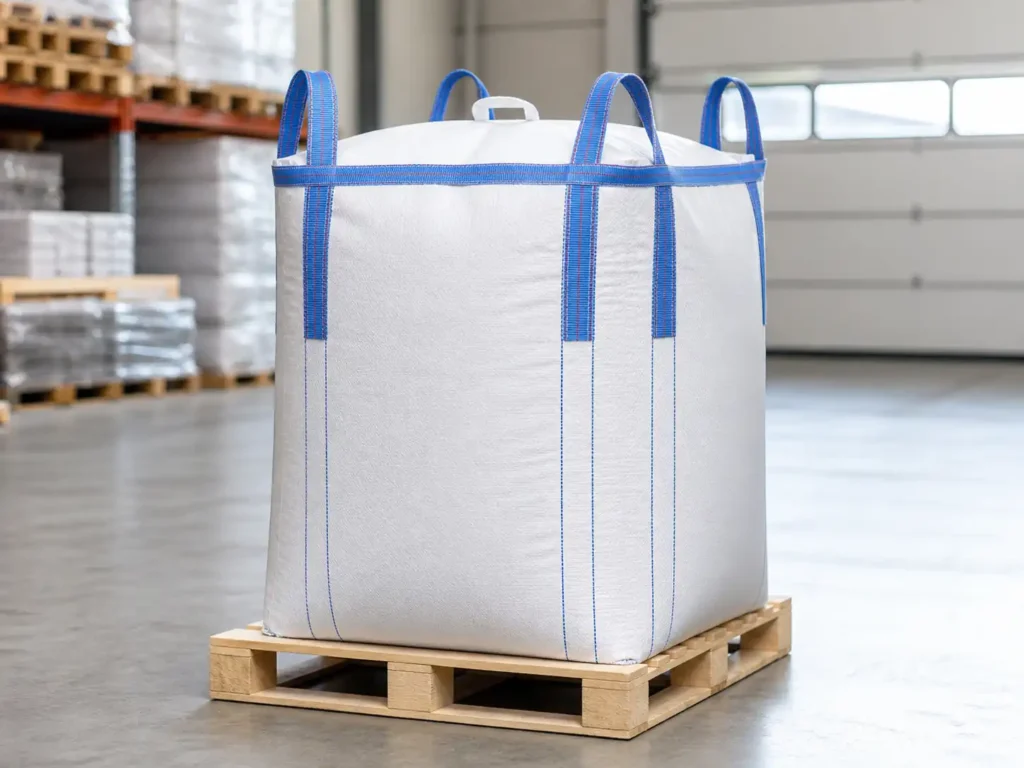
VIDEPAK Product Analysis of FIBC Jumbo Bags for Agricultural Packaging
In modern agriculture, good packaging does not only carry weight. It protects value, controls dust, reduces labor, limits moisture risk, supports traceability, and makes bulk handling cleaner from farm gate to port. That is why FIBC Jumbo Bags, usually made from woven polypropylene and commonly designed for loads from about 500 kg to 2,000 kg, have become a practical bridge between small sacks and fixed silo systems. ISO 21898:2024 frames the material, design, testing, and marking requirements for non-dangerous-goods FIBCs, while industry guidance also links the reuse decision to safety-factor class and inspection discipline.
Why FIBC Jumbo Bags Matter in Agriculture
Agriculture is a volume business, but it is also a quality business. Grain must stay dry. Seeds must stay true. Fertilizer must keep its shape instead of turning into lumps. Feed must move quickly and cleanly. That is where FIBC Jumbo Bags show their strength: they combine high-load handling, flexible storage, and process-friendly discharge in one format. The original VIDEPAK article builds this logic from material structure to field application, and that logic is sound because the same bag can move wheat, maize, fertilizer, coffee, seed, or feed with only targeted changes in fabric, coating, liner, top style, and bottom style.
This matters even more because post-harvest loss is still real, stubborn, and expensive. FAO materials note that cereal and grain-legume losses of about 10% to 15% are common in many developing countries, with storage and transport together accounting for a meaningful share; another FAO source also notes that grain may be stored in bulk or in bags, provided that cleaning, drying, and proper storage practice are in place. In plain terms: when the packaging choice is wrong, losses grow quietly; when the packaging choice is right, efficiency grows quietly too.
High load, low handling count
A single unit often replaces many smaller sacks, cutting touchpoints, reducing manual lifting, and simplifying stock counting.
Flexible storage logic
In warehousing, FIBC Jumbo Bags function like movable micro-storage units that can be grouped by batch, farm, grade, or destination.
Protection with process control
Coatings, liners, and fit-for-purpose tops and bottoms help manage dust, moisture, contamination, and discharge rate.
Understanding Top Configurations
From a marketing and application view, the top of a bag is not a small detail; it is the first decision point in the entire filling process. The top determines whether the operator fills fast or fills clean, whether the product breathes or stays sealed, whether the line matches manual filling or a fixed filling head. VIDEPAK’s own product pages list the main top options as Open Top, duffle Top, flap top, and Filling spout, and industry terminology guides describe the same family of constructions in broadly consistent terms.
Selection rule: choose the top by asking three simple questions in order—How will the bag be filled? How dusty is the product? How much closure protection is needed during transport and storage? When this order is respected, the top choice becomes clearer and the line runs smoother.
Open Top
The strength of the Open Top is speed and simplicity. It gives wide access, makes manual or semi-manual filling easy, and works well when the product is bulky, irregular, or not highly dust sensitive. Industry guidance notes that open-top designs are often chosen when easy, rapid filling matters more than sealed loading, and some agricultural use cases value that openness because airflow can be beneficial for products that should breathe, such as some produce categories. For agricultural commodities with lower dust risk and straightforward handling, the Open Top is practical, direct, and economical. It says yes to speed. It says yes to access. It says yes to visual inspection.
Still, the Open Top is not the universal answer. If the product is a fine powder, if dust control matters, or if transport routes are long and exposed, the fully open mouth can be too permissive. In those cases, an operator may gain filling speed but lose cleanliness and containment. For grains, coarse feed ingredients, some beans, some roots, and other easier-flowing agricultural materials, the trade-off may be acceptable. For fine fertilizer, seed treatment blends, or dusty feed premixes, it often is not. That contrast is exactly why top choice must follow product behavior, not habit.
duffle Top
The duffle Top, sometimes called a skirt top, is one of the most balanced choices in the market. FIBCA terminology describes it as an inlet extending from the top seam and following the bag’s base dimensions, and multiple handling guides describe it as a large tubular skirt that gives broad opening access while still allowing the bag to be tied closed after filling. In daily operations, this means the duffle Top behaves like an easy-fill bag at the start and a secure bag after closure. That dual nature is why it fits so many agricultural flows.
For marketers and buyers, the value of the duffle Top is easy to explain. Against the Open Top, it offers better closure. Against the Filling spout, it offers wider access and more flexibility. Against the flap top, it usually offers a larger mouth for fast loading. This is especially useful for seeds, beans, animal feed, coarse fertilizer, and mixed-SKU agricultural operations where one line may not stay dedicated to one product all day. When the filling equipment varies, when product forms change, or when changeovers are frequent, the duffle Top often becomes the safe middle path.
flap top
The flap top serves a different purpose: added coverage. Industry guidance describes a flap as a fabric cover sized to the bag opening, designed to shield the opening or port from outside contamination and transport damage. In practice, the flap top is valuable when the buyer wants a quick-fill structure but still wants a cover layer over the opening during storage, inland transport, or container shipment. For agricultural materials that are not ultra-fine but still need stronger protection from dirt, splash, and handling contact, the flap top is a smart upgrade.
This top style is especially useful when contamination risk is moderate rather than extreme. Think of products such as feed ingredients, grain fractions, or soil amendments moving through warehouses where traffic, dust, and weather transitions are common. The flap top does not create the same closed-filling condition as a Filling spout, yet it adds a visible, useful barrier. It is a simple idea, but a good simple idea: not fully sealed, not fully exposed, but well protected where it counts.
Filling spout
The Filling spout is the precision choice. Industry descriptions define it as a narrower cylindrical tube set into a closable top panel, ideal for connection to filling equipment so that loading becomes more controlled and much cleaner. For dusty powders and fine granules, this is often the preferred solution because the filling head and the bag top can work as a more closed system, reducing spillage and lowering airborne dust. In agricultural packaging, that makes the Filling spout highly relevant for fine fertilizer, seed treatment compounds, additives, flour-like feed ingredients, and other products where cleanliness is not a luxury but a process need.
The engineering also matters. Filling guides note that spout dimensions are tailored to the filling head, with about 15 inches being a common diameter and larger diameters used when liners are present and powders must reach the shoulders of the bag without bridging; VIDEPAK product guidance likewise gives a typical top-spout range of roughly 35 cm to 50 cm. So the Filling spout is not only a top style; it is a process interface. If the filling head is fixed, choose a spout that fits the line. If the line must keep dust inside, choose the Filling spout. If the product is fine and valuable, choose control before convenience.
| Top style | Best when | Main advantage | Watch-out |
|---|---|---|---|
| Open Top | Fast filling, low dust sensitivity, wide access | Speed and simplicity | Lower containment for dusty materials |
| duffle Top | Mixed products, flexible filling, broad opening | Open access plus tie closure | Less closed than a dedicated spout system |
| flap top | Added protection during transport and storage | Extra cover against dirt and damage | Not as closed as a fitted spout fill |
| Filling spout | Fine powders, fixed filling heads, dust control | Controlled, cleaner filling | Requires good line compatibility |
Comparison synthesized from VIDEPAK product listings and industry top-style definitions.
Quick top-selection flow
Understanding Bottom Configurations
If the top controls filling, the bottom controls value recovery. And in bulk packaging, value recovery is not a small matter. It shapes discharge speed, leftover residue, dust release, line cleanliness, and the chance of reusing the bag. VIDEPAK lists the main bottom choices as Flat Bottom, Duffle Bottom, and discharge spout, which matches widely used discharge logic in the broader FIBC industry.
Flat Bottom
The Flat Bottom is plain, economical, and direct. It has no built-in outlet, so discharge usually happens by cutting the base. That makes it a logical fit for single-use systems, operations that do not need controlled downstream feeding, or high-throughput situations where fast emptying matters more than reuse. A Flat Bottom can work very well for grains, coarse fertilizer, and other products that flow well and are unloaded into a receiving pit or hopper where the bag can be sacrificed after use.
But every simple choice has its limit. Because the Flat Bottom must be cut, it offers less discharge control, less cleanliness, and little chance of keeping the bag intact for reuse. For applications where product loss must be minimized, where dust must be controlled, or where the same package should stay functional after emptying, the Flat Bottom is usually not the best answer. In other words, it is efficient at once, but not efficient again.
Duffle Bottom
The Duffle Bottom is made for broad, fast release. Industry guidance describes it as a full-open style in which the entire bottom opens, making it useful for products that do not flow smoothly, bridge, or clump during storage. For agricultural packaging, that matters in products that can compact, cake, or move out in larger masses rather than in a clean narrow stream. When speed counts and the material is not cooperative, the Duffle Bottom becomes a useful tool. It is not delicate; it is decisive.
This bottom style can be especially relevant for some soil products, dense feed materials, or fertilizer-related products with poorer flow behavior. Yet the very feature that makes the Duffle Bottom powerful—full opening—also reduces control. If the downstream process needs measured feeding, dust control, or precise release into a small inlet, a narrower outlet may be better. So the Duffle Bottom should be chosen for flow difficulty and discharge speed, not for every general use case.
discharge spout
The discharge spout is the workhorse of controlled emptying. Multiple industry sources describe it as the most common bottom option because it allows product to flow out in a more measured way while keeping the bag structure intact. That matters for powders, fine granules, seeds, feed ingredients, and many agricultural products that are emptied into hoppers, screw feeders, blenders, or process receivers. The operator can open, regulate, and retie the discharge spout; the product leaves cleaner, and the process stays calmer.
From a buyer’s standpoint, the argument is simple but strong. Choose a discharge spout when clean transfer matters. Choose a discharge spout when product loss matters. Choose a discharge spout when there is a realistic chance of reuse in a proper safety class. Industry guidance notes typical outlet diameters that vary widely with the product and system, and EFIBCA also emphasizes that discharge must be carried out safely, with suitable support and with reuse limited to bags designed and inspected for it. This makes the discharge spout the most versatile bottom for controlled agricultural logistics.
| Bottom style | Discharge character | Best fit | Commercial note |
|---|---|---|---|
| Flat Bottom | Cut open for fast release | Single-use grain or coarse-flow products | Lower cost, lower control |
| Duffle Bottom | Full-open, rapid emptying | Clumpy or poor-flow products | Fast, but less measured |
| discharge spout | Controlled outlet flow | Powders, seeds, feed, fertilizer, hopper feeding | Cleaner and more reusable |
Bottom-style comparison compiled from VIDEPAK configuration pages and bulk-bag discharge guides.
Matching Structure to Product and Process
A good agricultural bag is not chosen by color, and not chosen by habit. It is chosen by an engineering match. VIDEPAK’s product analysis framework points to the same core variables again and again: safe working load, safety factor, body dimensions, height, fabric weight, liner choice, loop configuration, top structure, and bottom structure. For agricultural FIBC Jumbo Bags, VIDEPAK’s published guidance shows common body footprints around 85 × 85 cm to 110 × 110 cm, heights around 90 cm to 180 cm, and a top-spout range of roughly 35 cm to 50 cm depending on line design. The original article also notes common 1–2 ton agricultural ranges, typical fabric grammage around 150–230 g/m², and safety factors such as 5:1, 6:1, or 8:1.
The material system explains why these bags can do so much while using so little material. Woven polypropylene provides the load-bearing body; coating reduces porosity; liners improve dust and moisture control; specialized additives improve UV stability or manage electrostatic risk. The original VIDEPAK article presents this layered approach clearly, and ISO 21898 confirms that FIBC design is not casual packaging but a tested and marked industrial structure. For agricultural buyers, that means one useful truth: when the product risk goes up, the bag system must go up with it. More barrier, more control, more safety margin, more process fit.
VIDEPAK buyer logic
If the product is dusty, start with Filling spout + discharge spout. If the product is coarse and fast to load, look first at Open Top. If flexibility matters most, begin with duffle Top. If the product may cake or unload badly, evaluate Duffle Bottom before defaulting to a standard outlet. And if the bag may be reused, the safety factor and inspection regime must support that choice.
| Product condition | Recommended top | Recommended bottom | Reason |
|---|---|---|---|
| Fine, dusty fertilizer or powder | Filling spout | discharge spout | Cleaner fill and controlled emptying |
| Coarse grain or fast-fill commodity | Open Top | Flat Bottom or discharge spout | Simple loading; bottom depends on discharge control need |
| Mixed products, frequent changeovers | duffle Top | discharge spout | Flexible loading with practical downstream control |
| Poor-flow or clumping material | duffle Top or Filling spout | Duffle Bottom | Faster full release of difficult material |
Decision matrix built from VIDEPAK specifications and industry filling/discharge guidance.
Agricultural Applications in Real Supply Chains
Following the logic of the original VIDEPAK article, the real value of FIBC Jumbo Bags becomes clearest when we look at real agricultural product families rather than abstract bag theory. The same platform serves many crops, yet not in the same way. Every agricultural segment asks a different question of the bag: Can it breathe? Can it stay dry? Can it empty cleanly? Can it preserve quality? Can it move fast? The answer depends on configuration.
Cereals and coarse grains
For wheat, maize, barley, rice, and other grains, FIBC Jumbo Bags work as mobile storage units and transport units at the same time. FAO notes that grain can be stored in bags after proper cleaning and drying, and the VIDEPAK article explains how these bags can function like modular storage in warehouses or collection centers. For relatively free-flowing grain, buyers often consider an Open Top or duffle Top; on the discharge side, the choice between Flat Bottom and discharge spout depends on whether the unloading point needs quick dump or controlled feed. If traceability and batch segregation matter, FIBC Jumbo Bags offer clean unitization without the fixed cost of permanent silo build-out.
Seeds and planting materials
Seed is not only a commodity; it is future yield packed in a bag. That is why seed applications need more from FIBC Jumbo Bags than sheer strength. The original VIDEPAK article emphasizes traceability, mechanical protection, and protection of germination-related quality. In this segment, a duffle Top is often attractive because it offers broad access with cleaner closure than an Open Top, while a discharge spout helps controlled emptying into downstream packaging or treatment systems. For premium seeds, liners and cleaner handling conditions become even more important. Here the bag is doing two jobs at once: it is carrying product, and it is guarding performance.
Fertilizers and soil amendments
Fertilizer is where configuration discipline pays back quickly. Fertilizer products are heavy, often abrasive, sometimes dusty, and in many cases sensitive to moisture. Research literature shows that moisture uptake and hygroscopic behavior are central drivers of fertilizer caking; the VIDEPAK article likewise highlights barrier features, abrasion resistance, and anti-static design for fertilizer flows. In this application, the combination of Filling spout plus discharge spout is often the most process-friendly because it improves cleanliness at both ends. If the product has poor flow or tends to cake, evaluating a Duffle Bottom can also make sense. For fertilizer, the wrong package merely holds weight; the right package protects spread quality, handling speed, and customer satisfaction.
High-value export crops
Coffee, cocoa, spices, and premium pulses need something different: not just load security, but atmosphere control. The original VIDEPAK article points to barrier-lined bags for products sensitive to oxygen, moisture, and odor pickup. In these cases, FIBC Jumbo Bags become part of quality preservation, not only logistics. A Filling spout can help keep loading clean, while a protected discharge spout supports cleaner downstream emptying. If transport includes container stuffing, port storage, and long sea lanes, then coatings, liners, and added top or bottom protection move from “optional” to “commercially wise.” The bag is no longer a passive shell; it becomes a quality-control layer.
Animal feed and feed ingredients
Feed supply chains live on rhythm: receive, store, meter, blend, pack, repeat. This is why FIBC Jumbo Bags work so well in feed operations. The original article notes that feed, protein meals, premixes, and additives often move in mixed packaging systems, with ton-scale bags feeding mixers and smaller bags feeding retail distribution. In this setting, the most common pairing is often duffle Top or Filling spout with discharge spout, because both filling and discharge must fit production equipment rather than manual unloading. The bag must be strong, yes—but also predictable, clean, and easy to integrate into a running plant.
| Agricultural segment | Typical risk | Suggested top | Suggested bottom |
|---|---|---|---|
| Grains | Moisture, warehouse handling, batch separation | Open Top or duffle Top | Flat Bottom or discharge spout |
| Seeds | Quality, traceability, gentle handling | duffle Top | discharge spout |
| Fertilizer | Dust, caking, abrasion, moisture | Filling spout | discharge spout or Duffle Bottom |
| Coffee, cocoa, spices | Odor, oxygen, water vapor, contamination | Filling spout or protected duffle Top | discharge spout |
| Feed and premix | Dust, fast plant feeding, clean transfer | duffle Top or Filling spout | discharge spout |
Application mapping synthesized from the original VIDEPAK agricultural analysis, FAO storage guidance, and industry top/bottom selection references.
Building a Smarter Packaging Decision with VIDEPAK
From a market-facing VIDEPAK perspective, the best sales argument is not “one bag fits all.” The best argument is the opposite: one platform can be tuned for many agricultural realities. A customer that fills coarse grain by gravity does not need the same answer as a customer that fills dusty fertilizer on a sealed line. A seed producer that values traceability and controlled emptying does not buy with the same priorities as a trader seeking fast dump discharge. The power of FIBC Jumbo Bags lies in this flexibility, and the most persuasive commercial conversation is always specification-led.
That is why the top-and-bottom decision should be presented clearly to customers. If they want speed above all, start with Open Top and review whether Flat Bottom is acceptable. If they want the most practical all-round choice, start with duffle Top and usually pair it with a discharge spout. If they want the best dust control and equipment matching, start with Filling spout and keep the same process logic at the bottom with a discharge spout. If they are handling difficult-flow products, move the conversation early toward Duffle Bottom. This is concise, logical, and easy for the customer to act on.
Final positioning: FIBC Jumbo Bags are not just large containers; they are engineered packaging systems for agricultural efficiency. The right combination of Open Top, duffle Top, flap top, or Filling spout on the top, paired with Flat Bottom, Duffle Bottom, or discharge spout on the bottom, allows VIDEPAK to align each bag with the customer’s product flow, dust profile, storage risk, unloading method, and commercial goals. In agriculture, that fit is not a finishing touch. It is the difference between moving bulk and managing bulk well.
- VIDEPAK Product Analysis of FIBC Jumbo Bags for Agricultural Packaging
- Why FIBC Jumbo Bags Matter in Agriculture
- Understanding Top Configurations
- Understanding Bottom Configurations
- Matching Structure to Product and Process
- Agricultural Applications in Real Supply Chains
- Building a Smarter Packaging Decision with VIDEPAK
- Type A B C D FIBC Jumbo Bags
- Anti-Static FIBC Bags for Food
- Anti-Bulge FIBC Bulk Bags
- FIBC Jumbo Bags Solutions
- Introduction
- Engineering Solutions for Agricultural Challenges
- Technical Specifications by Agricultural Application
- Durability & Safety Metrics
- FAQs: Optimizing FIBC Selection
- VidePak’s Manufacturing Excellence
- References
Type A B C D FIBC Jumbo Bags
Complete classification and reinforced structural designs for agricultural bulk packaging.
Check More →Anti-Static FIBC Bags for Food
Safe and reinforced jumbo bags ideal for agricultural and food-grade product storage.
Check More →Anti-Bulge FIBC Bulk Bags
Reinforced anti-bulge jumbo bags with high capacity for agricultural bulk transportation.
Check More →FIBC Jumbo Bags Solutions
Custom reinforced jumbo bag packaging solutions optimized for agricultural products.
Check More →
The primary answer this article provides is: FIBC (Flexible Intermediate Bulk Container) jumbo bags reduce post-harvest losses by up to 30% through specialized designs—ventilated weaves (air permeability 600–1,200 L/m²/h), multi-layer barriers (oxygen transmission <0.1 cm³/m²/day), anti-static coatings (surface resistivity <10^6 Ω), and antimicrobial liners (99.9% bacterial inhibition). VidePak’s ISO 9001-certified production lines deliver 1–2 ton capacity FIBCs with 8:1 safety factors, trusted by agribusinesses in 50+ countries.
Introduction
Global food waste exceeds 1.3 billion tons annually, with inadequate storage and transport accounting for 40% of post-harvest losses in developing nations. FIBC jumbo bags, engineered for bulk agricultural commodities like grains, seeds, and fertilizers, are revolutionizing supply chains by merging durability with smart material science. Whether preserving maize in humid climates or safeguarding organic fertilizers from electrostatic ignition, modern FIBCs are no longer mere containers—they’re active preservation systems.
Since 2008, VidePak has deployed 30+ years of polymer expertise and Austrian Starlinger looms to produce FIBCs that meet UN, FDA, and EU standards. With 16 extrusion lines and 100+ circular looms, we manufacture 500,000 FIBCs monthly, serving Cargill, Syngenta, and Olam International across six continents.
Engineering Solutions for Agricultural Challenges
1. Ventilated Designs: Combating Moisture and Heat
- Laser-Perforated Panels: 0.8–1.2 mm micro-pores enable airflow of 800–1,200 L/m²/h, reducing grain moisture content from 14% to 9% in tropical climates.
- Breathable Liners: HDPE mesh (40–60 g/m²) allows vapor escape while blocking pests.
- Case Study: A Kenyan maize supplier reduced mold growth by 75% using VidePak’s vented FIBCs with UV-resistant PP fabric (180 g/m²).
2. Gas and Odor Barriers
- 5-Layer Coextrusion: BOPP/EVOH/PE composites achieve:
- Oxygen Transmission Rate (OTR): <0.1 cm³/m²/day (vs. 2,500 for standard PP).
- Water Vapor Transmission Rate (WVTR): <0.05 g/m²/day.
- Application: Cocoa beans retain aroma profiles for 24+ months under nitrogen flushing.
3. Anti-Static Systems for Hazard Mitigation
- Carbon-Embedded Fibers: Reduces surface resistivity to 10^5–10^6 Ω (ISO 61340-4-4), preventing sparks in combustible dust environments (e.g., flour, sulfur).
- Dissipative Coatings: Graphite-doped PE layers discharge static in <0.5 seconds.
4. Antimicrobial Protection
- Silver Ion Technology: AgNPs (50 ppm) inhibit Aspergillus flavus and Salmonella by 99.9% (ISO 22196).
- FDA-Compliant Additives: Non-leaching, triclosan-free formulations for organic produce.
Technical Specifications by Agricultural Application
| Commodity | Design | Key Parameters | Certifications |
|---|---|---|---|
| Wheat/Grains | Ventilated | 180 g/m² PP, 1,000 L/m²/h airflow | FDA 21 CFR 177.1520 |
| Fertilizers | Anti-Static | 220 g/m² PP, 10^6 Ω resistivity | UN 13H3, IECEx |
| Coffee Beans | Gas-Blocked | 5-layer BOPP/EVOH, OTR <0.05 cm³/m²/day | SCA Green Coffee Protocol |
| Organic Seeds | Antimicrobial | 150 g/m² PP + AgNP liner | OMRI Listed, EU Organic |
Durability & Safety Metrics
- Load Capacity: 1–2 tons with 6:1 to 8:1 safety factors (ISO 21898).
- Seam Strength: >2,500 N/5cm (ASTM D4884).
- UV Resistance: <5% tensile loss after 1,000 hrs QUV testing (ASTM G154).
FAQs: Optimizing FIBC Selection
Q1: How do ventilated FIBCs prevent condensation?
Micro-pores facilitate airflow equivalent to 20 air changes/hour, maintaining relative humidity <65% inside the bag.
Q2: Are anti-static FIBCs reusable in explosive environments?
Yes, if surface resistivity remains <10^8 Ω after 10+ washes. VidePak’s carbon-core bags retain conductivity for 15 cycles.
Q3: What certifications ensure food-grade compliance?
EU Regulation 10/2011, FDA CFR 175.300, and FSSC 22000 for direct contact with edible goods.
Q4: Can FIBCs withstand -30°C storage?
PP fabric remains flexible, but avoid impact loads. Use laminated PE liners (120–150 µm) for cryogenic conditions.
VidePak’s Manufacturing Excellence
- Starlinger STeX Looms: Weave 240 cm wide fabric with ±1% density tolerance.
- In-House Testing: Measures OTR (ASTM D3985), tear resistance (ASTM D2261), and microbial inhibition (ISO 20743).
- Sustainability: 100% recyclable PP with 30% post-industrial recycled content (UL ECOLOGO certified).
References
- VidePak Corporate Profile: https://www.pp-wovenbags.com/
- Industry Standards: ISO 21898, ASTM D4884, EU 10/2011.
- Research: Post-Harvest Loss Reduction Strategies (FAO, 2023).
For inquiries, contact info@pp-wovenbags.com.
External Resources:
- Explore anti-static FIBC innovations: Anti-Static FIBC Bags: Health and Safety Performance Evaluation.
- Learn about FIBC manufacturing processes: Understanding FIBC Jumbo Bag Production.
Authored by VidePak’s Agricultural Packaging Division | Updated: March 2025