
Laminated Woven Bags: Advancements in Technology, Materials, and Cost Control
What are Laminated Woven Bags and what else are they called?
Laminated Woven Bags are heavy‑duty packaging formats that unite a load‑bearing woven substrate—most commonly polypropylene raffia—with a continuous film skin applied by extrusion coating or by bonding a prepared film (often BOPP). The woven backbone carries shock loads and abrasion; the coherent skin narrows porosity, supports heat‑seal closure, and provides a printable face for graphics and regulatory marks. In other words: the fabric lifts, the laminate seals, and the face communicates. When these three work together, the result is a container that fills quickly, stacks squarely, survives weather, and protects product integrity across long routes and rough handling.
Because the same platform serves agriculture, minerals, building materials, food ingredients, and retail display sacks, a vocabulary of aliases has grown around it. The labels vary by region and equipment; the physics does not. For fast recognition, here is a numbered map of common alias names and what each one tends to imply in practice:
- BOPP‑laminated woven bags — a woven PP fabric laminated with bi‑axially oriented polypropylene for billboard‑quality print and lower moisture pickup.
- Coated woven polypropylene bags — PP fabric with a PP or PE extrusion‑coated skin; often a rugged mono‑material approach.
- Raffia laminated sacks — shop‑floor shorthand referencing the oriented tape‑yarn (raffia) construction under the laminate.
- Laminated PP valve bags — block‑bottom or pillow designs with a valve sleeve; lamination controls dust and print bleed.
- Moisture‑barrier woven sacks — purchasing language where humidity and rain exposure are key risks.
- Printed laminated woven polypropylene bags — emphasizes high‑resolution graphics and durable safety marks on the laminate face.
- Tubular laminated woven rolls — circular‑woven tubes supplied as roll stock for in‑house form‑fill‑seal conversion.
- Laminated PP woven rice bags — consumer‑facing subset used for rice, pulses, flour, pet food, and sugar.
- Weather‑resistant woven sacks — UV‑stabilized tapes and laminates for outdoor staging.
- UN‑compliant laminated woven sacks — a regulated niche subjected to design‑type testing for certain dangerous goods.
Whatever the alias, the engineering intent converges: predictable strength, clean handling, reliable sealing and discharge, and unambiguous identification from filler to fork truck to end user.
The materials of Laminated Woven Bags: what they are, why they’re chosen, where they sit, and how much they matter
On a parts list, a laminated woven sack looks deceptively simple. In production, however, each layer carries a job and a cost lever. Change one layer and you shift the performance envelope, machinability, and end‑of‑life routes. The map below moves from the consumer‑facing surface to the product‑contact side, explaining composition, properties, costs, and the exact roles in the load path.
What it is. A thin, continuous film or coating—commonly BOPP film at 18–30 μm or a PP/PE extrusion‑coated skin at 20–50 μm.
What it does. Stops sifting of fines, sheds rain and splash, carries high‑contrast artwork and safety marks, and offers a heat‑sealable interface when engineered with a seal layer. Film lamination provides tighter thickness tolerance and smoother planarity; extrusion coats simplify material families.
Cost lens. Film lamination adds a discrete film and adhesive (or tie resin) plus a lamination pass; extrusion coating adds polymer mass and line time but can preserve a single‑resin family. In 2024–2025, energy‑lean adhesives and lower‑temperature lamination recipes made measurable dents in unit energy costs.
What it is. Oriented PP tape yarns woven on circular or flat looms. Basis weights typically 70–140 g/m² for 10–50 kg sacks; heavier for abusive logistics lanes.
What it does. Provides panel tensile and tear strength, abrasion resistance, and dimensional memory that resists barreling when gussets or baffles are present. Picks per inch (PPI) and ends per inch (EPI) tune porosity and stiffness.
Cost lens. Resin mass and loom time dominate. Strength‑per‑gram gains via draw ratio, denier selection, and corner‑focused weave density outcompete brute GSM increases.
What they are. Solventless polyurethane adhesive systems (occasionally solvent‑based where needed) or extrusion tie layers for single‑pass bonding. Surface treatment—corona or flame—raises surface energy for ink anchorage and lamination bond strength.
What they do. Make three different surfaces behave like one cooperative web. The wrong chemistry invites tunneling, curl, or delamination; the right chemistry grows bond strength through cure and survives flexing and thermal cycling.
Cost lens. Adhesive coat weight and cure dwell are the hidden costs. Recent fast‑cure systems cut energy and WIP, which shows up in landed cost models.
What they are. Polyolefin sealants such as LDPE, LLDPE, metallocene‑rich LLDPE, or cast PP. Co‑extrusions stack a lower‑melt seal skin over a tougher core.
What they do. Provide forgiving temperature‑pressure‑time windows, resist flex‑cracking, and keep seals closed while bags are still warm or vibrating on conveyors. In dusty fills, a broad hot‑tack plateau is often the best predictor of zero‑leak pallets.
Cost lens. Thickness trades off with puncture resistance and crease propensity; the thinnest sealant that passes drop, vibration, and leak sampling for the actual product is the economic winner.
What they are. Loose or form‑fit LDPE/LLDPE liners for cleanliness and moisture control; antistatic liners for combustible powders; consumer fitments (zippers, handles) in retail SKUs.
What they do. Turn “moisture‑resistant” into “moisture‑managed,” tailor ergonomics, and enable controlled discharge without compromising strength.
Cost lens. Fitments add function but complicate setups; for bulk commodities, perfect the laminate and seam program before adding parts.
What are the defining features of Laminated Woven Bags?
Why do Laminated Woven Bags keep winning line trials and tenders? Because they compound advantages at very low mass. Consider the properties that matter on real machines and pallets:
- Barrier and cleanliness that scale with risk. Laminates reduce water‑vapor ingress compared to uncoated fabrics and block dust egress—vital for cement, salts, fertilizers, pigments, and food ingredients. Wipe‑clean faces improve housekeeping and audit outcomes.
- High strength‑to‑weight. Oriented PP tapes deliver tensile and tear capacity that paper alone cannot match at comparable mass. With gussets and baffles, stack geometry sharpens without heavy fabric penalties.
- Reliable sealing at speed. With engineered seal layers, faces form strong tops and bottoms on FFS lines even with minor dust at the land—cutting rework and customer complaints.
- Brand canvas without cartons. BOPP faces hold photo‑grade print that survives scuffs and humidity; safety pictograms and barcodes remain legible through the route.
- Mono‑material intent. Keeping PP fabric and PP/BOPP faces within one polyolefin family aligns with design‑for‑recycling guidance where collection exists.
- Weather‑ready staging. UV‑stabilized tapes and inks plus a non‑porous face give sacks the stamina to sit outdoors without turning spongy or illegible.
- Compatibility with automated handling. Smooth laminate improves web tracking and registration; targeted anti‑slip zones reduce wrap tension and pallet creep.
How are Laminated Woven Bags produced — from pellet to pallet?
Factories that consistently ship safe, clean Laminated Woven Bags treat manufacturing as a chain of quality gates with narrow, documented windows. The sequence below highlights where precision pays.
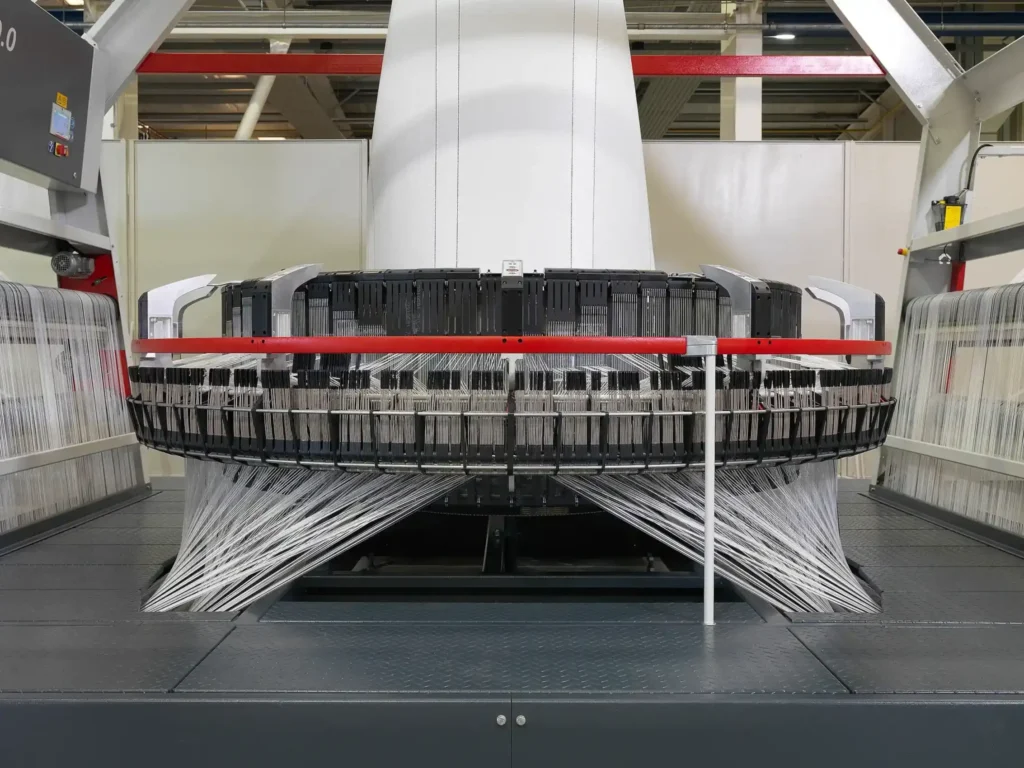
- Tape extrusion and drawing. Melt PP resin, extrude a film, slit into tapes, draw to target ratios, and anneal to lock orientation. Tensile strength, elongation, and creep resistance are largely born here.
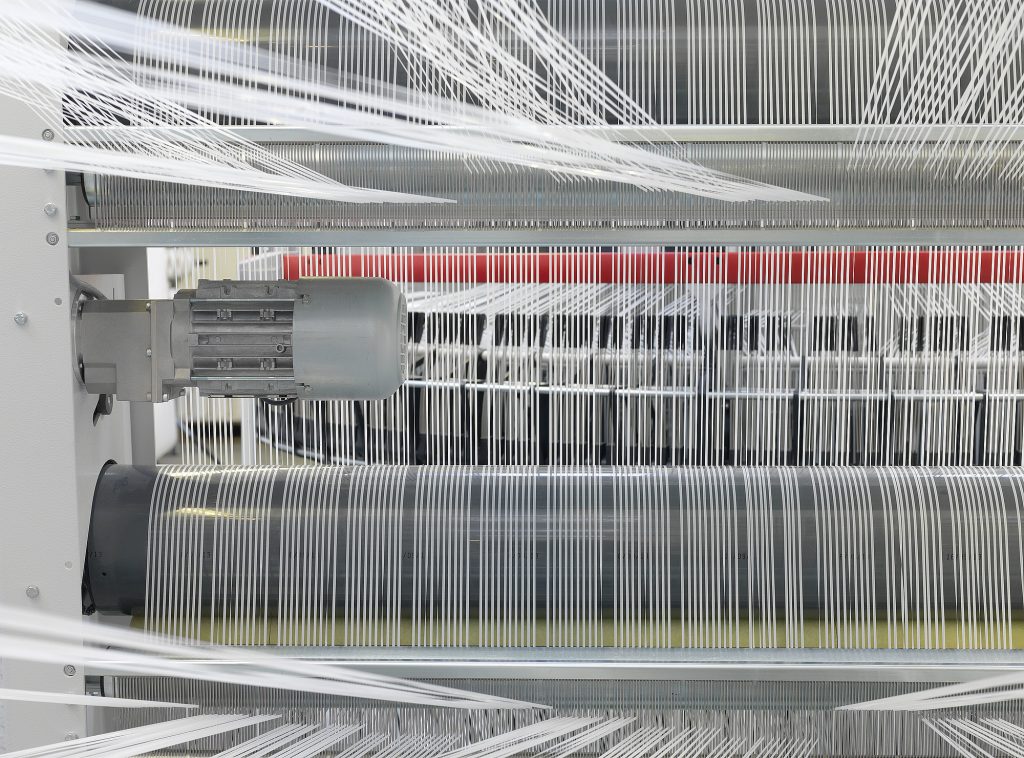
- Weaving. Circular or flat looms set EPI/PPI and GSM. Selvedge quality and edge trimming foreshadow downstream seam integrity.
- Surface treatment. Corona or flame raise dyne levels for printing and bonding.
- Extrusion coating or film lamination. Apply a PP/PE skin or bond BOPP film using solventless PU adhesive or extrusion tie resin; control nip pressure, web temperature, and tension to avoid wrinkles and micro‑cracks.
- Curing and conditioning. Staging laminated rolls in controlled rooms allows bond strength to grow to spec and curl to remain balanced.
- Slitting and roll engineering. Trim edges, set roll hardness, flag splices conspicuously, and map defects for traceability.
- Printing. Apply artwork, barcodes, and safety marks with ink systems suited to the laminate face; for food, low‑migration sets are common.
- Cutting and forming. Form pillow, gusseted, or block‑bottom bodies; install valve sleeves where used; shape fold radii to avoid over‑straining the laminate.
- Sealing and stitching. Execute top/bottom seals within documented temperature‑pressure‑time windows; where sewing remains, choose stitch programs that avoid perforation‑like tear paths.
- Quality assurance. Bond peel and seal strength, hot‑tack maps, leak tests (bubble/vacuum), drop trials (flat/edge/corner), compression/creep, abrasion and rub tests, static verification, and—if shipping regulated goods—UN design‑type testing.
Where do Laminated Woven Bags excel — application patterns and priorities
The format shows up wherever materials must move quickly, cleanly, and predictably. Grouping by use case reveals priorities and shortens trials.
- Cement, mortar, and dry construction mixes. Abrasion and dust control dominate; laminated faces keep warnings legible through rain and rub. Valve bags and block‑bottom styles speed placement and stacking.
- Fertilizers and agricultural minerals. Hygroscopic products punish porous sacks. Lamination, sometimes with liners, prevents clumping; UV‑stabilized print remains readable in depots.
- Rice, flour, pulses, sugar, and pet foods. Consumer SKUs demand billboard print and clean seals; laminate faces deliver shelf presence without cartons.
- Salts and de‑icing agents. Outdoor staging and wet handling require robust faces and sealed seams; discharge spouts and wear patches matter at silos.
- Pigments, fillers, and polymer additives. Dense, abrasive contents push panel strength and seal cleanliness; dust‑proof seam programs and reinforced bottoms are standard.
- Kitted industrial components. Wipe‑clean faces, scuff resistance, and traceable labelling help parts move between cells in advanced manufacturing.
Title‑led reasoning — why “Laminated Woven Bags: Advancements in Technology, Materials, and Cost Control” fits 2024–2025 decision‑making
A title should act like a roadmap. Three nouns—advancements, materials, cost—align with three responsibilities: improve performance, choose wisely, and spend less. That triad mirrors the way engineering, operations, and procurement talk to each other today.
Advancements that matter. Film suppliers leaned toward PP‑centric platforms for design‑for‑recycling; laminate faces with better ink anchorage at lower energy have appeared; solventless adhesives with faster cure reduced WIP dwell; and regulatory frameworks in key markets clarified claims and labeling. None of these headlines is flashy; together, they change factory math and compliance confidence.
Materials as the true performance dial. Woven PP remains the backbone; BOPP vs extrusion coat is a dial, not a duel; and seal chemistry is the quiet hero on dusty or warm fills. Combine them poorly and you invite leaks; combine them thoughtfully and throughput climbs without mass penalties.
Cost control that actually moves the needle. Resin exposure dominates monthly variance; energy and cure dwell come next; and overall equipment effectiveness (OEE) often beats raw‑material swaps. Stability—wider seal windows, better roll quality—usually repays faster than shaving microns off a film.
Systems thinking: decompose Laminated Woven Bags into subsystems, then recombine into one testable specification
Instead of asking for “stronger sacks,” target the subsystem that fails. Treat Laminated Woven Bags as five controllable parts.
Decisions: PP grade (homo vs impact), tape denier, draw ratio, UV package, coating vs film, sealant family, adhesive system. Risks: cold‑drop brittleness, delamination, seal peel at temperature, ink scuff. Controls: draw‑ratio windows, dyne audits, cure curves, abrasion‑resistant inks.
Decisions: circular vs flat; PPI/EPI; gusset and baffle geometry; corner density. Risks: seam‑first failure, corner tears, bulge‑induced overhang. Controls: minimum corner weave density, widened fold radii, double‑lock stitch programs.
Decisions: coat weight and bond, seal‑jaw planarity, temperature‑pressure‑time windows, hot‑tack profile. Risks: channel leaks, burned seals, curl and tunneling. Controls: peel/hot‑tack maps, dusted‑lip tests, jaw planarity checks.
Decisions: winding hardness, core strength, splice caps, edge profiles, web guides. Risks: telescoping, bag length drift, registration loss. Controls: roll‑hardness testing, unwind brake tuning, SPC on length.
Decisions: label completeness, lot trace, claim language, conformity to market rules. Risks: non‑compliance, greenwashing, slow recalls. Controls: documented BoMs, digital travelers, approved claims lists.
Integrated spec sketch. Convert the above into measurable targets: panel tensile minima and variance bands; seam efficiency thresholds; seal/hot‑tack windows; bond (peel) strength; WVTR/OTR guardrails for barrier‑sensitive SKUs; drop and compression tests; dyne and COF windows; labeling and traceability rules. Treat any change in film, adhesive, fabric GSM, or stitch program as a controlled change with a short requalification plan.
Technical tables: colorful summaries for faster decisions on Laminated Woven Bags
| Stack example | Typical thickness / GSM | What it’s for | Notes |
|---|---|---|---|
| Fabric + PP extrusion coat + seal | Fabric 90–120 g/m²; coat 25–40 μm | Cement, salts, fertilizers | Mono‑resin family; rugged and economical |
| Fabric + BOPP film + adhesive + seal | Fabric 80–110 g/m²; BOPP 18–30 μm | Retail sacks (rice, flour) | Lower WVTR and sharper print vs coat |
| Fabric + matte BOPP + coex seal | Matte BOPP 20–25 μm | Shelf presence with scuff control | Match dyne and ink system |
| Tubular woven roll + PP coat | As above | Roll‑fed FFS conversion | Smooth unwind and tracking matter |
| Seal/Bond property | Indicative target | Why it matters | Notes |
|---|---|---|---|
| Lamination peel | ≥ vendor spec N/15 mm after cure | Prevents delamination at gussets/folds | Verify before and after thermal cycling |
| Seal peel (top/bottom) | ≥ 2.5–4.0 N/15 mm (SKU‑specific) | Avoids leakers in vibration/stack | Map with dusted‑lip tests |
| Hot‑tack at discharge temp | Pass within defined T‑P‑t window | Keeps seals closed while warm | Critical for fast discharge lines |
| Dimension/test | Usual tolerance | Why it matters | Notes |
|---|---|---|---|
| Roll width | ±1–2 mm | Controls bag width and registration | Measure across diameter |
| Roll hardness profile | Vendor‑defined band | Avoids telescoping/length drift | Audit with durometers |
| Face‑to‑face COF | 0.25–0.45 | Balances handling and pallet stability | Use anti‑slip varnish selectively |
Failure modes and corrective levers for Laminated Woven Bags
Likely causes: dusty seal lands, under‑pressure, worn pads. Actions: add air knives/ionized blowoff; raise pressure before temperature; refresh pads; map hot‑tack.
Likely causes: under‑cure or incompatible tie; over‑strain at fold. Actions: widen fold radius; verify coat weight and cure; re‑balance tensions and nip.
Likely causes: tension imbalance or uneven cure. Actions: condition webs; tweak nip and chill; extend cure; reverse‑wind if needed to balance curl.
Likely causes: low dyne, weak ink set. Actions: audit surface energy; adopt abrasion‑resistant inks; add protective varnish in high‑rub zones.
Three blueprints you can adapt for Laminated Woven Bags
A) 25 kg cement — laminated PP valve bag
- Body: woven PP 95 g/m²; coated print face or BOPP laminate.
- Valve: internal sleeve sized to impeller packer; self‑sealing geometry plus hot‑melt patch.
- Bottom: block‑bottom with reinforced fold radii; patch program validated for edge drops.
- Tests: seam efficiency ≥ 85% of panel; drops 1.0 m flat/edge/corner; stack 3× height for 7 days; leak check under vibration.
B) 20 kg rice — BOPP laminated shelf‑display sack
- Face: matte BOPP for premium print with scuff control; low‑migration inks.
- Body: fabric 85–100 g/m²; gusseted for cube; anti‑slip varnish zone for pallet stability.
- Seals: wide hot‑tack plateau; dusted‑lip tests in qualification.
- QA: barcode legibility after rub, drop 0.8–1.0 m, compression/creep at ambient and warm climates.
C) De‑icing salts — coated woven with liner
- Face: PP extrusion coat 30–35 μm; wipe‑clean for yard handling.
- Liner: loose LLDPE 80–100 μm to fight clumping in humid depots.
- Stacking: validated wrap tension to avoid crush; corner boards optional.
- Durability: UV‑stabilized tapes and inks for outdoor staging.
Implementation roadmap: from first trial to steady state for Laminated Woven Bags
- Define the product and route: bulk density, particle shape, moisture and static behavior, climate, lift interfaces, stack time.
- Choose the body style: circular vs flat; gusseted vs block‑bottom; baffles where cube matters.
- Select laminate vs coat and liner strategy based on dust, moisture, and hygiene needs.
- Engineer seals and seams: widen hot‑tack, set stitch programs that avoid perforation effects, validate jaw planarity.
- Codify functional targets: panel tensile/tear, seam and seal strength, drop and compression matrices, static verification, rub/abrasion tests.
- Qualify with field‑mirroring tests: dusted‑lip seal tests, outdoor exposure, transport vibration, and warehouse creep.
- Instrument traceability: lot codes tied to bill of materials, machine recipes, and test results; QR/RFID where helpful.
- Train operators and drivers: seal window checks, roll handling, wrap tension, label reads; refresh quarterly.
- Review and improve: complaint dashboards, damage logs, near‑miss reviews; requalification after controlled changes.
Frequently asked questions about Laminated Woven Bags (engineer’s edition)
Are Laminated Woven Bags recyclable? Many builds stay within the PP family (PP fabric + PP coating or BOPP). In markets with polyolefin collection and sorting, they are designed for recycling; claim language should match local infrastructure, and a technical file should document inks, adhesives, and tie resins.
BOPP film or extrusion coat: which is better? Neither wins everywhere. BOPP offers premium print and lower WVTR; extrusion coats win for ruggedness and simplicity. Portfolios often use both, each where it fits best.
What drives cost? Resin exposure dominates monthly variance; energy and cure dwell come next. OEE—registration stability, roll quality, seal window width—frequently outperforms raw‑material swaps in reducing unit cost.
Do I need a liner? Use liners for extreme moisture control, hygiene, or static management. For many commodities, strong lamination plus clean seals is sufficient.
What one change fixes the most leaks? Widen hot‑tack and validate with dusted‑lip tests, then add targeted blowoff/ionization. Most “leakers” are seal‑land problems, not fabric failures.
Keyword and long‑tail placement for Laminated Woven Bags
This article intentionally and contextually uses variations that readers search for without diluting clarity: Laminated Woven Bags; BOPP‑laminated woven bags; coated woven polypropylene bags; laminated PP woven rice bags; moisture‑barrier woven sacks; laminated valve bags; tubular laminated woven rolls; laminated polypropylene sack printing; hot‑tack for laminated woven bags; dyne level for BOPP lamination; bond strength in solventless lamination; roll telescoping laminated stock; compression/creep laminated sacks; stack stability with baffles; mono‑material PP laminated sacks; recyclable polyolefin laminated woven packaging.
- Laminated Woven Bags: Advancements in Technology, Materials, and Cost Control
- What are Laminated Woven Bags and what else are they called?
- The materials of Laminated Woven Bags: what they are, why they’re chosen, where they sit, and how much they matter
- What are the defining features of Laminated Woven Bags?
- How are Laminated Woven Bags produced — from pellet to pallet?
- Where do Laminated Woven Bags excel — application patterns and priorities
- Title‑led reasoning — why “Laminated Woven Bags: Advancements in Technology, Materials, and Cost Control” fits 2024–2025 decision‑making
- Systems thinking: decompose Laminated Woven Bags into subsystems, then recombine into one testable specification
- Technical tables: colorful summaries for faster decisions on Laminated Woven Bags
- Failure modes and corrective levers for Laminated Woven Bags
- Three blueprints you can adapt for Laminated Woven Bags
- Implementation roadmap: from first trial to steady state for Laminated Woven Bags
- Frequently asked questions about Laminated Woven Bags (engineer’s edition)
- Keyword and long‑tail placement for Laminated Woven Bags
“Why should feed manufacturers prioritize laminated woven bags over traditional packaging?” asked a poultry farm owner at an agricultural trade show. “Because they combine unmatched durability, microbial resistance, and cost efficiency while meeting global safety standards,” replied Ray, CEO of VidePak. This exchange underscores the transformative role of laminated woven bags in livestock feed packaging—a sector projected to grow by 4.8% annually, reaching $460 billion by 2030, driven by demand for advanced, sustainable solutions.
1. Technological Innovations in Laminated Woven Bags
Laminated woven bags integrate polypropylene (PP) fabric with coatings like BOPP (Biaxially Oriented Polypropylene) or PE (Polyethylene) to address critical challenges in feed storage:
1.1 Barrier Properties
- Moisture Resistance: BOPP lamination reduces moisture permeability to <5g/m²/day, preventing mold growth in humid climates.
- Antimicrobial Coatings: Silver-ion infused liners inhibit bacterial growth by 99.7%, complying with FDA 21 CFR 177.1520 for food-contact materials.
- UV Protection: UV-stabilized layers withstand 500 hours of sunlight exposure, critical for outdoor storage in regions like Southeast Asia.
1.2 Structural Enhancements
- Reinforced Seams: Ultrasonic seaming technology eliminates needle holes, reducing leakage risks by 30% compared to stitched designs.
- Multi-Layer Design: A 3-ply structure (woven PP + BOPP + PE liner) achieves tensile strength of 12–15 N/mm², surpassing ASTM D5265 requirements for 1,000 kg/m² stacking loads.
Example: A Vietnamese shrimp feed producer reduced spoilage by 22% after switching to VidePak’s triple-layer bags with anti-fungal PE liners.
2. Material Selection and Cost Optimization
2.1 Material Innovations
| Component | Function | Cost Impact |
|---|---|---|
| Virgin PP | Base fabric strength (12 N/mm²) | +15% vs. recycled PP |
| 30% Recycled PP | Reduces carbon footprint | -20% material cost |
| BOPP Lamination | Waterproofing, printability | +10–12% per bag |
| PE Inner Liners | Antimicrobial, static-free | +8–10% per bag |
2.2 Production Efficiency
VidePak’s Starlinger AT-12 looms and 30 lamination machines enable:
- High-Speed Output: 12,000 bags/hour, cutting labor costs by 40%.
- Precision Coating: ±2μm thickness control, minimizing material waste to <3%.
- Customization: 10 Pantone colors and RFID tags for traceability, adding <5% to unit costs.
Case Study: A U.S. cattle feed supplier saved $18,000 annually by adopting VidePak’s 50kg laminated bags with 15% recycled PP content.
3. Application-Specific Design for Livestock Feed
3.1 Parameter Selection Guide
| Factor | Poultry Feed | Aquafeed | Ruminant Feed |
|---|---|---|---|
| Thickness | 90–100 GSM | 120–150 GSM (high oil resistance) | 80–90 GSM (breathability) |
| Outer Laminate | BOPP (UV resistance) | PE (waterproofing) | None (cost efficiency) |
| Inner Liner | Anti-static PE | Aluminum foil (oxygen barrier) | Perforated PE (moisture control) |
| Closure | Heat-sealed valve | Sewn + adhesive tape | Fold-over stitch |
3.2 Regulatory Compliance
- EU: EN 277:2015 for 1,200 kg/m² stacking strength.
- USA: FDA CFR 21 for direct food contact and OSHA 1910.134 for dust containment.
- Japan: JIS Z 1539 (≤8g/m²/day moisture permeability).
4. Cost-Benefit Analysis
4.1 Upfront vs. Long-Term Savings
- Initial Cost: Laminated bags cost 20–25% more than standard woven bags.
- Longevity: Reusable for 8–10 cycles, reducing replacement costs by 60%.
- Loss Prevention: Reduced spoilage saves $3–$5 per ton of feed.
4.2 Sustainability Initiatives
- Circular Economy: 30% post-industrial recycled PP, lowering CO₂ emissions by 1.2 tons per 10,000 bags.
- Biodegradable Liners: PLA-based films decompose in 180 days, aligning with EU Single-Use Plastics Directive.
5. Client Decision-Making Framework
5.1 Key Selection Criteria
- Load Capacity: For 50kg feed bags, opt for 120 GSM fabric + 20μm BOPP.
- Climate Adaptability: High-humidity regions require PE lamination (e.g., Vietnam, Indonesia).
- Safety: Antimicrobial liners mandatory for medicated feeds (e.g., tetracycline additives).
- Cost: Balance recycled content (15–30%) with regulatory requirements.
5.2 FAQs
Q1: What is the MOQ for custom laminated bags?
MOQ starts at 50,000 units, with 12-day lead times for designs under 5 Pantone colors.
Q2: How do laminated bags compare to FIBCs for bulk feed?
Laminated bags are 40% lighter and 30% cheaper for <1-ton batches, while FIBCs excel in 2-ton+ shipments.
Q3: Are these bags suitable for organic feed certification?
Yes. VidePak’s FDA-compliant PE liners meet USDA Organic 7 CFR Part 205 standards.
6. Future Trends and VidePak’s Roadmap
- Smart Packaging: IoT-enabled bags with humidity sensors (2026 rollout) for real-time quality monitoring.
- AI-Driven Production: Starlinger’s AI looms reduce defect rates by 18%, cutting waste.
- Bio-Based Materials: Partnerships with Corbion to develop 50% bio-PP laminates by 2027.
Conclusion
Laminated woven bags are redefining feed packaging through technological precision, material innovation, and lifecycle cost efficiency. VidePak’s integration of Starlinger automation, global certifications, and circular design principles positions it as a leader in the $8.3 billion agricultural packaging market. As Ray emphasizes: “In feed logistics, every gram of protection counts. With our laminated solutions, clients don’t just store feed—they safeguard their profitability.”
This report integrates insights from Intertek’s Materials Technology and Packaging Testing guidelines and industry case studies to ensure technical rigor. For further details on sustainable practices, explore our analysis of multiwall laminated solutions and livestock-specific packaging innovations.