
Biaxially Oriented Polypropylene (BOPP) laminated PP woven bags are a high-performance packaging solution that combines the strength of woven polypropylene fabric with the printability and barrier properties of laminated films. In production, a reverse-printed BOPP film is hot-laminated onto a tubular PP woven fabric, often with a thin inner layer of LDPE to seal the weave. The result is a single-polymer bag (all PP/PE) that combines the mechanical strength of the woven fabric with the superior printability and moisture barrier of the laminated films.
Why choose this construction? Because it delivers multiple benefits at once: the woven base provides exceptional tensile and tear strength, while the BOPP film yields a glossy, stable exterior for high-resolution graphics. Indeed, BOPP film is known for its remarkable flatness and clarity, so it translates into crisp multi-color printing. The combined bag is puncture-resistant, waterproof, dirt-resistant and fully recyclable. Is it strong? Yes. Is it moisture-proof? Yes. Is it eye-catching? Absolutely. BOPP laminated PP woven bags check every box.
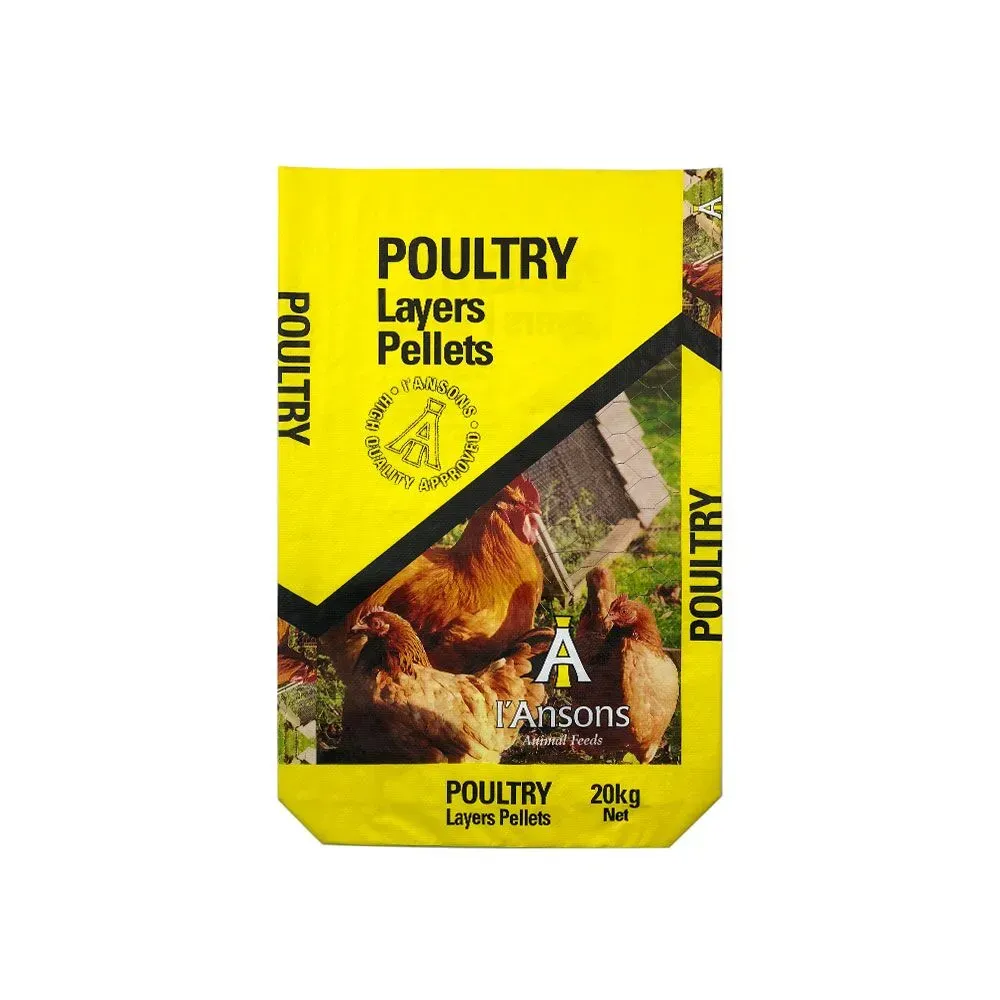
Figure: A 20kg animal feed bag made from BOPP laminated PP woven material. Its block-bottom base lets the bag stand upright when filled, and its glossy multicolor print shows the high-definition branding possible on these bags.
These bags are used across many industries. In food and feed, they package premium rice, flour, sugar, pulses, pet food and animal nutrition products. In agriculture, they carry fertilizers, seeds, and feed additives. In construction and industry, they hold cement, sand, tile adhesives, chemicals and plastic pellets. Unlike jute or paper sacks, BOPP laminated bags do not sag or tear under moisture. Compared to plain woven PP sacks, they look more attractive and can carry full-color logos. In short, they solve the common packaging dilemma: protecting the product while promoting the brand.
Specifications and Technical Parameters
BOPP laminated woven bags are engineered to precise dimensions and weights. A typical bag consists of a woven PP base fabric (often 60–120 gsm) laminated with an inner LDPE layer and an outer BOPP film. The total material thickness usually ranges 90–130 μm, and the combined weight (fabric + films) is on the order of 100–180 gsm. For example, one design might use 100 gsm fabric + 25 gsm LDPE + 25 gsm BOPP per side, totaling ~175 gsm. These lamination layers turn the bag into a unified sheet that is thin yet very strong and moisture-proof.
The woven PP fabric is made on circular (or shuttle) looms using high-tenacity tapes. Denier typically ranges 500D–2000D, chosen according to the load requirement. The fabric is laminated inline: the printed BOPP film (with hot-melt adhesive or co-extruded tie layer) meets the fabric under heated rollers, fusing all layers. In VidePak’s plant, for example, Starlinger extruders also co-extrude a thin LDPE film between layers to simplify bonding. The result is a seamless multi-layer sheet.
Finished bag dimensions are highly customizable. Typical widths are 0.4–0.6 m (16–24″) and lengths 0.5–1.1 m (20–44″), but wider or longer bags can be made. Side gussets (M-type) can be added to increase volume. After filling, a bag of this size might hold 5–40 kg of product. Heavier contents (e.g. sand) require heavier denier and thicker lamination, whereas lighter products (e.g. rice) can use the lower end of each range.
| Parameter | Typical Range / Notes |
|---|---|
| Total Thickness | 90–130 μm (fabric + films) |
| Fabric Weight | 60–120 gsm (woven PP) |
| Film (Laminate) Weight | ~40–60 gsm per side BOPP film |
| Denier (PP Tape) | 500D–2000D |
| Bag Width (open) | Custom (e.g. 400–600 mm) |
| Bag Length (open) | Custom (e.g. 500–1100 mm) |
| Printable Colors | 1–10 colors (typically 6–10 for full-color designs) |
| Carrying Capacity | Designed for ~5–40 kg payload |
| Anti-Slip Coating | Optional; friction >0.6 if applied |
Each manufacturer fine-tunes these specs. For example, HDPE liners may be co-extruded for added barrier, UV stabilizers added for outdoor durability, or heavier inks for abrasion resistance. All materials are typically virgin grade and (if food contact is needed) meet relevant regulations. This ensures every batch of bags performs consistently: for instance, fabric tear strength is guaranteed above a certain threshold, and the laminated sheets are tested to ASTM/ISO standards before bagging. The practical upshot: a well-specified BOPP bag will reliably protect and carry its contents exactly as engineered.
Bottom Types and Construction
A key choice is the bag’s bottom construction. Common variants include:
- Folded Bottom Seam (Plain Seam): The fabric tube is folded flat at the bottom and sewn shut. High-strength polyester thread stitches through all layers. This creates a pointed or V-shaped seam. It is economical and quite strong. However, needle holes mean it is not fully leakproof. To mitigate leaks, manufacturers often apply a multi-layer LDPE tape over the seam, which seals the holes and makes the bottom water-resistant. This combination of stitching plus tape is used widely for general-purpose bags.
- Heat-Sealed (Over-Taped) Bottom: In this variant, the folded or overlapped bottom edges are completely covered by heat-seal tape, leaving virtually no exposed thread. Alternatively, the bottom can be hot-welded without stitching. The result is a fully welded seam that is effectively waterproof. This bottom is chosen for moisture-sensitive cargo (e.g. food or chemicals) where even needle perforations cannot be tolerated.
- Block Bottom (Box Base): Here, multiple layers of the laminated material are folded and glued into a flat, square base. Think of it like attaching a small box at the bottom of the bag. The sides of the bag become vertical panels. A filled block-bottom bag will stand upright on its own – a major convenience for filling machines and warehouse display. It also maximizes the bag’s volume and stacking stability. This style is ideal for heavy or bulky loads (large feed bags, fertilizer sacks) because the load is evenly distributed across the base.
- Pinch Bottom (PBOM): In this style, the bag’s bottom is made by pinching the sides in and pasting them. Two opposite corners of the bottom are folded inward and glued together, yielding a nearly flat, square bottom. The advantage is that it uses less material than a full block bottom while still providing a firm base. PBOM bags typically have adhesive tape on the top flaps: after filling, the bag’s top is closed by a pinch-sealer machine. This produces a virtually airtight, dust-proof closure. Pinch-bottom bags are very common in automated filling lines (e.g. for flour, chemicals) because they seal quickly and tightly.
| Bottom Type | Description / Uses |
|---|---|
| Folded (Plain) Seam | Fabric folded & sewn. Simple and robust. Economical; suitable for many dry goods. Often combined with tape to improve leak resistance. |
| Heat-Sealed (Over-Taped) Seam | Folded bottom fully covered by LDPE tape (or heat-welded). Creates a waterproof seal. Ideal for wet/moist cargo (chemicals, foods). |
| Block Bottom (Square) | Layers glued into a rigid square base. Bag stands upright; maximizes volume; excellent stacking strength. Used for heavy/bulky loads. |
| Pinch Bottom (PBOM) | Corner pinches folded & glued. Flat base with slight side creases. Top closed by hot-melt tape. Airtight, sift-proof; enables high-speed filling. |
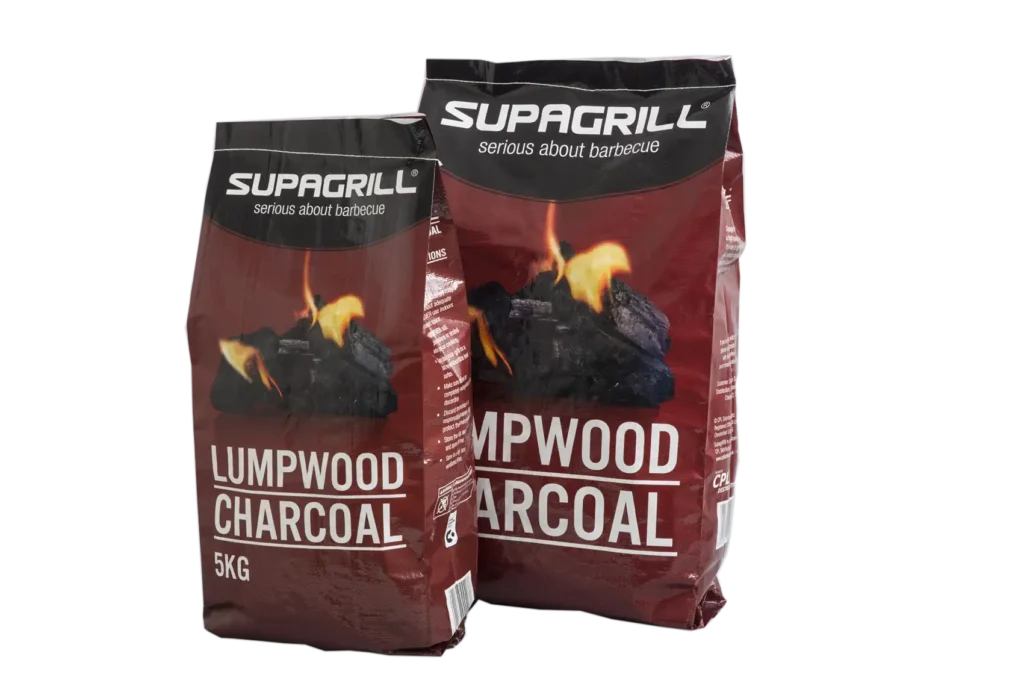
Figure: A 5kg charcoal bag (BOPP laminated PP woven) with a block-bottom base. This bag can stand upright when filled. Its robust woven panels and laminated film withstand handling, while the sharp graphics and matte texture exemplify quality finish.
Opening and Closure Types
The bag opening design determines how products are loaded:
- Valve Bag: A bag with a built-in filling valve on one side or corner. The bag’s bottom is pre-sealed (often block-bottom), and the top is mostly closed except for a small valve pocket. During filling, machines inject the product through the valve. Once filled, internal pressure (and sometimes gravity or a clamp) forces the valve to close automatically. This permits extremely fast, automated filling with minimal dust release. It’s ideal for dry powders and grains (cement, flour, etc.). No additional sealing step is needed, as the valve is self-closing.
- Sewn Open Mouth (SOM): The bag is delivered with its top end completely open. After filling (manually or by gravity), the top is closed by sewing a stitch through a reinforcing tape. This produces a very strong closure. SOM bags are simple and require no glue equipment – only a heavy-duty sewing machine. They are used for non-hazardous goods where a perfect seal isn’t mandatory (grains, animal feed, construction materials). The limitation is the sewn seam has tiny perforations from the needle, so it is not fully airtight or waterproof.
- PBOM (Pinch-Top) Bag: Similar to SOM, but designed for automatic sealing. The bag’s top flaps have hot-melt adhesive tape pre-applied. After filling, a pinch-sealer folds the flaps and activates the tape. The result is a nearly perfect seal without needle holes. PBOM bags combine the ease of filling an open-mouth bag with the speed of heat sealing. This makes them popular for products like flour, sugar, and chemicals that require fast throughput and good protection.
- SBOM (Satchel/PBOM): Also called a Webb-style or satchel bag. The bottom is a fully pasted block (with gussets), and the top has heat-melt tape. The bag opens wide (like a self-opening satchel) for filling, and after filling the top is pinch-sealed. SBOM thus merges the benefits of block-bottom and PBOM. It offers maximum volume (vertical sides) plus an airtight top seal. It is chosen for premium goods where both capacity and protection are critical.
| Opening Type | Description / Uses |
|---|---|
| Valve Bag | Built-in side/corner spout. Filled through valve; self-closes. Ultra-fast, dust-tight (e.g. cement, grains). |
| PBOM (Pinch-Top) | Open top; top closed post-fill by heat-sealer (hot tape). Near-airtight; fast sealing. Used for flours, powders, and chemicals. |
| SBOM (Satchel) | Glued block-bottom with gussets; pre-taped top. Stands up fully, top pinch-sealed. Combines full volume with tight seal. Good for premium bulks. |
| SOM (Sewn) | Open top; closed by sewing through tape. Simple and robust. Common for grains, feed, cement (manual seal). |
Design and Surface Options
Beyond bottoms and openings, BOPP woven bags can be customized in appearance and function:
- Side Gussets (M-type): Folding gussets may be added at the sides. A gusseted bag expands like an accordion and can hold roughly 30–50% more product (given the same outer width) than a flat-sided bag. This is useful for bulky light goods. Gussets also allow block-bottom bags to self-open on a filling cone. Flat-sided bags, by contrast, maximize front/back printable area and are simpler to manufacture.
- Glossy vs. Matte Film: The laminated BOPP film can have either a high-gloss or a matte surface. Glossy film is shiny and highly reflective. It makes colors pop and beads water. Matte film has a smooth, non-glare finish, which imparts a premium look and hides minor scratches or dust. Both finishes are fully printable. Matte is often used to suggest an “all-natural” feel, while gloss is more attention-grabbing on shelf.
- Micro-Perforations: Small holes can be laser-punched into the bag wall. These tiny vents let trapped air escape (preventing ballooning) without letting the product leak. This is useful for packaging things like charcoal, coffee, or any product that may release gas or moisture.
- Anti-Slip Coating: A roughened or rubberized texture can be applied to the surface. This increases friction between stacked bags, preventing them from sliding on conveyors or pallets. It’s especially important when stacking many layers high or when bags are moved on an incline.
- Transparent Window: A transparent window on a BOPP woven bag can be achieved by using a more translucent PP woven fabric and deliberately keeping the window area unlaminated: the bag is BOPP-laminated as usual for print quality and surface protection, but the chosen window zone is either masked during lamination or the BOPP film in that zone is removed afterward, so the customer can view the contents directly through the woven substrate; this approach delivers a clear inspection/visibility effect at low cost with a simple, robust structure and high production yield, although the window area will still show the woven texture and will not look as glass-clear as a dedicated transparent film, and it also reduces moisture and dust barrier performance locally because that section no longer benefits from the BOPP layer—making it best suited for granular products such as resins, grains, beans, rice, and similar materials where visibility matters more than full airtight protection.
| Feature | Purpose / Benefit |
|---|---|
| Flat vs Gusseted Sides | Flat: full front/back print area. Gusseted: expandable sides for ~30–50% more volume; allows self-opening and standing shape. |
| Glossy Laminate | High-shine, reflective finish. Intensifies colors; repels moisture; grabs attention. |
| Matte Laminate | Non-reflective, silky finish. Premium look; hides imperfections; anti-glare for easy reading. |
| Micro-Perforations | Tiny vent holes. Relieve air/gas pressure; prevent bag inflation. Ideal for charcoal, fresh produce. |
| Anti-Slip Texture | Textured coating. Increases friction; stabilizes stacked bags on pallets or slopes. |
| Clear Window | Transparent film patch. Shows contents (e.g. seeds, pellets) for display and inventory. Enhances product trust. |
Applications and Advantages
Thanks to this flexibility, BOPP laminated woven sacks serve countless products. Food staples (rice, flour, sugar, salt, grains) commonly use 10–20 kg bags. The lamination keeps moisture out and supports vibrant packaging. Animal feeds (pellets, kibble) use 5–25 kg bags; their durability protects the feed, and windows or perforations add convenience. Fertilizers & seeds (NPK, fertilizers, grains) are packed in 20–50 kg woven bags; the bags resist moisture and tearing, even when stored outdoors. Construction materials (cement, lime, grout) often use 25–50 kg block-bottom bags that don’t collapse on rough handling. Chemicals & minerals (plaster, charcoal, polymers) are also packed this way, often with valve bags for powders.
In all cases, these bags combine strength and convenience. They protect contents from dirt, moisture, and puncture, yet offer a smooth canvas for branding. In other words, industrial toughness meets retail-grade presentation. A company can ship 25 kg of sand as safely as usual, but with an attractive printed bag that sells the product – without ever compromising on safety or cost.
VidePak’s Production and Quality Assurance
VidePak is a leading supplier of BOPP laminated woven bags. Its manufacturing philosophy stresses premium inputs and full control:
- Top-Grade Materials: VidePak sources 100% virgin PP/PE resins (from BASF, Sinopec, Yangzi, etc.). Each resin lot is certified (melt-flow, density, etc.) to ASTM/ISO standards. Even inks and adhesives are from Tier-1 suppliers. This ensures the bag’s polymer layers meet regulatory and performance criteria.
- Modern Equipment: The factory runs dozens of European Starlinger extruders and circular weaving looms. Starlinger lines produce the PP tapes and lamination films. Biaxial film lines create the BOPP film. High-speed W&H printers apply flexographic graphics (6–8 colors), and W&H baggers handle folding, stitching, taping and sealing. This integrated line (resin → fabric → bag) enables tight tolerances and high output.
- High Capacity: With multiple parallel lines, VidePak can produce on the order of 300 million bags per year under ISO 9001:2015. Large warehousing of raw fabrics and pre-printed rolls means even big orders (tens of thousands of bags) ship quickly. This scale also allows cost efficiencies on raw materials.
- Quality Controls: All processes follow international standards (ASTM, ISO, EN). Incoming rolls of fabric and film are tested (e.g. ISO 1924 for tensile strength, ASTM thickness). Inline sensors measure web width to ±0.05 mm and ensure glue coverage >95%. Finished sacks are sampled for drop tests (ASTM D642), burst and seam tests, and moisture barrier tests. Only those passing every check are shipped.
- Traceability and Certification: Every order gets documentation. Bag batches carry lot numbers and QC certificates. VidePak holds ISO 9001:2015 (and often ISO 22000/BRC for food products). Customers receive detailed lab reports for parameters like grammage, tear, peel, and barrier. This transparent approach ensures trust – customers know exactly what they’re getting.
| Aspect | VidePak Practice |
|---|---|
| Raw Materials | 100% virgin PP/PE from BASF, Sinopec, Yangzi. Batch-certified to ASTM/ISO. |
| Equipment | European machinery: Starlinger extruders/looms, W&H printers & baggers. Integrated line (resin→bag). |
| Annual Output | ~300 million bags per year (ISO 9001 facility). Fast delivery for large orders. |
| Quality Standards | Design/tests per ASTM/ISO (tensile, burst, seal, WVTR). In-line metrology and final inspections. |
| Documentation | Batch-level traceability. Reports of all test results ship with bags (ISO 9001:2015 certified). |
| Customization | Full range of bag styles (flat/gusset, any bottom/opening, 1–10 colors, various laminates). |
These processes reflect VidePak’s experience and expertise. Each bag is built to specifications and thoroughly vetted, so “each VidePak bag does exactly what it’s supposed to”. This reliability – along with proven supply chain – embodies the trust (and authority) customers seek in packaging.
Conclusion
BOPP laminated PP woven bags offer a unique combination of features that few other packaging formats can match. They are strong yet lightweight, moisture-resistant yet breathable, durable yet printable, and fully recyclable. In one package, they deliver both the rugged protection of a woven sack and the marketing appeal of a printed bag.
Is it possible to have all these attributes? With BOPP laminated woven bags, the answer is clear – yes. These bags shield contents from rough handling and the elements, while making branding easy and effective. Strong on performance and strong on presentation, they meet the needs of producers and consumers alike.
References:
Laminated BOPP Woven Bags – VidePak
BOPP Woven Bags – Summer Show Plastic
BOPP Woven Bag | HOMPAK PACKAGING INC
Multiwall Paper Bags Manufacturer: VIDEPAK – VidePak
PP & PE Laminated Woven Bags | Summer Show Plastic Corporation
Quality PP Woven & BOPP Bags Manufacturer & Supplier
Multiwall Kraft Paper Bags Factory: Bottom and Top Options – VidePak