
In today’s competitive packaging industry, BOPP Woven Bags have emerged as a leading solution for businesses across a range of sectors. These bags offer a unique combination of durability, cost-effectiveness, and aesthetic appeal. Among the top manufacturers, VidePak stands out as a leading BOPP Bags Manufacturer and BOPP sacks Manufacturer, utilizing cutting-edge equipment from Starlinger, the world-renowned equipment supplier.
Context, Purpose, and Reading Guide for **BOPP Laminated Woven Bags**
This document reconstructs, enriches, and significantly extends the original narrative with a unified goal: to help engineers, buyers, packaging developers, and brand managers understand why **BOPP Laminated Woven Bags** remain a category-defining platform for strength, print fidelity, and cost discipline—and how to specify them precisely. The content mixes practical know‑how, manufacturing detail, and decision frameworks. It replaces shorthand with worked examples; it trades slogans for mechanisms; and it translates jargon into choices you can actually make on the factory floor.
Callout — Why readers trust this format: The narrative moves from materials and mechanics to printing and conversion, then to risk, quality, and application-mapped specifications. Each section introduces a practical checklist, a short table, or an example so that theory does not drift away from production reality. You will repeatedly encounter the product term **BOPP Laminated Woven Bags** and long‑tail variants such as BOPP laminated PP woven sacks, reverse‑printed BOPP laminated woven packaging, and block‑bottom BOPP valve sacks—this is deliberate and useful for information retrieval as well as scoping.
Pragmatically, readers ask three questions. What is it? How is it built? How do we know it will work on our lines? The structure that follows answers all three—first defining **BOPP Laminated Woven Bags** and their close relatives; next unpacking material architecture, printing routes, and lamination chemistry; then translating this into application‑ready formats (open‑mouth, pinch‑bottom, block‑bottom valve). At each step, we include design‑for‑recycling intent so specifications remain credible in the current regulatory climate.
Definition and Naming — What are **BOPP Laminated Woven Bags**?
At their core, **BOPP Laminated Woven Bags** are hybrid sacks that combine an oriented polypropylene film face with a woven polypropylene fabric body. A thin biaxially oriented polypropylene layer provides optics, printability, and surface protection; a woven polypropylene substrate supplies tensile strength, puncture resistance, and dimensional stability under stacked loads. The lamination between them—achieved through extrusion coating or adhesive bonding—creates a single, robust structure capable of carrying dense commodities while presenting high‑fidelity, shelf‑quality graphics.
The category spans commodity and premium variants. Commodity versions focus on durability with straightforward artwork and open‑mouth sewn closures. Premium variants emphasize reverse‑printed, photo‑grade imagery protected under the BOPP film, block‑bottom construction for cubic efficiency, valve designs for clean powder filling, and finishing options such as anti‑slip backs or matte tactile panels. Across this variety, the unifying concept is consistent: laminate the printable film to the woven backbone so that visuals endure and mechanics never become the bottleneck.
Common aliases for **BOPP Laminated Woven Bags** include:
- BOPP laminated PP woven sacks
- BOPP poly woven bags
- BOPP laminated polypropylene woven bags
- Reverse‑printed BOPP laminated woven packaging
- BOPP laminated rice bags
- Block‑bottom BOPP valve sacks
The same families of bags sometimes appear under local trade names or in retailer procurement lists as polypropylene laminated woven sacks, laminated poly woven rice bags, or reverse‑image BOPP printed woven packaging. The distinctions are typically about format and artwork protection, not about the fundamental film‑to‑fabric architecture.
Material Architecture — Layers, Roles, and Where They Live
To specify **BOPP Laminated Woven Bags** well, start with the stack‑up. Each layer performs a distinct job and compromises on one layer ripple through line performance, pallet stability, and retail appearance. Here is how the stack typically looks and why it is configured this way.
Functional layers:
- Woven PP fabric (backbone): a plain‑weave network of oriented tapes, often 10×10 to 14×14 picks per inch. This layer provides tensile capacity, tear resistance, and a stable geometry for pallet loads that sit for weeks or months in warehouses.
- BOPP film (face layer): a 15–35 μm oriented film chosen for either brilliant gloss or refined matte. It accepts high‑resolution print after surface treatment. In reverse‑printed constructions, the ink remains locked under the film where abrasion cannot touch it.
- Lamination tie layer: the glue—either a molten PP/PE extrusion coat or a solvent‑less polyurethane adhesive—that couples film and fabric. This layer determines bond strength, visual clarity, and resistance to delamination during drop or scuff events.
- Functional options: micro‑perforation for venting powders; anti‑slip varnish to stabilize pallets; UV masterbatch for outdoor storage; and easy‑open tapes that improve the consumer experience without compromising seam integrity.
When these layers are combined properly, the outcome is not just additive—it is synergistic. The film stiffens the face so artwork lays flat; the fabric shoulders the mechanical loads so film can remain thin and optical; the laminate distributes stress across the contact area so edges and gusset folds remain intact. That is why **BOPP Laminated Woven Bags** outperform single‑material sacks in the tricky middle ground where heavy contents meet premium branding.
| Layer | Typical choices | Why it matters |
|---|---|---|
| BOPP film | Clear/gloss, matte, white, pearlized; 15–35 μm | Printability, optics, scuff control, moisture resistance, stiffness |
| Tie layer | PP/PE extrusion coat or solvent‑less PU | Bond strength, visual clarity, recyclability intent, delamination resistance |
| Woven PP fabric | 55–110 GSM; 10×10–14×14 picks/inch; UV stabilized if needed | Tensile, tear, puncture resistance, bag shape under load |
Specification patterns are often summarized as three‑, four‑, or five‑layer stacks:
- 3‑layer: BOPP (printed) // extrusion coat (PP/PE) // PP woven fabric
- 4‑layer: BOPP (printed) // tie layer // PP woven fabric // optional inner liner
- 5‑layer: multi‑film face (e.g., BOPP plus specialty film) // tie // woven // liner // functional varnish
Feature Map — What **BOPP Laminated Woven Bags** Do That Others Don’t
Features are not marketing adjectives here; they are consequences of material physics and process control. When you select **BOPP Laminated Woven Bags**, you select a set of affordances that affect how quickly lines run, how pallets survive transit, and how products compete on a retail shelf. The following map organizes features by the user outcome they support.
- Visual performance: reverse‑printed imagery preserved under BOPP; gloss and matte modulation; metallic or pearlized accents; windowing to show contents.
- Mechanical performance: woven substrate prevents tears and creep; gusseted, block‑bottom geometries improve cube efficiency and stacking stability.
- Operational performance: film‑faced webs de‑nest cleanly; bag mouths present well on high‑speed fillers; valve designs minimize dust and product loss.
- Environmental intent: mono‑polypropylene builds support design‑for‑recycling ambitions where collection systems accept PP streams.
Printing latitude
Reverse rotogravure or CI‑flexo up to 8–10 colors yields smooth vignettes and sharp micro‑text. Corona‑treated faces maintain dyne levels for ink anchorage.
Stacking discipline
Block‑bottom valves produce brick‑like pallets that resist bulge; anti‑slip backs raise friction so columns stay aligned through vibration and braking.
Moisture control
The BOPP face provides a practical moisture barrier; inner liners can be added where low WVTR is mission‑critical (grease, fat, or hygroscopic powders).
Customization depth
Micro‑perforation, easy‑open tapes, die‑cut handles, window panels, and tactile matte zones let you tailor function and feel without sacrificing throughput.
Manufacturing Flow — From Resin and Film to Finished **BOPP Laminated Woven Bags**
Good bags begin with good inputs and disciplined lines. This section walks your team through upstream verification, core processing stages, and downstream assurance. The goal is not only to describe the sequence but to reveal where quality is created and where it is lost.
- Raw material receipt and verification: PP homopolymers for tapes; BOPP film grades (clear, matte, pearlized, metallizable); adhesives or extrusion resins for the tie layer; ink sets tuned for BOPP. Each lot arrives with a certificate of analysis for MFR, density, additives, haze, gloss, and dyne readiness. Sampling and retains ensure traceability.
- Tape extrusion and orientation: PP is melt‑extruded, quenched, slit into narrow tapes, and drawn to increase tensile properties. Tape width and thickness control are pivotal: variations here amplify later as weave defects or uneven coating.
- Weaving: circular or flat looms assemble tapes into a plain‑weave fabric. Pick density (e.g., 12×12) and GSM (e.g., 80–95) are matched to target loads. Operators monitor for broken ends, count variation, and width drift.
- Printing on BOPP film: artwork is reverse‑printed on the film’s inner face using rotogravure or CI‑flexo. Corona treatment increases surface energy to keep inks anchored. Presses maintain color via viscosity control and on‑press spectrophotometry; defect cameras watch for pinholes and streaks.
- Lamination: either extrusion lamination, where a molten PP/PE layer bonds film to fabric, or solvent‑less adhesive lamination, where a two‑part polyurethane forms the bond at lower temperatures. Nip pressure, chill roll profiles, and adhesive coat‑weight uniformity determine bond consistency and optical quality.
- Conversion and bag making: rolls are cut to length; gussets are formed; bottoms are sewn, pinched, or hot‑air welded into block‑bottom valves; valves or liners are inserted; top hems and side seams are completed according to the format. Easy‑open tapes and die‑cut handles are added when specified.
- Marking and compliance: lot codes, QR marks, recycling symbols, and handling icons are applied; language packs are verified for destination markets.
- Final assurance: sampling follows AQL plans. Teams check peel strength, coefficient of friction, tensile/elongation, seam integrity, and drop performance. Print registration, ΔE color tolerances, and dimensional accuracy are signed off before release.
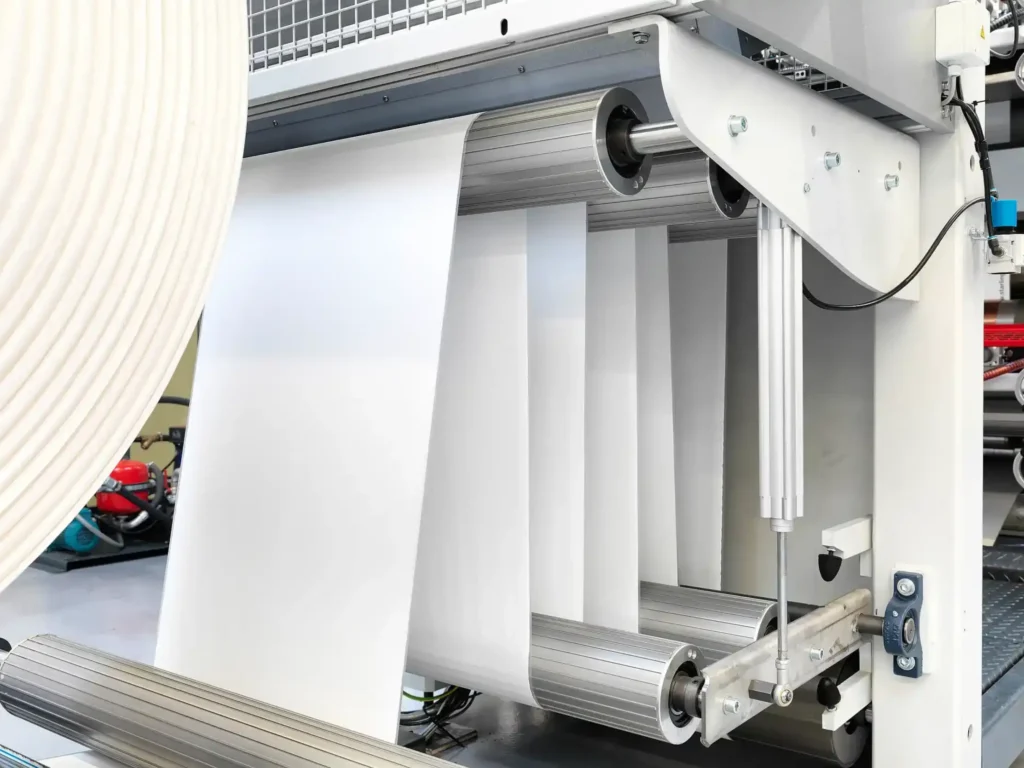
Equipment pedigree matters: woven sack lines from Starlinger and printing/web handling from W&H press families pair speed with precision. For teams moving from paper sacks or generic poly woven bags, this equipment mix often reduces waste on changeovers and stabilizes register on complex SKUs.
Applications — Where **BOPP Laminated Woven Bags** Earn Their Keep
Across food staples, agriculture inputs, construction powders, and pet nutrition, one pattern repeats: products that are heavy, dusty, or humidity‑sensitive benefit from the woven substrate, while brands that sell by appearance exploit the BOPP face. Here are common use‑cases and what the bag does for each.
- Rice and grains: high‑gloss faces with window panels showcase the product while the fabric resists tears during depot handling. Square‑bottom or pinch‑bottom shapes help the bag stand on shelves.
- Flour and pulses: reverse‑printed imagery stays legible despite abrasion in transit; liners can be specified to limit moisture ingress for long storage cycles.
- Fertilizer and agro‑chem: UV‑stabilized tapes and matte anti‑slip backs support outdoor storage and safe palletization. Micro‑perforation vents off‑gassing.
- Cement, putty, minerals: block‑bottom valve sacks run on high‑speed rotary packers, filling cleanly while forming stable pallets with excellent cube.
- Pet food and aqua feed: puncture‑resistant builds with optional liners manage grease and odor while preserving brand graphics in a scuff‑prone environment.
| Use‑case | Recommended format | Typical stack‑up | Key tests |
|---|---|---|---|
| Rice / grains (retail) | Open‑mouth, square‑bottom | BOPP (reverse‑print) // PP tie // PP woven (+ optional liner) | COF, print AQL, bond (peel), bag drop |
| Fertilizer | Block‑bottom valve | Matte BOPP // tie // PP woven (UV tapes) | UV exposure, COF, seam integrity, drop |
| Pet food | Open‑mouth sewn or pinch‑bottom | BOPP // tie // PP woven // optional liner | Bond strength, odor/taint (where required), drop |
| Cement / dry mortar | Block‑bottom valve | BOPP // extrusion tie // PP woven | Drop, seam, cube stability |
Internal reference link: for a focused catalog that aligns with this document’s scope, see the laminated BOPP woven bags overview. This link supports buyers who need a quick visual map of formats and surface options consistent with the terminology used here.
Quality Architecture — How **BOPP Laminated Woven Bags** Stay Consistent
Quality is not a single gate; it is an architecture of gates. Teams that excel with **BOPP Laminated Woven Bags** build the following four layers into their operations: standards discipline, material purity, equipment pedigree, and multi‑tier inspection. Each layer adds resilience and reduces the cost of quality by catching variance earlier and earlier in the process.
- Standards discipline: adopt recognized methods for films, laminates, and finished packaging so that tests mean the same thing across shifts and sites. Typical methods include film tensile, COF, peel/ply adhesion, bag drop, and seam strength protocols. Document SOPs and train against them.
- Material purity: prefer virgin PP and BOPP from top‑tier producers; verify dyne levels, haze/gloss, melt flow rate, and odor. If recycled content is required, apply controlled recipes with line segregation and enhanced inspection.
- Equipment pedigree: woven conversion on Starlinger lines and printing on W&H CI‑flexo or rotogravure assets reduce variance caused by mechanical drift, registration instability, or inconsistent winding. Vision systems lower rework.
- Layered inspection: incoming (resins, films, inks); in‑process (bond strength, COF, register, color delta); outgoing (drop, seam, dimension, print AQL). Tighten sampling for new artworks or material changeovers. Maintain retains and full lot traceability.
Representative test suite
- Film tensile and elongation
- Coefficient of friction (front/back)
- Bond/ply adhesion
- Seal/peel for liner interfaces
- Free‑fall drop with defined loads and heights
Risk‑based sampling
AQL plans are not static. New art, new ink systems, or alternative substrates trigger a temporarily tighter plan. High‑runner SKUs can adopt normal or reduced sampling once the process is proven stable.
Traceability discipline
Lot‑to‑bag trace links raw material lots to finished pallets. Retains allow for retrospective testing when transport incidents or warehouse conditions are questioned.
Printing and Customization — Routes, Trade‑offs, and Finishes for **BOPP Laminated Woven Bags**
Printing on the film and protecting the ink beneath lamination is the defining visual trick of **BOPP Laminated Woven Bags**. Reverse rotogravure and CI‑flexo are both correct answers; which one you choose depends on artwork complexity, SKU cadence, and waste tolerance. Consider the following dimensions when planning print strategy.
Reverse rotogravure
Engraved cylinders deliver photographic gradients and metallic accents with repeatable ink laydown. Best for long runs or hero SKUs. Dryer profiles and solvent balance control mottle and layflat.
Central‑impression flexo
CI‑flexo approaches gravure quality while enabling faster changeovers and lower make‑ready waste. Anilox volume, plate screening, and impression control govern highlight detail and midtone cleanliness.
Surface preparation
Corona treatment raises surface energy into the 38–42 dynes/cm window. Treat‑to‑print intervals should be minimized to avoid dyne decay; keep films clean while awaiting lamination.
Finish options include gloss, matte, dual‑finish split (gloss front panel with matte back or spot‑matte zones), metallic or pearlized films for premium cues, registered windows, and anti‑slip clear coats to raise back‑panel friction coefficient. Functionally, laser or needle micro‑perforation tunes venting for powders.
Systems Thinking — Reconciling Conflicts in **BOPP Laminated Woven Bags** Specifications
Specifying packaging is a conversation between competing goods: graphics versus throughput, bond reliability versus temperature budget, pallet stability versus surface appearance, ventilation versus barrier, recyclability versus performance add‑ons. The trick is not to choose sides but to choreograph trade‑offs so that no critical attribute is starved.
- Graphics vs. throughput: gravure for long, image‑rich campaigns; CI‑flexo for agile, seasonal rotations. Pilot both on a known SKU to compare waste profiles and speed ceilings.
- Bond reliability vs. heat budget: extrusion bonds are rugged and fast; adhesive bonds run cooler and protect delicate inks. Both meet spec—choose based on artwork sensitivity and line energy costs.
- Stack stability vs. appearance: matte backs and block‑bottom geometry increase friction and cube; high‑gloss fronts drive shelf impact. Split finishes respect both goals.
- Ventilation vs. barrier: micro‑perforation helps powder filling and off‑gassing but lowers moisture barrier; localize vents or add an inner liner if storage climates demand it.
- Recyclability vs. performance: mono‑PP is the default intent; avoid foreign polymers and metallized layers unless they change a measurable outcome that your customer values.
Parameter Menus and Ready‑to‑Use Templates for **BOPP Laminated Woven Bags**
Use the following menus to assemble a complete specification without guesswork. Each item is phrased as a knob you can set and a reason you would set it that way.
- Geometry: length × width × gusset; open‑mouth or valve; bottom type (sewn, pinch, block‑bottom). Gusset width controls cube on pallets and shelf posture in retail.
- Substrate: fabric GSM and pick density; tape denier; UV stabilization level. Higher GSM and pick counts resist puncture and bulge at the cost of weight and price.
- Film: BOPP type (clear, matte, white, pearlized); thickness; dyne target. Thicker films add scuff resistance and stiffness but can reduce conformability at creases.
- Printing: process (gravure or CI‑flexo); colors; line screen; ΔE tolerance; varnish plan. Define acceptable ΔE per brand color and set a reprint trigger.
- Lamination: extrusion or adhesive; tie layer target; bond spec (min peel in N/15 mm). Record failure modes—film tear or adhesive split—to diagnose issues quickly.
- Features: venting pattern; handles; easy‑open; liner type; anti‑counterfeit marks. Treat features as functions tied to use‑cases, not decorations.
- Testing: method list and acceptance criteria; sampling plan; documentation and retains. Align test geometry so results are comparable lot to lot.
Template: 10 kg premium rice
Reverse‑print clear BOPP 25 μm; window panel; PP woven 80–90 GSM; extrusion bond; anti‑slip back varnish; COF window defined; drop and peel targets locked.
Template: 25 kg fertilizer
Matte BOPP; block‑bottom valve; UV tapes; micro‑perforation near valve; CI‑flexo for SKU agility; seam weld integrity and stack tests prioritized.
Template: 20 kg pet food
Photo‑grade reverse rotogravure; optional liner for grease; anti‑scuff coatings; easy‑open tape; odor/taint screens where relevant.
Defects, Diagnostics, and Remedies in **BOPP Laminated Woven Bags** Production
Every converting line fights a small set of recurring demons. Naming them—and prescribing remedies—turns reactive firefighting into proactive control. Use this library to accelerate troubleshooting and to train new operators on what matters most.
| Symptom | Likely causes | Practical fixes |
|---|---|---|
| Mottle / orange‑peel on film | Solvent retention, dryer imbalance, ink rheology drift | Re‑balance fast/slow solvents; tune dryer set‑points and airflow; stabilize viscosity by temperature control |
| Delamination at edges | Low dyne, contaminated film, insufficient coat‑weight or nip pressure | Verify dyne; clean web; increase coat‑weight; review nip temperature and pressure; shorten print‑to‑laminate interval |
| Curl / poor layflat | Tension asymmetry, chill‑roll imbalance, tie‑layer mismatch | Balance web tensions; adjust chill‑roll profile; harmonize tie‑layer resin and thickness to the film/fabric pair |
| Blocking in wound rolls | High web temperature at wind‑up; insufficient anti‑block; roll hardness issues | Cool web before winding; add anti‑block; set roll hardness and taper tension correctly |
| Register drift | Nip slippage, poor sensor calibration, plate/cylinder mounting variation | Audit nip and tension control; recalibrate sensors; standardize mounting; use vision systems |
Procurement and Vendor Qualification for **BOPP Laminated Woven Bags**
Buying packaging at scale is not only a price contest; it is a due‑diligence exercise. An effective RFQ for **BOPP Laminated Woven Bags** goes beyond dimensions and artwork to document machine base, test capability, and change‑control maturity. Consider this checklist when qualifying suppliers.
- Confirm woven conversion and printing assets (Starlinger for woven lines, W&H for presses and winders).
- Request calibration certificates for COF testers, tensile frames, peel fixtures, and drop rigs.
- Ask for recent retain samples and their associated test records.
- Audit raw‑to‑finished traceability; confirm retain storage durations and retrieval processes.
- Review corrective‑action procedures for nonconformities; ensure 8D or equivalent closure discipline.
- Context, Purpose, and Reading Guide for **BOPP Laminated Woven Bags**
- Definition and Naming — What are **BOPP Laminated Woven Bags**?
- Material Architecture — Layers, Roles, and Where They Live
- Feature Map — What **BOPP Laminated Woven Bags** Do That Others Don’t
- Manufacturing Flow — From Resin and Film to Finished **BOPP Laminated Woven Bags**
- Applications — Where **BOPP Laminated Woven Bags** Earn Their Keep
- Quality Architecture — How **BOPP Laminated Woven Bags** Stay Consistent
- Printing and Customization — Routes, Trade‑offs, and Finishes for **BOPP Laminated Woven Bags**
- Systems Thinking — Reconciling Conflicts in **BOPP Laminated Woven Bags** Specifications
- Parameter Menus and Ready‑to‑Use Templates for **BOPP Laminated Woven Bags**
- Defects, Diagnostics, and Remedies in **BOPP Laminated Woven Bags** Production
- Procurement and Vendor Qualification for **BOPP Laminated Woven Bags**
This article will delve into the world of BOPP Laminated Woven Bags, exploring the sophisticated printing techniques available for these sacks and how they can be customized for various industry needs. Additionally, we will explore why VidePak‘s approach to producing high-quality BOPP Woven Bags sets the company apart in the global market.
What are BOPP Laminated Woven Bags?
BOPP Laminated Woven Bags, or Biaxially Oriented Polypropylene bags, are a type of multi-wall woven bags constructed with woven polypropylene fabric. The BOPP film is laminated on the surface, which not only enhances the aesthetic appeal but also improves the bag’s durability, moisture resistance, and strength. These bags are widely used in sectors such as agriculture, construction, and food packaging due to their robust nature and customizable features.
As a top BOPP Woven Bags Supplier, VidePak ensures that its bags are produced using Starlinger’s advanced extrusion lines and circular looms, which deliver optimal structural integrity. Combined with high-quality printing techniques, the end product is visually appealing, with a high degree of precision in branding and design elements.
Printing Techniques for BOPP Laminated Woven Bags
One of the defining features of BOPP sacks is their ability to undergo various printing processes. The print quality on BOPP laminated bags is an essential aspect that determines the brand’s visibility and overall appeal. VidePak, leveraging its state-of-the-art equipment from Starlinger, offers a range of printing techniques:
- Single Color Printing
This is the most basic form of printing, ideal for companies with simpler branding needs. It involves the use of one color and is often utilized for basic logo designs or text. Single-color printing is cost-effective and can still be impactful when used with thoughtful design. - Multi-Color Printing
For more intricate designs, multi-color printing is used. This process allows for greater visual complexity and depth, making it ideal for brands that require a detailed representation of their logos, product details, or promotional images. VidePak, as a premier BOPP Woven Bags Supplier, uses Starlinger’s multi-color printing machines that ensure vibrant color reproduction and sharp details. - Full-Color (CMYK) Printing
For brands looking for the highest level of detail and vibrancy, full-color printing using CMYK technology is the best option. This method allows the creation of photographic-quality images, ideal for businesses that require full-color product pictures or promotional graphics on their packaging. VidePak‘s equipment ensures that every hue is captured with high precision, resulting in a visually stunning final product. - Block Printing for BOPP Bags
Another common technique is block printing, which involves pressing ink through a stencil or template to create bold, graphic patterns. Block BOPP Bags are often used in industries like agriculture and construction, where the focus is on clarity and high visibility. VidePak’s experience in block printing ensures consistency and quality across high-volume orders.
Comparison of Different Printing Methods
| Printing Method | Advantages | Disadvantages |
|---|---|---|
| Single Color Printing | Cost-effective, simple, and clear branding options | Limited design possibilities |
| Multi-Color Printing | Offers more design flexibility, visually appealing | Slightly more expensive than single-color printing |
| Full-Color (CMYK) Printing | Photographic quality, high visual appeal, captures detailed images and complex designs | Higher production costs |
| Block Printing | Clear, bold designs, ideal for high visibility and durability; suitable for branding agricultural or construction sacks | Limited design flexibility, can appear less refined than multi-color or full-color prints |
Customization Options for BOPP Laminated Woven Bags
Another key benefit of BOPP Laminated Woven Bags is their flexibility in terms of customization. Depending on the requirements, customers can choose from a variety of finishing options, surface textures, and sizes. VidePak, as a top BOPP Woven Bags Supplier, provides a range of customizable features to suit the specific needs of its global clientele.
- Matte Finish vs. Glossy Finish
The surface finish of a BOPP laminated woven bag can be customized to create different visual effects.
- Matte Finish: Ideal for a more subtle, sophisticated look, matte finishes reduce the amount of light reflected from the surface, giving the bag a smooth and premium appearance. It is often used in packaging for luxury goods or products where understated branding is preferred.
- Glossy Finish: Glossy finishes are highly reflective and create a shiny, attention-grabbing appearance. These are perfect for products that need to stand out on the shelf and catch the consumer’s eye with vibrant colors and bold designs.
- Bag Sizes and Shapes
Another aspect of customization is the size and shape of the bag. VidePak, as a seasoned BOPP sacks Manufacturer, offers flexibility in this regard, allowing clients to choose from a variety of sizes, from small packaging bags to multi-wall woven bags that can hold heavy-duty materials like sand, cement, or fertilizers. - Custom Laminations
Custom lamination can also be applied to BOPP Laminated Woven Bags for added protection and durability. This option is particularly useful for bags that will be exposed to harsh environmental conditions or moisture. In some cases, lamination also adds a layer of UV resistance, which is critical for outdoor storage. - Specialized Features
For customers with unique packaging requirements, specialized features such as perforations for breathability, anti-skid surfaces, or handles for easy transport can also be added. These small customizations can greatly enhance the utility and convenience of the bags in specific applications.
Advantages of BOPP Laminated Woven Bags
When choosing BOPP Laminated Woven Bags, customers benefit from several advantages that set them apart from traditional packaging solutions:
- Durability
The combination of woven polypropylene fabric and laminated BOPP film creates an exceptionally durable product. These bags are highly resistant to tears, punctures, and abrasions, making them ideal for transporting heavy or sharp materials. - Moisture Resistance
Lamination provides excellent moisture resistance, a critical feature for products that are sensitive to water damage, such as food, agricultural products, or cement. This feature ensures that products are kept dry and safe during transport and storage. - Cost-Effectiveness
Compared to alternative packaging solutions, BOPP sacks offer a cost-effective option without compromising on quality. They are lightweight, reducing transportation costs, yet strong enough to withstand demanding conditions. - High-Quality Printing
With high-definition printing, businesses can enhance their brand visibility and product appeal. The ability to use vibrant colors, sharp images, and complex designs on the surface of BOPP laminated woven bags offers significant marketing advantages.
VidePak: A Leading BOPP Bags Manufacturer
With over 30 years of industry experience, VidePak has positioned itself as a global leader in the production of BOPP Woven Bags. Utilizing cutting-edge Starlinger equipment, the company ensures that its bags meet the highest standards of durability and quality. VidePak serves a wide range of markets, including North America, Europe, and Southeast Asia, and maintains a strong focus on customer satisfaction through its customizable packaging solutions.
Conclusion
BOPP Laminated Woven Bags are an excellent choice for businesses looking for durable, moisture-resistant, and aesthetically pleasing packaging. By offering various printing techniques such as single color, multi-color, and full-color printing, VidePak ensures that every client’s branding needs are met with precision. Furthermore, the company’s commitment to quality, evidenced by its use of Starlinger’s equipment, cements its position as a leading BOPP Bags Manufacturer and BOPP Woven Bags Supplier in the global market.
The ability to customize these bags in terms of size, shape, surface finish, and other features means that companies across multiple industries can find a solution that meets their specific needs. Whether for food packaging, agricultural products, or heavy-duty industrial use, BOPP Laminated Woven Bags provide the reliability and flexibility that modern businesses demand.