
What co-extrusion really delivers for heavy-duty sacks
Multi-layer co-extruded polyethylene (PE) packaging is not a “bag style” so much as a materials architecture: multiple molten polymer layers are extruded together at the same time to become one unified film, rather than separate sheets later glued together. This simultaneous, multi-layer extrusion is repeatedly defined as coextrusion in packaging contexts, including open-mouth bag terminology references and film specialists’ explanations.
Why does that matter to a buyer? Because industrial sacks live in contradictions. You want stiffness and toughness. You want fast filling and dust control. You want moisture resistance and reliable seals at speed. Co-extruded films exist precisely because a single polymer layer rarely wins every fight at once; by tuning resin types and layer ratios, one film can be engineered for sealability, flexibility, puncture resistance, temperature performance, and even gas barrier needs where required.
The manufacturing logic is also different from many laminated structures. Coextrusion forms a multilayer film directly from raw resins “in one step,” avoiding adhesive lamination steps and reducing concerns associated with adhesive/solvent use in some laminated constructions. A film technology supplier explicitly contrasts co-extrusion with laminated multilayer films, noting co-extrusion produces multilayer films without adhesives and associated solvents that can remain in the film, while a tie-layer approach is often needed when combining chemically dissimilar polymers in multilayer structures.
Finally, coextruded PE sacks are not limited to a single converting route. Suppliers describe producing PE block-bottom valve sacks from blown-to-size PE tube that is cut and fastened, with the bottom/top/valve formed by folding, while machinery makers describe producing open-mouth cross bottom sacks and cross bottom valve sacks from multilayer PE films using hot-air sealing (paste-free). In other words: the film design sets the performance ceiling; converting sets how much of that ceiling you actually reach.
Common product families in co-extruded multi-layer PE packaging
Across industrial “dry solids & raw materials” markets, suppliers commonly group co-extruded multi-layer PE solutions into three practical families: PE valve bags, PE Form-Fill-Seal (FFS) film/tube for automated lines, and PE open-mouth bags intended for stitching or heat sealing after fill. This product grouping is presented directly in industrial plastic packaging catalogs and product pages.
Before going deep, the fastest way to clarify is to ask a blunt question: Do you want to purchase pre-made bags, or do you want to run bags off a roll on an FFS machine? If you buy pre-made bags, you’re choosing between a valve top or an open mouth. If you buy rollstock, you’re choosing the film tube architecture, gusset geometry, and how the line will vent air at speed. Different starting points; different risks; different efficiencies.
| Product family | How it’s supplied | How it’s filled and closed | What it’s best at | Typical automation fit |
| Multi-layer Co-extruded PE valve bags | Pre-made sacks with a valve opening | Filled via spout/packer; valve can self-close by product pressure, or be sealed (e.g., tuck-in / sonic / heat / ultrasonic depending on design) | Low-dust filling, fast packer integration, strong pallet “brick” behavior | Manual-to-fully automated lines; designed for spout packing equipment |
| Multi-layer Co-extruded PE FFS film (tube) | Film (often tubular) on reels that becomes bags on the line | Formed, filled, sealed, cut on the FFS bagger; often uses air evacuation (micro-perforations or probes) | High-speed throughput, consistent seals, scalable automation | High-speed automated production lines; FFS-focused film architectures |
| Multi-layer Co-extruded PE open mouth bags | Pre-made bags, bottom pre-sealed | Filled through open top; closed by stitching or heat sealing after fill | Simplicity, broad filling-equipment compatibility, flexible operations | Manual, semi-auto, or automated lines depending on closing method |
Co-extruded Multi-layer Polyethylene Valve Bags
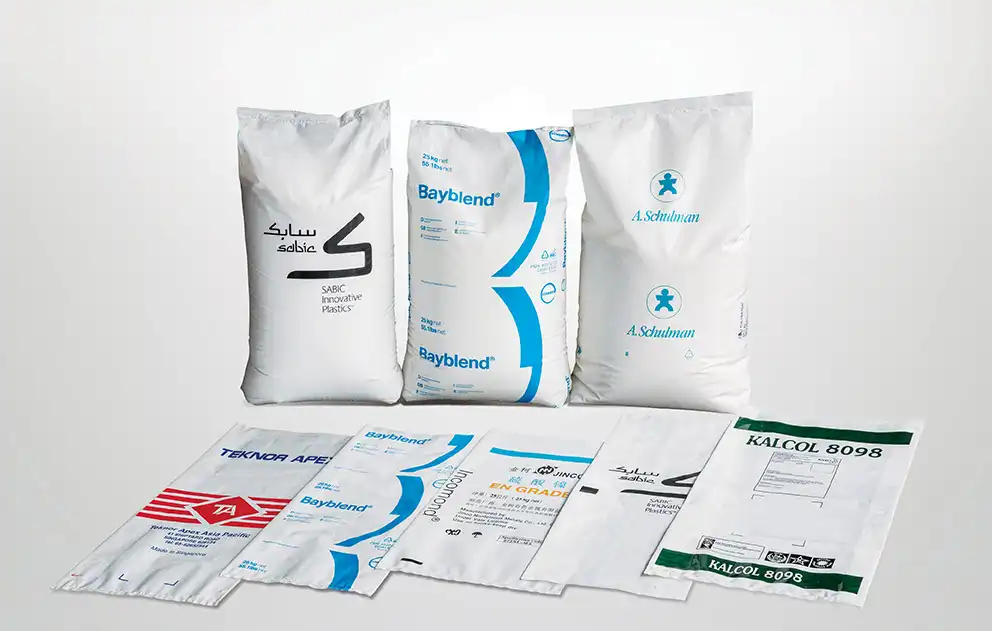
A co-extruded multi-layer PE valve bag is a sack engineered for spout filling: product enters through a valve opening (often in a top corner), the bag fills rapidly, and the valve closes by design—sometimes by internal product pressure, sometimes by a secondary seal step, sometimes both. Suppliers describe these as flexible coextruded PE bags suitable for powdered or granular items, offered in multiple valve options, and intended to fill without generating dust on manual or automated production lines.
The material argument is straightforward: multi-layer co-extruded films can be formulated to resist tearing and puncture while still remaining processable, printable, and sealable, which matters when sacks face abrasion, impacts, and sustained stress during stacking, transport, and storage. Film and resin suppliers—particularly those focused on “heavy duty sack (HDS) film”—highlight that these packages must endure dynamic and impact loads during filling and logistics, and that film design is tied to creep resistance and bag-drop performance (stack stability is not a marketing adjective; it’s an engineering variable).
Valve options are not cosmetic; they are the dust-control mechanism. In polyethylene valve bag guidance, available valve types are commonly listed as: standard internal valve, extended tuck-in sleeve, sonic seal sleeve, and reduced valve.
A practical way to interpret them is to map each valve design to two questions: How freely does the product flow? and How automated is the line? For example:
- A standard internal valve is described as a cost-effective option intended to strengthen the valve opening and improve sift resistance.
- A tuck-in sleeve is manually folded/tucked after filling; it’s simple, but it assumes an operator or an appropriate closing step.
- A sonic seal sleeve is designed for ultrasonic hermetic sealing; it is explicitly described as an outer sleeve extension laminated/coated for ultrasonic airtight closure and is positioned as automation-friendly.
- A reduced valve is defined (in valve bag references) as a smaller valve tube opening than the bag body width, often used to better control sifting behavior for certain products.
Now, what about the user’s requirement: Ultrasonic/Heat sealable valves?
Valve bag references describe heat sealing as a traditional sealing method and ultrasonic sealing as an advanced approach that can help create airtight closure—positioned as minimizing air/humidity ingress and supporting “cleanliness” in sensitive applications. Meanwhile, an ultrasonic sealer supplier notes that hermetic sealing depends on the valve structure and specifically calls out the need for a PE layer inside a sealable external valve (reported as at least 50 microns) for proper ultrasonic sealing behavior.
Venting is the other half of dust-free filling.
Without venting, a fast packer turns a bag into a balloon, and a balloon is simply dust waiting for a reason. Co-extruded PE valve bag options include venting via perforations or venting channels integrated into the back seam; one machinery concept for PE valve sacks describes a venting chamber placed alongside the longitudinal seam to enable high-speed filling of dusty powdery products while preserving moisture resistance.
Lastly, there are specialized valve-bag use cases that can change the resin recipe entirely. “Batch inclusion” polyethylene valve bags are described as low-melt film sacks designed to be added directly into a mixture during manufacturing (so the bag itself melts and disperses), minimizing exposure to hazardous powders; examples cite melt-point windows around 100–108°C for those custom films. Another supplier similarly states low-melt film options may use LDPE or EVA resin systems.
Co-extruded Multi-layer Polyethylene FFS Film
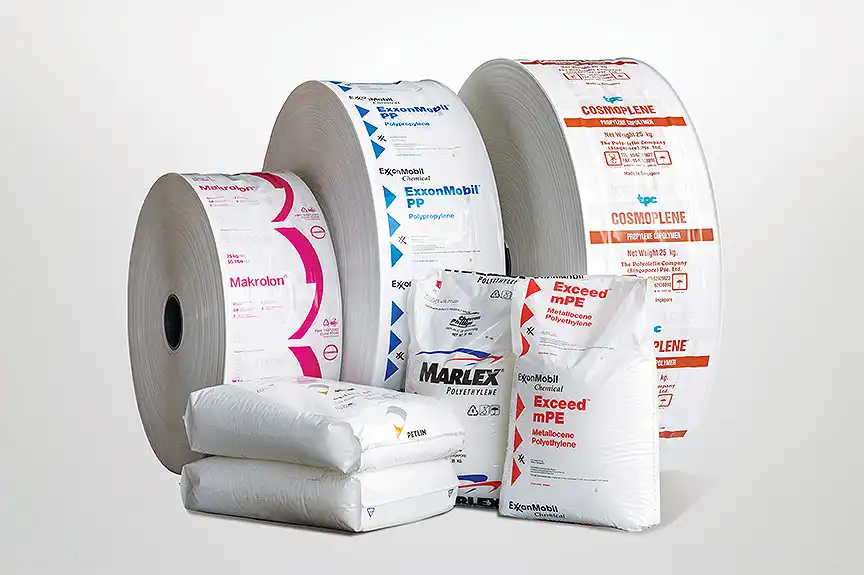
FFS film shifts the question from “Which bag do I buy?” to “Which bag do I manufacture on the line every minute of the shift?” In FFS (Form, Fill & Seal), the bagger forms the bag from film, fills it, seals it, and outputs finished sacks at high speed—this is explicitly how industrial FFS film solutions are positioned, emphasizing seal strength and filling speed for dry solids and raw materials.
Two details define FFS film’s performance profile in the real world: (1) stability on the machine and (2) air management during filling. A packaging supplier explicitly states that up to 3-layer co-extrusion films can be used to create strong tack force and stability on FFS machines while maintaining tear resistance. Meanwhile, blown-film equipment expertise describes the FFS workflow clearly: the film is fed from a reel as a side gusseted tube, and that tube may be made directly on the blown film line or produced via longitudinal welding from single-sheet film.
Air management is where many “good films” fail in practice. If trapped air is not evacuated, bags are bulky, pallet loads are unstable, and seals can be stressed. FFS tube film suppliers describe micro-perforation air evacuation systems—tiny holes used to let trapped air escape during filling—so the filled package becomes more compact and stable. Machine builders describe complementary approaches: dust-tight filling spouts, deaeration probes to remove air from the filled bag, and additional stages (vibration, partial evacuation) before final hermetic closure, explicitly framing deaeration as a process stage, not an afterthought.
Specification windows for FFS are also routinely published by machinery providers. For example, one FFS system describes bag weights in the 10–50 kg range and lists film thickness windows in the 80–250 µm range, alongside gusset depth parameters (used to create the “brick-like” pallet footprint). In other words: if your target is high-output packing of 25 kg or 40 kg sacks, FFS tube film is designed for that job; but the film architecture and the line’s venting strategy must be specified together, or you’re essentially buying speed with one hand and buying rework with the other.
Multi-layer Co-extruded Polyethylene Open Mouth Bags
Open mouth bags look “simpler”—until you watch them run at scale. The core definition is consistent across industry terminology references: open mouth bags are factory closed on one end of the tube, filled through an open top, and then closed by sewing or sealing on the fill end.
Co-extruded PE open mouth bags are positioned as durable packaging with a secure bottom seal (leak resistance), and the top can be stitched or heat-sealed after manual or automatic filling. Product pages also emphasize weather resistance, moisture/UV protection, and recyclability—common requirements in agriculture, building materials, chemicals/minerals, and animal nutrition.
What changes when the bag is co-extruded, rather than monolayer? Two practical effects. First, multi-layer PE films for open mouth bags are explicitly described as safeguarding contents against extreme temperatures and varying weather conditions, while delivering strong seal strength and mechanical properties (pressure/tear resistance). Second, converting quality becomes more noticeable: suppliers emphasize precise dimensional control so the bag has defined geometry—important for consistent filling, palletizing, and downstream automation.
Open mouth bags also come in distinct constructions beyond “just a bag with a hole.” One supplier distinguishes a cost-effective welded-bottom open-top PE sack (simple, functional) from an open-top block bottom PE sack with folded sides and a form-stable square base—explicitly describing the latter as maintaining a square shape after filling and improving pallet packing.
If you’ve ever fought pallet instability, you already know the implication: a well-designed bottom is not “packaging detail”; it is a logistics control surface.
Top and bottom constructions that define performance
Buyers often talk about “valve bags” or “open mouth bags,” but production teams talk about top types and bottom types—because that is where dust, leaks, pallet stability, and closing speed are decided.
Top types (filling & closure interface)
Open mouth (standard). This is the classic open top used for manual or semi-automatic lines, with closure by sewing, stitching, or heat sealing after fill; open-mouth definitions and product pages explicitly describe this factory-closed-on-one-end concept.
Valve top. Here the bag is filled through a valve opening (often at a corner). Valve sacks are repeatedly described as self-supporting sacks where internal pressure helps close the valve after filling, and different valve types can be selected to increase sealing based on product flowability. For industrial PE film sacks, dedicated converting machinery also matters. A machinery maker describes producing open mouth cross bottom sacks and cross bottom valve sacks from multilayer PE films using hot air sealing technology—explicitly positioning this as a paste-free, cost-effective step beyond adhesive-sealed sacks.
And, directly aligned with your requirement, the same machinery provider presents PE-sack production and valve sack “concepts,” stating they provide suitable machinery for favored valve sack designs, including PE valve sack concepts with sophisticated venting placed alongside the longitudinal seam.
Easy-open top. Easy opening features are essentially “designed failure,” in the best sense: a controlled tear or tape that opens cleanly where you intend, not where the bag is weakest. Industrial bag references describe EZ pull tape / pull-tab style opening features in bag designs (commonly in pinch-top and related constructions), and satchel-style open mouth designs are also described as convertible into easy-open formats. Even when your base bag is polyethylene, the principle holds: if the bag is intended to be opened frequently (retail, rework loops, sampling), you may need a feature that protects the user experience and your housekeeping.
Bottom types (shape & leak resistance interface)
Satchel bottom. Satchel bottom open mouth designs are explicitly described as a merger of block bottom and pinch bottom open mouth styles, delivering a square satchel-style bottom plus a sealable open mouth top, and improving palletization/transport versus standard pinch styles due to the square bottom.
Even if you are buying co-extruded PE rather than multiwall paper, the structural message is valuable: satchel-style bottoms are about self-standing geometry and pallet stability.
Block bottom. Multiple sources point to the same logic: a form-stable base, folded sides that help maintain a square filled shape, and easier pallet packing due to that geometry. For PE block-bottom valve bags, one supplier describes forming the bottom, top, and valve by folding, while another describes an open-top block-bottom PE sack as maintaining square shape after filling.
Pinch bottom. Pinch bottom open mouth constructions are described (in industrial bag references) as relying on pre-coated adhesive that is reactivated—often by heated air—then folded and pinched closed; they can be supplied with stepped or flat tops, and are positioned for sift-proof, airtight sealing when heat-seal closures are used.
For co-extruded PE portfolios, pinch-top concepts are most useful as closure logic: fast closure, strong sealing, and tamper-evidence—especially when your upstream filling is fast and your downstream warehouse expects stable, tight pallets.
Film architecture, blow-film processing, and functional options
The phrase “multi-layer” is deceptively simple. Are we speaking about film layers in the co-extrusion die (3-layer, 5-layer, 7-layer)? Or are we speaking about bag plies (single-ply vs two-ply bag construction)? Many suppliers list both. One industrial plastic packaging supplier, for example, highlights 7-layer plastic film capability for extrusion, while also listing “number of plies” for specific bag products. These are related but not identical.
Common layer counts and what each layer typically does
Below is a pragmatic way to interpret layer counts for co-extruded heavy-duty PE bags. The exact recipe is always application-specific, but published references consistently point to polyolefin blends (LDPE, LLDPE, HDPE, metallocene LLDPE) plus masterbatches/additives, and—where barrier layers are needed—tie layers to bond chemically dissimilar materials.
| Film architecture | Typical layer role logic | Example materials cited in published specs | When this architecture is favored |
| 1-layer (monolayer) | One resin family tries to do everything; simplest converting | LDPE / LLDPE / MDPE / HDPE / mLLDPE are listed as PE film “recipes” in industrial packaging offerings | When cost and simplicity dominate, and performance margins are generous |
| 2-layer | Often “inside vs outside” functional split (e.g., printability vs friction / barrier) | Co-extruded sacks are described as enabling different properties inside and outside (e.g., black interior + white exterior) | When you need different surface behavior (light sensitivity, print contrast, friction) without full multi-layer complexity |
| 3-layer | Classic heavy-duty sack structure: skin / core / skin, balancing seal, toughness, stiffness | 3-layer co-extruded film is explicitly cited for some industrial films (LLDPE/HDPE 3-layer tubular film; 3-layer co-extruded bags), and machinery lines cite 3-layer as a standard configuration | When you need strong mechanical performance with stable processing at high output |
| 5-layer | Adds sub-skins or functional interlayers for finer property tuning; may support downgauging or special barrier needs | Heavy duty sack/FFS film case studies and machinery references describe 5-layer POD HDS/FFS structures and 3-to-5 layer modularity | When you want “same performance at thinner gauge” or more robust pallet stability / drop performance |
| 7-layer and above | High flexibility in layer ratio design; common when adding barrier layers or specialized functions | Industrial plastic packaging suppliers explicitly advertise 7-layer plastic film extrusion capability; film technology references also present seven-layer film examples (e.g., barrier-focused film) | When you need sophisticated performance stacking: barrier + toughness + seal window + surface behavior |
A key nuance: multilayer structures often rely on tie layers when combining chemically dissimilar materials (for example, polyolefins with nylon or EVOH). A technical application note explains that multilayer films are often required to meet mechanical, barrier, printability, and runnability needs, and that to combine chemically different materials, a tie layer is needed; it also frames co-extrusion as enabling multilayer films in a single operation and notes that higher layer counts provide flexibility to use materials more economically for a target set of properties.
This is the quiet engineering truth behind “options”: sometimes the most important layer is the one nobody sees.
What the blown-film co-extrusion process looks like in practice
Co-extruded multilayer film manufacturing is consistently described as extrusion molding where two or more resins are melted and joined in a mold/die to form a multilayer structure, with the general flow being: melt → extrude through the die/mold → cool and solidify. One film technology source explicitly lists blown-film and T-die methods, and distinguishes water-cooling and air-cooling blown film methods for different cleanliness/optical needs.
For heavy-duty sacks specifically, blown-film equipment expertise adds an operations-level detail that matters to procurement: FFS sacks are typically produced by feeding a reel as a side gusseted tube, and that tube can be made directly on the blown film line or created through longitudinal welding from single sheet film produced on the blown film line.
That single sentence has purchasing consequences. It affects how you specify layflat width, gusset geometry, reel diameter, and even thickness tolerance requirements.
Some industrial plastic packaging producers also describe conversion steps such as sheet-to-tube forming, back-seam technology, and consistent venting rates to support filling and deaeration—linking film consistency with filling performance.
Functional options customers most often request
Options are where co-extruded multi-layer PE bags become “application packaging,” not generic sacks.
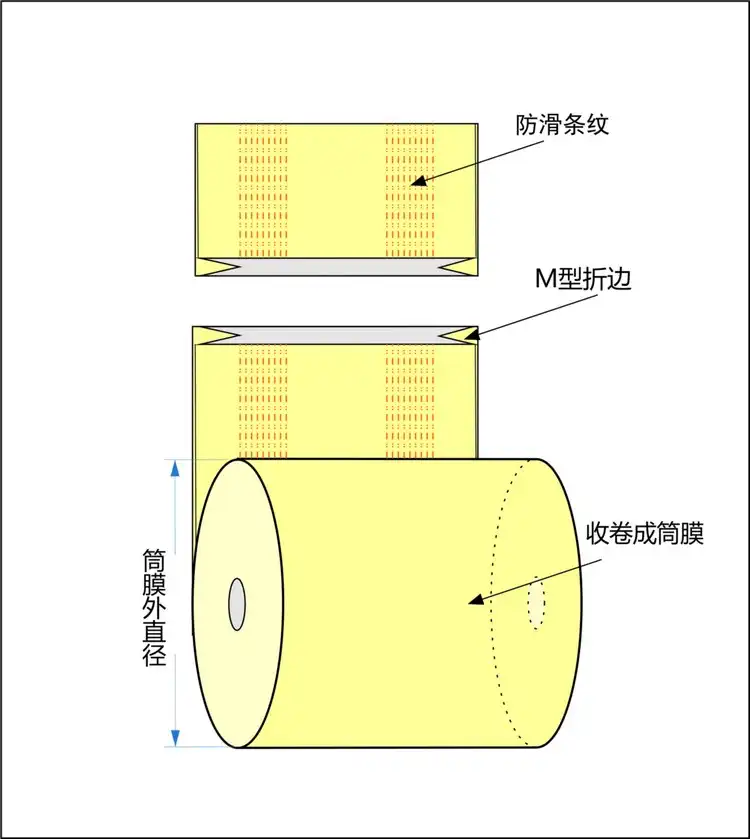
Gussets: flat side, side gussets, and M-type gussets. Industrial sack film and bag systems commonly use side gussets to create volume and achieve a more rectangular “brick” shape for pallet efficiency; gussets are defined in open-mouth bag terminology as side or bottom portions that allow volume.
For FFS automation specifically, converting references describe that modern VFFS/FFS systems may require pre-formed gussets to create the rectangular shape that maximizes pallet efficiency, and they explicitly name M-fold gusseting as a gusseting approach used for this purpose.
(If your pallet footprint must be “brick-perfect,” gusset geometry is not optional—it is the shape contract between your film and your downstream logistics.)
Anti-slip / anti-skid surfaces (coatings, embossing, varnish, additives). Multiple industrial sources reference anti-slip as either additives in the film recipe or surface texturing/embossing. Industrial sacks and tubes are described as providing anti-slip additives as an option; valve bag product pages cite anti-skid embossing or sanded finishes for enhanced grip; heavy-duty converting lines also describe embossing/gusseting towers as optional modules.
Micro-perforations and controlled venting. Micro-perforation is repeatedly positioned as an air-evacuation strategy: FFS film product pages describe micro-perforation systems to let trapped air escape during filling; venting technologies are also described as perforations or venting channels integrated into seams; and machinery solutions describe probe-based deaeration and staged air removal before final sealing.
Printing and color control. Industrial PE sacks are frequently specified with flexographic printing limits and with pigmented films for brand identification. One supplier specifies up to 10-color printing capability for industrial plastic packaging products, while another lists up to 8-color flexographic printing and notes the use of pigmentation and even PCR (recycled polyethylene) options.
Film-side functionality: anti-static, UV stabilizer, anti-block. These are routinely listed as selectable recipe elements for PE sacks/tubes, especially where dust attraction, outdoor storage, or machinability is a concern.
Air valve or controlled degassing. In strict heavy-duty sack practice, “air control” usually means micro-perforations or mechanical/probe-based deaeration, not consumer-style valves.
However, where a true one-way release feature is required (specialty use cases), packaging references describe one-way degassing valves as vents that allow gas to escape without allowing oxygen back in—commonly referenced in coffee packaging contexts—and some packaging providers state that such valves can be used to deflate large plastic bags during palletizing.
So the honest answer is: possible, but specify carefully. If your product doesn’t generate gas, a valve may be needless complexity; if your primary issue is trapped air during fill, micro-perforation or deaeration stations are usually the more standard industrial path.
Specification windows and a practical ordering checklist
Specifications are where misunderstandings become expensive. A “strong bag” is not one number; it is a system of dimensions, thickness, surface behavior, sealing method, and how the film behaves on your equipment.
Typical published spec ranges (what suppliers and OEMs actually state)
The ranges below consolidate published windows from industrial packaging suppliers and machinery providers. Treat them as practical starting points, not universal limits—many sources emphasize customization by application, and actual performance is tied to film recipe and sack construction.
| Parameter | Typical published ranges (examples) | Notes you should confirm in your RFQ |
| Film thickness / gauge | ~0.04–0.16 mm for PE sacks/tubes (40–160 µm) ; 120–200 µm for mono/coextruded PE AD-Plastic bags ; 4.0–7.0 mil film for PE block-bottom valve bags ; 80–250 µm film window listed for FFS systems ; 100–180 µm cited for 3-layer co-extruded forage/compost bags | Thickness is inseparable from drop resistance, creep, puncture, and sealing window; ask for performance data tied to your product and logistics route |
| Bag width / layflat | 250–620 mm listed for multiple industrial plastic bag products ; 350–600 mm width listed for PE AD-Plastic bags ; layflat max 800 mm on heavy-duty sack film lines | Confirm compatibility with filling spouts, bag placers, and pallet footprint |
| Bag length | 450–910 mm listed for industrial plastic valve/open-mouth bags ; 400–940 mm on PE AD-Plastic bags ; sack length 45–91 cm on a PE-film bottomer spec | Length must support headspace, closure method, and stable stacking |
| Bottom / top depth (block bottom geometry) | Bottom 80–160 mm (industrial plastic bag specs) ; bottom/top 90–180 mm (PE AD-Plastic) ; bottom width 8–18 cm on PE valve sack bottomer spec | Bottom geometry drives squareness, pallet stability, and “brick” behavior |
| Gusset depth (FFS / sack geometry) | Gusset depth min 40 max 90 mm listed for an FFS system | Confirm whether you need flat gusset, M-fold, or another geometry for your pallet target |
| Layer count | 3/5 layers common on heavy-duty sack film lines ; 7-layer film capability advertised by industrial plastic packaging producer ; 3-layer co-extruded film cited for bags in agriculture context | Ask which functional role is assigned to each layer (sealant vs stiffness vs barrier vs surface) |
| Capacity / bag weight range | FFS machine specs commonly publish 10–50 kg capability windows (depending on the machine and configuration) | Capacity depends on bag dimensions and product bulk density; align bag format, film thickness, and pallet pattern to your shipping constraints |
A short ordering checklist that prevents long headaches
If you want fewer surprises, specify the bag like an engineer, not like a shopper. Ask yourself—and your supplier—the questions below.
First: which family fits your production reality?
If you are chasing maximum throughput and automated consistency, FFS film is designed for that world, but you must design air evacuation and gusset geometry into the spec.
If you need low-dust spout filling with strong pallet behavior, valve bags are the “fast fill” workhorse—provided the valve type and venting method match your product’s flowability.
If flexibility matters more than peak speed, open mouth bags let you choose stitching or heat-seal closure based on your operation.
Second: define your sealing philosophy before choosing film.
Are you closing by sewing, by heat seal, by hot-air activation, by ultrasonic sealing, or by valve self-closing alone? Different closure routes demand different inner-layer sealant behavior and surface conditions. Seal methods and their roles are described across industrial bag references, including heat sealing and ultrasonic sealing logic for valve closures.
Third: treat “anti-slip” and “venting” as primary specs, not add-ons.
Anti-slip (embossing, coatings, additives) and venting (micro-perforation, vent channels, seam venting concepts) are repeatedly described as core industrial options because they directly control pallet safety, stable stacking, and filling performance.
Fourth: require evidence that matches your risk.
If your distribution route is harsh—high drops, rough handling, high temperatures—ask for performance framing. Film suppliers explicitly link heavy-duty sack performance to resisting stresses during filling, stacking, transport, storage, and rough handling, and resin suppliers frame downgauging and durability in terms of bag drop and creep stability.
Because in the end, the question is not “Can a bag hold product?” Almost any bag can—once. The real question is sharper, and it deserves to be asked out loud: Can your bag protect the product, protect the line speed, protect the pallet, and protect the people—simultaneously? Co-extruded multi-layer polyethylene bags exist to make that “yes” achievable, not by magic, but by design.