

What are PP Bags and why are they central to modern waste systems?
PP Bags are collection and packaging sacks engineered from polypropylene. They appear under many aliases—polypropylene bags, PP woven sacks, polywoven bags, poly sacks, woven PP packaging—but the essence is consistent: a light, durable, moisture‑resistant container that can be printed clearly, handled safely, stacked efficiently, and, when designed as mono‑material, directed into established PP recycling streams. From curbside programs to plant floors, from events to disaster relief, their role is equal parts material science and behavior design. They carry, they signal, they standardize. And because a waste program succeeds or fails on small details (a seam, a symbol, a slip angle), these bags become the quiet hinge on which the system turns.
Also known as
- Polypropylene bags
- PP woven sacks
- Poly sacks / polywoven bags
- Woven PP packaging
Typical program uses
- Curbside recycling and organics collection
- Construction and demolition debris
- Retail take‑back and deposit schemes
- Event cleanup and emergency response
Why they matter
- High strength at low mass
- Moisture and scuff resistance
- Photo‑grade print surfaces
- Mono‑material circularity potential
Material anatomy and cost logic of PP Bags
Behind every reliable sack is a polyolefin architecture: a woven polypropylene fabric that provides the skeleton, a film face that provides graphics and abrasion resistance, a co‑extruded tie that bonds them into one, plus optional inner liners for seal and odor control. Each layer contributes a distinct function, and each carries cost: grams saved here, adhesion gained there, friction tuned at the surface. The goal is not excess strength but calibrated performance—reliable under rain, readable after a truck ride, stack‑stable on pallets, and compatible with downstream PP recovery where available.
(1) Woven PP substrate
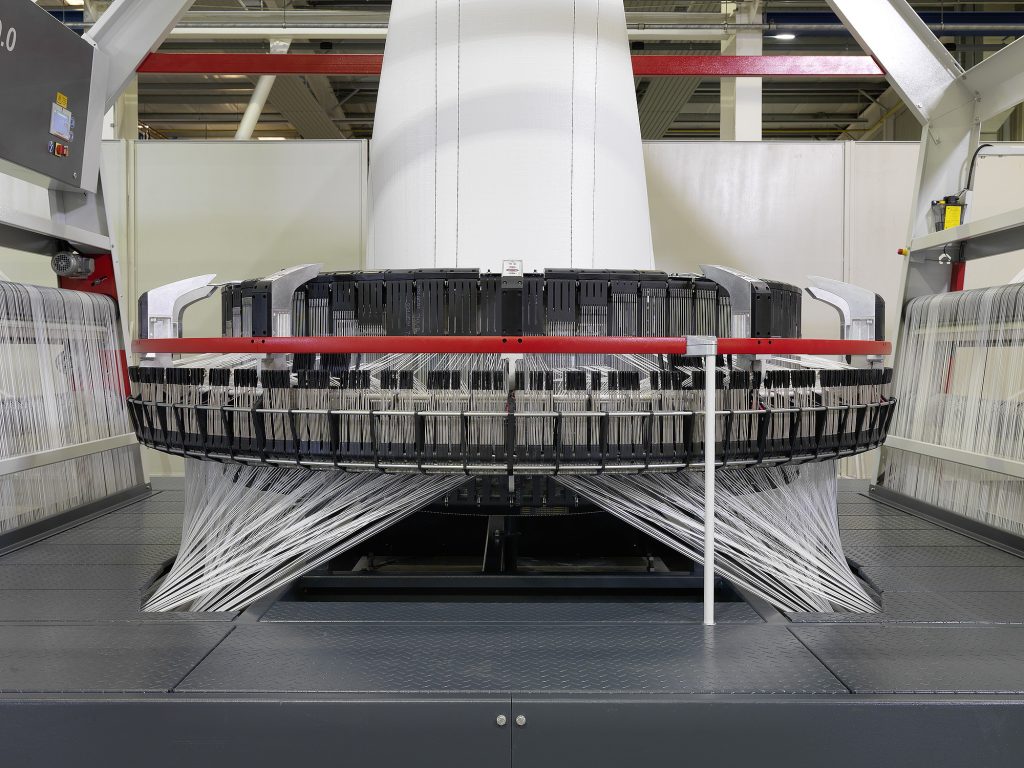
Isotactic polypropylene, semi‑crystalline and light (≈0.90 g/cm³), is extruded as a thin sheet, slit into tapes, and drawn to orient chains. Those tapes are interlaced on circular or flat looms into meshes such as 10×10, 12×12, or 14×14 ends per inch. Basis weights typically span 56–140 gsm. Orientation multiplies tensile strength; weave geometry balances forces across directions—vital when bags are dragged across asphalt or cinched with ties. The woven layer converts minimal mass into dependable load‑bearing capacity.
(2) Film face: BOPP or co‑extruded skin
Biaxially oriented polypropylene (BOPP) is selected for gloss, stiffness, and dimensional stability. Gauges of 18–25 μm accept high‑line‑screen gravure and advanced flexo; reverse printing entombs ink behind the laminate, protecting it from abrasion. Where aesthetics are secondary to handling, co‑extruded PP/PE skins with matte or micro‑texture improve grip and control coefficient of friction (COF) for safer pallets.
(3) Co‑extruded tie
A thin LDPE/PP/tie stack—sometimes enhanced with anhydride‑grafted components—flows between the film and fabric, then is compressed at the nip to create a durable fusion bond. Coat weights usually sit in the 12–23 gsm window. Precision is non‑negotiable: too little invites delamination during compaction; too much wastes resin and stiffens the bag needlessly.
(4) Inner liners (optional)
For moist organics or odor‑sensitive recyclables, HDPE/LDPE/LLDPE tubular liners—loose‑in or cuffed—add seal integrity. Micro‑perforations are engineered (not guessed) to vent trapped air during fast fills without compromising containment.
(5) Additives and identifiers
UV stabilizers extend outdoor life; anti‑slip masterbatches dial in COF; white masterbatch provides a high‑contrast canvas for icons; scannable marks (barcodes, QR) support route metrics and feedback loops.
Schematic composition:
[Printed Film (BOPP or Co‑ex)] → [Co‑ex Tie / Coating] → [Woven PP Fabric] → (Optional PE Liner)
| Layer | Typical Range / Option | Primary Function | Cost / Notes |
|---|---|---|---|
| Woven PP fabric | 10×10–14×14; 56–140 gsm | Load‑bearing, tear resistance | High strength per gram; commodity PP |
| BOPP / co‑ex skin | 18–25 μm; matte or gloss | Graphics, abrasion, moisture | Protects print via reverse imaging |
| Co‑ex tie | 12–23 gsm | Fusion bond, barrier tuning | Precision controls cost and peel |
| Optional liner | HDPE/LDPE/LLDPE; micro‑perfs optional | Seal, odor retention, leak control | Thickness balanced to regulations |
Core characteristics that distinguish PP Bags
Strength without bloat; clarity without clutter; moisture defense without bulk—these are practical virtues, not slogans. The following capabilities define day‑to‑day reliability and user trust.
- Mechanical performance: oriented tapes + balanced weave produce high safe working loads (≈10–50 kg) with credible drop and puncture resistance.
- Moisture and abrasion: film faces and coatings shed rain, resist scuffs, and preserve graphics during handling and compaction.
- Communication power: photo‑grade surfaces carry icons, color bars, and QR codes that cut contamination rates.
- Format versatility: open‑mouth, block‑bottom, valve, pinch‑top—match the filler and the route.
- Handling and safety: anti‑skid textures and target COF windows protect workers and pallets; venting tames ballooning on high‑speed fills.
- Circularity options: PP‑rich architectures align with PP recovery streams; PIR/PCR blends can be introduced where rules and performance allow.
How PP Bags are manufactured
The path from resin to ready‑to‑use sacks crosses extrusion, orientation, weaving, film making, printing, lamination, and converting. Each station has knobs to turn—temperatures, draw ratios, nip pressures, registration tolerances—and each knob leaves a fingerprint on performance.
- Tape extrusion and drawing. PP resin (with optional PIR/PCR content) is cast as a sheet, slit into tapes, and drawn to orient chains. Results: higher modulus, lower gauge, material savings.
- Weaving. Circular or flat looms set mesh and isotropy. Tighter counts improve print smoothness and laminate bond.
- Film preparation. BOPP is stretched in two directions for gloss and stiffness; co‑ex films are tailored for matte feel or seal initiation.
- Printing. Gravure or high‑definition flexo applies artwork, symbols, codes. Reverse placement shields ink from abrasion.
- Extrusion coating / lamination. A molten polyolefin stack enters the nip to bond film to fabric. Coat‑weight control (±1–2 gsm) stabilizes peel and cost.
- Finishing. Micro‑perforation for venting; anti‑skid textures for pallet stability; COF tuning for conveyors and wraps.
- Converting. Tubing, gusseting, cutting; block bottoms, valve patches; sewn, tape‑closed, or heat‑sealed tops; easy‑open features where needed.
- Quality checks. Tensile, tear, drop, seam shear, MVTR, COF, color ΔE, registration, and dimensional tolerances.
Where PP Bags excel in waste and recycling
Residential & Curbside
Collection for plastics, paper, metals, or mixed recyclables where bins are impractical. Clear color bands and icons cut contamination—the hidden tax on MRF economics.
Organics & Food Waste
Breathable vent patterns manage moisture and odor. Liners balance leak protection with controlled aeration for composting contexts where allowed.
Industrial & Commercial
Puncture‑resistant woven structures withstand rebar nicks, sharp sprues, mineral fines, yet remain light and stackable.
Deposit‑Return / Take‑Back
Serialized barcodes or QR links each bag to a route or participant, deterring fraud and enabling performance audits.
System thinking with PP Bags: breaking problems into solvable parts
Waste programs fail in familiar ways: contamination overwhelms sorters, pallets slip, rain ruins signage, audits lack data, and the packaging meant to collect recyclables becomes a disposal headache itself. The countermeasure is a system design where bag specs pre‑empt failure modes.
- Contamination reduction. Pictograms + color bands + QR help residents decide in seconds. Reverse‑printed film keeps those signals readable after transport.
- Collection efficiency. Target COF and anti‑skid skins protect workers; block‑bottom shapes stand upright for easier loading; easy‑open features accelerate MRF throughput.
- Weather management. Water‑resistant laminates shield contents and graphics; venting handles moisture in organics streams without structural collapse.
- Traceability. Serialized marks drive route analytics and policy adjustments; durable imaging preserves IDs.
- Circularity. PP‑rich laminates simplify end‑of‑life; PIR/PCR options advance procurement mandates where performance permits.
Comparing PP Bags with alternatives
Paper sacks tear when wet; PE film liners stretch under heavy puncture loads; rigid bins are capital‑intensive and space hungry. The woven‑plus‑film architecture occupies a middle ground—lively enough for rough handling, refined enough for legible graphics, light enough to ship compactly, and, if kept PP‑rich, straightforward to recycle where capability exists.
| Medium | Strengths | Limits | Where it fits |
|---|---|---|---|
| Paper sacks | Renewable, printable | Weak when wet; laminate separation at end of life | Dry environments, light loads |
| PE film bags | Sealability, softness, familiarity | Lower puncture and tear at comparable gauge | Light household liners, non‑abrasive loads |
| Rigid bins | Reusable, standardized, lifter‑friendly | High capital, storage footprint | Baseline residential programs |
| FIBCs | Very high capacity | Oversized for household scale | Industrial bulk moves |
Turning PP Bags into behavior change
Compliance follows clarity. A resident shouldn’t need a manual; a worker shouldn’t fight a pallet. The bag itself can carry the rules, invite the correct action, and speed the workflow.
- Color language and icons at multiple read heights guide sorting at a glance.
- Three‑tier instructions: a headline (“what goes in”), a pictogram, and a QR link for specifics.
- Right‑sizing: choose volumes aligned with typical generation (often 20–40 L for household streams).
- Feedback loops: serialized marks enable reward or notice systems; route data informs art revisions.
- Seasonal variants: moisture‑resistant finishes for rainy months; reinforced seams for woody yard waste.
Technical parameters and options for PP Bags
| Parameter | Typical Options / Ranges | Why It Matters |
|---|---|---|
| Fabric mesh | 10×10; 12×12; 14×14 | Higher counts improve print smoothness and tear strength |
| Fabric basis weight | 56–140 gsm | Balances load capacity vs flexibility |
| Film type | BOPP (18–25 μm) or co‑ex PP/PE | Determines print fidelity, finish, scuff resistance |
| Co‑ex tie coat weight | 12–23 gsm | Peel strength and moisture behavior |
| COF target | ≈0.3–0.6 (program specific) | Pallet stability vs line flow |
| Venting | Micro‑perfs, breathable valves, embossed films | Deaeration and dust control |
| Closures | Sewn, heat‑sealed, tape‑closed, easy‑open | Align to fillers and user needs |
| Liner | HDPE/LDPE/LLDPE (optional) | Moisture/odor control and sealability |
| Parameter | Typical Options / Ranges | Why It Matters |
|---|---|---|
| Printing method | Rotogravure or high‑definition flexo | Resolution and color fidelity |
| Color count | 6–12 | Branding and sorting clarity |
| Markings | Recycling symbols, barcodes/QR, program IDs | Traceability and compliance |
| Finish | Matte, gloss, hybrid | Readability, tactile feedback, COF |
| Parameter | Typical Options / Ranges | Why It Matters |
|---|---|---|
| Recyclability | Mono‑material PP preferred | Simplifies end‑of‑life |
| Recycled content | 0–50% PIR/PCR (where allowed) | Circularity targets |
| UV stabilization | As needed for outdoor storage | Service life |
| Food‑contact | Liner compliance and migration tests (if applicable) | Hygiene and legal conformity |
Risk modes and mitigations for PP Bags
- Seam failures: resolve with stitch density specs and dynamic load tests.
- Delamination: set coat‑weight windows and lamination temperatures; verify peel strength.
- Ink scuff/fade: prefer reverse printing, corona treatment, and rub tests with ΔE targets.
- Ballooning at fill: design vent patterns; use breathable valves matched to nozzle throughput.
- Pallet slippage: define COF ranges; apply anti‑skid textures; test under realistic humidity/temperature.
Implementation path: specifying and rolling out PP Bags
- Needs assessment: define waste fractions, route frequency, climate, and MRF capability.
- Specification drafting: set dimensions, mesh and gsm, film gauge, tie‑coat weight, COF, printing method, color count, markings.
- Supplier qualification: audit extrusion, weaving, lamination, converting; review QA documentation.
- Pilot and test: run routes; instrument pallets; measure contamination shifts before/after.
- Training and comms: align public visuals with bag art; prepare QR‑linked FAQs.
- Data feedback: use serialization for route analytics; iterate art and specs seasonally.
- Continuous improvement: introduce PIR/PCR where feasible; tune venting and COF by season; update icons as policy evolves.
Forward look: what comes next for PP Bags in circular systems
Expect stronger mono‑material adhesion strategies, better light‑weighting via orientation control, smarter IDs that bridge route analytics with resident incentives, and lower embodied energy as lines electrify and recover heat. In closed‑loop campuses and venues, washable liners and serialized ownership could introduce reuse without abandoning the ergonomics of woven PP.
Related resource: see polypropylene woven bags for substrate fundamentals that underpin many PP Bags used in collection programs.
FAQs tailored to real‑world use of PP Bags
Are they recyclable? Often, yes—especially when all layers remain PP‑rich and local PP streams accept woven articles. What loads are typical? Ten to fifty kilograms for sacks; above that, consider bulk containers. Heat‑sealed or sewn? Choose based on laminate skin and filler; heat sealing demands a sealable face, while sewn seams remain a robust default.
Keyword weaving for PP Bags
This article naturally integrates synonymous and long‑tail phrases that readers search for and practitioners use: polypropylene bags, PP woven sacks, woven poly packaging, laminated PP collection bags, BOPP‑faced woven sacks, valve‑type woven packaging, mono‑material PP solutions, anti‑skid laminated sacks, reverse‑printed polywoven bags, recycling collection bags, curbside PP sacks, organics collection packaging, pallet‑stable woven PP, and printed polypropylene refuse sacks.

- What are PP Bags and why are they central to modern waste systems?
- Material anatomy and cost logic of PP Bags
- Core characteristics that distinguish PP Bags
- How PP Bags are manufactured
- Where PP Bags excel in waste and recycling
- System thinking with PP Bags: breaking problems into solvable parts
- Comparing PP Bags with alternatives
- Turning PP Bags into behavior change
- Technical parameters and options for PP Bags
- Risk modes and mitigations for PP Bags
- Implementation path: specifying and rolling out PP Bags
- Forward look: what comes next for PP Bags in circular systems
- FAQs tailored to real‑world use of PP Bags
- Keyword weaving for PP Bags
- Market Demand and the Role of PP Bags
- Customization: Meeting Diverse Market Needs
- Technological Edge: Starlinger Machinery and Production Capacity
- Case Study: PP Bags in Action
- Sustainability and Circular Economy
- Product Specifications at a Glance
- FAQs: Addressing Client Concerns
- Future Trends and Strategic Partnerships
By leveraging 30+ years of industry expertise and cutting-edge technology, VidePak has positioned itself as a global leader in manufacturing customizable, durable, and eco-friendly PP woven bags tailored for waste management and recycling. This report explores how the company’s innovative solutions address diverse market demands while aligning with sustainability goals.
Market Demand and the Role of PP Bags
The global waste management sector is projected to reach $530 billion by 2025, driven by urbanization and regulatory pressures to reduce landfill dependence. Polypropylene (PP) woven bags, known for their strength, reusability, and recyclability, have emerged as critical tools for efficient waste segregation, transportation, and recycling. For instance, VidePak’s PP bags are engineered to withstand heavy loads (up to 50 kg) and harsh environments, making them ideal for construction debris, industrial waste, and municipal recycling programs.
Key Insight from Industry Experts
Ray, CEO of VidePak, emphasizes:
“Our clients don’t just need bags—they need tailored solutions. Whether it’s a valve design for powder waste or UV-resistant coatings for outdoor storage, customization is non-negotiable in today’s competitive landscape.”
Customization: Meeting Diverse Market Needs
VidePak’s strength lies in its ability to deliver bespoke PP bag solutions across industries. Below are critical customization options and their applications:
1. Structural Customization
- Valve Design: Ideal for fine-grained materials like cement or chemical powders. VidePak’s pasted valve bags ensure dust-free filling, reducing workplace contamination.
- Reinforced Handles and Gussets: For heavy-duty waste, such as construction rubble, bags with double-stitched handles and side gussets improve load stability.
- Perforations and Ventilation: Custom airflow openings prevent moisture buildup in organic waste collection, addressing odor issues.
2. Material and Durability Enhancements
- Thickness (80–200 GSM): Thicker bags (150+ GSM) are used for sharp industrial waste, while lighter variants suit household recycling.
- Laminated Layers: BOPP or PE coatings add waterproofing, crucial for coastal municipalities managing monsoon-season waste.
3. Branding and Compliance
- Multi-Color Printing: High-definition branding supports municipal campaigns (e.g., “Recycle Right” initiatives).
- Regulatory Labels: Pre-printed hazard symbols or recycling instructions ensure compliance with EU/EPA standards.
Technological Edge: Starlinger Machinery and Production Capacity
VidePak’s 100+ circular looms and 30+ lamination machines (Austrian Starlinger systems) enable rapid scalability. For example:
- Speed: Producing 2,000 bags/hour per loom, the company meets bulk orders (e.g., 500,000 bags for a European waste conglomerate) within 72 hours.
- Precision: Advanced extrusion lines ensure uniform thread density (10×10 strands/cm²), enhancing tensile strength by 40% compared to industry averages.
Case Study: PP Bags in Action
Client: A U.S.-based recycling firm managing e-waste.
Challenge: Sharp components (e.g., circuit boards) punctured standard bags during transit.
Solution: VidePak engineered anti-puncture PP bags with:
- 180 GSM thickness + PE inner lining.
- Double-layered bottom stitching.
- Custom printing for OSHA compliance.
Outcome: Reduced bag failure rate by 92%, saving $220,000 annually in replacement costs.
Sustainability and Circular Economy
PP bags are inherently recyclable, but VidePak goes further:
- Post-Consumer Recycled (PCR) Content: 30% PCR-PP bags reduce virgin plastic use, aligning with ESG commitments.
- Closed-Loop Programs: Partnering with waste processors, VidePak reclaims used bags for pelletizing, cutting carbon footprints by 25%.
Product Specifications at a Glance
| Parameter | Range/Options | Application Example |
|---|---|---|
| Capacity | 5–50 kg | Construction debris (25–50 kg) |
| Thickness | 80–200 GSM | Food waste (100 GSM) |
| Printing | Up to 8 colors, HD resolution | Municipal branding |
| Valve Types | Pasted, sewn, or heat-sealed | Chemical powders |
| Coating | BOPP, PE, UV-resistant | Outdoor storage |
FAQs: Addressing Client Concerns
Q1: How do PP bags compare to traditional plastic sacks?
A: PP bags offer 3x greater tensile strength and reusability, reducing long-term costs by 60%.
Q2: Can VidePak handle small-batch custom orders?
A: Yes! Minimum order quantities start at 5,000 units, with prototyping in 7 days.
Q3: Are PP bags suitable for food-grade waste?
A: Absolutely. FDA-approved liners and anti-microbial coatings ensure safety.
Future Trends and Strategic Partnerships
With the rise of smart waste management systems, VidePak is integrating QR codes and RFID tags into bags for real-time tracking. Collaborations with firms like Splunk (data analytics) further optimize waste logistics.
External Resources
- Learn how recyclable PP bags drive circular economies.
- Explore custom printing technologies for brand-centric solutions.
Conclusion
VidePak’s fusion of customization, scalability, and sustainability positions PP woven bags as indispensable tools in modern waste management. By continuously innovating—whether through material science or IoT integration—the company remains at the forefront of a $800 million global market, proving that “one-size-fits-all” is obsolete in the age of precision waste solutions.