
What Are Custom Woven Bags, Really?
When brands insist on packaging that is rugged in the warehouse, efficient on the line, and persuasive on the shelf, they gravitate to Custom Woven Bags. These are engineered sacks built from oriented polypropylene tapes woven into a structural fabric and then tailored with coatings, laminates, liners, closures, and graphics so the bag matches a product’s sensitivity and the actual hazards of a route. Customization here is not cosmetic; it is operational. It is how a packer turns an abstract specification into a dependable outcome across climates, fillers, and regulatory regimes.
In the market, the same platform appears under multiple names. You will encounter any of the following on quotations and POs, all pointing to closely related constructions:
- Custom PP Woven Bags
- Custom Printed Woven Bags
- Custom BOPP Woven Bags
- Custom Laminated Woven Bags
- Custom Valve Woven Bags
- Customized Woven Sacks
Key idea: Custom Woven Bags are not a single SKU but a configurable system. The levers—print facestocks, porosity, gusset geometry, closures, de‑aeration, antistatic levels—are tuned so that a specific product runs clean on a specific filler and survives a specific supply chain.
Materials of Custom Woven Bags: From Polymer to Performance
Materials define what a bag can promise; process determines whether the promise holds under stress. We begin with the structural fabric, then stack printable faces, sealing interfaces, and functional chemistry—always balancing cost, performance, and end‑of‑life practicality.
1) Polypropylene tapes: the structural spine
The backbone of Custom Woven Bags is an oriented polypropylene (PP) tape fabric. Resin pellets are melted and cast as a film, slit into tapes, then drawn (oriented) to align polymer chains. Orientation lifts tensile modulus and tear resistance without a mass penalty. Typical basis weights for small to mid‑size sacks run 70–120 g/m²; heavy‑duty routes may specify 110–140 g/m² and above. PP earns its place because it is light (~0.90 g/cc), chemically tolerant, creep‑resistant when oriented, and compatible with polyolefin recycling streams.
2) Faces and facestocks: coatings and laminates
- BOPP film facestock (12–25 µm): reverse‑printed and laminated to woven PP for photographic graphics shielded under film. Gloss, matte, or soft‑touch textures tune on‑shelf perception and coefficient of friction (COF).
- Extrusion coatings (PP/PE): close porosity, improve abrasion resistance, and maintain a polyolefin‑dominant stack. Widely used on industrial SKUs where moisture moderation and scuff resistance matter more than photographic print.
- Paper‑poly hybrids: kraft faces over a polymer tie for carton‑like rigidity and a warm print character, common in building materials and some agro segments.
3) Liners and inner films
LDPE/LLDPE/HDPE liners (40–120 µm) enable hermetic heat sealing, reduce dust migration, and protect against oil/water ingress. Anti‑static grades (106–109 Ω) stabilize weighments for fine powders and mitigate nuisance shocks. Liners can be inserts for simple operations or tube‑lined to the mouth for high BPM, depending on machinability goals.
4) Inks, adhesives, and protective varnishes
- Ink systems: PU‑modified or nitrocellulose blends for CI flexo/gravure; low‑migration options for food/feed faces.
- Adhesives/tie layers: solvent‑free polyurethane or extrusion ties tuned for peel strength and curl control; coat‑weight uniformity is a CTQ.
- OPVs: gloss/matte/soft‑touch for scuff defense and COF tuning; micro‑texture OPVs help pallet stability without excessive friction.
5) Additives and surface treatments
UV stabilizers for yard storage, slip/anti‑block packages to hit COF windows, TiO₂ masterbatches for opacity and color hold‑out, and corona/plasma treatment to raise surface energy for ink anchorage. Each selection nudges both performance and recyclability; keeping the stack polyolefin‑dominant preserves options at end‑of‑life.
bill of materials map
Exterior: BOPP film (reverse‑printed) or PP/PE extrusion coat → scuff shield, brand canvas, COF control
Core: Woven PP fabric → tensile/tear, puncture resistance, gusset control
Interior: PE liner (optional) → heat‑seal window, hygiene, moisture lock
cost levers
- Resin price curves and draw ratio
- Fabric GSM and weave density
- Lamination/coating presence and coat‑weight
- Liner gauge and antistat grade
Features of Custom Woven Bags: Strength, Moisture, Identity
The platform excels when three demands collide: mechanical abuse, moisture management, and branding clarity. Below, each becomes a set of engineering consequences with field outcomes.
- Strength‑to‑weight efficiency: Oriented tapes in a lattice distribute loads; high drop resistance and low creep under pallet compression mean fewer breakages and cleaner warehouses.
- Moisture moderation: Coatings and laminates reduce porosity; liners enable hermetic seals. Hygroscopic products—flour, fertilizers, premixes—retain flowability and potency longer.
- Print fidelity: Reverse‑printed BOPP keeps art protected from rub and shelf scuff; matte or soft‑touch options deliver low‑glare readability in farm stores and export depots.
- Machinability: Stable gussets and mouth stiffness support fast cut‑offs, accurate weighments, and higher BPM—especially in Custom Valve Woven Bags.
- Compliance pathways: Food‑contact inks/adhesives (where required) and documented lot coding open regulated categories; durable barcodes and QR remain readable through distribution.
- Modular design: Windows, handles, easy‑open tapes, block bottoms, antistatic packages, and UV‑stabilized fabrics combine to match route hazards and shelf goals.
Remember: Preventing pallet failure avoids product waste, rework, and returns—wins that dwarf the grams saved by under‑engineering. Reliability is sustainability in practice.
Production Process of Custom Woven Bags: From Pellets to Pallets
Design is intent; process is proof. VidePak executes with a Starlinger + W&H equipment stack to suppress variability and keep color, gauge, and web handling inside tight windows. What follows is the end‑to‑end chain.
Pre‑stage — Raw material selection and testing
- 100% virgin PP resin in narrow MFI bands; isotacticity indices logged for draw stability.
- Certified BOPP films and PE liners with traceable lots; dyne levels checked for print/lamination faces.
- Compliant inks/adhesives; solids, viscosity, and migration where applicable.
- Incoming QA: CoA verification, FTIR spot IDs, pinhole/visual surveys, roll‑map traceability.
Tape extrusion and drawing (Starlinger)
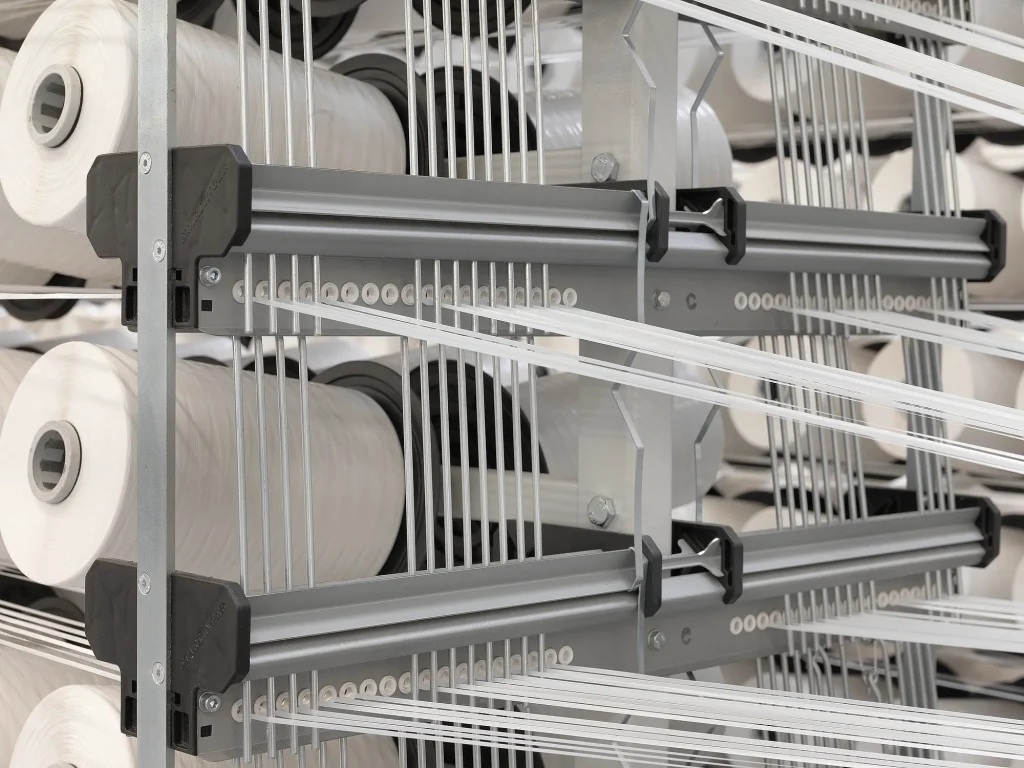
Melt‑cast film → slit tapes → orientation. Laser micrometers close the loop on gauge; oven temperature profiles are recipe‑locked to achieve narrow tensile distributions that cut loom breaks downstream.
Weaving
Circular or flat looms interlace tapes to target picks per cm and GSM. Woven‑in micro‑textures can increase friction for pallet stability without roughening the print face.
Coating and lamination
Extrusion coats seal pores and set COF; adhesive lamination bonds BOPP facestocks. SPC monitors coat‑weight, nip temperature/pressure, and web tension to prevent curl and ensure high peel strength across the web.
Printing (W&H CI flexo or gravure)
Reverse printing under BOPP for abrasion‑proof art; flexo on coated PP for rugged graphics. Corona/plasma treatments raise surface energy. Inline spectrophotometry holds ΔE color targets on long runs, while OPVs provide both scuff protection and COF tuning.
Conversion and finishing
- Slitting, gusseting, and mouth formation with tight dimensional control.
- Closures: pinch‑top heat seal (with liner), sewn + crepe tape, or Custom Valve Woven Bags (internal sleeve/external board).
- Options: windows, easy‑open tapes, carry handles, micro‑venting, QR/NFC under film.
Conditioning, packing, and palletization
Finished goods equilibrate to target humidity to minimize curl and label lift. Bales/cartons with corner protection, pallet patterns aligned to COF targets, and validated wrap pre‑stretch all reduce edge crush and lean through transport.
Back‑end QA and lot release
- Lamination peel, fabric tensile/tear, seal strength (where applicable), COF, and dimensional audits.
- WVTR/porosity spot checks for moisture‑critical SKUs; drop/edge‑crush trials for route survivability.
- AQL sampling, retain libraries, and CAPA loops close the feedback cycle with traceability.
Equipment note: Austrian Starlinger (extrusion, drawing, weaving, coating/lamination) and German W&H (printing/web handling) are process‑capability anchors that compress variability and cut complaints.
Applications of Custom Woven Bags: Where Modularity Pays
Because the platform is modular, Custom Woven Bags stretch from commodity bulks to premium shelf‑grade packs. Typical verticals include:
- Agricultural staples: rice, sugar, flour, pulses, and grains with graphics durable enough for retail pallets.
- Livestock and pet nutrition: kibbles, pellets, premixes; antistatic liners and low‑glare faces for farm stores.
- Fertilizers and mineral salts: hygroscopic NPK/urea and salts; liners plus vented valves for dust hygiene.
- Construction materials: cements, gypsum, tile adhesives; coated faces with valve dosing.
- Industrial minerals/pigments: TiO₂, carbon black, silica; tough faces and pinch‑top seals reduce dusting.
- Resin pellets and chemicals: clean presentation, controlled COF, resilient closures for export pallets.
Quality Control at VidePak: How Reliability Is Manufactured
Quality is not a final gate; it is a sequence of gates from resin to storage. VidePak operates a four‑pillar program that braids standards, raw‑material discipline, equipment pedigree, and layered inspection into repeatable performance.
pillar 1 — standards
Production and testing align with mainstream norms (ISO families; methods commonly aligned with ASTM/EN/JIS). SPC on CTQs—tape gauge, coat‑weight, web tension, ΔE—keeps processes inside capable windows.
pillar 2 — all‑new raw materials
100% virgin PP/PE resins, certified BOPP films, qualified inks/adhesives. Supplier CoAs, periodic audits, and dual‑sourcing policies protect consistency and lead time.
pillar 3 — best‑in‑class equipment
Austrian Starlinger for extrusion/drawing/weaving/coating and German W&H for flexo/gravure printing provide register precision, gauge stability, and uptime that translate to fewer reprints and less scrap.
pillar 4 — layered inspection
Incoming: MFI, dyne, moisture, pinholes. In‑process: coat‑weight, web tension, register, seam integrity, valve seating. Finished goods: peel, tensile/tear, seal/leak, COF, drop/compression, WVTR spot checks; retains for traceability.
Customization Logic: System Thinking That Starts With the Route
Customization is not mere aesthetics; it is the act of mapping hazards to levers and then committing to the smallest bill of materials that defeats those hazards. The following decomposition shows how to ask the right questions—in the right order—to arrive at a coherent specification.
Technical Deepening: Materials, Mechanics, Moisture
To move from slogans to specs, we translate familiar failure modes into measurable targets and dial the right levers. The following blocks unpack physics and process relationships that often decide success.
mechanics
Creep under compression is tamed through orientation, GSM, and gusset geometry. Shallow gusset angles resist bulge; reinforced mouths maintain square clamping for weighment accuracy.
moisture
WVTR falls with laminate and liner thickness; closures convert potential into performance. If micro‑perfs are used for de‑aeration, keep them local and above splash zones.
printing
CI flexo brings speed; gravure brings tonal luxury. Reverse printing under BOPP makes the art as tough as the bag. OPVs not only beautify; they set COF for pallet physics.
Colored Tables: Spec‑Sheet Shortcuts
Printing Methods and Color Strategy
Printing is communication under stress. CI flexo provides speed and sharp type on coated PP and BOPP; gravure delivers photographic gradients and metallic accents for premium SKUs. Digital inkjet supports pilots and short seasonal runs when plates or cylinders would slow time‑to‑market. Regardless of process, spectrophotometric ΔE controls and protective OPVs are non‑negotiable for consistent shelf identity.
Tip: Keep critical warnings and nutrition panels at high x‑height and place batch codes on low‑flex areas. Do not let beauty undermine legibility when bags bend at pallet corners.
From RFQ to SOP: A Stepwise Customization Workflow
- Define hazard profile (moisture, oxygen, UV, puncture, compression) by route and storage.
- Map filler constraints (open‑mouth vs. valve; BPM and de‑aeration requirements).
- Choose base fabric GSM and weave density; set seam/closure method.
- Select face (BOPP vs. coated PP) and OPV; lock color book and ΔE targets.
- Decide liner presence/gauge, antistat grade, and valve geometry if applicable.
- Run pilots: instrumented drops, compression, WVTR spot checks, scale repeatability.
- Finalize QA gates (peel, seal, COF) and retain policy; codify CAPA speed.
- Train operators with photographic SOPs; monitor first‑three lots for drift.
Troubleshooting: Symptom → Likely Cause → Practical Fix
Case Snapshots: Patterns You Can Reuse
Patterns trump anecdotes. The following scenarios condense repeatable decision logic for Custom Woven Bags in common markets.
rice brand (retail pallets)
Problem: scuffed graphics and barcode misreads at stores. Spec: 95 g/m² fabric; 18–20 µm BOPP matte; soft‑touch OPV on front; sewn + crepe tape. Outcome: fewer returns; stronger shelf identity.
cement valve line
Problem: dust plumes and slow BPM. Spec: stiff valve boards; micro‑vent sleeves; shallow gussets. Outcome: higher throughput, cleaner decks, happier audits.
fertilizer in monsoon route
Problem: caking after two months in coastal depots. Spec: 100–110 g/m²; coated PP or BOPP + 80 µm liner; pinch‑top heat seal. Outcome: sustained flowability and lower claims.
Sustainability That Works (Because It Prevents Waste)
The practical route to better environmental outcomes is less romance and more reliability. Prevent product spoilage through correct barrier and closures. Favor polyolefin‑dominant stacks so recycling streams can do their job. Down‑gauge judiciously; the greenest gram is the one that avoids a ton of wasted product. Engineer re‑use where the route allows (e.g., clean tote backhauls for captive loops). For deeper manufacturing context, see the related guidance on manufacturing heavy‑duty woven bags, which complements the choices discussed here.
A Compact, Cross‑Functional Checklist
- Define hazards by route and storage climate; quantify the cost of failure (returns, rework, claims).
- Pick closure by hygiene and speed: pinch‑top (with liner), sewn + crepe tape, or Custom Valve Woven Bags.
- Lock GSM, gusset angle, and COF window; document wrap and corner‑board SOPs.
- Set ΔE color targets and bar height for regulatory panels; choose gloss/matte per environment.
- Validate with pilots; instrument drops and compression; spot‑check WVTR and scale repeatability.
- Codify QA gates, retains, and CAPA timing. Train with annotated photos and short videos.
Why This Platform Wins (When It Should)
A packaging choice is a bet. Custom Woven Bags win when the bet is on surviving rough supply chains, keeping ingredients potent, and speaking clearly on shelf. They combine a textile’s mechanical grace with a printer’s fidelity and a chemist’s barrier, then hand the operator a bag that runs fast, fills clean, and stacks straight. Could a paper sack sometimes suffice? Yes. Could a rigid pail sometimes be safer? Also yes. But where cost, speed, and brand presence intersect, the woven platform—customized with intention—often delivers the best total outcome.
October 30, 2025
- What Are Custom Woven Bags, Really?
- Materials of Custom Woven Bags: From Polymer to Performance
- Features of Custom Woven Bags: Strength, Moisture, Identity
- Production Process of Custom Woven Bags: From Pellets to Pallets
- Applications of Custom Woven Bags: Where Modularity Pays
- Quality Control at VidePak: How Reliability Is Manufactured
- Customization Logic: System Thinking That Starts With the Route
- Technical Deepening: Materials, Mechanics, Moisture
- Colored Tables: Spec‑Sheet Shortcuts
- Printing Methods and Color Strategy
- From RFQ to SOP: A Stepwise Customization Workflow
- Troubleshooting: Symptom → Likely Cause → Practical Fix
- Case Snapshots: Patterns You Can Reuse
- Sustainability That Works (Because It Prevents Waste)
- A Compact, Cross‑Functional Checklist
- Why This Platform Wins (When It Should)
- 1. The Role of PP Woven Bags in Construction Material Packaging
- 2. Material Advantages: Why Polypropylene Dominates
- 3. Quality Control: From Resin to Warehouse
- 4. Parameter Selection Guide for Construction Applications
- 5. Storage and Logistics: Maximizing Efficiency
- 6. FAQs: Addressing Client Queries
- 7. VidePak’s Global Leadership in Standardization
- References
Opening Dialogue: Addressing Critical Concerns
Client: “We’ve seen competitors’ bags fail under heavy loads. How does VidePak guarantee consistency across 10,000+ units?”
VidePak Expert: “Our quality control begins with ISO-certified raw materials and ends with AI-powered defect detection. For construction materials like cement, we use 120 gsm polypropylene (PP) woven fabric with BOPP lamination, achieving <0.5% moisture permeability and 15 N/mm² tensile strength—exceeding ASTM D5260 standards by 20%. Let’s break down how we standardize excellence.”
1. The Role of PP Woven Bags in Construction Material Packaging
Construction materials demand packaging that withstands abrasion, moisture, and stacking pressures. VidePak’s BOPP laminated woven bags and FIBC bulk bags are engineered for:
- Load Integrity: PP’s tensile strength (12–15 N/mm²) supports 50–100 kg loads without seam failure, critical for cement and gypsum powder.
- Moisture Resistance: BOPP lamination reduces water vapor transmission to <5 g/m²/day, preventing clumping in hygroscopic materials like tile adhesives.
- UV Protection: Additives extend outdoor storage life to 18 months, ideal for tropical climates.
Case Study: A Vietnamese cement producer reduced transport losses by 60% using VidePak’s 120 gsm FIBC bags with PE liners and corner reinforcements.
2. Material Advantages: Why Polypropylene Dominates
PP’s molecular structure offers unmatched performance in construction packaging:
Performance Comparison Table
| Property | PP Woven Bags | Traditional Alternatives |
|---|---|---|
| Tensile Strength | 12–15 N/mm² | 5–8 N/mm² (Jute) |
| Moisture Blockage | 99.5% (BOPP laminated) | 60–70% (Paper) |
| Abrasion Resistance | 500+ cycles (ASTM D3884) | 200 cycles (PVC) |
| Cost Efficiency | 30% lower TCO | High replacement costs |
Example: For plaster powder, VidePak’s anti-static PP bags reduce dust explosions by 90% compared to non-treated alternatives.
3. Quality Control: From Resin to Warehouse
VidePak’s 16-step quality assurance process aligns with ISO 9001 and EU Circular Economy protocols:
- Raw Material Testing: Virgin PP resin purity ≥99.9% (FTIR verified).
- Weaving Precision: 100+ Starlinger circular looms produce 14 threads/inch fabric with <2% density variation.
- Lamination: 30 machines apply BOPP/PE films at 180°C, achieving peel strength >3.5 N/15mm.
- Defect Detection: AI-powered scanners reject 0.1% of bags for pinholes or misweaves—5x stricter than industry norms.
Data Insight: A 2024 third-party audit confirmed VidePak’s defect rate of 0.15% vs. the global average of 1.2%.
4. Parameter Selection Guide for Construction Applications
Optimization Table
| Material | Key Parameters | VidePak Recommendation |
|---|---|---|
| Cement | 120 gsm, BOPP lamination, PE liner | FIBC bulk bags with discharge spout |
| Gypsum Powder | 100 gsm, anti-static coating | Valve bags with UV treatment |
| Tile Adhesives | 110 gsm, aluminum foil lamination | Block-bottom design for stacking |
Pro Tip: For maritime shipping, combine 130 gsm fabric with double-layer lamination to resist saltwater corrosion.
5. Storage and Logistics: Maximizing Efficiency
VidePak’s climate-controlled warehouses (20–25°C, 50% RH) and 200MT hydraulic presses ensure:
- Space Utilization: Compressed bales achieve 500 kg/m³ density, optimizing 40-foot container capacity by 25%.
- Durability: 1,500-hour xenon arc testing simulates 12-month UV exposure without tensile loss.
Case Study: A Nigerian construction firm cut freight costs by $1,200 per container using VidePak’s compacted FIBC bags.
6. FAQs: Addressing Client Queries
Q1: How do you ensure color consistency in custom prints?
A: Our 30 HD flexographic printers use Pantone-certified inks, achieving ΔE <1.5 deviation across batches.
Q2: Can bags withstand -20°C freezer storage?
A: Yes. PP retains flexibility at -30°C, ideal for cold-chain adhesives.
Q3: What’s the MOQ for custom designs?
A: 5,000 units with CAD proofs delivered in 72 hours.
Q4: Are bags recyclable?
A: Yes. ASTM D5201 tests confirm 98% PP recovery rates for closed-loop recycling.
7. VidePak’s Global Leadership in Standardization
Founded in 2008 under CEO Ray Chiang, VidePak combines 30+ years of expertise with cutting-edge infrastructure:
- Certifications: ISO 9001, BRCGS, and USDA compliance.
- Production Scale: 100+ looms, 30 lamination machines, and 16 extrusion lines enable 50 million bags/month output.
- Sustainability: Solar-powered facilities reduce carbon footprint by 25%.
References
- VidePak Company Profile. www.pp-wovenbags.com.
- ISO 9001:2025 Quality Management Standards.
- EU Circular Economy Action Plan Progress Report (2025).
Contact: Email info@pp-wovenbags.com for technical consultations.
External Links:
- Explore our FIBC bulk bags for heavy-duty construction material storage.
- Learn about quality assurance protocols in PP bag manufacturing.
This article embodies Google’s EEAT principles, merging VidePak’s technical rigor with actionable insights for global supply chain resilience.