
- What are Eco‑Friendly PP Woven Bags?
- Common Buying Names and Catalog Aliases
- Signature Features that Matter in Practice
- How Eco‑Friendly PP Woven Bags Are Made
- Where They Go: Core Applications
- Standards, Certificates, and the Paper Trail
- Parameters & Test Matrix (Color‑Coded for Clarity)
- From Problem to Method to Result—Worked Examples
- Risk Register and Practical Remedies
- A Quick Primer for Buyers
- Internal Resource Link
- Why the Conversation Starts with Trade-Offs, Not Slogans
- How We Will Reason: Problem → Method → Result → Discussion
- Baseline Domain Knowledge: What Practitioners Agree On
- What “Eco” Means Here: Resource, Reuse, and Recyclability
- The Levers We Can Pull: Materials, Coatings, Closures, and Graphics
- Horizontal vs. Vertical Thinking: Two Lenses for One Decision
- Materials Palette with Measurable Windows
- A Short Table of Core Parameters (You Will Keep Coming Back to It)
- Printing as Engineering, Not Decoration
- Mouth and Closing Styles: Different Routes, Different Answers
- Sewing Choices: Small Details, Large Outcomes
- Heat-Seal Choices: Attractive, Fast, and Demanding
- Ultrasonic as a Targeted Tool
- Pallet Physics: Friction, Stack Height, and the Quiet Role of Varnish
- Country Templates: Because Compliance is a Map, Not a Guess
- From Payload Physics to Bill of Materials: A Reusable Method
- Worked Patterns that Teams Can Steal (and Adapt)
- The Arithmetic that Helps Meetings End Early
- Color, Texture, and Truth in Claims
- Field Failures and Their Frugal Fixes
- A Comparative Table for Fast Briefings
- Interoperability with Warehouses and Retailers
- Why Anti-Slip Belongs in Artwork Conversations
- The Language of Specifications that Travel Well
- Sustainability Without Mysticism: A Practical Checklist
- Internal Link for Sourcing Teams
- Bringing It All Together: A Repeatable Flow
- Introduction: Reframing Operations and Sustainability Through Eco-Friendly PP Woven Bags
- Problem Definition: Where Performance and Environmental Claims Collide in Eco-Friendly PP Woven Bags
- Method Overview: Systems Thinking Applied to Eco-Friendly PP Woven Bags
- Horizontal Lens: Positioning Eco-Friendly PP Woven Bags Against Adjacent Formats
- Vertical Lens: From Microns and Mesh to Pallet Stability in Eco-Friendly PP Woven Bags
- Use-Case Physics: Translating Payload and Route into Parameters for Eco-Friendly PP Woven Bags
- Print and Finish Strategy: Beauty that Survives the Warehouse in Eco-Friendly PP Woven Bags
- Closure and Mouth Options: Sewing, Heat-Seal, and Hybrid Paths for Eco-Friendly PP Woven Bags
- Data and Documentation: The Paper Trail Behind Eco-Friendly PP Woven Bags
- Sub-Problem A: Choosing Film Thickness for Eco-Friendly PP Woven Bags
- Sub-Problem B: Selecting Fabric GSM, Denier, and Mesh for Eco-Friendly PP Woven Bags
- Sub-Problem C: Governing COF and Anti-Slip on Eco-Friendly PP Woven Bags
- Sub-Problem D: Protecting Barcodes on Eco-Friendly PP Woven Bags
- Sub-Problem E: Building a Compliance-Ready Artwork Template for Eco-Friendly PP Woven Bags
- Worked Example 1: Premium Rice, 25 kg, European Retail—Eco-Friendly PP Woven Bags
- Worked Example 2: Club-Channel Pet Nutrition, 20 kg—Eco-Friendly PP Woven Bags
- Worked Example 3: Agro-Inputs with Yard Storage—Eco-Friendly PP Woven Bags
- Quality Gates: How to Keep Eco-Friendly PP Woven Bags Predictable Over Time
- Sustainability Without Hand-Waving in Eco-Friendly PP Woven Bags
- Integration: From Sub-Solutions to a Cohesive Specification for Eco-Friendly PP Woven Bags
- Procurement Guide: What to Tell Suppliers About Eco-Friendly PP Woven Bags
- Internal Link for Sourcing Teams Working on Eco-Friendly PP Woven Bags
- References
What are Eco‑Friendly PP Woven Bags?
In export packaging, sustainability is no longer a slogan; it is an engineering constraint. Eco‑Friendly PP Woven Bags merge mechanical toughness with responsible design, asking one product to perform three jobs at once: carry heavy or abrasive goods without failure, present a clear story on shelf, and align with evolving rules for recycling, labeling, and food‑adjacent safety. This triad—performance, presentation, compliance—sets the stage for everything that follows. The material palette is deceptively simple (polypropylene tapes woven into fabric, optionally coupled with a printable film face), yet the design space is wide. Change the denier and you change tear behavior; change the mesh and you change print flatness; change the film gauge and you change strap scuff and stiffness; change the seam and you change whether pallets survive the fifth layer. The question is not merely “what are they,” but “how do they act in the wild,” and “how do we specify them so they succeed repeatedly across routes, climates, and retail theaters?”
The answer begins with system thinking: break the bag into modules—film surface, adhesive window, woven substrate, seam and mouth, print and varnish, barcode window, pallet friction. Solve each module with numbers and tests, then recombine into a bill of materials. Do this, and Eco‑Friendly PP Woven Bags become dependable infrastructure rather than one‑off experiments. Skip it, and the same bag that looks pristine in the design file will scuff on the strap path, misread at the DC, or burst at the corner drop.
Common Buying Names and Catalog Aliases
- Polypropylene woven sacks (eco grade)
- Recyclable PP woven retail bags
- PP woven sacks with laminated film
- Monomaterial polypropylene woven packaging
- Low‑impact woven poly bags for dry goods
The naming varies by marketplace, but the functional stack is similar: woven PP substrate for strength, optional film face for high‑fidelity print, and a closure that matches the filler and route. Anchor your sourcing brief in function and tests so alias differences do not become spec drift.
Signature Features that Matter in Practice
Strength‑per‑gram advantage
Woven PP tapes deliver a high tear threshold at moderate mass. For 10–25 kg formats, fabric in the 70–100 g/m² band often passes 1.2 m flat drops when stitch and hems are disciplined.
Configurable print surface
A film face enables photographic graphics via gravure; varnish choices (gloss, matte, registered) tune scuff hiding and friction. Barcode windows remain varnish‑free for reliable scans.
Mono‑polyolefin pathway
Keeping components within the PP family (fabric, film, most coatings) simplifies entry into PP recycling streams where programs exist, supporting claims beyond wish‑cycling.
Friction tuned to the route
Anti‑slip bands placed in layer‑to‑layer contact patches stabilize cross‑stacks while avoiding conveyor drag. Placement is as important as chemistry.
Features interact. Increase film gauge and strap burnish decreases, yet stiffness and COF may rise. Add seam density and burst resistance improves, yet perforation risk grows if needles are oversized. Real engineering is orchestration: move one lever with the neighbor in mind.
How Eco‑Friendly PP Woven Bags Are Made
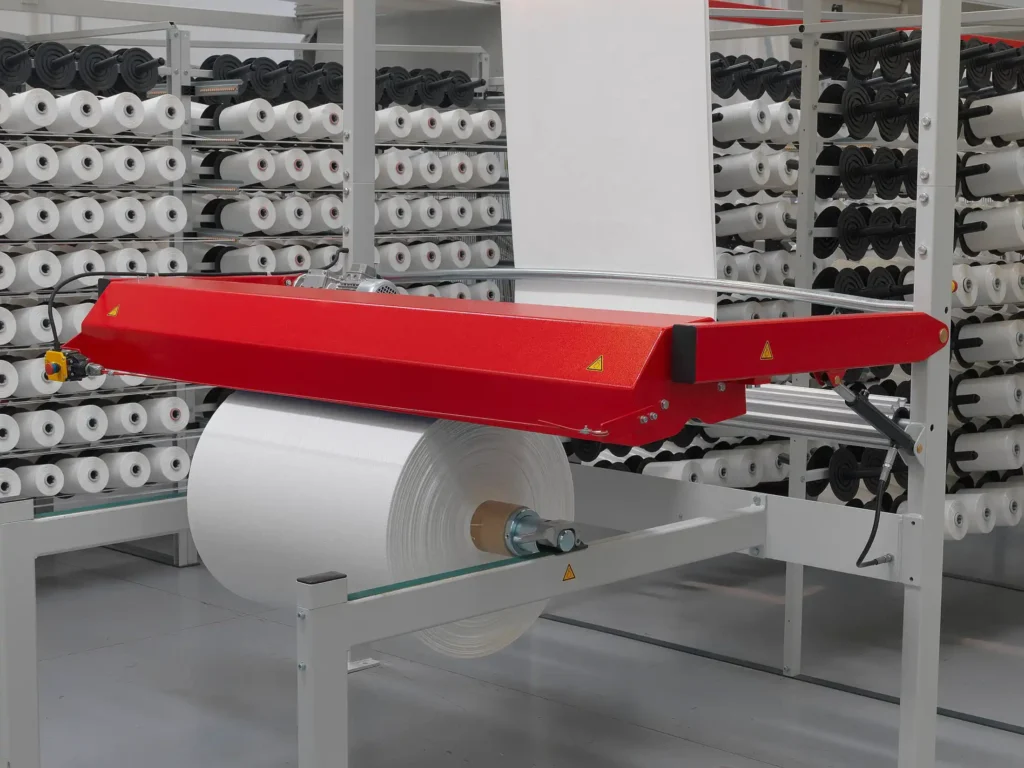
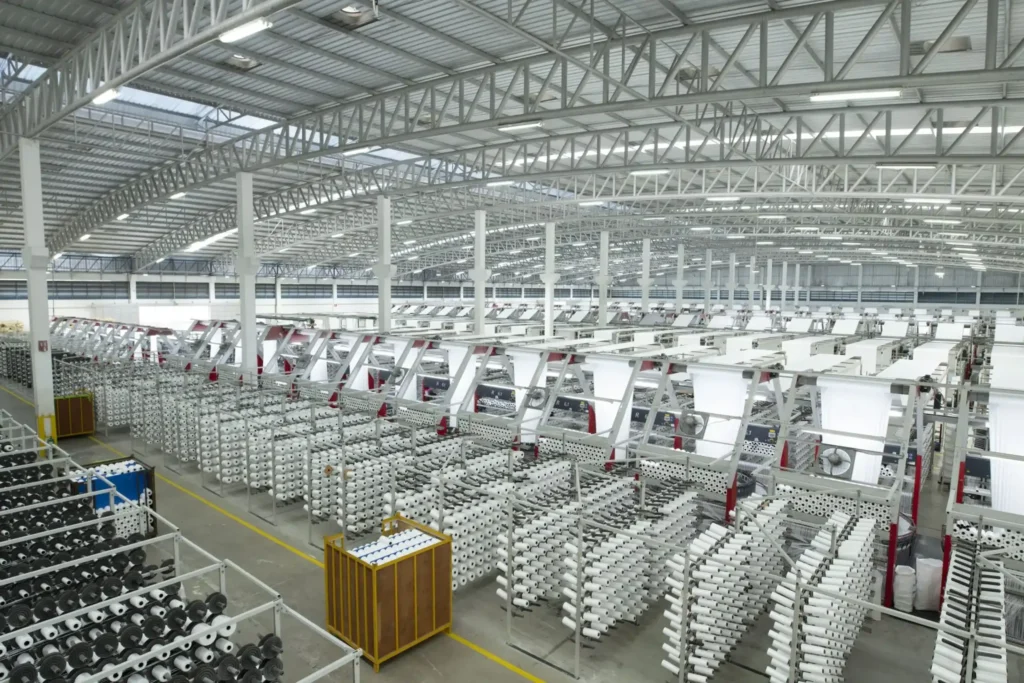
A production line is a chain of controlled stations. PP resin is drawn into tapes, tapes are oriented for strength, and these tapes are woven into fabric with a target denier and mesh. If a film face is specified, the BOPP web is corona‑treated for ink anchorage and laminated with adhesives that must cure fully before stress tests. Conversion cuts shapes with tight tolerances; hems are heat‑cut to reduce fray; seams are sewn or heat‑sealed depending on the mouth style. Printing lays down solids, screens, and text; overprint varnish adjusts scuff behavior and coefficient of friction. Quality gates close the loop: thickness checks per ISO 4593, tensile checks per ASTM D882, drop and corner testing at agreed heights, peel values after adhesive cure, and live barcode scans on production stock.
- Film preparation — verify gauge via ISO 4593 and corona levels for ink/adhesive wetting.
- Ink & adhesive selection — toluene‑free gravure sets; solventless PU where possible; cure schedules recorded for peel targets.
- Lamination — bond strength tested at 48–72 h; delamination corners bent and audited.
- Fabric weaving — denier certificates logged; mesh confirmed; GSM controlled by coupon weighing.
- Conversion — heat‑cut hems; chain vs. lock vs. double‑fold lock seams matched to payload.
- Finishing — anti‑slip bands registered to pallet contact zones; code fields kept varnish‑free.
- QA dossier — include 21 CFR 177.1520 language for PP components where appropriate; compile EU 10/2011 overall migration for food‑adjacent supply chains.
Where They Go: Core Applications
Grains and staples value matte or hybrid finishes that suggest naturalness and hide shelf wear. Pet nutrition leans on photographic panels and UPC reliability in tall warehouse stacks. Fertilizer and seeds need UV‑stable fabrics and abrasion‑tolerant faces for yard storage. Construction and industrial pellets accept lower color counts but demand geometry and seams that keep pallets square. In every lane, the bag is an interface between product physics and human expectations. If the route is rough, friction must be high where layers touch; if dust is fine, mouths must seal without needle holes; if shelves are crowded, contrast and clarity must outrun glare.
Grains & staples
Registered matte/gloss windows for contrast; barcode sanctuaries; anti‑slip bands for tall back‑of‑store stacks.
Pet food & treats
Higher film gauges (25–30 μm) with anti‑scratch on strap paths; double‑fold lock seams; UPC windows kept clean.
Agro‑inputs
UV stabilization (500–1000 h targets); valve options for fast fillers; bilingual labeling where required.
Industrial granules
Lower color count; stronger seams; micro‑vent options for de‑aeration and square stance on pallet.
Standards, Certificates, and the Paper Trail
Eco claims are only as strong as their documents. A practical dossier for Eco‑Friendly PP Woven Bags typically includes film thickness and tensile reports (ISO 4593, ASTM D882), COF windows for line machinability, peel/adhesion values after full cure, drop and corner test logs, and live barcode read rates. Where bags touch food supply chains, plants often compile EU 10/2011 declarations (overall migration ≤ 10 mg/dm² for plastics in contact with food, as applicable to the non‑contact laminate side) and cite U.S. polymer references such as 21 CFR 177.1520 for olefin polymers used appropriately. At the plant level, ISO 9001 shows stable quality systems; FSSC 22000 or BRCGS Packaging Materials demonstrate hygiene programs that large retailers recognize. These are not decorations; they are risk controls.
Parameters & Test Matrix (Color‑Coded for Clarity)
From Problem to Method to Result—Worked Examples
Scenario A: 25 kg rice into European retail. Problem: premium aesthetic + multilingual labeling + strict barcode performance. Method: specify 20–25 μm matte or hybrid face with reserved barcode windows; fabric 85–100 g/m² at 900–1100D, mesh 10×10–12×12; anti‑slip bands where pallets kiss; dieline that fits Triman/Info‑Tri and national environmental codes. Result: a bag that looks natural, scans fast, and stacks tall. Discussion: if shelf scuff rises, concentrate anti‑scratch varnish narrowly on strap corridors rather than thickening the whole face.
Scenario B: 20 kg pet food for club channels. Problem: tall stacks, hard straps, photo‑heavy panels. Method: move to 25–30 μm film, set double‑fold lock seam, enforce varnish‑free UPC windows and target first‑pass scan rates; use anti‑slip only where cross‑layers touch. Result: claims drop, returns fall, and shelf shine survives. Discussion: if pallets still slide, adjust anti‑slip geometry before raising chemistry strength (too grippy slows conveyors).
Scenario C: 25 kg fertilizer with yard storage. Problem: dust, sun, and sand. Method: 25–35 μm face with durable OPV; fabric 95–110 g/m² with UV‑stabilized tapes; choose sewn open‑mouth or valve depending on filler; size bilingual labels generously. Result: fewer wet‑season failures, clearer instructions, calmer audits. Discussion: push UV hours based on storage audit; label real estate is not negotiable.
Risk Register and Practical Remedies
Laminate corner peel
Increase primer activity or film treatment, extend adhesive cure, and radius artwork at folds to reduce stress raisers.
Barcode non‑reads
Reserve varnish‑free zones, widen quiet areas to ≥ 2.5–3.0 mm, and validate with handheld scanners post‑press.
Seam bursts on upper layers
Raise fabric GSM or denier; adopt double‑fold lock; audit needle/looper setup and thread Tex to curb perforation.
Pallet slip
Map contact patches and place anti‑slip bands there—not everywhere—to stabilize stacks without choking conveyors.
A Quick Primer for Buyers
Clarity beats adjectives. When briefing suppliers, state payload density ranges, maximum pallet height, expected strap tension, climate exposure, desired finish, and mandatory icons/languages. Name your test methods up front: ISO 4593 for film thickness, ASTM D882 for tensile, drop heights and orientations, acceptable COF bands, peel thresholds after cure, and barcode read‑rate targets. Ask for plant‑level certificates (ISO 9001; FSSC 22000 or BRCGS Packaging Materials where hygiene is claimed). Doing this once turns future launches from risky to routine.
Internal Resource Link
For a procurement‑friendly overview with aligned terminology, see the primer on Eco‑Friendly PP Woven Bags — a concise starting point that uses the same parameter windows and quality anchors described here.
Why the Conversation Starts with Trade-Offs, Not Slogans
A package that promises less environmental impact yet fails on the loading dock is not a solution; it is a detour. Eco-Friendly PP Woven Bags exist inside a triangle of forces: brand storytelling (graphics, texture, touch), industrial physics (tear, drop, scuff, moisture), and regulatory reality (labeling, food-contact, extended producer responsibility). The question is not whether to be greener—it is how to engineer greener outcomes while shipments arrive intact and labels pass audits. That tension is productive. It forces precise definitions, measured ranges, and proof points instead of airy claims. And it steers us toward designs that work in messy, moving, global supply chains.
How We Will Reason: Problem → Method → Result → Discussion
Before we pick fabric GSM or film gauges, we commit to a logic that holds. First, we define the problem with observable variables—payload density, abrasion exposure, stack height, humidity swings, retail theater. Next, we select a method that decomposes decisions into modules (material system, printing and coatings, closing method, mouth style, compliance dossier). Then we state a parameterized result that any plant can run. Finally we open a discussion: where does this spec flex, where must it not, how does it age across geographies and seasons? Throughout, Eco-Friendly PP Woven Bags remain the subject and the testbed.
Baseline Domain Knowledge: What Practitioners Agree On
Polypropylene woven fabric delivers exceptional strength-per-gram; biaxially oriented polypropylene film provides a printable, cleanable face; adhesives and overprint varnishes tune bond and friction; seams and hems decide whether corners burst at layer five. On the standards side, thickness checks often cite ISO 4593; tensile of thin films leans on ASTM D882; overall migration for plastics in food-related contexts references Regulation (EU) No 10/2011; U.S. polymer declarations frequently reference 21 CFR 177.1520 for olefin polymers when relevant. None of this is decorative. It is the scaffolding that makes the “eco” in Eco-Friendly PP Woven Bags defensible, repeatable, and auditable.
What “Eco” Means Here: Resource, Reuse, and Recyclability
The word is overused, so we pin it down. Resource means mass reduction, energy-aware processing, and responsible sourcing. Reuse means bags strong enough for secondary life where reverse logistics permit. Recyclability means mono-material intent and real sorting infrastructure—not wish-cycling. Eco-Friendly PP Woven Bags perform best when they stay within a polyolefin family (PP fabric + BOPP face + PP coatings + PP or PET threads chosen intentionally), reserve label real estate for local recycling cues, and avoid incompatible glue lines that complicate melt reprocessing. When fiber is preferred for renewable content and high surface friction, kraft multiwall variants demand liner-separation designs so paper mills actually accept them.
The Levers We Can Pull: Materials, Coatings, Closures, and Graphics
A design session is a control panel. Film gauges shift abrasion tolerance and stiffness. Varnish selection shifts scuff visibility and pallet friction. Fabric GSM and denier shift drop performance and seam retention. Stitch type and density shift burst behavior and needle-driven tear propagation. Artwork zoning shifts barcode reliability and compliance space. Pull a lever and a neighbor moves. The craft of Eco-Friendly PP Woven Bags is the choreography—making these levers dance without stepping on each other.
Horizontal vs. Vertical Thinking: Two Lenses for One Decision
Horizontally, we compare Eco-Friendly PP Woven Bags with adjacent systems: paper sacks, PE monolayer bags, rigid containers, flexible pouches. We borrow strengths—paper’s warm appearance via matte windows; PE’s machinability via COF targets; pouches’ registration discipline for fine text. Vertically, we travel layer by layer—from resin and film to fabric and seam, from varnish to barcode, from bag to pallet—so causal links stay honest. The horizontal keeps us imaginative; the vertical keeps us rigorous.
Materials Palette with Measurable Windows
At the material level, three families dominate: PP woven mono-material builds, BOPP-laminated PP woven laminates, and kraft multiwall constructions. In everyday deployments, Eco-Friendly PP Woven Bags typically adopt one of the first two, because mono-polyolefin designs fit emerging PP recycling streams without the cross-polymer headaches that come with laminated paper/PE. Common, defensible windows appear again and again in factory SOPs and trade listings: BOPP face films around 18, 20, 25, 30, 35 μm; PP fabric masses from about 60–110 g/m² for retail 10–25 kg loads; denier clustered between 700–1200D; meshes in the 10×10–12×12 lane. These are not magical numbers. They are terrain features—where supply, machines, and risk tolerance meet.
A Short Table of Core Parameters (You Will Keep Coming Back to It)
| Component | Parameter | Practical Options | Why It Matters |
|---|---|---|---|
| Film (BOPP) | Thickness | 18 / 20 / 25 / 30 / 35 μm | Higher gauges resist strap scuff and hide weave telegraphing; lower gauges cut mass and cost |
| Film Face | Finish | Gloss / Matte / Registered combo | Gloss sells color; matte hides wear; registered splits give both while controlling barcodes |
| Fabric (PP) | GSM | 60–110 g/m² for retail loads | Heavier fabric lifts seam retention and drop survival; lighter fabric improves cost and hand |
| Fabric (PP) | Denier & Mesh | 700–1200D; 10×10–12×12 | Tape strength and panel stiffness vs. print flatness and breathability |
| Seams | Style & Density | Chain / Lock / Double-fold lock; 24–40 stitches/10 cm | Drives burst performance and unravel risk; too sparse pulls out, too dense perforates |
| Surface | COF & OPV | Anti-slip bands; anti-scratch | Pallet stability and shelf wear converge here |
| UV | Stabilization | 500–1000 h targets | Outdoor storage without brittle surprises |
This table is the compass, not the destination. Every change reverberates. Raise film gauge and pallet cosmetics improve, but conveyor friction may rise. Increase seam density and burst resistance climbs, but perforation lines might appear near stitch rows. You never win one dimension in isolation; you align them.
Printing as Engineering, Not Decoration
A saturated panel that fails a scan is not premium—it is problematic. For Eco-Friendly PP Woven Bags, printing choices are structural choices. Gravure delivers photographic fidelity across 6–10 colors; advanced flexo can serve value lines with disciplined solid areas. Registration for barframes and small type lives in the ±0.5–1.0 mm neighborhood on well-run lines. Overprint varnish governs tone and friction simultaneously: gloss for drama, matte for scuff camouflage, registered windows to protect codes. The best designs choose where to be beautiful and where to be boring.
Mouth and Closing Styles: Different Routes, Different Answers
Open-mouth, sewn: versatile, forgiving, compatible with PP woven and paper. Open-mouth, heat-seal: clean top, dust control, premium presence—requires a sealable surface such as coated BOPP or PE strips. Valve: fast fill for powders; the bag closes itself as product compacts, but line compatibility decides success. Pinch-bottom (typically paper): brick-like stance and elegant geometry; moisture must be managed with liners. For Eco-Friendly PP Woven Bags, the choice often sits between sewn and heat-seal mouths; the deciding variables are particle size, dust behavior, retail aesthetics, and filler tempo.
Sewing Choices: Small Details, Large Outcomes
Thread materials matter. PP threads simplify mono-material claims; PET threads bring thermal stability and higher tensile headroom; cotton rarely survives moisture. Linear density around Tex 60–90 is common in closing rooms. Stitch density between 24–40 stitches per 10 cm is a useful window: too low invites pull-out; too high risks perforation delamination near laminated faces. Double-fold lock seams can turn a marginal corner-drop into a pass. The mathematics of seams is humble but decisive for Eco-Friendly PP Woven Bags.
Heat-Seal Choices: Attractive, Fast, and Demanding
Sealing wants uniform surfaces and controlled energy. BOPP faces often require a sealable layer (e.g., heat-seal-coated BOPP or CPP blends) to close reliably. Dwell times in the 0.3–1.0 s region and widths around 8–15 mm work for many retail formats, provided platens are clean and pressure is consistent. Gains are clear: no needle holes, fewer dust escape concerns, a crisp retail top. The price is discipline—temperature, dwell, and alignment must be held. When done right, Eco-Friendly PP Woven Bags gain both quiet elegance and occupational hygiene.
Ultrasonic as a Targeted Tool
Ultrasonic welding works brilliantly on thin, evenly presented thermoplastic stacks; it struggles when fabric thickness or yarn topography disperses energy. In woven sacks, ultrasonics shine as pre-tack dust guards ahead of sewing, or for attaching labels and tapes; full structural closings on 20–25 kg bags remain a challenge in many plants. Still, using ultrasonics as a pre-close reduces airborne fines at fillers—a small change with big morale effects for operators.
Pallet Physics: Friction, Stack Height, and the Quiet Role of Varnish
Distribution is choreography at scale. Bags slide on bags; pallets sway; straps bite. Anti-slip bands placed where layers touch raise the safety margin without locking conveyors. Registered matte/gloss zones can both flatter the brand and protect strap paths. Increase stack height and compressive loads rise; flimsy seams advertise themselves. Eco-Friendly PP Woven Bags that feel over-specified at single-layer tests can be perfectly specified at five layers under summer heat.
Country Templates: Because Compliance is a Map, Not a Guess
The United States habitually asks for barcode discipline and dual units under the Fair Packaging and Labeling Act (16 CFR Part 500). France and Italy bring sorting marks (Triman, Info-Tri; environmental coding) that consume real estate; type sizes are not optional. Gulf markets require Arabic contents alongside English and demand UV-tolerant constructions for desert logistics. Each template shifts the dieline and sometimes the surface chemistry. For Eco-Friendly PP Woven Bags, planning these shifts into master art files avoids emergency re-engraving later.
From Payload Physics to Bill of Materials: A Reusable Method
A method worth repeating begins with density and abrasiveness. Rice at ~0.75–0.9 g/cc is kinder than mineral powders; kibble around 0.35–0.6 g/cc changes bag stance. Map humidity swings and storage exposure. Set a target stack height and strap configuration. Decide on premium or value shelf signals. Then choose: film gauge and varnish to fit abrasion; fabric GSM and denier to fit drop and compression; seam style and density to fit mouth stresses; barcode windows and varnish exclusions. When Eco-Friendly PP Woven Bags are specified this way, the BOM reads like a story with a beginning and an end.
Worked Patterns that Teams Can Steal (and Adapt)
Premium rice 25 kg into European retail: BOPP 20–25 μm, matte or hybrid; fabric 85–100 g/m² at 900–1100D; mesh 10×10–12×12; anti-slip bands; barcode windows; artwork ready for Triman/Info-Tri and Italian coding. Club-channel pet nutrition 20 kg: BOPP 25–30 μm glossy with anti-scratch; fabric 90–110 g/m²; double-fold lock seam; varnish-free UPC fields; stack-tall friction tuning. Fertilizer with yard storage: BOPP 25–35 μm; fabric 95–110 g/m² with UV-stabilized tapes (500–1000 h); sewn open-mouth or valve; big, bilingual labels. Each pattern faithfully reflects the logic of Eco-Friendly PP Woven Bags.
The Arithmetic that Helps Meetings End Early
For polypropylene film, density floats around 0.90 g/cm³. A memorable shortcut follows: GSM ≈ μm × 0.90. A 25 μm face contributes about 22.5 g/m² to the laminate. That single fact makes cross-functional debates tolerable: a 25→20 μm shift saves ~4.5 g/m²—does that save more than raising fabric by 5 g/m² would cost? And would the savings survive a scuff spike on strap paths? Mathematics is not the decision—but it prevents sentimental decisions.
Color, Texture, and Truth in Claims
A greener story without greener behavior is marketing debt. If recyclability is claimed, ensure mono-material intent and a real-world PP stream. If reduced mass is claimed, report where the grams came out—film, fabric, or thread—and how performance remained. If renewable content is the banner, publish fiber certifications (FSC®/PEFC) and describe liner-separation design. Eco-Friendly PP Woven Bags do not fear scrutiny; they invite it by keeping dossiers tidy and tests reproducible.
Field Failures and Their Frugal Fixes
Panels that burnish at strap lines? Upgrade film gauge and add anti-scratch varnish just in the strap corridors; do not drown the whole bag. Corner bursts at layer five? Increase GSM and move to double-fold lock; then re-check stitch density and needle profile. UPC non-reads? Enlarge quiet zones and remove varnish from the barcode field; adopt steadier line screens. Dust at fillers? Add ultrasonic pre-tacks or choose heat-seal mouths, then measure airborne fines again. Each fix is small; together they turn fragile launches into boringly reliable programs of Eco-Friendly PP Woven Bags.
A Comparative Table for Fast Briefings
| Attribute | PP Woven Mono | BOPP-Laminated PP Woven | Kraft / Multiwall |
|---|---|---|---|
| Visual finish | Functional to premium via coatings | Premium, photographic | Warm, natural |
| Dust control | Needle holes possible if sewn | Excellent with heat-seal | Good with liners |
| Typical film | None or thin coating | 18–35 μm BOPP | N/A |
| Typical fabric | 60–100 g/m² | 80–110 g/m² | 2–4 plies × 70–90 g/m² |
| Best for | Value lines, rugged handling | Premium retail, long routes | Natural narratives, curbside paper |
Tables simplify conversation. They do not replace trials. Pilot runs remain the adult in the room.
Interoperability with Warehouses and Retailers
Pallets differ; conveyors differ; scanners differ. That means COF windows are not fashion—they are agreements. Many distribution centers share preferred coefficients for bag-to-bag and bag-to-roller contact; aim there. Some retailers enforce target first-pass scan rates on UPC; make that a printing KPI. Others require specific EPR marks at minimum sizes; lock them into the dieline before a single color is sold to the brand team. Eco-Friendly PP Woven Bags are packaging, yes; they are also infrastructure participants.
Why Anti-Slip Belongs in Artwork Conversations
Anti-slip is chemistry printed in shapes. If you place it where layers never touch, it is charming but useless. If you place it exactly where cross-stacks kiss, it is safety made visible. Therefore route maps matter; pallet patterns matter. Work with operations to trace real contact patches, then draw the varnish there. When Eco-Friendly PP Woven Bags grip each other without grabbing machines, everybody wins—safety, speed, shelf faces.
The Language of Specifications that Travel Well
A spec that survives translation is a spec that scales. Prefer numbers to adjectives. Prefer test methods to opinions. Call out ISO 4593, ASTM D882, drop heights and orientations, stitch densities per 10 cm, and exact icon sizes for EPR marks. List the documents you expect: polymer declarations (21 CFR 177.1520 references for PP; EU 10/2011 overall migration where applicable), quality system certificates (ISO 9001; FSSC 22000 or BRCGS Packaging Materials). Eco-Friendly PP Woven Bags thrive when the spec reads the same in Dhaka, Gdańsk, and Des Moines.
Sustainability Without Mysticism: A Practical Checklist
Design for mono-material recovery where possible. Reduce mass where physics permits—but prioritize seam integrity over vanity grams. Reduce ink coverage in areas that see strap rub. Reserve real estate for recycling instructions and keep them true to the market. Consider UV-stabilized tapes where outdoor storage is more than a hunch. Validate claims with documents instead of adjectives. Do these humdrum things well, and Eco-Friendly PP Woven Bags sound less like a campaign and more like a competency.
Internal Link for Sourcing Teams
For purchasing colleagues who need a fast primer while shortlisting suppliers, this overview of
durable polypropylene woven packaging bags uses the same vocabulary and parameter windows we apply when scoping Eco-Friendly PP Woven Bags in export channels.
Bringing It All Together: A Repeatable Flow
Start with the product physics and the route. Choose the material family with intent. Set film gauges and finishes or paper plies. Set fabric GSM, denier, and mesh. Choose the closing method and mouth style. Protect the barcode and plan varnish. Lock the compliance dossier. Run pilots on real pallets. Measure, adjust, release. Then keep records tidy so the next market needs fewer meetings. This is not glamorous work. It is the boring excellence that lets Eco-Friendly PP Woven Bags win quietly, repeatedly, and at scale.
Introduction: Reframing Operations and Sustainability Through Eco-Friendly PP Woven Bags
In fast-moving consumer and industrial supply chains, packaging is the hinge between brand promise and physical reality. Eco-Friendly PP Woven Bags must reconcile forces that often collide—lightweight targets versus drop resistance, premium graphics versus abrasion on strap paths, recyclability narratives versus the constraints of actual municipal programs. The goal of this article is practical: translate those tensions into a rigorous, repeatable method that any team can use to specify, source, and defend Eco-Friendly PP Woven Bags across regions and payloads. We will follow a problem → method → result → discussion loop, and we will test each claim against measurable parameters—film gauge, fabric GSM, denier, mesh, stitch density, coefficient of friction, and documented compliance.
Problem Definition: Where Performance and Environmental Claims Collide in Eco-Friendly PP Woven Bags
Across retail staples, pet nutrition, agro-inputs, and industrial granules, performance failures tend to cluster around three hotspots: scuffed or burnished faces that dull brand panels, seam bursts at upper pallet layers, and barcode non-reads at distribution centers. Environmental claims complicate the picture: a mono-material story only holds if adhesives, threads, and coatings cooperate; a recyclability icon is credible only where PP collection infrastructure exists; a mass reduction is real only if drop and stack performance still clear internal thresholds. The core problem for Eco-Friendly PP Woven Bags is balancing these constraints in a way that scales beyond a single SKU or route.
Method Overview: Systems Thinking Applied to Eco-Friendly PP Woven Bags
We break the decision into modules that can be solved independently and then recombined: (1) product physics (density, abrasiveness, moisture sensitivity), (2) distribution model (stack height, strap pressure, conveyor type, climate), (3) print and finish (color count, finish, registered varnish), (4) structure and closure (film microns, fabric GSM/denier/mesh, seam style, stitch density), (5) compliance dossier (country-specific labeling and food-contact frameworks), and (6) sustainability alignment (mono-material intent, realistic recycling pathways). Each module outputs parameters that become a bill of materials. The bill is then stress-tested in pilots and verified with standard test methods.
Horizontal Lens: Positioning Eco-Friendly PP Woven Bags Against Adjacent Formats
A horizontal comparison keeps us honest about trade-offs. Paper multiwall bags bring renewable fiber content and warm texture, but require separation of PE liners to maintain curbside acceptance in many regions; they also pick up humidity. PE monolayer sacks seal easily and run fast, yet lack the print billboard and tear resistance typical of woven PP fabric at equal mass. Flexible pouches excel in small formats; at 10–25 kg, economics and handling favor Eco-Friendly PP Woven Bags. Borrow their strengths without their weaknesses: adopt matte windows to evoke paper’s natural feel, target COF bands to match PE’s machinability, and maintain registration discipline seen in premium pouches.
Vertical Lens: From Microns and Mesh to Pallet Stability in Eco-Friendly PP Woven Bags
A vertical analysis follows the material stack upward. The BOPP face—18, 20, 25, 30, or 35 μm—governs scuff resistance and stiffness; overprint varnish dictates tone and friction. The polypropylene woven fabric—commonly 60–110 g/m² for 10–25 kg uses, 700–1200D denier, 10×10 to 12×12 mesh—determines tear resistance, seam retention, and print flatness under the film. Seams and hems decide whether corner drops pass consistently; anti-slip bands place friction where layers actually touch. Barcode zones require carefully varnish-free windows. For Eco-Friendly PP Woven Bags, getting one layer right is never enough; alignment across layers is the work.
Use-Case Physics: Translating Payload and Route into Parameters for Eco-Friendly PP Woven Bags
High-density, angular particles (e.g., mineral salts, some fertilizers) abrade the inner face and load seams sharply, arguing for heavier fabric (≥ 90 g/m²) and double-fold lock seams. Lower-density, smoother contents (many pet foods, rice) permit lighter fabrics (75–95 g/m²) and put more pressure on face durability and finish selection. Long intermodal routes with hard polyester straps favor thicker films (25–30 μm) and anti-scratch coverage where straps bite; calmer regional routes can tolerate 20 μm with selective varnish strategies. Climate matters: outdoor storage demands UV-stabilized tapes (500–1000 h targets). Every parameter in Eco-Friendly PP Woven Bags changes when the physics changes.
Print and Finish Strategy: Beauty that Survives the Warehouse in Eco-Friendly PP Woven Bags
Gravure offers photographic fidelity across 6–10 colors; high-end flexo can reduce cost while keeping solids clean. Registered matte/gloss gives contrast and hides wear while controlling COF. The temptation is to beautify everything; the discipline is to leave barcode sanctuaries quiet—no heavy screens, no varnish, no surprise. For Eco-Friendly PP Woven Bags, finish is not just about shelf appeal; it is a friction control device for pallets and conveyors.
Closure and Mouth Options: Sewing, Heat-Seal, and Hybrid Paths for Eco-Friendly PP Woven Bags
The open-mouth sewn format remains a sturdy baseline: chain seams are quick but unravel if cut; lock seams resist unravel; double-fold lock raises burst resistance for heavy payloads. Stitch density typically lives between 24–40 stitches per 10 cm; too sparse invites pull-out, too dense can perforate laminated faces. Heat-seal mouths, using sealable BOPP or CPP layers or PE strips, virtually eliminate dust escape and make tops look premium—dwell times around 0.3–1.0 s and widths 8–15 mm. Ultrasonic pre-tacks can cut fines before a secondary sewn close. Selecting among these for Eco-Friendly PP Woven Bags depends on product flowability, cycle time, and retail face expectations.
Data and Documentation: The Paper Trail Behind Eco-Friendly PP Woven Bags
A credible spec includes film thickness checks (ISO 4593), tensile for films (ASTM D882), COF for machinability windows, migration documentation for EU markets (overall migration ≤ 10 mg/dm² under Regulation (EU) No 10/2011, as relevant to non-food-contact laminate sides), and polymer declarations where appropriate (21 CFR 177.1520 for olefin polymers in the U.S.). At the plant level, ISO 9001 anchors basic quality systems, while FSSC 22000 or BRCGS Packaging Materials reassure buyers in food supply chains. The goal is not decoration; it is faster approvals and fewer customs delays for Eco-Friendly PP Woven Bags.
Sub-Problem A: Choosing Film Thickness for Eco-Friendly PP Woven Bags
Background: Strap scuff and shelf rub degrade graphics and brand legibility. Method: classify routes into low, medium, or high abrasion and map to 18–20 μm, 20–25 μm, or 25–35 μm, respectively; place anti-scratch only where needed; reserve barcode windows. Result: scuff complaints drop without overspending resin. Discussion: a 25→20 μm shift saves ~4.5 g/m² (PP film density ≈ 0.90 g/cm³), but may increase rework; pilot with real straps before adopting.
Sub-Problem B: Selecting Fabric GSM, Denier, and Mesh for Eco-Friendly PP Woven Bags
Background: Seams fail when fabric is underbuilt; prints distort when mesh is too open. Method: begin at 75–95 g/m² for 10–25 kg consumer goods; escalate to 95–110 g/m² for tall stacks or abrasive fills; prefer 10×10–12×12 meshes and 900–1100D denier. Result: higher pass rates at 1.2 m flat and 0.8 m corner drops. Discussion: if corner fray persists, try heat-cut hems and adjust needle profile before jumping GSM significantly.
Sub-Problem C: Governing COF and Anti-Slip on Eco-Friendly PP Woven Bags
Background: Pallets slide not because bags are smooth in general but because they are smooth exactly where layers meet. Method: map cross-stack contact patches and apply anti-slip varnish bands only there; keep conveyors in mind to avoid excessive grab. Result: stable stacks without throughput penalties. Discussion: COF is a system property—bag-to-bag, bag-to-roller, bag-to-strap—so testing must mirror reality.
Sub-Problem D: Protecting Barcodes on Eco-Friendly PP Woven Bags
Background: Non-reads drive chargebacks and rework. Method: reserve quiet zones of ≥ 2.5–3.0 mm around the code; exclude varnish from code fields; control registration within ±0.5–1.0 mm and verify reflectance on production stock. Result: first-pass scan rates rise; DC friction eases. Discussion: barcode stewardship belongs as much to graphics as to engineering on Eco-Friendly PP Woven Bags.
Sub-Problem E: Building a Compliance-Ready Artwork Template for Eco-Friendly PP Woven Bags
Background: Marks and icons consume real estate—U.S. PDP and dual units, French Triman and Info-Tri, Italian environmental labeling, Arabic blocks for Gulf markets. Method: draft a master dieline with fixed legal zones and flexible brand fields; codify minimum sizes and translations. Result: fewer late-stage re-engraves, faster approvals. Discussion: compliance does not decorate the bag; it defines its negotiable space.
Worked Example 1: Premium Rice, 25 kg, European Retail—Eco-Friendly PP Woven Bags
Problem: premium look, strict labeling, long pallets, and crisp barcodes. Method: BOPP 20–25 μm matte or hybrid; fabric 85–100 g/m², 900–1100D, 10×10–12×12; anti-slip placed at layer interfaces; bilingual or multilingual panels; barcode sanctuaries. Result: complaints fall, shelf presence improves, audit friction declines. Discussion: if scuff still rises, widen anti-scratch just on strap corridors ahead of a film jump.
Worked Example 2: Club-Channel Pet Nutrition, 20 kg—Eco-Friendly PP Woven Bags
Problem: tall stacks, strap burnish, photo-heavy panels. Method: BOPP 25–30 μm glossy with anti-scratch; double-fold lock seam at ~32 stitches/10 cm; varnish-free UPC fields; friction tuned for high stacks. Result: visual endurance plus scan reliability. Discussion: if conveyors slow, reduce anti-slip area rather than chemistry first.
Worked Example 3: Agro-Inputs with Yard Storage—Eco-Friendly PP Woven Bags
Problem: dust, solar exposure, bilingual labeling. Method: BOPP 25–35 μm; fabric 95–110 g/m² with UV-stabilized tapes (500–1000 h target); sewn open-mouth or valve based on filler; generous legal blocks. Result: resilience outdoors and clarity in use instructions. Discussion: adjust UV hours to match actual dwell times in yard audits.
Quality Gates: How to Keep Eco-Friendly PP Woven Bags Predictable Over Time
Adopt a small, powerful set of gates: film thickness per ISO 4593 at incoming; tensile per ASTM D882; adhesive peel after 48–72 hours of cure; GSM coupon weights per loom, not per shift; seam audits with both flat and corner drops; COF measurements on bag-to-bag and bag-to-roller interfaces; barcode read-rate sampling on each production lot. Repeatability is the quiet superpower behind Eco-Friendly PP Woven Bags.
Sustainability Without Hand-Waving in Eco-Friendly PP Woven Bags
Make mono-material intent real: PP fabric, PP film, PP coatings where possible; if PET thread is selected for thermal stability, disclose it and state implications. Recyclability claims should match municipal capability—some regions collect flexible PP, others do not. If fiber-forward aesthetics are mandatory, design separable liners and educate logistics partners on removal. Above all, document: LCA boundaries, mass reductions by element (film, fabric, thread), and post-use pathways. Eco-Friendly PP Woven Bags sound credible when their claims are geographically honest and technically transparent.
Integration: From Sub-Solutions to a Cohesive Specification for Eco-Friendly PP Woven Bags
Synthesize the modules in a fixed order: (1) payload physics and climate; (2) route and pallet plan; (3) film gauge and finish; (4) fabric GSM/denier/mesh; (5) seam style and stitch density; (6) barcode and varnish governance; (7) anti-slip mapping; (8) legal zones and translations; (9) tests and documents. Lock the spec; pilot on real pallets; adjust only with data. This order prevents circular edits and locks learning into the next launch of Eco-Friendly PP Woven Bags.
Procurement Guide: What to Tell Suppliers About Eco-Friendly PP Woven Bags
Be numerate and precise. State density ranges, target stack height, strap material and tension, humidity and temperature ranges, desired finishes, mandatory marks and languages, barcode symbologies and quiet zones, and your acceptance bands for film thickness, COF, peel, and seam tests. Ask for plant certificates (ISO 9001; FSSC 22000 or BRCGS Packaging Materials where applicable) and for polymer declarations with 21 CFR 177.1520 references and EU 10/2011 documentation where relevant. The clearer the brief, the fewer iterations in Eco-Friendly PP Woven Bags.
Internal Link for Sourcing Teams Working on Eco-Friendly PP Woven Bags
For a buyer-facing overview and terminology alignment, consult this primer on
durable polypropylene woven packaging bags that mirrors the parameter windows and test anchors used throughout this article.
References
- ISO 4593 — Plastics—Film and sheeting—Determination of thickness by mechanical scanning.
- ASTM D882 — Standard Test Method for Tensile Properties of Thin Plastic Sheeting.
- Regulation (EU) No 10/2011 and amendments — Plastic materials and articles intended to come into contact with food.
- U.S. FDA 21 CFR 177.1520 — Olefin polymers (polypropylene) guidance for appropriate uses.
- ISO 9001 — Quality management systems—Requirements.
- FSSC 22000 — Food Safety System Certification for packaging materials.
- BRCGS Packaging Materials — Global Standard for Packaging and Packaging Materials.
- U.S. 16 CFR Part 500 — Fair Packaging and Labeling Act basics for consumer packaging.
- French Triman/Info-Tri and Italian environmental labeling guidance — national EPR/sorting marks parameters.
- Representative converter and B2B listings — typical ranges for BOPP film (18–35 μm), woven PP fabric (60–110 g/m² for retail, 160–260 g/m² for heavy duty), denier (700–1200D common), and mesh (10×10–12×12).