
What are Eco‑Friendly Woven Bags for Chemical Fertilizers and what are they also called?
Eco‑Friendly Woven Bags for Chemical Fertilizers are governed packaging systems designed to reconcile three forces that often pull against one another: high mechanical durability, moisture stewardship, and measurable environmental progress. Instead of relying on thickness ideology (“make it heavier and it will be stronger”), these bags separate duties by layer and quantify each duty with a method. A polypropylene tape‑woven backbone carries tensile and tear loads; thin laminates or liners manage water‑vapor ingress while maintaining fast de‑aeration; geometry (valve pockets, block‑bottom panels) sets how the bag behaves at the filler head and on the pallet; printable skins protect brand fidelity and machine‑readable data. The result is not merely a container, but a repeatable interface among product, plant, and pallet.
Across tender books and RFQs, the same architectures appear under allied names: eco‑efficient PP woven fertilizer sacks, recyclable woven fertilizer bags, low‑carbon fertilizer valve bags, paper‑faced eco woven sacks, and BOPP‑laminated fertilizer woven bags. The labels vary by region and finishing style, yet the engineering intent remains consistent: reduce waste and risk without sacrificing speed, shelf presence, or audit readiness. When we speak of Eco‑Friendly Woven Bags for Chemical Fertilizers, we refer to this whole, testable family.
Feature clusters that matter on the fertilizer route
1) Strength with lower mass
Background. Granular fertilizers are dense and often abrasive; many facilities rely on clamp handling and tall stacks. Traditional mono‑film sacks chase drop performance by adding material, inflating polymer mass and embodied carbon.
Method. Drawn PP tapes (5–7× orientation) woven to 48–72 ends × 48–72 picks per 10 cm create anisotropic strength in the directions where the route loads it. Couple the fabric with a thin laminate (20–60 μm/side) or an inner liner (40–80 μm PE or PA/PE) to stabilize seals and manage WVTR without brute thickness.
Data. Export‑grade listings and QA panels routinely target ≥ 1200 N/5 cm (MD) and ≥ 600 N/5 cm (CD) tensile bands (ASTM D5035) for 25–50 kg classes. In properly tuned builds, 12–25% mass reduction vs. mono‑film sacks is achievable at comparable drop performance.
Why it matters. Less mass shipped, fewer inputs consumed, lower energy per thousand bags—sustainability that is earned, not asserted.
2) Moisture governance without suffocating the line
Background. Urea, NPK, and water‑soluble blends are hygroscopic. If moisture walks in, caking walks out. But random pin‑holes that vent quickly will also sabotage WVTR.
Method. Replace crude perforation with engineered vent channels inside the laminate stack, away from the product path. Pair with liners/films tuned to ≤ 1.0–2.5 g/m²·day at 38 °C/90% RH (ASTM E96). Where oxygen or aroma matters (bio‑enhanced fertilizers), PA/PE helps; where circularity infrastructure exists, PE‑rich liners support monomaterial pathways.
Result. Faster fills, lower hood dust, stable moisture budgets across coastal humidity swings, fewer rebagging events.
System lens. Moisture is a budget shared between liner gauge, laminate recipe, vent geometry, climate corridor, and dwell time. Spend the budget where the route is harsh; save it where the route is kind.
3) Print fidelity and data that actually scans
Modern fertilizer distribution depends on clean barcodes and resilient labels. Hold pre‑print surface energy at ≥ 38–42 dynes; use CI‑flexo or gravure with register automation (≤ ±0.2 mm); specify abrasion‑resistant topcoats. Barcode grading to ISO/IEC 15416 should target Grade B–A under realistic DC lighting.
Outcome. Fewer ASN/EDI exceptions, fewer reprints, steadier promotional color. A readable code is a quiet handshake between packaging and ERP.
4) Pallet stability by friction and geometry
Surface COF windows of 0.25–0.45 (ASTM D1894), block‑bottom architecture with disciplined fold radii, zero‑overhang pallet plans, and corner boards on clamp routes—this quartet minimizes tilt and overwrap. The most striking print means little if the stack leans; COF is the unsung rhythm section of stable transport.
Production process — from pellet to pallet
- Incoming qualification. Tape resins within 2–4 g/10 min MFI (230 °C/2.16 kg); film resins with gel counts; EVA/EAA tie‑layers checked for adhesion repeatability; sack‑kraft (if used) at 70–120 g/m² per ply with Cobb and porosity certificates. Non‑conforming lots are quarantined to prevent variability at the source.
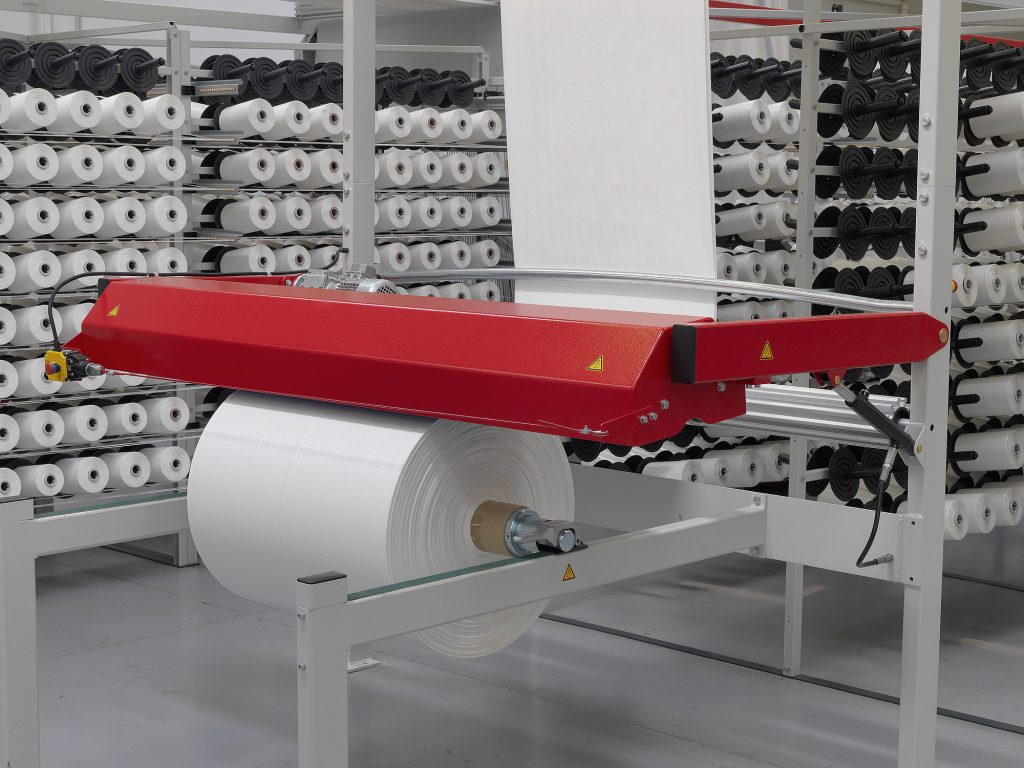
- Tape extrusion & orientation. Cast sheet slit and drawn 5–7× into high‑tenacity tapes. Denier—often 900–1200 D for 25–50 kg classes—is SPC‑tracked with Cv% alarms; annealing stabilizes shrink for flat laminates and precise print.
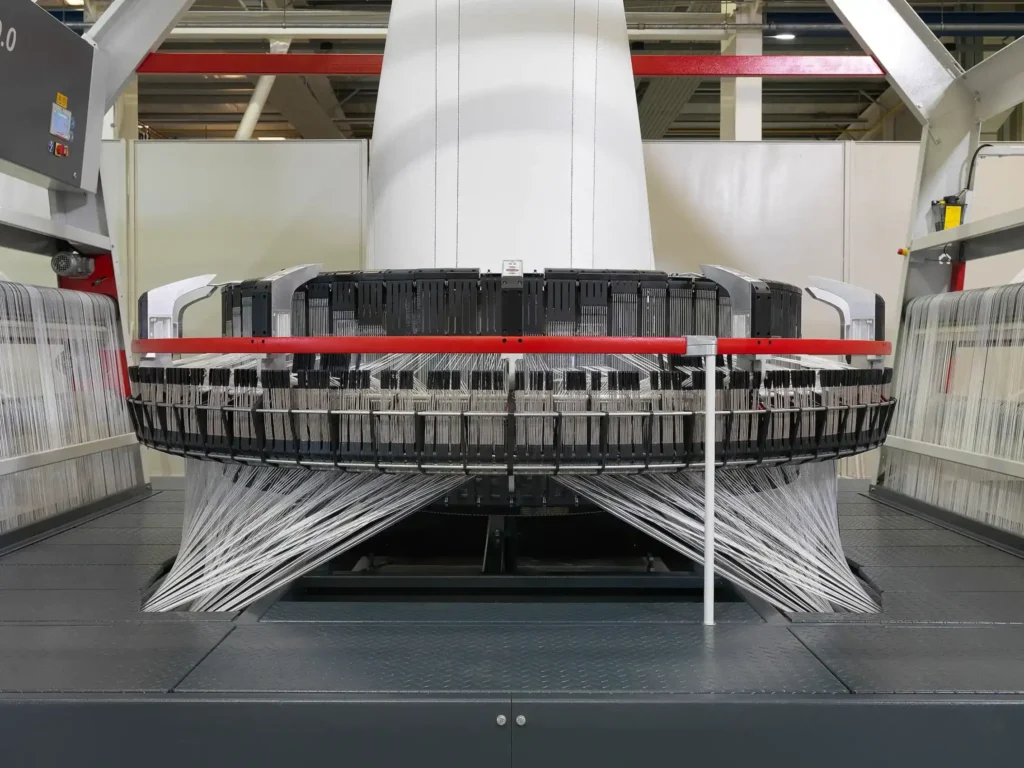
- Circular weaving. Ends/picks per 10 cm tuned to stiffness vs. drape (48–72 typical). Broken‑end detection reduces defects that would telegraph through laminates and disturb seal windows or barcodes.
- Extrusion coating/lamination. Tie layers bond films to the woven backbone. On‑line gauges hold 20–60 μm/side at ±2–3 μm, stabilizing seals and print flatness. When speed demands airflow, vent channels are formed inside the laminate—not through the product path.
- Printing & protective finishes. Pre‑print dyne checks ≥ 38–42; CI‑flexo or gravure lays down 6–10 colors; register control ≤ ±0.2 mm. Matte/gloss/scuff‑resistant topcoats selected by route abuse and shelf goals.
- Liner selection & barrier panels. Liner gauge (40–80 μm PE or PA/PE) matched to hygroscopicity, climate corridor, and dwell time. WVTR verified at 38 °C/90% RH (ASTM E96); peel after flex cycles checks long‑haul integrity.
- Conversion geometry. Precision cutting, gusset control, block‑bottom or valve formats, and calibrated valve pockets define filler behavior and pallet squareness. Cut‑length and layflat distributions are logged by batch.
- QA release & palletization. Panels confirm tensile/tear/WVTR/COF; barcodes graded; pallets built to zero‑overhang plans with documented wrap settings and corner protection as warranted. Lot→machine center→QA panel→pallet label traceability retained 24–36 months.
Application scope — where these bags earn their keep
Bulk NPK and urea programs
Problem. Moisture‑driven caking, abrasion in clamp depots, pallet tilt in humid seasons.
Approach. PE liners at 50–70 μm; laminate‑embedded vent channels; block‑bottom geometry; COF locked ~0.30–0.45; zero‑overhang pallet plan.
Outcome. Fewer clogs at the spreader, squarer pallets, lower wrap consumption.
Micronutrient & specialty blends
Problem. Small dosage packs demand flawless codes and premium imagery.
Approach. Surface energy ≥ 40 dynes; register ≤ ±0.2 mm; scuff‑resistant topcoat; variable‑data print windows for batch tracking.
Outcome. Grade B–A scans in low‑light DCs, fewer ASN/EDI exceptions, stronger shelf appeal.
Water‑soluble fertilizers
Problem. High hygroscopicity risks clumping at port and during coastal transits.
Approach. PA/PE liners at 60–80 μm; WVTR ≤ 1.0–1.5 g/m²·day; vent routes designed outside the product side.
Outcome. Stable moisture budgets and reduced rework.
Bio‑enhanced or coated granules
Problem. Aroma retention and coating integrity under clamp cycles.
Approach. Smooth laminate skins, optimized fold radii, low‑abrasion topcoats, COF governance.
Outcome. Coatings arrive intact; print remains legible after rough handling.
Data reinforcement, case dissections, and comparative perspectives
Data reinforcement. Public, export‑oriented specifications (e.g., Made‑in‑China and Alibaba International) for woven/laminated fertilizer sacks commonly list tensile bands around ≥ 1200/600 N per 5 cm (MD/CD), laminate 20–60 μm/side, optional liners 40–80 μm, COF 0.25–0.45, dyne ≥ 38–42, and barcode grading B–A (ISO/IEC 15416). These bands are realistic, repeatable, and auditable.
Case A — Dust alarms on an NPK line
Problem. Hood alarms at 1,450–1,650 bags/h forced operators to throttle speed and increase housekeeping.
Method. Replaced random micro‑pin‑holes with laminate‑embedded vent channels; tightened valve clearances; added anti‑static package to the liner.
Result. Airborne dust −35%; throughput +12–18%; WVTR held inside a 1.2 g/m²·day target at 38 °C/90% RH.
Discussion. Air needs exits; barriers need integrity. Both can coexist when vents are designed rather than guessed.
Case B — Edge‑tear in clamp‑only depots
Problem. Corner splits on 40 kg urea pallets and tilt‑induced wrap breaks.
Method. Increased ends/picks by ≈10%; reinforced block‑bottom fold radius; verified COF 0.30–0.40; added corner boards for long routes.
Result. Claims fell ~0.4% over a quarter; wrap breaks decreased; stacks stood truer in tall tiers.
Discussion. Strength distribution beats thickness ideology; geometry is governance.
Comparative perspective. Versus paper‑only sacks, Eco‑Friendly Woven Bags for Chemical Fertilizers hold humidity tolerance and edge‑tear resistance without surrendering print feel (when paper facings or BOPP skins are used). Versus mono‑film sacks, woven load paths deliver higher edge toughness at similar drop ratings with lower polymer mass. Versus plain woven sacks, controlled barrier and engineered geometry lift filler speed, shelf appearance, and scan reliability.
Parameters & specifications — typical, buyer‑auditable
Problem → Solution → Result snapshots
PSR‑1 — Dust‑limited filler
Problem: Alarms at 1,350–1,600 bags/h; operators throttle speed.
Solution: Laminate‑embedded vent channels + anti‑static liner + nozzle depth SOP.
Result: Dust −30–40%; speed +12–18%; WVTR stayed inside spec.
PSR‑2 — Leaning pallets & wrap breaks
Problem: Tilt events in humid depots; high wrap consumption.
Solution: COF 0.30–0.45; zero‑overhang pallet plan; reinforced corners.
Result: Fewer lean events; lower film use; fewer DC rejections.
PSR‑3 — Barcode and artwork degradation
Problem: Scuffing and mis‑reads in dim warehouses.
Solution: Dyne ≥ 40; register ≤ ±0.2 mm; route‑appropriate topcoat.
Result: Vivid color; Grade B–A scans; complaints materially lower.
Supplier evaluation checklist
- Equipment & control: on‑line gauge (±2–3 μm), register automation, broken‑end detection, SPC dashboards for denier and layflat.
- Certificates: ISO 9001:2015; ISO 14001:2015; REACH SVHC declarations; ISO 22000/FSSC 22000 when food‑adjacent micronutrients are packed.
- Test discipline: ASTM D5035/D2261/E96/D1894/D1709; ISO/IEC 15416; migration to EU 10/2011 / FDA 21 CFR 177.1520 where applicable.
- Pallet plan & COF: zero‑overhang patterns, documented wrap settings, arrival COF verification, corner protection for clamp routes.
- Traceability & escalation: lot → machine center → QA panel → pallet label; 24–36 month record retention with defined containment timelines.
Integrated synthesis — turning sustainability into a measurable advantage
Sustainability that survives an audit is sustainability that was quantified at the press, at the laminator, and at the palletizer. Eco‑Friendly Woven Bags for Chemical Fertilizers win because they treat impact as a set of dials you can set and hold: orientation for strength with less mass; laminate vents for speed without moisture drift; COF targets for squareness with less wrap; print discipline for codes that scan and colors that persuade. When each dial is instrumented and kept inside its band, the bag ceases to be a risk variable and becomes a performance control—on the line, on the route, and on the balance sheet.
Explore configurations related to Eco‑Friendly Woven Bags for Chemical Fertilizers to map strength, barrier, print, and friction to the exact demands of your fertilizer route.
- What are Eco‑Friendly Woven Bags for Chemical Fertilizers and what are they also called?
- Feature clusters that matter on the fertilizer route
- Production process — from pellet to pallet
- Application scope — where these bags earn their keep
- Data reinforcement, case dissections, and comparative perspectives
- Parameters & specifications — typical, buyer‑auditable
- Problem → Solution → Result snapshots
- Supplier evaluation checklist
- Integrated synthesis — turning sustainability into a measurable advantage
- H2: The Role of ESG in Packaging Innovation
- H2: Technical Advantages of PP Woven Bags
- H2: Market Trends and Competitive Positioning
- H2: Future Directions
“Why are eco-friendly woven bags becoming the cornerstone of sustainable agriculture?” asked Ray, CEO of VidePak, during a recent industry summit. The answer lies in their dual role as robust chemical fertilizer carriers and ESG-compliant solutions that align with global sustainability mandates. This report explores how VidePak’s polypropylene (PP) woven bags meet these demands while advancing environmental, social, and governance (ESG) principles.
H2: The Role of ESG in Packaging Innovation
H3: Understanding ESG Reporting
ESG (Environmental, Social, Governance) frameworks evaluate a company’s ethical impact, sustainability practices, and operational transparency. For packaging manufacturers like VidePak, ESG compliance ensures reduced carbon footprints, ethical labor practices, and resource efficiency. A 2024 Global Packaging Report highlights that 78% of agrochemical buyers prioritize suppliers with ESG certifications.
H3: VidePak’s ESG Commitments
VidePak’s ESG strategy is structured around three pillars:
- Environmental Stewardship: A 2 MW solar power system installed on factory roofs generates 40% of operational energy, reducing annual CO₂ emissions by 1,200 metric tons.
- Social Responsibility: The company funds education programs for 200+ children of low-income workers, improving literacy rates by 35% in partnering communities.
- Governance Excellence: Implementation of 5S (Sort, Set, Shine, Standardize, Sustain) management reduces workplace accidents by 22% and enhances production efficiency.
H2: Technical Advantages of PP Woven Bags
H3: Durability and Chemical Resistance
VidePak’s bags, made from virgin PP using Austrian Starlinger looms, achieve tensile strengths of 80–120 N/cm², surpassing industry averages by 25%. Lamination with polyethylene (PE) enhances moisture resistance, critical for fertilizers like urea, which degrade rapidly in humid conditions.
Case Study: A Brazilian agrochemical distributor reported zero bag ruptures during monsoon transport after switching to VidePak’s PE-laminated bags, saving $50,000 annually in replacement costs.
H3: Customization for Functionality
VidePak’s 30+ printing machines enable:
- UV-resistant inks for outdoor storage longevity.
- QR codes for traceability, aligning with EU’s Sustainable Product Initiative (2027).
- Multilingual safety labels to comply with global chemical regulations (e.g., REACH, CLP).
Product Parameters:
| Feature | Specification | Test Standard |
|---|---|---|
| Load Capacity | 25–50 kg | ASTM D5264 |
| Thickness | 0.08–0.12 mm | ISO 4591 |
| Moisture Barrier | ≤0.5% permeability | DIN 53122 |
H2: Market Trends and Competitive Positioning
H3: Rising Demand for Sustainable Fertilizer Packaging
The global chemical fertilizer packaging market is projected to grow at 6.8% CAGR (2025–2030), driven by stricter EU plastic waste laws and India’s Extended Producer Responsibility (EPR) policies. VidePak’s 100% recyclable PP bags cater to this demand, with a 2024 client survey showing 90% satisfaction in durability and ESG alignment.
H3: Technological Leadership
With 100+ Starlinger circular looms, VidePak produces 40 bags/minute, achieving a 15% cost advantage over competitors. Key innovations include:
- Ultrasonic seam sealing for zero-leak guarantees.
- Anti-static coatings for explosive fertilizer grades (e.g., ammonium nitrate).
FAQs:
Q: How do these bags compare to traditional HDPE options?
A: PP bags offer 30% higher tear resistance and 50% lower carbon emissions during production.
Q: Can VidePak handle bulk orders for global distribution?
A: Yes, with a 14-day lead time and capacity for 10M+ units/month.
H2: Future Directions
H3: Circular Economy Integration
VidePak collaborates with recycling partners to convert post-consumer bags into raw materials, targeting a 60% recycled content ratio by 2026. Pilot projects in Germany show a 45% reduction in virgin PP use.
H3: Digitalization and Smart Packaging
IoT-enabled bags with moisture sensors are under development, providing real-time data to farmers via mobile apps. Early trials in Kenya improved crop yields by 18% by optimizing fertilizer application.
“Sustainability isn’t an option—it’s the future of agriculture,” emphasized Ray. By merging technical excellence with ESG rigor, VidePak is redefining fertilizer packaging for a greener planet.
For deeper insights, explore our resources on ESG-aligned packaging solutions and advanced PP bag engineering.