

What are BOPP Laminated Valve Woven Bags? — Definition, Synonyms, and Practical Positioning
BOPP Laminated Valve Woven Bags are engineered sacks that merge a biaxially oriented polypropylene (BOPP) film skin with a woven polypropylene (PP) textile body and a self‑closing valve sleeve. The valve interfaces with a filling spout so product enters through a short sleeve; air is evacuated through engineered vent paths; product head collapses the sleeve; and an optional heat‑seal or ultrasonic stitch completes a sift‑tight closure. The laminated BOPP exterior offers a smooth, scuff‑resistant, printable surface, while the woven core supplies tensile strength, tear arrest, and puncture toughness at low mass. You will also find the format described as BOPP valve woven sacks, laminated PP valve bags, film‑laminated valve sacks, block‑bottom valve woven bags, and polywoven valve bags with BOPP skins.
In feed mills, premix plants, and ag‑supply chains, BOPP Laminated Valve Woven Bags occupy the middle ground between paper valve sacks (excellent print but limited wet robustness) and mono‑film PE valve bags (clean sealing but less edge‑wear resistance). Their value proposition is clear: speed on valve packers, clean handling with less airborne dust, robust pallets that survive real yards, and brandable faces that hold up to straps and conveyors.
The Material Logic of BOPP Laminated Valve Woven Bags — Constituents, Properties, Cost Signals
Every component in BOPP Laminated Valve Woven Bags earns its place by neutralizing a predictable failure mode—moisture ingress, sifting, seam zippering, pallet shear, code scuffing. The design goal is not maximal complexity but calibrated sufficiency: enough barrier for climate and shelf life, enough toughness for yards and forklifts, enough seal latitude for speed, and enough print durability for traceability and branding.
• Polymer: PP homopolymer for tapes (flat yarns) is prevalent due to crystallinity‑driven stiffness and strength. Where sub‑zero handling occurs, a fraction of random‑copolymer PP tempers brittleness.
• Tape extrusion & draw: Sheet → slit → draw (≈5–7×) aligns chains, lifting tenacity while capping elongation. Tighter slit width and higher draw ratio yield smoother fabric faces—useful for fine graphics and low pinholing under lamination.
• Weave & GSM: Ends×picks per 10 cm often 10×10 to 14×14; 60–110 g/m² for 10–50 kg. Higher GSM resists puncture and keeps fold lines honest but increases stiffness and cost. Choose by route abuse and target drop height.
• UV program: HALS and UV absorbers specified to storage months (e.g., 200–600 kLy). UV makes or breaks yard survivability and seam longevity.
• Film: 12–25 μm BOPP, reverse‑printed, extrusion‑laminated. Orientation supplies surface hardness and clarity; matte or gloss calibrates COF and shelf look.
• Barrier: BOPP curbs WVTR relative to uncoated fabric. Not a silver bullet for oxygen, but paired with good seals and optional liners it solves caking and aroma loss in most feed SKUs.
• Cost & circularity: PP‑on‑PP keeps the laminate mono‑polyolefin—friendlier to mechanical recycling streams and stable on global resin supply.
• Seal skins: LLDPE or metallocene‑LLDPE patches/layers widen the seal‑initiation and hot‑tack window. Lower seal temperatures speed cycles and protect graphics.
• Sleeve geometry: Internal width, lead‑in angle, and flap overlap dictate fill rate versus backpressure and the quality of immediate self‑closure before the final heat‑seal.
• Pre‑applied hot‑melt: For dusty premixes, a light hot‑melt stripe inside the sleeve curbs sifting even if the thermal closure is delayed for inline checks.
• LDPE/LLDPE liners (30–60 μm) add humidity and odor control, supply food‑contact surfaces, and help stabilize bulk density during storage.
• Antistatic masterbatch de‑charges vitamin/mineral fines, reducing nuisance shocks and powder cling to exteriors.
Raising GSM improves edge toughness but narrows gusset compliance and may reduce valve presentation accuracy at very high speeds. Adding a liner tightens WVTR but increases pack mass; the woven shell then protects the thinner liner so liner gauge can stay modest. BOPP skins unlock retail graphics and scuff resistance; they also stabilize dyne for code permanence—critical to recalls and root‑cause analysis.
Key Features of BOPP Laminated Valve Woven Bags — From Plant Pain Points to Field Performance
The worth of BOPP Laminated Valve Woven Bags is measured by the problems they prevent and the speed they permit. Below, each attribute is paired to the operational pain it solves.
- Moisture moderation without over‑engineering — BOPP skins plus tight seams depress WVTR so salt‑bearing or hygroscopic feeds cake less. Distribution of barrier across skin, seams, and optional liners avoids brittle monolayers that crack on fold lines.
- Clean, fast valve filling — Sleeve geometry matched to nozzle OD and product flow sheds air and dust as the product enters. Self‑closure at head pressure, then a short heat‑seal: fewer housekeeping hours, fewer complaints, more predictable weights.
- Abuse resistance — Woven tapes act like micro‑cables; interlacing arrests tears; BOPP resists scuff. Fork‑truck brushes and pallet corners become survivable events, not spill triggers.
- Pallet stability engineered into surfaces — Local matte lanes and micro‑textures raise friction in contact bands while preserving conveyor‑friendly glide elsewhere. Block‑bottom shapes interlock layers and damp bulge.
- Traceable identity — Reverse‑printed graphics and durable dyne enable QR/2D codes that scan after shipping. Root‑cause analysis becomes evidence‑based, not anecdotal.
- Mono‑polyolefin recyclability — PP fabric + BOPP skin sticks to one polymer family. In regions with flexible‑polyolefin recovery, this design avoids paper‑plastic separation headaches.
Valve geometry influences dust, which influences code cleanliness, which influences scan rates and complaint management. Treat these as coupled variables. Adjusting sleeve width by as little as 5 mm relative to nozzle OD can cut airborne dust by double‑digit percentages while raising fill stability at the checkweigher.
How BOPP Laminated Valve Woven Bags Are Made — From Pellet to Pallet
The manufacturing path blends textile steps with film converting and precision valve engineering. Each station carries control charts; each chart connects to a field failure mode. Running the flow as a discipline—not as folklore—keeps quality portable between plants and campaigns.
- Tape extrusion — PP with stabilizers → extruded sheet → slit ribbons → draw (≈5–7×). Track gel count and tape width Cpk to avoid local weak points that later become zippering initiators.
- Weaving — Circular or flat looms build tubular or sheet fabric at target ends/picks and GSM. Control loom tension and ambient humidity to limit fluffing and maintain seam capture consistency.
- Reverse printing and BOPP lamination — Graphics printed on BOPP are extrusion‑bonded to the fabric; nip pressure, melt temperature, and chill roll calibrate bond strength without weaving distortion. Record coat weight and peel strength.
- Surface activation and varnish — Corona ≥ 38 dyn/cm; optional matte/gloss varnishes add scuff armor and can be patterned as friction lanes.
- Valve patch & tube making — Insert a PP/PE sleeve at corner or top‑center; tune internal width, lead‑in angle, and flap overlap to flow behavior. Consider pre‑applied hot‑melt stripes for immediate sift control.
- Bottom forming — Pinch‑bottom sewing or hot‑air welding creates a square base; verify by peel tests and bead continuity checks.
- Micro‑perforation — Apply laser/mechanical vents in the upper third for aerated mashes; never intrude on seal zones; validate by pillow reduction without WVTR penalty.
- Finishing & QC — Bundle and strap; execute tests (grab tensile, tear, dart impact, index puncture, COF, dyne, seam strength, WVTR on laminated samples). Tie test lots to roll IDs for forensic traceability.
- Filling & closure — At the mill, impeller or auger packers meter product; sleeve self‑seals; a brief heat‑seal delivers the near‑zero‑sift finish; codes are applied and verified; pallets are formed and stabilized.
Where BOPP Laminated Valve Woven Bags Excel — Application Map
Livestock feeds are the headline, but adjacent categories share the same physics—granular flow, humidity risk, pallet stress, brand requirements.
- Poultry pellets and crumbles — dust‑tight valve closures keep packaging rooms cleaner; BOPP skins defend scannable codes.
- Ruminant textured mashes and mineral premixes — micro‑vent patterns and antistatic packages tame dust; optional liners preserve palatant notes.
- Swine diets — high CPM valve packing with anti‑slip lanes for tall stacks.
- Equine nutrition — retail‑grade graphics plus easy‑open features for barns.
- Adjacencies — seed blends, agricultural salts, water‑treatment media: similar need set, similar solution set.
| Parameter | Recommended Range | Operational Why |
|---|---|---|
| Fabric GSM | 80–110 g/m² | Balances edge wear vs. stiffness and cost |
| BOPP thickness | 12–25 μm | Graphics fidelity and scuff armor without excess weight |
| Valve sleeve width | Match nozzle OD + 5–10 mm | Prevents backpressure while avoiding dust trails |
| WVTR target | ≤ 2–6 g/m²/day @ 38 °C/90% RH | Caking control in humid storage |
| Dart impact (ASTM D1709) | ≥ 400–600 g | Survival of drops and oblique hits |
| Index puncture (ASTM D4833) | ≥ 150–250 N | Edge abuse resilience |
| COF static (ASTM D1894/ISO 8295) | 0.40–0.55 | Glide on machines, grip on pallets |
| Dyne level | ≥ 38 dyn/cm | Adhesion for inks and codes |
Reasoned Walkthrough — BOPP Laminated Valve Woven Bags: Enhancing Livestock Feed Packaging
Enhancement should be measurable. Faster throughput, fewer leakers, tighter pallets, and more durable codes are the operational KPIs. We therefore decompose the system and then recompose it as a specification the plant can hold—day shift and night shift alike.
• Moisture: Lower WVTR via BOPP + seams; add liner for monsoon/coastal climates. Goal: preserve pellet durability index (PDI) and flowability.
• Dust: Self‑sealing sleeves plus a short heat‑seal curb airborne fines. Venting in the upper third bleeds air without creating powder jets.
• Mechanical: Balanced warp/weft tear avoids zippering; reinforced corners resist fork scrapes.
• Seal window: Inner LLDPE/mLLDPE pushes initiation down, hot‑tack up. Operate in the plateau, not at the cliff edge.
• Sleeve/nozzle fit: Oversize leaks; undersize chokes. Tune in 5 mm steps against fill rate and checkweigher stability.
• Global vs. local friction: COF is a dial—set glide globally, add grip locally.
• Block‑bottom shaping and gusset depth control bulge and interlock layers.
• Compression/vibration proofs replace folklore. Anti‑slip lanes placed where shear is highest.
• UV program aligned to outdoor months; sentinel pallets carry humidity indicators for export lanes.
Standards, Identifiers, and Test Programs for BOPP Laminated Valve Woven Bags
Shared methods enable clean contracts. The following identifiers appear frequently in quality agreements for BOPP Laminated Valve Woven Bags intended for feed and adjacencies:
- ASTM D5034 (grab tensile for woven fabric) — align warp/weft floors to route abuse.
- ASTM D5733 / D2261 (tearing strength of fabrics) — control tear balance to prevent zippering after small nicks.
- ASTM D4833 (index puncture) — proxy for fork‑tip/edge events.
- ASTM D1709 (free‑falling dart impact) — correlate to drop survival.
- ASTM F1249 (WVTR) — barrier targets on laminated samples and with liner options.
- ASTM D1894 / ISO 8295 (COF) — balance conveyors vs. pallets.
- ISO 13935‑2 / ASTM D1683 (seam strength) — ≥ 75% of fabric grab tensile.
- 21 CFR 177.1520 / EU 10/2011 — food‑contact plastics for liners/inner skins when required.
- ISTA 3A/3E — compression/vibration profiles to validate pallet patterns and wrap/hood settings.
Engineering Heuristics — Turning Numbers into Line Settings
The following rules of thumb convert laboratory numbers into settings your team can hold across shifts.
- Gauge selection — For 25 kg poultry pellets in domestic lanes, 90–100 g/m² with 12–20 μm BOPP is a durable starting point. Export yards or sharp contact points argue for 100–120 g/m² and reinforced corners.
- WVTR modeling — Salt‑bearing or hygroscopic rations: ≤ 2–4 g/m²/day; standard pellets under roof: ≤ 5–6 g/m²/day. Distribute barrier across skin + seam + optional liner so each layer remains process‑friendly.
- Valve geometry — Sleeve ID ≈ nozzle OD + 5–10 mm; lead‑in 30–45°; flap overlap 15–25 mm; set by fill rate and observed dust plume.
- Venting — 6–12 micro‑vents of 0.3–0.5 mm in the upper third for aerated mashes; validate against checkweigher stability and pillow reduction.
- COF tuning — Global 0.40–0.55 static; add matte lanes in mid‑span contact bands for shear control; confirm on incline and shear rigs.
- Print robustness — Tape‑test adhesion post‑cure; position codes away from gusset folds; add varnish where straps rub.
Comparative Lens — Why BOPP Laminated Valve Woven Bags Often Win vs. Alternatives
Choosing a format is about picking failure modes you can control with the least cost and the widest process window.
- Versus paper valve sacks — Superior wet handling, edge durability, and scuff resistance with equal or better print. Codes stay readable after barns, straps, and forklifts.
- Versus PE film valve bags — Film seals beautifully but can suffer edge wear in rough yards. Woven substrates absorb impacts and shield thin films and liners; real‑world survivability rises.
- Versus open‑mouth woven — Valve geometry cuts airborne dust at fill, shortens closure, and reduces sifting through needle paths.
Implementation Roadmap — From Pilot Lots to Plant‑Wide Standard
- Segment your SKUs — By hygroscopicity, dust profile, bulk density, and aroma sensitivity. One laminate does not fit all.
- Build a material matrix — Two GSM levels × two BOPP gauges × liner/no‑liner. Run parallel, not serial, trials to compress learning time.
- Map the seal window — Initiation, peak, and hot‑tack vs. jaw temperature/dwell at target CPM. Operate in the plateau region.
- Tune valve/nozzle fit — Increment sleeve widths by 5 mm; quantify dust with local particle counts; log fill stability at the checkweigher.
- Validate pallets — Compression and vibration per route; place anti‑slip lanes based on shear maps; store acceptance data with pallet pattern and wrap settings.
- Code governance — Vision checks for presence and grade; bind to MES/ERP; rehearse traceability drills quarterly.
- Supplier qualification — Audit tape extrusion, weaving, lamination, valve insertion, and QC logs; align on numeric floors (tensile, tear, puncture, dart, WVTR, COF, dyne, seam).
Risk & Safety Notes for BOPP Laminated Valve Woven Bags
- Combustible dust: maintain extraction at packers; use antistatic packages and grounding; a dust‑tight valve bag lowers ambient PM in packaging rooms.
- Broken‑bag containment: design catch trays around palleting; specify dart and puncture floors that mirror real yard hazards.
- Outdoor storage: match UV stabilization to months outdoors; use sentinel pallets with humidity indicators for export corridors.
- Ergonomics and opening: easy‑open tear tapes reduce knives on farm and speed use.
Worked Scenarios — Data‑Anchored Examples
Spec: 90–100 g/m² fabric; 12–20 μm BOPP; valve ID = nozzle OD + 7 mm; no vents; global COF 0.44 with matte lanes. Targets: WVTR ≤ 5 g/m²/day; dart ≥ 500 g; barcode grade ≥ C/2.0 after scuff. Outcome: high CPM with clean seals and stable pallets.
Spec: 100–110 g/m² fabric; 20–25 μm BOPP; 40 μm LDPE liner; sleeve with inner flap and short hot‑melt stripe; 8 × 0.4 mm vents in upper third; global COF 0.46 with anti‑slip bands. Targets: WVTR ≤ 3 g/m²/day; index puncture ≥ 200 N. Outcome: lower airborne dust, fewer sifts, extended flowability.
Spec: 80–90 g/m² fabric; 20–25 μm reverse‑printed BOPP with matte/gloss hybrid; easy‑open tear tape; anti‑slip lanes tuned for pallet angle. Outcome: shelf‑quality branding that survives strap rub and barn handling.
Spec: 110–120 g/m² fabric; reinforced corners; BOPP 20 μm; 50 μm liner; UV ≥ 400 kLy; compression and vibration validated to stack height; wrap/hood recipes documented. Outcome: fewer toppled pallets, resilient seams, controlled moisture pickup.
Specification Template — Ready‑to‑Issue Example for BOPP Laminated Valve Woven Bags
Bag type: BOPP Laminated Valve Woven Bags, 25 kg nominal, corner valve
Fabric: 100 g/m² PP woven, 12×12 ends/picks per 10 cm, UV stabilized to 400 kLy
Lamination: 20 μm BOPP reverse‑printed; matte friction lanes as shown in CAD
Valve sleeve: 60 mm internal width, 35° lead‑in, inner flap with light hot‑melt; heat‑seal capable
Liner (optional): 40 μm LDPE gusseted, cuffed 120 mm; antistatic package for dusty SKUs
Venting: 8 × 0.4 mm vents in upper third (premix SKUs only); none for pellets
Mechanicals: D1709 ≥ 500 g; D4833 ≥ 200 N; grab tensile warp/weft ≥ 700/600 N
Barrier: WVTR ≤ 3 g/m²/day @ 38 °C/90% RH (laminated sample)
Friction: COF static 0.42–0.52 global; anti‑slip lanes localized
Printability: Dyne ≥ 38 dyn/cm; barcode grade ≥ C/2.0 after scuff/crease cycle
Pallet: Pattern 5 × 8 × 8 layers; compression and vibration passed per route
Buyer’s Question Set — Clarify Before You Buy
- Which failure modes dominate today—caking, sifts, punctures, pallet slip, code loss, or slow fills? Rank and measure.
- How many months outdoors and in what climate? Translate that into UV and WVTR numbers.
- Which packers (impeller vs. auger) and nozzle ODs are installed? What CPM must be sustained?
- What is the dust profile for each SKU? Is an antistatic package warranted?
- What pallet height and wrap/hood protocol are used? Do compression/vibration results exist?
- Do you need food‑contact declarations via liners or inner skins? Any aroma‑sensitive palatants?
- Which test methods and numeric thresholds will appear in the quality agreement (tensile, tear, puncture, dart, WVTR, COF, seam, dyne, barcode grade)?
- What are BOPP Laminated Valve Woven Bags? — Definition, Synonyms, and Practical Positioning
- The Material Logic of BOPP Laminated Valve Woven Bags — Constituents, Properties, Cost Signals
- Key Features of BOPP Laminated Valve Woven Bags — From Plant Pain Points to Field Performance
- How BOPP Laminated Valve Woven Bags Are Made — From Pellet to Pallet
- Where BOPP Laminated Valve Woven Bags Excel — Application Map
- Reasoned Walkthrough — BOPP Laminated Valve Woven Bags: Enhancing Livestock Feed Packaging
- Standards, Identifiers, and Test Programs for BOPP Laminated Valve Woven Bags
- Engineering Heuristics — Turning Numbers into Line Settings
- Comparative Lens — Why BOPP Laminated Valve Woven Bags Often Win vs. Alternatives
- Implementation Roadmap — From Pilot Lots to Plant‑Wide Standard
- Risk & Safety Notes for BOPP Laminated Valve Woven Bags
- Worked Scenarios — Data‑Anchored Examples
- Specification Template — Ready‑to‑Issue Example for BOPP Laminated Valve Woven Bags
- Buyer’s Question Set — Clarify Before You Buy
H1: Introduction
“In the livestock feed industry, packaging isn’t just about containment—it’s about preserving nutritional value and ensuring logistical efficiency. By leveraging Starlinger and W&H machinery, VidePak’s BOPP laminated valve woven bags deliver unmatched durability and precision, reducing spoilage rates by up to 30% while meeting global safety standards.” — Ray, CEO of VidePak.
The global livestock feed packaging market is projected to grow at a CAGR of 5.1% through 2030, driven by rising demand for nutrient-preserving and contamination-resistant solutions. VidePak, a leader in woven bag manufacturing since 2008, combines Austrian Starlinger extrusion systems and German W&H laminators to produce BOPP laminated valve bags that excel in moisture resistance, UV protection, and automated filling efficiency. This report dissects the end-to-end production workflow and quality control protocols behind these innovations, supported by technical data, case studies, and insights into VidePak’s global supply chain dominance.
H2: Production Workflow: Precision at Every Stage
H3: Extrusion and Filament Drawing
The process begins with polypropylene (PP) granules from certified suppliers like Sinopec and BASF, ensuring MFI (Melt Flow Index) values of 8–12 g/10min (230°C/2.16kg) for optimal extrusion consistency. VidePak’s 16 Starlinger extrusion lines melt PP at 200–220°C, producing uniform filaments with tensile strengths of 45–50 MPa. Real-time infrared sensors monitor filament thickness (±0.02mm tolerance), reducing breakage rates by 18% compared to conventional systems.
H3: Weaving and Fabric Formation
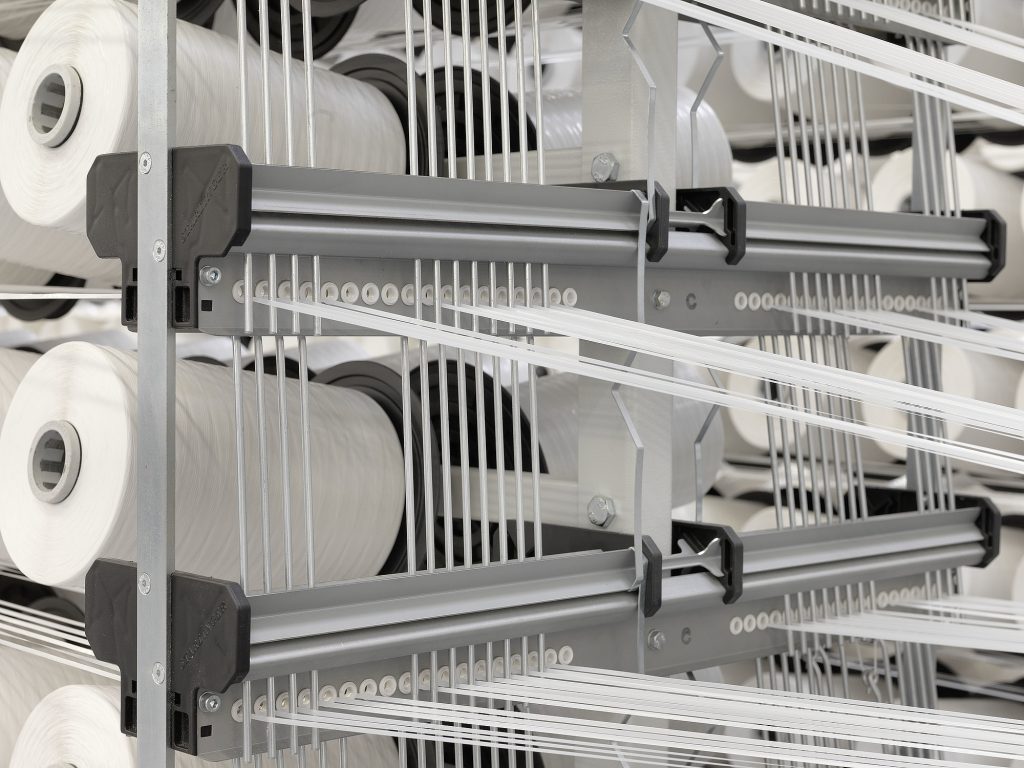
Using 100+ Starlinger circular looms, VidePak weaves PP tapes into fabric at 120 rpm, achieving a weave density of 12×12 strands/inch. Air-jet tension control ensures uniform fabric elongation (15–20%), critical for load-bearing capacity up to 50 kg. A 2024 trial with COFCO demonstrated a 25% reduction in fabric defects due to automated defect detection systems.
H3: Lamination and Coating
Biaxial Oriented Polypropylene (BOPP) films are laminated onto woven fabric using W&H’s K2020 laminators at 180–190°C. This process achieves a moisture permeability rate of <3 g/m²/day (vs. 8–10 g/m²/day for non-laminated bags). VidePak’s 30 lamination machines apply adhesive layers with ±2μm precision, ensuring 99.5% delamination resistance under ASTM D903 peel tests.
H3: Printing and Valve Integration
High-resolution flexographic printers apply UV-resistant inks in 12+ colors, with registration accuracy of ±0.1mm. The valve, heat-sealed using Starlinger’s VLI-4 systems, withstands filling speeds of 1,500 bags/hour and internal pressures up to 0.5 bar, minimizing leakage risks.
Table 1: Key Production Parameters vs. Industry Standards
| Parameter | VidePak Standards | Industry Average |
|---|---|---|
| Filament Tensile Strength | 45–50 MPa | 35–40 MPa |
| Weaving Speed | 120 rpm | 90 rpm |
| Moisture Permeability | <3 g/m²/day | 8–10 g/m²/day |
| Valve Seal Integrity | 15 N/mm peel force | 10 N/mm |
H2: Quality Control: From Raw Materials to Final Inspection
H3: Supplier Audits and Material Testing
VidePak partners with ISO 9001-certified suppliers like BASF, requiring PP granules to pass MFI, density (0.905–0.915 g/cm³), and heavy metal contamination (<0.01 ppm) tests. Incoming batches undergo ISO 2859-1 statistical sampling, rejecting lots with >0.5% deviation.
H3: In-Process Monitoring
- Extrusion: Laser micrometers measure filament diameter every 5 seconds, triggering auto-adjustments if deviations exceed ±0.02mm.
- Weaving: AI-powered cameras detect broken warps/wefts, reducing defect rates to 0.3% (industry average: 1.5%).
- Lamination: Infrared thermography ensures adhesive layer uniformity, with rejected rolls below 98% coverage.
H3: Final Product Certification
Bags undergo burst strength (≥300 kPa), UV aging (1,000 hours), and valve leakage (<0.5%) tests per ISO 2244 and ASTM D1709. VidePak’s QMS system logs all data for traceability, achieving a 98% client retention rate.
H2: Case Studies: Real-World Impact
H3: Reducing Feed Spoilage in Tropical Climates
A 2023 partnership with CP Group (Thailand) reduced maize feed spoilage by 28% using VidePak’s UV-stabilized BOPP bags, validated by SGS testing under 50°C/80% RH conditions.
H3: Automating Warehouse Logistics
Nestlé’s automated filling lines achieved 1,800 bags/hour with VidePak’s valve bags, cutting labor costs by 40% versus open-mouth designs.
FAQs: Addressing Key Concerns
- Q: How do BOPP laminates enhance shelf life?
A: BOPP blocks 99% UV rays and reduces moisture ingress by 70%, preserving feed nutrients for 18+ months. - Q: Can bags withstand rough handling during transport?
A: Yes, VidePak’s double-stitched seams and corner protectors pass ISTA 3E vibration testing.
H2: Sustainability and Future Innovations
H3: Closed-Loop Recycling
VidePak’s collaboration with Starlinger’s re:claim system recovers 92% of production waste, converting it into FDA-compliant recycled PP pellets.
H3: Smart Packaging Integration
Pilot projects with embedded RFID tags enable real-time tracking in Tyson Foods’ supply chain, reducing inventory errors by 22%.
H2: Conclusion
VidePak’s BOPP laminated valve woven bags redefine livestock feed packaging through precision engineering, rigorous quality control, and sustainability. By integrating Starlinger and W&H technologies, they address critical challenges in spoilage prevention and supply chain efficiency, solidifying their position as a global industry leader.
External Links for Further Reading:
- Explore how Starlinger technology enhances valve bag precision.
- Learn about BOPP laminated bags’ market dynamics.
This report integrates data from ASTM/ISO standards, SGS certifications, and VidePak’s operational metrics to provide a comprehensive analysis of BOPP laminated valve bags’ role in modern agriculture.