
What is Custom Printed Woven Bags? — Definitions, scope, and practical naming
This thoroughly reasoned document examines Custom Printed Woven Bags as a modern packaging platform where polymer science, printing technology, supply‑chain mechanics, and brand strategy intersect. The phrase Custom Printed Woven Bags refers to a family of bags built on a woven polypropylene mesh that is decorated with customer‑specific artwork using flexographic, rotogravure, or digitally enabled workflows, sometimes with a laminated film face and sometimes printed directly onto the coated fabric. These bags carry agricultural staples, food ingredients, fertilizers, minerals, pet nutrition, seeds, and e‑commerce replenishment packs; they operate in weights from small retail sizes to industrial formats. The core promise is twofold: industrial durability and retail‑grade communication. Strength without aesthetic clarity wastes shelf potential; graphics without mechanical resilience invite complaints. True excellence lies in the balance.
Because manufacturing communities speak in dialects, you will encounter several everyday labels that map to the same technical object. Knowing the aliases reduces mis‑specification and speeds procurement cycles.
Also known as (aliases):
- Printed PP Woven Bags
- Custom PP Woven Sacks
- Photo‑quality Woven Polypropylene Bags
- BOPP‑Laminated Woven Sacks
- Reverse‑Printed Woven PP Packaging
- Brandable Woven Polypropylene Bags
- Graphic‑rich Woven PP Carriers
Each name points to the same structural philosophy: a high‑tenacity woven shell that bears load, an engineered surface that carries print, and a seam/closure architecture that transfers forces safely during filling, stacking, shipping, and use. Throughout this article the anchor expression remains Custom Printed Woven Bags.
The materials of Custom Printed Woven Bags — From resin families to printable faces
To understand Custom Printed Woven Bags, treat the bag like a set of cooperating subsystems. Each subsystem is a lever that changes more than one outcome. Alter the polymer grade; you affect draw ratios, seam efficiencies, and down‑gauging potential. Change the face finish; you influence both pallet friction and color depth. Swap an adhesive route for a thermal route; you change cure‑to‑ship timing and emissions. The following material map documents what goes where and why it matters.
Woven polypropylene (PP) fabric — The structural mesh
Polypropylene is the dominant structural polymer due to its low density (~0.90 g/cc), hydrophobic chemistry, and excellent specific strength when oriented into tapes. Tape (raffia) fabrication follows a slit‑film extrusion, quench, reheat, and draw sequence, after which tapes are woven on circular or flat looms into fabric densities such as 8×8, 10×10, or 12×12 tapes per inch. The fabric’s areal weight (for example 60–120 g/m² in retail sacks and 120–240 g/m² in industrial bags) governs tensile curves, tear paths, and seam behavior. UV stabilizers (HALS/UV absorbers) can be dosed for outdoor exposure. Calcium carbonate fillers sometimes shift opacity/cost but must be balanced against ductility.
- Load path physics: warp and weft carry the mass; seam efficiency often dictates ultimate performance more than base fabric gsm.
- Cost levers: resin grade, tape denier, picks per inch, loom uptime, yield losses at cutting/sewing, and the use of recycled PP (which requires re‑validation of seam factors).
- Durability levers: UV class, coating choice, and corner reinforcement strategy for high‑abuse routes (mineral powders, aggregates).
Printable faces — Coated fabric vs. BOPP laminate
There are two mainstream routes to render the exterior of Custom Printed Woven Bags image‑ready: (1) print directly onto a PP‑coated fabric, or (2) laminate a biaxially oriented polypropylene (BOPP) film and reverse‑print the artwork on the film’s inner face. The first route is lean and agile; the second provides optical polish, scratch protection, and moisture resistance by encapsulating ink under the film thickness.
- Coated‑fabric printing: a thin PP or PE extrusion coating (often 15–35 g/m²) closes pores for ink laydown. Surface treatment (corona, flame) sets dyne levels for anchorage. Pros: fewer layers, nimble changeovers, lower gauge. Cons: reduced scuff resistance versus film‑encapsulation, narrower gloss window.
- BOPP reverse‑print lamination: the film is corona‑treated, graphics are laid on the inner face, and the film is laminated to the fabric via solvent‑free PU, extrusion PP, or thermal activation. Pros: photo‑quality print, superb abrasion protection, adjustable finishes (gloss, matte, micro‑emboss). Cons: film mass, lamination energy/time, tighter process control.
Ink systems and color management
Artwork in Custom Printed Woven Bags spans spot colors for commodity lines to photographic gradients for premium pet food or seed brands. Rotogravure inks excel at laydown uniformity; modern flexographic sets (water‑based or high‑solids solvent systems) deliver impressive results with fast changeovers. Digital print pilots, while niche for woven substrates, enable micro‑runs and variable data (batch codes, serials). Pigment selection prioritizes lightfastness/heat resistance; binders (polyurethane, acrylic, nitrocellulose blends) are tuned for reverse‑print or surface‑print adhesion. Spectrophotometry (ΔE) guards brand accuracy.
Bonding interfaces — Adhesive, extrusion, or thermal
When a film face is specified, you must choose how to bond it. Three credible routes exist, each with distinct implications for emissions, cure time, and mono‑material claims.
- Solvent‑free polyurethane adhesive lamination: two‑component PU metered at low coat weights cures to an elastic film with high peel strength and low VOCs. It offers broad process windows but demands temperature/time discipline.
- Extrusion PP lamination: a molten polypropylene curtain is extruded between film and fabric, creating an all‑PP interface. This route favors mono‑material stories and can run fast if nip cooling is well controlled.
- Thermal activation films: specialty BOPP with a heat‑activatable layer bonds under heat/pressure without liquid adhesive, simplifying changeovers at a film premium.
Closures and ergonomics
The interface between bag and human is where loyalty is won or lost. Easy‑open tear tapes eliminate knives on the warehouse floor. Pinch‑bottom heat seals reduce sifting in fine flours. Sewn bottoms tolerate rough terrain in outdoor logistics. Die‑cut handles and reinforced hand holes change load distribution and reduce strain injuries. In short: ergonomics is not an accessory; it is the customer experience.
Design note: Treat surface finish as both an aesthetic and a physics variable. Gloss tends to reduce exterior coefficient of friction (COF) and increase pallet slippage; matte and micro‑emboss finishes raise COF and calm stacks. Specify finish with pallet behavior in mind.
What are the features of Custom Printed Woven Bags? — A capability map that goes beyond aesthetics
It is easy to equate Custom Printed Woven Bags with artwork alone. That is a mistake. The platform is compelling because multiple performance threads braid together: strength, moisture behavior, machinability, pallet physics, and graphical communication. Remove one and the system weakens.
- Strength‑to‑weight efficiency: oriented PP mesh plus disciplined seams deliver high working loads at competitive mass.
- Sift‑proofing and moisture control: coatings/liners and laminate faces confine powders and reduce humidity pickup.
- Print durability: reverse‑printed films encapsulate inks, defending them from belt kisses and bag‑to‑bag abrasion in transit.
- Pallet stability: finish‑driven COF, interleaf selection, and wrap recipe produce calm stacks even in cross‑dock environments.
- Customization at scale: registered matte/gloss windows, micro‑emboss textures, metallic accents, and die‑cut handles deliver brand cues without sacrificing throughput.
- Mono‑polymer alignment: PP‑only stacks (film/tie/fabric/liner) simplify end‑of‑life narratives where PP collection exists.
Callout: In procurement reviews the winning bid is rarely the heaviest bag. It is the one that proves seam efficiency, preserves color under abrasion, and holds a COF window that stops tier shift at the destination warehouse.
What is the production process of Custom Printed Woven Bags? — From pellets to pallets
Factories differ in automation and regional practice, yet the journey from resin to retail is recognizable. The value of this roadmap is not in rote memorization but in seeing where quality hides and where poor discipline exacts downstream penalties.
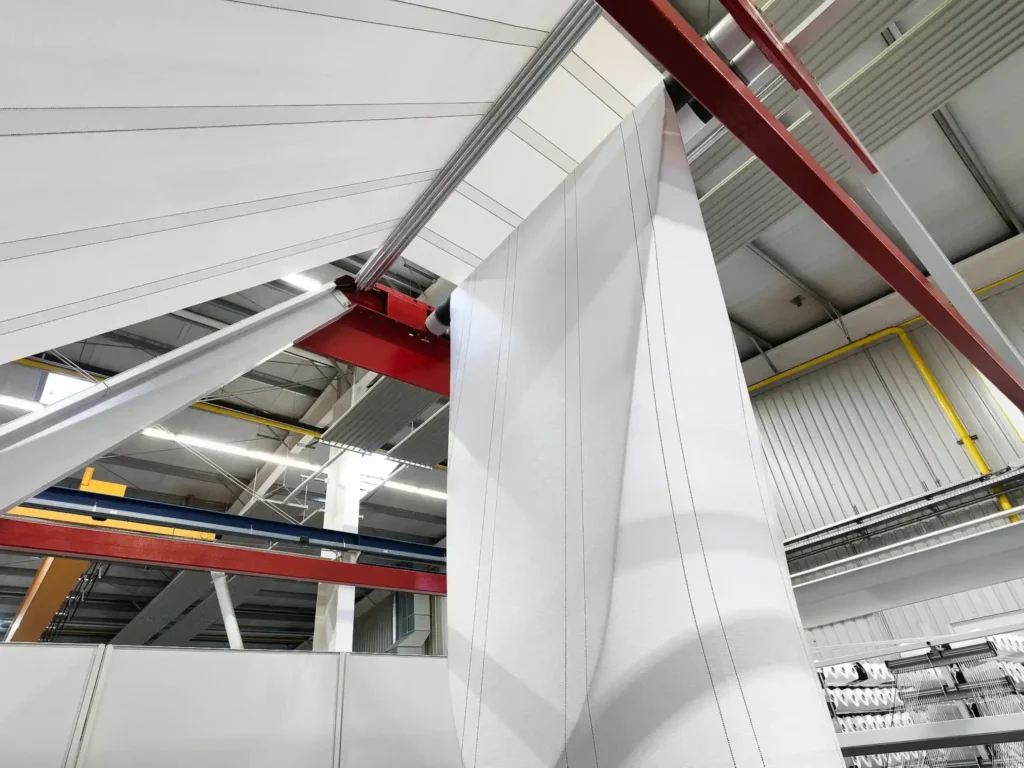
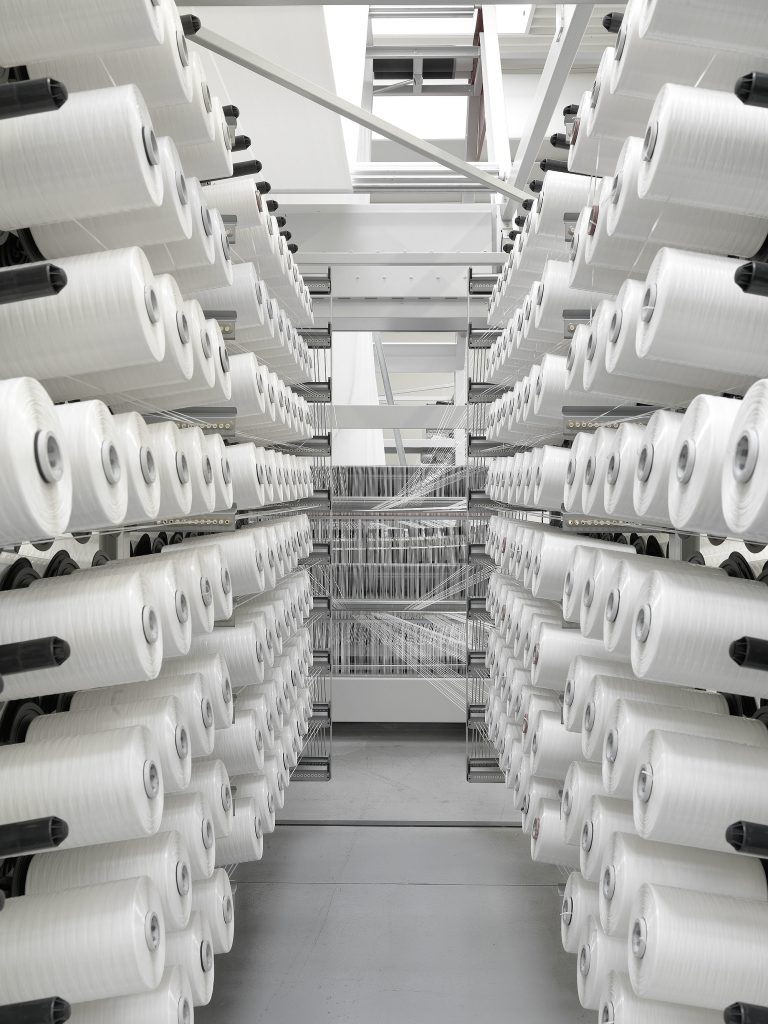
- Tape extrusion and orientation: PP pellets are melted, extruded as a thin sheet, slit into tapes, and drawn to align polymer chains. Output: bobbins of oriented tapes.
- Weaving: circular or flat looms interlace tapes into the target weave and width. Denier/pick density choices map to SWL and durability.
- Coating (if direct print): a PP/PE curtain seals pores; surface is treated to print dyne. If lamination is chosen, this step may be skipped or minimized.
- Printing: rotogravure for photographic art; flexo for agile mid‑runs; digital pilots for micro‑batches and serials. Registration, dryer profiles, and web tensions are monitored continuously; ΔE metrics enforce brand color.
- Lamination (if specified): solvent‑free PU, extrusion PP, or thermal activation bonds BOPP to the fabric; nip/cure parameters dictate peel and curl outcomes.
- Slitting, forming, cutting: laminates or coated fabrics are slit to width, bodies are cut, and side gussets are formed. Micro‑perforations (if any) are added only when gas management is proven necessary.
- Seaming and closure: sewn or heat‑sealed pinch bottoms, with easy‑open tapes where user experience demands. Reinforcements protect stress risers at corners and loop roots.
- Finishing & QA: peel, exterior COF, drop/burst on filled bags, seam efficiency, dimensional checks, and pallet tests under vibration. Labels and instructions for use are verified; clean‑area controls apply for food‑grade orders.
Process tip: If you change anything—film gauge, coat weight, denier—do not skip re‑validation. Printing windows, cure profiles, and seam efficiencies are coupled; a tweak in one place moves the goalposts elsewhere.
What is the application of Custom Printed Woven Bags? — Sector‑by‑sector realities
The advantage of Custom Printed Woven Bags is the way a common architecture adapts to varied routes with targeted changes. The following table captures design priorities and typical options by sector, helping teams convert requirements into parts lists.
| Sector | Typical Contents | Design Priorities | Common Options |
|---|---|---|---|
| Food staples & pet nutrition | Rice, flour, sugar, pulses, kibble | Odor control, sift‑proofing, photo‑quality art | BOPP reverse‑print faces; pinch‑bottom; easy‑open; matte grip zones |
| Agriculture & seeds | Seeds, fertilizers, soil amendments | UV stability, tear resistance, handle ergonomics | UV‑stabilized tapes; reinforced corners; die‑cut handles |
| Minerals & industrial powders | Cement blends, gypsum, calcium carbonate, resins | Puncture resistance, pallet stability, abrasion shielding | Heavier denier; matte/emboss finish; sewn bottoms; micro‑perfs only if needed |
| E‑commerce & replenishment | Refill packs, bulk household goods | Brand clarity, handling convenience, reuse appeal | Soft‑touch varnish; gusseted stands; QR‑linked instructions |
For a catalog‑style snapshot of woven polypropylene bag families that underpin Custom Printed Woven Bags, see this reference page: woven polypropylene bags. It complements the engineering perspective here by showing commercial variants in one view.
Thinking from the headline — Custom Printed Woven Bags: Excellence in science and polypropylene quality
The headline sets a demanding expectation: excellence not only in graphics but in the science below the surface and the quality of polypropylene throughout. To honor that, organize your thinking along four axes: material discipline, print discipline, operations discipline, and policy discipline. Each axis has questions whose answers cascade into the specification.
Material discipline — The polymer path
Ask what the resin must do, not what the last spec did. If the bag needs outdoor storage, target a UV class and confirm stabilizer loadings. If you plan to down‑gauge, verify that denier and draw ratios still deliver seam factors. If mono‑polymer stories matter to downstream customers, bias toward PP interfaces—film, tie, and liner—so your claim is evidence‑ready.
Print discipline — Color, ink, and substrate fit
A beautiful proof on sample film means little if line reality is different. Lock surface energy windows (pre‑print dyne levels), ink rheology, and dryer profiles. Decide where photographic depth is truly valuable and where disciplined spot color is sufficient. Keep a clean ΔE log. Use registered matte/gloss to create tactile cues that also raise COF for pallet stability—a neat example of science serving both marketing and logistics.
Operations discipline — Handling and pallet physics
Many failures are not material failures; they are physics failures. Bags slip because finish/COF, interleaf material, and wrap recipes were never tuned together. Stacks lean because corner reinforcement was an afterthought. Sewing bursts not because the wall was weak but because stitch density and thread spec were misaligned with load paths. Excellence means measuring what matters and designing for the way pallets actually move through your route.
Policy discipline — Labels, claims, and end‑of‑life
If your customers operate under producer‑responsibility rules or strict retailer scorecards, they will ask about polymer families, recyclability guidance, and labeling. Document PP continuity when you can; where mixed systems are necessary, be clear and conservative. Avoid vague claims. Put QR‑linked instructions for use on‑pack so downstream teams can implement the spec you wrote.
Checklist capsule: For Custom Printed Woven Bags, specify outcomes in the same units your customer notices — no delamination after warehouse vibration, easy‑open in under three seconds, pallet stacks that resist 0.5 g deceleration without tier shift, and brand colors within ΔE tolerance. When the outcomes are clear, the bill of materials practically writes itself.
System thinking — Break the challenge into sub‑problems, then integrate
A systems lens avoids over‑engineering. Decompose the design into targeted questions, engineer each answer, then recombine into a single, teachable specification that operators can run without interpretation.
Sub‑problem A — Containment with headroom
Map worst‑case drops and corner loads; engineer seams where fractures begin; consider local reinforcements instead of blanket wall mass. Validate on filled bags, not flat strips.
Sub‑problem B — Print durability under abrasion
If conveying or bag‑to‑bag friction is aggressive, prefer reverse‑printed film faces; add matte grip zones where stacks touch; audit COF windows periodically.
Sub‑problem C — Moisture, odor, and barrier
Use liners only when data demand them; if you must vent, specify micro‑perforation density tied to product outgassing, not guesswork. Prefer PP liners if mono‑polymer stories matter downstream.
Sub‑problem D — Pallet stability
Treat finish/COF, interleaf, and wrap as a package; test under vibration and braking; specify ranges and recipes, not vague preferences.
Sub‑problem E — Labeling, traceability, and policy
Put QR‑linked specs on the bag; keep certificates for inks/films; align claims with local collection guidance. Clarity reduces friction later.
Technical tables — Parameters and levers summarized
| Layer / Feature | Options | Typical Ranges / Notes | Impact |
|---|---|---|---|
| Woven PP fabric | Denier, picks/inch, UV class | 8×8–12×12; 60–240 g/m²; UV stabilized if outdoors | Load curve, tear path, seam efficiency |
| Printable face | Coated fabric or BOPP laminate | 15–35 g/m² coat; 20–40 μm BOPP; gloss or matte | Graphics durability, COF, moisture behavior |
| Ink systems | Gravure, flexo, digital pilots | 6–10 colors typical; ΔE tracking | Color fidelity; changeover economics |
| Bonding route | PU adhesive, PP extrusion, thermal | Cure and nip windows define peel/curl | Emissions, mono‑polymer claims, lead time |
| Closure & ergonomics | Sewn, pinch‑bottom, tear tapes, handles | Match to product mass and user context | User safety, openability, sifting |
| Quality metric | Target / Range | Why it matters | Field analogue |
|---|---|---|---|
| Surface energy (dyne) | ≥38–42 dynes pre‑print | Ink anchorage; color stability | Graphics that survive conveyors |
| Peel strength | Application‑specific (both MD/TD) | Delamination resistance | Faces that do not blister under heat |
| Exterior COF | Tune by finish (e.g., 0.3–0.5) | Pallet stability; line flow | Stacks that stay put in braking |
| ΔE color drift | ≤2–3 on brand colors | Brand trust; icon clarity | Identical packs across lots |
A worked example — Upgrading a 25‑kg pet nutrition bag
Starting point: gloss film at 35 μm, solvent‑based gravure, PU adhesive lamination, 900 denier fabric (10×10), sewn bottom, no liner. Issues: corner scuffs, occasional pallet slip, and uneven openability. Redesign: a 30 μm matte–gloss hybrid BOPP with registered grip windows; solvent‑free adhesive with higher green strength; 1000 denier fabric (10×10); pinch‑bottom heat seal with easy‑open tape; COF tuned via micro‑emboss. Expected outcomes: improved scuff resistance, higher pallet stability, predictable easy‑open in under three seconds, and a modest face‑layer mass reduction without print compromise.
Language and discoverability — Natural long‑tail phrasing
Practitioners rarely search with a single phrase. They use variations such as custom printed woven polypropylene bags, reverse‑printed BOPP woven sacks, matte‑finish woven PP pet food bags, pinch‑bottom printed woven bags, or mono‑polymer polypropylene printed bags. This article adopts those variants naturally while keeping the central keyword Custom Printed Woven Bags frequent and meaningful.
From requirement to specification — A checklist you can run tomorrow
- State outcomes in field terms: drop heights, COF windows, ΔE tolerances, openability times, allowable pallet lean; tie each to a test.
- Lock the polymer family: where feasible, keep film/tie/fabric/liner in PP for credible end‑of‑life narratives.
- Engineer seams first: seam efficiency beats brute gsm; move grams to corners and loop roots where needed.
- Print with discipline: verify dyne; maintain ink viscosity/temperature; log ΔE; protect via reverse print when abrasion is high.
- Tune friction, not mass: matte/emboss finishes and wrap recipes calm pallets more effectively than blanket over‑gauging.
- Right‑size barrier: liners only when product data demand; micro‑perfs only when gas management is proven necessary.
- Instrument the spec: place QR/data matrix on bag linking to SWL, finish, lamination route, and instructions for use.
Final cue for action: Treat Custom Printed Woven Bags as a system that merges mechanics, chemistry, artwork, and human factors. When you specify outcomes and measure what matters, excellence in science and polypropylene quality stops being a slogan and becomes an everyday result.
- What is Custom Printed Woven Bags? — Definitions, scope, and practical naming
- The materials of Custom Printed Woven Bags — From resin families to printable faces
- What are the features of Custom Printed Woven Bags? — A capability map that goes beyond aesthetics
- What is the production process of Custom Printed Woven Bags? — From pellets to pallets
- What is the application of Custom Printed Woven Bags? — Sector‑by‑sector realities
- Thinking from the headline — Custom Printed Woven Bags: Excellence in science and polypropylene quality
- System thinking — Break the challenge into sub‑problems, then integrate
- Technical tables — Parameters and levers summarized
- A worked example — Upgrading a 25‑kg pet nutrition bag
- Language and discoverability — Natural long‑tail phrasing
- From requirement to specification — A checklist you can run tomorrow
- 1. The Science of Polypropylene: Building Blocks of Durability
- 2. Health and Safety: From Raw Materials to Final Product
- 3. Manufacturing Excellence: Starlinger Technology and Customization
- 4. Sustainability: Balancing Performance and Eco-Consciousness
- FAQs: Addressing Critical Concerns
- 5. Market Differentiation: Data-Driven Success
- Conclusion: The Path Forward
“What defines a high-quality woven bag?”
Ray, CEO of VidePak, leans forward confidently: “It’s the marriage of advanced polypropylene science, rigorous safety protocols, and precision manufacturing. At VidePak, excellence isn’t an option—it’s engineered into every thread.”
This statement encapsulates VidePak’s philosophy. Founded in 2008 and now a global leader with $80M annual revenue, the company combines 30+ years of expertise with cutting-edge technology to produce custom woven bags that meet stringent health, safety, and performance benchmarks. This report delves into the scientific principles behind polypropylene (PP) quality, evaluates health and safety frameworks, and demonstrates how VidePak’s innovations align with global standards.
1. The Science of Polypropylene: Building Blocks of Durability
Polypropylene, a thermoplastic polymer, is the cornerstone of woven bag production. Its molecular structure—comprising long hydrocarbon chains with high crystallinity—grants exceptional tensile strength (30–40 MPa), chemical resistance, and UV stability. VidePak exclusively uses virgin PP resin, avoiding recycled materials that risk introducing contaminants or weakening fiber integrity.
Key Parameters for PP Quality:
- Melt Flow Index (MFI): Ranges between 2–4 g/10min for optimal extrusion and weaving. Higher MFI reduces fiber strength, while lower values hinder processing efficiency.
- Additives: UV stabilizers (e.g., hindered amine light stabilizers) and antioxidants (e.g., phenolic compounds) extend bag lifespan under harsh conditions.
Case Study: VidePak’s BOPP laminated woven bags utilize PP films with a thickness of 18–25 microns, achieving a puncture resistance of 8–12 N. This ensures reliable protection for agricultural products like fertilizers, even in humid climates.
2. Health and Safety: From Raw Materials to Final Product
Health risks in woven bags often stem from inadequate material purity or improper manufacturing. VidePak’s protocols address these concerns through:
A. Toxicological Compliance
- Heavy Metal Testing: PP resins are screened for lead, cadmium, and mercury via X-ray fluorescence (XRF), adhering to EU REACH and U.S. FDA standards.
- Migration Testing: Ensures no harmful substances leach into packaged goods, critical for food-grade applications like livestock feed.
B. Mechanical Safety
- Load-Bearing Capacity: VidePak’s FIBC bags withstand 5:1 safety factor ratios (e.g., 5,000 kg safe working load for a 1,000 kg design).
- Seam Strength: Ultrasonic seaming technology achieves 80–100 N/cm seam strength, preventing failures during transport.
3. Manufacturing Excellence: Starlinger Technology and Customization
VidePak’s 100+ circular looms and 30+ lamination machines, sourced from Austria’s Starlinger, enable unparalleled precision:
| Parameter | VidePak Standard | Industry Average |
|---|---|---|
| Weaving Density | 10×10 strands/inch | 8×8 strands/inch |
| Print Resolution | 175 LPI (lines per inch) | 150 LPI |
| Moisture Barrier (BOPP) | <1.0 g/m²/24hr | <2.5 g/m²/24hr |
Example: A client requiring flame-retardant bags for construction waste received PE-coated valve bags with a limiting oxygen index (LOI) of 28%, exceeding the ISO 4589-2 benchmark of 26%.
4. Sustainability: Balancing Performance and Eco-Consciousness
While PP is recyclable (resin ID code 5), VidePak integrates biodegradable additives for compostable options. Their 2024 initiative reduced carbon footprint by 15% through:
- Energy Recovery Systems: Capturing heat from extrusion lines to power auxiliary units.
- Water-Based Inks: Eliminating volatile organic compounds (VOCs) in printing.
FAQs: Addressing Critical Concerns
Q1: How does VidePak ensure colorfastness in printed designs?
A: By using UV-cured inks and testing against ISO 105-B02 standards (500+ hours of xenon-arc exposure).
Q2: Are woven bags safe for food contact?
A: Yes, when produced with FDA-compliant PP and laminated with food-grade BOPP films. VidePak’s food-grade woven bags undergo third-party certification by SGS.
Q3: What distinguishes Starlinger equipment?
A: Starlinger’s circular loom technology ensures uniform weave density (±2% tolerance), critical for load stability.
5. Market Differentiation: Data-Driven Success
VidePak’s 2024 client survey highlights:
- 98% Satisfaction Rate: Attributed to zero reported leakage in 50,000+ valve bags shipped.
- 40% Faster Lead Times: Achieved via AI-driven production scheduling.
Conclusion: The Path Forward
The woven bag industry demands relentless innovation. VidePak’s fusion of material science, safety rigor, and Starlinger’s engineering positions it as a leader. As Ray summarizes: “Our bags don’t just carry goods—they carry trust.”
For businesses seeking reliability, custom-printed solutions tailored to exact needs, VidePak remains the benchmark.
Note: All data reflects 2025 industry standards and VidePak’s internal testing protocols.