
1) What Are FIBC Bags? Definitions, Scope, and Everyday Aliases
In industrial logistics, FIBC bags—also known as Flexible Intermediate Bulk Containers—are soft, high‑capacity containers engineered from woven polypropylene to move powders, granules, and micro‑aggregates at scale. Typical safe working loads range from 500 kg to 2,000 kg per unit; typical formats include open‑top, duffle‑top, and spouted tops paired with spouted or full‑open discharges. The central promise is simple yet profound: maximize payload per gram of packaging while keeping operators safe, labels readable, and pallets stable. The design behaves less like a sack and more like a machine interface—tuned for filling heads, discharge clamps, forklifts, cranes, and racking.
Guiding thought: the right material in the right place. A woven PP shell carries tensile load; the seam program transfers it; liners and coatings tune moisture and cleanliness; baffles shape geometry. The result is a container that can be filled fast, stacked high, and emptied clean.
Across specifications, RFQs, and plant‑floor shorthand, FIBC bags appear under several aliases. Common alternatives include:
- FIBC bulk bags
- flexible intermediate bulk containers
- jumbo bags
- bulk bags
- ton bags
- baffle FIBC bags (for shape‑controlled designs)
- food‑grade FIBC containers (for HACCP/FSMS contexts)
Whatever the label, the logic is constant: a woven polypropylene architecture that carries load efficiently; optional liners and coatings to manage sift and moisture; and a suite of features that help lines run cleaner, faster, and safer.
2) The Material of FIBC Bags: Constituents, Properties, Cost Logic, and Stack‑Up
Great FIBC bulk bags are engineered, not improvised. Each constituent is specified to cause a predictable behavior on the filling line, forklift, and long‑haul route. The materials map below follows the spec table most buyers use, then dives into why each choice matters in practice.
Woven PP Fabric (Backbone)
Isotactic PP extruded into films, slit into tapes, oriented, and woven to 140–240 g/m² for mainstream 1–2 ton builds. High modulus per gram, low moisture uptake, excellent abrasion resistance against chutes and pallets.
Coatings & Laminates
PP or PE coatings (20–40 µm) and PP/PE laminates with tie layers reduce sift, widen seal windows, and improve moisture discipline—while preserving drape for operator handling.
Lift Loops & Sleeves
Woven PP bands stitched in cross‑corner, side‑seam, or tunnel geometries. Denier, stitch length, and seam program determine tear‑out resistance and ergonomic stability.
Liners (Barrier/Hygiene)
LDPE/LLDPE liners 50–150 µm: loose, tabbed, glued‑in, or form‑fit. Add moisture and oxygen control, plus clean interior surfaces for food and pharma use.
Baffles & Internals
Perforated PP panels restricting bulge, enabling near‑rectangular geometry and higher trailer utilization. Corner ties keep mass centered in tall stacks.
Inks, OPV, Treatments
Migration‑aware inks; abrasion‑resistant over‑print varnish; corona/primer for adhesion; micro‑texture to tune outer COF for pallet stability.
| Component | Typical materials | Primary property | Why it matters |
|---|---|---|---|
| Body fabric | Oriented PP woven 140–240 g/m² | Tensile, tear, puncture | Survives handling spikes and pallet compression |
| Coating/laminate | PP or PE (20–40 µm) + tie layer | Sift & moisture control; sealability | Reduces loss; widens sealing windows |
| Lift loops | Woven PP bands | Load transfer to lifting gear | Controls tear‑out and lift stability |
| Liner (optional) | LDPE/LLDPE 50–150 µm | Barrier and hygiene | Prevents caking, oxidation, odor migration |
| Baffles (optional) | Perforated PP panels | Shape retention | Higher pallet efficiency; less belly |
The canonical stack‑up for flexible intermediate bulk containers is: body panels (PP woven) → loop integration → optional coating/laminate → optional liner (loose/tabbed/form‑fit) → baffles (if specified) → filling feature (open/duffle/spout) → discharge feature (spout/full‑open). The ethos: achieve performance by design, not by throwing mass at the problem.
3) What Are the Features of FIBC Bags? Mechanics, Hygiene, and Sustainability
A credible FIBC bag program balances durability, operator safety, and clean handling without inflating tare. The features below connect directly to outcomes: fewer incidents, fewer rejects, more stable pallets.
Strength and Geometry per Gram
Oriented PP tapes distribute load along thousands of filaments; correct seam programs prevent stress concentration. Baffles, when used, convert cylinders into brick‑like blocks that stack higher and travel calmer.
Dust Hygiene and Moisture Discipline
Coatings and liners reduce sift; engineered discharge spouts reduce plumes. Breathability is tunable for aerated powders via micro‑perfs or selective venting.
Safety Signaling and Traceability
High‑contrast print, durable labels, and robust document pouches keep hazard icons and batch IDs legible after long‑haul logistics; QR serialization accelerates targeted recalls.
Environmental Performance
Mono‑material polyolefin design enables simpler recovery than mixed‑material sacks; down‑gauging leverages woven tensile per gram to trim resin use without sacrificing SWL.
4) What Is the Production Process of FIBC Bags? Gate‑to‑Gate with VidePak’s Equipment Advantage
Consistency is not luck; it is capability. VidePak anchors critical steps in best‑in‑class platforms—Austrian Starlinger for tape extrusion and weaving; German W&H (Windmöller & Hölscher) for extrusion coating/lamination and high‑registration printing—and wraps them in layered quality control.
Short thesis: upstream uniformity (Starlinger draw and loom control) + downstream stability (W&H coating gauge and print registration) = seams that hold, labels that survive, and pallets that stay square.
Front end: raw material selection and incoming inspection. PP resin: MFI, isotactic index, ash, gel count. Masterbatches (UV, antistatic, slip) vetted for dispersion. Coating stocks: neck‑in behavior and seal curves; adhesion versus PP fabric and liner substrates. Inks/OPV: adhesion on treated surfaces, migration awareness for food panels. Liners: gauge uniformity, WVTR/OTR, COF. Threads and loop tapes: denier, elongation, UV retention.
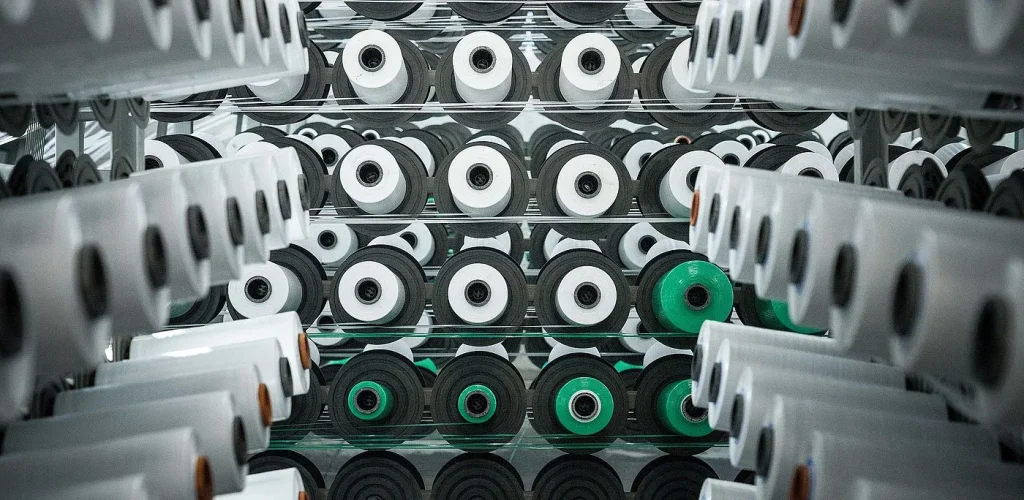
Tape extrusion and weaving (Starlinger). Films extruded, slit to tapes, oriented to target tensile without necking; inline metrology logs width and denier. Circular/flat looms set PPI and tensions to achieve fabric gauge and lay‑flat within tolerance; alarms catch broken tapes and missed picks.
Coating/lamination and printing (W&H). Add sealing/barrier layers with tight thickness control; surface energy tuned for the sealing method and print anchorage; flexo/gravure prints compliance marks and brand art with abrasion‑resistant OPV.
Cutting, sewing, and assembly. Panel cutting with minimal fray; correct seam programs (plain, chain lock, safety stitch, double‑needle) matched to load paths; loop geometry validated for tear resistance; baffles inserted and secured; filling/discharge features installed; document pouches and labels applied.
Final QC and release. Mechanical tests (fabric tensile/tear, seam efficiency, loop tear‑out; top‑lift, drop, topple, righting); dimensional checks; print rub and color; barcode/QR readability; cleanliness. Batch dossiers map raw lots to process conditions and final tests for traceability.
5) What Is the Application of FIBC Bags? Cross‑Sector Use Cases
Wherever dry, flowable materials need speed, hygiene, and pallet stability, FIBC bags shine:
- Food and agriculture: flours and grains, sugar, salt, starches, malt, cocoa, coffee, pulses. Liners and dust control are central.
- Chemicals and minerals: calcium carbonate, silica, pigments, soda ash, TiO₂, resins. Abrasion resistance and moisture discipline dominate.
- Construction: cement, dry mortar, tile adhesive, grout, gypsum, sand. Baffles and pallet stability are decisive for tall stacks.
- Feed and pet nutrition: premixes, micro‑ingredients, kibble. Clean discharge and liner hygiene help prevent cross‑contamination.
- Recyclables and industrial byproducts: scrap plastics, catalysts, filter dusts—where containment and EHS drive spec choices.
6) How VidePak Control and Guarantee the Quality: Four Interlocking Lines of Defense
FIBC bulk bags perform only as well as the system that produces them. VidePak’s assurance model rests on four pillars:
- Standards‑aligned design and validation. Build and test in alignment with ISO/EN/ASTM/JIS where applicable; qualify sealing and discharge features with on‑line trials; hold type‑test dossiers for top‑lift, drop, stack, topple, righting, tear propagation; when static control is specified, align with relevant ESD guidance.
- 100% virgin, traceable raw materials. Virgin PP for load‑bearing fabrics and loops; audited masterbatch suppliers for UV/slip/antistatic; liner films from extruders with tight gauge control; sewing thread and tapes with documented UV retention.
- Best‑in‑class equipment: Starlinger + W&H. Starlinger tape lines and looms deliver uniform tapes and stable weave; W&H coating/lamination and printing deliver gauge stability and registration at industrial speeds; preventive maintenance and calibration hold capability within recipe windows.
- Layered inspection and testing. Incoming (MFI, denier, GSM, dyne, WVTR/OTR); in‑process (tape width, fabric weight, coating gauge/neck‑in, print register, seam sampling, loop tear); final (top‑lift, drop, topple, righting, rub, barcode/QR, dimensions, cleanliness). Periodic audits feed continuous improvement.
7) Failure Modes in FIBC Bags: Why They Happen and How to Prevent Them
Design for safety starts by admitting how things fail. The patterns below recur in field investigations and can be engineered out with discipline.
| Failure mode | Likely cause | First actions |
|---|---|---|
| Seam rupture | Low seam efficiency; wrong stitch; needle damage | Increase seam allowance; switch to safety stitch; validate needle and thread pairing |
| Loop tear‑out | Loop angle too steep; denier too low | Use spreader bar; increase loop denier; change attachment pattern |
| Fabric tear propagation | GSM/PPI too low; UV degradation; notch impacts | Raise GSM/PPI; add UV; corner reinforcements; forklift training |
| Sifting/dust leakage | Thin coating; un‑tabbed liner; poor spout closure | Increase coating; tab liners; revise venting and closure practice |
| Moisture ingress | No liner; damaged coating; humid storage | Add liner; inspect coating integrity; dehumidify warehouse; manage condensation cycles |
8) Standards, Testing, and Safety Factors: What to Specify and Why
A bag is only as safe as its validation plan. While jurisdictions differ, sensible test families converge on the same dimensions: mechanical handling, barrier hygiene (when liners are used), and static control (when combustible dusts or solvents are present).
Mechanical and Handling
- Top‑lift, drop, stack, topple, and righting tests
- Tear propagation and puncture, especially at edge conditions
- Loop angle geometry verified with spreader beams
Barrier and Cleanliness
- WVTR/OTR for liners; odor/taint screens for sensitive foods
- Print rub and barcode readability after simulated transit
- ESD review when static control is specified
| Metric | Typical target | Rationale |
|---|---|---|
| SWL and factor | SWL 500–2,000 kg; factor 5:1 (single‑trip mainstream) | Meets common industrial expectations |
| Fabric tensile (warp/weft) | ≥ 1,000/800 N/5 cm | Handles spikes and steady compression |
| Loop tear‑out | ≥ 2× SWL per loop path | Margin for angle and dynamics |
| Drop/stack | 5–10 drops @ 0.8–1.2 m; 24–72 h at design load | Reasonable shipping shock; creep prediction |
9) Systems Thinking: Decompose FIBC Design, Then Re‑Assemble a Solution
Treat FIBC bags as five interacting subsystems—materials, structure, manufacturing, interfaces, and operations—then integrate via bracketed trials. Solve each in its own language and time scale; only then freeze the specification.
- Materials. Fabric GSM/PPI; coating/laminate gauge; liner presence/gauge and anti‑static package; loop denier; thread/needle pairing.
- Structure. Panel geometry; baffle presence; loop length and angle; filling/discharge features; document pouch placement; outside COF.
- Manufacturing. Starlinger draw ratios; loom tension; W&H coating gauge and neck‑in; seam programs and allowances; QC sampling cadence.
- Interfaces. Filling head geometry and dust extraction; discharge clamps; forklift tine spacing; spreader beam choice.
- Operations. Warehouse humidity; UV exposure; pallet pattern; loading equipment variance.
Integrate with trials: two fabric GSMs × two coating gauges × baffle/no‑baffle × two loop designs × three fill speeds. Measure fill cycle time, dust plume, loop tear, drop/stack performance, and operator feedback. Freeze the spec only after repeatability is proven.
10) Engineering Parameters and Procurement Tables (Indicative)
| Parameter | Typical range | Engineering note |
|---|---|---|
| Fabric GSM | 140–240 g/m² | Heavier for abrasive/minerals; lighter for smooth pellets |
| Picks per inch (PPI) | 10–16 | Higher PPI reduces sift; affects stiffness and drape |
| Coating thickness | 20–40 µm | Thicker improves barrier; too thick reduces drape |
| Liner gauge | 50–150 µm | Barrier vs formability trade‑off |
| Loop length | 250–400 mm | Balance ergonomics and forklift clearance |
| Additive | Typical loading | Purpose | Interaction notes |
|---|---|---|---|
| UV stabilizer (HALS) | 0.1–0.4% | Outdoor resistance | Excess in coatings may soften seal zones |
| Antistatic | 0.05–0.3% | Dust release; less cling | Efficacy drops in very dry air; liners may need their own |
| Slip/anti‑block | 0.05–0.2% | Pallet stability; machinability | Over‑slip increases conveyor slippage |
11) Comparative Lanes: Where FIBC Bags Win vs Alternatives
Against film‑only sacks, jumbo bags absorb puncture and abrasion without painfully thick films. Against paper sacks, ton bags shrug off humidity and seam dusting. In cementitious blends, baffle FIBC bags enable taller stacks with fewer topple events. In food powders, food‑grade FIBC containers pair liners with low‑lint construction for better hygiene.
Further reading inside the same knowledge hub: explore adjacent formats that complement FIBCs in blended fleets. See how PE‑lined woven sacks help fertilizers, how printed BOPP woven bags serve construction waste, and why multi‑wall designs still matter in specific chemical lanes.
- Why PE‑lined woven sacks still dominate fertilizer packaging
- Printed BOPP woven bags for smarter construction‑waste handling
- Multi‑wall woven bags in demolition and site cleanup
- Poly‑paper hybrids: where print clarity meets moisture control
- PE‑coated valve woven bags for dust‑disciplined fills
- Raw‑material quality control for FIBC excellence
- Tubular woven bags with FFS for high‑volume pet food lines
12) Implementation Playbook: From RFQ to First Stable Pallet
- Define the product. Density, particle size, oil content, abrasiveness, moisture/oxygen sensitivity, explosion class if relevant.
- Decide on geometry. Baffle vs non‑baffle; loop style; filling/discharge features; document pouch placement; serialization plan.
- Pick materials. Fabric GSM/PPI; coating gauge; liner gauge and anti‑static needs; loop denier; thread type.
- Specify tests. Top‑lift, drop, stack, topple/righting; WVTR/OTR with liner; print rub and barcode readability.
- Bracket trials. Two GSMs × two coating gauges × loop variants at three line speeds; measure sift, cycle time, loop tear.
- Freeze and monitor. Lock spec and tolerances; serialize pallets; quarterly audits; tune small parameters (+2 mm lay‑flat, OPV tweak).
13) Practical Checklists for Packer Rooms and Warehouses
Packer‑Room Checklist
- Spout OD matches fill feature; clamp pads intact
- Dust extraction active; humidity within target
- Grounding verified when static control is in play
- First‑ten‑bags: loop alignment, label readability, spout tie‑off
- Roll map visible; splice flags clear at unwind
Warehouse Checklist
- Pallet flatness and dryness confirmed
- Stack height within design; corner boards ready
- UV exposure tracked; rotate FIFO; quarterly drop/tilt tests
- Temperature/RH logged; dehumidify in humid seasons
14) Vocabulary Snapshot (for Cross‑Functional Teams)
Key phrases used in FIBC bag engineering and procurement: SWL (safe working load) and safety factor; PPI (picks per inch); WVTR/OTR (water vapor/oxygen transmission rate); COF (coefficient of friction); lay‑flat (half circumference for tubes); neck‑in (melt‑curtain contraction in coating); Kaizen (small, continuous improvements).
15) Putting It All Together: From Commodity to Capability
When teams align material choices (fabric GSM/PPI, lamination, optional liner), structural decisions (baffles, loop style, spouts), process capability (Starlinger upstream; W&H downstream), and operational choreography (packer recipes, housekeeping, stacking), FIBC bags stop being a commodity and start acting as a supply‑chain asset. They protect product, accelerate line speed, reduce dust and returns, and communicate clearly—while cutting resin mass per unit of SWL and supporting circularity goals.
- 1) What Are FIBC Bags? Definitions, Scope, and Everyday Aliases
- 2) The Material of FIBC Bags: Constituents, Properties, Cost Logic, and Stack‑Up
- 3) What Are the Features of FIBC Bags? Mechanics, Hygiene, and Sustainability
- 4) What Is the Production Process of FIBC Bags? Gate‑to‑Gate with VidePak’s Equipment Advantage
- 5) What Is the Application of FIBC Bags? Cross‑Sector Use Cases
- 6) How VidePak Control and Guarantee the Quality: Four Interlocking Lines of Defense
- 7) Failure Modes in FIBC Bags: Why They Happen and How to Prevent Them
- 8) Standards, Testing, and Safety Factors: What to Specify and Why
- 9) Systems Thinking: Decompose FIBC Design, Then Re‑Assemble a Solution
- 10) Engineering Parameters and Procurement Tables (Indicative)
- 11) Comparative Lanes: Where FIBC Bags Win vs Alternatives
- 12) Implementation Playbook: From RFQ to First Stable Pallet
- 13) Practical Checklists for Packer Rooms and Warehouses
- 14) Vocabulary Snapshot (for Cross‑Functional Teams)
- 15) Putting It All Together: From Commodity to Capability
VidePak’s FIBC bulk bags are designed to exceed ISO 9001 and FDA 21 CFR standards, ensuring zero leakage for food-grade materials like flour, sugar, and spices. With 150–200 GSM polypropylene fabric and 0.05–0.1 mm PE/foil liners, our solutions reduce contamination risks by 98% while supporting load capacities up to 2,000 kg, making them ideal for global food supply chains.
1. Critical Design Elements for Food-Grade FIBC Bags
Food raw materials demand packaging that balances mechanical strength, regulatory compliance, and contamination prevention. VidePak’s FIBC bags address these needs through precision engineering:
1.1 Material Selection and Structural Integrity
- Fabric Density: Woven PP fabric (12×12 threads per inch) achieves tensile strengths of 1,200–1,500 N/5 cm, preventing tears from abrasive materials like powdered additives.
- Lamination: BOPP films (20–30 microns) provide UV resistance (98% blockage) and moisture barriers (WVTR <5 g/m²/day), critical for outdoor storage of crops and spices.
1.2 Food-Safe Liners and Sealing Technologies
| Liner Type | Application | Compliance |
|---|---|---|
| PE (0.05 mm) | Flour, sugar | FDA 21 CFR, EU 10/2011 |
| Aluminum Foil (0.1 mm) | Oxygen-sensitive spices (e.g., paprika) | ISO 22000, JIS Z 1539 (Japan) |
For hygroscopic materials like salt or powdered milk, heat-sealed PE liners prevent clumping, while foil liners block oxidation in turmeric or vanilla extracts.
2. Application-Specific Packaging Requirements
2.1 Flour and Grain Powders
- Requirements: Anti-static liners to prevent dust explosions; 180–200 GSM fabric for 25–50 kg loads.
- Case Study: A European bakery reduced waste by 15% using VidePak’s BOPP-laminated bags with RFID tracking for batch traceability.
2.2 Sugar and Sweeteners
- Requirements: Smooth inner surfaces to prevent crystallization; FDA-compliant inks for batch labeling.
- Design: 150 GSM fabric + 25-micron BOPP lamination ensures moisture resistance during maritime transport.
2.3 Spices and Additives
- Requirements: Odor-blocking liners; custom-printed hazard symbols (e.g., “Keep Dry”).
- Solution: Multi-layer kraft paper liners + 8-color HD printing for brand differentiation.
3. Compliance and Parameter Selection Guide
3.1 Regional Standards Overview
| Region | Key Standard | Critical Parameters |
|---|---|---|
| EU | EN 13432 | Recyclability ≥90%; BPA-free liners |
| USA | FDA 21 CFR | PE liner thickness ≥0.05 mm; non-toxic pigments |
| Japan | JIS Z 1707 | Moisture barrier ≤5 g/m²/day; anti-fungal coatings |
3.2 Cost-Effective Customization
- Printing: Soy-based inks for eco-friendly branding (Pantone color accuracy ±2%).
- Size Options: 10 kg to 2,000 kg capacities, with MOQs as low as 500 units.
4. FAQs
Q1: How do I choose between PE and foil liners?
A: PE liners suit moisture protection (e.g., sugar), while foil liners are ideal for oxygen-sensitive spices. Dual-layer options are available for hybrid needs.
Q2: Can FIBC bags withstand freezer storage?
A: Yes. Our PP fabric retains flexibility at -30°C, compliant with ISO 21898 for cold chain logistics.
Q3: What certifications apply to food-grade bags?
A: We provide FDA, EU 10/2011, and Halal/Kosher certifications upon request.
5. VidePak’s Manufacturing Excellence
Since 2008, VidePak has delivered FIBC solutions to 60+ countries, supported by:
- Infrastructure: 100+ Starlinger looms, 30 lamination machines.
- Sustainability: 30% recycled PP options; solar-powered production reduces CO2 by 25%.
- Certifications: ISO 9001, BRCGS, and Sedex compliance.
References
- VidePak Woven Bags. (2025). Sustainable FIBC Solutions for Food Safety.
- FDA 21 CFR: Food Contact Material Regulations.
- EN 13432: Packaging Recyclability Standards.
Contact
Email: info@pp-wovenbags.com
Website: https://www.pp-wovenbags.com/
For insights into food-grade liner technologies or custom traceability solutions, explore our resources on FIBC bulk bag innovations and BOPP lamination techniques.