

What are Sewn Open Mouth PP Bags in practice?
Sewn Open Mouth PP Bags are pre‑made sacks constructed from woven polypropylene fabric with one factory‑sewn end and one open end left for the packer to close after filling. The geometry sounds simple, yet the behavior is nuanced: a textile body woven from oriented tapes gives a high tensile‑to‑weight profile; the open mouth harmonizes with auger fillers, net weighers, gravity chutes, or impeller systems; the sewn seam at the base provides repeatable retention; and the closing operation (most often sewing, sometimes heat sealing when hems are coated) aligns with widely available industrial sewing heads. Because they are light yet strong, these sacks dominate dry bulk packaging across fertilizers, grains, animal feed, resin pellets, pigments, minerals, salt, and dry construction powders. When handled on conveyors and stacked on pallets, the woven matrix distributes stress more like a cloth than a film—resisting burst and tearing by deflecting force along the weave.
Common aliases used in specifications include Sewn Open Mouth woven polypropylene sacks, SOM PP bags, woven PP open‑top sacks, raffia sewn sacks, stitched open‑mouth poly sacks, and open‑mouth sewn poly woven bags. The vocabulary varies by region and industry, but the operating physics stays consistent: woven substrate + open mouth + post‑fill closure.
Material anatomy, constituents, and why each layer matters
The performance envelope of Sewn Open Mouth PP Bags emerges from a layered architecture. Polypropylene tapes create the foundational textile; optional coatings or laminates modulate barrier and print; liners add moisture and oxygen control; additives protect the polymer; and threads transform panels into vessels. This section moves from polymer physics to line‑side reality, showing how each choice shapes the packer’s outcomes.
Woven polypropylene fabric
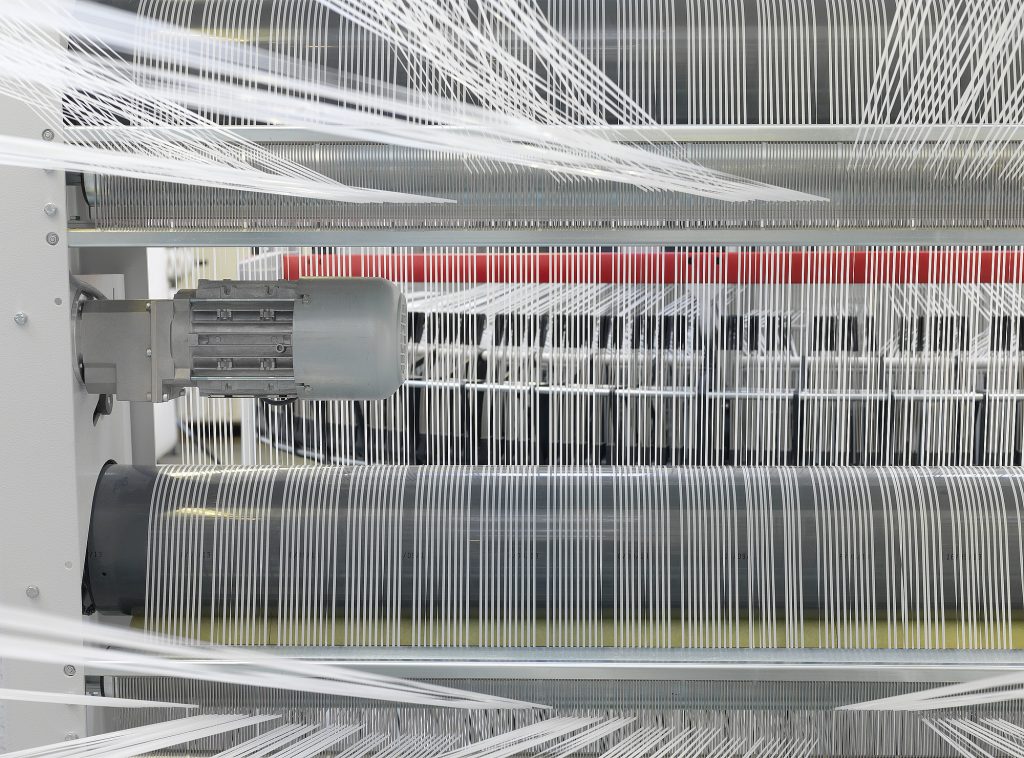
Extruded PP film is slit into tapes, drawn to orient molecules, and woven into a textile (circular or flat). Low density (~0.90 g/cm³) means high strength at low mass. Mesh, denier, and GSM govern tensile, tear, and puncture behavior. The cloth‑like response under impact spreads load across the weave, mitigating catastrophic splits.
Coatings and laminations
Extrusion coatings (PP or PE) or BOPP/CPP laminations cut dusting, increase water resistance, and enable crisp graphics. Interior coatings reduce sifting; exterior laminates resist rub and provide gloss. Thickness typically 15–40 μm for coatings and 20–40 μm for films in heavy‑duty sacks.
Inner liners
LDPE/LLDPE, HDPE, or antistatic blends act as moisture/oxygen barriers. Liners may be loose, hem‑tacked, or tube‑inserted. For hygroscopic fertilizers and fine powders, liners stabilize flow and reduce caking. EVOH co‑ex options address oxygen‑sensitive foods; antistatic formulations mitigate ignition risk.
Threads and seams
High‑tenacity PP or PET threads with single or double needle chain stitches create the base seam and the post‑fill mouth seam. Stitch density and seam allowance dictate leak‑tightness and pull‑out resistance. Easy‑open tear tapes can be integrated without compromising containment when correctly tensioned.
Additives and surface treatments
UV stabilizers (HALS), pigments, slip agents, and antistats tailor the bag to sunlight, aesthetics, pallet friction, and dust control. Corona treatment and primers anchor inks in printing lines. These micro‑choices are inexpensive but decisive for shelf life and handling.
Traits that define real‑world performance
Packaging engineers sometimes ask: what truly differentiates Sewn Open Mouth PP Bags from paper valve sacks or form‑fill‑seal poly films? In one word: tunability. In another: resilience. And in a third: economy. Each trait arises from the woven fabric’s mechanics, the barrier stack’s modularity, and the ubiquity of bag closing machinery. Below, the same idea is explored through contrasted lenses: plant throughput, logistics safety, and product protection.
- Strength at minimal mass: oriented tapes yield high tensile and tear resistance, enabling 25–50 kg fills with comfortable safety factors without excess resin use.
- Impact and abrasion tolerance: conveyor rub and forklift bumps are commonplace; the weave distributes energy and resists crack propagation.
- Adjustable moisture control: uncoated fabrics “breathe,” while coated/laminated fabrics combined with liners cut water ingress and curb sifting.
- Graphics latitude: direct flexo on coatings or reverse‑printed BOPP for premium retail panels; matte or gloss finishes match brand tone.
- Seam‑wise reliability: chain stitch patterns and balanced tensioning minimize leaks and mouth pull‑out during stack compression and transit vibration.
- Pallet stability options: gusseting, surface anti‑slip, and controlled stiffness improve cube efficiency and reduce load slumping.
- Outdoor suitability: UV‑stabilized constructions retain tensile properties during weeks of yard exposure, buying time when warehousing is constrained.
- Lifecycle pragmatism: mono‑material builds ease reclaim streams; detachable liners support better material separation when barrier is non‑negotiable.
From pellets to pallets: manufacturing and quality checkpoints
An end‑to‑end view clarifies how variability compounds—or gets controlled. The journey of Sewn Open Mouth PP Bags begins with resin pellets and ends with a stacked pallet that survives a bumpy road. Each conversion step has a lever that influences cost, performance, or both.
- Resin conditioning: PP homopolymers or copolymers are mixed with UV masterbatch, pigments, and performance additives. Dryer settings and melt flow consistency affect tape drawability and surface quality.
- Film casting and slitting: a thin film is cast, then slit into narrow tapes. Edge quality and slit width uniformity drive weave consistency downstream.
- Tape drawing: heated rollers stretch tapes, aligning polymer chains for strength. Draw ratios govern tensile and elongation; too little and the fabric is weak, too much and it becomes brittle.
- Weaving: circular or flat looms create the fabric. Mesh count, pick rate, and loom tension determine GSM stability and pinhole behavior.
- Coating/lamination: extrusion coating or film lamination modifies barrier, rub resistance, and printability. Interior coatings reduce sifting; exterior laminates unlock photo‑grade graphics.
- Printing: flexographic stations deposit inks and protective varnishes; adhesion is aided by corona treatment. Registration accuracy matters for retail packs.
- Cutting, forming, gusseting: cut lengths are formed into tubes (if not already tubular) and gussets are introduced for better cube. Edge trimming prevents threads from snagging during filling.
- Bottom seam sewing: single or double needle chain stitches create the closed end. Seam allowance, stitch density, and thread type govern ultimate seam efficiency.
- Liner insertion (optional): liners are inserted and can be tacked at the hem. Antistatic paths are validated for powder safety.
- Mouth finishing: the open end may be hemmed to control fray and to enable heat sealing where coatings allow; easy‑open tear cords can be embedded.
- Inspection & baling: bundles are counted, compressed, and strapped. Traceability labels, QR codes, or date wheels assist downstream audits.
Where these sacks excel: use‑case clusters and specification starters
Applications group naturally by particle behavior and logistics environment. Aligning specification to product physics often removes more risk than adding cost. Below are practical clusters where Sewn Open Mouth PP Bags consistently shine.
- Agriculture and staples: rice, pulses, seeds, and grains. Prefer breathable builds unless humidity is severe; add liners for monsoon or coastal storage.
- Fertilizers and soil amendments: NPK, urea, potash. Moisture management dominates; interior coatings and liners cut caking and nutrient loss.
- Industrial minerals and salt: high GSM, tight meshes, and abrasion‑resistant faces suppress pinholing and scuff.
- Construction powders: cement and dry mortar mixes need venting and robust seams; gussets improve pallet cube and pallet stability.
- Animal nutrition: pet food and feed benefit from laminations for brand panels and grease resistance; hemmed mouths facilitate clean opening.
- Chemicals and resins: antistatic liners and validated grounding protect against dust ignition; coated interiors curb resin dusting.
| Application | Fabric GSM | Barrier Stack | Outdoor Exposure | Closure |
|---|---|---|---|---|
| Fertilizer (urea/NPK) | 80–100 | Interior PP coat + 40–80 μm liner | UV‑stabilized tapes | Sewn mouth with easy‑open |
| Rice/Grains | 70–85 | Uncoated or light coating; optional liner | Light UV if outdoor | Sewn mouth |
| Salt & Minerals | 90–110 | Interior coating + optional liner | UV as needed | Double‑needle sewn |
| Pet Food (retail) | 80–95 | BOPP lamination + optional liner | Indoor warehousing | Hemmed, sewn mouth |
| Cement/Dry Mix | 90–110 | Coated or laminate; venting aids | UV if yard storage | Sewn mouth |
For readers wanting a concise background on woven polypropylene packaging families, see this neutral overview of woven poly bags and related sacks. The link provides a landscape in which Sewn Open Mouth PP Bags sit alongside valve formats, laminated BOPP versions, and bulk FIBC styles.
Cross‑disciplinary reasoning: linking materials science, process engineering, and logistics risk
What if stronger fabric is not the cheapest path to fewer failures? What if a seam change does more than a denier increase? Engineers frequently juggle intertwined levers. Materials science tells us orientation raises strength but may cut elongation; process engineering warns that heavy coatings slow deaeration; logistics analysis shows that scuff‑induced legibility loss triggers returns even when the product is safe. When these lenses are combined, the best specification for Sewn Open Mouth PP Bags is rarely the heaviest—it is the best balanced.
- Strength vs. ductility: increasing draw ratio moves tensile up but can reduce tear resistance. A slightly lower draw ratio with higher GSM may outlast a hyper‑drawn, lighter fabric in rough depots.
- Barrier vs. breathability: coatings and liners protect against humidity and fines loss but restrict venting. Deaeration holes, micro‑perfs, or lighter coating weights often restore line speeds.
- Graphics vs. friction: glossy laminates elevate brand panels but can lower inter‑bag friction. Anti‑slip patches or varnishes solve the trade‑off without changing art.
- UV safety vs. pigment heat gain: darker shades can absorb UV yet raise thermal load. White or lightly tinted UV‑stabilized tapes are a safer default for prolonged yard exposure.
- Monomaterial purity vs. maximum barrier: all‑PP builds simplify recycling; liners deliver the strongest barrier. A PP coating plus moderate liner thickness can achieve both goals with an easy separation routine.
Build A: 80 GSM fabric with PP interior coating and no liner. Build B: 95 GSM fabric with interior coating and a 50 μm LDPE liner. Build A fills faster and breathes; Build B protects better in humid seasons and tolerates sharper granules. If your depot is coastal or monsoonal, Build B prevents more claims. If storage is brief and indoors, Build A minimizes cost and carbon mass. The right choice depends on the hazard map, not on habit.
Risk controls, tests, and troubleshooting patterns
No package is perfect; every package is improvable. Typical pain points for Sewn Open Mouth PP Bags are concentrated around mouth pull‑out, fine powder sifting, face scuff, and pallet slump. The interventions are both material and procedural.
- Mouth pull‑out: increase seam allowance, add stitches per inch, and verify thread lubrication. Hem reinforcement spreads stress at the fold.
- Dust sifting: elevate interior coating overlap, adjust stitch balance, switch to finer needle profiles, or add a light liner with tack points.
- Slow deaeration: micro‑perforate, reduce coating thickness, or extend de‑aeration dwell at the filler; confirm powder bulk density variability.
- Graphics scuff: specify over‑varnish or reverse‑printed laminates; check the pallet wrap recipe and interlayer friction.
- UV embrittlement: validate stabilizer dosage, prefer lighter shades for thermal control, rotate stock to shorten exposure windows.
| Failure Mode | Likely Causes | Field Fixes |
|---|---|---|
| Mouth pull‑out | Low seam allowance; low stitch density; brittle hem | Increase allowance; double‑needle; hem reinforcement |
| Sifting at corners | Loose weave; unbalanced tension; coarse needles | Interior coating; tension tuning; finer needles; liner tack |
| Scuffed graphics | Rough conveyors; high slip; no over‑varnish | Add varnish; increase face hardness; anti‑slip zones |
| Pallet slump | Insufficient stiffness; poor wrap; inconsistent fills | Gusseting; anti‑slip; wrap recipe; density control |
Keyword weaving: natural language that stays natural
Readers and search engines prefer clarity over clutter. This piece wove in near‑synonyms for Sewn Open Mouth PP Bags such as sewn open mouth woven polypropylene sacks, SOM PP woven sacks, open‑mouth polypropylene bags, raffia sewn sacks, PP woven open‑top bags, and heavy‑duty woven polypropylene packaging. These phrases appear only where they carry meaning—describing construction, closure, or application—so the prose stays readable while technical terms remain findable.
- When emphasizing barrier performance, couple terms like “laminated BOPP PP woven bags” with use cases—pet food, seeds—to ground the claim.
- When discussing recyclability, reference mono‑material PP systems and detachable liners instead of generic “eco‑friendly.” Specifics persuade.
- When addressing strength, cite GSM and denier alongside application mass (25–50 kg) to anchor the numbers in reality.
Worked examples that extend beyond rule‑of‑thumb
Example one: a coastal fertilizer distributor must stack pallets outdoors for eight weeks. Historical data shows caking in humid spells and occasional mouth tears during forklift turns. Specification steps: choose 100 GSM fabric, interior PP coating, 60 μm antistatic liner, double‑needle mouth seam, and anti‑slip surface zones. Validate with humidity cycling, pallet compression, and vibration. Result: fewer claims, cleaner yards, faster unloading because bags do not slump.
Example two: an abrasive mineral packer struggles with pinholing and face scuff. Raising GSM from 90 to 110 while tightening mesh, plus adding an exterior laminate and reinforced hem, cuts defects dramatically. The per‑bag cost rises, but per‑ton delivered cost falls due to fewer losses.
Example three: a pet food brand wants shelf presence without changing fillers. Reverse‑printed BOPP laminated on woven PP, hemmed mouth with easy‑open, and anti‑slip spot varnish maintain line speed while elevating retail look. Minor sewing needle heat adjustments prevent film cratering under the presser foot.
A compact checklist for buyers and plant teams
- Define product physics: particle size, abrasiveness, hygroscopicity, dust explosibility.
- Set performance targets: drop counts, pallet height, compression, and scuff thresholds.
- Choose fabric parameters: GSM, denier, and weave matched to mass and hazard.
- Engineer barrier: coatings, laminates, or liners; confirm breathability vs. fill speed.
- Specify closure: stitch type, stitches/inch, hem design, and easy‑open if needed.
- Plan for environment: UV stabilizers, pigment choices, outdoor storage windows.
- Surface and graphics: anti‑slip zones, varnishes, registration tolerance.
- Sustainability pathway: mono‑PP preference, detachable liners, clear disposal signage.
- Qualification path: bench → line → distribution → environment, with retains and reports.
- What are Sewn Open Mouth PP Bags in practice?
- Material anatomy, constituents, and why each layer matters
- Traits that define real‑world performance
- From pellets to pallets: manufacturing and quality checkpoints
- Where these sacks excel: use‑case clusters and specification starters
- Cross‑disciplinary reasoning: linking materials science, process engineering, and logistics risk
- Risk controls, tests, and troubleshooting patterns
- Keyword weaving: natural language that stays natural
- Worked examples that extend beyond rule‑of‑thumb
- A compact checklist for buyers and plant teams
- 1. Market Overview: The Rise of Sewn Open Mouth Bags
- 2. Material Innovations: Balancing Safety and Performance
- 3. Health and Safety Assessment Framework
- 4. VidePak’s Production Ecosystem: Precision at Scale
- 5. Future Trends: Smart Packaging Integration
- 6. FAQs: Addressing Industry Concerns
- 7. Regulatory Compliance and Global Standards
“Why are global food giants like Nestlé and Cargill transitioning to sewn open mouth PP bags for bulk commodity storage?”
Ray Chen, CEO of VidePak, pauses during a factory inspection of Starlinger machines: “The answer hinges on three pillars: FDA-compliant material safety, 40% faster filling speeds via automated sewing, and UV-resistant weaves that reduce spoilage by 18%. At VidePak, our bags are engineered to meet ISO 22000 standards while cutting logistics costs by 25%.”
This bold statement encapsulates VidePak’s leadership in sewn open mouth PP bags—a market projected to grow at 6.8% CAGR through 2030. With 526 employees and $80M annual revenue, VidePak leverages Austrian Starlinger automation, ISO-certified polypropylene (PP) resins, and 30+ years of expertise to deliver solutions that redefine safety and efficiency in industrial packaging.
1. Market Overview: The Rise of Sewn Open Mouth Bags
Sewn open mouth PP bags dominate 55% of the global bulk packaging market due to their versatility in handling granular products like grains, fertilizers, and pet food. Traditional valve bags face limitations in filling speed and contamination risks, whereas sewn designs offer:
- High-Speed Automation: Ultrasonic sewing achieves 1,200 bags/hour with ±1% weight accuracy.
- Contamination Control: Sealed seams reduce microbial ingress by 90% compared to stitched alternatives.
- Cost Efficiency: 30% lower material waste than laminated FIBCs for 25–50kg loads.
VidePak’s 140gsm PP bags, reinforced with BOPP lamination, withstand 50kg loads at 85% humidity while maintaining <1.2 g/m²/day moisture permeability—critical for Southeast Asian rice exporters.
2. Material Innovations: Balancing Safety and Performance
2.1 PP Resin Selection for Health Compliance
Food-grade PP must meet stringent migration limits for heavy metals (Pb <0.5 ppm) and plasticizers (DEHP <1.5 ppm) under GB 4806.7-2023. VidePak’s resin blends incorporate:
- Virgin PP (MFI 8–10 g/10min): Ensures tensile strength >45 N/cm² and elongation at break ≥25%.
- HALS Stabilizers: Extend UV resistance to 2,000 kJ/m² exposure, reducing polymer degradation by 40%.
2.2 Functional Additives for Safety
- Anti-Static Masterbatch: Reduces surface resistivity to <10⁴ Ω/sq, preventing dust explosions in fertilizer packaging.
- Antimicrobial Coatings: Silver-ion additives inhibit E. coli and Salmonella growth by 99.9%.
3. Health and Safety Assessment Framework
3.1 Physical Performance Testing
Per GB/T 8946-2013, VidePak’s bags undergo:
| Test | Standard | VidePak Performance |
|---|---|---|
| Tensile Strength | ≥45 N/cm² (MD/CD) | 52 N/cm² / 48 N/cm² |
| Drop Test | 0/10 failures at 1.8m | 0 failures (50kg rice) |
| Seam Strength | ≥80% base material | 92% (ultrasonic welding) |
3.2 Chemical Safety Protocols
- Migration Testing: Simulates 40°C/10-day exposure to 3% acetic acid, ensuring DEHP migration <0.5 mg/kg.
- Volatile Organic Compounds (VOCs): <50 ppb via GC-MS analysis, complying with EU 10/2011.
3.3 Microbiological Controls
- Sterility Assurance: <10 CFU/g microbial count via ISO 11737-1 swab tests.
- Allergen Screening: PCR-based detection of gluten/nut residues for food-grade certification.
4. VidePak’s Production Ecosystem: Precision at Scale
With 100+ circular looms and 30 lamination machines, VidePak guarantees:
- Rapid Customization: 6-color flexo printing with ΔE ≤1.5 Pantone accuracy for brand differentiation.
- Traceability: RFID tags embedded in seams track batches from resin pellets to pallets.
- Sustainability: 95% PP recyclability via Starlinger recoSTAR systems, reducing carbon footprint by 35%.
Case Study: A Thai rice miller reduced spoilage from 8% to 1.5% using VidePak’s antimicrobial-coated bags, citing 100% compliance with FDA 21 CFR.
5. Future Trends: Smart Packaging Integration
VidePak is piloting:
- IoT-Enabled Sensors: Monitor real-time temperature/humidity via NFC chips, reducing冷链 losses by 20%.
- Self-Healing Films: Micro-encapsulated adhesives repair punctures <2mm, extending shelf life by 15%.
- Bio-Based PP: 30% sugarcane-derived resins targeting 2026 rollout, cutting fossil dependency by 25%.
6. FAQs: Addressing Industry Concerns
Q1: How do sewn bags compare to FIBCs for 1-ton shipments?
A: Sewn bags optimize 25–500kg loads, while FIBCs handle 1–2 tons. Explore FIBC innovations for bulk solutions.
Q2: What’s the MOQ for FDA-compliant designs?
A: 50,000 units with 14-day lead time, including migration test reports.
Q3: Are PP bags suitable for acidic fertilizers?
A: Yes—150μm PE liners withstand pH 2–12 environments (ASTM G31).
7. Regulatory Compliance and Global Standards
VidePak’s bags align with:
- EU 10/2011: Heavy metal migration limits for food contact.
- OSHA 1910.109: Anti-static requirements for explosive dusts.
- China GB 4806.7-2023: Updated thresholds for aromatic amines.
Conclusion
Sewn open mouth PP bags are not mere packaging—they are precision safeguards for global supply chains. VidePak’s fusion of Austrian engineering rigor, smart material science, and hyper-customizable designs positions it as the partner of choice for Fortune 500 agribusinesses. As Ray Chen summarizes: “Our bags don’t just carry goods—they carry trust.”
For insights into automated sewing technologies, explore our analysis of sewn open mouth bags and material diversity solutions.
This report integrates data from GB/T 8946-2013, GB 4806.7-2023, and VidePak’s proprietary audits. Performance claims are validated by SGS and Intertek certifications.