
Square Bottom PP Valve Bags — orientation
Let us begin with a working definition. Square Bottom PP Valve Bags are rectangular, brick-shaped industrial sacks manufactured from woven polypropylene and fitted with a self-closing corner valve. The geometry is not a stylistic flourish; it is a logistics tool. During fill, an impeller, screw, or air packer pushes granules or powders through the valve; once the target weight is reached, product head pressure presses the valve shut. The result is a tidy prism that stands upright, stacks cleanly, travels well, and keeps codes and hazard icons facing outward—a boon to operators who prize throughput as much as orderliness.
- Block Bottom PP Valve Bags
- Square-Bottom Woven Polypropylene Valve Sacks
- AD‑style Woven PP Valve Bags
- Flat-Bottom PP Valve Sacks
- Square Base Woven PP Valve Sacks
- Block-Bottom Woven Valve Sacks (PP)
The material architecture of Square Bottom PP Valve Bags
Packaging that “just works” is rarely simple. Square Bottom PP Valve Bags succeed because each layer has a job: the woven shell resists abuses that would shred film; the optional liner slows moisture and odor; the valve manages flow and de‑aeration; surface treatments safeguard print fidelity and scan grade. When these roles are honored—and not over-specified—the bag hits strength, barrier, and cost targets together.
Slit PP film is drawn into oriented tapes (raffia) and woven on circular or flat looms. Denier (often 600–1200) and weave density (e.g., 10×10 to 12×12 picks/in²) tune tensile, tear, and seam hold. Uncoated shells are breathable; coated shells (typically 12–40 g/m² polyolefin) smooth the print face and add light barrier. BOPP lamination increases scuff resistance and photographic print clarity for retail-facing SKUs.
Cost signal: GSM × area governs resin mass; line speed and scrap control decide competitiveness.
LDPE/LLDPE liners around 60–120 μm absorb route abuse and reduce water‑vapor ingress; HDPE liners trade toughness for lower WVTR. Loose liners maximize separability; tacked liners speed fill. Short internal sleeves at the valve allow heat‑sealing when dust performance must be elevated.
Trade-off: breathability for de‑aeration versus barrier for caking control; the right balance varies with climate and dwell time.
Valve sleeves are polyolefin films calibrated to admit product but bleed air; after fill they self‑close or heat‑seal. Reinforcement tapes distribute stress where clamp trucks squeeze and where corners meet conveyors.
HALS + UV absorbers extend outdoor life; antiskid textures (twill/emboss) lift friction angle; slip/antiblock tunes bag‑to‑bag interactions. Treated print faces (>38 dynes/cm) keep labels and barcodes readable through dust, cold, and stretch‑wrap glare.
- Woven PP tube or sheet → folded and welded into a block bottom sleeve (adhesiveless hot‑air welding on many lines).
- Corner valve unit integrates with the sleeve; micro‑perforations or breathable coatings manage de‑aeration.
- Optional liner inserted loose or tacked at mouth; optional heat‑seal step for higher sift‑proofing.
- Graphics printed (flexo) on treated/laminated faces, with live validation of barcode grade.
Core features that matter in fertilizer logistics
Features count only when they change outcomes on the line or in the field. Here is how Square Bottom PP Valve Bags turn engineering details into measurable advantages.
Valve geometry pairs with impeller or air packers to sustain high bagging rates while venting air through pores or engineered perforations. Less dust, less housekeeping, higher OEE.
The block bottom presents flat faces that interlock under stretch‑wrap. Stacks remain within pallet edges, improving clamp‑truck handling and trailer cube.
Coatings and liners slow humidity ingress that drives urea and some NPKs to cake. Flowability preserved upstream is uniformity preserved downstream.
Oriented PP tapes achieve tensile and tear targets without punitive resin use—useful where freight cost and carbon are scrutinized.
Four large panels are perfect for nutrient declarations, hazard icons (where applicable), and traceability marks. Legible codes accelerate every scan event across the route.
Mono‑polyolefin builds (PP shell, PP/PE components) align with drop‑off programs and take‑back partnerships where curbside acceptance is limited.
Production process — from pellets to pallets
A defect seen on a dock usually began hours—or days—earlier on the line. The process below highlights control points that translate directly into fewer ruptures, cleaner fills, and better stacks for Square Bottom PP Valve Bags.
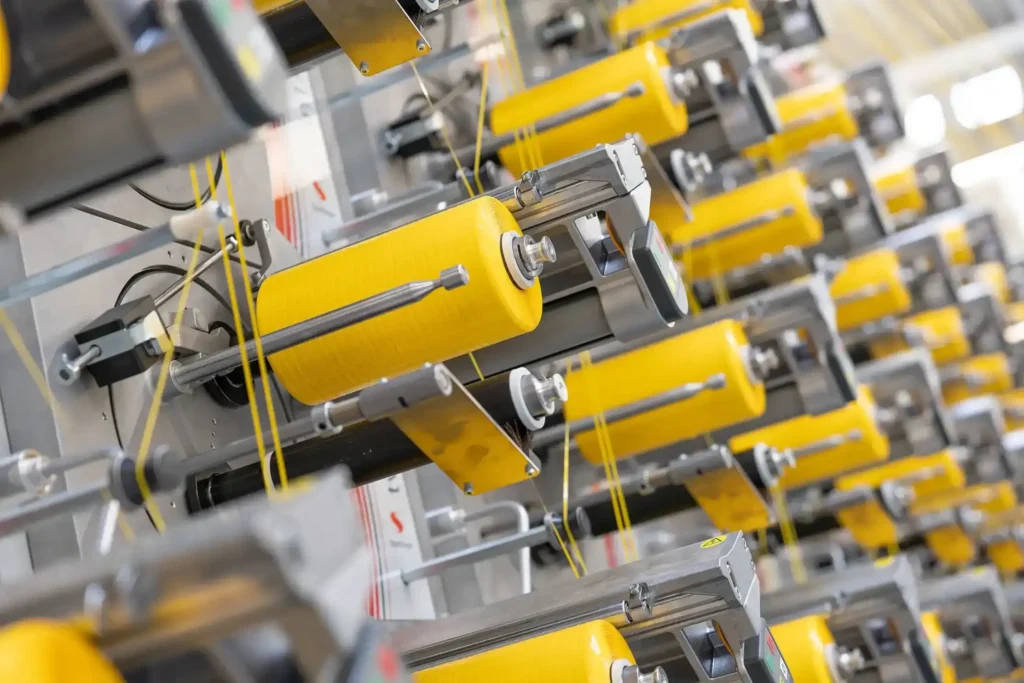
- Tape extrusion. PP resin (optionally with color masterbatch, UV, slip) becomes a thin film, then tapes. Gauge uniformity and edge quality govern the downstream denier distribution and weave stability.
- Drawing (orientation). Tapes are drawn to align polymer chains, lifting tensile and modulus. Draw ratio too high embrittles folds; too low yields limp fabric and poor seam efficiency.
- Weaving. Circular looms (tubular) or flat looms (sheet) create the shell. Pick density and loom tension must sit within tight limits; tension drift is the quiet thief of quality.
- Coating/lamination (optional). Extrusion coating (LDPE/LLDPE) or BOPP lamination smooths the face and adds barrier; coat weights around 12–40 g/m² are common. The coating choice interacts with de‑aeration requirements at the packer.
- Conversion to square bottom. Conversion lines fold and hot‑air weld tubes into block‑bottom sleeves, integrate the valve unit, and cut lengths precisely. Geometry accuracy here dictates stacking behavior later.
- Valve formation and options. Sleeve diameter and friction are matched to spout OD and product flow; options include self‑sealing or heat‑sealable valves and internal baffles for rapid de‑aeration.
- Liner integration (if required). Loose or tacked liners are introduced; seal windows (temperature, pressure, dwell) are validated to control peel strength and pinholes.
- Printing and coding. Flexographic plates and inks run on treated faces; inline verifiers guard barcode grade under real wrap and glare conditions.
- Quality release. GSM/denier checks, seam efficiency, conditioned drop tests (corner/flat), valve leak tests, moisture ingress trials for coated/liner variants, and a pallet tilt or compression check prior to shipment.
Where Square Bottom PP Valve Bags excel in chemical fertilizers
Fertilizer is varied, unforgiving, and often hygroscopic. That is precisely why Square Bottom PP Valve Bags have found a home across plants, regional blend hubs, and cooperatives.
Moisture uptake drives caking and bridge formation. Pair breathable shells with liners in humid regions; keep stacks conservative; rotate stock (FIFO). Valve sealing can reduce dust around mixers and during pallet changes.
As an oxidizer, it requires compliant hazard labeling and moisture‑resistant packaging. Squared faces keep icons visible; stable stacks reduce rework in segregated storage areas.
Sensitivity varies with formulation and prill size. The block bottom preserves neat stacks through long routes and climate swings; de‑aeration tuning prevents short‑fills on high‑speed packers.
Fine powders benefit from heat‑sealable valves and smooth print faces that keep tiny text and UPCs legible after wrap and transport.
For a broader overview of valve architectures and variants, compare with PP woven valve bags commonly used across powders and granules.
From the title to the thinking — a structured path
“Exploring Square Bottom PP Valve Bags: Applications in Chemical Fertilizers.” The title is a map. Exploring implies hypothesis and trial rather than slogans; the artifact (Square Bottom PP Valve Bags) brings a known mechanical signature; the application (chemical fertilizers) adds constraints—hygroscopicity, dust, oxidizer signage, long dwell, rough handling. With that map in hand, the work splits into four streams that later weave back together: materials, line integration, storage behavior, and compliance.
- Material architecture. Choose weave, denier, and GSM for the load; add coating/liner only where climate and caking merit it.
- Line integration. The valve is a precision interface: match spouts, calibrate breathability, guard seal windows.
- Handling and storage. Turn the square bottom’s geometry into real gains via antiskid surfaces, conservative fill levels, and pallet patterns that resist lean.
- Compliance and recovery. Keep icons honest, codes readable, recovery guidance specific to the region served.
System analysis → system synthesis
When a bag fails, we often blame a seam or a forklift. But the root cause usually sits in the system: an imbalanced wall stack, a mismatched valve, an overzealous wrap, a warehouse that breathes humidity at night. Here, we break the system into five subsystems and solve each on its own terms; then we weave the answers together.
Baseline: woven PP shell (about 60–110 GSM for 10–50 kg duty) plus an optional PE liner of 60–120 μm. Heavier liners suit sharp granules and long humid routes. The trade-off is perennial: permeability for de‑aeration versus barrier for caking control. Start conservative: uncoated shell + liner in wet climates; add single‑side coating if you need a smoother print face or a small barrier boost.
Filling speed and dust are twins. Valve sleeve inner diameter, friction, baffle design, and micro‑perforation pattern govern air escape. Heat‑sealable valves cut sifting for fine blends but demand a disciplined temperature/dwell window.
Engineer for seam efficiency, not just fabric tensile. Double‑fold seams with the right stitch density resist corner drops; bottom weld geometry must be tightly held to prevent splay and pinholes during conversion.
Moisture plus stack pressure equals caking. Countermeasures include liners, breathable shells that still sift‑proof, antiskid textures, careful fill heights, and pallet tilt checks during qualification. Row spacing and ventilation are underrated allies.
Mono‑polyolefin designs ease take‑back and film/PP collections, though curbside acceptance remains uneven. On‑pack instructions should name the route (drop‑off, take‑back) rather than wave at an abstract idea of recyclability.
Engineering tables you can lift into RFQs
Advanced notes specific to fertilizer packaging
Some truths are stubborn: humidity never sleeps; stacks remember pressure; valves that seal beautifully in the lab can hesitate on the line. These notes face those truths.
- Hygroscopicity and caking. Packaging is a lever, not a cure‑all. Where humidity is high, pair liners with conservative stack heights, dehumidification where feasible, and dispatch targets that avoid long dwell.
- Oxidizer awareness. Where ammonium nitrate is involved, keep hazard icons correct and visible; preserve moisture resistance; adopt storage segregation and stack discipline.
- De‑aeration versus barrier. Over‑sealing to fight moisture can choke airflow and inflate reject rates. Balance micro‑perforation, fabric porosity, and valve design against your barrier strategy.
- Valve sealing choices. Heat‑sealable valves cut sifting but require tight thermal windows. Internal sleeves and post‑fill taps can further reduce emissions for dusty blends.
- UV and outdoor dwell. If pallets stage outdoors, spec UV‑stabilized grades, document exposure assumptions, and use top sheets to avoid ponding on pallet tops.
A practical specification workflow
- Define the duty cycle. Product (grade, prill size, density, dust, oxidizer status), route (distance, climate, dwell), handling (conveyors, drop heights, clamp practice, wrap settings).
- Select the base fabric. Choose weave/denier/GSM to hit drop and tear targets; optimize GSM only after seam efficiency passes in instrumented drops.
- Choose the barrier architecture. Uncoated shell + liner in humid regions; add single‑side coating when print fidelity or modest barrier is required; reserve heavier liners for sharp or wet routes.
- Engineer valve and de‑aeration. Match sleeve and spout; tune perforations and baffles; set a sealing window for heat‑seal valves; verify cycle time and dust at target throughput.
- Validate storage and stacking. Agree on pallet pattern, wrap tension, antiskid spec, and stack height; run a 24–72 h tilt/compression study to observe lean.
- Align artwork and compliance. Nutrient declarations, hazard pictograms (if applicable), and disposal guidance must remain readable after wrap and cold soak; verify barcode grade in situ.
- Close the loop where possible. If curbside recovery is limited, plan take‑back or film/PP collections; separate liners at source and bale shells for transport efficiency.
Risk register — common defects and durable fixes
- Bottom corner splits. Root cause: weld geometry drift. Counter: re‑center folds, verify heat profiles, add in‑line vision on bottom formation.
- Seam tears on drop. Root cause: low stitch density or insufficient denier. Counter: double‑fold seam; raise denier; re‑validate seam efficiency.
- Liner pinholes. Root cause: sealing hotspots or sharp granules. Counter: tune seal window; increase gauge; smooth product transitions at the valve.
- Sifting at the valve. Root cause: sleeve mismatch or poor de‑aeration timing. Counter: resize sleeve; adjust baffles/perforations; tune dwell.
- Bulging, leaning stacks. Root cause: overfill and soft corners. Counter: enforce fill‑height targets; increase antiskid; adjust pallet pattern and wrap tension.
- Graphics scuffing or unreadable codes. Root cause: low dyne level or ink mismatch. Counter: raise surface energy; switch ink system; verify barcode grade post‑wrap.
Cost and carbon — what really moves the needle
Price lists tell one story; routes and rework tell another. Total cost for Square Bottom PP Valve Bags is more than resin and labor—failures, housekeeping, claims, and downtime loom large.
GSM × area dominates resin mass. Resin pass‑throughs tied to public indices keep contracts fair; scrap reduction and uptime protect margins when prices swing.
High‑speed conversion, automated handling, and inline inspection lower per‑bag cost even when resin is elevated.
Fewer ruptures and cleaner fills reduce rework, cleaning, and claims. Stable stacks cut night‑shift downtime from topples.
Reusing shells with fresh liners in internal loops, or contracting take‑back, lowers net material throughput and disposal fees—wins for cost and carbon.
An RFQ skeleton you can copy into procurement
- Product. Grade and composition (e.g., urea 46‑0‑0; NPK 15‑15‑15); bulk density; dust level; oxidizer status; target capacity (kg); pallet pattern; wrap method.
- Structure and materials. Fabric weave, denier, GSM; UV stabilization; coating (none/1‑side/2‑side, coat weight); valve type (heat‑sealable/non‑sealable), sleeve dimensions; de‑aeration features; liner gauge/polymer/integration.
- Performance targets. Drop height and pass criteria; seam efficiency threshold; dart impact for liners; barcode grade post‑wrap; stack tilt/compression results; antiskid spec.
- Compliance and artwork. Nutrient declarations; hazard pictograms (if applicable); region‑specific disposal guidance; code symbologies and placement.
- QA and acceptance. Sampling plan (AQL); in‑process audit rights; pre‑shipment inspection; documentation package.
- Commercials. Resin index linkage; lead times; MOQs; spare valve sleeve stock for packer trials.
Keywords and long‑tail phrases
Square Bottom PP Valve Bags; block bottom PP valve sacks; square‑bottom woven polypropylene valve bags; AD‑style PP valve bags for fertilizer; PP woven valve sacks for urea; moisture‑resistant PP valve bags with PE liner; micro‑perforated PP valve bags for fast de‑aeration; heat‑sealable valve sleeve woven PP bags; fertilizer packaging valve sacks 25 kg; antiskid square‑bottom PP fertilizer bags; woven polypropylene valve sacks with BOPP coating; UV‑stabilized PP valve fertilizer bags; impeller packer valve bags for chemical fertilizers; breathable coated PP valve sacks.
- Square Bottom PP Valve Bags — orientation
- The material architecture of Square Bottom PP Valve Bags
- Core features that matter in fertilizer logistics
- Production process — from pellets to pallets
- Where Square Bottom PP Valve Bags excel in chemical fertilizers
- From the title to the thinking — a structured path
- System analysis → system synthesis
- Engineering tables you can lift into RFQs
- Advanced notes specific to fertilizer packaging
- A practical specification workflow
- Risk register — common defects and durable fixes
- Cost and carbon — what really moves the needle
- An RFQ skeleton you can copy into procurement
- Keywords and long‑tail phrases
Ray, CEO of VidePak, gestures toward a production line during a facility tour:
“Square bottom PP valve bags aren’t just containers—they’re engineered ecosystems. Their structural stability and moisture resistance make them indispensable for chemical fertilizers, but what truly sets them apart is our mastery of extrusion parameters. With Starlinger and W&H equipment, we achieve tensile strength variations below 2%, ensuring every bag withstands 1.5-ton loads without fail.”
1. Introduction
Square bottom polypropylene (PP) valve bags have become the gold standard for packaging hygroscopic and corrosive chemical fertilizers, combining stackability, durability, and controlled dispensing. VidePak, a global leader with $80 million annual revenue and 526 employees, exemplifies innovation in this niche. Equipped with 100+ Starlinger circular looms and 16 W&H extrusion lines, the company produces over 20 million bags annually, serving agribusiness giants like Yara and Nutrien. This report dissects precision manufacturing processes, critical quality controls, and technological synergies that enable these bags to dominate the fertilizer packaging market.
2. Production Workflow: From Resin to Finished Bag
The manufacturing of square bottom PP valve bags involves six stages, each governed by stringent parameters:
2.1 PP Resin Preparation
VidePak sources virgin PP pellets from BASF and Sinopec, prioritizing melt flow index (MFI) ranges of 8–12 g/10 min (ISO 1133) to balance extrudability and strength.
2.2 Extrusion and Tape Formation
Starlinger’s extrusion lines operate at 170–200°C, with temperature zones controlled to ±1°C. This ensures uniform polymer melting, critical for tape consistency.
- Draw Ratio (DR): A 5:1 DR (achieved via W&H’s synchronized godet rollers) aligns polymer chains, boosting tensile strength to 35–40 MPa (machine direction).
2.3 Weaving and Lamination
Circular looms produce 12×12 threads/cm² fabric, reducing pore size to 0.1 mm. A 20 μm LDPE coating (applied via Starlinger’s laminators) achieves a hydrostatic head of 12,000 mm, preventing fertilizer caking.
2.4 Valve and Bottom Sealing
Ultrasonic welding fuses valve sleeves with <0.2 mm alignment tolerance, while heat-sealed square bottoms withstand 200 N/cm peel resistance (ASTM D882).
3. Machine-Driven Quality: Starlinger & W&H Synergy
VidePak’s equipment portfolio ensures unmatched consistency:
| Parameter | Starlinger Control | W&H Innovation | Impact on Quality |
|---|---|---|---|
| Extrusion Temp | PID-controlled zones ±1°C | Adaptive thermal sensors | Reduces MFI variance to ±0.5% |
| Draw Ratio | 5:1 with real-time feedback | Dual-stage godet rollers | Fiber strength CV < 1.5% |
| Energy Efficiency | 18% lower kWh/kg vs. industry | Regenerative braking systems | CO2 emissions reduced by 25% |
Case Study: A 2024 trial with a Brazilian fertilizer producer showed VidePak’s bags reduced transport damage by 40% compared to stitched alternatives, attributed to DR-controlled fiber alignment.
4. Critical Parameters: Temperature and Draw Ratio
4.1 Extrusion Temperature
- Underheating (≤160°C): Causes incomplete melting, leading to tape fractures (defect rate >5%).
- Overheating (≥210°C): Degrades PP chains, reducing tensile strength by 30%.
4.2 Draw Ratio Optimization
- Low DR (3:1): Fibers exhibit 20% lower crystallinity, increasing moisture permeability.
- High DR (7:1): Excessive orientation causes brittleness (elongation at break <250%).
VidePak’s 5:1 DR balances strength (38 MPa) and flexibility (400% elongation), validated by ISO 527-2 testing.
5. Sustainability and Market Alignment
- Recyclability: 98% PP recovery via pyrolysis, aligning with EU Circular Economy 2030 targets.
- Market Demand: The global agro-packaging market will grow at 5.7% CAGR through 2030, driven by Asia-Pacific fertilizer demand (Grand View Research, 2024).
- VidePak’s Edge: Proprietary LockSeam™ technology reduces valve leakage to <0.1% (vs. industry 1.5%).
6. FAQs: Addressing Industry Concerns
Q1: How do square bottoms improve palletizing efficiency?
A: The flat base increases stack stability by 50%, allowing 20% higher warehouse stacking (per ISO 2233).
Q2: Can these bags resist urea hydrolysis?
A: Yes. LDPE coatings and UV-stabilized PP resist ammonia corrosion for 18+ months, as proven in Nigerian field trials.
Q3: What certifications ensure food-grade safety for blended fertilizers?
A: FDA 21 CFR 177.1520 and EU 10/2011 compliance, with ≤50 ppm heavy metal thresholds.
7. Conclusion
Square bottom PP valve bags epitomize the fusion of material science and precision engineering. By leveraging Starlinger’s extrusion rigor and W&H’s draw ratio innovations, VidePak delivers bags that transcend packaging—they are reliability engineered into every seam. As Ray concludes, “In fertilizers, where moisture is the enemy and strength is non-negotiable, our bags don’t just contain—they protect legacies.”
Explore our innovations in chemical-resistant packaging and sustainable manufacturing.