
Breathable woven bags are a unique solution in the packaging industry, primarily designed to address the needs of various applications, including waste management and recycling. These bags provide a combination of durability and breathability, making them ideal for storing and transporting recyclable materials. In this article, we will explore the characteristics, production processes, and specific applications of breathable woven bags, especially in the context of waste management.
What are Breathable Woven Bags?
Breathable Woven Bags are textile-like industrial sacks engineered to allow controlled airflow while preserving the strength, puncture resistance, and stack stability expected from heavy-duty packaging. The fabric is created by interlacing narrow polypropylene (PP) tapes that have been slit from cast or blown film and thermally oriented for strength. Air exchange is then introduced either intrinsically (via the natural porosity of uncoated woven PP) or deliberately (via micro-perforations, vent stripes, mesh windows, or patterned apertures). The result is a package that helps powders de-aerate quickly at the filler, lets crops respire during storage, and keeps pallets tidy across long supply chains.
Because procurement language varies across regions and suppliers, the same platform appears under multiple labels. To align teams, here are the common market names for Breathable Woven Bags:
- Ventilated Woven Polypropylene Bags
- Micro-perforated PP Woven Sacks
- Breathable PP Woven Sacks
- Ventilated Bulk Bags (FIBC)
- Air-permeable Woven Poly Bags
- Vent-strip Woven PP Bags
- Perforated Woven Polypropylene Packaging
- Ventilated Block-bottom Valve Bags
- Woven Poly Produce Bags
- Breathable Poly Woven Packaging
The Materials of Breathable Woven Bags: Resin, Architecture, and Interfaces
Breathable Woven Bags are systems, not single substances. Every layer solves a failure mode: a seam that tears on the dock, a corner that ruptures in transit, a powder that cakes in coastal humidity, a produce stack that heats in storage. Below is how the materials collaborate to prevent those failures.
Polypropylene resin (base polymer)
Most woven programs specify homopolymer PP with melt flow around 2–4 g/10 min for tape extrusion. After drawing, semicrystalline domains align, yielding a high strength-to-weight ratio and excellent dimensional stability. PP’s non-polar chemistry brings low moisture uptake and broad chemical resistance, which matters in yards, warehouses, and containers exposed to seasonal swings.
- Role: mechanical spine of the woven fabric; low moisture absorption; resistance to salts, fertilizers, and many minerals.
- Where used: warp and weft tapes throughout the substrate.
- Cost levers: resin dominates BOM; additives and energy follow; dual-sourcing near-identical grades helps tame volatility.
Additives, stabilizers, and color packages
Small percentages, outsized effects. UV stabilizers enable outdoor staging; slip and anti-block adjust friction for pallet stability and robotic grippers; white masterbatch raises opacity for crisp graphics; carbon black improves UVI but can heat up in sun. Moderation is not optional—additive overuse can degrade draw behavior or print fidelity.
Fabric architecture: denier, draw ratio, weave density
Tapes are slit from chilled film, then drawn in stages to orient chains. Denier sets potential strength; draw ratio converts it; weave density (picks per inch) governs stiffness and sifting. Common constructions sit near 10×10–12×12 tapes per inch with typical fabric basis weights of ~75–110 gsm. Products with dusting risk prefer tighter constructions; produce sacks often retain more open structures or add vent components.
Breathability engineering: intrinsic vs engineered
There are two broad families:
- Intrinsic-breathable: uncoated woven PP where inter-tape gaps provide modest airflow. Use for crops and low-sift granules.
- Engineered-breathable: otherwise tight surfaces that gain airflow via micro-perforations, vent stripes, mesh windows, or patterned apertures. Use for powders on high-speed valve lines or bulk produce where directional airflow is desired.
Coatings, laminations, and surface treatments
Counterintuitive but common: breathable designs often include coatings. A thin PP or PE layer (about 20–40 μm) smooths the print face, controls sifting, and enables pinch-top heat sealing. Airflow is then introduced with carefully placed micro-perfs or vent stripes. Surface treatment (corona or flame) raises surface energy for inks, while overprint varnish resists rub on conveyors.
Closures, valves, and liners
Open-mouth sacks close with sewing (chainstitch/lockstitch) or pinch-top sealing. Valve sacks use internal or external sleeves matched to nozzle diameter; the sleeve geometry plus micro-venting manages de-aeration during fill to prevent “pillowing.” In produce FIBCs, longitudinal vent stripes are stitched into side panels to keep air moving through the stack. Liners are generally avoided in produce (they block airflow) but appear in powders needing odor or oil barriers.
Feature Set: What Breathable Woven Bags Actually Deliver
Good packaging is judged by outcomes, not adjectives. Here is how Breathable Woven Bags translate design choices into dock-visible results.
- Fast de-aeration: engineered vents purge trapped air so fillers maintain BPM without “pillow” bags.
- Moisture moderation: airflow enables crops to respire and reduces condensation pockets; polymer faces still resist rain and splashes.
- High strength-to-weight: oriented tapes and balanced weaves endure drops, drags, and bumps at modest mass.
- Clean pallets: sift control from coatings and seam design keeps dust inside and labels legible.
- Stack stability: block-bottom or square-ends create brick-like units; anti-skid embossing prevents layer-to-layer slip.
- Print presence: treated faces accept crisp flexo; optional BOPP laminations elevate gloss and scuff resistance for retail-facing sacks.
- Scalability: the same principles scale from 10–50 kg sacks to ventilated FIBCs handling 1,000 kg+ of agricultural produce.
Production Process: From Pellet to Pallet
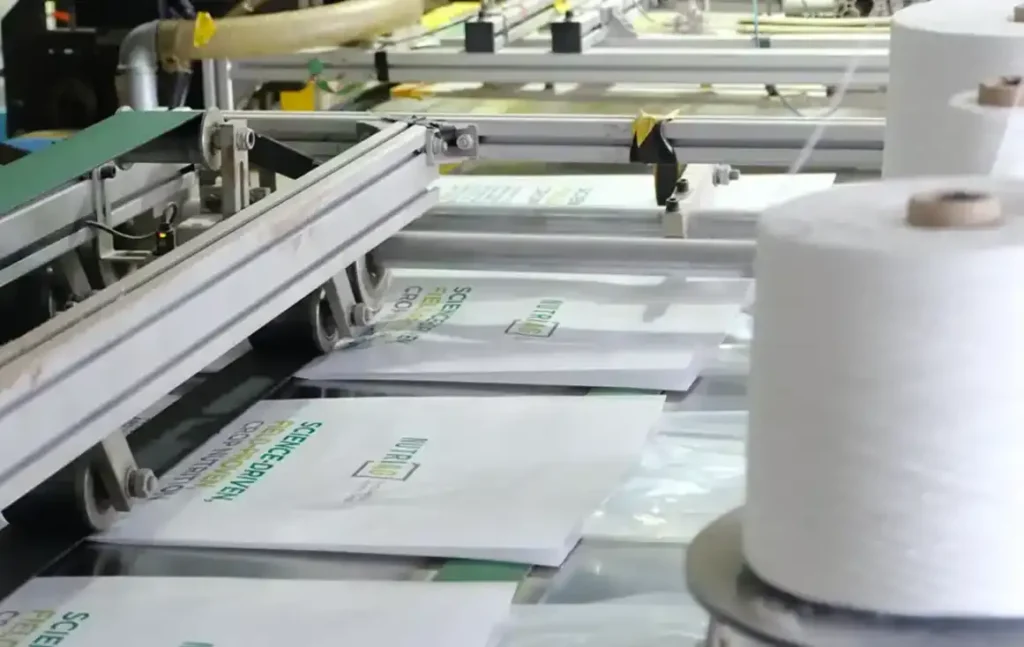
Manufacturing excellence is choreography. Heat and tension build tapes; looms build fabric; finishing builds function; conversion builds geometry. Drift at any step becomes tomorrow’s complaint ticket.
- Extrusion and slitting: PP pellets are cast or blown into film; chill-rolls lock thickness; razor slits cut tapes with narrow width tolerance.
- Drawing: tapes are heated and stretched in stages to align chains; draw ratio matches resin MFR and line speed.
- Weaving: circular or flat looms interlace warp and weft to target density; detectors flag broken ends and pick variation.
- Surface preparation: corona/flame treatment boosts surface energy; primers can follow for demanding print jobs.
- Coating/lamination (as required): a thin PP/PE layer (≈20–40 μm) smooths the face, enables heat-seal, and tightens WVTR; anti-skid emboss may be added.
- Breathability engineering: needle or laser micro-perforation in targeted zones; or, in FIBCs, sewing of vent stripes or mesh panels into sidewalls.
- Printing: water-based flexo with OPV (matte/gloss) for rub resistance; registration and ΔE controls protect brand color.
- Conversion: tubing, bottom formation (block-bottom/pinch-bottom), valve insertion or hem prep, sewing/heat sealing.
- Quality checks: drop/seam tests, air-permeability band checks, WVTR where relevant, dimensional audits, and graphics rub.
Application Scenarios: Where Breathable Woven Bags Excel
It is tempting to list markets. It is more useful to list risks and show how Breathable Woven Bags neutralize them.
- Dusty powders → block-bottom valve sacks with targeted micro-perfs.
- Retail-facing → pinch-bottom open-mouth with EZ-open and varnished print.
- Legacy lines → sewn open-mouth with crepe tape and heavy hems.
- Bulk produce → ventilated FIBCs with longitudinal vent stripes.
Engineering the Airflow: How to Quantify “Breathable”
Breathability is a number before it is a claim. Here is a practical way to quantify and tune it.
- Air-permeability band: specify airflow (e.g., CFM or L/m²·s) at a defined pressure differential and temperature. Set a band, not a single point, to allow for process variation while protecting fill rate.
- Perf strategy: for valve sacks, concentrate micro-perfs near the valve quadrant; for produce, distribute vent area evenly around the body or use vent stripes on all sides to minimize hot spots.
- Moisture vs airflow trade: more holes mean more venting and more ingress; coastal lanes or monsoon seasons may demand fewer/lower-diameter perfs and greater reliance on intrinsic fabric porosity.
- Validation: pressure decay tests for linered powders; continuous temperature logging in produce stacks; dust-loss grams measured under typical BPM on the filler.
System Thinking: From Sub-problems to a Single Specification
Design moves fast when teams share a common map. Break the challenge into five parts, solve each, then recombine into one coherent, testable spec for Breathable Woven Bags.
- Product physics: bulk density; particle size/shape; hygroscopicity; respiration/latent moisture; oil/fat content.
- Filling line dynamics: gravity vs pneumatic; nozzle geometry; target BPM; de-aeration window; dust capture system.
- Distribution climate: humidity cycles; temperature extremes; outdoor dwell; UV exposure; pallet height and dwell time.
- Regulatory & claims: food contact where applicable; hazard pictograms for chemicals; recyclability marks that match local law; barcode and QR standards.
- Automation & safety: bag friction for end-effectors; compressibility; geometry tolerance; permissible manual lift weight.
Synthesis rule: set outcome targets first (air-permeability band; drop matrix; dust loss grams; pallet-lean incidents; WVTR band if relevant). Then back-solve: fabric gsm, venting method, coating microns, UVI package, and closure strategy.
Technical Tables: Decisions at a Glance
Table 1 — Construction options and breathability levers
| Subsystem | Typical options | Purpose | Impact levers |
|---|---|---|---|
| Woven PP fabric | 10×10–12×12 tapes/in; 75–110 gsm | Base strength; intrinsic porosity | Denier; draw ratio; weave density |
| Coating/lamination | PP or PE (≈20–40 μm) | Print face; sift control; heat seal | Thickness vs bond; anti-skid emboss |
| Breathability method | Uncoated fabric; micro-perfs; vent stripes; mesh windows | Controlled airflow | Perf count/diameter; stripe count |
| Valve/sleeve | PP fabric, PE film, non-woven | De-aeration during fill | Sleeve length/angle |
| Surface treatment | Corona/flame; OPV varnish | Ink adhesion; rub resistance | Treatment level; varnish type |
| UV package | UVI rating (e.g., 1,600 h) | Outdoor staging | Stabilizer dosage |
Table 2 — Application-tuned examples
| Use case | Capacity | Preferred breathability | Format | Additional notes |
|---|---|---|---|---|
| Potatoes/onions/carrots | 25–1,000+ kg | Vent stripes or mesh windows | Ventilated FIBC; gusseted sacks | Promote cross-flow; reduce temperature shock |
| Fertilizers/minerals (granular) | 25–50 kg | Intrinsic porosity; optional micro-perfs | Open-mouth; valve | UV-stabilized fabric for yard storage |
| Cement/gypsum/powders | 25–50 kg | Micro-perfs focused near valve | Block-bottom valve | Faster fill; less “pillowing” |
| Wood pellets/charcoal | 10–25 kg | Intrinsic porosity or light perforation | Open-mouth | Controls moisture accumulation and odors |
Table 3 — Performance targets (set before RFQ)
| Metric | Typical target band | Why it matters |
|---|---|---|
| Air permeability | Tuned to filler (e.g., X–Y CFM at ΔP) | Fill speed; bag shape control |
| Drop performance | ≥10 drops @ 1.0–1.2 m (25 kg) | Transit survivability |
| Seam efficiency | ≥85% | Avoid seam failures |
| Dust-loss at filler | Line-specific grams | Cleanliness; worker safety |
| UVI rating | Per storage profile (e.g., 1,600 h) | Outdoor resilience |
Table 4 — Failure modes and controls
| Failure mode | Likely cause | Design control |
|---|---|---|
| Caking on arrival | WVTR too high; insufficient airflow balance | Thicker polymer where needed; tune perf density; consider pinch-top for hermeticity |
| Dusty pallets | Leaks at valve or seams | Heat-sealable sleeve; anti-sift seam design; targeted micro-perfs |
| Leaning stacks | Geometry or friction inconsistency | Block-bottom; anti-skid emboss; wrap pattern alignment |
| Unscannable barcodes | Ink rub; low contrast | OPV varnish; quiet zones in layout; darker base shade |
Table 5 — Cost architecture levers
| Lever | Typical impact |
|---|---|
| Lower fabric gsm one step | Reduces cost; re-check drop/tear margins |
| Reduce coating microns | Lowers mass and cost; verify bond and friction |
| Add anti-skid emboss | Slightly higher conversion cost; fewer pallet reworks |
| Switch to targeted micro-perfs | Improves fill speed control; minor conversion cost |
| Increase run length (10k → 50k) | Unit price bends to volume; plan inventory/artwork |
Keyword Architecture and a Single Helpful Link
Use buyer-language judiciously and naturally: breathable woven bags; ventilated woven polypropylene bags; micro-perforated PP woven sacks; ventilated FIBC bulk bags; breathable poly woven packaging; vent-strip bulk bags; air-permeable woven polypropylene; UV-stabilized woven poly produce bags; breathable block-bottom valve bags; recyclable mono-PP breathable packaging. For a concise glossary on the base substrate, see woven polypropylene bags.
From Working Title to Structured Page: A Note on Method
The writing path mirrored the headline. Define Breathable Woven Bags and reconcile aliases. Connect materials to function—how resin, architecture, and venting prevent real failures. Translate features into metrics the dock can see. Walk the process so controls are explicit. Frame applications as risk-control scenarios. Then condense the trade-offs into tables to accelerate cross-functional decisions. Long sentences sit beside short ones; rhetorical questions poke at assumptions; parallel clauses and contrasts sustain rhythm. The aim is clarity teams can act on—engineering can specify, procurement can quote, operations can run.
Understanding Breathable Woven Bags
Breathable woven bags are made from woven polypropylene (PP) or other synthetic fibers that allow air to circulate. This feature is particularly advantageous for applications involving organic materials, where moisture management is crucial. Unlike traditional plastic bags, breathable woven sacks prevent the buildup of heat and moisture, which can lead to spoilage or degradation of the contents.
Key Characteristics of Breathable Woven Bags
- Ventilation: The woven structure allows air to flow through the bag, reducing moisture buildup.
- Durability: Made from high-quality materials, these bags are resistant to tearing and puncturing.
- Reusability: Breathable woven bags can be used multiple times, making them an eco-friendly option.
- Customization: They can be produced in various sizes, colors, and with different printing options to suit specific needs.
Production Process of Breathable Woven Bags
The production of breathable woven bags involves several key stages:
| Stage | Description |
|---|---|
| Raw Material Selection | High-quality polypropylene or other fibers are chosen for their durability and breathability. |
| Weaving | The fibers are woven together to create a breathable structure, allowing air circulation while maintaining strength. |
| Coating (Optional) | Some bags may undergo coating to enhance their moisture resistance, although this can affect breathability. |
| Cutting and Sewing | The woven fabric is cut to size and sewn into bags, often with reinforced seams for added durability. |
| Quality Control | Each batch undergoes rigorous testing to ensure they meet the necessary standards for strength and breathability. |
| Printing and Customization | Bags can be printed with logos or designs as per client requirements. |
Applications in Waste Management
Breathable woven bags are particularly effective in waste management, providing a reliable solution for collecting and storing recyclable materials. Here are some specific applications:
- Collecting Recyclables: These bags can be used for collecting materials such as paper, plastics, and metals, facilitating easy sorting and recycling.
- Organic Waste Management: The breathable nature of these bags helps in managing organic waste, allowing it to decompose without odor buildup or spoilage.
- Storage Solutions: They serve as excellent storage options for recyclables before they are transported to recycling facilities, ensuring that materials remain in good condition.
Preventing Material Leakage
One of the primary concerns in waste management is preventing the leakage of materials, particularly when dealing with fine particles or organic waste. Here’s how breathable woven bags address this issue:
- Design Features: The tightly woven fabric minimizes the size of openings in the bag, reducing the chances of small particles leaking out.
- Internal Liners: Many breathable woven bags come with an optional inner liner that provides an additional layer of protection against leaks. This liner can be made from a variety of materials, depending on the contents being stored.
- Sealing Techniques: Advanced sealing techniques at the bag’s opening ensure that contents remain secure and prevent spillage during transport.
Advantages Over Traditional Bags
Breathable woven bags offer several advantages over traditional plastic bags, especially in the context of waste management:
- Environmental Impact: Being reusable and recyclable, these bags reduce the amount of single-use plastic waste generated.
- Cost-Effectiveness: While the initial investment may be higher, the long-term durability and reusability of breathable woven bags result in cost savings.
- Improved Efficiency: The ability to manage moisture and odors effectively leads to a more efficient waste management process.
The Future of Breathable Woven Bags
As the focus on sustainability grows, the demand for breathable woven bags is expected to increase. They present a viable solution for businesses looking to minimize their environmental impact while effectively managing waste. Innovations in materials and production processes will likely enhance their functionality, making them even more appealing to various industries.
Conclusion
Breathable woven bags represent a significant advancement in the packaging industry, particularly for waste management and recycling applications. Their durability, breathability, and versatility make them an ideal choice for collecting and storing recyclable materials. As awareness of sustainability continues to rise, the role of breathable woven bags in promoting eco-friendly practices will undoubtedly expand.
By focusing on the key aspects of breathable woven bags and their applications, this article highlights the importance of choosing the right packaging solutions for waste management. The innovative design and production methods used in creating these bags ensure that they meet the growing demands of sustainability and efficiency.