
What Are Tubular Woven Bags with Form‑Fill‑Seal (FFS) Systems?
Tubular Woven Bags with Form‑Fill‑Seal (FFS) Systems are polypropylene woven packages supplied as continuous tubular sleeves or pre‑made rolls that are automatically formed, filled, and sealed on FFS machinery. Instead of relying on manual sewing or semi‑automatic stations, the substrate enters an FFS line, is registered by photoeyes, shaped by forming shoulders, filled by augers or scales, then closed with calibrated heat‑seal jaws or fold‑over seals. The result is a repeatable pack geometry, fewer touch points, tighter hygiene control, and higher overall equipment effectiveness (OEE) for powders, granules, and pellets—especially in animal feed, aquafeed, pet food, seeds, fertilizers, minerals, salts, and resins.
Also known as (aliases for buyer cross‑reference)
- Tubular PP Woven FFS Bags
- Tubular Woven Sacks for FFS
- FFS‑Compatible Tubular Woven Sleeves
- Tubular Form‑Fill‑Seal Woven Bags
- Woven Polypropylene FFS Tubing
- Automated FFS Tubular Woven Packaging
Why this many names? Because the same idea serves many priorities at once. Production wants speed; quality wants consistency; safety wants cleaner closures; logistics wants pallets that behave. Tubular Woven Bags with Form‑Fill‑Seal (FFS) Systems are the compromise that isn’t a compromise: textile toughness with film‑like automation.
One‑line purpose
Convert FFS line speed into delivered reliability by holding shape, controlling dust, and sealing cleanly—bag after bag.
Primary users
Animal feed mills, aquafeed plants, pet food brands, seed and fertilizer packers, chemical/mineral producers.
Key difference
Tubular geometry + engineered venting + controlled sealing windows = faster fills, tighter weights, calmer pallets.
The Materials of Tubular Woven Bags with FFS Systems
Every layer in Tubular Woven Bags with Form‑Fill‑Seal (FFS) Systems is there to control a behavior you can measure. The woven mesh carries the load; coatings and laminates deliver sealing and print; venting patterns evacuate air at the spout; liners add barrier and hygiene; finishes tune pallet friction; additives stabilize against UV or static. The stack‑up below links each component to outcomes on your line and in your lane.
Material stack by function
- Woven polypropylene fabric (structural chassis): PP is extruded as film, slit into tapes, draw‑oriented, and woven (circular/flat) into a tubular sleeve. Denier, GSM, and weave density tune tensile/tear and creep.
- Coatings and laminates (surface & sealing system): PP/PE extrusion coats (≈15–35 µm) close pores and create a heat‑sealable face. BOPP laminates (18–35 µm, reverse‑printed) protect graphics and control surface friction via matte/gloss balance.
- Venting architecture (de‑aeration): micro‑perfs, laser vents, or hot‑needle arrays release entrained air so weights settle fast and seals don’t fight pillows.
- Liners (barrier & hygiene): loose or form‑fit PE/PP liners add moisture/odor protection; antistatic options handle flammable dusts; high‑slip liners aid discharge.
- Finishes and textures (pallet behavior): anti‑slip stripes, micro‑emboss, and matte coats tune COF for taller stacks and long sea legs; over‑varnish protects codes.
- Additives and color systems: UV packages extend outdoor life; antistat reduces cling; masterbatches set opacity and brand color; slip/anti‑block agents used where liners are present.
Cost is a set of dials, not a verdict. Thin coats widen margins but narrow seal windows; heavy laminates look premium yet may scuff without varnish; higher GSM resists abuse but stiffens folds. The right recipe is the one that survives your hazards at the lowest total cost of failure.
| Component | Typical Options | Influence on Behavior |
|---|---|---|
| Fabric GSM | 80–120 g/m² | Strength vs. pliability; seam efficiency; drop survivability |
| Tape denier | 800–1200 D | Tensile/tear balance; creep resistance |
| Weave density | 12×12 to 14×14 | Dimensional stability; print laydown; porosity |
| Coating thickness | 15–35 µm | Splash resistance; heat‑seal window; COF |
| BOPP gauge | 18–35 µm | Graphics fidelity; rub resistance; barcode life |
| Anti‑slip strategy | Matte varnish; stripes; emboss | Pallet stability; wrap cuts reduction |
Tip: design the obvious weak link. If anything must fail, let it be a seal you can test and control—not an invisible delamination discovered at the worst time.
What Are the Features of Tubular Woven Bags with FFS Systems?
Features matter when they answer predictable problems. The following attributes translate engineering nouns into operator verbs and logistics outcomes.
- Automation‑ready geometry: tubular sleeves feed evenly, track straight, and seal square; register marks help jaws land exactly where they should.
- Throughput with control: micro‑perfs and vent bands evacuate air so weights settle quickly; line variance shrinks; dust abatement improves.
- Hygienic closures: heat seals and fold‑over seals reduce stitch holes and fiber shedding; fewer harbor points than sewn tops.
- Graphic headroom: reverse‑printed BOPP protects color; matte/gloss control maintains shelf look while keeping COF in range; scan rates stay high.
- Pallet stability: anti‑slip textures and COF targets set column behavior; pallets arrive upright; wrap damage declines.
- Durability under abuse: woven PP tolerates abrasion and point loads from conveyors and forks; base zones can be reinforced without making the whole bag stiff.
- Monomaterial potential: PP woven + PP coat + BOPP yields an all‑PP substrate in many specs, easing sortation in PP streams.
Reader prompt
Which failure taxes you most—sifted dust, toppled pallets, or scuffed branding? That answer allocates budget toward venting, COF control, or BOPP lamination.
What Is the Production Process of Tubular Woven Bags with FFS Systems?
From pellets to pallets, consistency wins. VidePak standardizes on heavy‑duty woven platforms from Austria’s Starlinger and high‑register printing/lamination and converting from Germany’s W&H (Windmöller & Hölscher). Stable tension, clean selvages, accurate register, and tight gauges are not luxuries—they are risk controls.
Upstream: raw material selection and checks
- Virgin PP matched to target melt flow and draw ratio; CoAs archived; moisture checked.
- Masterbatches: UV, antistat, color; compatibility verified lot by lot.
- BOPP and coatings: gauge, haze, surface energy verified; bondability mapped.
Core manufacturing
- Tape extrusion & drawing: film slit to tapes, oriented; tighter tape width/gauge improves weaving and seam integrity.
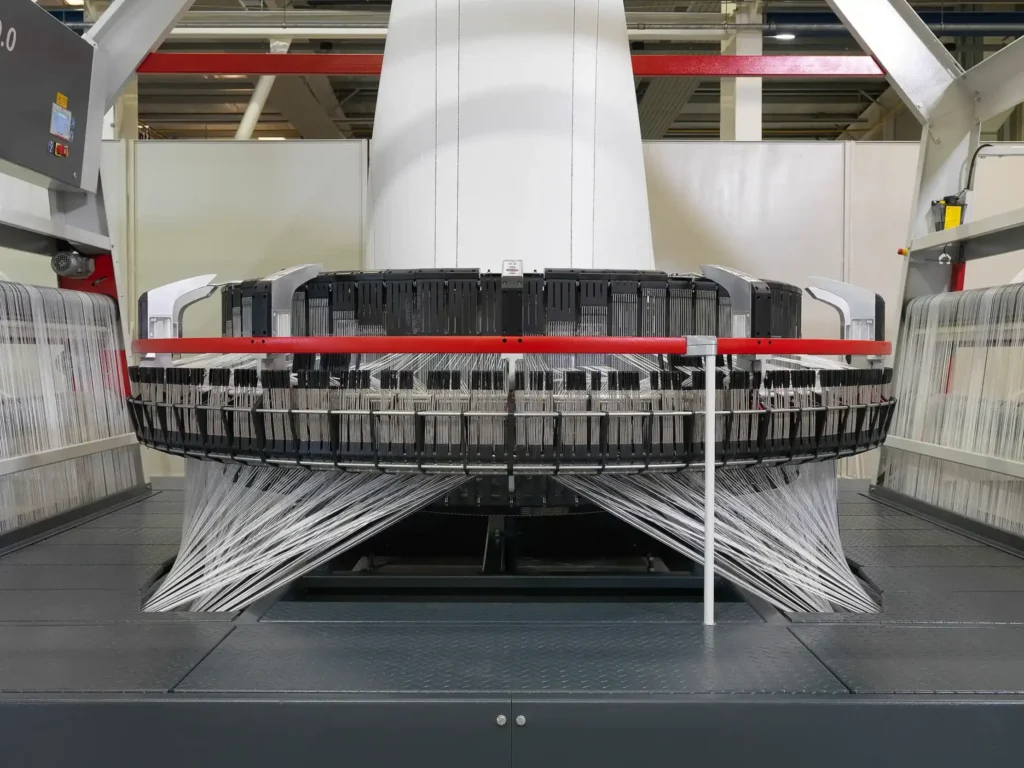
- Weaving (tubular or flat): circular looms produce sleeves; flat looms feed forming/overlap seams. Weave density set per load/print needs.
- Coating/lamination: PP/PE coat for splash and sealability; reverse‑printed BOPP bonded for premium graphics.
- Venting engineering: micro‑perf or laser arrays applied according to bulk density and fill speed; validate with scale behavior and dust index.
- Printing: W&H presses deliver register precision; rub‑fast inks protect handling icons, barcodes, and regulatory panels.
- Conversion: cut‑off control, header design for reliable infeed, bottom formation (if required), and eye marks for photoeyes.
- Palletizing: square stacks; COF‑matched wrap; corner boards; pallet cards with lot and revision.
Downstream QA and release
- Dimensions: width, cut length, tube squareness, header accuracy.
- Mechanicals: tensile/tear, burst, drop; seam strength and seal peel/burst on representative jaws.
- Surface: COF, rub/adhesion, barcode readability, color drift (ΔE).
- Venting: flow metrics and dust index at line speed; pillow index post‑seal.
- Sampling: AQL release with retains archived per SOP.
The fewer the surprises on the floor, the quieter the claims inbox. Standards + stable equipment + simple specs = predictable pallets.
What Is the Application of Tubular Woven Bags with FFS Systems?
Because they blend textile toughness with automated sealing and controlled venting, Tubular Woven Bags with Form‑Fill‑Seal (FFS) Systems fit a wide industrial map. The scenarios below tie format choices to day‑to‑day outcomes.
- Animal feed and pet food: fast‑fill pelleted feed and crumbles demand de‑aeration and strong, hygienic seals. BOPP‑laminated versions carry brand panels into retail while matte balances shelf look with stacking friction.
- Aquafeed and specialty nutrition: higher fat levels and oil‑coated pellets challenge seals. Controlled heat‑seal windows, high‑slip liners, and targeted vents keep seals tight and pallets square in humid marine climates.
- Seeds and grains: gentle handling, antistatic provisions (dust), and traceability printing (QR/Datamatrix) support identity‑preserved crops and regulated lots.
- Fertilizers and soil amendments: coated faces or BOPP resist yard humidity; matte stripes stabilize pallets during long inland hauls; UV packages extend outdoor life.
- Salt, sugar, premixes, and minerals: sift‑proof venting and abrasion‑tolerant woven bases keep fines in and tines out. Reverse‑printed graphics prevent scuffing of regulatory text.
- Industrial chemicals and resins: antistatic features, venting control, and liner integration make woven FFS formats competitive with film FFS while preserving woven durability.
Related reading
To compare a closely related interface and heat‑seal control, review FFS roll films with heat‑seal know‑how and note when film‑based lanes complement tubular woven FFS programs.
How VidePak Controls and Guarantees the Quality
Quality is not a slogan; it is a rhythm on the floor. VidePak’s rhythm converts standards into habits and habits into outcomes.
- Standards first: design and testing aligned to mainstream frameworks—ISO, ASTM, EN, JIS. Test suites include tensile/tear, seam efficiency, burst, drop, tilt/stack, COF, rub, and liner WVTR where relevant.
- 100% new raw materials: virgin PP, certified masterbatches, compliant inks/varnishes, and traceable liners minimize drift and simplify root‑cause investigations.
- Best‑in‑class equipment: Starlinger for woven‑package platforms and W&H for high‑register printing/lamination narrow process windows and lift first‑pass yield.
- Full‑stack inspection: IQC on resins/films/inks; IPQC on tape gauge, weave density, coating/lamination bond, vent geometry, seal peel/burst; FQC on dimensions, mechanics, sift‑proofing, COF, graphics.
- Instrumented action: SPC dashboards on draw ratio, loom stoppages, bond strength, register, and FPY; CAPA projects close loops on excursions; retains archived for trace.
Why standards?
Comparable data builds trust across sites and auditors. Only numbers with methods can be defended.
Why virgin inputs?
Predictable strength and bond behavior beat cheapness that arrives with surprises. Fewer surprises, fewer claims.
Why Starlinger & W&H?
Tight tension windows and crisp register are invisible safety nets that keep little errors from becoming big ones.
System Thinking: From Hazards to Specs to Outcomes
Treat Tubular Woven Bags with Form‑Fill‑Seal (FFS) Systems as interacting subsystems. Break the problem down—mechanics and load path, filling interface, moisture/odor control, identity and communication, logistics and pallet stability, end‑of‑life—and then recombine into a coherent specification that behaves the same way every shift.
| Subsystem | Levers | What Shifts When You Pull Them |
|---|---|---|
| Mechanics & load path | Fabric GSM/denier, base reinforcement, seal jaw width/dwell | Drop survival, corner crush, seam retention, peel/burst |
| Filling interface | Vent pattern, liner venting, fill profile, jaw temperature | Fill speed, weight variance, dust index, pillow index |
| Moisture & odor | Coat vs. BOPP, liner gauge/material, storage SOPs | Caking risk, aroma retention, shelf comfort |
| Identity & communication | Color coding, iconography, barcode targets, varnish choice | Right action at a glance; scan rates; rub‑fast text |
| Logistics | COF tuning, corner boards, wrap recipe, pattern | Topple frequency, damage rate, container utilization |
| End‑of‑life | Monomaterial PP, separable liners, labeling | Sorting ease, reclaim, waste avoidance |
Recombine thoughtfully. For odor‑critical organics, choose generous liner gauge and secure heat‑seal windows. For moisture‑hating powders, target lower WVTR and add matte varnish to stabilize pallet friction. For returns‑sensitive consumer packs, specify peelable seals and friendly opening features.
Parameters and Ranges: Color‑Coded Quick Reference
| Parameter | Typical Range / Options | Purpose / Notes |
|---|---|---|
| Fabric GSM | 80–120 g/m² | Strength vs. pliability; seam and drop performance |
| Weave density | 12×12 to 14×14 | Dimensional stability; porosity; print laydown |
| BOPP gauge | 18–35 µm | Rub‑fast premium graphics; barcode life |
| COF (bag/bag) | 0.35–0.55 via stripes/matte | Pallet stability through vibration and ramps |
| Seal jaw width | 8–14 mm | Peel/burst margin; tolerance to variation |
Quality and Performance Tests That Matter
| Test | Protects Against | Tighten When |
|---|---|---|
| Seam strength | Top/bottom failures on lift and set‑down | Tall stacks; heavy density products; long sea legs |
| Drop test | Corner crush, impact puncture | Rough yards; export; high forklift traffic |
| COF | Stack slippage and wrap cuts | Tall columns; smooth films; sea vibration |
| Rub/adhesion | Illegible graphics and codes | Retail‑facing SKUs; regulatory environments |
Troubleshoot Once, Fix for Good
Most field issues trace to a few repeat offenders. A seam opens because the hem is thin, the needle too large, or stitch density too low. A pallet leans because COF is mismatched to the wrap recipe. Odor escapes because liner gauge is thin and seals are narrow. Each has a countermeasure you can code into the spec and train into the shift.
| Symptom | Likely Causes | Corrective Actions |
|---|---|---|
| Pillow after seal | Vent density too low; fill profile too aggressive | Increase micro‑perfs; add vent band; modulate fill profile |
| Seal leakers | Insufficient jaw temperature/dwell; contamination | Raise temp/dwell; clean jaws; adjust fold geometry |
| Barcode scan failures | Gloss glare; ink/varnish mismatch | Matte varnish; increase barcode x‑height; retune ink |
| Pallet slippage | Low COF; glossy BOPP | Matte balance; anti‑slip stripes; retune wrap |
Cost, Risk, and the Pallet You Actually Ship
A unit price can seduce; a total cost can educate. The bag that looks cheap but pillows into its neighbor is not cheap. The line that moves fast but pushes rework downstream is not fast. Specify to the lane you have: define barrier bands, seal windows, pallet recipes; and measure outcomes you actually pay for—intact pallets per hundred shipped, rewrap hours per week, kilograms per container, claims per million, days between issues. Tubular Woven Bags with Form‑Fill‑Seal (FFS) Systems set up with discipline lower each of those numbers without calling attention to themselves.
A quiet KPI dashboard is not an accident; it is the echo of a well‑written specification executed on stable equipment by teams watching the right numbers.
Sustainability and End‑of‑Life
Multilayer packaging can complicate recycling, but design choices can soften trade‑offs. Favor monomaterial PP pathways (woven + PP coat + BOPP), document separable liners, and print guidance for sorting. The highest‑impact sustainability action is durability: packages that do not fail prevent emergency repacks and wasted trips.
KPI Dashboard Ideas
- Mechanics: tensile/tear, seam strength, drop, and compression results.
- Dimensions: width/length/gusset variance; squareness; GSM; coating gauge.
- Seals: peel/burst; dust index; weight variance.
- Graphics: color drift (ΔE), register, rub resistance.
- Process: lamination bond strength, press waste, first‑pass yield.
- Field: claims per million, time to CAPA close, topple/overhang incidents.
RFQ/RFP Checklist for Woven FFS Programs
- Product map: particle size, bulk density, hygroscopicity, fat/oil level, flammability, odor sensitivity.
- Lane map: fill method, target rate, storage (indoor/yard), transport (road/sea/rail), climate.
- Geometry: width × cut length, gusset yes/no, tube squareness, header format for infeed.
- Surface: coat vs. BOPP; matte/gloss; anti‑slip strategy; micro‑perf patterns.
- Printing: method, colors, barcode specs, regulatory panels.
- Seal plan: jaw width/temp/dwell windows; fold vs. straight seal; peel/burst targets.
- QA plan: tests, acceptance bands, AQL, retain policy.
- Sustainability: monomaterial preference, separable liners, recycling guidance on print.
Comparative Notes: Woven FFS vs. Film FFS vs. Open‑Mouth
- Woven FFS vs. Film FFS: woven brings abrasion tolerance and tear resistance; film brings absolute seal simplicity; BOPP‑laminated woven splits the difference with graphics parity and textile toughness.
- Woven FFS vs. Open‑Mouth: FFS reduces manual touches and stitch holes, improves hygiene, and stabilizes cadence; open‑mouth remains versatile for mixed lines and low‑volume SKUs.
- When in doubt: map hazards (dust, humidity, abrasion, print wear) and choose the platform whose failure modes you can comfortably control.
Frequently Asked Questions (Straight Answers)
- Are all tubular woven packs heat‑sealable? Only if coated/laminated with a sealable surface; uncoated woven needs sewing or tape.
- Do micro‑perfs weaken the bag? Proper patterns vent air without creating tear paths; validate with burst/drop tests at true line speed.
- Is BOPP recyclable with PP fabric? Yes, both are PP. Many streams accept monomaterial PP structures; verify locally.
- How wide should my seal be? Typical 8–14 mm; choose wider for dusty lanes or variability; confirm with peel/burst distributions, not anecdotes.
- Why emphasize Starlinger and W&H? Because consistent gauge and register reduce variation that otherwise becomes downtime or claims.
Implementation Timeline (From Spec to First Shipments)
- Week 0–1: discovery of product, lane, and compliance.
- Week 1–2: spec draft covering GSM, weave density, coating vs. BOPP, vent plan, seal plan, COF targets, and pallet plan.
- Week 2–3: artwork approval and plates/cylinders; barcode and regulatory proofing.
- Week 3–4: pilot lot; tests—tensile/tear, burst, drop, COF, rub, seal peel/burst—plus on‑line FFS trial.
- Week 4–6: DOE adjustments; lock spec; sign AQL and retain policy.
- Week 6+: ramp with FPY monitoring and CAPA loop active.
Operator SOP Snippets (Adapt and Adopt)
Form & feed
Verify shoulder alignment; track eye‑marks; keep tension even; scrap indicators set; use anti‑static measures for dusty pellets.
Sealing
Confirm jaw temperature/pressure/dwell; make trial seals at start of shift; audit peel/burst every 50 bags; keep jaws clean.
Print & code
Measure ΔE; check quiet zones; run rub tests on the intended surface; confirm QR/barcode scan at three angles.
Technical Case Notes (Condensed but Useful)
Tubular Woven Bags with Form‑Fill‑Seal (FFS) Systems in coastal export lanes faced humidity‑driven seal variability and pallet wobble. Switching to fold‑over heat‑seal, increasing coat to 25 µm, and adding matte stripes dropped defects by over eighty percent and improved container counts through tighter stacks. In retail pet food, direct‑print woven scuffed in transit; a move to BOPP reverse print with matte/gloss balance reduced rub claims to near zero and raised scan rates with larger x‑height and improved quiet zones. For premixes with fine minerals, increasing micro‑perf density and adding a vent band cut cycle time by twelve percent while halving dust index at the spout.
Glossary
- FFS: continuous process that forms the bag, fills product, and seals in one automated flow.
- Micro‑perforation: patterned tiny holes that allow air to escape during filling.
- COF: coefficient of friction; governs pallet stability and wrap behavior.
- WVTR: water vapor transmission rate; lower values indicate better moisture barrier (liners).
- ΔE: color difference metric used in print QA and brand control.
Keyword Cluster (Natural Weaving)
tubular woven bags with form‑fill‑seal systems; tubular pp woven ffs bags; woven polypropylene ffs tubing; tubular woven ffs sacks for animal feed; bopp laminated tubular ffs bags; coated woven ffs packaging; micro‑perforated ffs woven tubes; anti‑slip tubular woven ffs sacks; heat‑sealable tubular woven bags; monomaterial polypropylene ffs woven; ffs woven bags for aquafeed; tubular woven packaging for pet food; automated ffs woven sleeves; tubular ffs sacks with liners; high‑speed ffs tubular woven.
October 25, 2025
- What Are Tubular Woven Bags with Form‑Fill‑Seal (FFS) Systems?
- The Materials of Tubular Woven Bags with FFS Systems
- What Are the Features of Tubular Woven Bags with FFS Systems?
- What Is the Production Process of Tubular Woven Bags with FFS Systems?
- What Is the Application of Tubular Woven Bags with FFS Systems?
- How VidePak Controls and Guarantees the Quality
- System Thinking: From Hazards to Specs to Outcomes
- Parameters and Ranges: Color‑Coded Quick Reference
- Quality and Performance Tests That Matter
- Troubleshoot Once, Fix for Good
- Cost, Risk, and the Pallet You Actually Ship
- Sustainability and End‑of‑Life
- KPI Dashboard Ideas
- RFQ/RFP Checklist for Woven FFS Programs
- Comparative Notes: Woven FFS vs. Film FFS vs. Open‑Mouth
- Frequently Asked Questions (Straight Answers)
- Implementation Timeline (From Spec to First Shipments)
- Operator SOP Snippets (Adapt and Adopt)
- Technical Case Notes (Condensed but Useful)
- Glossary
- Keyword Cluster (Natural Weaving)
“Our customers often ask: How can we balance sustainability with functionality in bulk packaging?”
“The answer is clear,” says Ray Chiang, CEO of VidePak. Fabric polypropylene (PP) woven bags offer unparalleled durability, cost-efficiency, and eco-friendly advantages, making them the cornerstone of modern industrial and agricultural packaging.
For over 17 years, VidePak has leveraged its 30+ years of industry expertise and cutting-edge manufacturing capabilities to deliver tailored PP woven bag solutions. With a workforce of 526 professionals and a global footprint generating $80 million in annual sales, we combine innovation with sustainability to meet the evolving demands of industries ranging from agriculture to construction.
The Science of Customization: Addressing Diverse Product Needs
PP woven bags are not a one-size-fits-all solution. Different products—such as seeds, grains, coffee beans, or starch—require specific design considerations to ensure optimal protection, shelf life, and transport efficiency. Below, we analyze key requirements across applications:
1. Seed Packaging: Balancing Breathability and Moisture Control
Seeds demand precise moisture and oxygen exchange to maintain germination rates. PP bags with controlled permeability (measured in g/m²/24h) prevent mold while allowing minimal airflow. For example, maize seeds stored in bags with a 90-100 g/m²/24h moisture vapor transmission rate (MVTR) show a 95% germination rate after 12 months, compared to 70% in non-breathable alternatives. VidePak’s BOPP laminated woven bags integrate micro-perforations to achieve this balance, ensuring seed viability even in humid climates.
Critical Parameters:
- Fabric Weight: 80–100 g/m² for structural integrity.
- Lamination: Optional BOPP coating for UV resistance.
- Inner Liners: Biodegradable PE liners for added moisture control.
2. Nut and Coffee Bean Packaging: Preventing Oxidation and Pest Infestation
Nuts and coffee beans are prone to rancidity and insect damage. Anti-static PP woven bags with aluminum foil layers block oxygen ingress (reducing oxidation by 40%) and deter pests. For example, VidePak’s kraft paper laminated bags use a 12µ aluminum foil layer to extend coffee bean freshness by 6–8 months.
Critical Parameters:
- Thickness: 0.18–0.25 mm for puncture resistance.
- Closure Systems: Heat-sealed valves to prevent tampering.
3. Grain and Starch Packaging: Stackability and Moisture Resistance
Wheat, rice, and starch require bags that withstand stacking pressures of up to 8 tons per pallet while resisting humidity. VidePak’s FIBC bulk bags with woven PP + PE liners achieve a moisture barrier efficiency of 99.5%, critical for tropical markets.
Critical Parameters:
- GSM (Grams per Square Meter): 120–150 GSM for heavy-duty use.
- UV Stabilizers: Added to outer layers for outdoor storage.
Optimizing Product Parameters: A Data-Driven Approach
Selecting the right PP woven bag involves evaluating four key factors:
| Parameter | Seed Bags | Nut/Coffee Bags | Grain Bags |
|---|---|---|---|
| Fabric Weight | 80–100 GSM | 100–120 GSM | 120–150 GSM |
| Lamination | BOPP (optional) | Aluminum foil | PE coating |
| Breathability | High MVTR | Low MVTR | Moderate MVTR |
| Closure Type | Sewn mouth | Heat-sealed valve | Pasted valve |
Case Study: A soybean exporter in Brazil reduced post-harvest losses by 22% after switching to VidePak’s 120 GSM BOPP laminated bags with integrated insect-repellent additives.
VidePak’s Competitive Edge: Technology Meets Sustainability
With 100+ circular looms, 16 extrusion lines, and 30+ lamination machines, VidePak’s Austrian Starlinger-powered facilities ensure precision at scale. Our eco-friendly PP resins are 100% virgin-grade, complying with FDA and EU food-contact standards.
Innovations Driving Market Leadership:
- Custom Multi-Layer Lamination: Combines PP with biodegradable PLA liners for compostable solutions.
- Anti-Microbial Coatings: Extend shelf life for starch and flour packaging.
- Smart Printing: 10-color rotary printers enable high-definition branding while reducing ink waste by 30%.
FAQs: Addressing Client Concerns
Q: How do I choose between laminated and non-laminated bags?
A: Lamination (e.g., BOPP) enhances moisture and UV resistance but reduces breathability. For seeds, use partial lamination; for grains, full lamination is ideal.
Q: What GSM is suitable for 50 kg rice packaging?
A: 90–110 GSM provides optimal strength-to-weight ratios. VidePak’s FIBC bags with 150 GSM handle up to 2,000 kg safely.
Q: Can PP bags be recycled?
A: Yes. VidePak’s reLÜ™ series uses 30% post-consumer recycled PP, reducing carbon footprint by 40%.
Conclusion: Partnering for a Greener Future
As global demand for sustainable packaging grows, VidePak remains committed to innovation. Our 30+ R&D specialists continuously refine fabric blends and production techniques, ensuring clients meet both regulatory and environmental goals. From custom-printed valve bags to anti-static FIBC solutions, we deliver reliability without compromising the planet.
References
- Paperboard Packaging Alliance (2025). Fiber-Based Packaging Innovations.
- Newtopchem (2025). PC41 Catalyst in Biodegradable Polymers.
- Westpak Group Ltd (2025). Sustainable Food Packaging Strategies.
- Paradise Packaging (2024). HDPE/PP Woven Fabric Applications.
- Polybags.ie (2025). Polythene Bag Market Trends.
External Links
- Explore our advanced BOPP laminated woven bags for enhanced branding.
- Learn how FIBC bulk bags revolutionize heavy-duty logistics.
Authored by VidePak’s Marketing Team | 2025-03-07