
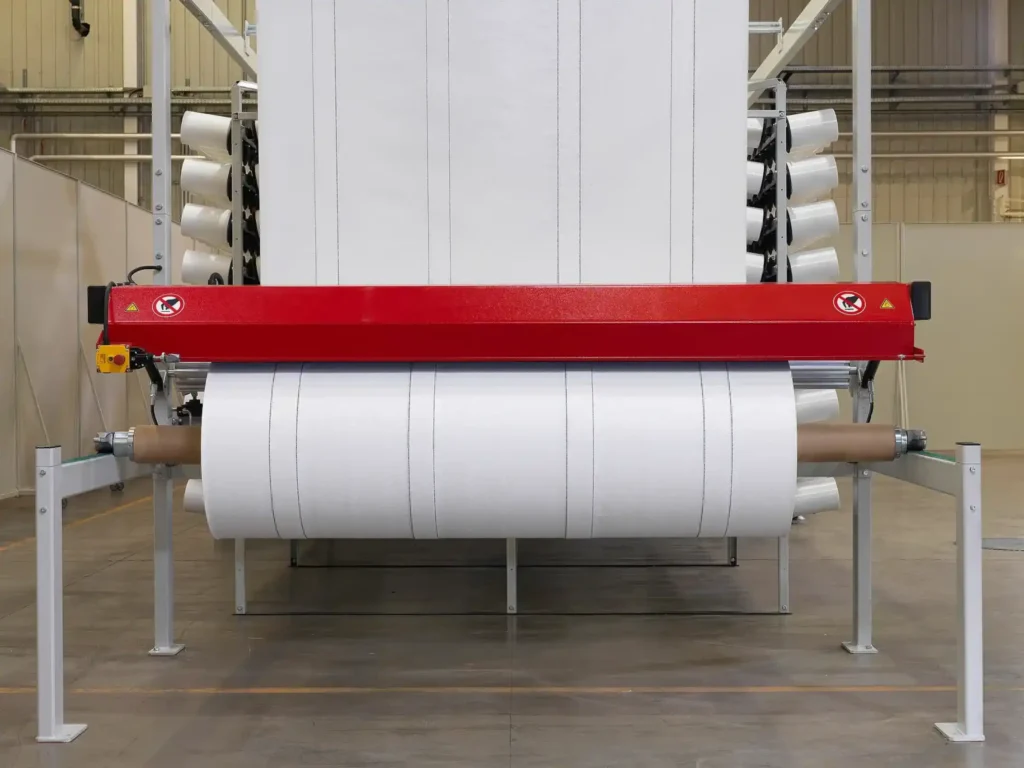
On high‑mix food lines, forming in place limits touchpoints, keeps bags square, and lets graphics change without re‑tooling. In a word: agility, without chaos.
Corona treatment and abrasion‑resistant overvarnish keep labels and barcodes readable after 1,000+ km of transit.
Outside COF protects chute speeds; inside COF prevents hang‑ups on the forming shoulder during high‑rate dosing.
Choose PP/PP for moisture‑led recipes, or add a slim EVOH layer for oxygen‑sensitive foods.
Resin → Co‑ex film → Gauge & treat → Print → Slit/wind → QA → FFS line (form/fill/seal) → Case pack → Palletize.
Plants moving to FFS PP Bags report 20–40% faster pack rates on 2–5 kg SKUs, fewer seal reworks, and better case‑pack density—often with no change to the recipe.
| Attribute | Typical Options / Values | Notes |
|---|---|---|
| Gauge (single web) | 80–140 μm | Heavier for sharp/abrasive contents |
| Gauge (tubular) | 120–200 μm | Heavy‑duty sacks and larger SKUs |
| Layflat width | 350–650 mm | Match to forming set & dose size |
| Outside COF | 0.25–0.45 | Chute flow vs. pallet grip balance |
| Corona | 38–40 dynes | Ink anchorage for flexo |
| Printing | Up to 8–10 colors | Solvent or water‑based flexo |
| Seal window | ~140–165 °C | Dependent on sealant layer |
| Dart impact | >200 g (ASTM D1709) | Buyer‑specific thresholds |
| Tensile | Per ASTM D882 | MD/TD targets by buyer spec |
| OTR (barrier builds) | <5–20 cc/m²·day (ASTM D3985) | For oxygen‑sensitive foods |
| Compliance | ISO 22000; BRCGS; EU 10/2011; 21 CFR 177.1520 | Lot‑level DoC and migration tests |
Call to action
Share your product type, target shelf life, and pack size. VidePak will return a tuned FFS PP Bags specification—gauge, layflat, sealant, barrier stack—plus a validation checklist aligned to ISO 22000/BRCGS and EU 10/2011.
- 1. Introduction: The Role of FFS PP Bags in Modern Feed Packaging
- 2. Application-Specific Challenges and Solutions
- 3. Key Parameters for Selecting FFS PP Bags
- 4. Cost-Benefit Analysis and Sustainability
- 5. FAQs: Addressing Client Concerns
- 6. Future Trends: Smart and Bio-Based Solutions
- 7. Conclusion: Elevating Feed Safety Through Engineering Excellence
“Why are FFS (Form-Fill-Seal) PP bags becoming the gold standard for livestock feed packaging?”
The answer lies in their seamless integration of automation, durability, and sustainability, enabling cost-effective, hygienic, and scalable solutions for diverse feed applications—from poultry to aquaculture. VidePak, a global leader in woven bag manufacturing, leverages advanced Austrian Starlinger machinery and 100% virgin PP materials to deliver FFS bags that meet stringent industry demands while aligning with global ESG goals.
1. Introduction: The Role of FFS PP Bags in Modern Feed Packaging
FFS PP bags, designed for automated filling and sealing, are revolutionizing livestock feed packaging by combining high-speed production (up to 120 bags/minute) with precision quality control. These bags are particularly critical for industries requiring contamination-free storage of hygroscopic or nutrient-sensitive materials, such as poultry feed, aquaculture pellets, and premixed additives. VidePak’s $80M annual revenue and global market presence underscore their expertise in tailoring FFS solutions to meet sector-specific needs.
Key Insight:
“In feed packaging, a single compromised bag can lead to spoilage costing thousands. Our FFS systems ensure hermetic seals and material integrity from production to pallet.”
— Ray, CEO of VidePak
2. Application-Specific Challenges and Solutions
Livestock feed types demand distinct packaging specifications. Below is a breakdown of critical requirements across sectors:
2.1 Poultry and Swine Feed
- Challenge: High fat content in poultry feed increases oxidation risk, while swine feed requires resistance to abrasion during transport.
- Solution: VidePak’s FFS bags with BOPP lamination (0.05mm thickness) block UV light and oxygen, extending shelf life by 30%. Anti-static coatings prevent dust explosions during filling.
2.2 Aquaculture and Fish Feed
- Challenge: Fish pellets require moisture resistance (<0.5% water ingress) and breathability to prevent mold in humid environments.
- Solution: PE-coated PP bags with micro-perforations (200–500 pores/m²) balance moisture barriers and airflow, reducing spoilage rates by 25%.
2.3 Premixes and Veterinary Additives
- Challenge: Trace nutrient degradation due to light exposure and microbial contamination.
- Solution: Aluminum foil-lined FFS bags with light-blocking layers and antimicrobial additives (e.g., silver ions) ensure compliance with FDA CFR 21 standards.
3. Key Parameters for Selecting FFS PP Bags
Clients must evaluate five critical factors to optimize feed packaging:
| Parameter | Poultry Feed | Aquaculture Feed | Premixes |
|---|---|---|---|
| Thickness (mm) | 0.08–0.12 | 0.10–0.15 | 0.06–0.10 |
| Grammage (g/m²) | 90–120 | 110–150 | 80–100 |
| Outer Layer | BOPP Laminated | PE-Coated | Aluminum Foil |
| Inner Layer | None | Micro-Perforated Film | Antimicrobial Lining |
| Load Capacity (kg) | 25–50 | 20–40 | 10–25 |
Data Source: Livestock Feed Packaging Market Report, 2025
4. Cost-Benefit Analysis and Sustainability
VidePak’s FFS bags reduce operational costs through:
- Automation Efficiency: Starlinger FFS systems cut labor costs by 40% compared to manual sewing.
- Recyclability: 100% PP construction enables closed-loop recycling, diverting 1,200 tons/year of waste from landfills.
- Energy Savings: Solar-powered extrusion lines reduce carbon footprint by 15%.
Case Study: A Vietnamese aquaculture farm reduced feed losses by 18% after switching to VidePak’s PE-coated FFS bags, achieving ROI within 8 months.
5. FAQs: Addressing Client Concerns
- How does bag thickness affect cost and performance?
Thicker bags (0.15mm+) offer higher puncture resistance but increase material costs by 20–30%. Thin films (0.06mm) suit lightweight premixes. - Are antimicrobial linings safe for animal feed?
Yes—VidePak uses FDA-approved additives like zinc oxide, which inhibit bacterial growth without leaching toxins. - Can FFS bags withstand maritime humidity?
PE coatings and hermetic seals prevent moisture ingress even at 85% RH, ideal for export to tropical regions.
6. Future Trends: Smart and Bio-Based Solutions
- IoT-Enabled Bags: QR codes for batch tracking and expiry alerts (piloted with a EU poultry conglomerate).
- Bio-PP Blends: Partnering with Braskem to develop 30% sugarcane-based PP, targeting a 2030 launch.
For insights into sustainable practices, explore our guides on automated FFS systems and eco-friendly material innovations.
7. Conclusion: Elevating Feed Safety Through Engineering Excellence
FFS PP bags are more than packaging—they are a lifeline for global food security. By mastering parameters like breathability, antimicrobial protection, and automated sealing, VidePak sets industry benchmarks while driving the transition to circular economies.
Final Perspective:
“In feed packaging, every micron of film and every sealed seam matters. VidePak’s commitment to precision ensures that nutrition reaches livestock—not landfills.”
— Journal of Agricultural Packaging Innovation, 2025