
What is FIBC Bags?
FIBC Bags—also called flexible intermediate bulk containers, bulk bags, or big bags—are engineered polypropylene containers designed to move, store, and protect powders and granules at industrial scale, typically 500 kg to 2,000 kg per unit. In fertilizer programs you’ll often hear sub‑types such as Q‑bags (baffle‑reinforced to keep a square footprint) and conductive Type C/D FIBCs where electrostatic control is non‑negotiable. At heart, FIBC Bags couple high‑tenacity woven PP fabrics with reinforced lift loops, tailored inlets/outlets, and optional liners so one collapsible container can behave like a rigid bin—stackable, crane‑ready, forklift‑friendly.
If that sounds like a contradiction—a bag that acts like a bin—it’s by design. From a systems perspective, FIBC Bags sit at the intersection of polymer science (drawn‑tape modulus, coating grammage, liner permeability), textile mechanics (weave density, seam efficiency, creep under compression), and safety engineering (SWL/SF, electrostatic behavior, drop/stack performance). Viewed horizontally against neighboring formats: paper big sacks speak “natural” but wick moisture and slump in humid depots; rigid bins are indestructible but brutal on freight and storage; small 25–50 kg sacks are ergonomic yet multiply touches, dust, and labor. FIBC Bags reconcile the trade‑offs—unitize tons, reduce handling, protect chemistry, and keep the line running. For purchasing teams mapping a packaging roadmap, it’s pragmatic to benchmark FIBC Bags alongside other PP woven solutions to pinpoint the volume at which bulk handling shifts total cost.
A vertical lens reveals cause and effect: resin grade drives drawability; draw ratio sets tensile strength; weave density and yarn denier transmit that strength into the shell; coating and liner choices govern moisture ingress and sift control; loop geometry translates fabric strength into safe lifts; anti‑static architecture governs ignition risk in dusty air. Change one dial upstream and the echo is heard downstream—in pallet lean, in caking at corners, in the hiss of sift from a seam. That is why specifiers treat FIBC Bags not as generic sacks but as calibrated containers.
What is the features of FIBC Bags?
Features matter only insofar as they prevent loss—product loss to caking, time loss to rework, safety loss to static discharge. The architecture of FIBC Bags is a catalog of countermeasures built into fabric, seam, and liner.
FIBC Bags Manufacturer
Professional manufacturer of FIBC bulk bags optimized for chemical and fertilizer packaging safety.
Check More →FIBC Bulk Bags Versatility
Versatile FIBC jumbo bags designed for secure packaging of chemicals, fertilizers, and industrial materials.
Check More →FIBC Jumbo Bags Production
Advanced manufacturing process for heavy-duty FIBC bags ideal for chemical and fertilizer storage.
Check More →Heavy-Duty Woven Bags Guide
Complete guide to industrial-grade FIBC bags for safe chemical and fertilizer bulk packaging.
Check More →Load capacity you can name and trust. Safe Working Load (SWL) windows commonly cover 500–2,000 kg; Safety Factors (SF) of 5:1 (one‑way) and 6:1 (multi‑trip) align with industry norms and ISO conventions. Stitch patterns, patch reinforcements, and loop design convert the laboratory strength of fabric into the predictable reality of a lift. A bag that can be hoisted without drama is a bag that will be filled without fear.
Moisture moderation and sift control. Fertilizers are hygroscopic storytellers: urea clumps, NPK blends cake, MAP/DAP bridge. Coated fabrics (≈ 20–35 g/m² PE/PP) slow humidity ingress; sift‑proof seams with filler cords block needle‑line leakage; tubular or form‑fit PE liners (60–120 µm) isolate product from ambient moisture and prevent odor transfer. Less caking, cleaner decanting—more flow when the gate opens.
Static safety by construction. Fertilizer dusts plus dry air plus rapid fills equal potential discharge. Type A (no electrostatic features) suits benign zones; Type B prevents brush discharges but not sparks; Type C integrates conductive threads and requires grounding; Type D uses static‑dissipative fabrics that do not require ground leads. With FIBC Bags, the electrostatic type is a design choice that maps to your process hazard analysis, not an afterthought.
Top and bottom fit the filler, not vice versa. Choose open top for crane‑fill and quick inspections; filling spout (Ø 35–50 cm) for enclosed, dust‑controlled charging; or a full duffle/skirts when multiple products share the same shell. Discharge can be flat (slit to open) or a spout with star or iris closure to meter flow. Add baffles (Q‑bag) when cube efficiency matters—squared‑off bodies reduce bulge, improve truck stuffing, and yield safer, tidier aisles.
Handling that feels predictable. 4‑loop lift is standard; 2‑loop crane‑fill is common in prilling plants; cross‑corner loops improve fork access on fast‑paced docks. Outer faces tuned to a COF of ≈ 0.45–0.60 help pallets stand straight without mummifying them in wrap. Predictability is a feature.
Identification that endures the route. Big fonts and bigger pockets. A4 document envelopes, durable labels, and 1–3 color flexo prints communicate grade, hazard statements, batch codes, and QR traceability. The goal is simple: what’s printed at origin is legible at destination.
Consider the pattern: moisture managed, dust contained, static controlled, flow predictable—four pillars that turn FIBC Bags from commodity to capability.
What is the production process of FIBC Bags?
Production is choreography; field performance is the applause. Every upstream setting on a FIBC Bags line becomes a downstream behavior on a pallet.
1) Tape extrusion & drawing. Virgin PP is extruded into film, slit into tapes, and hot‑drawn to align chains. Draw ratio governs tensile strength and elongation; die gap, quench rate, and anneal temperature lock width and crystallinity. Consistency here prevents weak lanes in fabric that later masquerade as “mystery seam failures.”
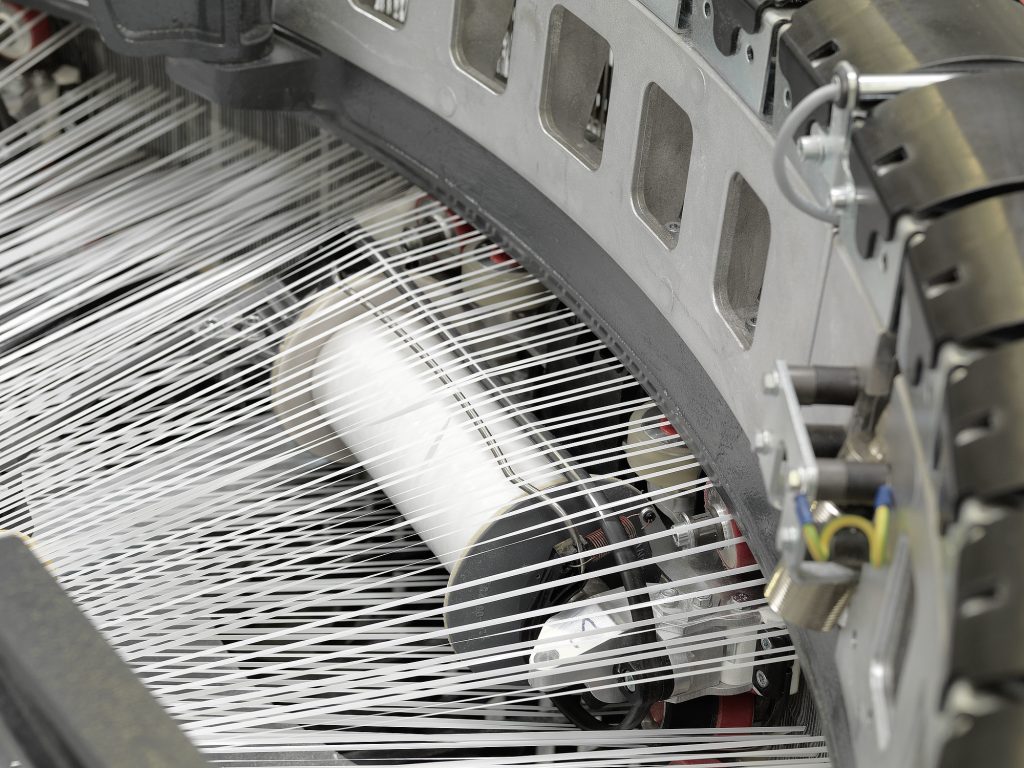
2) Weaving on circular looms. Over 100 circular looms interlace warp and weft to meshes generally 10×10–14×14 for heavy shells. Uncoated base fabrics for FIBC Bags typically run 140–240 g/m²; heavier builds or coatings are selected for higher SWL, longer dwell times, or sift‑sensitive powders. Balanced loom tension reduces skew, a small variable with large consequences in conversion and stacking.
3) Coating & lamination (as needed). A PE/PP melt coat (~20–35 g/m²) is applied where humidity moderation and print holdout are required. UV‑stabilizer packages are tuned to the route; additional films can be laminated for abrasion zones. Coating windows matter: too cool and bonds starve; too hot and the fabric over‑relaxes.
4) Cutting & component preparation. Bodies, bases, and tops are cut precisely; baffles are fabricated for Q‑bags; lift loops are woven or cut from webbing and pre‑assembled. Liner sets—tubular for standard shells, form‑fit for baffle bodies—are produced with optional antistatic formulations.
5) Sewing & assembly. High‑tenacity threads, calibrated chain/lock stitches, reinforcement patches, and sift‑proof filler cords bring the shell together. Document pockets, labels, and pictograms are applied. Loop height (typically 25–38 cm) and spacing are matched to your forklift geometry so drivers can “see and seat” without fighting the bag.
6) Testing & QA. Routine checks verify fabric tensile/tear, seam and loop strength, top‑lift and cyclic tests, COF, liner/film thickness, UV stability, and filled‑bag drop and stack performance. Where required, electrostatic behavior is validated according to the specified Type. For non‑dangerous goods programs, builds align with ISO 21898 conventions; UN‑rated options are available for regulated chemistries.
7) Palletization & hygiene. Finished stacks are interleaved and stretch‑wrapped; clean‑room or low‑lint areas are used for food‑/feed‑grade liners. The result is not an assembly of parts but a calibrated container ready for your filler and your audit.
VidePak runs this sequence on industry‑top platforms from W&H (Germany) and Starlinger (Austria)—16 extrusion lines, 100+ circular looms, and 30+ lamination/printing machines—keeping adhesion, registration, and seam strength inside documented windows, lot after lot. For adjacent categories and interoperability with smaller sacks, it’s useful to frame FIBC Bags within the broader PP‑woven ecosystem used across your plant.
What is the application of FIBC Bags?
Because FIBC Bags carry a ton without acting like a ton, they’ve become the workhorse for chemical and fertilizer supply chains where efficiency is king and safety won’t compromise.
Nitrogen, phosphate, potash & blends. Urea, ammonium nitrate*, MAP/DAP, SOP/MOP, NPK recipes—humidity moderation and sift‑proof seams keep products free‑flowing; liners mitigate caking at corners and reduce dust during decant. (*Observe local rules for oxidizer handling and storage.)
Additives & micronutrients. Zinc sulfate, borates, stabilizers, inhibitors, conditioners—form‑fit liners prevent cross‑contamination between small‑dose, high‑value chemistries; document pouches safeguard CoAs and SDSs through the voyage.
Seeds & agro‑inputs. Baffle‑reinforced FIBC Bags hold shape in tall stacks; COF‑controlled outer faces reduce leaning in depots without climate control.
Industrial chemicals & minerals. Calcium carbonate, titanium dioxide, salt, silica, resins—Type C/D static architectures mitigate ignition risk in dust‑capable zones; discharge spouts with iris or star closures meter flow to hoppers and mixers.
Ports, terminals, inland logistics. Four‑loop handling fits standard forklifts; consistent base footprints simplify container stuffing and racking; tidy stacks reduce dunnage, trip hazards, and unplanned aisle blockages.
Where retail off‑take is needed from bulk, operations often pair FIBC Bags with 25–50 kg woven sacks for on‑site decant, preserving the cleanliness of the air while restoring the convenience of smaller formats. The result is a flexible, two‑tier packaging plan that lets procurement buy in bulk while sales deliver in the sizes customers want.
Typical Parameters for FIBC Bags
The ranges below reflect widely available, real‑world specifications; VidePak provides application‑specific customization.
| Parameter | Typical Range / Option | Notes (for FIBC Bags) |
|---|---|---|
| Safe Working Load (SWL) | 500 – 2,000 kg | Select by product density, stacking plan, and route risk |
| Safety Factor (SF) | 5:1 (one‑way), 6:1 (multi‑trip) | Aligns with common industry practice and ISO conventions |
| Fabric weight | 140 – 240 g/m² (uncoated) | Heavier/coated for sift‑ or moisture‑sensitive goods |
| Coating weight | 20 – 35 g/m² | Moisture moderation and print base quality |
| Body footprint | 85×85 – 110×110 cm | Matches standard pallets and container stuffing |
| Overall height | 90 – 180 cm | Tuned to SWL, flowability, and ceiling height |
| Lift loops | 4‑loop (std.), 2‑loop (crane), cross‑corner | Loop height 25 – 38 cm for forklift visibility |
| Top options | Open / Spout Ø35–50 cm / Duffle | Select by dust profile and filling method |
| Bottom options | Flat / Discharge spout (star/iris) | Flow control and cleanout efficiency |
| Liner options | Tubular / Form‑fit PE 60–120 µm | Antistatic and barrier options available |
| Static type | A / B / C / D | Grounding for Type C; dissipative fabrics for Type D |
| COF (outer) | ≈ 0.45 – 0.60 | Pallet stability without excessive wrap |
| UV stability | 200 – 400 hours (typical) | Exposure package tuned to route staging |
| Printing | Flexo 1–3 colors | Grade, hazard, batch, brand and logistics marks |
Why VidePak
Founded in 2008, VidePak’s core team brings 30+ years of woven‑packaging experience and a workforce of 568. We manufacture FIBC Bags alongside BOPP woven, valve, and kraft‑paper woven ranges using 100% new raw materials to stabilize mechanical properties and color outcomes. Our platform—W&H printing/conversion and Starlinger tape & loom lines—spans 16 extrusion lines, 100+ circular looms, and 30+ lamination/printing machines, giving us capacity and control. With annual sales of USD 80 million and shipments across the US, Europe, Brazil & South America, Southeast Asia, Japan, Korea, Central Asia, the MENA region, East & South Africa, we convert specifications into pallets that behave exactly as drawings promise.
Ready to validate a fertilizer spec, mitigate caking, or upgrade static safety? Share product density, target SWL/SF, preferred top/bottom, liner needs, and route conditions—we’ll engineer FIBC Bags that meet your KPIs and supply the test data that proves it.
- What is FIBC Bags?
- What is the features of FIBC Bags?
- What is the production process of FIBC Bags?
- What is the application of FIBC Bags?
- Typical Parameters for FIBC Bags
Flexible Intermediate Bulk Containers (FIBC) have emerged as an essential solution for packaging chemical fertilizers and construction materials. Their high durability, customizable features, and resistance to environmental challenges ensure safe storage and transport, making them a reliable choice for industries handling bulk materials like cement, gypsum, and fertilizers.
Why FIBC Bags Are Ideal for Chemical Fertilizer Packaging
1. Superior Material Strength
FIBC bags, primarily made from polypropylene (PP), offer high tensile strength, making them resistant to tearing and wear. This strength is crucial for handling heavy loads, with capacities ranging from 500 kg to 2,000 kg. Polypropylene’s lightweight nature also reduces overall transportation costs, making it a cost-efficient choice.
2. Moisture Resistance and Inner Liners
Fertilizers are highly sensitive to moisture, which can lead to clumping and loss of effectiveness. FIBC bags often feature inner PE liners or laminated outer coatings to prevent moisture infiltration, ensuring the product remains dry and usable during transit and storage.
3. Customizable Design
To meet varying industry needs, FIBC bags come in multiple configurations:
- Open-top: For easy filling.
- Spout-top: For controlled dispensing.
- Valve-top: For sealed packaging. These designs cater to different handling and dispensing requirements, enhancing operational efficiency.
Applications in the Construction Materials Sector
FIBC bags also excel in the packaging of construction materials such as cement, gypsum powder, putty, and joint fillers. These materials demand robust and reliable packaging due to their weight and environmental sensitivity.
Material-Specific Advantages
| Material | Challenges | FIBC Solution |
|---|---|---|
| Cement | Dust and moisture exposure | Dust-proof seams and laminated outer layers |
| Gypsum Powder | Bulk handling and weight concerns | High-capacity bags with reinforced stitching |
| Putty and Joint Filler | Abrasion and transportation wear | Abrasion-resistant polypropylene construction |
Performance Parameters for Construction Packaging
| Parameter | Optimal Range | Purpose |
|---|---|---|
| Thickness | 120–250 GSM | Ensures durability and tear resistance. |
| Load Capacity | 500–2,000 kg | Matches varying product weights. |
| Liners | Optional PE or foil liners | Provides additional moisture and dust protection. |
| UV Stabilization | Yes (optional) | Protects bags stored outdoors from sunlight damage. |
Advanced Features in FIBC Bags
1. Anti-Static and Conductive Bags
For environments where static buildup poses risks, anti-static FIBC bags are essential. These bags dissipate static charges, ensuring safety during handling of fertilizers and powders. Conductive FIBC bags go a step further, grounding electrostatic charges to avoid sparks.
2. Dust-Proof and Leak-Proof Seams
Specially designed seams prevent leakage of fine powders, making these bags ideal for construction materials like cement and gypsum.
3. UV Resistance
Outdoor storage demands UV-resistant bags. These are treated with stabilizers that prevent degradation from prolonged sun exposure, ensuring longevity.
Global Compliance and Quality Standards
VidePak, a leader in the FIBC manufacturing industry, adheres to stringent quality protocols, ensuring compliance with:
- ISO Standards: Guarantee consistent quality in material and manufacturing.
- ASTM Regulations: Aligns with international material testing standards.
- European REACH Regulations: Ensures materials are safe and environmentally sustainable.
- Japanese JIS Standards: Maintains precision and reliability in packaging for sensitive applications.
These standards not only enhance product reliability but also build customer trust across global markets.
FAQs About FIBC Bags
Q1: Are FIBC bags suitable for fertilizer storage in humid climates?
Yes, FIBC bags with PE liners and laminated exteriors are designed to protect fertilizers from humidity and moisture, ensuring product integrity.
Q2: How do I choose the right FIBC bag size?
The choice depends on product density and storage space. Customizable dimensions allow for optimal utilization of storage and transport facilities.
Q3: Can FIBC bags be reused?
Yes, with proper handling and cleaning, many FIBC bags are reusable, making them an eco-friendly option.
Q4: What makes FIBC bags environmentally friendly?
Polypropylene is recyclable, and many manufacturers, including VidePak, adopt sustainable production practices to reduce environmental impact.
Q5: Do FIBC bags support branding?
Absolutely. With advanced printing technology, FIBC bags can feature logos and other branding elements, improving product recognition.
Advancements and Trends in FIBC Technology
1. Sustainability Initiatives
The packaging industry is shifting towards eco-friendly solutions. Recyclable FIBC bags are a step forward in reducing environmental waste. Some manufacturers are also exploring biodegradable options for niche applications.
2. Integration of Smart Features
RFID tagging and QR codes are becoming standard in FIBC bags, enabling real-time tracking and efficient inventory management.
3. Enhanced Automation Compatibility
Modern FIBC bags are designed to work seamlessly with automated filling and handling systems, boosting operational efficiency.
VidePak’s Commitment to Excellence
VidePak leverages state-of-the-art technology, including machinery from Starlinger, to deliver high-quality FIBC bags. The use of virgin polypropylene ensures unmatched durability and consistency, while rigorous quality checks align with global standards.
To explore advanced moisture-resistant solutions, visit:
For insights into construction material packaging, check out:
Conclusion
FIBC bags represent the pinnacle of modern packaging solutions for chemical fertilizers and construction materials. Their adaptability, durability, and compliance with international standards make them a vital component in bulk storage and transportation. By integrating advanced features and sustainable practices, VidePak continues to lead the industry, delivering packaging solutions tailored to the needs of diverse industries.