
What Are FIBC Bags and the Benefits of Fine Yarn Technology: A Detailed Exploration?
FIBC Bags and the Benefits of Fine Yarn Technology: A Detailed Exploration describes a family of large, collapsible bulk containers—widely called bulk bags, jumbo bags, super sacks, or formally flexible intermediate bulk containers (FIBCs)—that are crafted from woven polypropylene (PP). The distinguishing idea is simple but transformative: use narrower, lower‑denier PP tapes (often called fine yarns) to build a tighter, more uniform fabric at equal or lower grammage. The effect? FIBC Bags and the Benefits of Fine Yarn Technology: A Detailed Exploration deliver the same Safe Working Load (SWL) while cutting dust escape, sharpening on‑bag graphics, calming pallet stacks, and improving ergonomics for crews who load, lift, and store them all day.
In practice, FIBC Bags and the Benefits of Fine Yarn Technology: A Detailed Exploration sit at the junction of polymer science and field logistics. The woven PP matrix supplies tensile strength and shock absorption; the finer tapes reduce interstitial voids, which means better sifting control and more efficient coating. You see it on the dock as cleaner floors; you see it in the warehouse as squarer stacks; you see it in audit photos as legible warnings after long, dusty hauls. For readers who want a quick category reference while they evaluate specifications, this overview of FIBC Bags and the Benefits of Fine Yarn Technology: A Detailed Exploration shows how fine‑yarn builds extend the baseline advantages of conventional FIBCs.
What Are the Features of FIBC Bags and the Benefits of Fine Yarn Technology: A Detailed Exploration?
Strength that travels light. Fine‑yarn tapes (≈500–800D, ≈2.0–2.5 mm width) enable weave densities around 13×13 to 15×15 while keeping fabric mass in the ~160–220 g/m² range for general duty. In other words, FIBC Bags and the Benefits of Fine Yarn Technology: A Detailed Exploration achieve 500–2,000 kg SWL with less polymer per lift and smoother seam behavior thanks to more uniform load paths.
Less sifting, fewer housekeeping loops. Tighter picks shrink the fabric window. For powders—cement, lime, fly ash, TiO₂, talc, silica, mineral fillers—FIBC Bags and the Benefits of Fine Yarn Technology: A Detailed Exploration reduce fines escape measurably, often allowing lighter PP coating (≈20–30 g/m²) or thinner liners (LDPE ≈60–100 μm) without compromising cleanliness.
Flatter coated panels, sharper codes. Smaller pores allow extrusion coating to bridge evenly, so panels stay flat and barcodes/2D codes remain high‑contrast and scannable. The message survives the miles.
Cubic discipline. More warp–weft intersections act like micro‑baffles, resisting bulge. Pallets of FIBC Bags and the Benefits of Fine Yarn Technology: A Detailed Exploration tend to stack squarer; add internal baffles (Q‑bag) and cube efficiency improves further for warehouse aisles and container loading.
Operator comfort baked in. Fine‑yarn fabrics keep strength without “boardiness.” Bags conform better to loader buckets and rigging; loop options (2‑loop, 4‑loop, cross‑corner, or tunnel; webbing 30–50 mm) present cleanly to forklifts, telehandlers, and cranes. Less wrestling, more rhythm.
Environmental alignment. Using less polymer at the same SWL trims upstream resin footprint. Meanwhile, FIBC Bags and the Benefits of Fine Yarn Technology: A Detailed Exploration remain compatible with common test regimes (ISO 21898 logic; UN 13H1/13H2 where specified) and accept UV packages (≈150–200 kLy) for outdoor staging.
Read across these features and you’ll spot a braid—materials science × print engineering × warehouse ergonomics. Read down them and you’ll see a ladder—resin → tape → fabric → coating → seam → pallet → route performance—each rung reinforcing the one below.
What Is the Production Process of FIBC Bags and the Benefits of Fine Yarn Technology: A Detailed Exploration?
Resin selection & compounding. Homopolymer PP with controlled Melt Flow Index (≈2–4 g/10 min at 230 °C/2.16 kg) balances drawability and toughness. UV masterbatch (≈0.1–0.3%) and functional additives are dosed for climate and handling. Fine‑yarn builds magnify any inconsistency, so pellet cleanliness and dispersion are non‑negotiable for FIBC Bags and the Benefits of Fine Yarn Technology: A Detailed Exploration.
Tape extrusion & orientation. PP is extruded as a thin film, slit into tapes, then drawn ~5–7× to align polymer chains. Fine yarn targets ≈2.0–2.5 mm tape width and ~500–800D denier (vs. conventional ≈2.8–3.2 mm, 900–1,200D). Uniform draw ratio → even fabric → predictable seams.
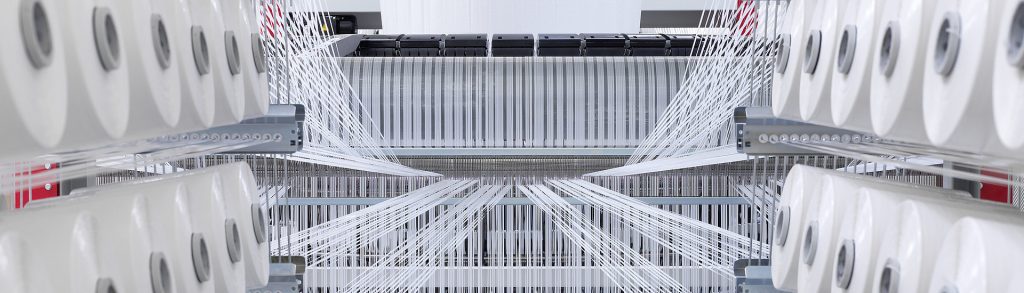
Weaving (circular/flat looms). Higher pick counts (≈13×13–15×15) are maintained with disciplined tension, yielding smooth selvedges and flat fabric for downstream coating. VidePak operates 100+ circular looms to keep schedules stable and quality consistent across large programs of FIBC Bags and the Benefits of Fine Yarn Technology: A Detailed Exploration.
Coating & finishing. PP extrusion coating (≈20–30 g/m²) closes interstices for dust and splash control. Because the fabric window is smaller, fine‑yarn cloth needs less resin to seal—an efficiency that can be traded for weight, cost, or added print fidelity. Anti‑slip varnish can be zoned on high‑contact areas; panels are prepped for high‑contrast printing and durable, abrasion‑resistant inks.
Cutting, sewing & loop integration. Automated cutters hold panel tolerances; reinforcement patches land where loops will concentrate stress. Loops (corner, cross‑corner, tunnel) are stitched or bartacked with high‑tenacity thread. Stitch density, seam allowance, and bite depth are validated so FIBC Bags and the Benefits of Fine Yarn Technology: A Detailed Exploration behave the same on day 90 as on day one.
Top, bottom & baffles. Open or duffle tops speed loader fills; spout tops (Ø ≈35–50 cm) connect to silos/hoppers. Flat or spout‑discharge bottoms (Ø ≈30–50 cm) control pour‑back. Optional internal baffles (Q‑bag) deliver cube stability for high stacks or container cubing.
Quality assurance & proof tests. Lot‑wise top‑lift, cyclic loading (e.g., 30 cycles at the safety factor), seam‑peel, drop, UV checks, and dimensional audits confirm field behavior. Air permeability and fabric evenness are monitored closely in fine‑yarn builds to ensure dust‑control targets are met.
VidePak’s press and converting suite—Germany’s W&H laminators/presses and Austria’s Starlinger FIBC lines—anchors repeatable color, register, and seam performance for FIBC Bags and the Benefits of Fine Yarn Technology: A Detailed Exploration across campaigns.
What Is the Application of FIBC Bags and the Benefits of Fine Yarn Technology: A Detailed Exploration?
Powders & micro‑granules. Cement, lime, fly ash, TiO₂, talc, silica, mineral fillers, masterbatches—materials where dust is both a nuisance and a risk. With tighter cloth and optimized coating, FIBC Bags and the Benefits of Fine Yarn Technology: A Detailed Exploration reduce escapes and keep receiving bays cleaner.
Resin & compound logistics. PE/PP pellets, engineered compounds, and color concentrates travel safer and stack squarer. Panels stay flat for machine‑readable IDs and warehouse signage, while loops present predictably to forklifts.
Food & feed ingredients (with liners when required). Flour, starch, premixes, grains: less dust on loading/unloading, with LDPE liners (≈60–100 μm) managing moisture and hygiene. The result is order rather than drift.
Mining & minerals. High bulk densities push SWLs; fine‑yarn fabrics distribute stress more evenly across the grid, supporting heavy‑duty lanes with the cubic calm of Q‑bags when stacks run high.
Construction & civil works. Sand, gravel, dry mortar, grout blends—FIBC Bags and the Benefits of Fine Yarn Technology: A Detailed Exploration shorten site setup and simplify pour‑back with controlled discharge spouts, saving minutes that turn into money.
For a baseline comparison of smaller woven formats used alongside big bags on the same sites, see this complementary anchor—FIBC Bags and the Benefits of Fine Yarn Technology: A Detailed Exploration—which helps teams align small‑bag and FIBC specifications inside one SOP.
VidePak at a Glance — Capacity Behind FIBC Bags and the Benefits of Fine Yarn Technology: A Detailed Exploration
Founded in 2008, VidePak is powered by a core team with 30+ years of packaging experience. Today, 568 colleagues operate a bench of industry‑leading assets: 100+ circular looms, 16 extrusion lines, and 30+ lamination/printing machines from top suppliers such as Germany’s W&H and Austria’s Starlinger. We work exclusively with virgin raw materials, support custom builds and multi‑color printing, and ship globally—to the United States, Europe, Brazil, South America, Southeast Asia, Japan, South Korea, Central Asia, the MENA Region, East Africa, and South Africa—with annual sales near USD 80 million. That footprint translates into reliable schedules and consistent quality for FIBC Bags and the Benefits of Fine Yarn Technology: A Detailed Exploration across seasons.
Technical Parameters of FIBC Bags and the Benefits of Fine Yarn Technology: A Detailed Exploration
The ranges below reflect real, orderable specifications seen across reputable converters and sourcing platforms. Treat them as a starting brief; VidePak tunes to your product rheology, climate, and handling method.
| Parameter | Typical Options / Ranges for FIBC Bags and the Benefits of Fine Yarn Technology: A Detailed Exploration |
|---|---|
| Safe Working Load (SWL) | 500 kg, 1,000 kg, 1,500 kg, 2,000 kg |
| Safety Factor (SF) | 5:1 single‑use utility; 6:1 multi‑trip when specified (ISO 21898 logic) |
| Fabric Weight (uncoated) | ~160–220 g/m² general duty; heavier options for high‑duty lanes |
| Tape Denier (fine yarn) | ~500–800D (conventional often ~900–1,200D) |
| Tape Width (fine yarn) | ≈2.0–2.5 mm (conventional ≈2.8–3.2 mm) |
| Weave Density | ~13×13 to 15×15 (fine yarn); ~10×10 to 13×13 (conventional) |
| Coating Weight | PP extrusion coat ~20–30 g/m² (often reduced with fine‑yarn cloth) |
| UV Stabilization | Typical package 150–200 kLy for outdoor staging |
| Loop Styles | 2‑loop, 4‑loop, cross‑corner, tunnel sleeves; webbing 30–50 mm |
| Top Options | Open, duffle, spout Ø 35–50 cm |
| Bottom Options | Flat, discharge spout Ø 30–50 cm (star‑closure optional) |
| Baffles (Q‑bag) | Optional internal baffles for cubic stability |
| Liners | LDPE 60–100 μm (insert or glued) as required |
| Testing (lot‑wise) | Top‑lift, cyclic load (e.g., 30 cycles at SF), seam peel, UV aging, drop |
Numbers are indicative, not idealized; they mirror what buyers of FIBC Bags and the Benefits of Fine Yarn Technology: A Detailed Exploration actually order and deploy.
How to Specify FIBC Bags and the Benefits of Fine Yarn Technology: A Detailed Exploration for Your Use Case
Start with four questions: What is the product’s particle size distribution and bulk density? How moisture‑sensitive is it? What is the harshest handling event (fast loader fill, crane lift, tall stack, ocean transit)? What labeling/traceability must survive dust and abrasion? Answer those, then set SWL/SF for the heaviest wet case. Select fine‑yarn constructions (≈13×13–15×15) for powders and micro‑granules; add coating only as needed to hit dust targets. If you stack high or must cube out containers, specify Q‑bag baffles; if you discharge to separators, pick spout bottoms with star‑closures. Reserve high‑contrast panels for warnings and 2D codes. Validate with line trials; then lock the spec so FIBC Bags and the Benefits of Fine Yarn Technology: A Detailed Exploration behaves predictably from pilot to program.
- What Are FIBC Bags and the Benefits of Fine Yarn Technology: A Detailed Exploration?
- What Are the Features of FIBC Bags and the Benefits of Fine Yarn Technology: A Detailed Exploration?
- What Is the Production Process of FIBC Bags and the Benefits of Fine Yarn Technology: A Detailed Exploration?
- What Is the Application of FIBC Bags and the Benefits of Fine Yarn Technology: A Detailed Exploration?
- VidePak at a Glance — Capacity Behind FIBC Bags and the Benefits of Fine Yarn Technology: A Detailed Exploration
- Technical Parameters of FIBC Bags and the Benefits of Fine Yarn Technology: A Detailed Exploration
- How to Specify FIBC Bags and the Benefits of Fine Yarn Technology: A Detailed Exploration for Your Use Case
Introduction
Flexible Intermediate Bulk Containers (FIBCs) are essential in industries like agriculture, construction, and chemicals for their ability to carry heavy loads while maintaining durability and efficiency. Fine yarn technology has elevated FIBC performance by enhancing strength, flexibility, and sustainability. This report explores how the processes of extrusion, stretching, and weaving impact FIBC durability and flexibility and how advanced equipment like Starlinger and W&H ensures unmatched quality.
Key Production Processes and Their Impact on FIBCs
1. Extrusion: The Foundation of Yarn Strength
Extrusion involves melting polypropylene resin and forming it into filaments. This step determines the basic quality of the yarn and, by extension, the FIBCs.
- Temperature Control: Precise control of melt temperature is critical to avoid polymer degradation. Starlinger’s advanced extrusion systems ensure uniform melting, producing filaments with consistent strength and flexibility.
- Filament Uniformity: Uniformly thick filaments reduce weak points in the fabric, ensuring that the FIBCs maintain integrity under stress. Consistent extrusion directly translates to higher load-bearing capacity.
For example, bags designed to carry 1,000 kg loads depend on this uniformity to avoid tearing during transportation.
2. Stretching (Drawing): Strengthening the Yarn
Stretching aligns the molecular structure of the polypropylene, significantly improving tensile strength and elasticity. This process is critical for creating yarns capable of withstanding heavy and dynamic loads.
- Optimal Stretch Ratios: Controlled stretching maximizes yarn strength by aligning polymer chains without over-stretching, which could cause brittleness. W&H machinery excels in automating this process, ensuring every filament meets exact specifications.
- Elasticity Enhancement: Properly stretched yarns maintain flexibility, a vital property for bags that must endure movement and impact during handling.
For example, FIBCs used in agriculture benefit from these properties, as they need to resist tearing when loaded with sharp or irregular materials like grains and fertilizers.
3. Weaving: Balancing Durability and Flexibility
Weaving transforms yarn into fabric and determines the bag’s structural integrity and adaptability.
- Fine Weave Patterns: A tighter weave increases the fabric’s puncture resistance and reduces the risk of tears, making the FIBCs suitable for transporting sharp or heavy items.
- Customizable Density: By adjusting the weave density, manufacturers can create bags tailored to specific load capacities, balancing strength and cost-effectiveness.
For instance, a bag with a higher weave density is ideal for carrying hazardous chemicals, where both safety and containment are paramount.
Benefits of Fine Yarn Technology in FIBCs
1. Superior Durability
Fine yarn technology ensures high tensile strength while keeping the fabric lightweight. This durability comes from the precise alignment of polymer chains during stretching, which enhances load-bearing capabilities.
2. Enhanced Flexibility
The smooth surface of fine yarn fabrics allows for additional coatings, such as anti-static or UV-resistant layers, without compromising flexibility. This makes FIBCs versatile for various industries, including agriculture, chemicals, and construction.
3. Environmental Efficiency
By using less material without sacrificing strength, fine yarn technology reduces waste and supports sustainability. Recyclable polypropylene further minimizes the environmental impact of FIBC production.
Performance Parameters of FIBCs
| Parameter | Why It Matters | How It’s Controlled |
|---|---|---|
| Tensile Strength | Determines the bag’s ability to handle heavy loads. | ASTM D5034 tensile tests. |
| Elasticity | Prevents sudden tearing under dynamic stress. | ISO 13934-1 elongation tests. |
| Puncture Resistance | Ensures durability when carrying sharp materials. | Puncture resistance testing. |
| Fabric Density | Matches load capacity to specific industrial needs. | Dynamic load testing and density checks. |
Each parameter is crucial for ensuring that FIBCs perform reliably in demanding environments, from construction sites to agricultural fields.
Industry Trends and Innovations
Sustainability in Manufacturing
Fine yarn technology aligns with global sustainability goals by reducing raw material usage while maintaining performance. Recyclable polypropylene and energy-efficient processes further enhance the eco-friendly profile of FIBCs.
Advanced Equipment for Consistency
Starlinger and W&H machinery are pivotal in ensuring consistent quality. Starlinger’s precise temperature control during extrusion guarantees uniform filament production, while W&H’s automated stretching systems optimize molecular alignment for maximum strength. Discover more here.
Customization to Meet Diverse Needs
Industries increasingly demand tailored solutions, such as food-grade linings for agricultural use or anti-static coatings for chemical transport. Fine yarn fabrics provide the flexibility needed for these customizations.
FAQs
1. How does extrusion affect FIBC quality?
Precise extrusion ensures uniform filament thickness, which enhances the bag’s load-bearing capacity and reduces weak points.
2. Why is stretching crucial for durability?
Stretching aligns the polymer chains in the yarn, maximizing tensile strength and elasticity. This is essential for handling heavy or irregular loads.
3. How does weaving impact FIBC performance?
Weaving determines the fabric’s structural strength and flexibility. Fine weaves provide superior durability and resistance to punctures.
4. Are FIBCs made with fine yarn technology sustainable?
Yes, fine yarn reduces raw material usage and supports recyclability, making these FIBCs environmentally friendly and cost-efficient.
Conclusion
The durability and flexibility of FIBCs rely on the precision of extrusion, stretching, and weaving processes. Fine yarn technology enhances each of these stages, ensuring that the bags meet the demands of industries requiring high performance and reliability. With advanced machinery from Starlinger and W&H, companies like VidePak produce FIBCs that set new standards for quality and sustainability.
For further insights, explore:
- FIBC Bags: Revolutionizing Bulk Packaging with Ultrasonic Sealing Technology
- The Evolution and Benefits of FFS Roll Bags: A Focus on Fine Yarn Technology
Fine yarn technology represents the future of bulk packaging, offering unparalleled strength, adaptability, and environmental benefits.