##
What are FIBC Bags?
FIBC Bags (Flexible Intermediate Bulk Containers) are collapsible, heavy‑duty containers built from woven polypropylene and engineered to move dry, flowable materials at industrial scale. In practice they are known by many working aliases—bulk bags, jumbo bags, big bags, super sacks, one‑ton bags—yet the essence stays the same: an engineered package specified by Safe Working Load (SWL), Safety Factor (SF), electrostatic classification (Type A/B/C/D), and a suite of handling, filling, and discharge features.
They are not merely larger versions of small sacks. They operate as a designed system in which fabric strength dovetails with seam geometry; lift loops speak the language of forklifts and cranes; spouts orchestrate dust behavior; liners patrol moisture and oxygen; and documentation encodes safety, hygiene, and traceability. Treated in this way,
FIBC Bags compress freight cost per kilogram, stabilize material flow, and integrate seamlessly into modern warehouses and automated dosing lines.
If a definition must be short: an FIBC is a mobile silo you can fold, a logistics unit you can audit, and a safety‑relevant device you can verify. If a definition must be complete: it is a convergence of polymer science, textile mechanics, electrostatics, ergonomics, and regulation—held together by SOPs as much as by stitches.
Callout — Why the definition matters
Misunderstand an FIBC as “just a big bag,” and you under‑specify risks: combustible dust ignition, moisture pickup, pallet tilt, seam creep, label loss. Define it as a system, and you specify counter‑measures: electrostatic type, barrier stack, baffle geometry, stitch pattern, rub‑resistant inks, and auditable test IDs.
##
What are the features of FIBC Bags?
Strength‑to‑weight efficiency. Woven polypropylene delivers high specific tensile and tear performance at low tare mass. Typical body fabric for general purpose builds ranges around 160–220 gsm, though abrasive or high‑density products may require heavier selections. When paired with SF 5:1 (single‑trip) or SF 6:1 (multi‑trip),
FIBC Bags safely carry SWL bands from 500 kg up to 2000 kg, enabling a dramatic reduction of bag touches per ton.
Configurable handling. Two‑loop, four‑loop, and cross‑corner loop designs ensure predictable rigging whether operators use tines, hooks, or slings. Base constructions (standard base, full lift belt, or single‑point) are chosen for compatibility with local handling equipment, ceiling heights, and hoist geometry.
Controlled filling and discharge. Duffle tops favor variable fills and manual lines, spouted inlets synchronize with automated dosing, and conical tops assist with headspace management. Discharge is tailored via flat bottoms, petal/star closures, or spouted outlets often combined with iris locks to moderate flow, contain dust, and protect operator visibility.
Barrier and hygiene. Food‑ and pharma‑aligned builds use LDPE liners (often 60–100 μm), EVOH‑coextrusions for oxygen control, or aluminum barrier liners for stringent moisture/oxygen protection. These are typically managed under hygiene systems such as ISO 22000 or BRCGS Packaging, with prerequisites that cover pest control, allergen segregation, and document control.
Static control. Combustible dusts transform a packaging choice into a safety decision. Type B, C, and D
FIBC Bags respond differently: Type C relies on interconnected conductive threads and mandatory earthing; Type D uses dissipative fibers designed to drain charge without a ground lead when used within approved practices. Qualification is verified using IEC 61340‑4‑4 test methods and is coupled to customer work instructions to avoid field drift.
Stackability and cubing. Baffle (Q‑bag) constructions maintain a near‑rectangular form, reducing bulge and overhang. The dividend appears downstream: better container cube, neater warehouse lanes, fewer stretch‑wrap failures, and less compressive stress on corner layers.
Data points seen across peer factories and sourcing portals. Body fabric 160–220 gsm PP; liner 60–100 μm LDPE; SWL 1000–1500 kg common; SF 5:1 or 6:1; filled volumes roughly 0.8–1.5 m³; UV stabilization for outdoor staging periods; document pouches standard on export builds.
Feature card — Ergonomics
Cross‑corner loops keep openings accessible to forklift tines, reducing swing and snag. Visual loop color coding supports quicker rigging checks before lift.
Feature card — Clean discharge
Iris locks and conical bottoms let operators modulate flow, avoiding hammering, product hang‑ups, and blinding of nearby sensors.
Feature card — Identity & traceability
Lot IDs, SWL/SF markings, and handling pictograms remain legible using abrasion‑resistant inks and varnishes suited to warehouse abrasion.
Case analysis. A mineral filler plant consolidated from 25 kg sacks to 1‑ton baffle
FIBC Bags, lowering forklift cycles by about 30% and shrinking dust in the weigh area due to spouted fills with lined discharges.
Comparative study. Against steel bins,
FIBC Bags reduce tare weight and avoid rigid cleaning downtime; against small sacks, they consolidate touchpoints, cut stretch‑wrap usage per ton, and shorten pick/pack windows.
##
What is the production process of FIBC Bags?
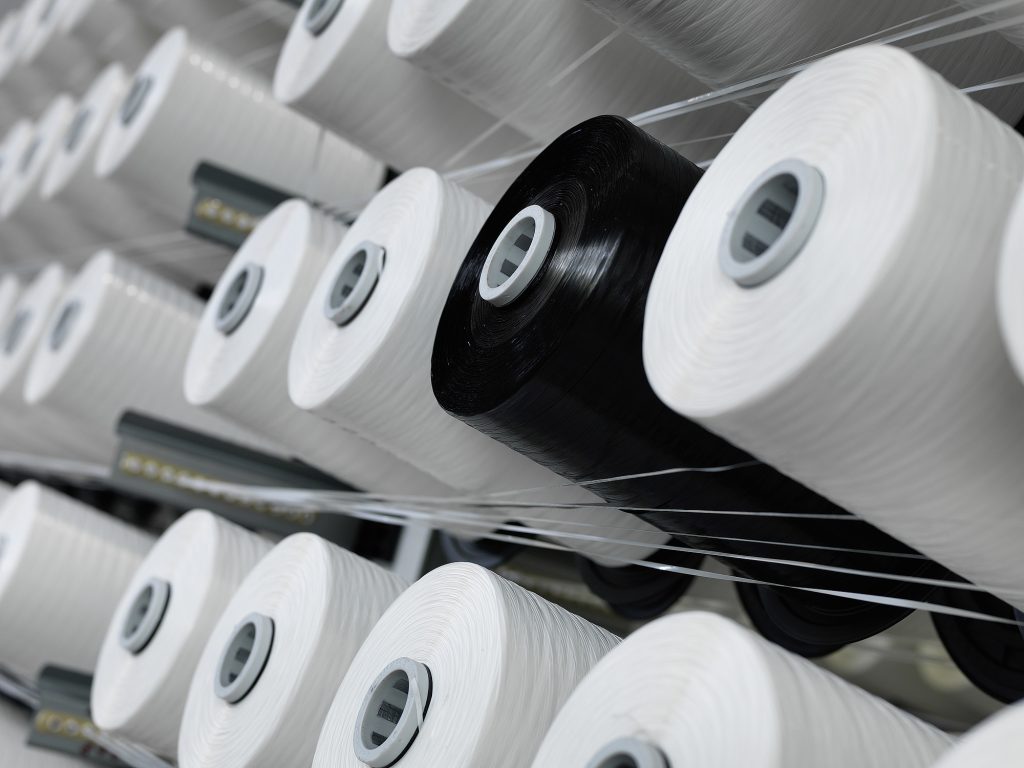
1) Tape extrusion and orientation. Polypropylene pellets are melted and extruded into a film, then precision‑slit into tapes which are drawn to align polymer chains. The draw ratio is the quiet governor: too low and elongation is excessive; too high and shock fracture risk rises. The production target balances tensile strength, tear propagation, and seam performance so the final bag remains both strong and forgiving.
2) Fabric weaving. Circular and flat looms interlace tapes according to set densities. Stitch efficiency later depends on weave regularity now: inconsistent tape widths travel downstream as seam stress risers. For baffle builds, internal webs restrain bulge and preserve a square profile under load.
3) Coating and lamination (optional). PP coating reduces sift and anchors ink; when humidity or oxygen is critical, separate liners (LDPE, EVOH co‑ex, or aluminum) are produced and inserted. Coating weight is a design dial—raise it and you gain barrier at the cost of de‑aeration during fill; lower it and you ease venting but risk moisture ingress in storage.
4) Cutting and conversion. Heat or ultrasonic knives seal edges to prevent fray. High‑stress regions receive reinforcement patches. Stitch patterns (chainstitch, lockstitch) and seam allowances are selected to distribute loads along the bag’s load path rather than concentrating them at corners.
5) Accessories integration. Lift loops, document pouches, sift‑proof tapes, and dust‑proof seams are fitted. For Type C
FIBC Bags, conductive yarns are grid‑connected and landed to a verified earthing lug.
6) Printing and identification. Multi‑panel prints communicate SWL, SF, handling pictograms, and any regulatory information. Abrasion‑resistant overprint varnishes maintain legibility through warehousing and transport.
7) Quality testing. ISO 21898 guidance typically informs top lift, cyclic lift, topple, drop, stacking, and seam strength checks. Electrostatic testing aligns with IEC 61340‑4‑4. Where regulated, UN performance codes (e.g., 13H2/13H3/13H4) require further testing under ADR/IMDG frameworks.
Process map (textual)
Resin → Film → Slit tapes → Draw → Weave → Coat/Laminate → Convert (panels, loops, baffles) → Print → QA → Palletize.
##
What is the application of FIBC Bags?
Chemicals and minerals. Titanium dioxide, calcium carbonate, alumina, fertilizer prills—materials that require dust control, consistent flow, and predictable weighment.
Construction materials. Cement, dry mortar blends, sand, and aggregates benefit from fewer touches and faster yard turns. Baffle
FIBC Bags keep pallets square; standard bodies support flexible SKUs.
Agriculture and food ingredients. Sugar, starches, grains, cocoa, and flavor bases require hygiene controls, validated liners, and auditable lot IDs.
Recycling and waste streams. Post‑industrial scrap, rags, coarse litter, and filter cakes need abrasion‑resistant bases and reliable seams.
Case analysis (application). A gypsum producer moved from loose bulk trucks during monsoon to lined
FIBC Bags; moisture pickup dropped, claims fell, and yard cleanliness improved.
Comparative study (application). For export, baffle bodies on 1100×1100 mm pallets improved container payload versus round‑body bags and reduced deformation damage on outer layers.
##
Demand signals and how FIBC Bags respond
Globalization with SKU proliferation. Buyers expect shorter lead times and more variants.
FIBC Bags let producers consolidate long‑run manufacturing, then deconsolidate at regional hubs without building silo infrastructure. The result is agility without capex bloat.
Cost‑to‑serve compression. Freight volatility rewards lower tare and higher payload density. One‑ton
FIBC Bags reduce manual handling, compress forklift minutes, and eliminate layers of repacking.
Regulatory scrutiny. Hazard labeling, food hygiene, and combustible dust management elevate packaging from commodity to compliance tool.
FIBC Bags bring auditable markings, documented test plans, and repeatable features.
Callout — Quantified impact
Shifting from 25 kg sacks to 1000–1250 kg FIBC Bags regularly produces a 4–6× reduction in bag touches per ton, with correlated reductions in stretch‑wrap usage, pallet counts, and loading bay congestion.
Case analysis. A starch exporter adopted food‑grade lined
FIBC Bags under ISO 22000 hygiene oversight; container sweat ceased damaging the outer rows, complaint rates declined, and claim cycles shortened.
Comparative study. Against silo tankers,
FIBC Bags add flexibility for mixed‑SKU loads and avoid return travel of empty tanks—trading off slightly longer on‑site discharge durations that can be mitigated with spout/iris combinations.
##
Compliance, testing, and third‑party frameworks
Non‑dangerous goods. ISO 21898 outlines testing for top lift (static and cyclic), stacking, topple, drop, sift‑proofing, and seam strength. Documentation establishes lot traceability so each shipment can be audited back to material and process parameters.
Electrostatic safety. IEC 61340‑4‑4 provides standardized evaluation for static protective
FIBC Bags. Type C requires mandatory grounding; Type D dissipates charge by design when used properly. Choice depends on dust class, solvent presence, humidity profiles, and work practice maturity.
Food‑grade governance. Hygiene management systems such as ISO 22000 and BRCGS Packaging set the scaffolding for material segregation, cleaning, personnel practices, and foreign body control.
UN performance (where applicable). Dangerous goods demand UN‑certified FIBCs with codes such as 13H2/13H3/13H4. Testing then follows ADR/IMDG protocols, including drop, stack, topple, and vibration sequences.
Standards badge
ISO 21898 — Non‑dangerous goods test regimen (top lift, cyclic top lift, drop, stack, sift‑proofing).
Standards badge
IEC 61340‑4‑4 — Electrostatic performance of Type B/C/D bags; grounding protocols for Type C.
Standards badge
ISO 22000 / BRCGS Packaging — Hygiene systems for food‑contact variants; documented prerequisite programs.
Data points commonly specified by buyers. SWL 1000–1500 kg with SF 6:1 for multi‑trip use; liner thickness 70–90 μm for moisture‑sensitive powders; UV stabilization tailored to outdoor staging windows.
Case analysis. Implementing an IEC 61340 earthing SOP around Type C
FIBC Bags reduced near‑miss electrostatic events in a resin loading bay during dry winter conditions.
Comparative study. Type D simplifies handling by removing ground leads but requires vigilant prohibition of insulating liners that could defeat dissipation; Type C demands a ground but is forgiving when SOP discipline is high.
##
Operations: filling, discharge, and inventory flow
Filling line alignment. Spouted tops pair naturally with gravimetric or volumetric dosing; duffle tops eliminate aiming errors on manual fills and absorb SKU variability. Baffle bodies reduce bulge, increasing stack height without compromising lane safety.
Discharge ergonomics. Iris and petal closures permit controlled release; conical bottoms assist stubborn powders; anti‑dust features preserve visibility at the hopper. Proper discharge also safeguards downstream feeders and augers from surge loads.
Inventory and cube. Square geometry through baffles improves container payloads by reducing voids; return logistics benefit from collapsible empties that nest neatly.
Callout — Practical tuning checklist
- Match fabric breathability and micro‑perforations to powder fineness to prevent ballooning and short‑weights.
- Specify valve reinforcement that seals under back‑pressure without manual tucks.
- Standardize pallet footprints (e.g., 1100×1100 mm) to improve container cube in export lanes.
Case analysis. A fertilizer packer standardized on 95 cm body widths to load three‑across in 40‑ft containers, raising utilization without stressing sidewalls.
Comparative study. Duffle tops outperform spouts for coarse granules on manual lines; spouts dominate for fine powders on automated dosing equipment where dust capture is installed.
##
Risk controls and continuous improvement
Material risk. UV degradation, seam creep, moisture ingress, and static ignition are addressed through stabilizer packages, reinforcement patches, coating/liner selection, and electrostatic type.
Process risk. Variation in tape denier, weave density, and stitch spacing is curbed via documented SOPs, in‑process inspection, and final product testing. Statistical sampling plans keep field surprises rare.
People risk. Rigging SOPs with pictograms, earthing checklists, and discharge guards reduce incidents. Clear SWL/SF markings create shared awareness among contractors.
Data program. Routine top‑lift cycles, drop heights, and tilt‑table runs alert teams before failures escalate in the field. Trending these metrics supports continuous improvement.
Countermeasure card — UV & weather
UV stabilizers in PP resin slow embrittlement; lighter exterior prints reduce heat gain; covers and SOPs control outdoor exposure windows.
Countermeasure card — Moisture
Liner thickness and barrier material align to humidity profiles; sealed seams and sift‑proof tapes limit fines escape and ingress paths.
Countermeasure card — Electrostatics
Type selection (B/C/D) matched to dust class; ground checks for Type C; work practice constraints for Type D; verification under IEC 61340‑4‑4.
Case analysis. Dust‑proof seam tape on calcium carbonate
FIBC Bags reduced housekeeping man‑hours and lowered airborne dust readings during maintenance audits.
Comparative study. Aluminum liners outperform PE on oxygen barrier but complicate recyclability; EVOH‑coex liners achieve moderate barrier with easier downstream handling in many non‑food loops.
##
Sustainability and end‑of‑life
Resin efficiency. High draw ratios and optimized gsm reduce resin per ton shipped. Baffle bodies cut wrap usage by improving stack stability and reducing corner damage.
Mono‑material thinking. PP fabric plus PP coating keeps constructions in a single polymer family, making regrind and recycling streams cleaner than mixed paper/plastic structures.
Governed re‑use. Where hygiene and risk allow, SF 6:1 multi‑trip programs produce visible reductions in packaging spend and waste. Inspection criteria (loop wear, seam integrity, contamination) must be enforced.
Case analysis. A grain exporter swapped mixed paper/PE sacks for mono‑material PP
FIBC Bags, then established baled returns. The recycler’s yield improved due to lower contamination and simpler sorting.
Comparative study. Paper bulk sacks provide familiar aesthetics but underperform in humidity and tear resistance at high SWL levels compared with PP FIBC constructions.
##
Specification snapshot (indicative)
| Attribute |
Typical Options / Values |
Notes |
| SWL |
500 / 1000 / 1250 / 1500 / 2000 kg |
Selected per product density and handling regime |
| Safety Factor |
5:1 (single‑trip); 6:1 (multi‑trip) |
Aligned to buyer policy and test regimen |
| Body Fabric |
160–220 gsm woven PP |
Heavier gauges for abrasive loads |
| Liner |
60–100 μm LDPE; EVOH‑coex; aluminum |
Match to humidity and oxygen sensitivity |
| Inlet |
Spout; duffle; conical top |
Choose for fill method and dust behavior |
| Discharge |
Plain; spout; star closure; iris |
Controls cleanup and flow steadiness |
| Loops |
2 / 4 / cross‑corner |
Dictates rigging safety and ergonomics |
| Geometry |
Standard; baffle (Q‑bag) |
Baffles for better cube stability |
| Static Type |
A / B / C / D |
Per IEC 61340‑4‑4 and dust class |
| Hygiene |
ISO 22000; BRCGS Packaging |
For food‑contact scenarios |
| Testing |
ISO 21898 lift/drop/stack/tilt |
With lot traceability |
##
Integrated solution path for VidePak buyers
Step 1 — Define the risk and regulatory envelope. Does the application involve food contact, combustible dusts, or UN dangerous goods? Answers select electrostatic type, hygiene system, and the testing plan.
Step 2 — Model product flow and site constraints. Bulk density, particle size distribution, angle of repose, humidity profile, and available filling/discharge equipment inform inlet/outlet choices, baffle needs, and seam allowances.
Step 3 — Balance logistics and cost‑to‑serve. Fix pallet footprint and containerization strategy. Where cube matters, prefer baffle bodies; where nimble changeovers matter, keep to standard forms with duffles.
Step 4 — Lock specification and validation. Freeze SWL/SF, fabric gsm, liner barrier, loop pattern, and print panels. Validate through lift/drop/tilt tests and, if relevant, IEC electrostatic checks. Implement handling pictograms and SOPs so the specification survives real work.
Outcome — Predictable performance at scale. The end state is a bag that arrives, fills, stacks, and empties the same way every time—reducing claims and near‑misses while improving throughput and preserving shipment integrity.
##
Single internal link for further exploration
Explore design variants and application notes related to
FIBC Bags for additional context, visuals, and specification options.
##
Coda on language, logic, and style
A package that contains is not yet a package that convinces. A label that informs is not yet a label that endures. A loop that lifts is not yet a loop that reassures the operator under a rainy sky. In that gap—between basic function and earned trust—
FIBC Bags do their best work. They reconcile properties that seem opposed: permeability versus barrier, stiffness versus conformity, throughput versus dust control. They ask reasonable questions and answer them in material: What does the powder want? What does the line demand? What does the law require? And what, in the end, will the operator forgive?
Packaging does not have to shout. It has to show up reliably, every shift, every season, every route. That is the tone of
FIBC Bags when they are specified with care and operated with discipline—quietly decisive, practically elegant, and ready for real work.
FIBC bags, capable of holding 500–2,000 kg of materials, are indispensable for industries requiring bulk transport solutions. However, modern market demands extend beyond load capacity—companies now prioritize ESG compliance, recyclability, and carbon footprint reduction. VidePak’s FIBC bags, produced using Austrian Starlinger machinery and virgin PP resins, address these needs by achieving tensile strengths exceeding 45 N/cm² while maintaining full recyclability.
VidePak partners with PP resin giants like BASF and Sinopec under long-term contracts, securing:
VidePak’s FIBC bags exemplify how industrial packaging can harmonize economic efficiency with planetary stewardship. By prioritizing recyclable PP, systemic recycling, and bio-innovation, the company not only meets global market demands but sets a benchmark for the industry’s sustainable transformation.