
What is FIBC Bags? (Definition & Aliases)
In bulk handling for the pet nutrition value chain, FIBC Bags identify a family of heavy‑duty containers engineered from woven polypropylene (PP) and designed to move free‑flowing solids at scale. The format is known by many aliases—Flexible Intermediate Bulk Containers, bulk bags, jumbo bags, big bags, and super sacks—but the intent is singular: to move hundreds or thousands of kilograms of material safely, cleanly, and efficiently while safeguarding both product integrity and operational rhythm. A typical body consists of a woven PP shell with lifting loops, an optional liner for barrier control, and top/bottom features that orchestrate filling and discharge. In pet food operations, FIBC Bags provide the missing bridge between upstream milling and downstream retail packs, acting as mobile silos that are easier to sanitize than bins and less wasteful than small sacks.
Calling FIBC Bags a “container” undersells their role. They are load paths, airflow policies, dust management strategies, and documentation bundles stitched into fabric. They speak the language of line speed, forklift geometry, and audit readiness. They carry not merely material, but confidence: confidence that a day’s production will not stall on a torn loop, that a discharge will not generate a dust cloud, that a certificate will be ready when a buyer asks for proof.
What are the Features of FIBC Bags? (Appearance, Performance, Compliance)
Features only matter when they translate into real choices on the shop floor: fewer stoppages, cleaner discharges, faster approvals. The following clusters reframe the feature set of FIBC Bags as adjustable levers—each with a technical rationale, a situational trade‑off, and a measurable outcome.
Fabric gsm, seam geometry, and loop style distribute stresses from lift to base. A U‑panel or circular body reduces critical seam length; 4‑panel designs maximize cubic stability. The goal: SWL achieved with predictable elongation and minimal seam creep.
Coating (≈20–30 gsm) and liners (≈60–100 μm) tune moisture and aroma behavior. Form‑fit liners reduce pleats, speeding discharge and minimizing fines retention.
Inlet spouts, duffle tops, and discharge spouts with petal closures choreograph air and solids. Micro‑venting patterns preserve fill speed when coatings impede deaeration.
Types A/B/C/D per IEC 61340‑4‑4. Type C requires grounding; Type D uses dissipative yarns to minimize human error. Selection maps to dust class and solvent exposure.
Plants typically run ISO 9001:2015 and ISO 22000/FSSC 22000; many buyers ask for BRCGS Packaging. Liners align with FDA 21 CFR 177.1520 and/or EU 10/2011.
SWL & Safety Factor to ISO 21898; fabric tensile (ASTM D5035); seam strength (D1683 analogues/in‑house); lift, topple, tear, and stacking tests define approval windows.
What is the Production Process of FIBC Bags? (From Tape to Tested Container)
Process discipline converts polymer into reliability. Each station in the manufacture of FIBC Bags anticipates a different failure mode—and prescribes a different test. Connect the mode to the measure and you shorten debug loops, reduce scrap, and protect capacity.
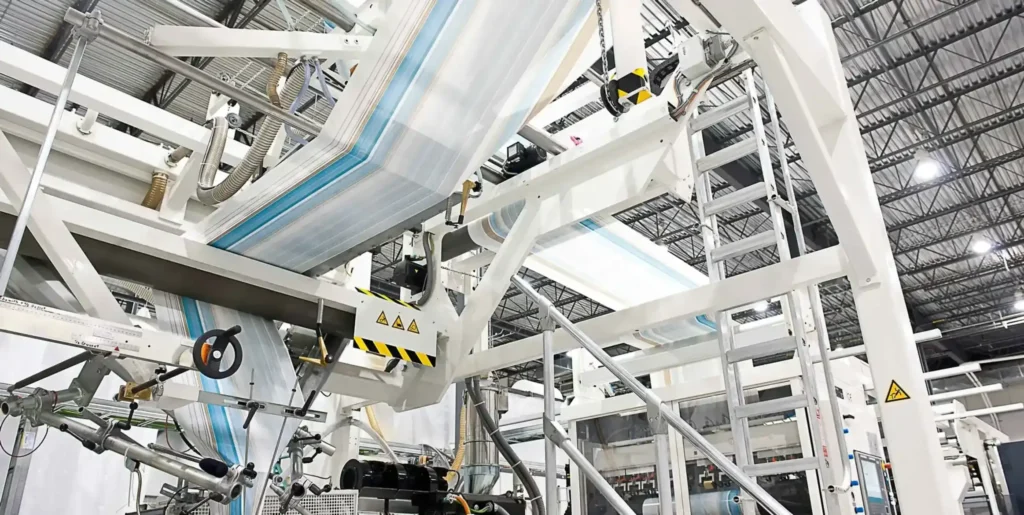
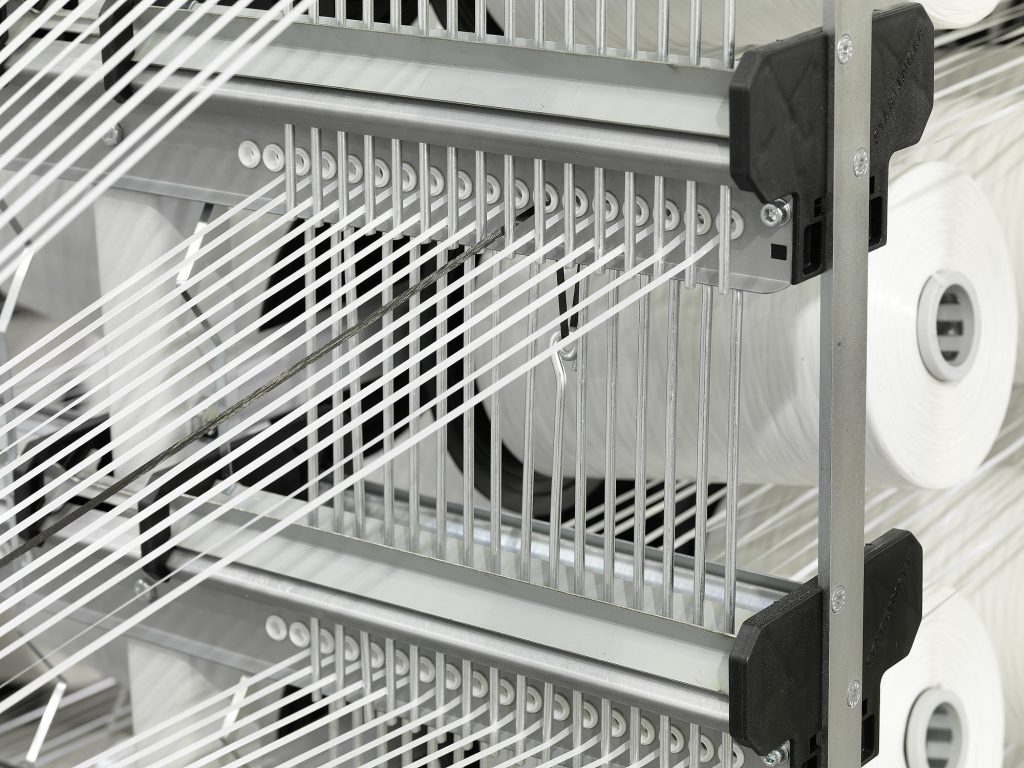
- PP tape extrusion & weaving: Polypropylene granules are extruded, slit, drawn, and woven into fabric (circular or flat). Fabric basis weight (≈120–240 gsm) maps to target SWL and Safety Factor. Tighter tape gauges stabilize tensile variation.
Failure to anticipate: uneven tensile across warp/weft leading to localized seam stress. Countermeasure: tensile sampling per ASTM D5035 and loom calibration logs.
- Cutting & body formation: Panels are cut for 4‑panel, U‑panel, or circular bodies; edges heat‑cut to prevent fray; reinforcements positioned at load junctions.
Failure to anticipate: seam pull‑out at panel junctions. Countermeasure: stitch density targets and bartack patterns recorded per style.
- Loop assembly: Corner or cross‑corner loops (≈200–320 g/m webbing) are sewn with lock/chain stitches; bartacks reinforce stress concentrations.
Failure to anticipate: loop tear during accelerated lift. Countermeasure: top‑lift tests and cyclic loading to ISO 21898.
- Coating/lamination (optional): PP coating (≈20–30 gsm) improves dust and moisture behavior; beware reduced deaeration during fill.
Failure to anticipate: slow fills and trapped air. Countermeasure: micro‑venting patterns on vertical panels; spout baffles to modulate airflow.
- Liner fabrication (if specified): LDPE/PP liners ≈60–100 μm; form‑fit variants minimize pleats and speed discharge. Food contact declarations accompany liner lots.
Failure to anticipate: aroma loss or moisture ingress. Countermeasure: liner gauge selection tied to seasonal humidity and route length; migration testing retained.
- Top & bottom construction: Inlet spout/duffle/open top; discharge spout/full open/flat bottom with petal closures and safety flaps; sift‑proof tapes applied to seams.
Failure to anticipate: dust plumes at discharge. Countermeasure: petal‑style closures and form‑fit liners; housekeeping SOPs verified.
- Inspection & testing: Dimensional checks; lift, topple, tear, and stacking tests; SF verification at 5:1 (single‑trip) or 6:1 (multi‑trip) per ISO 21898. Electrostatic checks per IEC 61340‑4‑4 (Type C continuity; Type D resistivity).
Failure to anticipate: undocumented variability. Countermeasure: retain method‑named reports (SGS/Intertek/TÜV) and batch COAs; archive torque/strain data from lift rigs.
- Cleaning & finishing: Air cleaning, metal detection (where required), labeling, and palletization with protective wrap or slipsheets.
- Fabric tensile to ASTM D5035; seam strength to internal method aligned with ASTM D1683.
- SWL/SF verification to ISO 21898 with top‑lift, topple, tear, and stacking protocols.
- Electrostatic classification to IEC 61340‑4‑4 (Type A/B/C/D), including continuity points for Type C and surface resistivity for Type D.
- Liner migration references for FDA 21 CFR 177.1520 and EU 10/2011; retain lot‑linked declarations.
What is the Application of FIBC Bags? (Industries & Use Cases)
The versatility of FIBC Bags lies in how cleanly they shuttle material between nodes—mills, blenders, dryers, and small‑pack machines—while preserving hygiene and throughput. In pet nutrition, three recurring scenes define the spec.
Meat‑and‑bone meal, fish meal, plant proteins, and grains arrive in FIBC Bags to minimize dust and streamline unloading through discharge spouts. Electrostatic Type C/D may be mandated where dust clouds or solvents occur.
Salt, starches, and vitamin/mineral premixes move in lined FIBC Bags to maintain moisture and aroma integrity; form‑fit liners reduce residue after discharge.
Finished kibble transfers from dryer to small‑pack (1–25 kg) via food‑grade FIBC Bags, limiting handling damage and stabilizing line cadence.
Fertilizers, resins, pigments, minerals—each sector tunes gsm, liners, electrostatic class, and spout style to its own rheology and regulatory load.
FIBC Bags: Transforming Pet Food Packaging
Transformation is more than a slogan; it is a pattern of better answers to old questions. How can we run faster without getting dirtier? How can we protect product without suffocating fill? How can we meet audits without losing weeks to paperwork? FIBC Bags suggest a system‑level reply: coordinate materials science, mechanical design, electrostatic safety, and documentation—then lock the gains into SOPs so today’s success repeats tomorrow.
Real, purchasable configurations: fabrics ≈120–240 gsm; liners ≈60–100 μm; coatings ≈20–30 gsm; SWL 500–2000 kg; Safety Factors 5:1 (single‑trip) and 6:1 (multi‑trip). Test methods cited by suppliers include ISO 21898 for SF/SWL and IEC 61340‑4‑4 for electrostatic class.
A kibble plant faced loop tears and dust plumes during discharge. By shifting from 4‑panel to U‑panel bodies with cross‑corner loops, adding form‑fit liners, and tightening stitch density, downtime fell, housekeeping shrank, and customer complaints receded.
Versus paper sacks: far fewer handling cycles and less packaging waste. Versus rigid bins: collapsibility slashes return freight and storage. Versus valve sacks: better for bulk moves into blending and storage nodes.
Integrating Disciplines: Materials, Mechanics, Electrostatics, Logistics
The promise of FIBC Bags emerges when four disciplines stop arguing and start collaborating. Materials science sets barriers and surface energies; mechanical engineering defines load paths and joint reliability; electrostatic management reduces ignition risk; logistics orchestrates pallets, racking, and wraps. Common metrics—WVTR, tensile, seam pull, surface resistivity, stack height—are not rivals. They are instruments in the same orchestra. Tuning one affects the others. The art is coordination.
Consider paired tensions: speed vs. cleanliness, barrier vs. deaeration, safety factor vs. mass, Type C vs. Type D, paperwork vs. launch. The right answer is rarely binary. It is usually a tuned compromise: a micro‑vented coated panel, a 5:1 SF with smarter loop geometry, a Type C bag in a well‑trained plant, or a Type D bag where grounding cannot be trusted.
Cost, Value, and Trade‑offs
Unit price tempts, system cost rules. A heavier fabric can hide a poor loop geometry; a thicker liner can mask weak housekeeping; a higher Safety Factor can conceal training gaps. But none of these are free. The path to value with FIBC Bags is not “more of everything.” It is “enough in the right place.” Reinforce where loads converge. Vent where air stalls. Document where auditors will ask. Spend where risk concentrates; save where redundancy adds weight but not safety.
| Decision | Immediate Effect | Downstream Impact |
|---|---|---|
| Upgrade to U‑panel body with cross‑corner loops | Fewer critical seams; easier forklift engagement | Lower loop tears; smoother lifts; faster cycles |
| Specify micro‑vented coated panels | Maintained fill speed with moisture protection | Fewer humidity claims; no throughput penalty |
| Adopt form‑fit liner at 80 μm | Reduced pleats; faster discharge | Less residual product; cleaner totes; quicker turnaround |
| Standardize stitch density (≥4 stitches/cm) and bartacks | Higher seam reliability | Lower field failures; fewer stoppages |
Risk Registers and Quality Gates
A robust specification for FIBC Bags is inseparable from a risk register. Name the risks, place the gates, and automate the evidence. A short list of high‑yield checkpoints can eliminate a long list of avoidable headaches.
- Incoming fabric: gsm, tensile per ASTM D5035, and weave regularity (visual + pick counts).
- Loop webbing: mass per meter and tensile pull; bartack integrity verification.
- Coating & liners: coating weight (g/m²), liner gauge (μm), and food‑contact declarations (FDA 21 CFR 177.1520, EU 10/2011).
- Electrostatic class: IEC 61340‑4‑4 report; Type C continuity point map or Type D surface resistivity log.
- Container tests: ISO 21898 lift/topple/stack cycle results stored with batch COAs; photographic evidence of seam stitching patterns.
Human Factors: Ergonomics and Openability
Operators remember friction more than features. A loop that is hard to catch, a spout that won’t align, a tear tape that snaps—these are the stories that shape plant opinion. To make FIBC Bags beloved rather than tolerated, pay attention to handholds and eye‑level cues. Cross‑corner loops improve fork engagement. Printed arrows guide spout orientation. Thread tails trimmed short prevent snags. The payoff is quiet but real: fewer micro‑stalls, calmer shifts, happier teams.
Sustainability Without Slogans
Sustainability in FIBC Bags is less about buzzwords and more about mass, reuse, and credible end‑of‑life. A lighter fabric that still meets SF reduces resin. A 6:1 multi‑trip tote, where hygiene allows, spreads embodied impacts over more cycles. Clear polymer disclosure on liners supports recycling where streams accept polyolefins. Honest language about local infrastructure builds trust; inflated claims do the opposite.
Specification Blueprint: Inputs, Decisions, Proof
Moving from RFQ to approved spec for FIBC Bags benefits from a repeatable rhythm. Inputs are gathered. Decisions are made with explicit trade‑offs. Proof is assembled with method‑named tests. The result is a spec that runs today and audits tomorrow.
- Inputs: bulk density and flowability; oil/fat content; route humidity and temperature; lift gear geometry; target throughput; sanitation constraints.
- Decisions: body style (circular/U‑panel/4‑panel); fabric gsm (120–240); SWL (500–2000 kg); SF (5:1/6:1); loop design; top/bottom features; liner gauge (60–100 μm); coating weight (20–30 gsm); electrostatic type (A/B/C/D).
- Proof: ISO 21898 test suite with lift/topple/tear/stack; IEC 61340‑4‑4 classification; fabric/seam pulls; rub and COF where relevant; food‑contact declarations; QA sampling plan.
- Roll‑out: pilot a single SKU; run transport and pallet trials; tweak micro‑vents and spout geometry; freeze spec; archive process windows and photos of stitch patterns.
Key Technical Parameters (Reference Summary)
| Parameter | Mainstream Options / Ranges | Notes |
|---|---|---|
| Safe Working Load (SWL) | 500 / 1,000 / 1,500 / 2,000 kg | Select to product density and lift gear |
| Safety Factor (SF) | 5:1 single‑trip; 6:1 multi‑trip | Verify per ISO 21898 |
| Fabric basis weight | 120–240 gsm PP woven | Raise gsm for abrasive products |
| Body style | Circular / U‑panel / 4‑panel | Trade‑off: seams vs. cubic stability |
| Loops | Corner / Cross‑corner / Single‑loop | Webbing ≈200–320 g/m typical |
| Coating | 20–30 gsm PP (optional) | Moisture & dust control |
| Liner | LDPE/PP 60–100 μm (optional) | Food contact per FDA/EU 10/2011 |
| Top options | Spout / Duffle / Open | Hygiene vs. speed trade‑off |
| Bottom options | Discharge spout / Full open / Flat | Add safety flap for dust control |
| Electrostatics | Type A/B/C/D per IEC 61340‑4‑4 | Ground Type C; Type D is non‑grounded |
| Dimensions | ≈90×90×110 cm common | ≈1 m³ for 1,000 kg SWL |
| Tests | Lift, topple, tear, stacking; tensile/seam | Reference ISO 21898 & internal SOPs |
| Compliance | ISO 9001:2015; ISO 22000/FSSC 22000; BRCGS Packaging; FDA 21 CFR 177.1520; EU 10/2011 | Third‑party method‑named reports preferred |
Buyer‑Style FAQ
- How do we reduce dust at discharge? Specify sift‑proof seams, choose petal‑style closures, and deploy form‑fit liners; verify with a dust‑box test and visual inspections.
- Which electrostatic type should we pick? For non‑flammable dusts in safe zones, Type A/B suffice; for combustible dust atmospheres, use Type C with grounding or Type D where grounding is unreliable.
- Can FIBC Bags be certified for food contact? Yes—request FDA 21 CFR 177.1520/EU 10/2011 declarations for liners, maintain ISO 22000/FSSC 22000 at the plant, and log metal detection records.
- Will heavier fabric always be safer? Not necessarily. Smarter loop geometry, U‑panel bodies, and bartacking can achieve the same Safety Factor with less resin mass.
- What is FIBC Bags? (Definition & Aliases)
- What are the Features of FIBC Bags? (Appearance, Performance, Compliance)
- What is the Production Process of FIBC Bags? (From Tape to Tested Container)
- What is the Application of FIBC Bags? (Industries & Use Cases)
- FIBC Bags: Transforming Pet Food Packaging
- Integrating Disciplines: Materials, Mechanics, Electrostatics, Logistics
- Cost, Value, and Trade‑offs
- Risk Registers and Quality Gates
- Human Factors: Ergonomics and Openability
- Sustainability Without Slogans
- Specification Blueprint: Inputs, Decisions, Proof
- Key Technical Parameters (Reference Summary)
- Buyer‑Style FAQ
“Why are FIBC (Flexible Intermediate Bulk Container) bags revolutionizing the pet food industry?”
The answer lies in their unmatched capacity to balance cost-efficiency, safety, and scalability, driven by advanced material engineering and precision manufacturing processes. VidePak, a global leader in woven bag production, leverages cutting-edge Starlinger machinery and rigorous quality controls to deliver FIBC bags that meet the stringent demands of pet food packaging—from kibble storage to high-volume logistics.
1. Introduction: The Rise of FIBC Bags in Pet Food Logistics
The global pet food market, projected to reach $165 billion by 2030, demands packaging solutions that ensure freshness, prevent contamination, and optimize supply chain efficiency. FIBC bags, capable of holding 500–2,000 kg of dry or semi-moist pet food, have emerged as a game-changer. VidePak’s $80M annual revenue and 30+ years of expertise position it as a pioneer in this sector, producing over 5 million FIBC bags annually using 100% virgin PP resins and Austrian Starlinger systems.
Key Insight:
“Pet food isn’t just a product—it’s a promise of nutrition. Our FIBC bags ensure that promise remains intact from factory to feeder.”
— Ray, CEO of VidePak
2. Technical Specifications: Precision in Design
2.1 Thickness, Grammage, and Size Ranges
FIBC bags are engineered to balance strength and flexibility. VidePak’s offerings include:
- Thickness: 0.15–0.30mm, optimized for puncture resistance while maintaining pliability.
- Grammage: 120–200 g/m², ensuring durability without excessive material use.
- Dimensions: Customizable from 90×90×90cm to 120×120×120cm, accommodating 500–2,000 kg loads.
| Parameter | Range | Application |
|---|---|---|
| Thickness | 0.15–0.30mm | Heavy-duty kibble storage |
| Grammage | 120–200 g/m² | Moisture-sensitive formulations |
| Load Capacity | 500–2,000 kg | Bulk transport and retail distribution |
2.2 Anti-Static Technology: Preventing Hazardous Sparks
Static electricity poses risks in environments with combustible dust, such as pet food processing plants. VidePak’s anti-static FIBC bags integrate:
- Conductive Threads: Carbon-coated PP fibers dissipate static charges, reducing surface resistivity to <10⁹ Ω/sq (per IEC 61340-4-1 standards).
- Grounding Straps: Optional copper straps provide a direct path for static discharge, critical for facilities handling flammable additives.
Case Study: A U.S. pet food manufacturer reduced electrostatic incidents by 95% after switching to VidePak’s anti-static FIBC bags, validated by third-party safety audits.
3. Quality Assurance: Beyond Industry Standards
VidePak’s FIBC bags undergo 12-stage testing to ensure reliability:
- Tensile Strength: >45 N/cm² (ASTM D5034), preventing seam bursts under dynamic loads.
- UV Resistance: <5% strength loss after 500 hours of accelerated weathering (ASTM D4329).
- Seam Integrity: Ultrasonic welding achieves seam strengths >40 N/cm², exceeding ISO 13937-2 requirements.
FAQs:
- How do I choose the right FIBC size for my product?
Consider bulk density—e.g., 1 m³ of dry kibble weighs ~600 kg. VidePak’s 1,000 kg bags (120×120×120cm) are ideal for most formulations. - Are anti-static bags recyclable?
Yes—VidePak’s conductive additives are compatible with standard PP recycling streams (EPBP guidelines).
4. Sustainability and Market Differentiation
VidePak’s FIBC bags align with ESG goals through:
- Closed-Loop Recycling: 98% production scraps are reused, reducing virgin material consumption by 15%.
- Solar-Powered Production: 2MW rooftop panels cut CO₂ emissions by 1,200 tons annually.
Future Trends:
- Smart FIBCs: RFID tags for real-time humidity monitoring (piloted with EU clients).
- Bio-PP Blends: 30% plant-based resins in development with Braskem, targeting 2026 launch.
For insights into advanced safety features, explore our guides on anti-static FIBC solutions and high-capacity packaging innovations.
5. Conclusion: Redefining Pet Food Logistics
VidePak’s FIBC bags exemplify how technological precision and sustainability can transform an industry. By mastering variables like static control, load capacity, and material efficiency, the company sets benchmarks in packaging reliability while driving the transition to circular economies.
Final Perspective:
“In pet food packaging, every gram of safety and every millimeter of durability matter. VidePak’s FIBC bags ensure both—delivering trust, one bag at a time.”
— Global Packaging Innovations, 2025