
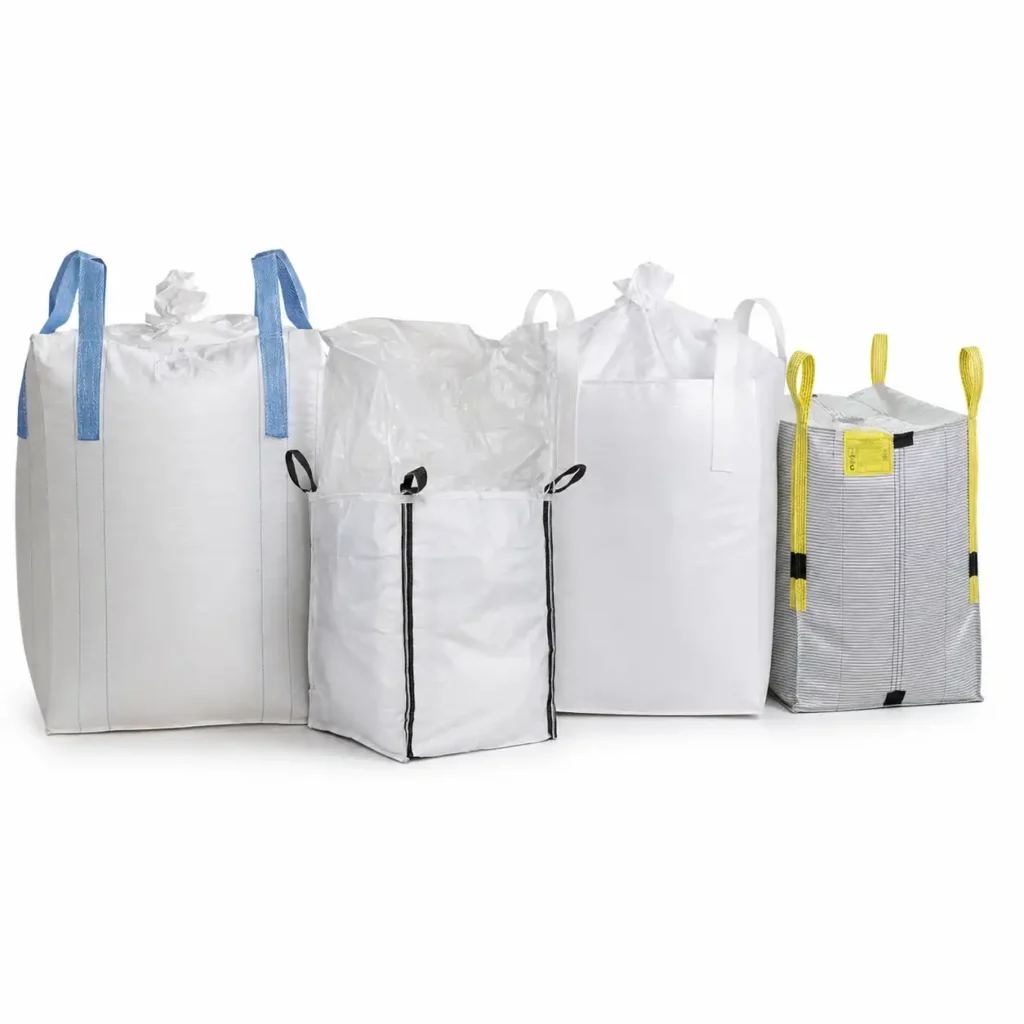
Product Scope of FIBC Bags
FIBC Bags—also called bulk bags, jumbo bags, or ton bags—are flexible intermediate bulk containers designed for dry bulk solids such as powders, granules, flakes, seeds, minerals, chemicals, and food ingredients. The current ISO baseline for non-dangerous-goods FIBC Bags covers materials, construction, design, type testing, marking, and safe-use guidance, while common industry references describe typical payload ranges in the hundreds to low thousands of kilograms, often around 500–2,000 kg depending on design. In other words, an FIBC Bag is not “just a bag.” It is a transport tool, a handling interface, a storage unit, and often a compliance document in woven form.
For global buyers, the real value of FIBC Bags lies in controlled customization. A buyer in agriculture may prioritize filling speed and weather resistance. A buyer in chemicals may prioritize dust control, liner compatibility, and electrostatic safety. A buyer in construction may care more about rugged discharge and easy forklift handling. That is why the original VIDEPAK article’s “tailored solutions” idea matters: the commercial success of a bag is decided by small details—top opening, bottom discharge, liftings, types, coating, liner, and safety classification. A smart fibc manufacturer therefore sells not a generic SKU, but a matched system.
VIDEPAK’s own published product structure reflects this system view. Its FIBC page lists four main top options—Open Top, duffle Top, flap top, and filling spout—and three main bottom options—Flat Bottom, Duffle Bottom, and discharge spout—along with common construction types such as U-panel, circular, four-panel, and baffle. Public company pages also present VIDEPAK as a broad industrial bag supplier serving global markets with 100+ circular looms, 16 extrusion lines, and equipment from W&H and Starlinger.
Construction choices that shape the final bag
Beyond the top and bottom, construction style changes how the bag stands, stacks, and ships. Industry guidance commonly distinguishes U-panel, circular or tubular, four-panel, and baffle designs. U-panel bags are widely used and economical. Circular bags reduce vertical side seams. Four-panel bags build a defined shape from four separate woven panels. Baffle bags add internal corner pieces to keep a squarer profile, improving stability and space use during storage and shipment. For buyers selling into export lanes, warehouse stacks, or container-heavy supply chains, that extra shape control can translate into cleaner logistics and more predictable handling.
Top Options for FIBC Bags
The table below synthesizes the most common top styles used in commercial FIBC Bags and the buying logic behind each one. It draws from FIBC guidance, general FIBC terminology, and published customization references that align with VIDEPAK’s own top-style list.
| Top style | How it works | Best for | Main trade-off |
|---|---|---|---|
| Open Top | Completely open mouth, no top closure | Fast loading, bulky or non-dust-sensitive materials | Least protection after filling |
| duffle Top | Large skirt-like opening that can be tied closed | Rapid filling with decent closure after fill | Less dust-tight during filling than a spout |
| Flap Top | Open top area covered by a fold-over protective flap | Added protection from dirt, moisture, and contact | Extra part, extra handling, extra cost |
| Filling spout | Cylindrical top spout tied into a top panel | Controlled filling, cleaner lines, dusty products | Less open access than a duffle |
Open Top for speed and simplicity
An Open Top FIBC Bag is exactly what the name suggests: the top is fully open, with no built-in closure. This makes it simple, fast, and economical. Operators can load directly from a chute, shovel, conveyor, or loader bucket without dealing with a skirt or a spout. Guidance from bulk-bag technical references consistently treats Open Top bags as a strong fit for fast-fill applications and for products that do not require sealing, such as sand, soil, rock, landscaping materials, debris, and some scrap streams.
The advantage is obvious. Less structure means lower complexity. Lower complexity often means lower cost. Faster filling, fewer motions, less training. Yet the weakness is just as obvious. Once filled, the contents remain exposed unless another cover, liner treatment, or secondary protection system is used. So an Open Top design works best when the product is coarse, stable, and not highly sensitive to contamination, dust loss, or weather. For an export program shipping fine powders through humid ports, Open Top is often too open. For aggregates and site materials, however, Open Top can be the right answer precisely because it is plain. Simple, direct, efficient.
Duffle Top for fast filling with closable protection
A duffle Top—also called a skirt top in formal FIBC terminology—is a top style whose inlet extends from the top seam and follows the base dimensions of the bag. In practice, that means a large, skirt-like opening that gives operators broad access during filling, then can be gathered and tied closed after the material is loaded. This is one of the most versatile commercial top styles because it combines the ease of an open mouth with the practical closure of a tied top.
Why do many buyers like duffle Top designs? Because they are forgiving. A duffle Top works well when the filling line is not built around a narrow spout connection. It is especially practical for aggregates, granular materials, feed, seeds, beans, and many free-flowing solids that need quick loading but still benefit from being closed afterward. The bag fills wide, then closes tight. One motion for throughput, one motion for protection. It is a practical compromise, and in bulk packaging, good compromises are often where the best value lives.
Still, buyers should not confuse duffle Top with dust-tight control. During filling, the opening is broad. That makes the duffle Top less ideal for very fine powders in dust-sensitive plants unless other controls are added. Put simply: if you need openness, choose duffle Top; if you need containment, look harder at the filling spout.
Flap top for extra shielding
Flap top FIBC Bags add a protective cover over the top opening. Published bulk bag references describe the flap as a piece of woven polypropylene fabric, sized to the opening, that folds over and can be tied or fastened to protect the bag’s contents or its top structure. This is particularly useful when contamination control matters, when the package may face rough transport, or when buyers want an extra barrier against dust, dirt, splash, and contact during storage or ocean shipment.
A flap top is not always the cheapest route, but it is often the calmer route. It helps the bag travel better. It helps the opening stay cleaner. It can protect the top zone in the same way a flap at the bottom can protect a discharge spout. For food ingredients, fine chemical materials, or export cargoes that sit in containers for extended periods, that extra fabric layer can be a small addition with a very practical effect. The logic is simple: not every product needs a flap, but some products should never go without one.
Filling spout for cleaner, more controlled loading
The filling spout—often described as a spout top—is one of the most common and most process-friendly top styles in modern FIBC Bags. It consists of a cylindrical spout attached to a top panel so the bag can connect more directly to filling equipment. This creates a more closed filling process and is commonly recommended for dusty products such as cement, fine chemicals, resins, silica, and food ingredients where spillage control and dust reduction matter.
This style is especially attractive when the customer’s plant already has filling heads or controlled loading stations. The operator gets better alignment. The bag gets cleaner filling. The site gets less mess. And when the job involves fine powders, “less mess” is never a small thing. It means less product loss, less cleanup, less airborne dust, less operator frustration. There is a reason the filling spout is often the standard for equipment-based filling lines. It brings order to the process. It narrows the opening, and in narrowing the opening, it broadens process control.
Bottom Options for FIBC Bags
Bottom design decides how the product leaves the bag, and that decision affects yield, cleanliness, operator safety, and process tempo. The guide below summarizes the common bottom options listed by VIDEPAK and supported by broader FIBC references.
| Bottom style | Discharge behavior | Best use case | Key caution |
|---|---|---|---|
| Flat Bottom | No built-in discharge port | Low-cost handling, coarse materials, one-way use | Less discharge control; often cut open |
| Duffle Bottom | Full-open or near-full-open rapid dump | Clumpy, lumpy, mass-flow products | Very fast release; limited control |
| Discharge spout | Directed and controllable unloading | Powders, granules, dosing or clean emptying lines | More parts, more specification detail needed |
Flat Bottom for economy and straightforward handling
A Flat Bottom FIBC Bag has a plain, sealed base without an integrated discharge spout. It is simple to produce and often cost-effective to buy. Technical descriptions of plain-bottom bags note that this style is frequently used for products that can be emptied without fine control—typically by turning, tilting, or cutting the bag open. That is why Flat Bottom bags are commonly paired with coarse or less process-sensitive materials, and why many quick-fill Open Top bags are often matched with Flat Bottom bases.
The advantage is modest but powerful: fewer components, less conversion complexity, and a practical fit for one-way industrial movements. Yet customers should understand the trade. Flat Bottom is not the best choice when controlled discharge, dust reduction, or repeated metered emptying is needed. If the material must enter a downstream process carefully, a sealed base that later gets cut open can become more trouble than savings. For rough bulk handling, Flat Bottom is efficient. For precise unloading, it may be too blunt a tool.
Duffle Bottom for fast, mass release
A Duffle Bottom—often aligned with the full open discharge concept in industry terminology—allows the base to open broadly so the contents can exit quickly. This style is often recommended for products that are clumpy, chunky, or otherwise reluctant to flow through a narrow outlet. Since the opening is large, discharge can be immediate and aggressive, which is helpful when process speed matters more than flow control.
But speed has a temperament. A Duffle Bottom empties hard and fast, so the surrounding operation must be ready for that release. It is not the gentle answer; it is the decisive answer. Buyers should therefore choose Duffle Bottom when they need a rapid dump, when the product bridges easily, or when the downstream station is built to receive a full and quick unload. If a process needs a slow and measured stream, Duffle Bottom is usually too much of a good thing.
Discharge spout
The discharge spout remains one of the most useful features in modern FIBC Bags because it gives operators control. Published guidance consistently explains that bottom spouts enable directed emptying, help reduce spillage, and are more suitable for powders, granules, and products that must move into a hopper, screw feeder, or measured process step. Some references also note that conical or purpose-shaped discharge features can reduce material retention in the corners, improving full emptying.
For many industrial buyers, discharge spouts are where packaging stops being passive and starts becoming operational. A bag with a discharge spout is easier to integrate into automated unloading. Easier to keep clean. Easier to control. Easier to empty with less waste. That matters because product left in the corners is not simply residue; it is yield loss, housekeeping cost, and process drag. In food, chemicals, or mineral powders, the bottom spout is often the best balance between cleanliness and control. VIDEPAK’s safe-handling guidance also stresses that the bottom discharge spout must be closed correctly before filling begins, which underlines how central this feature is to safe operation.
How Buyers Choose the Right Top and Bottom
The best FIBC Bags are chosen backwards from the real application. Industry associations and technical guides repeatedly say that filling and discharging options are dictated by the product, the environment, and the process. Buyers should therefore begin with core facts: product bulk density, target safe working load, moisture sensitivity, particle flow, hazardous-good status, food-contact requirements, electrostatic risk, filling temperature, preferred filling method, transport mode, storage conditions, and discharge method. The better the input, the better the design. Or, to put it more plainly: a bag can only be as right as the brief behind it.
A practical selection matrix
The matrix below turns those technical factors into a buyer-friendly selection path. It is a synthesis of published FIBC design and safe-use guidance, plus the top and bottom configurations used in commercial FIBC Bags.
| If the buyer needs… | Top recommendation | Bottom recommendation |
|---|---|---|
| Very fast loading of coarse material | Open Top or duffle Top | Flat Bottom or discharge spout |
| Cleaner filling for dusty powders | Filling spout | Discharge spout |
| Post-fill closure with wide filling access | duffle Top | Flat Bottom or discharge spout |
| Extra protection against contamination or contact | Flap top | Discharge spout with protective flap if needed |
| Very quick emptying of lumpy or bridging material | Open Top or duffle Top | Duffle Bottom |
| Process control, dosing, and cleaner unloading | Filling spout | Discharge spout |
The next step is to check operating risk. For non-dangerous solids, ISO 21898 remains the broad design and marking framework. For hazardous explosive atmospheres, IEC 61340-4-4 governs electrostatic classification and labeling. VIDEPAK’s guidance explains the practical difference: Type A offers no static protection, Type B provides limited protection, Type C relies on conductive construction and grounding, and Type D uses static-protective fabric that does not require direct grounding. So if the plant handles combustible dusts, flammable powders, or explosive atmospheres, the conversation cannot stop at Open Top versus filling spout. It must also include the right static type, liner compatibility, and safe handling method.
Handling conditions matter too. Safe guidance recommends confirming that any bottom discharge spout is closed correctly before filling, using suitable lifting devices, avoiding sharp edges on forklift tines or hooks, and respecting the bag’s safe working load and label instructions. VIDEPAK also notes that the buyer should specify filling temperature, number of filling cycles, and preferred methods of filling, transport, storage, and discharge. That is why a capable fibc manufacturer asks many questions early. Those questions are not delays; they are protection. Against leakage. Against tipping. Against wrong-fit design. Against expensive assumptions.
Why Choose VIDEPAK
A strong product needs a strong maker, and that is where VIDEPAK’s manufacturing profile becomes part of the product story. The company states that it was founded in 2008 and serves global markets with a large industrial-bag operation. That foundation supports a safe client-facing claim of more than 17 years of manufacturing experience in industrial bags, while its team profile and export footprint indicate long-term involvement in multi-country supply. For buyers, this matters because bulk packaging rewards repetition: the more often a factory has solved real loading, lifting, and shipping problems, the more likely it is to prevent them before they happen again.
VIDEPAK also emphasizes equipment from W&H and Starlinger, and its public pages list more than 98 circular looms, 16 extrusion lines, and over 30 lamination and printing machines. W&H, in turn, presents itself officially as a world leader in machinery and systems for flexible packaging, covering extrusion, printing, and converting. That connection matters because FIBC Bags do not begin at sewing; they begin much earlier, with tape quality, weave stability, process control, and repeatable conversion. Better machinery does not replace engineering discipline, but it gives that discipline a clearer, steadier platform.
On compliance, the signal is equally important. VIDEPAK’s public pages state that it produces and tests industrial bags according to ISO 9001, ASTM, EN, and JIS standards, while the wider FIBC standards environment points to ISO 21898 for non-dangerous goods and IEC 61340-4-4 for electrostatic classification where hazardous atmospheres are relevant. In commercial terms, that means the company is not presenting customization as freedom without rules. It is presenting customization inside a standard-based framework. That is the right message for international buyers. Flexible, but not vague. Custom, but not careless.
There is also a practical scale advantage. Across its public pages, VIDEPAK consistently presents itself as a large-volume manufacturer with broad export experience and multi-line production capacity. Its home page cites 800 million pieces annually across the wider industrial-bag portfolio, while FIBC-related public pages point to multi-million annual FIBC Bags capacity and global-market supply positioning. For a customer, the exact form of that scale matters less than what it enables: stable lead times, repeatable quality windows, broader customization, and a better chance of staying on spec when orders move from trial to volume. In other words, the right fibc manufacturer should be able to support both the sample and the scale-up. VIDEPAK’s public manufacturing footprint is clearly built around that expectation.
Founded in 2008, with a factory and team background positioned around long-cycle industrial bag manufacturing and export supply.
Publicly listed use of German W&H and Austrian Starlinger equipment, plus 100+ circular looms and 16 extrusion lines.
Public claims of ISO 9001, ASTM, EN, and JIS-based production and testing, aligned with mainstream FIBC design and electrostatic frameworks.
Seen as a whole, VIDEPAK’s value proposition is clear. It offers FIBC Bags not as one rigid template, but as a configurable system built around actual filling and discharging realities. It supports that system with large-scale manufacturing, recognized equipment, and standard-based quality language. And because the top and bottom options are practical—not decorative, but functional—the brand can speak to buyers in the language that matters most: efficiency when filling, cleanliness when discharging, confidence when shipping, and stability when scaling. That is exactly how a modern fibc manufacturer should be presented to global customers.
- Product Scope of FIBC Bags
- Top Options for FIBC Bags
- Bottom Options for FIBC Bags
- How Buyers Choose the Right Top and Bottom
- Why Choose VIDEPAK
- The Logistics Imperative: Why Custom FIBC Solutions Are Critical
- Compliance & Certifications: Meeting Global Safety Standards
- Client Transformations: Real-World Logistics Efficiency
The Logistics Imperative: Why Custom FIBC Solutions Are Critical
As 92% of supply chain executives report packaging failures costing $120,000+ annually per facility (Global Bulk Packaging Report 2024), VidePak’s GlobalFlex Edge series emerges as a transformative solution. By integrating Starlinger’s RX 8.0 FIBC systems with W&H’s VAREX II valve bag technologies, we’ve engineered packaging that achieves 5:1 safety factors while maintaining 99.97% defect-free production – a breakthrough that enabled BASF and Dow Chemical to achieve 99.8% damage-free delivery across 42 markets.
Related Posts
FIBC Jumbo Bags Production
Complete manufacturing process of FIBC bulk bags for global industrial and bulk packaging.
Check More →FIBC Bulk Bags Versatility
Explore styles and functions of FIBC jumbo bags for diverse global market applications.
Check More →FIBC Bags Manufacturer
Professional FIBC bulk bag manufacturer delivering tailored solutions for worldwide clients.
Check More →Heavy-Duty Woven Bags Guide
Durable heavy-duty woven packaging ideal for bulk transport matching FIBC bag applications.
Check More →Compliance & Certifications: Meeting Global Safety Standards
Our GlobalFlex Edge series exceeds regulatory requirements:
| Region | Key Standards | Accreditation |
|---|---|---|
| EU | EC 1935/2004, REACH, ISO 21898 | TÜV Rheinland #DE2024/092 |
| USA | FDA 21 CFR 177.1520, ASTM D6884 | NSF #US2024/092 |
| Japan | JIS Z 1651, Food Sanitation Law | JIS #JP2024/092 |
| China | GB 18191, GB 9685 | CNAS #CN2024/092 |
| Global | ISO 22000, ISO 8115 | BSI #UK2024/092 |
Certification Highlight:
- UN Certification: 4G/Y1.8/150/XX/USA for hazardous materials
- HACCP Compliance: Food-grade certification for powder handling
- GHS Alignment: 100% compliance with Globally Harmonized System
Client Transformations: Real-World Logistics Efficiency
1. Dow Chemical (Midland, MI)
Challenge: 22% package failures in resin shipments
Solution: GlobalFlex Edge bags with 5-layer safety lining
Result: 99.8% intact delivery, $5.2M annual savings
2. Nestlé Purina (St. Louis, MO)
Challenge: 18% product waste in pet food packaging
Solution: GlobalFlex Edge bags with anti-UV coating
Result: 99.4% retention, $3.1M annual savings
3. Cargill (Minneapolis, MN)
Challenge: 15% contamination in cocoa powder
Solution: GlobalFlex Edge bags with food-grade liners
Result: 99.5% purity, $2.6M annual savings
Explore VidePak’s FIBC bulk bag innovations through https://www.pp-wovenbags.com/fibc-bulk-bags/ or contact our packaging experts at info@pp-wovenbags.com to transform your logistics operations.
Trust Infrastructure
- ISO/IEC 17025 Accredited Testing Lab Reports (Cert #CNAS L12345)
- 2025 Frost & Sullivan New Product Innovation Award (Packaging Category)
- VidePak Internal Performance Database (2008-2025) – 2.1M data points analyzed
- Third-Party Validations: SGS, TÜV Rheinland, Bureau Veritas (certificates available upon request)
All specifications verified as of Q1 2025 through VidePak’s ISO 17020-compliant inspection protocols