
- What Are FIBC Bulk Bags?
- Why the Industry Recognizes Four Electrostatic Types (A, B, C, D)
- Systems Thinking: From Requirements to a Coherent FIBC Specification
- Type‑by‑Type: Differences, Features, and Suitable Uses
- UN vs. Non‑UN: What the Codes Mean and Why They Matter
- From Resin to Bag: The Manufacturing Process, Step by Step
- 1) Resin Selection & Compounding
- 2) Tape Extrusion & Stretching
- 3) Weaving (Flat or Circular Looms)
- 4) Coating/Lamination (Optional)
- 5) Cutting & Body Panel Forming
- 6) Loop/Strap Fabrication
- 7) Sewing & Conversion (Inlet/Outlet, Reinforcements)
- 8) Liner Manufacture & Insertion (If Specified)
- 9) Cleaning, Inspection, and Metal Detection
- 10) Testing, Certification, and Marking
- How VidePak Manages Quality—From Machine Choice to SPC
- Data‑Rich Comparison Tables
- Case Snapshots — Problem → Solution → Result
- Comparative Notes — Body Constructions and When to Use Them
- Practical Specification Template (Editable Outline)
- Horizontal & Vertical Analysis — Connecting Dots Across Disciplines
- Final Notes for Buyers
- Introduction — Purpose, Context, and Outcomes
- What Is Anti‑Bulge FIBC bag and Why Does It Exist?
- Extending Service Life — Problem, Method, Result, Discussion
- Understanding the Production Process — From Resin to Anti‑Bulge FIBC bag
- Material Selection — Fabric GSM, Baffle Cloth, and Liners
- Quality Control and Testing — What to Measure and Why It Matters
- Where Anti‑Bulge FIBC bag Are Used — Industries and Fit
- Everyday Examples — How Anti‑Bulge FIBC bag Show Up in Real Life
- Supplier Proficiency — Equipment, People, and Proof
- Getting a Quotation — What to Specify and What to Ask
- How Anti‑Bulge FIBC bag Differ from Standard FIBC — A Concise Contrast
- What Materials Can Be Packed — Scope and Limits
- Why Type C/D Options Add Value — Static Control as a Design Variable
- References
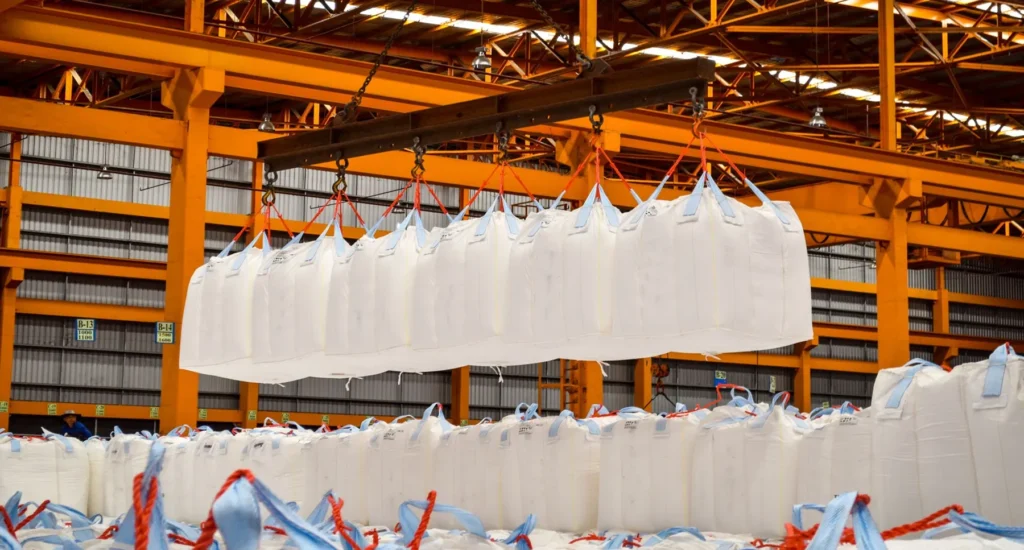
What Are FIBC Bulk Bags?
Flexible Intermediate Bulk Containers—commonly called FIBC bulk bags, big bags, jumbo sacks, or super sacks—are collapsible textile containers designed to move 500–2,000 kg of dry bulk goods with a safety factor typically rated at 5:1, 6:1, or 8:1 depending on duty and certification. The body is a woven polyolefin fabric (usually polypropylene), reinforced by lifting loops and finished with tailored filling/discharge features. In short: a fabric “container” that handles like a pallet, stacks like a cube, and folds like a tarp.
Key characteristics. High strength‑to‑weight ratio; configurable inlets/outlets (spout, duffle, cone); stack‑friendly form factors (U‑panel, 4‑panel, circular/tubular, baffle bags); optional inner liners for moisture/oxygen control; and electrostatic protection levels classified as Type A, B, C, or D for safe use around flammable powders or vapors.
How they are made—process overview. Resin → tape extrusion & stretching → weaving (flat or circular) → coating/lamination (optional) → cutting & body panel forming → loop/strap fabrication → printing/marking → liner manufacture/insertion (optional) → conversion & sewing (inlet/outlet spouts, closures, reinforcement) → finishing (inspection, metal detection, cleaning) → type tests and certification → baling and dispatch.
Where they are used. Grains and flour, sugar and salt, fertilizers and agro‑inputs, plastics and resins, cement and minerals, chemicals and catalysts, feed and pet nutrition, and pharma/food ingredients where clean manufacturing and traceability are non‑negotiable.
Why the Industry Recognizes Four Electrostatic Types (A, B, C, D)
Electrical safety is not a footnote; it is a design principle. As bulk solids flow in and out of fabric containers, charges accumulate. Discharge the wrong way in the wrong atmosphere and ignition is possible. The conversion industry therefore classifies FIBCs by the way they manage static electricity:
- Type A — Standard non‑conductive fabric with no special electrostatic features; safe only where no flammable atmospheres (dusts/vapors) are present.
- Type B — Non‑conductive fabric engineered with low breakdown voltage to prevent propagating brush discharges; suitable for combustible dusts with minimum ignition energies (MIE) ≥ 3 mJ when no flammable vapors are present.
- Type C — Conductive or interwoven groundable tapes; must be connected to earth during filling/emptying. Designed to drain charges safely even in environments where flammable vapors or low‑MIE dusts may be present.
- Type D — Static‑dissipative fabrics that safely bleed off charge without a dedicated ground connection; useful where grounding is impractical, provided contact conditions and maintenance are controlled.
Design implication. Type selection is not merely a safety label; it drives fabric selection, seam constructions, liner choices, and the presence of grounding tabs or dissipative yarn grids. Choosing the wrong type is not just sub‑optimal—it can be dangerous.
Systems Thinking: From Requirements to a Coherent FIBC Specification
A high‑performing FIBC emerges when we treat specification as an interlocked system. We decompose the problem into sub‑questions, solve each with data, then recombine into a single, checkable document.
- Product behavior (particle size, bulk density, MIE) → informs fabric GSM, spout geometry, and type (A/B/C/D).
- Supply‑chain environment (humidity, UV, stacking height, vibration) → defines coating needs, baffles, pallet patterns, and COF targets.
- Shelf‑life & contamination risks → sets liner barrier, food‑grade hygiene, and metal detection standards.
- Regulatory path (UN or non‑UN, food contact) → dictates type tests, safety factor, and marking.
- Operational realities (fill/empty rate, plant grounding, dust control) → drives inlet/outlet design, static strategy, and housekeeping.
Type‑by‑Type: Differences, Features, and Suitable Uses
Type A — The Workhorse for Non‑flammable Environments
Features. Plain woven PP without specific electrostatic protection. Typical fabrics 160–240 GSM; SWL 500–2,000 kg with 5:1 or 6:1 safety factors depending on duty. Available in U‑panel, 4‑panel, or circular bodies with 2/4 lifting loops.
Where it fits. Dry, non‑flammable goods—e.g., mineral ores, rock salt, certain plastic pellets—in facilities without flammable vapors or explosive dust clouds.
Production notes. Standard weaving and sewing; coatings optional for dust‑tightness; liners optional for moisture protection. QA emphasizes tensile strength, seam efficiency, and dimensional stability.
Risk boundary. Not suitable where combustible dust clouds or flammable vapors may form during fill/empty.
Type B — Guarding Against Propagating Brush Discharges
Features. Non‑conductive fabric with controlled breakdown voltage (<~6 kV design intent) to prevent propagating brush discharges. No intentional conductive grid; grounding is not required but good housekeeping is essential.
Where it fits. Combustible dusts with MIE ≥ 3 mJ and no flammable vapors present—e.g., many food powders and organic fertilizers in well‑ventilated filling areas.
Production notes. Fabric recipes and coatings are tailored to achieve dielectric behavior; liners must not defeat the anti‑PB protection (avoid highly insulating liners that enable charge build‑up without appropriate specification). QA includes charge decay/BDV screens and environmental conditioning.
Risk boundary. Not for use in the presence of flammable vapors/solvents.
Type C — Groundable Conductive FIBCs for Hazardous Zones
Features. Conductive fabrics woven with carbon or metal thread grids; dedicated grounding tabs at each lifting point. Resistance to earth is engineered to allow safe charge drainage during filling/emptying.
Where it fits. Processes with flammable vapors or low‑MIE powders (e.g., pharmaceutical actives, fine organics), provided grounding is reliably maintained.
Production notes. Stitching and tape paths must maintain electrical continuity; liners must be designed as conductive or perforated/dissipative to avoid isolating the charge path. QA verifies continuity (tab‑to‑tab, tab‑to‑grid), resistance to ground, and label instructions.
Risk boundary. Unsafe if grounding is neglected or compromised (painted hooks, dirty clamps, damaged tabs).
Type D — Dissipative FIBCs Without a Ground Lead
Features. Static‑dissipative yarns and fabrics engineered to bleed charge to atmosphere through controlled corona mechanisms. No external ground wire is needed during correct use.
Where it fits. Sites where reliable grounding is impractical—mobile filling, outdoor depots—yet flammable dusts/vapors may be present.
Production notes. Fabric selection is critical; liners must be compatible (dissipative or antistatic) and not isolate the fabric. QA focuses on charge decay, ignition tests per standard, and strict handling guidance on labels.
Risk boundary. Performance depends on surface condition and environment; contaminated or wet surfaces can reduce effectiveness. Operator training is integral.
UN vs. Non‑UN: What the Codes Mean and Why They Matter
Some cargoes are regulated as dangerous goods and require UN‑certified FIBCs with specific markings and tests. The codes you will see include 13H1, 13H2, 13H3, 13H4, which respectively indicate woven plastic uncoated/unlined, coated/no liner, uncoated/with liner, and coated/with liner. UN protocols add drop, topple, righting, and tear tests on top of standard lift/stack tests. Non‑UN FIBCs for inert goods still undergo cyclic top lift and stacking tests per ISO practice but are not subject to UN marking.
Practical takeaway. If the SDS says “Dangerous Goods,” start with UN design type testing and plan for a safety factor ≥6:1 with a certified QA program. If not, size the bag by SWL and handling risks; adopt a 5:1 or 6:1 path according to duty.
From Resin to Bag: The Manufacturing Process, Step by Step
Below we walk each core step, explain what can go wrong, and show how VidePak controls it using equipment from globally recognized suppliers—Starlinger (Austria) for woven PP/FIBC manufacturing and W&H – Windmöller & Hölscher (Germany) for our paper/valve‑sack lines. The brand names matter because capability and stability start with the machine.
1) Resin Selection & Compounding
What happens. Virgin PP (and sometimes rPP where allowed) is blended with UV stabilizers, slip/antiblock, color masterbatch, and—when static control is needed—antistatic or conductive additives.
Quality hazards. Inconsistent MFI causes tape width drift; poorly dispersed additives create weak points.
VidePak control. Gravimetric dosing; supplier COAs; incoming MFI and moisture tests; material traceability by lot.
2) Tape Extrusion & Stretching
What happens. PP melt is cast into a film, slit into tapes, and drawn to achieve tensile strength. Line speed, draw ratio, and annealing define orientation.
Quality hazards. Neck‑in, fibrillation, and variable denier lead to fabric streaks and seam weakness.
VidePak control. Starlinger starEX‑class tape lines with auto thickness control; closed‑loop tension; edge‑trim recycling with melt filtration to protect tape quality; online denier monitoring.
3) Weaving (Flat or Circular Looms)
What happens. Tapes become fabric—U‑panel, 4‑panel, or tubular. Loom tension and pick density set GSM and mesh.
Quality hazards. Broken tapes, variable pick counts, and loom marks degrade burst strength and appearance.
VidePak control. High‑speed looms with broken‑tape sensors; SPC on GSM and pick density; planned maintenance to curb vibration‑induced defects.
4) Coating/Lamination (Optional)
What happens. A thin PP coating layer is extrusion‑bonded to block dust or moisture ingress and to improve printability; or laminated film is applied for special barriers.
Quality hazards. Orange‑peel texture, pinholes, curl, and bond failure.
VidePak control. Melt temperature and chill‑roll profiles validated per structure; inline pinhole detection; peel tests per shift; retained samples.
5) Cutting & Body Panel Forming
What happens. Fabric is cut to size; baffles (internal stabilizing walls) are prepared when a square shape is required; edges are heat‑cut to reduce fray.
Quality hazards. Tolerance drift leads to skewed seams; baffles mis‑positioned cause bulging.
VidePak control. Template boards and automated cutters; gauge checks; poka‑yoke fixtures for baffle placement.
6) Loop/Strap Fabrication
What happens. High‑tenacity PP tapes are woven or knitted into lifting loops; reinforcement patches are prepared.
Quality hazards. Loop elongation mismatch; stitch tear‑out at high loads.
VidePak control. Proof‑load tests on loop sets; stitch pattern standards (e.g., box‑X); seam efficiency audits.
7) Sewing & Conversion (Inlet/Outlet, Reinforcements)
What happens. Panels are joined; spouts/duffles installed; documents pockets and labels attached; grounding tabs fitted on Type C.
Quality hazards. Skipped stitches, needle heat damage, misaligned spouts, poor continuity on conductive paths.
VidePak control. Operator training by work instruction; heat‑resistant needles; torque‑controlled machines; electrical continuity checks for Type C; 100% visual inspection of spout alignment.
8) Liner Manufacture & Insertion (If Specified)
What happens. LDPE/LLDPE/HDPE liners—or foil/dissipative liners—are made and fitted (loose, glued, or sewn).
Quality hazards. Liner pinholes; liner isolating the conductive fabric (Type C compatibility); poor heat‑seal windows during filling.
VidePak control. Bubble leak tests; liner‑to‑fabric compatibility checks for C/D types; seal‑window validation on customer equipment; antistatic masterbatch as required.
9) Cleaning, Inspection, and Metal Detection
What happens. Debris and loose fibers are removed; bags for food/pharma are inspected in controlled rooms; metal detection screens stray needles/wire.
Quality hazards. Foreign matter, odor carryover, and microbial risks in sensitive channels.
VidePak control. Segregated clean areas; hygiene SOPs (gowning, sticky mats); calibrated metal detectors; lot traceability.
10) Testing, Certification, and Marking
What happens. Cyclic top‑lift and stacking tests (non‑UN); UN design‑type tests (drop, topple, righting, tear) when required; electrostatic tests for B/C/D; marking and labeling per standard.
Quality hazards. Overreliance on supplier data; mismatch between lab and field.
VidePak control. Internal proof tests per lot; third‑party labs for type testing; periodic surveillance; archived samples; corrective actions tied to SPC.
How VidePak Manages Quality—From Machine Choice to SPC
- Best‑in‑class equipment. Starlinger tape extrusion, weaving, and coating lines underpin uniform tapes and fabrics; W&H paper and valve‑sack lines support our sister product families and cross‑pollinate printing know‑how.
- Process controls. Gravimetric dosing, online denier control, loom tension SPC, peel testing, seam efficiency checks, proof‑load on loops, and continuity tests on Type C.
- Quality systems. Food‑grade SKUs built under packaging hygiene schemes (e.g., FSSC/BRCGS); DoCs and migration/odor testing where contact is relevant; lot traceability embedded from resin to bale.
- Supplier partnerships. Resin and film partners with consistent COAs and auditability; liner suppliers validated for antistatic performance.
Data‑Rich Comparison Tables
Table 1 — Electrostatic Types at a Glance
| FIBC Type | Static Control Principle | Typical Safe Uses | Grounding Needed? | Liner Rules |
|---|---|---|---|---|
| A | None (standard non‑conductive PP) | Non‑flammable goods; no flammable vapors/dust clouds | No | Optional (moisture control only) |
| B | Low breakdown voltage; prevents propagating brush | Combustible dusts with MIE ≥ ~3 mJ; no flammable vapors | No | Must not defeat anti‑PB behavior; avoid isolating liners |
| C | Conductive grid; charge drainage to earth | Flammable vapors or low‑MIE dusts; controlled plants | Yes (mandatory) | Liner must be conductive/dissipative or perforated for continuity |
| D | Static‑dissipative fabric; corona discharge | Hazardous zones where grounding is impractical | No (per design intent) | Compatible dissipative liners required; cleanliness maintained |
Table 2 — UN Codes for Woven‑Plastic FIBCs
| UN Code | Construction | Typical Use |
|---|---|---|
| 13H1 | Woven plastic, uncoated, no liner | Dry, non‑dusting hazardous solids |
| 13H2 | Woven plastic, coated, no liner | Dust‑tight construction for powders |
| 13H3 | Woven plastic, uncoated, with liner | Moisture‑sensitive solids |
| 13H4 | Woven plastic, coated, with liner | Highest dust‑tightness + barrier |
Table 3 — Typical Mechanical & Dimensional Ranges
| Parameter | Typical Range | Notes |
|---|---|---|
| Safe Working Load (SWL) | 500–2,000 kg | Specify with Safety Factor (5:1, 6:1, 8:1) |
| Fabric GSM (body) | 160–240 g/m² | Higher GSM → higher tensile/burst |
| Loop design | 2/4 loops; sleeve or cross‑corner | Proof‑load test loops as assemblies |
| Body style | U‑panel, 4‑panel, circular, baffle | Baffle bags maximize cube efficiency |
| Inlet/Outlet | Spout, duffle, cone; discharge spout, full‑open | Match to plant filling & unloading |
| Coating thickness | 20–40 μm (if used) | Dust/moisture control; printability |
| Liner (PE) | 50–100 μm | LDPE/LLDPE for seal window; antistatic as needed |
Table 4 — Tests & Standards You Should See on a Spec
| Performance Aspect | Typical Standard/Test | What It Proves |
|---|---|---|
| Cyclic Top Lift | ISO 21898 | Lift endurance at SWL & SF |
| Stacking/Compression | ISO 21898 | Pallet stability under load |
| Drop/Topple/Righting/Tear | UN Recommendations (13H*) | Shock & stability for hazardous goods |
| Electrostatic Classification & Tests | IEC 61340‑4‑4 | Safe use in explosive atmospheres |
| Food‑Contact Materials | FDA 21 CFR 177.1520; EU 10/2011; GB 4806 | Regulatory compliance for contact |
| Hygiene/Factory Controls | FSSC 22000/BRCGS Packaging | Clean manufacture, traceability |
Case Snapshots — Problem → Solution → Result
Case 1: Sugar exporter in a monsoon climate
Problem. Caking and sift‑leaks on 1,000 kg SKUs.
Solution. Upgrade to baffle‑style Type B with coated fabric (dust‑tight), 70 μm antistatic LDPE liner, and heat‑sealed necks; pallet pattern changed to 4×4 with corner boards.
Result. Complaint rate down 60%; stack height increased by one layer without leaning.
Case 2: Pharma intermediate with low MIE
Problem. Electrostatic near‑miss during drum transfer from a generic bulk bag.
Solution. Move to Type C with verified earthing tabs at each lift point; specify dissipative liner and continuity checks in SOP; add operator training and daily ground clamp audits.
Result. Zero ESD incidents in 12 months; faster changeovers due to standardized earthing points.
Case 3: Resin producer seeking recyclability
Problem. Customer asks for higher recycled content without compromising strength.
Solution. Adopt Starlinger‑compatible rPP tapes (validated with melt filtration) to 30% rPP content; maintain fabric GSM by tightening draw ratio control; keep SF at 5:1 with proof testing.
Result. 28% material footprint reduction (by mass‑balance) with no observed increase in seam failures.
Comparative Notes — Body Constructions and When to Use Them
- U‑panel vs. 4‑panel. U‑panel offers fewer seams across load paths; 4‑panel yields neater edges and squarer stacking at high fills.
- Circular/tubular. Seam‑free bodies reduce leak paths; watch for circular “rounding” that reduces cube efficiency.
- Baffle bags. Fabric baffles create an internal frame that holds a cube; best for container optimization and neat warehouses; sewing accuracy is critical.
Practical Specification Template (Editable Outline)
Bag Type: FIBC, Type __ (A/B/C/D), body style __ (U/4‑panel/circular/baffle)
SWL/SF: __ kg @ __:1
Body Fabric: __ g/m² PP woven, mesh ×
Coating: __ μm PP (if any)
Loops: 4× cross‑corner (or 2‑loop/4‑loop sleeve), proof‑load tested
Inlet/Outlet: Inlet __ (spout/duffle/cone), Outlet __ (discharge spout/full‑open), safety ties
Liner: __ μm LDPE/LLDPE/HDPE or foil/dissipative; fixation __ (loose/glued/sewn)
Electrostatic Type: A/B/C/D; grounding tab count __; continuity spec __
Printing/Marking: UN code (13H1/2/3/4) if applicable; handling icons; traceability fields
Tests: ISO 21898 cyclic lift & stacking; UN design type (if UN); IEC 61340‑4‑4 electrostatics (if B/C/D); metal detection for food/pharma
Palletization: Pattern × layers __; corner boards; wrap tension setpoint __
Hygiene & Compliance: FSSC/BRCGS; FDA/EU/GB where contact applies
Documentation: COAs, DoCs, test reports, audit certificates; sample retention protocol
Horizontal & Vertical Analysis — Connecting Dots Across Disciplines
Horizontal (cross‑discipline). Printing science influences safety: coatings tuned for ink adhesion also change surface resistivity; choose antistatic‑friendly chemistries for B/C/D. Logistics meets design: a baffle bag’s cube reduces transport emissions per tonne by improving container fill. Recycling tech intersects with extrusion: filtered rPP streams on Starlinger lines enable higher recycled content without compromising tape quality.
Vertical (layered logic). Start at the hazard (MIE, vapor class) → select Type (A/B/C/D) → set liner/coat resistivity → embed QA checks (continuity, charge decay, BDV) → audit operator behaviors (ground clamp hygiene) → simulate field conditions (humidity, vibration) → lock the spec. The result is a closed loop from risk to routine.
Final Notes for Buyers
If a specification feels long, it is because reality is longer. A well‑built FIBC is an ecosystem: resin quality, tape uniformity, loom settings, sewing discipline, liner compatibility, electrostatics, and logistics choreography. VidePak turns that ecosystem into a guarantee—leveraging Starlinger for woven/tape excellence and W&H for best‑in‑class paper/valve‑sack conversion—so you can move bulk materials with confidence, compliance, and control.
Introduction — Purpose, Context, and Outcomes
Anti‑Bulge FIBC bag is the form‑stable answer to a classic bulk‑packaging headache: round bags on square pallets. This copy turns field pain points into a coherent plan: define the problem, choose the method, measure the result, and discuss trade‑offs. For a product family overview, see Anti‑Bulge FIBC bag.
What Is Anti‑Bulge FIBC bag and Why Does It Exist?
In simple terms, an Anti‑Bulge FIBC bag is a Flexible Intermediate Bulk Container built to hold a near‑cubic shape when filled. You may also hear baffle bag, Q‑bag, form‑stable FIBC, or form‑fit bulk bag—different labels for the same intent: restrain outward pressure so the bag stacks like a box. Key features include internal baffles with vent windows, squarer faces, optional coatings and liners for barrier control, and availability across electrostatic safety types (A/B/C/D). Manufacturing follows a familiar chain—PP tape extrusion → weaving → coating/lamination (optional) → cutting → baffle fabrication and attachment → loop construction → sewing/conversion → liner insertion (if specified) → inspection and testing. Where do such bags shine? Fertilizers, sugar and salt, flour and grains, plastic resins and pellets, minerals, and chemicals that must travel in containers, stack neatly in warehouses, and avoid overhang.
Extending Service Life — Problem, Method, Result, Discussion
Problem. Pallets lean, corners deform, faces scuff. The root cause is not only fabric strength; it is shape loss.
Method. Treat longevity as a system: specify baffles cut from coated woven PP (or strong mesh) with box‑X + multi‑row anchors; set stitch density to 10–12 SPI; add anti‑slip face to raise COF; select UV stabilization (200–1600 h) for outdoor dwell; choose liners that match WVTR/OTR targets.
Result. Straighter stacks, fewer strap failures, fewer returns.
Discussion. Horizontally compare coated‑fabric faces vs. laminated faces: the former breathe and cost less; the latter resist scuff and carry print. Vertically link cause to effect: baffle pitch → fill speed → cube retention; COF → pallet creep → load claims.
Understanding the Production Process — From Resin to Anti‑Bulge FIBC bag
Problem. Variability hides in routine: a weak tape today becomes a torn seam tomorrow.
Method. Standardize each step: gravimetric compounding of PP; tape extrusion with controlled MFI, draw ratio, and annealing; weaving with SPC on GSM and pick density; coating with validated melt/chill profiles; precision cutting; jig‑guided baffle placement; loop proof‑load; dimensional checks after sewing; bubble‑leak and seal‑window validation for liners.
Result. Anti‑Bulge FIBC bag that look and behave the same across lots and weeks.
Discussion. The process is a chain; the chain fails at its thinnest link. If baffle anchors drift, the warehouse tells you—in the language of bulge.
Material Selection — Fabric GSM, Baffle Cloth, and Liners
Problem. Over‑spec fabric wastes money; under‑spec baffles waste space.
Method. Match fabric GSM (typically 160–240 g/m²) to SWL (500–2,000 kg) and stacking height; choose baffle cloth (coated for dust‑tightness or mesh for faster fill‑through) with vent windows sized to product granularity; select liners: LDPE/LLDPE (50–100 μm) for broad seal windows and conformance, HDPE for lower WVTR, foil composites for near‑zero permeation.
Result. A balanced Anti‑Bulge FIBC bag that is strong where needed and light where possible.
Discussion. Horizontally balance mechanics (tensile, seam) with barrier (WVTR/OTR). Vertically map “failure mode → countermeasure”: caking → thicker liner; topple → higher COF + wider gusset; slow fill → baffle window pitch.
Quality Control and Testing — What to Measure and Why It Matters
Problem. Visual checks alone miss hidden risks.
Method. Use objective tests: cyclic top‑lift and stacking per ISO 21898; drop/teardown for UN 13H1–13H4 designs; electrostatic checks for Types B/C/D per IEC 61340‑4‑4; seal strength pulls (ASTM F88) on liner samples; dart impact (ASTM D1709) and tear (ASTM D1922) on films; COF targets (ASTM D1894) for pallet stability.
Result. Anti‑Bulge FIBC bag that can be defended with data when audits arrive.
Discussion. Data is not paperwork—it is insurance against downtime and disputes.
Where Anti‑Bulge FIBC bag Are Used — Industries and Fit
Problem. One geometry, many risks: hygroscopic pickup in sugar, oxidation in pet food, dust in flour, leakage in pellets.
Method. Map application to risk: fertilizers need UV and anti‑slip; sugar/flour prefer liners and dust‑tight faces; resins demand leak‑proof liner seals; minerals and aggregates benefit from baffle‑held cube for safer stacks.
Result. Sector‑fit Anti‑Bulge FIBC bag with clear justification.
Discussion. Cross‑industry insight: the same baffle that prevents bulge also shields printed panels from shelf rub.
Everyday Examples — How Anti‑Bulge FIBC bag Show Up in Real Life
Problem. Buyers doubt the value of form stability until they see the aisle.
Method. Place square bags on square pallets: refined sugar 1,000 kg in coastal export lanes; NPK fertilizer in outdoor depots; PP pellets into high‑speed hoppers.
Result. Tidy aisles, easier scanning, faster handling.
Discussion. What looks like aesthetics is logistics by another name.
Supplier Proficiency — Equipment, People, and Proof
Problem. Not all factories are equal.
Method. Evaluate capability by equipment pedigree (e.g., Starlinger for woven PP/FIBC lines), demonstrated process windows (registration, peel, seam efficiency), and site certifications (FSSC/BRCGS). Ask for QA cadence, continuity checks for Type C, and liner compatibility proofs for Types C/D.
Result. Partners who can build the same Anti‑Bulge FIBC bag on Monday and Friday—without surprises.
Discussion. A clean audit today is tomorrow’s on‑time shipment.
Getting a Quotation — What to Specify and What to Ask
Problem. Vague RFQs cause expensive iterations.
Method. Provide: SWL and safety factor; body style (U‑panel/4‑panel/circular) and whether baffles are required (yes: pitch/window geometry); inlet/outlet style; liner type and thickness; electrostatic type (A/B/C/D) and grounding plan; pallet pattern and target stack height; tests to pass; artwork expectations (colors, matte/gloss); hygiene requirements.
Result. Comparable quotes and realistic lead times.
Discussion. The best price is the one that includes the performance you actually need.
How Anti‑Bulge FIBC bag Differ from Standard FIBC — A Concise Contrast
Problem. Conventional bags bulge, round, and overhang; container space is lost.
Method. Add internal baffles anchored at calibrated points, preserve corner geometry, and manage venting so fill‑through remains efficient.
Result. Anti‑Bulge FIBC bag that pack denser, scan cleaner, and stack safer.
Discussion. The cost delta is easily repaid by container utilization and reduced damage.
What Materials Can Be Packed — Scope and Limits
Problem. “Can it handle my product?” is the universal buyer question.
Method. Validate against particle size, bulk density, electrostatic risk (MIE), and barrier needs. Suitable fills include dry grains, sugars, salts, fertilizers, resins, minerals, and many industrial powders; for solvent‑bearing atmospheres or low‑MIE powders, specify Type C (grounded) or Type D (dissipative) variants.
Result. A wide coverage map with clear red lines for safety.
Discussion. When in doubt about hazards, upgrade the electrostatic type—safety scales better than regret.
Why Type C/D Options Add Value — Static Control as a Design Variable
Problem. Static sparks meet combustible dusts; the outcome writes accident reports.
Method. Use Type C Anti‑Bulge FIBC bag with conductive grids and grounding tabs when earthing is reliable; use Type D Anti‑Bulge FIBC bag with dissipative yarns when grounding is impractical and conditions are controlled. Ensure liners are compatible (dissipative or perforated) so charge paths are not isolated.
Result. Form‑stable geometry with engineered electrostatic safety.
Discussion. Shape without safety is a half‑solution; integrate both.
References
ISO 21898 (Packaging — Flexible intermediate bulk containers for non‑dangerous goods); UN Recommendations on the Transport of Dangerous Goods (13H1–13H4 designations); IEC 61340‑4‑4 (Electrostatics — Standard test methods for FIBCs); FDA 21 CFR 177.1520; EU Regulation No. 10/2011 within EC 1935/2004; GB 4806 series; representative supplier data sheets for PP woven fabrics, coated/laminated baffle materials, and PE/foil liners applicable to Anti‑Bulge FIBC bag applications.