
Flexible Intermediate Bulk Containers (FIBC), commonly known as Jumbo Bags, are large, heavy-duty woven polypropylene bags designed for bulk handling and transport. They are extremely strong yet flexible, capable of carrying tons of material. These bags are widely used in industries such as agriculture, construction, mining, and chemicals, because they can safely hold dry powders, granules, and other free-flowing materials. Choosing the right FIBC type and design ensures safe, efficient handling. Below we introduce the main fabric types, top and bottom styles, construction forms, and lifting loop designs of FIBC Jumbo bags, as well as VidePak’s high-quality manufacturing of these products.
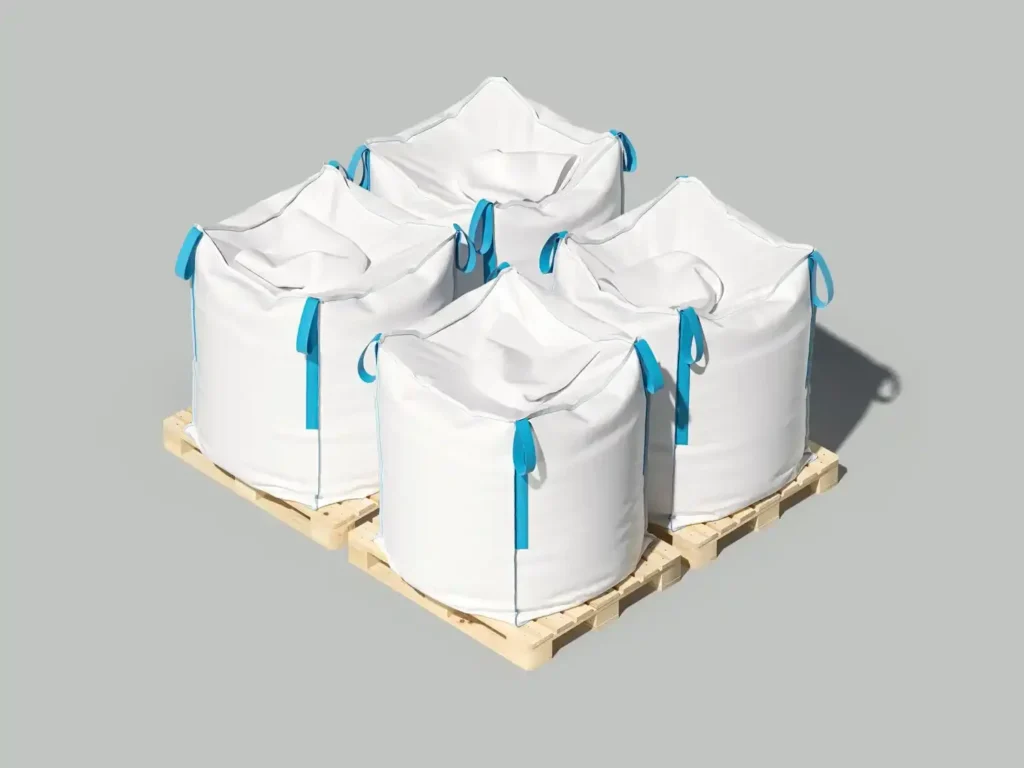
FIBC Fabric Types: Type A & Type B & Type C & Type D
FIBCs are classified into four safety types (A, B, C, D) based on their electrostatic properties. This classification guides safe use in different environments:
- Type A bags are the most basic. Made from plain woven polypropylene, they offer no special static protection. When contents rub against the bag, static can build up, so Type A bags are suitable only for non-flammable, non-hazardous products. Common uses include storing sand, gravel, minerals or other inert materials. They should never be used with flammable powders or in explosive atmospheres.
- Type B bags are similar to Type A in basic materials but use fabric with a lower breakdown voltage. This means energetic sparks (propagating brush discharges) are less likely, though they do not dissipate static charge. Thus, Type B FIBCs can carry dry, flammable powders where strict grounding isn’t required. However, they should not be used in environments with combustible dust or where ignition energies exceed safety thresholds.
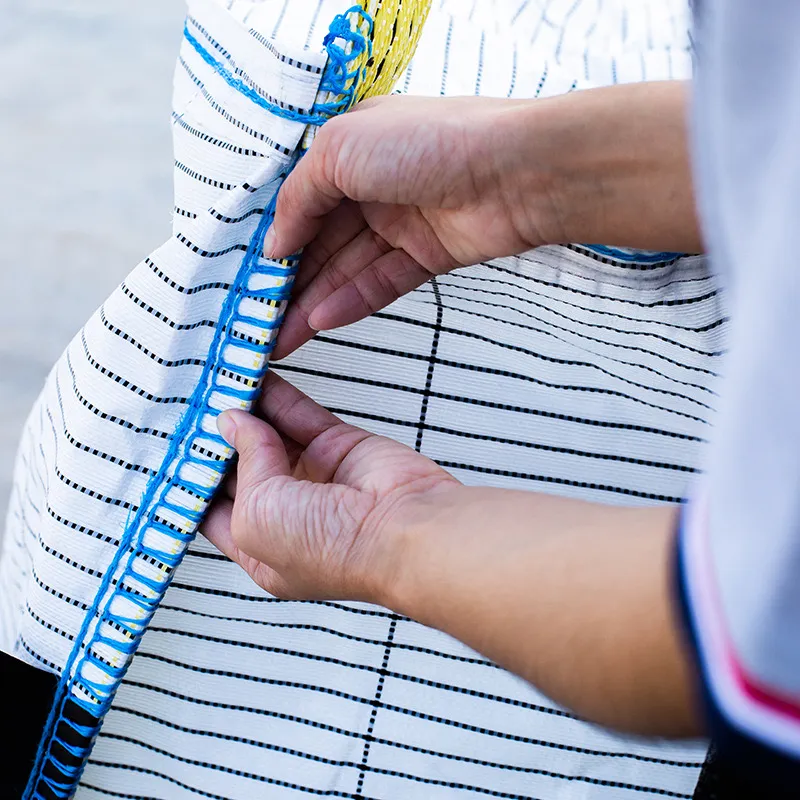
- Type C (Groundable) FIBCs incorporate conductive yarns woven into the fabric (usually in a grid pattern). This allows the bag to be electrically grounded during filling/discharge to safely remove static charge. Type C bags are ideal for handling flammable powders, vapors or dusts in hazardous environments. Critical: they must be grounded at all times; failure to ground negates their safety feature. These bags are widely used in chemical, mining, and pharmaceutical applications where reliable grounding and static protection are needed.
- Type D (Anti-Static) FIBCs use special static-dissipative fabric that prevents sparks without external grounding. The fabric contains quasi-conductive yarns that emit any charge safely into the atmosphere (low-energy corona discharge). Type D bags can be used for flammable powders and combustible dusts in hazardous areas without the complexity of grounding. They are suited for chemicals and fine powders where any spark could be dangerous. However, if the bag surface becomes contaminated (e.g. with conductive grease), their anti-static effectiveness is reduced.
The table below summarizes these FIBC types:
| FIBC Type | Fabric/Protection | Typical Uses |
| Type A | Plain woven PP; no static protection | Non-flammable materials (e.g. sand, aggregate); general storage in non-hazardous areas. |
| Type B | Plain PP with low breakdown voltage (no static dissipation) | Dry flammable powders in dust-free areas (ignition energy <3mJ). Avoid when any combustible gas or solvent is present. |
| Type C | PP woven with conductive threads (ground-able) | Flammable powders or dusts in hazardous environments (must connect to ground during use). Common in chemical and mining industries. |
| Type D | Antistatic (dissipative) fabric, no grounding needed | High-risk flammable/combustible powders. Suitable for volatile chemicals or where grounding is impractical. Ensure bag is clean (no conductive contamination). |
Using the correct type is crucial. For instance, a Type A bag is cost-effective but unsafe for flammable materials, whereas Type D offers maximum static protection with ease of use. Always match bag type to the material and environment: non-hazardous loads can use basic Type A, flammable powders require groundable Type C or self-dissipative Type D.
FIBC Jumbo Bag Top Styles
The top design of an FIBC bag affects how it is filled and closed. Common top styles include:
- Open Top: A completely open bag top (no closure). It allows full access, ideal for bulky or oversized materials. After filling, the skirt can be gathered and tied. Open tops are simple and cost-effective, used for things like soil, gravel, scrap, or other materials not requiring a sealed closure.
- Duffle (Duffel) Top: Features a large tubular skirt sewn onto the top. This design lets operators completely fill the bag (like open-top) and then tie off the skirt. It combines easy filling with a secure closure. Duffle tops are widely used for aggregates, animal feed, grains, beans, and granular materials. Because the skirt is substantial, it does not connect to filling equipment; the material drops from above. They are excellent when you need full access and a closure after filling.
- Spout (Filling Spout) Top: A cylindrical spout (filler tube) is sewn into the center of the top panel. During filling, this spout connects to the filling chute or equipment, enabling a controlled, dust-tight fill. Afterward, the spout is tied off with a built-in drawstring. Spout tops are ideal for fine powders and dust-prone products (chemicals, cement, flour, food ingredients) because they minimize spillage and airborne dust.
- Spout Top with Flap: This is a spout top with an additional fabric flap over it. The flap covers the closed spout, providing extra containment against moisture or contamination. It combines the sealed filling of a spout with added security. Useful for materials that need both dust control and a bit of extra closure protection.
- Conical Spout Top: A variation of spout top with a built-in funnel (high filling cone). The internal conical shape promotes complete filling (reducing trapped material) and can speed up filling. It’s used in specialized applications where the bag must fill quickly with fine or damp powders.
The following table summarizes these top styles, their structure, and typical uses:
| Top Style | Structure & Features | Applications |
| Open Top | No closure; the bag is entirely open. After filling, edges are tied. | Bulk items (soil, rock, scrap, debris) where dust/sealing isn’t critical. Cost-effective. |
| Duffle Top | Large tubular skirt sewn on top. Fully open for filling, then tied off with drawstring. | Granules, seeds, animal feed, chemicals, beans – materials needing easy fill and closure. Not ideal for dust control. |
| Spout (Filling Spout) | Cylindrical tube sewn into center of top. Connects to fill spout equipment; closeable with tie. | Fine powders, chemicals, cement, food ingredients – any dusty material needing contained fill (e.g. cement, salt, flour). |
| Spout + Flap | Spout top with extra fabric flap covering it. Offers additional coverage over the closed spout. | Sensitive powders or moisture-sensitive products requiring an extra layer of protection. |
| Conical Spout Top | Spout top with an internal funnel-shaped filler. Ensures rapid, complete filling. | Specialized use with difficult-to-flow powders (damp or clumpy) where full discharge is needed. |
In practice, open and duffle tops offer simplicity and lower cost but less dust control, while spout-based tops (especially with flaps) provide closed filling to keep material contained. VidePak Jumbo Bags can be customized with any of these top styles to fit the material and filling method required.
FIBC Jumbo Bag Bottom Styles
Just as tops differ, the bottom design (discharge style) determines how the bag’s contents are emptied. Key bottom styles include:
- Plain (Flat) Bottom: A sealed bottom with no discharge opening[19]. This is the simplest, most economical option. To empty, workers must cut or pull the bag open. Plain bottoms are used when the bag will be emptied one-time by cutting, or when discharging is handled by tipping/pouring (for very coarse or rock-like materials).
- Discharge Spout Bottom: A closing spout at the bottom center. Often 14″×18″ diameter, it allows controlled emptying. The spout is opened (untied) and contents flow out in a stream. This style is common for granular or powdered products, as it speeds unloading and minimizes waste. Variations include:
- Conical Discharge Spout: Features an internal funnel (conical) insert so that almost all powder flows out without blockage. Useful for sticky or moist powders.
- Spout with Flap: A discharge spout plus an extra fabric flap over it. The flap is untied first, then the spout for an added safety enclosure. This double layer can help prevent spillage or contamination at discharge.
- Duffle Bottom: A bottom with a large openable pane (also called a “fully open bottom”). One or more seams can be untied to let the entire base open like a flap, dumping all contents at once. Duffle bottoms are excellent for coarse or clumpy loads (e.g. gravel, shells) where a quick, full empty is desired. They do not allow controlled flow (everything empties suddenly), so they require careful handling.
- Flap (Diaper) Bottom: A type of bottom with a single tied panel that is untied and opened sideways (like a diaper). This allows faster unloading than a plain bottom but is still reusable. (Not shown in table below; it is similar to duffle but typically opens only one side.)
Below is a summary table of common bottom styles:
| Bottom Style | Structure & Features | Applications |
| Plain (Flat) Bottom | Sealed bottom; no spout or opening. | Cheapest; used for single-use bags emptied by cutting or for dumping bulky materials (e.g. scrap, debris). |
| Discharge Spout Bottom | Cylindrical spout sewn into base. Tied closed; untie to discharge material. | Powders and granular products needing controlled discharge (chemicals, grains, cement, plastic pellets). Spout diameters are often 14″×18″. |
| Conical Spout Bottom | Discharge spout with an internal conical insert. Ensures full flow. | Sticky or fine powders (sugar, chemicals) where trapped material must be minimized. |
| Discharge Spout + Flap | Spout plus an extra fabric flap over it. Flap untied first, then spout. | Situations needing extra barrier at the bottom before spout opening (sensitive powders or dusty loads). |
| Duffle Bottom | Bottom panel (a “flap”) that fully opens. Can dump all contents quickly. | Coarse, bulky or irregular materials (rocks, shells, feed) requiring rapid release. Not for powders that need controlled flow. |
Selecting the right bottom style depends on unloading needs: spouts provide controlled, dust-reduced discharge, whereas duffle bottoms give full, rapid emptying. VidePak Jumbo Bags can be tailored with any of these bottom options during manufacturing.
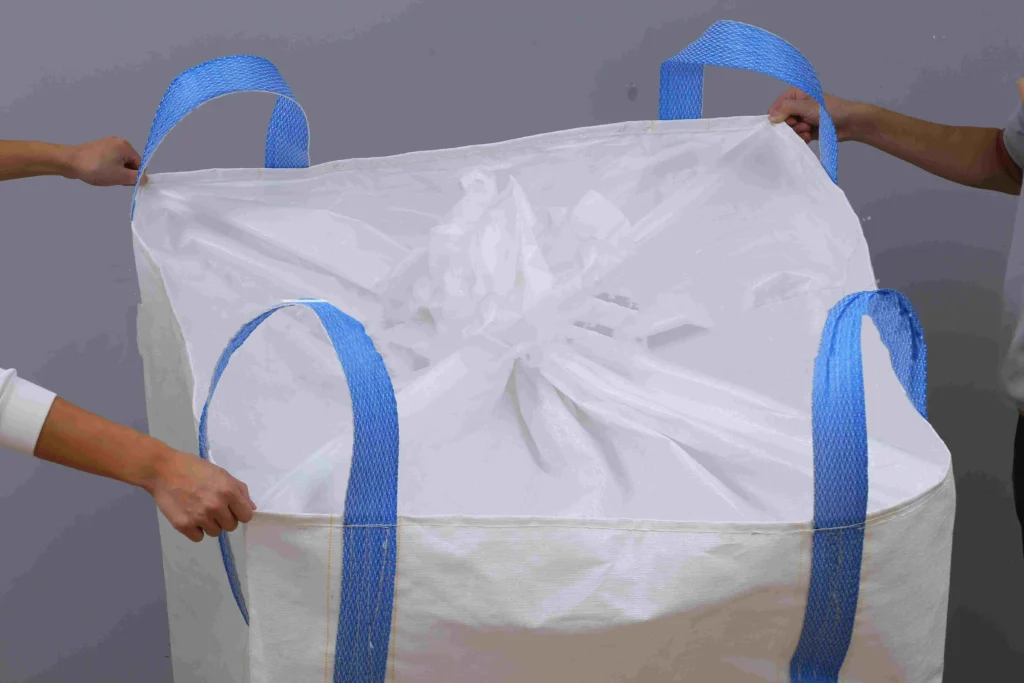
FIBC Jumbo Bag Constructions
The bag construction (fabric panel design) determines the bag’s shape and stability when filled. The most common FIBC constructions are:
- 4-Panel: This industry-standard design consists of five separate pieces: four vertical side panels sewn together and one bottom panel. The result is a square/rectangular bag that maintains its shape well. However, the numerous seams can be points of weakness. 4-panel bags generally fill and stack uniformly, making them suitable for stable storage.
- U-Panel: Constructed from three main pieces: one large U-shaped tube forming the bottom and two opposite sides, plus two smaller fabric pieces sewn in for the other two side panels. U-panel bags also form a square shape when filled and are the most popular style due to fewer seams (one big piece + two small pieces). They balance shape retention and cost-effectiveness.
- Circular (Tubular): Made from one continuous tube of fabric for all four sides, with separate pieces for top and bottom. Despite the name, a “circular” FIBC looks square-ish when filled, but it has minimal sewing (only at top and bottom). This construction is very economical but holds its shape the least, often bulging more under load. It is suited for applications where cost is critical and perfect squareness is not required.
- Baffle (Q-Bag): A baffle bag is any of the above (4-panel, U-panel, or circular) with additional square panels sewn into each of the four internal corners. These internal baffles force the bag to retain a cube shape when filled, preventing bulging and increasing volume (often by ~30% vs. unbaffled). Baffled bags are ideal when space efficiency and stackability are important – for example, when maximizing storage or shipping efficiency. The most common is a 4-panel bag with corner baffles.
The table below compares these constructions:
| Construction | Structure | Features & Uses |
| 4-Panel | Four side panels + separate bottom piece. | Strong, retains square shape; industry standard. More seams (slightly lower burst strength at seams). Good for stable loads and easy stacking. |
| U-Panel | U-shaped fabric forms 3 sides + bottom; two additional side panels sewn in. | Popular design; fewer seams than 4-panel. Holds shape well. Cost-efficient. |
| Circular | Tubular fabric forms all four sides; top and bottom sewn on. | Minimal seams (only top/bottom). Least expensive. Bag tends to bulge; less squareness. Used when bag shape is less critical. |
| Baffle | Internal square baffle panels in each corner. Can be U-panel, 4-panel, or circular bag with baffles. | Locks the bag into a cubical shape. Increases volume (up to +30%) and stability for stacking. Ideal for space optimization. |
In summary, 4-panel and U-panel constructions will keep a squarish shape (U-panel being slightly cheaper), circular is lowest cost but more rounded, and baffled bags excel at maximizing volume and stack strength. VidePak offers all these constructions to match storage needs and stability requirements.
Lifting Loops and Accessories
All Jumbo Bags have lifting loops that allow cranes or forklifts to move them. The loop style can vary:
- 4 Corner Loops (Standard): Four loops, one at each corner, sewn into the bag seams. This is the most common. Cranes or forklifts pick up each loop to lift the bag. It provides good stability and easy handling for cranes.
- Cross-Corner (Tunnel) Loops: Also four loops, but each loop extends across the bag from one side to the adjacent side (through the bag’s top, forming a ‘staple’ shape). These tunnel loops pass over the top and down the side, distributing weight along the fabric. They can reduce stress on seams and make the loops easier to locate for equipment.
- Stevedore Straps: In some systems, flat heavy straps are threaded through the bag’s loops:
- Double Stevedore: Two straps, each threaded through two loops on opposite sides. Forklift forks slide under these straps to lift the bag. This spreads the load and allows forklift handling without hooking loops.
- Single Stevedore: One strap goes through all four loops. Allows lifting from any forklift direction using one big strap.
- Sleeve (Tunnel) Lift: A separate strong fabric sleeve (tube) is fixed around the bag’s mid-section. Forklift forks slide directly under or through this sleeve. This approach avoids using loops entirely, securing the bag for forklift lifting.
These loop/strap styles affect handling: corner loops work for cranes or hooks, while stevedore straps and sleeves facilitate forklift use. VidePak bags typically include four corner loops as standard, and can be paired with forklift straps or sleeves as needed for the customer’s equipment.
VidePak’s Jumbo Bag Manufacturing
VidePak is a leading supplier of FIBC Jumbo Bags. They emphasize quality raw materials and modern production to ensure top performance. Key highlights include:
- Premium Materials: VidePak sources 100% virgin polypropylene resin from top global suppliers (BASF, Sinopec, Yangzi Chemical). Using high-grade, certified resins ensures material consistency and strength in every bag.
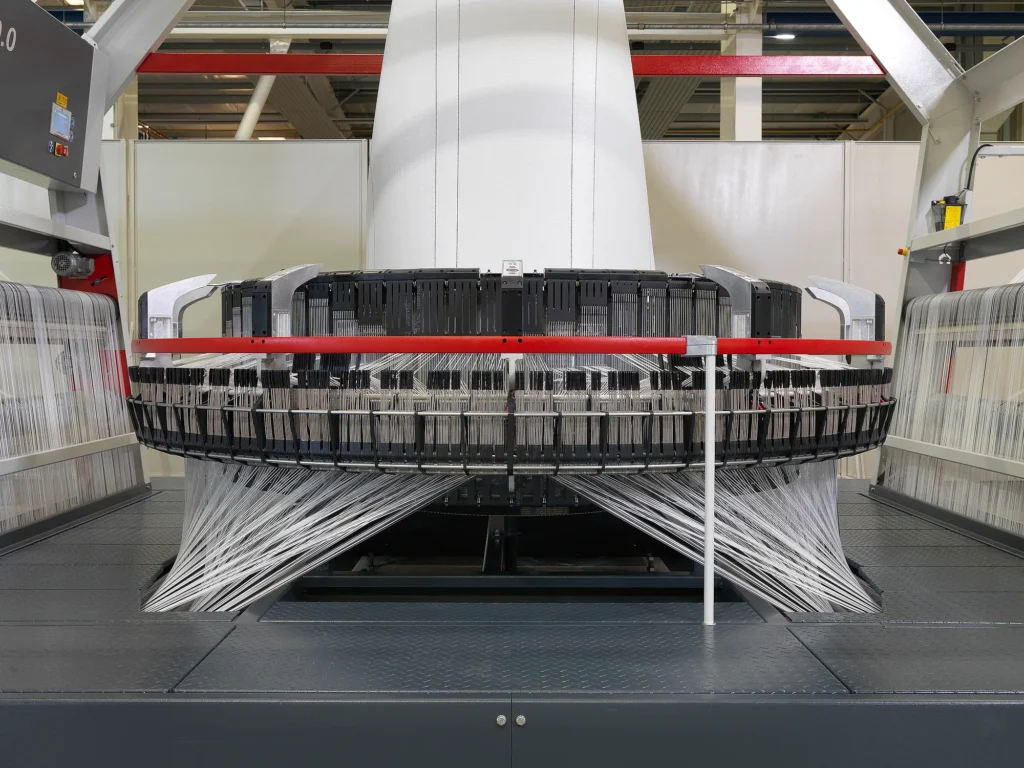
- Advanced Equipment: The factory is equipped with state-of-the-art Austrian Starlinger looms and bag-making machines. These advanced lines ensure precise weaving, extrusion of film, and bag sewing, leading to stable production and high bag quality.
- International Standards: Production follows strict international standards. VidePak’s processes and testing comply with ASTM, ISO, EN, JIS specifications. For example, raw materials are pre-tested to ASTM/ISO specs, and final bags undergo impact, tensile and drop tests in line with ASTM/ISO methods. This guarantees each bag meets the advertised capacity and safety.
- Production Capacity and QC: The facility has a full complement of equipment (100+ looms, extrusion lines, baggers) and a large annual output (~2 million jumbo bags). Every production batch is inspected: electronic controls monitor fabric dimensions, and sample bags are tested for tensile strength, tear resistance, leakproofness, etc., before shipping. This rigorous quality control ensures customers receive only fully compliant, defect-free bags.
- Experience and Partnerships: VidePak’s team has 25+ years in industrial bags. They have built quality systems through projects with Fortune 500 companies (e.g. Nestlé, Sinopec). This expertise translates to reliable manufacturing and confidence in delivering high-grade FIBC products.
In short, VidePak’s Jumbo Bags combine global-grade materials and cutting-edge production (Starlinger/W&H) under robust QC. Their facility turns premium raw polypropylene into heavy-duty FIBC bags meeting ASTM/ISO standards. The result is a very stable product supply (millions of bags/year) that customers can trust to meet load, safety, and regulatory requirements.
Tables of Key Features
Table 1: FIBC Bag Electrostatic Types (Type A–D):
| Type | Fabric/Protection | Use Case |
| A | Plain PP; no static control | Non-flammable solids in safe areas. |
| B | Plain PP; low breakdown voltage | Dry powders (flammable); no grounding, no combustible dust. |
| C | PP with conductive yarns (groundable) | Flammable powders/dust; must be grounded for safe use. |
| D | Antistatic PP (dissipative) | Flammable/combustible products in hazardous areas; no grounding needed. |
Table 2: Top Fill Styles for FIBC:
| Top Style | Structure & Operation | Typical Uses & Remarks |
| Open Top | Fully open mouth; material dumped/loaded in bulk. Close by gathering skirt. | Soil, rock, waste, scrap (non-dusty). Lowest cost; less containment. |
| Duffle Top | Large tubular skirt sewn on top. Fully open during fill; tie off after. | Grains, seeds, feed, aggregates; need full access & closure. Not sealed against dust. |
| Spout Top | Cylindrical filler tube in top. Attaches to hopper; tie when filled. | Powders, fine chemicals, cement, food ingredients (dusty loads). Contained filling. |
| Spout + Flap | Spout + extra fabric flap over it. Spout ties off; flap covers it. | Sensitive or hygroscopic powders needing dust control + added moisture barrier. |
| Conical Spout Top | Spout with built-in funnel (cone). Promotes complete filling. | Sticky/damp powders; ensures nearly complete emptying (no residue). |
Table 3: Bottom Discharge Styles for FIBC:
| Bottom Style | Structure & Operation | Typical Uses |
| Plain/Flat Bottom | Sealed base; no discharge opening. | Single-use or open dumping (e.g. scrap, rubble). Low-cost. |
| Discharge Spout Bottom | Cylindrical outlet in base. Untie to release. | General powders and granules (chemicals, grains, plastic pellets). Controlled flow. |
| Discharge Spout + Flap | Spout + additional bottom flap. Untie flap first. | Fine or hazardous powders needing extra containment. |
| Conical Spout Bottom | Spout with inner funnel. Facilitates full discharge. | Sticky/powdery materials (cement, sugar) that can cling. |
| Duffle (Fully Open) | Bottom panel opens fully (like a hatch). | Coarse solids or large lumps (mining ore, nutshells) for rapid emptying. |
Table 4: FIBC Bag Constructions:
| Construction | Description | Characteristics |
| 4-Panel | Four side panels + separate bottom piece. | Maintains square shape; many seams (standard design). Good for stacking. |
| U-Panel | One U-shaped piece (bottom + 2 opposite sides) + 2 side panels. | Popular; fewer seams; holds shape well. Balance of cost and strength. |
| Circular | One continuous tube for all sides. | Least seams (only top/bottom sewing). Bag is more round; cheapest. |
| Baffle | Any above style + corner baffles. | Enforces square shape; +30% volume. Highly stable and stackable. |
Table 5: FIBC Lifting Loop Configurations:
Conclusion
FIBC Jumbo Bags are versatile bulk containers, and understanding their types and features is vital for safe, efficient use. We have outlined the four electrostatic safety types (A–D), the various top and bottom designs, construction styles (4-panel, U-panel, circular, baffled), and lifting loop options. Each choice – from a plain Type A bag with an open top to a baffled Type D bag with spout top and spout bottom – has specific strengths for different materials and conditions.
VidePak leverages this diversity by offering fully customizable Jumbo Bags. They source premium materials (BASF/Sinopec/Yangzi), use advanced Starlinger and W&H machinery, and follow ASTM/ISO/JIS standards. With an annual production capacity of about 2 million FIBCs and rigorous quality testing (tensile, drop, UV resistance, etc.), VidePak ensures each bag meets the highest quality and safety requirements.
By carefully matching bag type, top/bottom style, construction, and loops to the product and operation, businesses can optimize handling, protect materials, and comply with safety norms. VidePak’s Jumbo Bags, made to international standards, provide that reliable solution for any bulk packaging need.
Reference:
Types of FIBC Bags, FIBC Bags Specification & FIBC Bags Uses