
What is FIBC Bulk Bags? — Definitions, scope, and why names matter
This document presents a structured, deeply reasoned exploration of FIBC Bulk Bags, weaving together polymer science, safety engineering, supply‑chain practice, and sustainability policy. The acronym expands to Flexible Intermediate Bulk Container. In everyday use, FIBC Bulk Bags are large, flexible containers fabricated from woven polypropylene (PP) and designed to store and transport dry, flowable materials—minerals, food ingredients, plastics, fertilizers, scrap, and more—at capacities that typically range from 250 kg to 2,000 kg per unit. The essence is simple but powerful: a high‑tenacity woven mesh bears the load; carefully engineered seams and lift loops transfer that load safely; optional liners control moisture and dust; and dimensioning (with or without internal baffles) defines how the bag behaves on a pallet, in a container, and at discharge.
Like many industrial products, FIBC Bulk Bags live behind a thicket of aliases. Understanding those labels avoids mis‑specification, aligns expectations, and helps teams read standards correctly.
Also known as (aliases):
- Flexible Intermediate Bulk Containers (FIBCs)
- Big Bags
- Jumbo Bags
- Bulk Sacks
- PP Woven Bulk Containers
- Industrial Tote Bags
- Baffle Bags (Q‑bags) when internal baffles are present
All of these refer to the same core format unless a static‑protection type (A/B/C/D), a UN certification for dangerous goods, or a geometric descriptor (baffled vs. free‑form) is explicitly attached. Throughout the text, the anchor term remains FIBC Bulk Bags.
What are the materials of FIBC Bulk Bags? — From monomers to mesh
At their heart, FIBC Bulk Bags are an elegant assembly of just a few elements. Each element contributes a precise function, and the interaction among them defines performance. Treat each element as a lever: pulling one changes others, sometimes in non‑obvious ways. The sections below profile the materials, their properties, typical cost levers, and the exact role they play in the bag.
Reading aid: If you are new to FIBC Bulk Bags, scan the bold sub‑headings first, then return for the details. If you are an engineer, the bullet lists include the knobs you can actually turn in a plant or during sourcing.
Woven polypropylene fabric — The structural backbone
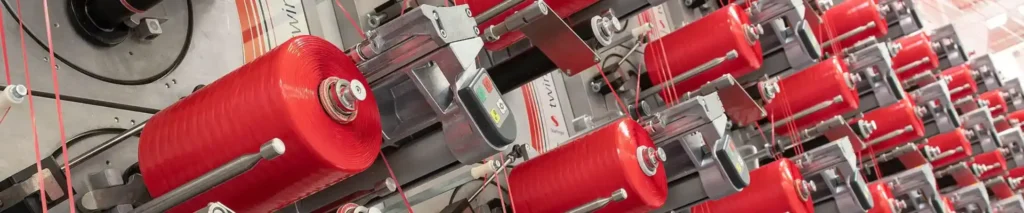
Polypropylene (PP) is a semi‑crystalline thermoplastic with low density (~0.9 g/cc), high fatigue resistance, and excellent performance when oriented into tapes. In FIBC Bulk Bags the fabric is made by extruding a thin PP film, slitting it into tapes, drawing those tapes to orient polymer chains (boosting tensile strength and modulus), and weaving on circular or flat looms. Common areal densities span roughly 140–240 gsm, tuned to Safe Working Load (SWL) and Factor of Safety (typically 5:1 for single‑trip and 6:1 for multi‑trip designs). Fabric decisions—denier, picks per inch, and weave pattern—govern drop performance, corner tear resistance, and seam efficiency.
- Strength physics: oriented tapes resist elongation and distribute load across warp and weft. Tear will favor the weakest seam path, hence seam design is as important as base fabric gsm.
- Cost levers: resin grade and melt flow index, denier selection, loom productivity, and the use of recycled PP. Introducing recycled content demands tighter statistical process control and re‑validation of seam efficiencies.
- Durability: UV‑stabilizer masterbatches (HALS/UV absorbers) defend against outdoor degradation for agriculture and construction routes.
Coatings and cast films — Tuning surface and barrier
A thin PP or PE extrusion coating (often 20–40 gsm) seals inter‑yarn pores for sift‑proofing and provides a smoother, printable surface. Coatings also change the exterior coefficient of friction (COF), which influences pallet stability and conveyor behavior. The tradeoff is added mass and, when mixing polymers, a more complex end‑of‑life story. Many buyers now prefer to stay within a PP family wherever feasible to ease documentation for recyclability programs.
Inner liners — Moisture, oxygen, and cleanliness management
Loose, shaped, or form‑fit liners are specified when the product is hygroscopic, dusty, or oxygen‑sensitive. Typical materials are LDPE/LLDPE; barrier needs introduce coextrusions (e.g., EVOH). A rising alternative is a PP liner to preserve a single polymer family; this choice interacts with static‑protection, hygiene, and design‑for‑recycling objectives. In food and pharma streams, liners may carry antistatic, slip, or specific migration controls and are handled under clean‑area SOPs.
Lift systems — Webbing, loops, and load paths
High‑tenacity PP webbing forms one‑, two‑, or four‑loop lift architectures. Stitch patterns, overlap lengths, and thread specifications determine seam efficiency—often the gating factor in type tests. Reinforcement patches distribute stress at loop roots. For crane or forklift handling, loop geometry and spacing must match lifting gear to avoid pinch damage and asymmetric loading.
Fill and discharge features — Control at entry and exit
Top designs include open top, duffel skirt, and fill spout with tie‑offs. Bottom designs include flat bottom (single‑use), discharge spout with petal/iris safety systems, and full‑bottom discharge for cleanout. Auxiliary details—dust flaps, document pockets, tamper‑evident ties—feel small but are operationally decisive.
Static‑protection classes — A, B, C, and D
Powders can charge during filling and emptying. To prevent ignition, FIBC Bulk Bags use static‑control fabrics and rulesets. Type A offers no protection and is used far from flammable atmospheres. Type B is insulating with a low breakdown voltage to prevent propagating brush discharges but still requires non‑flammable atmospheres. Type C integrates conductive yarns and must be reliably grounded during use. Type D uses static‑dissipative fabrics that suppress sparks without grounding when operated within a specified humidity and dust‑cloud window. Choosing among these is not a stylistic preference; it is a process‑hazard decision that should be documented, trained, and audited.
What are the features of FIBC Bulk Bags? — A capability map
Explaining the merit of FIBC Bulk Bags is less about listing attributes and more about showing how they collaborate. Strength meets handling. Handling meets hygiene. Hygiene meets policy. Consider the following feature clusters and how they reinforce each other in real operations.
- Strength‑to‑weight efficiency: oriented PP mesh and proven seams deliver high SWLs with reasonable mass, especially at 5:1 or 6:1 safety factors.
- Configurability: one‑, two‑, and four‑loop variants; free‑form or baffled geometry; liners or coatings; spouts, skirts, or flat tops.
- Flow management: inlet and discharge spouts, iris/petal closures, antistatic liners, and baffle porting tame both free‑flowing and cohesive powders.
- Cube utilization: Q‑bags maintain a square footprint to maximize container and trailer payloads and to stabilize warehouse stacks.
- Information density: large panels accept high‑visibility graphics—safety pictograms, lot codes, or stream identifiers in recycling programs.
- Policy alignment: mono‑polymer designs and documented instructions for use support evolving producer‑responsibility and recyclability criteria.
Callout: In many bids, the winning design is the one that trades a few grams of fabric for smarter seams and a tuned friction window on the exterior. Pallet stability and seam integrity beat blanket over‑gauging almost every time.
What is the production process of FIBC Bulk Bags? — From pellets to pallets
While factories vary in scale and automation, the sequence is recognizably similar the world over. What matters is not memorizing steps, but understanding where control points live and how each step affects downstream behavior.
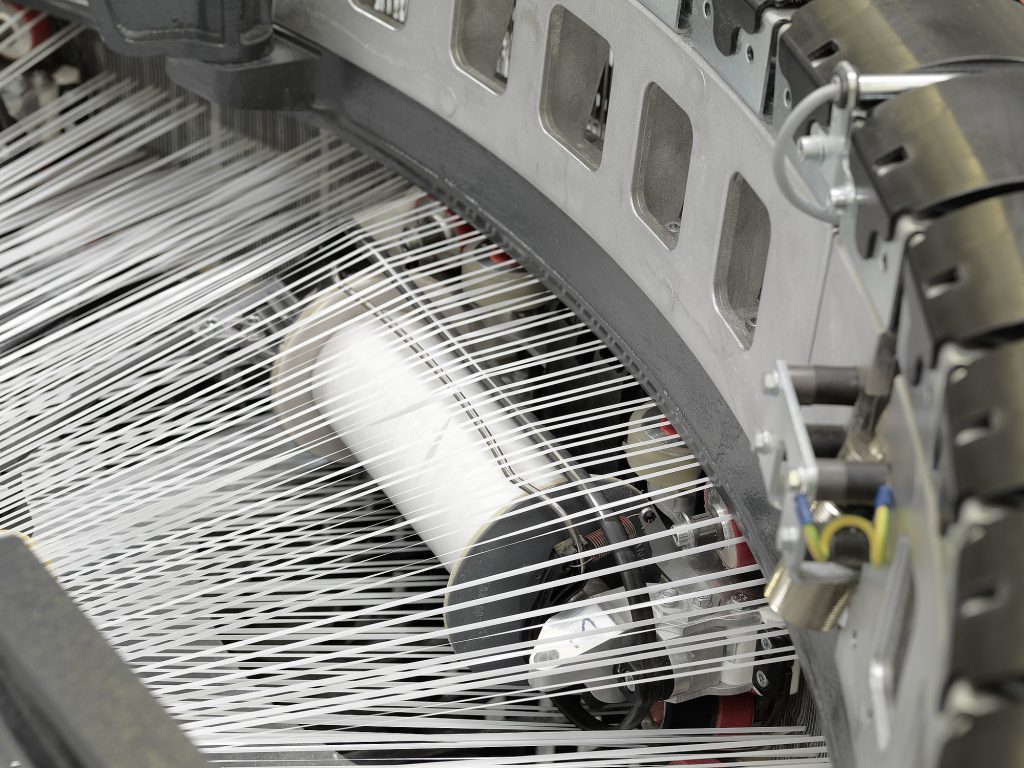
- Tape extrusion and draw: PP pellets are melted, cast into a thin film, slit into tapes, and drawn to the target ratio. Draw stabilizes dimensions and improves tensile properties.
- Weaving: circular or flat looms interlace tapes at the specified gsm and pick density. Loom tension and splices affect subsequent coating and cutting yields.
- Coating (optional): a PP/PE curtain may be extruded onto the fabric to close pores for dust control and to tailor surface friction.
- Cutting and sewing: body panels are cut; webbing and lift loops are attached; spouts, skirts, and baffles are assembled; document pockets and labels are applied.
- Liner preparation and insertion: loose, shaped, or form‑fit liners are produced with any antistatic/barrier features and anchored to prevent draw during discharge.
- Testing and QA: top lift, load cycle, tear propagation, and stacking/topple tests are run on designed samples; labels and instructions for use (IFU) are verified; clean‑area controls are enforced for food‑grade orders.
Process tip: If you change the fabric gsm by a small amount, do not skip seam re‑validation. Seam efficiency—not base fabric strength—often governs the final pass/fail outcome in type testing.
What is the application of FIBC Bulk Bags? — Sector by sector, need by need
A strength of FIBC Bulk Bags is their broad and practical applicability. The same base architecture—the woven shell plus lift loops—adapts to the demands of minerals, food, chemicals, recycling, construction, and agriculture with only targeted changes in seams, geometry, liners, or static protection.
| Sector | Typical Contents | Design Priorities | Common Options |
|---|---|---|---|
| Chemicals & Minerals | Pigments, resins, calcium carbonate, silica, gypsum, cement | Dust control, static protection, discharge cleanliness | Type C/D, coated fabric, discharge spout with iris safety |
| Food & Feed | Sugar, grains, whey, premix, seeds | Hygiene, moisture control, traceability | Clean‑room sewing, liners, document pockets, tamper ties |
| Recycling & Waste | Metals, plastics, fiber bales, organics | Footprint stability, weatherability, labeling | Baffle geometry, UV‑stabilizers, high‑visibility graphics |
| Construction & Aggregate | Sand, rubble, stone | Puncture resistance, easy discharge | Heavy fabric gsm, full‑bottom discharge, reinforced corners |
For a catalog‑style overview of commercial options, see this accessible reference page: industrial big bags (FIBCs). It complements the engineering focus here by presenting market variants side by side.
Reasoning from the headline — FIBC Bulk Bags: Innovations in materials and design options
A headline is a promise, and this one promises two things: that material advances inside FIBC Bulk Bags genuinely change capability, and that design options now available to buyers are not cosmetic tweaks but operational levers. To honor that promise, it helps to think like a systems engineer. First, map the environment—standards, safety, and policy. Second, map the mechanics—strength, flow, and friction. Third, integrate the two around the day‑to‑day realities of plants and routes.
Standards and safety — The non‑negotiables
The current global baseline for non‑dangerous goods is ISO 21898:2024, which refines construction requirements, type tests (top lift, load cycling, tear propagation), and stacking guidance. Static‑protection classifications (A/B/C/D) sit alongside that standard in practice; selection depends on atmosphere and product, not taste. In environments with flammable gases or flammable dust clouds, use Type C with verified grounding or Type D within its specified operating window. These are knowledge disciplines, not fashion statements.
Strength without bloat — Where grams really count
It is tempting to throw fabric mass at every problem. But failures often originate in seams or at corners, where stress concentrates during lifts and sudden stops. That is why the savviest programs shift some grams from blanket gsm to reinforcement where fractures begin, and then validate through corner‑focused drop tests and route‑specific vibration profiles. Baffles are another elegant lever: instead of over‑building walls, install a skeleton that keeps the bag square so stacks do not wander.
Friction, finishes, and pallet physics
Exterior COF is not an afterthought. Gloss finishes tend to lower friction and can invite tier shift on tall stacks. Matte or embossed faces raise COF and help bags stay put during cross‑dock handling and over‑the‑road braking. Wrap recipes and interleaf materials interact with finish; treat the trio as a package and you will keep stacks upright without wasting film or time.
Barrier logic — Only as much as you need
Moisture and oxygen are enemies for many powders, yet over‑specifying liners adds cost and complicates end‑of‑life. The right question is not “Which liner?” but “Why a liner at all?” If a liner is justified by product data, choose the simplest polymer family that meets the requirement and document it for design‑for‑recycling claims. In strictly dry streams, good coatings and housekeeping might do more than a thick liner.
Digital traceability — Small codes, large effects
More suppliers now place QR or data matrix codes on FIBC Bulk Bags that link to the specific lot’s SWL, safety factor, static class, liner type, and instructions. This closes the loop between specification and use. In high‑turnover operations, quick scanning beats binder hunting and reduces misuse risk.
System thinking — Break the problem down, then integrate
A practical way to specify FIBC Bulk Bags is to decompose the challenge into sub‑problems and to give each a precise, testable answer. Once those answers are in hand, combine them into a single bill of materials and a single set of instructions for use. The result is not a perfect bag in the abstract, but a bag that is perfect for your route and your product.
Sub‑problem A — Containment with headroom
Define worst‑case lifts and drops; engineer seams accordingly; use corner reinforcements where failures initiate; validate with filled‑bag drop tests, not just flat laminate pulls.
Sub‑problem B — Static and atmosphere
Classify the filling/emptying environment; pick A/B/C/D conservatively; if Type C, train and audit grounding; if Type D, stay within its specified window.
Sub‑problem C — Product protection
Specify liners only when product data justify them; match polymer families where possible; set cleanliness controls for food/feed grades.
Sub‑problem D — Cube and stability
Use baffles to keep geometry square; set finish/COF for pallet stability; tune wrap recipes; match bag dimensions to pallet footprints.
Sub‑problem E — Documentation and policy
Provide on‑bag QR links to specs, tests, and instructions; maintain evidence for audits; align materials and labels with emerging recyclability criteria.
Technical details — Tables you can act on
| Configuration | Where it fits | Pros | Considerations |
|---|---|---|---|
| Four‑loop, free‑form | Minerals, aggregates | Widely available; robust; easy handling | Lower cube efficiency; dust control depends on coating/liner |
| Four‑loop with baffles | Food ingredients, fine powders | Superior cube utilization; better stack stability | Sewing complexity; baffle porting needed for flow |
| One‑ or two‑loop sling | Fertilizer, grains | Fast single‑operator handling; fewer components | Specialized hooks; reduced print area |
| UN‑certified dangerous goods | Hazardous solids | Performance‑tested; traceable | Requires UN marking and specific test regimes |
| Type C conductive | Flammable atmospheres | High safety margin with proper grounding | Grounding must be checked every fill/empty cycle |
| Type D static‑dissipative | Flammable dust/gas without reliable grounding | No ground cable; simpler logistics | Operate within specified humidity/product windows |
| Material lever | Options | Effect | Notes |
|---|---|---|---|
| Fabric gsm | 140–240 gsm typical | SWL, tear resistance | Do not increase by habit; validate seams first |
| Coating mass | 20–40 gsm PP/PE | Sift‑proofing, surface friction | Higher mass raises COF modestly and adds grams |
| Liner type | Loose, shaped, form‑fit; PE or PP | Moisture/oxygen control | Pick the simplest polymer family that works |
| Static class | A, B, C, D | Ignition risk mitigation | Grounding discipline for Type C; windowing for Type D |
A worked example — Redesigning a sugar export bag
Imagine a 1,000 kg SWL four‑loop bag, 200 gsm fabric, PE coating, loose PE liner, Type B fabric, free‑form cube. Issues: container cube inefficiency, seam dusting, and buyer requests for improved recyclability documentation. The redesign: migrate to a baffled geometry with ported baffles; adopt a form‑fit PP liner to preserve a single polymer family; re‑engineer seams to hold the same safety factor at 190 gsm; upgrade to Type C with verified grounding. The results: better container fill, calmer stacks, reduced dusting at seams, and cleaner documentation for markets emphasizing design‑for‑recycling claims. None of these moves are exotic; all are disciplined.
Language and discoverability — Natural long‑tail phrasing
Engineers and buyers rarely type a single phrase into a search bar. They look for “conductive Type C FIBC Bulk Bags for solvents,” “static‑dissipative Type D jumbo bags,” “baffle FIBC Bulk Bags for cube utilization,” “food‑grade FIBC Bulk Bags with form‑fit liners,” or “PP‑liner bulk containers designed for recyclability.” This document reflects that reality by using natural variants while keeping the central keyword FIBC Bulk Bags visible and meaningful.
From requirement to specification — A checklist you can run tomorrow
- State outcomes in field terms: SWL, factor of safety, drop and stack limits, ignition risk assumptions, cube targets; tie each to a test.
- Choose static class deliberately: if in doubt between C and D, a grounded Type C with training is often the conservative path.
- Engineer seams, not just gsm: seam efficiency beats brute mass.
- Use baffles to win cube: it is frequently cheaper and safer than raising fabric mass.
- Decide your polymer family: when feasible, preserve PP continuity and document it.
- Specify liners only when justified: coatings and housekeeping may suffice for dry, inert streams.
- Train and label: pair on‑bag QR with clear IFUs and short video SOPs.
- Audit pallets: set finish/COF and wrap recipes together; test stacks under vibration profiles.
Final cue for action: Treat FIBC Bulk Bags as a system. The best specification is the one that stitches together safety classification, seam design, finish/COF tuning, liner logic, and documentation into a coherent whole that your operators can follow without interpretation.
- What is FIBC Bulk Bags? — Definitions, scope, and why names matter
- What are the materials of FIBC Bulk Bags? — From monomers to mesh
- Woven polypropylene fabric — The structural backbone
- Coatings and cast films — Tuning surface and barrier
- Inner liners — Moisture, oxygen, and cleanliness management
- Lift systems — Webbing, loops, and load paths
- Fill and discharge features — Control at entry and exit
- Static‑protection classes — A, B, C, and D
- What are the features of FIBC Bulk Bags? — A capability map
- What is the production process of FIBC Bulk Bags? — From pellets to pallets
- What is the application of FIBC Bulk Bags? — Sector by sector, need by need
- Reasoning from the headline — FIBC Bulk Bags: Innovations in materials and design options
- System thinking — Break the problem down, then integrate
- Technical details — Tables you can act on
- A worked example — Redesigning a sugar export bag
- Language and discoverability — Natural long‑tail phrasing
- From requirement to specification — A checklist you can run tomorrow
Product Manager Laura: “With industries demanding higher safety and sustainability, how can FIBC bulk bags evolve to meet diverse needs without compromising cost efficiency?”
CEO Ray (VidePak): “By integrating advanced PP/PE blends, modular design architectures, and AI-driven quality control, VidePak’s FIBC solutions achieve 95% recyclability while supporting custom configurations—from anti-static liners to RFID-enabled tracking—ensuring compliance and operational excellence.”
1. Market Dynamics: The Push for Smarter, Greener FIBC Solutions
The global FIBC market is projected to grow at a CAGR of 5.8% through 2030, driven by demand in chemicals, agriculture, and construction sectors. Regulatory pressures, such as the EU’s Circular Economy Action Plan and U.S. EPA mandates, are accelerating the shift from single-use plastics to reusable, recyclable FIBCs. VidePak’s use of virgin PP granules and Starlinger extrusion technology ensures tensile strengths of 35–45 MPa, outperforming traditional HDPE bags by 30% in load-bearing capacity.
For instance, a 2024 study by Packaging Insights revealed that FIBCs with UV-resistant BOPP lamination reduce material degradation by 40% in outdoor storage, critical for industries like construction waste management.
2. Material Innovations: Balancing Performance and Sustainability
Modern FIBCs leverage advanced materials to address sector-specific challenges:
2.1 PP/PE Hybrid Fabrics
- Recyclability: VidePak’s PP/PE blends achieve 95% recyclability when processed through closed-loop systems, reducing landfill dependency by 60% compared to non-recyclable alternatives.
- Anti-Static Properties: Conductive carbon-black coatings (0.5–1.0% additive concentration) mitigate explosion risks in chemical transport, complying with IEC 61340-4-4 standards.
2.2 Functional Liners
- PE Liners: Low permeability (<0.5 g/m²/24hr) makes PE ideal for moisture-sensitive products like fertilizers. A 2023 trial in Brazil showed PE-lined FIBCs reduced spoilage by 25% in humid climates.
- Aluminum Foil Liners: Essential for hazardous materials, foil liners block oxygen ingress (OTR <5 cm³/m²/day), extending shelf life of pharmaceuticals by 30%.
3. Design Customization: Tailoring FIBCs to Application Needs
Selecting the right configuration requires evaluating five key parameters:
| Parameter | Chemicals | Food | Construction |
|---|---|---|---|
| Lamination | Anti-static BOPP (30 µm) | Food-grade PE (25 µm) | UV-resistant PP (35 µm) |
| Inner Liner | Conductive Type C/D | Aluminum foil (0.15 mm) | None |
| Closure Type | Pasted valve | Heat-sealed top | Spout + drawstring |
| Load Capacity | 1,500 kg | 1,000 kg | 2,000 kg |
| Printing | Hazard symbols | QR codes for traceability | Safety warnings |
Case Study: A European chemical firm reduced spillage by 35% using VidePak’s block-bottom FIBCs with reinforced seams, saving $120,000 annually in cleanup costs.
4. Future Trends: Smart and Circular Solutions
VidePak is pioneering two innovations:
- RFID Integration: Embedded tags enable real-time tracking, improving supply chain transparency. A pilot with a Dutch logistics firm achieved 98% inventory accuracy.
- Bio-Based PP: Trials with 20% sugarcane-derived PP show tensile strength losses of <5%, aligning with EU’s 2030 carbon neutrality goals.
For industries prioritizing automation, solutions like Form-Fill-Seal FIBCs streamline filling processes, while Recyclable PP Bags highlight closed-loop systems.
5. FAQs: Addressing Critical Concerns
Q1: How does BOPP lamination affect recyclability?
A: BOPP films are fully recyclable when separated from PP fabric. VidePak’s partnerships ensure 75% closed-loop recovery rates.
Q2: Are aluminum foil liners cost-effective for small orders?
A: Foil adds 15–20% cost but is mandatory for hazardous liquids under OSHA 1910.120. PE liners are preferable for volumes <5 tons/month.
Q3: What’s the ROI of switching to custom FIBCs?
A: A U.S. construction firm achieved an 18-month payback period through reduced spillage and reuse cycles.
Conclusion
FIBC bulk bags are no longer mere containers but strategic assets in sustainable logistics. VidePak’s fusion of Starlinger’s engineering precision, ISO-certified processes, and client-centric innovation positions it as a leader in this transformative sector. By prioritizing modular customization and circular materials, the company empowers industries to meet regulatory demands while driving operational efficiency. As global waste regulations tighten, adopting these solutions isn’t just prudent—it’s imperative for future-proofing supply chains.