
Definition and Naming: What are Woven Poly Bags for Chemical Fertilizer?
In industrial logistics and agricultural retail, Woven Poly Bags for Chemical Fertilizer serve as the workhorse container for 10–50 kg payloads. Built from polypropylene (PP) tapes that are extruded, oriented, and woven into tubular fabric, these packages are then converted into open‑mouth or valve configurations with optional liners and laminations. In catalogs they also appear as PP woven sacks, fertilizer woven bags, laminated woven poly bags, or—when a printed biaxially oriented polypropylene skin is bonded to the fabric—BOPP‑laminated woven bags. The mission is consistent across names: shield hygroscopic fertilizers (urea, NPK blends, DAP, MAP, ammonium sulfate, potash) from moisture, caking, abrasion, and label wear while surviving rough handling in ports, depots, and open yards.
The category occupies a distinctive middle ground: it must communicate brand and grade with clarity like a consumer package, yet it must endure forklift tines, stacked pallets, and tropical rain like a bulk industrial container. A single polymer family—polypropylene—enables this dual identity by being transformed into three complementary elements: a high‑tenacity woven backbone, a printable outer skin, and a barrier‑oriented inner lining. When these elements are tuned together, Woven Poly Bags for Chemical Fertilizer reconcile shelf communication with supply‑chain resilience.
Material Architecture: From Resin to Fabric to Film
Materials are strategy in disguise. The design of Woven Poly Bags for Chemical Fertilizer concentrates value into four purposeful layers—tape/yarn, woven fabric, laminations/films, and liners/closures—each with distinct physics, cost drivers, and quality checkpoints.
Isotactic PP homopolymer is preferred for modulus and tensile strength; controlled‑rheology grades simplify tape formation. Melt flow indices of ~2–6 g/10 min (230 °C/2.16 kg) balance processability with mechanicals. During tape drawing (≈6–8×), molecular alignment raises tenacity and creep resistance. Under‑drawn tapes sag; over‑drawn tapes split—either failure inflates loom downtime and seam variability.
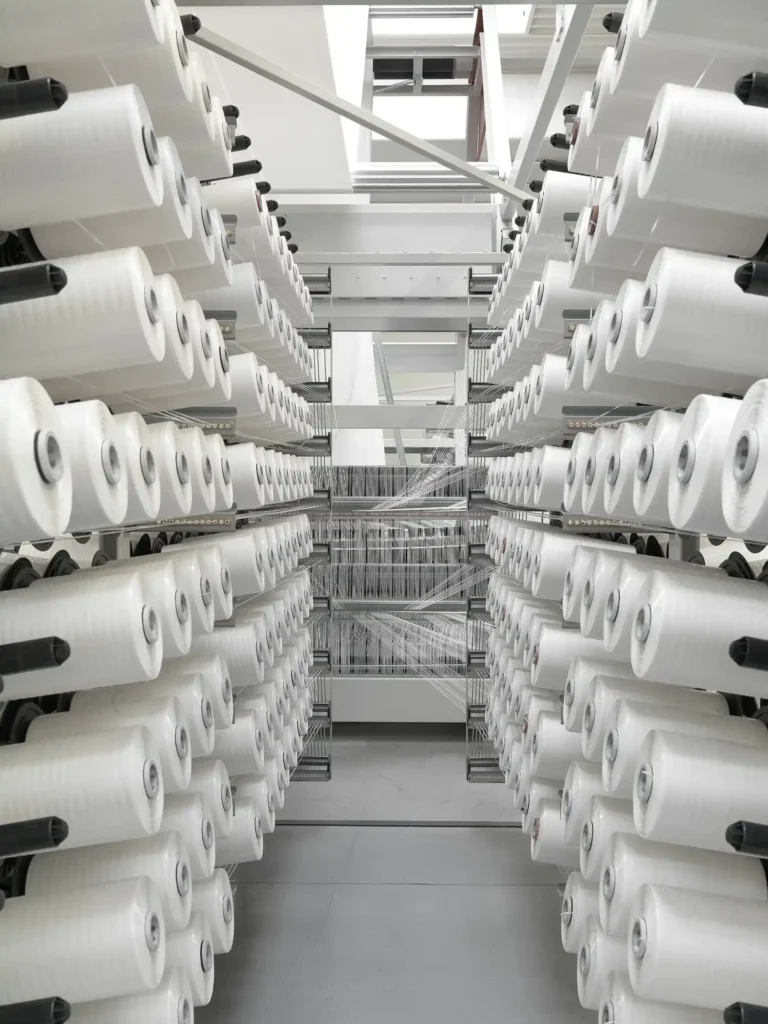
Circular looms produce tubular fabric at 60–120 g/m² with weave densities around 10×10 to 12×12 tapes per inch. The fabric is the skeleton: it carries tensile load, resists puncture, limits bulging under compression, and translates directly into seam efficiency. Fabric GSM is the first and largest cost lever.
Extrusion coating applies a 18–30 μm PP film that reduces porosity and dusting. A printed BOPP film (20–35 μm) can be laminated for abrasion‑proof graphics and a modest WVTR improvement. Metallization is seldom justified for fertilizers: moisture control dominates oxygen control, and metallized layers complicate recyclability without commensurate value.
High‑hygroscopic products benefit from LDPE/LLDPE liners (20–60 μm), sometimes gusseted for block‑bottom geometry. Closures include open‑mouth stitch, hot‑air weld, and valve sleeves that self‑seal during high‑speed filling. Liner cuff‑seals under the sew line are potent against edge‑wicking.
Costs track chemistry and grams. Resin typically contributes 50–70% of cost of goods; lamination, printing coverage, and UV packages add increments tied to climate and brand ambitions. In short: every micron, every gram, every pigment has a job—if it does not, remove it.
Feature Set: Translating Pain Points into Performance
Features matter when they change outcomes. For Woven Poly Bags for Chemical Fertilizer, the outcomes are simple to name yet hard to deliver: less caking, fewer returns, safer stacking, cleaner filling, legible labels. Each outcome cascades from a concrete engineering choice.
- Moisture stewardship: Lamination uniformity and liner design set bag‑level WVTR. Urea cakes above ≈60–65% RH; bag designs therefore target WVTR that keeps mass gain below agreed thresholds during humid‑season dwell tests.
- Seam integrity: Moisture ingress is seam‑dominated. Heat‑sealed liners, tape under sew lines, and hot‑air welded bottoms curb edge‑wicking that ordinary stitching cannot resist.
- Mechanical robustness: Balanced weave and well‑drawn tapes resist puncture from granular fertilizers and pallet corners. Typical targets include ≥5 drops at 1.2 m for 25–50 kg fills.
- Stack stability: Screen‑printed anti‑slip bands lift pallet friction, raising safe stack height without thick interleaves.
- Print longevity: Reverse‑printed BOPP protects inks from abrasion; UV‑stable pigments protect from sun fade; compliance panels remain legible after rail or barge transport.
- Operational compatibility: Valve designs and low‑dust coatings enable cleaner, faster filling. Tuned COF keeps bags upright on conveyors yet mobile at transfer points.
- Security: Serialized QR/Datamatrix codes under the laminate enable traceability and deter counterfeiting in fragmented distribution networks.
- Sustainability: Mono‑PP architectures (PP fabric + PP coating + BOPP print web) maintain compatibility with PP recycling streams where available; avoiding paper or foil simplifies end‑of‑life.
Process Map: How the Bags Are Made and Why It Matters
The manufacturing choreography behind Woven Poly Bags for Chemical Fertilizer converts polymer pellets into stack‑stable, graphics‑rich sacks. Each step modifies structure—and therefore performance.
Resin + masterbatch → sheet → slit tapes → draw at ratio windows that maximize tenacity without embrittlement.
Circular looms set pick density and tension; fabric GSM anchors tensile and seam efficiency.
Extrusion coat for porosity control; BOPP lamination for print durability and marginal WVTR gains.
Reverse print, cut to length, form bottoms, insert liners, add valve sleeves, apply anti‑slip, serialize.
Quality control spans resin COA verification, tape tenacity, loom appearance, coat‑weight mapping, adhesion, WVTR via MOCON (ASTM F1249), COF (ASTM D1894), drop resistance on filled bags, and UV weathering where outdoor storage is common. Traceability links bag IDs to resin, ink, and tie‑layer lots for targeted recalls rather than blanket withdrawals.
Application Landscape: Where the Design Choices Meet Chemistry
Fertilizer chemistry dictates packaging nuance. Woven Poly Bags for Chemical Fertilizer must adapt to hygroscopicity, granule hardness, and dusting behavior while also fitting equipment realities at the packer.
- Urea (46‑0‑0): Highly hygroscopic; favors laminated fabric with gusseted, cuff‑sealed liners; valve bags for high‑speed fill; stringent WVTR and seam controls.
- NPK blends (e.g., 15‑15‑15, 20‑10‑10): Moderate hygroscopicity; graphics emphasize grade clarity; durability in rural retail requires abrasion‑proof inks.
- DAP/MAP: Granular phosphates that dust; lamination reduces dusting at packers and during handling.
- Potash (MOP/SOP): Abrasive crystals; prioritize puncture resistance and bottom seam reinforcement.
- Ammonium nitrate fertilizers (UN 2067): Subject to dangerous‑goods transport provisions in some jurisdictions; packaging must align with segregation and labeling rules.
Systems Thinking: Mapping the Loops Behind Innovation
The phrase “Innovations in Woven Poly Bags for Chemical Fertilizer Applications” is only meaningful when mapped to feedback loops that move the whole system. Consider five:
- Materials loop: draw ratio → modulus → down‑gauging → mass reduction → freight and carbon savings. Push draw too far and seams embrittle; measure tenacity inline to keep the loop virtuous.
- Moisture‑barrier loop: coat uniformity → WVTR spread → caking risk → returns → brand equity. Tighten pinhole counts; variability is the secret enemy of shelfable fertilizer.
- Machinability loop: tuned COF → packer uptime → scrap rate → unit cost → reinvestment. A COF corridor aligned to the packer design is cheaper than any miracle film.
- Security loop: serialization → traceability → counterfeit deterrence → price integrity → stewardship funding. Place codes under laminate for readability after abrasion.
- End‑of‑life loop: mono‑PP → sortability → recycling yield (where infra exists) → goodwill → policy alignment. Simpler stacks win as EPR policies mature.
Standards, Certifications, and Test Methods
Engineering claims for Woven Poly Bags for Chemical Fertilizer are anchored in test methods and management systems. For mechanics and barrier: ASTM D882 (tensile), ASTM D1709 (dart impact), ASTM D1894 (COF), ASTM F88/F88M (seal strength), and ASTM F1249 (WVTR by MOCON). For site governance: ISO 9001:2015 for quality management, ISO 14001:2015 for environmental management, and ISO 45001:2018 for occupational health and safety. Where packaging is produced alongside food contact items, FSSC 22000 (Version 6) is increasingly adopted to formalize hygiene, traceability, and culture—even when the end product is fertilizer, not food.
| Property | Typical range | Why it matters |
|---|---|---|
| Fabric GSM | 60–120 g/m² | Primary lever for tensile and seam efficiency; over‑spec inflates cost and stiffness. |
| BOPP print film | 20–35 μm | Protects inks, improves scuff resistance; minor WVTR effect. |
| Extrusion coat weight | 18–30 μm | Porosity and dust control; directly influences WVTR spread. |
| Liner thickness | 20–60 μm | Barrier and dust control; fit and cuff sealing are decisive for caking. |
| WVTR (38 °C/90% RH) | Target ≤ 2.5 g/m²·day (bag‑level) | Aligned to fertilizer CRH; low WVTR reduces mass gain in humid storage. |
| COF (kinetic, face/face) | 0.25–0.40 | Balances pallet stability and conveyor flow; tune by stripe density, not by guesswork. |
| Mechanical/Conversion | Target | Test/remark |
|---|---|---|
| Drop resistance | ≥ 5 drops @ 1.2 m (25–50 kg) | Internal SOP simulating real logistics. |
| Seam strength efficiency | ≥ 70% of fabric strength | Stitch density, thread spec, or weld quality drive results. |
| Valve fill rate | ≥ 10–20 bags/min | Packer geometry and dust control matter. |
| UV stability | Tiered (e.g., 200/400/800 h QUV) | Match to expected outdoor exposure. |
Engineering Economics: Total‑Cost Logic
For Woven Poly Bags for Chemical Fertilizer, economics are not a footnote—they are the blueprint. Down‑gauge fabric by 5–10 g/m² and resin savings compound across millions of sacks, provided stackability and seam metrics hold. Reverse print under BOPP reduces scuff‑related rework. Valve bags shorten fill cycles and reduce reclaim around packing spouts. Energy per thousand bags falls when seal initiation temperature (SIT) is lowered for liners and when solvent recovery or higher‑solids inks are deployed on presses. The cheapest gram is the gram you do not convert.
Use stiffness from orientation to trade microns for modulus; specify white film to reduce ink load when opacity is needed.
Stabilize heat‑seal maps; verify dyne levels; avoid set‑off through targeted drying.
Leverage cube efficiency with block‑bottom designs; tune anti‑slip placement for taller, safer stacks.
Failure Modes and Field Diagnostics
Real bags fail in real places: monsoon yards, dusty packhouses, river barges. The following patterns recur for Woven Poly Bags for Chemical Fertilizer and point to specific countermeasures.
Likely cause: seam leakage or poor liner cuffing
Action: chamber test at bag level; add tape under sew; switch to hot‑air weld if needed.
Likely cause: COF too low under moisture
Action: increase anti‑slip density; validate COF wet and dry; add interleaf sheets for tall stacks.
Likely cause: insufficient UV stabilization or surface print
Action: reverse print; upgrade pigments; tune UV package to climate.
Likely cause: sleeve mismatch; nozzle geometry; fabric cut variance
Action: audit sleeve spec; test self‑closing valves; tighten length control.
Design Playbook: Practical Choices and Trade‑offs
Design is decision‑making with constraints. For Woven Poly Bags for Chemical Fertilizer, the best choices are often the least glamorous ones: seam engineering over exotic films, coat‑weight uniformity over marginal barrier gains, COF corridors over ad‑hoc friction fixes. Ask pointed questions: if oxygen is irrelevant, why pay for metallization? if the line is the bottleneck, why not widen the seal window? if the farm shop is dimly lit, why chase photographic imagery instead of larger numerals for grade?
- Favor mono‑PP stacks to preserve sortability under emerging EPR regimes.
- Use white films and registered matte/gloss accents to achieve premium look without multi‑material complexity.
- Pick COF 0.30–0.35 as a starting point for mixed pallets; tune by pattern testing on real depalletizers.
- Right‑size UV packages to exposure; over‑dosing wastes money, under‑dosing loses legibility.
Case Snapshots: Turning Principles into Practice
Three compact scenarios illustrate how engineering choices ripple through outcomes for Woven Poly Bags for Chemical Fertilizer.
- Coastal urea, 50 kg, monsoon storage. Switching from stitch‑only to cuff‑sealed liners lowered bag‑level WVTR variability and reduced caking‑related complaints by a large margin; anti‑slip bands at one‑third and two‑thirds height prevented pyramid slumps during rain‑soaked loading.
- Dusty DAP filling at high throughput. BOPP lamination contained fines, improving packer housekeeping and boosting valve fill rate; reverse print survived conveyor scuff without relabeling.
- Potash on mixed pallets. Reinforced bottom seams and micro‑embossed anti‑slip strips stabilized stacks to 8–9 layers; dart impact improvements in the coating reduced pinhole propagation at corners.
Market Signals in 2024–2025
Buyer scorecards increasingly reward suppliers that publish energy per thousand bags, scrap ratios, and recycled content where feasible. The shift toward mono‑polyolefin designs accelerates as producer‑responsibility policies expand. Digital serialization under laminate spreads through fertilizer markets to combat diversion and counterfeiting. Registered matte/gloss and sharper graphics migrate from consumer goods into agriculture, mirroring the premiumization of inputs sold to professional growers and smallholders alike.
In the world of industrial packaging, Woven Poly Bags have established themselves as an essential solution for a wide range of products. Among their numerous applications, one of the most critical is in the packaging of chemical fertilizers, such as granular fertilizers and compound fertilizers. These bags, known for their durability and strength, are particularly effective for handling the demanding requirements of fertilizer distribution and storage. This article explores the role of Woven Poly Bags in the fertilizer industry, comparing them with other packaging options, and examines the advantages they offer.
The Role of Woven Poly Bags in Chemical Fertilizer Packaging
Woven Poly Bags, also referred to as Woven Poly Sacks, Poly Woven Bags, and PP Woven Sacks, are made from polypropylene fibers that are woven together to form a strong, flexible fabric. This construction makes them ideal for various industrial applications, including the packaging of chemical fertilizers. Here’s why Woven Poly Bags are so well-suited for this purpose:
- Strength and Durability:
The woven structure of these bags provides exceptional strength, allowing them to withstand the weight of heavy fertilizers. Whether dealing with granular fertilizers, compound fertilizers, or other chemical products, Woven Poly Sacks offer reliable performance and reduce the risk of tearing or rupturing during handling and transportation. - Resistance to Moisture and Chemicals:
Chemical fertilizers can be corrosive or prone to absorbing moisture, which can affect their quality and effectiveness. Poly Woven Bags are designed to resist moisture and protect the contents from environmental factors. Some variations of Woven Poly Bags can also be coated or laminated to enhance their resistance to chemicals and moisture, providing additional protection for sensitive products. - Cost-Effective and Versatile:
Compared to other packaging materials, Woven Poly Bags offer a cost-effective solution without compromising on quality. They are also highly versatile, suitable for various types of fertilizers and other industrial materials. The affordability and adaptability of these bags make them a popular choice among manufacturers and distributors. - Ease of Customization:
Woven Poly Sacks can be easily customized with printing options for branding and product information. This feature is particularly beneficial for fertilizer companies looking to differentiate their products and provide essential details on the packaging.
Applications in the Fertilizer Industry
The use of Woven Poly Bags in the chemical fertilizer industry is widespread due to their ability to meet specific packaging needs:
- Granular Fertilizers:
Granular fertilizers are often packaged in Woven Poly Bags due to their bulk and weight. The strong construction of these bags ensures that they can handle large quantities of granular fertilizer without compromising the integrity of the packaging. - Compound Fertilizers:
Compound fertilizers, which consist of a blend of nutrients, also benefit from the durability of Woven Poly Sacks. The bags provide reliable protection against external elements, ensuring that the compound fertilizers remain intact and effective until they reach the end user. - Specialty Fertilizers:
For specialty fertilizers, such as those used in high-value crops or specific agricultural applications, Poly Woven Bags offer a tailored solution. The bags can be designed to meet specific requirements, such as enhanced barrier properties or additional strength, to suit the unique needs of specialty fertilizers.
Comparative Analysis with Other Packaging Solutions
While Woven Poly Bags are highly effective for fertilizer packaging, it is valuable to compare them with other packaging options to understand their relative advantages:
- Woven Poly Bags vs. Paper Bags:
Paper bags are another common packaging choice for fertilizers. While they offer some benefits, such as biodegradability, they may not provide the same level of durability and moisture resistance as Woven Poly Sacks. Woven Poly Bags are generally stronger and more resistant to environmental factors, making them a preferred choice for heavy and moisture-sensitive fertilizers. - Woven Poly Bags vs. Plastic Bags:
Plastic bags, including those made from polyethylene, are often used for packaging. However, Woven Poly Bags offer superior strength and durability compared to standard plastic bags. The woven structure provides additional support and resistance to tearing, making Woven Poly Sacks a better option for handling heavy or abrasive materials. - Woven Poly Bags vs. Bulk Bags:
Bulk bags, or FIBCs (Flexible Intermediate Bulk Containers), are used for larger quantities of material. While they offer high capacity and strength, Poly Woven Bags are more suitable for smaller quantities and retail applications. Woven Poly Sacks provide a more cost-effective and versatile solution for packaging standard-sized quantities of fertilizers.
Industry Trends and Future Directions
The packaging industry is continuously evolving, with several trends influencing the development and use of Woven Poly Bags:
- Sustainability:
As environmental concerns grow, there is an increasing focus on sustainable packaging solutions. Manufacturers are exploring options for recyclable or biodegradable Woven Poly Bags. Innovations in material science and production processes aim to reduce the environmental impact of packaging materials. - Technological Advancements:
Advances in manufacturing technology are improving the performance and functionality of Woven Poly Bags. Enhanced weaving techniques, coatings, and laminations are contributing to better strength, moisture resistance, and overall quality. - Customization and Branding:
The demand for customized packaging solutions is rising. Companies are investing in advanced printing and design technologies to create eye-catching and informative Woven Poly Sacks that enhance brand visibility and appeal. - Regulatory Compliance:
As regulations around packaging and product safety become stricter, manufacturers must ensure that Woven Poly Bags comply with industry standards. This includes adhering to guidelines for material quality, safety, and environmental impact.
In summary, Woven Poly Bags are an essential component of the chemical fertilizer packaging industry, offering durability, moisture resistance, and versatility. Their applications in packaging granular and compound fertilizers highlight their effectiveness in meeting the demands of the industry. By comparing Woven Poly Bags with other packaging solutions and considering industry trends, it is evident that they continue to play a vital role in ensuring the secure and efficient distribution of fertilizers. As the industry evolves, ongoing innovations and sustainability efforts will shape the future of Woven Poly Sacks and their role in packaging and storage.