
In the growing pet food packaging market, companies are constantly exploring innovative materials that balance durability, sustainability, and consumer appeal. One such innovation is Kraft Paper PP Bags, which are laminated with woven fabric to offer enhanced strength, protection, and aesthetic appeal. This packaging solution is particularly well-suited for pet food products, such as dog food, cat food, and other animal feed. These Kraft Paper Woven Bags combine the natural appearance and eco-friendly perception of paper with the durability of polypropylene (PP) woven fabric, making them a popular choice for manufacturers in the pet food industry.
Definition and Naming — What are Innovative Kraft Paper PP Bags for Pet Food Packaging?
Kraft Paper PP Bags are hybrid retail‑to‑industrial sacks that marry a woven polypropylene (PP) backbone with an outer kraft paper face engineered for high‑quality printing, shelf appeal, and controlled friction during storage and transport. In pet nutrition channels these packages are frequently configured as pinch‑bottom open‑mouth sacks, pasted‑valve sacks, or sewn open‑mouth sacks. Across plants and RFPs they also appear under adjacent labels: paper‑laminated woven PP sacks, kraft‑faced woven poly bags, paper‑BOPP laminated woven bags, or simply paper‑laminated PP. The intent behind the architecture is consistent: let PP deliver strength, tear resistance, and dimensional stability, while paper delivers brand storytelling, matte data windows, and a look‑and‑feel consumers associate with naturalness and trust.
The format exists because pet food packaging must be two things at once: beautiful and durable. Bags are lifted by humans, gripped by robots, squeezed by pallets, and judged by shoppers. They must close cleanly at the plant and open predictably at home. They must contain aroma without smothering a brand’s personality. Kraft Paper PP Bags reconcile those pressures with a division of labor among layers: the woven PP core carries mechanical load; the kraft face carries ink and friction; the tie‑layer carries adhesion; optional liners and coatings carry moisture and fat control; closure systems carry dust‑tightness and convenience.
Constituents and Structure — The Material of Innovative Kraft Paper PP Bags for Pet Food Packaging
Materials are not a shopping list; they are an argument about physics, supply risk, and brand experience. To understand why Kraft Paper PP Bags survive warehouse shocks and still look composed in aisle lighting, deconstruct the stack from the inside outward—core, face, bridge, barrier, closure, and accessories—then reconnect those parts in a cost‑aware, compliance‑ready bill of materials.
1) Structural core — Woven PP
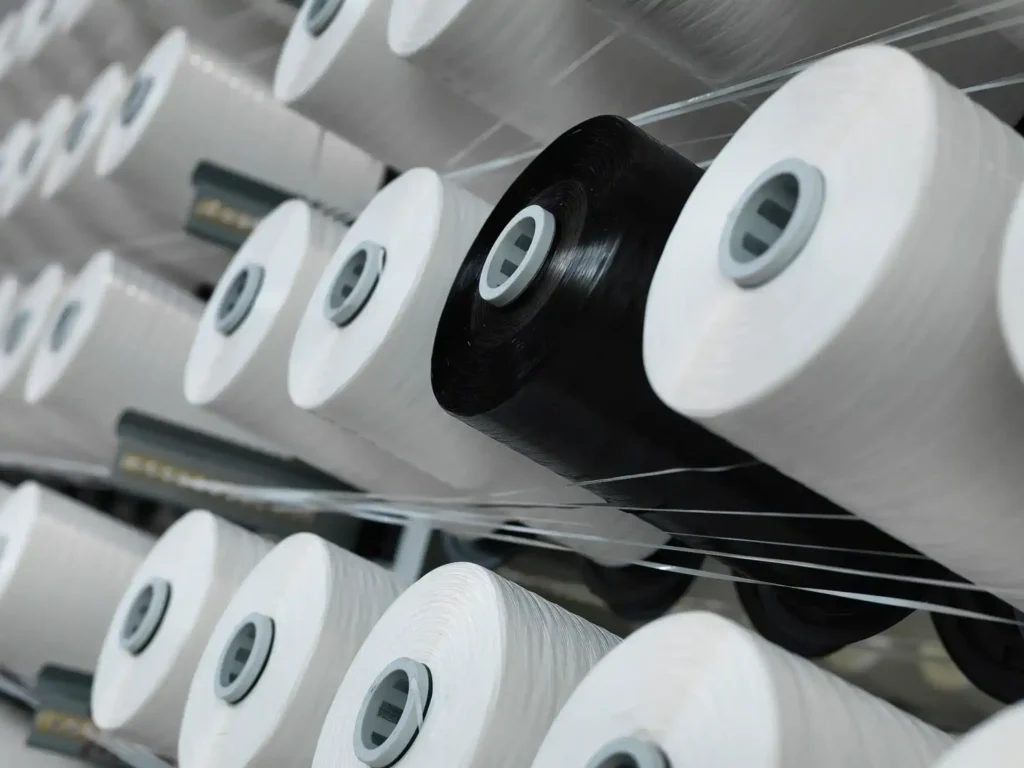
Drawn PP tapes (600–1200 denier) woven into plain fabrics set the mechanical floor: tensile strength, tear propagation resistance, and puncture tolerance against angular kibbles and baked treats. Circular or flat looms deliver tubular or sheet fabrics, with picks per inch (PPI) tuned for dimensional repeatability so mouth widths do not drift on automated lines.
2) Paper face — Sack kraft outer ply
White or brown sack kraft (70–100 g/m²) gives a matte, print‑friendly canvas and a reassuring tactile stiffness. Extensible grades add energy absorption on drops, while surface sizing improves ink holdout so brand colors stay saturated without bleeding into fibers. Anti‑slip lacquers on the paper face create friction that lock pallets during transport.
3) Adhesion bridge — Extrusion coat or adhesive
Kraft and PP do not bond without help. The interface relies on an extrusion tie‑layer (often PP/PE blends carrying functional groups such as EAA) or a solventless polyurethane adhesive. This bridge must wet fibers, grip the PP texture, tolerate heat during pinch closure, and survive flex through the bag’s life.
4) Barrier suite — BOPP, dispersion coats, or liners
Pet food contains fat and aroma; both migrate if given a path. Programs deploy reverse‑printed BOPP (12–25 µm) for scuff‑proof graphics and extra mouth stiffness; water‑based dispersion coatings for grease resistance without plastic look; and thin LDPE liners (20–50 µm) when odor containment trumps minimalism. The art is right‑weighting: no more barrier than the recipe and route demand.
5) Closures — Pinch, valve, or sewn
Pinch‑bottom hot‑melt closures create a flush, dust‑tight finish prized in retail. Pasted valves deliver velocity for 10–25 kg fills. Sewn open‑mouth styles are rugged and field‑serviceable for breeder or kennel supply chains. Each closure implies distinct failure modes and inspection points.
6) Accessories — Reclosure and convenience
Sliders, hook‑and‑loop strips, and tear tapes influence kitchen usability and repeat aroma containment. Hardware must not cannibalize seam integrity; designs that integrate reclosure without invading the pinch zone tend to age better in the field.
| Layer | Material | Typical range | Primary function | Cost sensitivity |
|---|---|---|---|---|
| Woven core | PP tapes, plain weave | 70–110 g/m² fabric; 8–14 PPI | Tensile, tear, puncture resistance | High (resin mass dominates) |
| Kraft face | White/brown sack kraft | 70–100 g/m² | Print canvas, friction control | Medium (pulp + press) |
| Tie‑layer | Extrusion PP/PE + EAA, or PU adhesive | 12–25 µm eq. | Adhesion under heat and flex | Medium |
| Barrier | BOPP 12–25 µm; dispersion coats; LDPE liner | Risk‑based | Grease/odor/humidity control | Medium–High (artwork swings) |
Feature Set — What is the Features of Innovative Kraft Paper PP Bags for Pet Food Packaging?
Seven capabilities distinguish Kraft Paper PP Bags from single‑material rivals. Each solves a specific pain point in pet nutrition logistics, retail presentation, and at‑home use.
Strength‑to‑weight efficiency
Oriented tapes deliver high modulus at low mass; ply‑bonded paper spreads impact loads. The result: reliable drop performance with manageable shipping weight.
Retail‑grade printability
Matte fields accept fine text, color holds stable across lots, and scannability survives under glare and stretch wrap when quiet zones are respected.
Moisture/grease tuning
From dispersion coats to liners, barrier can be sized to recipe and route rather than applied by habit.
Pallet stability
Anti‑slip lacquers and consistent gussets prevent creep and lean, which reduces secondary packaging waste from over‑wrapping.
Filling speed
Valve sacks with porosity‑tuned inner papers and well‑fit patches keep cycle times low and weight control tight.
Openability & reclosure
Sliders and tear tapes reduce household frustration; clean pinch seams remain dust‑tight until first opening.
Manufacturing Flow — What is the Production Process of Innovative Kraft Paper PP Bags for Pet Food Packaging?
The process is a duet between polymer conversion and paper converting, with lamination keeping time. A small drift in any station becomes a loud complaint downstream, so controls matter at every handoff.
- PP tape extrusion and weaving. Resin + masterbatch → cast sheet → slit → draw → tapes → looms. Control draw ratio, tape width, PPI, and GSM. Track defects (broken ends, floats) that become leak paths under pinch or valve stress.
- Paper supply and print. Sack‑kraft mills supply reels graded for tensile, stretch, and porosity. Flexo or gravure presses lay down brand art and compliance panels. Matte windows are reserved for codes; ΔE tolerances are enforced lot‑to‑lot.
- Surface prep and lamination. Corona‑treat woven fabric to ≥38 dyn/cm; apply extrusion tie‑layer or adhesive; laminate paper. Verify peel strength and flatness; log coat weights as SPC charts.
- Tubing and gusseting. Multi‑ply webs are formed into tubes with controlled overlaps; gussets are set for shelf blocking and pallet fit. Cameras monitor glue patterns to prevent sift paths.
- Valve insertion or mouth preparation. Valve patches are applied and bonded; for pinch styles, mouth edges are prepared for hot‑melt activation.
- Bottoming and finishing. Pasted valve ends or pinch folds are executed; SOM seams are stitched and optionally crepe‑taped. EZ‑open features and sliders are added where specified.
- QA and palletization. Dyne checks, peel tests, seam strength, CoF, drop/stack simulations, and print rub tests are run by lot. Pallets receive moisture guards and traceable labels linking reels, resin lots, and ink batches.
Use Cases — What is the Application of Innovative Kraft Paper PP Bags for Pet Food Packaging?
Pet nutrition is not one product but a portfolio of densities, fat contents, and aroma profiles. Kraft Paper PP Bags map neatly across that portfolio because the same chassis can be tuned by barrier, closure, and reclosure choices.
- Dry kibble 10–25 kg: pasted valve or pinch‑bottom; optional liner for odor; anti‑slip lacquers for pallet stability; matte code windows for scan reliability through wrap.
- Premium treats 3–10 kg: pinch‑bottom with slider; white kraft for color pop; BOPP faces optional for photo‑quality product imagery.
- Breeder/kennel supply 20–25 kg: sewn open‑mouth for rugged routes; brown kraft for scuff camouflage; tear tapes for easier field opening.
- E‑commerce club formats: gusseted geometry and consistent bottoms for long LTL routes; lacquer weight tuned to prevent pallet creep without excessive wrap.
| Segment | Preferred style | Core need | Design levers |
|---|---|---|---|
| Retail kibble | Pasted valve or pinch | Speed with clean presentation | Porous inner paper; matte codes; anti‑slip |
| Club/e‑commerce | Pinch‑bottom + slider | Pallet stability and consumer convenience | Gusset geometry; lacquer weight; slider spec |
| Breeder supply | Sewn open‑mouth | Rugged handling and repairability | Brown kraft; crepe tape; tear tape |
Framing the Theme — Innovative Kraft Paper PP Bags for Pet Food Packaging
Innovation here is not a novelty zipper or a shiny varnish; it is a discipline: specify the woven chassis correctly, right‑weight the barrier, reserve matte for data and gloss for drama, and prove every claim on the packer at speed. When those rules are lived rather than written, Kraft Paper PP Bags stop being a compromise and start acting like a multiplier—faster fills, cleaner pallets, clearer shelves, calmer homes.
Systems Thinking — From Sub‑Problems to One Specification
Break the packaging problem into eight subsystems, analyze each on its own terms, then synthesize the answers into a single page that manufacturing, quality, and brand will defend.
- Containment mechanics. GSM, PPI, overlaps, bottom folds. Measure MD/TD tensile, tear, bag burst, drop (flat/edge/corner), and compression dwell. Design to pass with margin, not to sneak by.
- Deaeration and throughput. Inner paper porosity, valve geometry, and any micro‑perfs. Monitor fill time distributions, dust counts at the spout, and weight accuracy.
- Barrier and aroma. Decide among dispersion coats, BOPP, liners. Quantify WVTR and grease resistance; perform sensory checks for odor containment.
- Closure integrity. Choose pinch, valve, or sewn; define failure modes and inspection points. For pinch: temperature, pressure, dwell windows; for valve: patch adhesion and sift counts.
- Print and data. ΔE tolerances, varnish strategy, quiet zones, and barcode grade targets (through wrap). Place art around codes, not codes around art.
- Compliance and hygiene. Food‑contact declarations (paper components under 21 CFR 176.170/.180; plastic components under 21 CFR 177.1520; EU 10/2011 where applicable), plant‑level FSMS (e.g., FSSC 22000), allergen and pest‑control SOPs.
- Pallet physics. Anti‑slip lacquer weight, gusset width, layer patterns, and wrap tension. Validate static and dynamic CoF; test tilt under acceleration.
- Cost and risk. Cylinder/plate counts, standardized widths, dual‑source resins and papers, liner thickness. Track OEE, waste, and defect rates; keep spare cylinders for top movers.
| Subsystem | Key levers | KPI | Typical traps |
|---|---|---|---|
| Mechanics | GSM, PPI, overlaps | Drop/stack curves | Light‑weighting the face before the core |
| Throughput | Porosity, valve fit | Cycle time, weights | Defaulting to perforations |
| Barrier | Dispersion/BOPP/liner | WVTR, grease kits | One‑size‑fits‑all barriers |
Professional Knowledge Anchors — Certifications, Identifiers, Third‑Party Evidence
Packaging for pet food touches consumer safety, logistics safety, and environmental policy. While no single standard writes your spec, recognized identifiers keep audits short and decisions defensible. For Kraft Paper PP Bags, the following appear most often in customer files in 2024–2025:
- Food‑contact materials (US/EU): 21 CFR 176.170/176.180 (paper and paperboard), 21 CFR 177.1520 (olefin polymers in plastic components), EU 10/2011 under EU 1935/2004 for plastic layers; EU 2023/2006 for GMP across materials intended to contact food.
- Plant hygiene and quality: FSSC 22000 (Version 6), ISO 22000, BRCGS Packaging; often paired with ISO 9001 and ISO 14001 for quality and environmental management.
- Labeling context (pet food): AAFCO model regulations guide nutrition panel content and claims; GS1 barcoding requirements dictate quiet zones and grades for retail and e‑commerce scans.
- Package performance: ASTM D5276 (drop), ASTM D4577 (stack compression), ASTM D1894 (coefficient of friction), ASTM D5264 (print rub), ASTM D1003 (haze/gloss when BOPP is present). E‑commerce programs frequently invoke ISTA 3B or retailer‑specific regimes.
- Third‑party labs and certification bodies: SGS, Intertek, and Eurofins routinely test barrier, migration (where relevant), and performance; their reports form the backbone of specification files.
Printing & Branding — Making the Message Survive the Journey
Engineers demand numbers; marketers demand nuance. Kraft Paper PP Bags reconcile both by using paper’s natural print latitude and PP’s structural calm. The discipline lies in finish strategy and code governance.
- Finish strategy: gloss is a spotlight; matte is a library. Place gloss where eyes linger, matte where scanners work. Avoid halftones behind codes.
- Color governance: ΔE targets and paper shade management across mills keep brands consistent. White kraft is not identical reel‑to‑reel; measure and compensate, do not assume.
- Durability: rub‑resistant inks and protective varnishes keep brand fields intact after long LTL routes. Reverse‑printed BOPP makes scuff almost irrelevant when used.
Sustainability & Lifecycle — From Mass to Meaning
Sustainability earns trust when it changes bills of materials. With Kraft Paper PP Bags, credible routes include:
- Right‑weighting barriers: replace legacy thick coats with modern dispersions where grease risk allows; reserve liners for high‑fat, high‑aroma recipes.
- Designing for recovery: prefer paper‑forward faces; keep plastic layers as thin and segregated as performance allows; use loose liners when policy or infrastructure favors paper recovery.
- Responsible fiber: maintain chain‑of‑custody and updated certificates; document sources and keep records audit‑ready.
Economics & Risk — The Counterintuitive Math of Total Cost
Unit price is not total cost. The math of Kraft Paper PP Bags tilts heavily toward throughput, rework avoided, and pallet calm. Three levers recur in successful programs:
Secure drop/stack with woven GSM and PPI before shaving grams from paper. A strong core hides its savings; a weak face broadcasts its failures.
Art families share dimensions and color builds; change content, not geometry. Make‑ready time falls, color variation tightens, cash stays in the business.
Common footprints across tiers compress inventory and tooling, quicken changeovers, and improve OEE at tubers and bottomers.
Parameter Sheets — Quick Reference Tables
| Parameter | Typical range | Why it matters |
|---|---|---|
| Woven GSM | 70–110 g/m² | Defines mechanical floor for drop/stack |
| Kraft basis | 70–100 g/m² | Print fidelity and scuff tolerance |
| Dyne level pre‑lam | ≥ 38 dyn/cm | Adhesion reliability for tie‑layer |
| CoF (face) | Static 0.35–0.55 | Denesting and pallet stability |
Troubleshooting — Symptom, Mechanism, Countermeasure
- Pallets creep on turns. Mechanism: face CoF too low or lacquer under‑applied. Countermeasure: increase anti‑slip lacquer or add matte tactile bands at high‑contact zones.
- Underweight fills at speed. Mechanism: poor deaeration or sloppy valve fit. Countermeasure: raise inner paper porosity; tighten valve geometry; avoid unnecessary perforations.
- Delamination at the mouth. Mechanism: tie‑layer starvation or thermal over‑stress during pinch. Countermeasure: verify coat weight and nip; cool web before folding.
- Barcode fails through wrap. Mechanism: glare and halftone noise. Countermeasure: move codes to matte windows; enforce quiet zones; test under warehouse lighting.
- Corner splits in drop. Mechanism: over‑tight folds or insufficient woven GSM. Countermeasure: relieve fold stress; add chassis GSM; stagger overlaps.
Implementation Roadmap — From RFQ to First Stable Run
- Frame the risk envelope. Recipe fat and aroma; humidity and dwell on routes; handling severity. Translate into barrier and closure hypotheses.
- Choose the chassis. Lock woven GSM, denier, and PPI based on drop/stack curves from past lots or pilot webs.
- Specify the face. Brown for scuff camouflage or white for color pop; decide where gloss belongs and where matte must protect data.
- Engineer the bridge and barrier. Set tie‑layer coat weight and peel targets; choose dispersion/BOPP/liner by measured risk, not habit.
- Close without regret. Pinch or valve or sewn—each with temperature/pressure/dwell or patch criteria and inspection frequencies.
- Pilot on the actual filler. Validate cycle time, dust, weights, and pallet stability. Iterate valve dimensions, gussets, and lacquer weight.
- Publish the one‑page control plan. SPC charts (GSM, PPI, dyne, CoF), peel/ seam tests, barcode audits, and review cadence for certifications and policies.
FAQ — Short Answers to Large Questions
Can Kraft Paper PP Bags meet food‑adjacent documentation? Yes, when components carry correct declarations (paper under 21 CFR 176.170/.180; plastic under 21 CFR 177.1520; EU 10/2011 where applicable) and the plant operates under an FSMS recognized by customers (e.g., FSSC 22000).
Are liners mandatory? No. Many SKUs succeed with dispersion coats alone. Liners are justified for high‑fat formulas or stringent odor control; they should be loose where paper recovery is a priority.
Do sliders pay back? On premium tiers and club packs, yes—through differentiation and reduced household waste from better reseal. On value tiers, tear tapes often suffice.
Why Kraft Paper Laminated Bags Are Ideal for Pet Food Packaging
Pet food packaging must meet a wide range of functional and aesthetic requirements. Manufacturers and retailers need bags that are durable, can withstand long shelf life, and are resistant to environmental factors such as moisture, tearing, and punctures. Additionally, these bags must appeal to consumers, who are increasingly conscious of sustainability and product safety. Kraft Paper PP sacks laminated with woven fabric provide the perfect balance of these characteristics, offering several advantages.
- Durability and Strength:
Pet food products, particularly large bags of dog and cat food, require packaging that can handle significant weight without tearing. Kraft Paper PP Bags offer the toughness and resistance needed to prevent damage during transportation and storage. The lamination of woven polypropylene fabric provides the necessary strength while maintaining a lightweight structure, making these bags ideal for heavy-duty pet food packaging. - Moisture Resistance:
Pet food is highly sensitive to moisture, which can lead to spoilage and degradation of the product. Kraft Paper Woven Bags laminated with PP fabric offer excellent moisture resistance, protecting the contents from environmental humidity and potential water exposure during storage and transportation. This is especially critical for dry pet food like kibble, which needs to remain dry and fresh for long periods. - Customizable Designs:
The outer layer of Kraft Paper PP sacks offers ample opportunities for high-quality printing and branding. Companies can use vibrant graphics, logos, and product information to attract pet owners and build brand recognition. The paper’s natural texture also appeals to eco-conscious consumers who prefer packaging that aligns with their environmental values. Additionally, options such as matte or glossy finishes allow brands to tailor the look of the packaging to suit their marketing strategy. - Sustainability and Eco-Friendliness:
The growing trend towards sustainable packaging solutions is also influencing the pet food industry. Kraft Paper PP Bags can be designed with environmentally friendly materials, using recycled content or paper from sustainable sources. Moreover, because these bags are durable and reusable, they can contribute to reducing overall waste. This appeals to modern consumers who are increasingly aware of the environmental impact of their purchases and look for brands that align with their values.
Pet Food Packaging Applications
Kraft Paper Woven Bags are widely used in the packaging of various pet food products, such as:
- Dog Food: Large bulk bags of kibble or other dry dog foods benefit from the durability and moisture resistance of Kraft Paper PP Bags.
- Cat Food: For smaller quantities of cat food, these bags offer the same level of protection while being easy to store and transport.
- Pet Treats: These packaging solutions are also well-suited for dry pet treats, ensuring freshness and long shelf life.
Paper Valve Woven Bags: The Advanced Packaging Solution
In addition to traditional Kraft Paper Woven Bags, Paper Valve Woven Bags provide an advanced packaging solution, especially for products like pet food that require precise filling processes. Valve bags offer a self-closing mechanism that allows efficient filling and sealing. This eliminates the need for additional sealing processes, making it faster and more cost-effective for manufacturers.
Paper Valve Woven Bags are laminated with woven polypropylene to offer improved strength and protection. They are particularly useful in the automated filling systems used by large pet food manufacturers. The valve system allows for fast and dust-free filling, which is important when handling powdered or granulated pet food ingredients.
A Comparison with Competitors
When comparing Kraft Paper PP sacks to other packaging solutions used in the pet food industry, it’s clear that these laminated bags offer distinct advantages. Traditional plastic bags, for instance, may not offer the same level of durability or environmental appeal. Plastic bags can be less resistant to punctures and tearing, which is critical when packaging large, heavy bags of pet food. Additionally, plastic packaging does not have the same eco-friendly perception that paper-based materials offer.
Some competitors in the pet food packaging industry still rely on unlaminated paper bags, which, while sustainable, often lack the necessary strength and moisture resistance required for large quantities of pet food. By contrast, Kraft Paper PP Bags provide superior protection without compromising on sustainability. This is especially important as pet food products are often stored for extended periods, and any compromise in packaging integrity can lead to product degradation.
Starlinger’s Role in Innovation
To ensure the highest quality in Kraft Paper Woven Bags and Paper Valve Woven Bags, many manufacturers, including leading companies like VidePak, use state-of-the-art equipment from industry pioneers like Starlinger. Starlinger’s advanced machinery for extrusion, weaving, and lamination ensures that the final product meets the highest standards of durability, quality, and appearance.
By using Starlinger’s cutting-edge technology, VidePak can guarantee that their Kraft Paper PP Bags offer superior strength, moisture resistance, and print clarity. This investment in high-quality machinery sets VidePak apart from its competitors, ensuring that their pet food packaging not only meets industry standards but exceeds customer expectations.
Conclusion
The application of Kraft Paper PP Bags and Kraft Paper Woven Bags in the pet food packaging industry is rapidly growing, thanks to their unmatched durability, moisture resistance, and customizability. For pet food manufacturers and retailers, these bags provide the perfect balance of strength, sustainability, and visual appeal, ensuring that products remain fresh and undamaged during transport and storage.
As the demand for pet food packaging solutions evolves, companies like VidePak continue to lead the way by adopting advanced materials and processes, including Paper Valve Woven Bags and state-of-the-art lamination technology. Through innovations like these, the pet food industry can meet the growing needs of both manufacturers and environmentally conscious consumers.