
What Are Innovative Manufacturing of Laminated Woven Bags: The Role of Multi-Layered Co-Extrusion Blown Film and Ultrasonic Sealing Technology?
Packaging that must lift like a crate, look like a poster, and run like a metronome needs more than a single trick. It needs a system. Innovative Manufacturing of Laminated Woven Bags: The Role of Multi-Layered Co-Extrusion Blown Film and Ultrasonic Sealing Technology names that system: a composite sack built on a high‑strength woven polypropylene (PP) base, clad with a functional film—reverse‑printed BOPP or a tailored multi‑layer co‑extrusion (co‑ex) blown film—and finished with ultrasonic sealing for clean, consistent closures. In the trade you’ll hear aliases such as BOPP laminated woven bags, co‑ex film laminated PP bags, block‑bottom laminated sacks, or ultrasonic‑sealed woven bags; the architecture endures while the vocabulary shifts. The proposition is memorable because it is measurable: lamination protects and persuades; ultrasonic energy seals and simplifies; the woven core bears and endures. That triad—protect, seal, endure—turns packaging from a consumable into a capability.
Horizontally, Innovative Manufacturing of Laminated Woven Bags: The Role of Multi-Layered Co-Extrusion Blown Film and Ultrasonic Sealing Technology brings together polymer science (semicrystalline PP tapes, seal‑initiation windows), print engineering (ink systems, dot gain on films vs. paper), and operations (pallet compression, de‑aeration, line hygiene). Vertically, it stacks decisions from resin → tape → fabric → laminate → print → seal → QA → pallet. Each layer answers the one before it and prepares the one after it. Ask a plant manager why this matters and you’ll hear it plainly: fewer leaks, faster cycles, better stacks. Ask a brand lead and you’ll get a different chorus: richer graphics, tougher surfaces, clearer codes. Same bag, different wins.
For readers mapping the composite to related product families, explore this anchor for a film‑forward perspective: Innovative Manufacturing of Laminated Woven Bags: The Role of Multi-Layered Co-Extrusion Blown Film and Ultrasonic Sealing Technology. To see how the woven substrate underpins the build, compare with the base fabric platform via Innovative Manufacturing of Laminated Woven Bags: The Role of Multi-Layered Co-Extrusion Blown Film and Ultrasonic Sealing Technology.
Features of Innovative Manufacturing of Laminated Woven Bags: The Role of Multi-Layered Co-Extrusion Blown Film and Ultrasonic Sealing Technology
Strength that doesn’t shout, graphics that don’t fade, seams that don’t fray. The PP woven skeleton resists tear propagation from sharp granules and tile shards while keeping basis weight modest. Reverse‑printed BOPP locks artwork beneath a protective film for photo‑grade visuals; co‑ex films accept flexo/gravure with bold bands and scannable microtext. Ultrasonic sealing replaces stitch lines with stitch‑free hems, minimizing powder paths and lint, tidying the mouth where audits begin and complaints are born.
Co‑ex film as a toolbox, not a monolith. In co‑extrusion, composition is choreography. Outer skin for scuff, core for impact, inner for seal—swap polymers, tune layer thickness, and the film behaves differently without re‑engineering the fabric below. Prefer a satin touch for premium feed? Need a wipe‑clean gloss for cement depots? An emboss changes the coefficient of friction; a tie layer shifts peel strength; a pigment pack manages UV.
Moisture and dust under management. Humidity swells starches; dew blurs inks; fine powders find needle holes like water finds cracks. Innovative Manufacturing of Laminated Woven Bags: The Role of Multi-Layered Co-Extrusion Blown Film and Ultrasonic Sealing Technology addresses all three with laminated faces, optional PE liners (20–80 μm), and stitch‑free ultrasonic hems. Where fast filling traps air, micro‑perforation creates orderly escape routes—no ballooned cheeks, no underweights.
Ergonomics and safety by design. Matte/gloss contrasts cue handling zones; anti‑slip textures keep tall pallets honest; UV‑stabilized substrates endure outdoor staging from monsoon coasts to high‑sun plateaus. The goal is simple and serious: better grip for people, better friction for pallets, better control for auditors.
Read horizontally and the features echo across disciplines—chemistry converses with mechanics, print with logistics, welding with hygiene. Read vertically and you see an intent ladder: presentation → protection → performance, each rung dependent on the last, each rung enabling the next. That is the logic embedded in Innovative Manufacturing of Laminated Woven Bags: The Role of Multi-Layered Co-Extrusion Blown Film and Ultrasonic Sealing Technology.
Production Process of Innovative Manufacturing of Laminated Woven Bags: The Role of Multi-Layered Co-Extrusion Blown Film and Ultrasonic Sealing Technology
Tape extrusion & orientation. It begins with 100% virgin PP. A cast film is slit into tapes, then drawn to align polymer chains. Tape denier and draw ratios are set against seam‑pull and drop‑test targets typical for 5–50 kg classes. Stable tapes weave into stable cloth; that axiom sits at the head of every traveler sheet.
Weaving. Tapes interlace on VidePak’s >100 circular looms (tubular) or flat looms (back‑seamed). Mesh counts in the 8×8–14×14 band and fabric weights of 60–120 gsm are chosen to balance puncture resistance, drape, and print clarity. More picks sharpen icons and microtext; fewer reduce mass and cost.
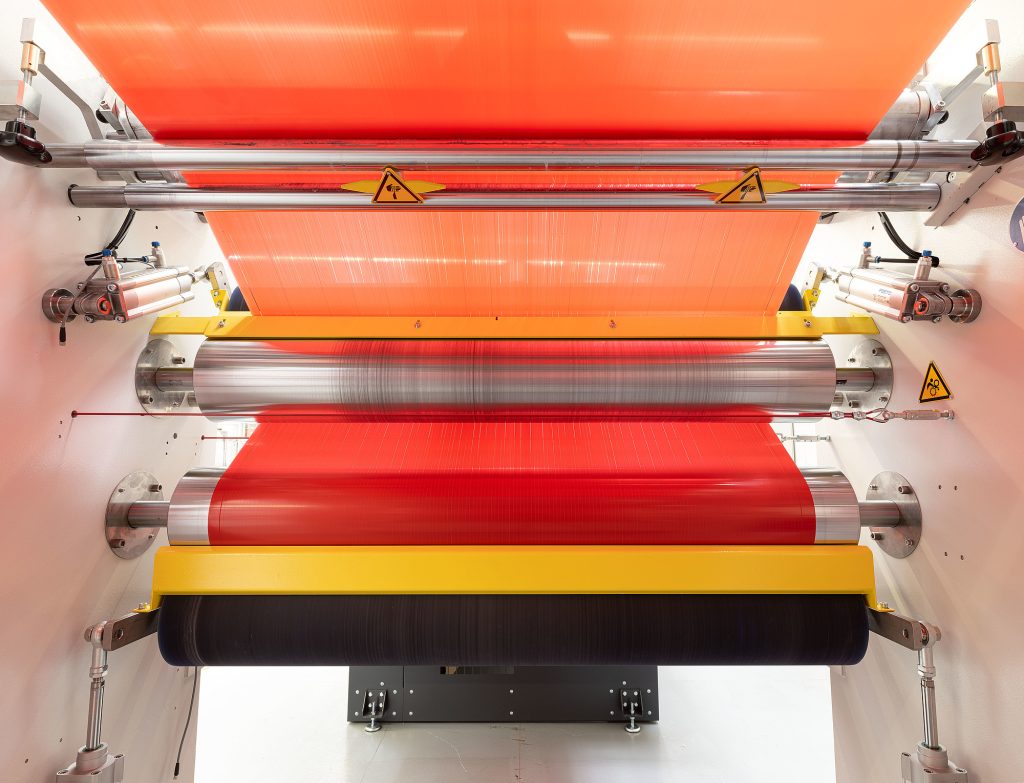
Co‑ex blown film & BOPP preparation. Two laminate routes carry most demand. Route A: reverse‑printed BOPP (15–35 μm) laminated via LDPE/LLDPE extrusion lamination—the retail‑grade billboard. Route B: a multi‑layer co‑ex PE film (25–80 μm, 3–7 layers) laminated directly—a mono‑polyolefin, seal‑friendly finish with tunable seal windows. Typical co‑ex stacks run skin/core/skin, with tie resins managing peel and impact; EVOH is avoided to preserve recycling pathways for certain customers.
Extrusion lamination. A molten PE tie layer bonds film to fabric at controlled temperature, nip pressure, and line speed. KPIs: peel strength above spec without curl, flat lay for printing, and a stable COF for stretch‑wrap efficiency. Registration is guarded like reputation: once it drifts, everything looks wrong even when it measures right.
Printing. Flexographic or rotogravure presses—up to 8–10 colors—apply brand assets, bilingual legends (CN/EN), lot/batch data, and machine‑readable codes. Because block‑bottom panels magnify mis‑register, plate/cylinder control, web tension, and adhesive windows are locked down at every splice.
Converting & ultrasonic sealing. Sheets are cut, gussets formed, and bodies made as open‑mouth or valve (block‑bottom) styles. Here the story turns ultrasonic: horn and anvil focus vibrational energy at the interface, generating localized heat inside the seam band, not in the air. The result is a neat 8–12 mm seal, minimal fuzz, and fewer leak paths compared with sewn mouths. Micro‑perforation near the shoulder manages de‑aeration on fast lines. If a liner is specified, it is inserted free, spot‑tacked, or mouth‑stitched to prevent crawl.
Quality assurance. Routine checks include fabric GSM and mesh uniformity, lamination peel, print rub/adhesion, drop tests (0.8–1.2 m typical), seal integrity after conditioning, valve back‑pressure (if applicable), and dimensional audits for pallet fit. Data isn’t décor; it is the contract between your line and your customer’s line.
VidePak’s process discipline rides on assets from W&H (Windmöller & Hölscher, Germany) and Starlinger (Austria), supported by 16 extrusion lines and 30+ lamination/printing machines. A core team with 30+ years in woven packaging converts control charts into consistency at scale.
Applications of Innovative Manufacturing of Laminated Woven Bags: The Role of Multi-Layered Co-Extrusion Blown Film and Ultrasonic Sealing Technology
Construction powders & adhesives. Cement, mortar, gypsum, tile adhesive—dense, abrasive, dusty. Laminates protect graphics through rough handling; ultrasonic hems reduce needle‑hole sifting; block‑bottoms build square pallets that travel well and stack safely.
Agriculture & fertilizers. Urea, NPK, soil amendments, and seeds demand moisture control and tidy filling. Co‑ex skins tune seal windows for hot/cold plants across regions; optional liners add insurance when monsoon seasons test every seam.
Chemicals & resins. Masterbatch, polymer pellets, mineral fillers are unforgiving on shells and indecisive on dust. A puncture‑tough woven core meets print‑rich hazard labeling on BOPP; anti‑slip exteriors keep tall stacks obedient over long hauls.
Food & pet nutrition. Rice, grains, kibble want clean mouths and durable faces. Reverse‑printed BOPP carries lifestyle imagery; ultrasonic hems open cleanly at home; aroma control comes via liners and seal layer selection.
Across these channels, Innovative Manufacturing of Laminated Woven Bags: The Role of Multi-Layered Co-Extrusion Blown Film and Ultrasonic Sealing Technology converts the same hardware into different wins: faster lines for ops, cleaner plants for EHS, sharper brands for sales, stronger pallets for logistics.
Technical Specifications — Laminated Woven Bags (Typical Ranges)
| Item | Typical Options / Range | Notes |
|---|---|---|
| Product | Laminated Woven Bags (PP woven + film laminate) | BOPP or multi‑layer co‑ex film laminated to PP fabric |
| PP Fabric Mesh / Denier | 8×8–14×14; 700D–1500D | Load, puncture, and print‑clarity balance |
| PP Fabric Basis Weight (GSM) | 60–120 gsm | Typical for 5–50 kg formats |
| Laminate Film Type | BOPP 15–35 μm; Co‑ex PE 25–80 μm (3–7 layers) | Reverse‑printed BOPP or seal‑friendly co‑ex |
| Lamination Method | Extrusion lamination (LDPE/LLDPE tie) | Adhesive‑free bond; stable registration |
| Printing | Flexo/Gravure up to 8–10 colors | Full panels incl. gussets; bar/QR supported |
| Sealing Options | Ultrasonic hem 8–12 mm; sewing/pasting as specified | Stitch‑free, dust‑reduced closures |
| Perforation | Micro‑perforation on request | For de‑aeration during fast filling |
| Inner Liner (Optional) | PE 20–80 μm | Added moisture/aroma control |
| Common Sizes | 30×45 cm, 40×58 cm, 50×80 cm, 60×90 cm (custom) | Width ≥30 cm typical; lengths per fill weight |
| Typical Fill Weights | 5–50 kg classes (e.g., 20/25/50 kg) | Validate via seam/tear/drop testing |
Values reflect widely used configurations seen on Made‑in‑China/Alibaba listings and peer factories for laminated woven PP packaging.
Why VidePak
Established Expertise & Scale. Since 2008, VidePak has focused on woven and composite packaging. With 568 employees and a core team boasting 30+ years across resin selection, co‑ex recipes, lamination windows, and ultrasonic seam design, we translate black‑box jargon into day‑to‑day reliability.
Top‑Tier Equipment. Lines from W&H and Starlinger underpin stable extrusion, weaving, lamination, printing, and converting. Capacity spans >100 circular looms, 16 extrusion lines, and 30+ lamination/printing machines—ready for seasonal peaks and multi‑SKU campaigns.
Material Integrity & Compliance. 100% new raw materials with food‑grade pathways; RoHS/REACH‑aligned inputs; anti‑slip and UV packages tuned to route and climate. Pallet patterns, cube utilization, and stretch‑wrap specs are engineered, not improvised.
Global Reach. Shipments across the USA, Europe, Brazil & South America, Southeast Asia, Japan, Korea, Central Asia, MENA, East & South Africa—with annual sales around USD 80 million—signal dependable supply for regional and multinational brands.
Brand‑Ready Output. Multicolor, abrasion‑resistant graphics; matte/gloss effects; ultrasonic‑clean mouths. Tell us your product, line speed, and target market—VidePak will engineer Innovative Manufacturing of Laminated Woven Bags: The Role of Multi-Layered Co-Extrusion Blown Film and Ultrasonic Sealing Technology to protect, perform, and persuade.
- What Are Innovative Manufacturing of Laminated Woven Bags: The Role of Multi-Layered Co-Extrusion Blown Film and Ultrasonic Sealing Technology?
- Features of Innovative Manufacturing of Laminated Woven Bags: The Role of Multi-Layered Co-Extrusion Blown Film and Ultrasonic Sealing Technology
- Production Process of Innovative Manufacturing of Laminated Woven Bags: The Role of Multi-Layered Co-Extrusion Blown Film and Ultrasonic Sealing Technology
- Applications of Innovative Manufacturing of Laminated Woven Bags: The Role of Multi-Layered Co-Extrusion Blown Film and Ultrasonic Sealing Technology
- Technical Specifications — Laminated Woven Bags (Typical Ranges)
- Why VidePak
- 1. Pioneering Manufacturing Technologies
- 2. Tailored Solutions for Operational Excellence
- 3. Applications Across Key Industries
- 4. Advantages Over Traditional Packaging
- 5. Emerging Trends in Laminated Woven Bags
- FAQs
- 6. Steps to Incorporate Laminated Woven Bags in Your Operations
- Conclusion
Laminated woven bags, leveraging multi-layered co-extrusion blown film and ultrasonic sealing technology, provide unparalleled strength, customization options, and eco-friendliness, making them essential for industrial, agricultural, and retail packaging solutions. This combination of advanced manufacturing techniques ensures these bags excel in durability, branding opportunities, and operational efficiency, meeting the evolving demands of modern businesses.
1. Pioneering Manufacturing Technologies
Multi-Layered Co-Extrusion Blown Film
This innovative process creates a composite film with distinct layers, each optimized for a specific function:
- Moisture and Contaminant Barrier: High-density polyethylene (HDPE) layers protect against environmental exposure, ensuring product integrity.
- Strength and Flexibility: Polypropylene (PP) cores provide durability and tensile strength, ideal for heavy loads.
- Enhanced Aesthetics: The outermost layer can feature custom finishes such as matte or glossy to suit branding needs.
Ultrasonic Sealing Technology
High-frequency sound waves fuse materials, offering precision and reliability. Key benefits include:
- Unmatched Seal Strength: Strong bonds ensure leak-proof packaging, essential for industries handling powders, grains, or liquids.
- Eco-Friendly Approach: Eliminates adhesives, reducing chemical waste and environmental impact.
- Customization Capabilities: Enables the creation of resealable closures or tailored shapes for user convenience.
2. Tailored Solutions for Operational Excellence
Color-Coding with Stripes
Adding colored stripes (e.g., red, green, blue) helps businesses organize inventory effortlessly.
- Example: A logistics company can use green-striped bags for organic products and red-striped bags for hazardous materials, streamlining warehouse operations.
Integrated Labeling Systems
Custom labeling options include:
- Barcode Printing: Supports inventory digitization and real-time tracking.
- Detailed Product Information: Provides essential data such as batch numbers, weight, and handling instructions.
Stackable and Ergonomic Designs
Laminated woven bags are engineered for ease of use in storage and transportation:
- Uniform Dimensions: Facilitate stacking and palletizing.
- Convenient Features: Handles or loops improve manual handling efficiency.
3. Applications Across Key Industries
Industrial Applications
Laminated woven bags are indispensable in sectors like construction and chemicals:
- Robust Construction: Ideal for transporting cement, sand, or chemical powders without spillage.
- Weather Resistance: Multi-layer films safeguard materials during long-term storage or harsh transit conditions.
Agriculture
These bags offer tailored solutions for packaging grains, seeds, and fertilizers:
- Categorization with Stripes: Color coding distinguishes between different crop types.
- Moisture Protection: Advanced barriers preserve product quality during extended storage.
Retail and Consumer Goods
In the retail industry, laminated woven bags are popular for high-end packaging:
- Visual Appeal: Glossy finishes and high-resolution printing enhance brand presence on shelves.
- Sustainability Messaging: Eco-conscious packaging resonates with modern consumer values.
4. Advantages Over Traditional Packaging
| Feature | Laminated Woven Bags | Traditional Packaging |
|---|---|---|
| Durability | High tensile strength; resistant to wear | Prone to tearing and deformation |
| Environmental Impact | Recyclable materials and reduced waste | Often non-recyclable and polluting |
| Customization Options | Wide range of sizes, finishes, and labels | Limited to standard configurations |
| Cost Efficiency | Longer lifespan reduces overall costs | Frequent replacements increase expenses |
5. Emerging Trends in Laminated Woven Bags
Eco-Friendly Innovations
The push for sustainability drives demand for recyclable materials and energy-efficient production methods. Laminated woven bags meet these needs with minimal environmental impact and compliance with global green standards.
Integration with Smart Warehousing
The rise of automated warehouses emphasizes the importance of scannable barcodes and RFID integration. Laminated bags with embedded tracking systems are increasingly favored by large-scale operations.
Advanced Printing Technology
Businesses now employ digital printing for vibrant graphics, QR codes, and brand messages directly on packaging, enhancing marketing efforts and traceability.
FAQs
Q: Why are laminated woven bags preferred for heavy-duty applications?
A: Their multi-layered construction offers superior strength and durability, while ultrasonic sealing ensures leak-proof performance under extreme conditions.
Q: How can these bags enhance warehouse efficiency?
A: Customizations such as color coding, barcode integration, and stackable designs simplify inventory management and logistics.
Q: Are laminated woven bags eco-friendly?
A: Yes, they are made from recyclable materials and utilize energy-efficient manufacturing techniques, aligning with global sustainability goals.
Q: What branding options are available?
A: High-resolution printing supports logos, detailed product descriptions, and promotional graphics, creating a strong brand identity.
6. Steps to Incorporate Laminated Woven Bags in Your Operations
- Assess Requirements: Identify packaging needs based on product type, weight, and storage conditions.
- Select Custom Features: Choose desired sizes, finishes, and color-coded stripes for streamlined operations.
- Collaborate with Trusted Suppliers: Partner with manufacturers utilizing advanced technologies like co-extrusion and ultrasonic sealing.
- Test Product Quality: Ensure prototypes meet durability, aesthetic, and functional standards.
- Implement in Logistics: Train teams to leverage labeling and coding features for enhanced efficiency.
Conclusion
The innovative use of multi-layered co-extrusion blown film and ultrasonic sealing technology positions laminated woven bags as a superior choice for packaging solutions. From industrial applications to retail branding, these bags deliver durability, sustainability, and unmatched customization. To learn more about multi-layered co-extrusion technology and advanced manufacturing techniques, explore how these advancements can revolutionize your packaging strategy.