
What Are Laminated Woven Bags?
Laminated Woven Bags are polypropylene (PP) sacks built on a textile backbone—PP tapes that have been extruded, slit, and drawn—then faced with a thin protective film that transforms a rugged carrier into a brand‑forward package. In trade usage they are also called BOPP‑laminated PP woven bags, PP‑coated woven sacks, laminated tubular woven bags, and laminated valve sacks. Labels multiply, yet the essence remains: a fabric that refuses to tear easily, coupled with a laminate that resists moisture, dust, and abrasion while holding crisp graphics. If you want a single anchor for product exploration, Laminated Woven Bags is a concise gateway to variants and finishing choices.
Background and domain knowledge. The science behind Laminated Woven Bags is part rheology, part mechanics. PP’s semi‑crystalline chains become stronger when drawn; tapes woven into a mesh distribute loads along warp and weft, lowering local stress. The laminate—either PP extrusion coating or BOPP—adds continuity to the surface, closing inter‑yarn gaps and providing an ink‑receptive, scuff‑resistant face. In operations, this pairing means fewer pinholes, cleaner pallets, and colors that survive the conveyor, the forklift, and the last mile. In marketing, it means high‑coverage imagery without surrendering durability.
Horizontal and vertical thinking. Horizontally, compare Laminated Woven Bags to three neighbors: multi‑wall paper sacks (excellent print feel, modest wet strength), unlaminated woven sacks (high mechanical integrity, limited graphics), and glossy monolayer pouches (great graphics, poor abrasion tolerance). Vertically, trace cause and effect through the stack: resin → tape drawing → mesh/denier → lamination → printing → closure geometry. Alter one tier and the others respond—tighten the mesh to curb sift‑out, and you may raise coating weight for ink holdout; upgrade denier for tear resistance, and you’ll retune stiffness to preserve hand feel. This is a system, not a collection of parts.
数据强化(Data reinforcement). Across supplier catalogs and peer sites, repeating windows appear: fabric 60–160 g/m², mesh 8×8–14×14, tape 500D–1500D, BOPP 12–25 μm, PP coating 15–30 μm, finished widths 35–75 cm, and practical fills 5–50 kg (with engineered builds extending toward ~120 kg when closures are reinforced). These aren’t marketing flourishes; they are levers for drop performance, rub life, and pallet behavior.
案例剖析(Case analysis). A rice mill that moved from unlaminated woven to Laminated Woven Bags specified 10×10 mesh, 900D tapes, and 20 μm BOPP. Shelf scuff complaints fell; inbound QA reduced random opens because lot color and grade were legible through designed windows. A fertilizer brand chose matte‑BOPP to suppress pallet rub marks while preserving premium print; claim frequency for label blur declined noticeably.
对比研究(Comparative study). Relative to unlaminated woven sacks, Laminated Woven Bags shine on print fidelity, dust hygiene, and moisture resistance. Relative to multi‑wall paper, they keep seam strength in humid depots and survive repeated drops. Relative to glossy PE pouches, they keep their angles, stack square, and withstand abrasion—more warehouse‑proof, less showroom‑only.
What Are the Features of Laminated Woven Bags?
Strength meets shelf impact—without compromise. The woven backbone of Laminated Woven Bags absorbs impact and resists seam propagation; the laminated face turns that strength into a story: color‑true graphics, smoother panels, and branding that remains legible after long routes. Protection and presentation, designed to agree rather than argue.
Moisture, dust, and scuff management. The laminate acts like armor. PP coating around 15–30 μm or BOPP around 12–25 μm closes the fabric, reducing powder leaks and limiting capillary moisture ingress. In abrasive environments—fertilizer yards, mineral depots—the film bears the brunt, so print doesn’t.
Human‑centric handling. Fabric basis weight (typically 60–160 g/m²), denier (500D–1500D), and mesh (8×8–14×14) define how a bag feels in the hand, how it nests on a pallet, how it behaves under stretch‑wrap. Want a bag that stands proud on a shelf? Raise GSM a notch. Need it to conform to pallet corners? Balance GSM with denier and keep stiffness in check.
Design‑for‑recycling options. Laminated Woven Bags can be specified as mono‑PP—woven PP plus PP coating or PP/BOPP—to target PP recycling streams where the infrastructure exists. When a paper aesthetic is desired, matte BOPP and print effects emulate kraft without adding fibers that complicate sortation.
数据强化(Data reinforcement). Typical supplier statements match line reality: finished widths 35–75 cm for 5/10/25/50 kg SKUs; UV‑stabilized tapes for yard storage; anti‑slip finishes for pallet stability; and valve options where high‑speed filling matters. Numbers are not decorations; they’re commitments your line has to live up to.
案例剖析(Case analysis). A masterbatch producer using Laminated Woven Bags with valve tops reported smoother spout filling and less oscillation of the bag body, allowing a higher line set point. A seed packer added EZ‑open hems to reduce consumer frustration while maintaining lamination for print clarity.
对比研究(Comparative study). Against coated paper sacks, Laminated Woven Bags offer superior wet strength and seam retention; against all‑plastic pouches, they deliver better crease recovery and less conveyor scuffing. Where each rival excels is clear; where they break is clearer.
What Is the Production Process of Laminated Woven Bags?
From resin to mesh. Polypropylene pellets are melted, cast into film, slit into tapes, and drawn to orient molecules for strength. Tapes are woven on circular or flat looms; mesh and denier set the mechanical baseline. Fresh fabric is corona‑treated to raise surface energy for coating, lamination, or ink anchorage.
From mesh to billboard. Converters either extrude‑coat PP directly onto the fabric or laminate a BOPP film. Printing follows—flexographic for speed and cost efficiency; gravure for photographic fidelity. Tubes are formed, gussets shaped, lengths cut. Tops are heat‑cut or hemmed; bottoms close via single/double fold and single/double stitch, or with pinch‑bottom hot‑melt when presentation rules. Valve sleeves can be inserted for high‑throughput fills; PE liners are optional for barrier or hygiene without abandoning the laminated face.
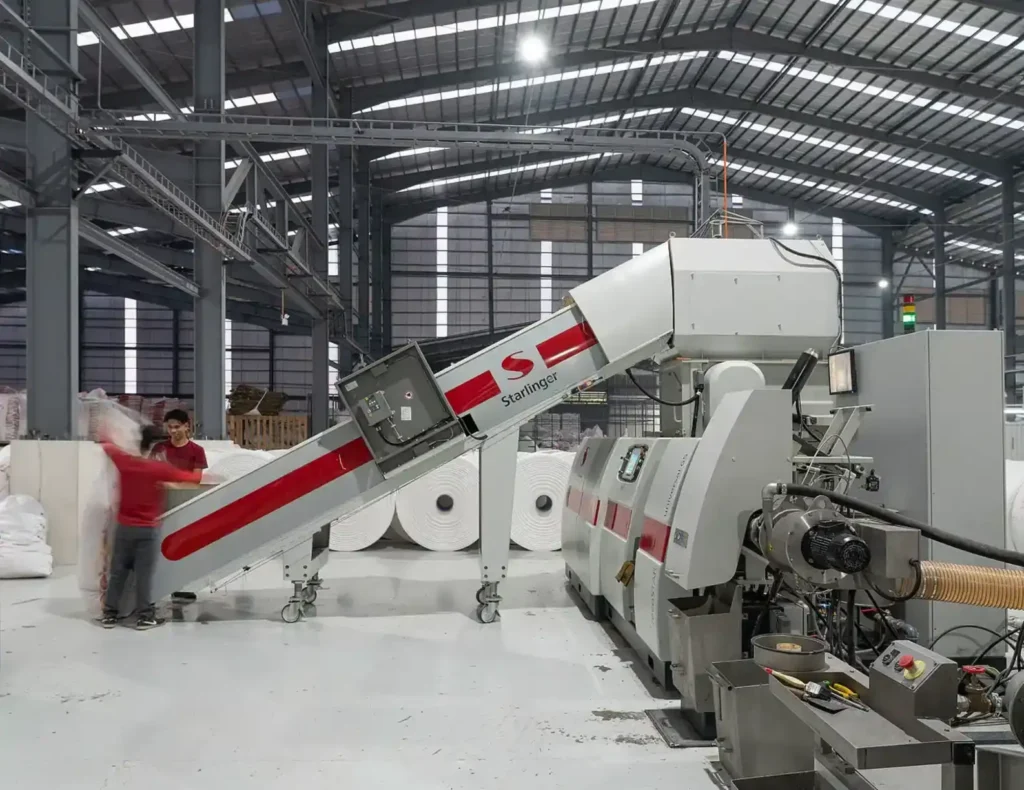
Starlinger and W&H: precision as a habit, not an event. Why invoke specific machinery families? Because process capability is destiny. Starlinger’s tape and loom systems with closed‑loop thickness and tension control produce consistent fabric flatness; consistent flatness yields cleaner register on the press and tighter seam behavior at the closer. W&H presses—CI flexo and gravure—are renowned for register stability, web handling at speed, and color repeatability. The net effect for Laminated Woven Bags is boring in the best way: fewer color shifts, fewer mis‑traps, fewer weak bottoms.
Process controls that matter. Loom tension → fabric flatness → print register. Corona dyne levels → ink anchorage → rub resistance. Coating/lamination weight → dust control and scuff life. Stitch density and fold geometry → powder hygiene. Every dial has a failure mode: under‑treated surfaces ghost; over‑tight meshes haze; short overlaps leak. Good lines know these failure poems by heart—and avoid them.
数据强化(Data reinforcement). Verifiable ranges seen across Made‑in‑China/Alibaba: BOPP 12–25 μm; PP coating 15–30 μm; widths 35–75 cm mapping to 5–50 kg fills; meshes 8×8–14×14; tapes 500D–1500D. Plants frequently declare ISO 9001:2015 for quality governance; food‑adjacent lines add BRCGS Packaging Materials (Issue 7) or ISO 22000. Polymer food‑contact references appear as 21 CFR 177.1520 (olefin polymers) and EU No 10/2011.
案例剖析(Case analysis). A flour producer battling sift‑out during monsoon months switched from cold‑cut tops to heat‑cut + hem and upgraded bottoms to double‑fold/chain‑stitch in Laminated Woven Bags. Spillage fell; cleanup shrank. Another converter migrated from solvent lamination to extrusion coating to reinforce the mono‑PP story and cut VOCs—print gloss held, thanks to W&H’s register control.
对比研究(Comparative study). Extrusion coating vs. BOPP lamination: coating keeps mass lower and simplifies mono‑material claims; BOPP brings photographic print and higher rub life. Tubular vs. flat fabric: tubular eliminates a side seam (fewer leak paths), while flat offers wider size ranges and sometimes faster loom changeovers.
What Is the Application of Laminated Woven Bags? (Industrial & B2B)
Materials that push back demand formats that push harder. Laminated Woven Bags carry fertilizers, seeds, grains, pet litter, cement additives, gypsum, calcium carbonate, resins, and carbon black. On long routes—warehouse → yard → port → retailer—the square‑stacking geometry and rub‑resistant face keep pallets intact and brands legible.
数据强化(Data reinforcement). Industrial SKUs center on 5/10/25/50 kg, with finished widths 35–75 cm. Meshes tighten for fine powders; UV‑stabilized tapes are chosen for depot storage; anti‑slip finishes reduce pallet glide; valve formats accelerate spout filling and limit airborne dust at the hopper.
案例剖析(Case analysis). A fertilizer exporter cut abrasion claims after switching to matte‑BOPP Laminated Woven Bags; the panel resisted pallet rub through sea transit. A masterbatch line using tubular laminated valve sacks reported steadier bag behavior under fill, unlocking a measurable increase in bags per minute.
对比研究(Comparative study). Compared with FIBCs (ISO 21898 governs big bags), these sacks occupy the manual‑handling middle tier—easier to merchandise and to lift without hoists—yet durable enough for abrasive contents. Compared with unlaminated woven sacks, the laminated face lifts perceived and actual quality: cleaner pallets, fewer dust trails.
What Is the Application of Laminated Woven Bags? (Food, Retail & Branding)
When the story must travel with the product. Premium rice, specialty flours, pet foods, BBQ fuels, garden inputs—categories that sell with the eyes as much as with the spec—benefit from Laminated Woven Bags. Reverse‑printed BOPP supports billboard‑grade imagery; matte finishes evoke a kraft look; EZ‑open features turn the first unboxing into a frictionless moment.
数据强化(Data reinforcement). Practical stacks combine BOPP 12–25 μm with substrates in the 80–120 g/m² band for scuff life and stand‑up shelf presence. Food‑adjacent plants align to BRCGS Packaging Materials Issue 7 or ISO 22000; polymer contact is referenced to 21 CFR 177.1520 / EU 10/2011. Where moisture is sensitive, a light PE liner can be inserted without abandoning the laminated exterior.
案例剖析(Case analysis). A pet‑food SME that adopted Laminated Woven Bags with pinch‑bottoms saw fewer handle‑tear returns and crisper planogram lines—the stiffer front face held the print flat. A rice brand used unprinted BOPP windows to showcase grain length; shoppers responded with their baskets.
对比研究(Comparative study). Versus glossy all‑plastic bags, Laminated Woven Bags feel warmer and recover creases better; versus coated paper sacks, they hold seam integrity in humid backrooms and survive last‑mile abrasion with fewer rub marks.
Specifications & Compliance Sheet (selected, supplier‑verifiable)
| Parameter | Typical range / option | Engineering note |
|---|---|---|
| Fabric GSM | 60–160 g/m² | Stiffness vs. conformability; match to stack height |
| Mesh (warp×weft) | 8×8 – 14×14 | Tighter mesh for powders; moderate for grains/resins |
| Tape denier | 500D – 1500D | Higher denier ↑ tear & seam strength |
| BOPP film | 12–25 μm | Print fidelity & scuff resistance |
| PP coating | 15–30 μm | Dust/moisture control; mono‑PP story |
| Finished width | 35–75 cm | Align to 5–50 kg formats & pallet geometry |
| Top finish | Heat‑cut / cold‑cut; hem, EZ‑open | Fray control & UX |
| Bottom | Single/double fold; single/double stitch; pinch‑bottom | Powder hygiene vs. throughput |
| Valve sleeve | Optional | High‑speed filling & dust reduction |
| UV stabilization | Optional | Outdoor storage tolerance |
| Food contact (polymer) | 21 CFR 177.1520; EU No 10/2011 | Regulatory anchors for PP contact |
| Woven sack standard | GB/T 8946‑2013 | General technical requirements |
| Quality systems | ISO 9001:2015; BRCGS Packaging Materials (Issue 7) | Plant governance & hygiene |
| Tensile references | ASTM D5034 / D5035 | Third‑party test methods |
Note: Ranges reflect common supplier data and public standards. Validate through sampling, drop/stack testing, and on‑line sifting audits.
Systems Synthesis: Starlinger + W&H → One VidePak Blueprint
Performance node (protect & present). Begin Laminated Woven Bags at 10×10 mesh / 900D / 80–100 g/m² for 25–50 kg fills; upgrade to 12×12 / 1100D for powders or tall stacks. Choose matte vs. glossy BOPP to balance rub life with visual tone; default to double‑fold bottoms with chain stitch when powder hygiene is non‑negotiable.
Precision node (machinery capability). Favor Starlinger tape/loom lines for stable tape thickness and fabric uniformity; deploy W&H flexo or gravure presses for register control on long runs. Closed‑loop tension, auto‑register, and inline defect monitoring prevent the small drift that becomes a big claim.
Compliance node (license to sell). Keep plants on ISO 9001:2015; align food‑adjacent runs to BRCGS Packaging Materials Issue 7 or ISO 22000; reference 21 CFR 177.1520 / EU 10/2011 for polymer contact; document performance with ASTM D5034/D5035 tensile and routine stack/drop tests.
Recyclability node (design‑for‑recycling). Stay mono‑PP wherever possible (PP coating or PP/BOPP); publish sortation guidance for PP streams; consider lighter coatings where infrastructure is limited. If paper aesthetics are required, lean on matte PP effects instead of fiber blends.
Sourcing node (assurance). Require resin COAs, batch‑level traceability, UV packages for depot storage, and rub‑resistance targets aligned to route length. If labels are paper, keep FSC® claims confined to the label to avoid mixed‑material confusion.
Integrated configuration (VidePak‑ready). 1) Two lamination lanes—extrusion‑coated mono‑PP for simplicity; BOPP‑laminated for high‑fidelity branding. 2) Parameter presets—10×10 / 900D / 90 g/m² baseline; 12×12 / 1100D / 110 g/m² for powders. 3) Closure rules—heat‑cut + hem at the top; double‑fold + chain stitch at the bottom; valve sleeves for speed. 4) Validation—drop/stack tests at target heights, rub/ink adhesion on laminated faces, and on‑line sifting audits backed by third‑party tensile per ASTM D5034/D5035.
Engineered this way, Laminated Woven Bags don’t merely look precise—they run precise: predictable color, repeatable seams, restrained dust, and pallets that keep their silhouette from filler to shelf.

- What Are Laminated Woven Bags?
- What Are the Features of Laminated Woven Bags?
- What Is the Production Process of Laminated Woven Bags?
- What Is the Application of Laminated Woven Bags? (Industrial & B2B)
- What Is the Application of Laminated Woven Bags? (Food, Retail & Branding)
- Specifications & Compliance Sheet (selected, supplier‑verifiable)
- Systems Synthesis: Starlinger + W&H → One VidePak Blueprint
Main Answer: Laminated woven bags achieve unmatched durability and print clarity through advanced processes—extrusion, drawing, weaving, lamination, coating, printing, and bag-making—each optimized with Starlinger and Windmöller & Hölscher (W&H) machinery for rigorous quality control.
Introduction
Laminated woven bags are indispensable in industries demanding moisture resistance, UV protection, and branding precision, from agriculture to chemicals. Their performance hinges on seven meticulously controlled production stages. This report dissects each process, highlights quality assurance protocols, and underscores how Starlinger and W&H technologies elevate manufacturing standards.
1. Extrusion: Building the Foundation
Extrusion melts polypropylene (PP) resin into a uniform film, dictating the bag’s baseline strength.
Q: How does co-extrusion enhance film performance?
A: Layering PP with polyethylene (PE) or BOPP balances tensile strength and moisture resistance.
Starlinger’s Visco+ extruder uses a dual-layer die to produce films with a PP core (MFI 3–5 g/10 min) and a BOPP outer layer. For example, a 0.08 mm film with ±0.003 mm thickness tolerance ensures consistency in multiwall laminated woven bags for fertilizers.
Quality Control:
- Melt Flow Index (MFI) tests: Verify resin viscosity (3–5 g/10 min at 230°C).
- Laser thickness gauges: Detect deviations exceeding ±0.005 mm.
2. Drawing: Maximizing Tape Strength
The extruded film is slit into tapes and stretched to align polymer chains.
Q: Why is draw ratio critical?
A: A 1:6–1:8 draw ratio optimizes tensile strength (8–10 N/tex) while retaining 15–20% elongation.
W&H’s TA-CON stretching line heats tapes to 160°C and stretches them at 200 m/min. For heavy-duty FIBC bags, this ensures tapes withstand 1-ton loads without snapping.
Quality Control:
- Tensile testers: Confirm break force ≥8 N/tex (ASTM D882).
- Elongation checks: Ensure 15–25% stretch to absorb impacts.