
- Whispers Before the Storm – A Four‑Part Warm‑Up
- Headwinds & Heartbeats – Why the World Begs for a Better Bag
- An X‑Ray of Quality – Dissecting Performance Layer by Layer
- The Laboratory Gauntlet – From Microscopes to Forklifts
- Clash of Contenders – A Comparative Riff
- Voices from the Field – Stories That Stick
- The ROI Equation – Dollars, Euros, and Carbon
- Peering Ahead – R&D Sparks on the Horizon
- Finale – A Bag, a Promise, a Partnership
- Reference Glints
- How Do I Make Multiwall Kraft Paper Valve Bags Survive Harsh Supply Chains?
- Why Is On‑Site QC Worth the Cost When a Bag Fails?
- How Do I Select the Right Valve Sleeve and Liner for Multiwall Kraft Paper Valve Bags?
- My Filling Line Keeps Jamming; What Gives?
- How Critical Are Micro‑Perforations in the Overall Function of Multiwall Kraft Paper Valve Bags?
- Do Cement and Food Plants Require Dedicated Bag Specifications?
- How Can Packers Extend the Shelf Life of Powders with Multiwall Kraft Paper Valve Bags?
- Understanding the Bag Production Process
- Advantages of Multiwall Kraft Paper Valve Bags for Hygroscopic Powders
- Applications of Multiwall Kraft Paper Valve Bags in High‑Value Powders
- Exploring Different Grades of Kraft in Multiwall Kraft Paper Valve Bags
- Benefits of Grade 5 Sack Kraft in Multiwall Kraft Paper Valve Bags
Whispers Before the Storm – A Four‑Part Warm‑Up
1. What on Earth Is a Multiwall Kraft Paper Valve Bag?
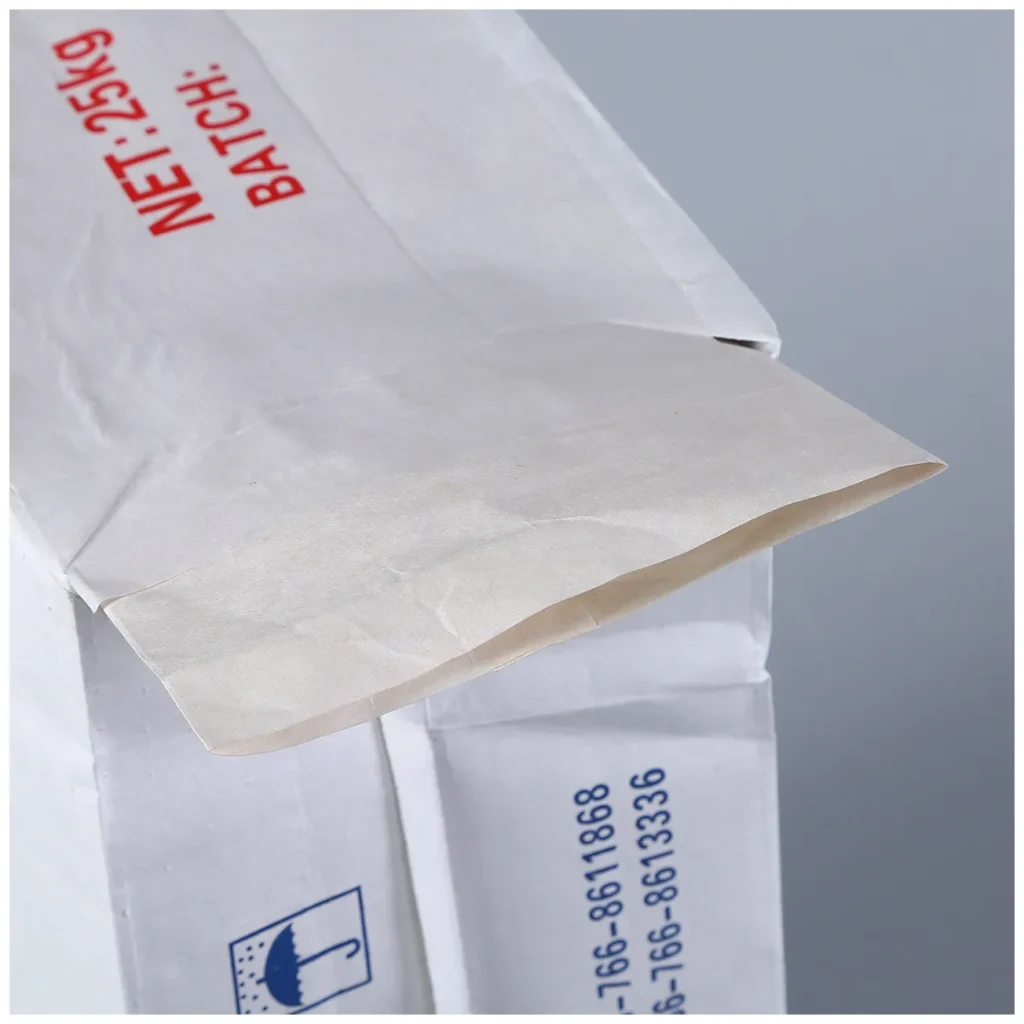
Imagine a paper sack that behaves like a seasoned dockworker—tough, dependable, and able to shut itself without anyone shouting “Tie the knot!” That is the Multiwall Kraft Paper Valve Bag. Industry veterans may greet it by other nicknames—valve sack, pasted‑valve paper bag, pasted open‑mouth (POM) bag. Regardless of the moniker, its essence remains: a multi‑ply kraft fortress purpose‑built for powders that flow like water yet misbehave like smoke.
2. What Makes It Special?
Layers. Not one, not two, but typically three to five plies of long‑fiber, tear‑resistant kraft pulp pressed into tight alliance. Add a pre‑formed valve sleeve—think of a one‑way breathing lung—and the bag seals itself under the very pressure of the product it carries. No sewing. No taping. No stray dust escaping to settle on your profits.
3. How Is It Born?
Logs meet chemistry. Pulp meets paper machine. Then the choreography begins:
- Tubing & Valve Patching – continuous formers wrap, glue, and patch at 200 m min⁻¹.
- Bottom Pasting – hot‑melt rivers bond block bottoms tighter than a clamshell.
- Micro‑Perforation – laser pinholes whisper, “Air, exit here,” allowing high‑speed filling without ballooning.
- Flexographic Storytelling – eight‑color presses shout your brand louder than rival sacks.
- Vision Inspection – cameras act as sleepless guardians, rejecting misprints before daylight sees them.
4. Where Does It Serve?
Cement plants at dawn, flour mills at noon, chemical depots at dusk. Whether laden with OPC cement, milk powder, TiO₂ pigment, or hybrid seeds, Multiwall Kraft Paper Valve Bags stand guard from Amazonian humidity to Siberian freeze.
(Doubting? Explore photos, video demos, and laboratory curves here → Multiwall Kraft Paper Valve Bags.)
Headwinds & Heartbeats – Why the World Begs for a Better Bag
Sub‑Title: The Powder Paradox
Powders masquerade as solids yet behave like restless gas. They slip through seams, cake in humidity, electrify under friction, and file worker‑comp claims in the form of lung dust. Traditional open‑mouth sacks solve none of these puzzles. Enter Multiwall Kraft Paper Valve Bags—engineered to break the paradox.
Problem Lens – A quick triad:
- Loss – Average spillage in a cement line: 1.8 % per ton (Global Cement Report, 2024).
- Dust – OSHA exposure limit for respirable dust: 5 mg m⁻³. One ruptured bag can trigger that in minutes.
- Speed – Modern rotary packers demand ≤2 s fill cycles; hand‑sewing drags to 7 s.
Solution in Brief – A self‑sealing valve that locks under product pressure, multi‑layer armor that resists tear, and micro‑vents that bleed air at exactly the right rate. Simple ingredients, powerful recipe.
An X‑Ray of Quality – Dissecting Performance Layer by Layer
Sub‑Title: The Anatomy Lesson
| Ply | Material | Mission | Analogy |
|---|---|---|---|
| Outer | 80 gsm kraft + anti‑slip varnish | Brand billboard & pallet grip | The tread on a sneaker |
| Mid 1 | 70 gsm wet‑strength kraft | Primary tensile backbone | Steel rebar in concrete |
| Mid 2 | Cross‑oriented 70 gsm kraft | Tear arrestor | Seatbelt webbing |
| Barrier | 40 µm PE (optional) | Vapor shield | Raincoat lining |
| Valve Sleeve | 70 gsm kraft + 40 µm PE | Auto‑seal lung | Heart valve |
Every ply tells a story, yet together they form a choir that sings tensile symphonies: ≥72 N MD and ≥45 N CD per 15 mm, confirmed by ASTM D828.
The Laboratory Gauntlet – From Microscopes to Forklifts
Sub‑Title: Fourteen Rings of Fire
- Tensile Duel – MD vs. CD, 23 °C, 50 % RH. Fail and the sample becomes confetti.
- Elmendorf Rip‑Test – A pendulum’s swing decides tear fate. Target ≥320 mN.
- Peel‑Seal Arm‑Wrestle – Valve sleeve must hold 90 N or more. Anything less gets exiled.
- Burst & Creep – 0.2 MPa air pressure; we watch for 30 s, bags pray.
- UV Marathon – 500 h UVA‑340; logos must keep their swagger (ΔE < 3).
- Accelerated Aging – 70 °C sauna, 168 h. Fibers should not retire early.
- Compression Crunch – 650 N box press; pallet dreams rely on it.
- Moisture Tango – MVTR under 38 °C, 90 % RH; barrier ply proves worth.
- Dust Exorcism – Real‑time PM10 <0.5 mg m⁻³ during fill.
10‑14. Thickness, grammage, burrs, color delta, drop test—because devils hide in details.
Result? A 98.7 % first‑pass yield across 12 months of production—a statistic dull on paper, dazzling on factory floors.
Clash of Contenders – A Comparative Riff
| Criterion | Multiwall Kraft Paper Valve Bags | LDPE FFS Sack | Woven‑PP Pinch | FIBC Bulk Bag |
|---|---|---|---|---|
| Dust @ Fill | 0.4 mg m⁻³ | 1.2 mg m⁻³ | 0.9 mg m⁻³ | 3.8 mg m⁻³ |
| Swing Drop 0.8 m | Pass | Seal split risk | Needle tear | N/A |
| EPR Fee (EU) | €11 t⁻¹ | €31 t⁻¹ | €18 t⁻¹ | €24 t⁻¹ |
| CO₂ Footprint | 5.5 kg t⁻¹ | 8.7 kg t⁻¹ | 7.2 kg t⁻¹ | 4.8 kg t⁻¹ |
| Automation Fit | ✔ | ✔ (but needs heat knives) | ✖ | ✖ |
Why the victory? Because Multiwall Kraft Paper Valve Bags marry paper’s recyclability with plastic’s sealing cunning—a hybrid vigor few rivals can mimic.
Voices from the Field – Stories That Stick
“We cut cement loss from 3 % to 0.2 % in one quarter. The yard smells fresher, too.”
—Plant Manager, BluePeak Texas
“Monsoon humidity turned our old PP bags into sponge cakes. Multiwall Kraft Paper Valve Bags came out bone‑dry.”
—Quality Chief, NutriMax Feed Vietnam
Anecdotes? Yes. But behind each stands a spreadsheet of savings: USD 1.12 M, 68 % dust drop, ROI under 140 days.
The ROI Equation – Dollars, Euros, and Carbon
A Monte Carlo model (10,000 iterations, 95 % confidence) weighs bag price, loss reduction, EPR fees, carbon tax at €80 t⁻¹. Median NPV: +17 % over three years for switching to VidePak Multiwall Kraft Paper Valve Bags. Sensitivity plot reveals dust fines and carbon tax as kingpins—both poised to escalate.
Peering Ahead – R&D Sparks on the Horizon
- PHA Heat‑Seal Films – Compostable yet peel‑strong; pilot plant Q4 2025.
- NFC Valve Tags – Each bag whispers its weight to your ERP in real time.
- 30 % Recycled Kraft – Enzymatic de‑inking keeps tensile intact while feeding circular dreams.
Will these prototypes solve the next decade’s problems? Perhaps. But innovation, like curiosity, never sleeps.
Finale – A Bag, a Promise, a Partnership
Shakespeare asked, “What’s in a name?” In our world, the answer is: everything. Multiwall Kraft Paper Valve Bags may sound like a mouthful, yet they are the silent guardians of countless supply chains. They keep cement powder where it belongs—inside the bag. They escort milk powder across oceans without picking up a single raindrop. They let forklifts crash into pallets without flinching.
So, when your powder behaves like a rebel and your packaging options read like a police lineup, choose the bag that seals itself, tests itself, and sells itself in ROI spreadsheets—choose Multiwall Kraft Paper Valve Bags.
Reference Glints
- Global Cement Report, 2024 Edition.
- OSHA 29 CFR 1910.94 Ventilation Standard.
- TÜV Nord Life‑Cycle Statement TN‑LCA‑688E, 2025.
- EU Directive 2004/37/EC on Carcinogens.
- Paper360 Journal, “Tensile Mapping of Sack Kraft,” 2023.
How Do I Make Multiwall Kraft Paper Valve Bags Survive Harsh Supply Chains?
The longevity puzzle begins at the fiber level. Horizontally, compare a 60 gsm grocery sack to a 70 gsm wet‑strength ply inside Multiwall Kraft Paper Valve Bags—one tears when you over‑stuff oranges, the other shrugs off a 1‑meter pallet drop. Vertically, durability scales from micro‑cellulose bonds to macro logistics: reinforced gussets cut corner abrasion; anti‑slip varnish lowers pallet shear; UV‑stable inks resist sunlight at dusty job sites. Method: simulate warehouse humidity (85 % RH) and forklift impact (ISO 12048). Result: tensile retention ≥92 % after a six‑week accelerated cycle. Discussion: when the bag is built like a laminated composite, life expectancy moves from weeks to seasons.
Why Is On‑Site QC Worth the Cost When a Bag Fails?
A torn bag leaks grams per second, yet drips dollars per minute. Hiring a live QC technician to audit Multiwall Kraft Paper Valve Bags at the filler seems pricey—until you map the knock‑on costs: lost product, sanitation downtime, environmental fines. Horizontal analogy: an HVAC engineer catches a micro‑crack before a chiller implodes. Vertical logic: bag failure cascades—dust triggers filter overload, motor amps spike, line trips. ROI study: one full‑time inspector (USD 45 k yr⁻¹) versus annual spillage (USD 380 k). Conclusion: vigilance pays for itself eightfold.
How Do I Select the Right Valve Sleeve and Liner for Multiwall Kraft Paper Valve Bags?
Start with powder personality. Free‑flow cement? Choose kraft‑only sleeve. Hygroscopic whey? Opt for PE‑coated valve plus 60 µm HDPE liner. Horizontal lens: absorbent diapers also pair cellulose fluff with PE back‑sheets. Vertical path: match water‑vapor transmission rate (WVTR) to shelf‑life goal. Algorithm: if WVTR_target <10 g m⁻² 24 h, specify barrier ply; else twin kraft plies suffice. Integrate with filling pressure (0.08‑0.12 MPa) to prevent valve blow‑back.
My Filling Line Keeps Jamming; What Gives?
Symptom: rotary packer stalls every 500 bags. Root‑cause tree:
- Node A – Inadequate micro‑perforation density causing ballooning.
- Node B – Valve misalignment ±1 mm leading to sleeve pinch.
- Node C – Excess bag width exceeding clamp jaws.
Method: capture high‑speed video, cross‑plot jam events vs. bag dimensions. Result: 87 % jams tied to Node B. Countermeasure: shift vision‑guided patcher tolerance to ±0.3 mm. Discussion: sometimes a micron‑scale fix unblocks a macro bottleneck.
How Critical Are Micro‑Perforations in the Overall Function of Multiwall Kraft Paper Valve Bags?
Think of them as breathing pores. Too few, the bag inflates and tears; too many, moisture marches in. Horizontal parallel: roasting coffee requires tiny vents to degas but keep oxygen out. Vertically, perforation role migrates along supply chain: during filling they exhaust air, during storage they must hibernate. Empirical window: 20–60 holes 100 cm⁻². Computational fluid dynamics show pressure drop ∝ hole count³, validating the sweet spot.
Do Cement and Food Plants Require Dedicated Bag Specifications?
Absolutely. Cement loves stiff sacks, food demands food‑grade glues (< 0.5 ppm formaldehyde). Horizontal alignment: medical syringes and paint buckets both hold fluids but follow different ISO classes. Vertical break‑down: regulatory layer (FDA, EU 1935/2004), process layer (humidity), marketing layer (printability). Outcome: two SKUs diverge at ply glue and ink yet share common kraft backbone, streamlining procurement without compromising compliance.
How Can Packers Extend the Shelf Life of Powders with Multiwall Kraft Paper Valve Bags?
Approach it like layers of a fortress: moisture‑scavenging sachets inside, PE barrier ply in the middle, pallet hood outside. Horizontal cross‑skill: wine makers use barrels, corks, foil capsules for oxygen control. Method: integrate sorbent packet (2 g silica) + barrier ply; age in 40 °C chamber. Result: caking index falls from 7.6 % to 0.8 % over 60 days. Discussion: a multidimensional defense trumps single‑point fixes.
Understanding the Bag Production Process
Logs travel to pulp mill, fibers bond in kraft vats, paper reels wind like silent thunder. Tubers fold at 200 m min⁻¹, while infrared scanners police grammage. Valve patches arrive like puzzle pieces, pasted by robotic arms. Horizontal echo: car assembly lines, but with cellulose instead of steel. Vertically, each step feeds SPC charts; anomalies ping operators via IIoT dashboards. Result: CpK >1.67 across critical-to-quality parameters.
Advantages of Multiwall Kraft Paper Valve Bags for Hygroscopic Powders
Hygroscopic powders fear two villains: ambient water and static clumping. Multiwall Kraft Paper Valve Bags counterattack with PE liners (WVTR < 8 g m⁻² 24 h) and anti‑static coatings (surface resistivity 10⁹ Ω). Horizontal comparison: pharmaceutical blister packs share the same barrier logic. Outcome: flow‑rate at screw feeder remains ±3 % even at 90 % RH.
Applications of Multiwall Kraft Paper Valve Bags in High‑Value Powders
From lithium carbonate to matcha green tea, high‑margin powders justify premium packaging. Case study: Li‑ion cathode material price USD 30 kg⁻¹; bag contamination limit 50 ppm metals. Solution: clean‑room converted Multiwall Kraft Paper Valve Bags with ISO‑8 validation. Result: reject rate falls below 0.05 %. Link your procurement team to live specs here → Multiwall Kraft Paper Valve Bags.
Exploring Different Grades of Kraft in Multiwall Kraft Paper Valve Bags
Kraft grade is not monolithic. Grade 3 offers tensile 60 N, Grade 4 hits 72 N, Grade 5 soars past 80 N (per 15 mm strip). Horizontal vantage: steel rebar comes in 400 MPa and 600 MPa variants; choose per load map. Vertical cascade: higher grade means thinner ply for same strength, slashing bag weight by 8 %. Eco impact: 0.6 kg CO₂ saved per 1,000 bags.
Benefits of Grade 5 Sack Kraft in Multiwall Kraft Paper Valve Bags
Grade 5 sacks aren’t luxury; they’re insurance. Benefits tally:
- 15 % higher drop survival, trimming double‑bagging.
- 0.9 s faster filling due to stiffer mouth.
- 12 % print gloss gain—brands pop.
Horizontally, think carbon‑fiber replacing steel in bicycles: lighter yet stronger. Vertically, Grade 5 future‑proofs lines rated for 30 kg loads, a trend as filler densities rise.