
In the global packaging industry, Multiwall Laminated Woven Bags have emerged as a leading solution for transporting and storing a wide range of goods. These bags offer enhanced strength, protection, and versatility compared to conventional packaging, making them ideal for a variety of industries. The concept behind these bags lies in their multi-layered construction, which provides a strong barrier against environmental factors like moisture, UV rays, and physical wear and tear. The laminated structure gives these bags extra durability, enabling them to support heavy loads and protect contents during transportation and storage.
Definition and Scope of Multiwall Laminated Woven Bags
Multiwall Laminated Woven Bags designate a family of engineered sacks constructed around a woven polyolefin substrate—commonly polypropylene tape fabric—onto which additional plies are bonded by extrusion coating, adhesive lamination, or hot‑melt techniques. The outer ply can be biaxially oriented polypropylene film or kraft paper; the inner face may carry a polyolefin coating or a lightweight liner. The architecture blends structural strength, moisture management, and printability, enabling reliable protection and clear product identification across bulk goods such as cement, fertilizers, grains, feeds, salts, sugars, plastic resins, specialty minerals, and dry construction chemicals. Why has this platform become so visible? Because it resolves a threefold contradiction: bags must be light yet tough, breathable during filling yet protective during storage, and cost‑controlled yet premium‑looking.
Alias glossary applied in different regions and sectors: BOPP‑laminated woven polypropylene bags; paper‑laminated woven sacks; coated woven PP valve sacks; kraft‑laminated woven packaging; laminated poly woven bag (multi‑ply); hybrid paper‑poly sacks; mesh‑based laminated PP sacks used for vented produce; high‑barrier laminated woven sacks with optional special films; heavy‑duty laminated woven packaging.
In practice, the term Multiwall Laminated Woven Bags is less a single blueprint and more a configurable platform. A structural fabric delivers tensile and tear resistance; a laminate or coating adjusts barrier and graphics; seams and closures orchestrate filling speed and leak control. The result is a system that can be dialed toward impact toughness for minerals, toward moisture defense for hygroscopic fertilizer blends, or toward shelf presence for branded feed and seed.
Materials, Layer Roles, and Cost–Performance Logic
Materials science underpins every reliable iteration of Multiwall Laminated Woven Bags. Each layer offers a capability and carries a cost. The art is choosing the minimum stack that still satisfies strength, machinability, branding, and regulatory needs. The following breakdown ties material choices to their role in the package system and to economic consequences on the production line and through the logistics chain.
Woven Polypropylene Fabric
Slit PP tapes are drawn to align molecules, then woven to yield a stiff, puncture‑resistant fabric. Fabric mass typically spans 55–120 g/m² for small sacks and can reach about 140 g/m² for dense loads. This backbone carries the drop energy, resists yarn pull‑through at seams, and provides the dimensional stability that high‑speed baggers prefer.
Economics matter: PP’s strength‑to‑price ratio keeps cost favorable versus many alternatives. Adjusting fabric GSM often changes system cost more than any other parameter, which is why engineers defend it judiciously rather than trimming it indiscriminately.
Lamination or Coating
Extrusion‑coated PP and film or paper laminates close the interstices of the weave, lowering dust sifting and improving moisture resistance. BOPP film (~15–30 μm) adds scuff hardness and a smooth, print‑ready face. Kraft papers in the 60–100 gsm range contribute a familiar tactile finish and allow easy‑open features.
Cost trade‑offs are nuanced: BOPP film raises unit price yet boosts shelf impact and abrasion endurance; paper lamination can be competitive where local kraft is economical and a traditional aesthetic is valued.
Print and Decoration
Reverse‑printed BOPP shields inks beneath the film surface; flexographic or gravure systems apply branding and regulatory text with durable color. On coated fabrics or paper skins, post‑lamination printing is common. Cylinder or plate choices influence upfront tooling and run economics.
Inner Liners and Functional Films
Optional PE liners or sleeve liners improve cleanliness and mitigate humidity ingress for hygroscopic products. Specialty barrier films exist for niche chemistries, though they may complicate end‑of‑life pathways. Liners also promote clean discharge for very fine powders.
Closures, Seams, and Valves
Side or bottom stitching with PP tapes, heat seals on coated faces, pinch or sewn tops, and especially valve mouths govern line speed and dust behavior. Micro‑perforations enable de‑aeration during fast fills; macro vents suit produce or feed where moisture is less critical.
Additives and Surface Finishes
Slip agents tune coefficient of friction (COF) for stacking vs conveyor flow; UV stabilizers defend yard exposure; antistatic treatments support safety where dust ignition hazards exist. These are small cost inputs with outsized operational benefits.
| Parameter | Typical Range | Rationale |
|---|---|---|
| Fabric weight (GSM) | 55–140 g/m² | Balances tensile/tear with cost; denser powders often require higher GSM. |
| Tape denier | 600–1200 D | Higher denier increases tensile strength and puncture resistance. |
| Weave density | 10×10 to 12×12 picks/in | Tighter weave reduces sifting and improves print flatness. |
| Laminate selection | BOPP 15–30 μm; kraft 60–100 gsm | BOPP for scuff and photo‑quality graphics; kraft for tactile finish and easy‑open features. |
| Outer COF | 0.25–0.45 | Balances pallet stability with conveyor flow characteristics. |
| Micro‑perforation (cement) | 80–250 holes/m² | Vent trapped air during fast fills while limiting moisture ingress. |
Characteristic Strengths and Signature Capabilities
Why choose Multiwall Laminated Woven Bags over conventional multi‑ply paper sacks or simple poly bags? Because the platform allies three virtues—mechanical resilience, moisture moderation, and print durability—on a weight‑efficient base. Drawn PP tapes supply high tensile ratios; laminates seal interstices and resist scuffing; reverse‑printed films preserve brand panels through rough handling. The bags square‑up nicely for solid pallet blocks, reducing tilt and improving freight cube utilization.
Strength‑to‑Weight
Comparable weight to paper but significantly tougher against puncture and tear, supporting faster filling rates and fewer transit losses.
Moisture Management
Laminates and optionally liners reduce sifting and humidity pickup; perforation patterns reconcile de‑aeration with storage defense.
Print Longevity
Reverse‑printed film protects inks; paper skins accept crisp flexo with varnishes. Branding stays legible from line to jobsite.
Looking for related constructions? See an overview of laminated BOPP woven sacks for additional materials and conversion options.
Manufacturing Pathway: From Resin to Ready‑to‑Fill
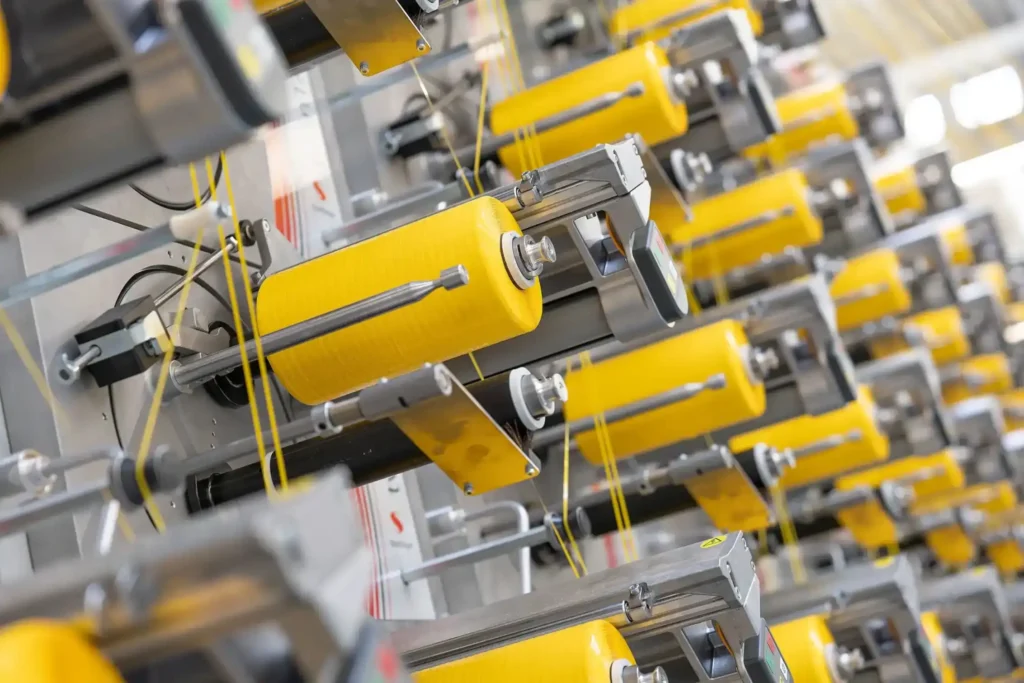
The journey of Multiwall Laminated Woven Bags begins with polyolefin resin and ends on a stabilized pallet. Each stage imposes tolerances that echo downstream—tape draw ratios affect seam efficiency; corona treatment governs ink anchorage; perforation geometry recalibrates moisture performance. A condensed map follows, with remarks that tie processing choices to line performance and logistics outcomes.
- Film Extrusion and Tape Drawing: PP is extruded, slit, and mono‑axially oriented. Draw ratios set tensile modulus and elongation. Cooling conditions influence tape clarity and thickness uniformity, which in turn affects weave stability.
- Weaving: Circular or flat looms build the fabric. Pick density and edge trim quality influence subsequent lamination flatness and seam strength.
- Surface Activation: Corona or flame treatment elevates surface energy to ensure dependable bonds and durable printing.
- Lamination/Coating: Extrusion coating bonds molten PP; adhesive lamination joins kraft or printed BOPP to the fabric. Coat weight must seal interstices without harming foldability.
- Printing: Reverse on BOPP prior to lamination, or direct flexo/gravure on paper/coated faces post‑lamination. Registration accuracy is essential for barcodes and regulatory panels.
- Conversion: Cut‑to‑length, gusseting, corner creasing, side/bottom closing. Valve patches or sleeves are positioned for filler compatibility. Easy‑open features may be integrated.
- Perforation and Venting: Micro‑perfs tailored to bulk density and aeration profile; too few prolong deaeration, too many compromise humidity defense.
- Quality Verification: WVTR, COF, drop, creep, and seam efficiency tests; print scuff evaluations; for food/feed, migration testing with relevant simulants.
- Palletization: Squared stacking aided by bag geometry; slip sheets and stretch hoods stabilize loads. UV exposure windows and stacking heights are validated to match storage reality.
Use‑Case Mapping and Selection Guide
Align the specification of Multiwall Laminated Woven Bags with the physics and economics of the product being packed. Below, common applications are framed as decision nodes rather than one‑size‑fits‑all prescriptions.
Cement & Mineral Powders
Valve format with localized micro‑perfs for rapid deaeration; matte BOPP or coated PP exteriors withstand scuff; optional liners if humidity exposure is severe.
Fertilizers & Agro Inputs
Film‑laminated woven PP resists abrasion and chemical aggression from salts; liners for urea and hygroscopic NPK; COF tuning for pallet stability in shiny films.
Feed, Seed, and Pet Nutrition
Paper‑laminated variants deliver familiar texture and permit easy‑open features; reverse‑printed BOPP elevates retail presence for premium lines.
Sugar, Salt, Rice, and Grains
Food‑compliant polyolefin stacks with traceable inks; moisture considerations drive liner decisions; clear brand panels aid inventory and retail identification.
Plastic Resins & Masterbatch
High‑strength constructions, anti‑slip finishes, and optional antistatic treatments; valve bags excel in pneumatic filling environments.
Construction Chemistries
Dry mortar and tile adhesives benefit from scuff‑resistant exteriors and tuned perforations; liners considered when long rainy seasons are expected.
Reasoned Framework: Versatility and Adaptation Across Markets
The headline promise of Multiwall Laminated Woven Bags contains two ideas that are easy to praise yet difficult to implement: being versatile and being adaptive. Versatility means one platform can serve radically different bulk products without wholesale re‑engineering. Adaptation means specifications evolve as markets, regulations, and logistics change. How do practical decisions deliver both outcomes simultaneously?
First, the structural core stays constant while peripheral layers shift. PP tape fabric anchors mechanical performance; laminates, perforation schemas, and closures become dials that are spun to match product physics and branding strategy. Printing technology migrates between reverse‑printed films (for abrasion and color fidelity) and paper skins (for traditional aesthetics and easy opening). COF tuning and UV stabilization follow the storage and transport model rather than the product chemistry alone.
Second, tradeoffs are localized instead of global. Want faster deaeration? Concentrate micro‑perfs to a zone near the valve rather than across all panels. Need outdoor storage? Increase UV package on the film or choose a film face instead of paper only where stacks are yard‑exposed. Striving for recyclability? Favor mono‑PP laminates and minimize inks, keeping decorative ambition but not at the expense of downstream sorting.
Third, the evaluation unit is the delivered metric ton—not the unit bag price. Line speed, reject rates, dust abatement costs, pallet stability, and returns adjust total applied cost more than a few cents saved on materials. A practical decision framework measures cost per ton delivered to the customer in good condition, backed with controlled line trials.
Contrasts, Rhetorical Tests, and Practical Answers
Is a paper‑laminated sack automatically more sustainable than a film‑laminated one? Not necessarily: paper/PP hybrids may face separation hurdles in certain recycling systems, whereas mono‑PP laminates can integrate into polyolefin streams where infrastructure exists. Does higher COF always improve safety? It stabilizes pallets, yet excessively sticky faces can snag on conveyors. Should every hygroscopic powder receive a liner? Only if climate, dwell time, and product sensitivity justify the added cost and complexity. The living answer is contextual, and context is engineered.
- Recyclability vs Print Premium: reverse‑printed clear BOPP maintains looks with lower ink rub‑off and fewer varnish layers.
- Fast Fill vs Moisture Defense: micro‑perfs near the valve enable rapid deaeration without sacrificing global WVTR too severely.
- Shelf Presence vs Cost: gravure cylinders raise upfront spend but decrease per‑unit ink cost at scale, while flexo plates benefit short runs.
- Yard Storage vs Tactile Feel: choose film faces with UV packages for outdoor storage, or use paper faces with protective varnish where needed.
Specification Starters and Parameter Windows
These templates illustrate how Multiwall Laminated Woven Bags are tuned for different contents and operational constraints. Values must be validated with line trials and stability testing.
Cement: 50 kg Valve Sack
Fabric 80–95 g/m²; reverse‑printed matte BOPP 20 μm; localized micro‑perfs 160–200 holes/m²; internal flap valve; outer COF ~0.35–0.40; drop to 1.2 m; stacked creep for 8 weeks; WVTR target under humid conditions.
Fertilizer: 25 kg Open‑Mouth
Fabric 75–85 g/m²; glossy BOPP 18 μm or coated PP face; optional PE liner 30–40 μm for urea; heat‑sealed top; COF ~0.28–0.32; pallet slip test around 15° incline.
Feed/Pet Nutrition: 20–25 kg Paper‑Laminated
Fabric 70–80 g/m²; sack kraft 80–90 gsm with easy‑open tape; 4–6 color flexo; sewn top with crepe tape; scuff cycles exceeding 500 on tumble testing; humidity exposure control for ink rub.
Process Diagnostics to Field Deployment
Diagnostics
Characterize particle size and shape, bulk density, hygroscopic behavior, and abrasiveness. Map route‑to‑market, yard storage windows, and filler constraints.
Design
Set fabric GSM and weave, choose laminate face, pick valve vs open mouth, and specify COF and venting. Add UV or antistatic packages as required.
Validation
Run WVTR, drop, seam efficiency, scuff, and creep tests with the actual product. For food or feed, complete migration studies and documentation.
Deployment: train operators on valve alignment and pallet building; monitor damages and dust; iterate on COF and perforation until both speed and moisture targets are satisfied.
Key Phrases and Long‑Tail Variants
To meet varied search intents while staying precise, this article intentionally uses synonymous descriptors alongside the canonical term Multiwall Laminated Woven Bags: laminated poly woven sacks; BOPP‑laminated PP valve bags; paper‑laminated woven polypropylene sacks; heavy‑duty laminated woven packaging; multi‑ply woven poly bags; extrusion‑coated woven PP sacks; block‑bottom valve sacks; cement packaging woven bags; fertilizer laminated poly sacks; feed and seed woven polypropylene bags; recyclable mono‑PP laminated bags. The language mirrors how engineers, procurement teams, and plant managers describe the platform in RFQs and line specifications.
In this article, we will explore the technical aspects of Multiwall Laminated Woven Bags, their benefits, and how they meet the specific needs of various global markets. We will also highlight the expertise of VidePak in this field, a company known for its commitment to quality, innovation, and the ability to adapt its products to the distinct demands of different regions.
The Construction and Advantages of Multiwall Laminated Woven Bags
Multiwall Laminated Woven Bags are constructed from several layers, each of which serves a specific function. The core material typically consists of woven polypropylene (PP), known for its high tensile strength and resistance to wear. The woven structure gives the bag its robustness, allowing it to carry heavy products like cement, animal feed, fertilizers, or chemicals without tearing. On top of this woven core is a laminated layer, which provides additional protection against external elements such as moisture, dust, and UV rays.
This multi-layered construction is what differentiates Multiwall Laminated Woven sacks from traditional woven bags. The lamination ensures that the contents of the bag remain protected even in harsh environmental conditions, making these bags highly suitable for industries like agriculture, chemicals, and construction, where product integrity is crucial.
Key Benefits of Multiwall Laminated Woven Bags:
- Enhanced Durability: The multi-layer construction makes Laminated Woven Bags incredibly strong and tear-resistant, capable of withstanding significant wear during transport.
- Moisture Resistance: The laminated outer layer ensures that the bag is moisture-resistant, which is especially important for industries that require the safe storage of moisture-sensitive materials such as grains or chemicals.
- UV Protection: The lamination can also provide UV protection, preventing the degradation of both the bag and its contents when exposed to sunlight for extended periods.
- Customization: Multiwall Woven Bags can be customized in terms of size, shape, and design to meet the specific requirements of the customer, making them versatile across multiple industries.
- Cost-Effective: Despite their advanced construction, Multiwall Laminated Woven sacks are relatively low-cost, offering a durable and efficient packaging solution without breaking the budget.
VidePak’s Expertise in Multiwall Laminated Woven Bags
At VidePak, we have been at the forefront of the woven bag manufacturing industry for over three decades, with a focus on quality and innovation. We produce a wide range of Multiwall Laminated Woven Bags that are designed to meet the needs of diverse global markets. With our extensive industry experience, state-of-the-art machinery, and commitment to using only the best raw materials, we ensure that our bags consistently meet the highest standards of performance.
Meeting the Specific Needs of Global Markets
One of the key aspects that set VidePak apart from its competitors is our deep understanding of the different market needs across the globe. Each market has its own set of requirements when it comes to packaging. These differences can be seen in aspects such as quality standards, design preferences, and the primary applications for which the bags are used. With a presence in major markets like North America, Europe, the Middle East, Southeast Asia, South America, and South Africa, VidePak is well-versed in adapting our Multiwall Laminated Woven sacks to cater to these unique regional demands.
- Quality:
Different markets have different expectations in terms of quality. For example, European and North American markets often demand bags that are certified to meet stringent safety and environmental standards. VidePak ensures that our Laminated Woven Bags comply with all relevant certifications, making them suitable for use in industries with high regulatory requirements, such as food packaging or pharmaceuticals. - Design:
The design of Multiwall Woven Bags can vary significantly depending on the preferences of the end-user. In markets like Southeast Asia, for instance, there may be a greater demand for vibrant, multi-colored printing on the bags to appeal to local consumers. Conversely, in regions like the Middle East, durability and UV resistance might take precedence due to the harsh environmental conditions. At VidePak, we offer full design customization to meet the aesthetic and functional needs of each market. - Main Applications:
The primary applications for Multiwall Laminated Woven sacks can differ depending on the industry and the region. In agricultural markets, these bags are often used to package grains, seeds, and fertilizers. In industrial sectors, they are used for transporting chemicals or construction materials like cement. Each application requires specific features such as resistance to moisture or the ability to withstand heavy loads. VidePak’s ability to produce customized Laminated Woven Bags means that we can deliver the right packaging solution for any application, no matter the industry or location.
Material Innovation: Pushing the Boundaries of Multiwall Laminated Woven Bags
While the core material used in Multiwall Laminated Woven Bags is usually polypropylene (PP), various other materials can be incorporated to improve the bag’s performance or meet specific market demands. VidePak utilizes advanced material innovations to ensure that our bags deliver top-tier performance in a wide variety of applications.
- Polypropylene (PP):
As the main material in most Multiwall Woven Bags, PP provides excellent strength and flexibility. It is durable, lightweight, and resistant to tearing, which is why it is a go-to material for packaging in heavy-duty industries. The woven PP core in our bags ensures they can handle heavy loads without risk of breaking. - Polyethylene (PE) Lamination:
In addition to the PP woven core, a polyethylene (PE) layer is often laminated to the bag to provide moisture resistance and improved barrier protection. This makes the bag ideal for packaging products that need to be shielded from moisture, such as grains or powdered chemicals. - Aluminum Foil Lamination:
For high-barrier applications, such as packaging sensitive food products or pharmaceuticals, aluminum foil lamination can be added to the Multiwall Laminated Woven sacks. This additional layer provides a strong barrier against oxygen, light, and moisture, ensuring that the contents remain protected. - UV-Stabilized Coatings:
In regions with high levels of sun exposure, UV-stabilized coatings can be applied to the bags to protect them from the damaging effects of ultraviolet light. This ensures that both the bag and its contents remain intact, even when exposed to sunlight for long periods.
By using these advanced materials and technologies, VidePak ensures that our Multiwall Laminated Woven Bags are capable of meeting the specific challenges posed by different industries and markets.
Certification and Compliance: Ensuring Global Standards
One of the key strengths of VidePak is our commitment to maintaining rigorous quality control and ensuring that our products comply with international standards. This commitment has helped us build a solid reputation across multiple markets. Our Laminated Woven Bags are certified to meet all relevant industry standards, including ISO, SGS, and FDA certifications, depending on the application.
Comprehensive Product Range to Meet All Market Demands
At VidePak, we understand that no two markets are the same. This is why we offer a comprehensive range of Multiwall Laminated Woven sacks and related packaging solutions. Our product range is designed to meet the needs of industries as diverse as agriculture, chemicals, construction, and food processing. No matter the application or the specific requirements of the market, we can provide the right packaging solution.
With 526 employees, 150 circular looms, 16 extrusion lines, 32 lamination machines, and 16 printing machines, VidePak has the production capacity to handle even the largest orders. This allows us to serve not only local markets but also customers across the globe, ensuring timely delivery and consistent product quality.
VidePak’s Achievements and Market Leadership
Since its inception in 2008, VidePak has made significant strides in the packaging industry. With over 30 years of industry experience within our team, we have built a reputation for quality and innovation. Our success in the field of Multiwall Laminated Woven Bags is a testament to our commitment to meeting the unique needs of every market we serve.
Key Achievements Include:
- Global Reach: With a presence in North America, Europe, the Middle East, Southeast Asia, South America, and South Africa, VidePak has established itself as a global leader in the packaging industry.
- Innovation: By continuously investing in state-of-the-art technology and materials, we remain at the forefront of the industry, offering cutting-edge solutions like UV-stabilized coatings, aluminum foil laminations, and advanced PE lamination.
- Customization: Our ability to customize every aspect of our Laminated Woven Bags, from size and shape to material and printing, ensures that we meet the specific requirements of every market.
- Sustainability: At VidePak, we are committed to reducing our environmental impact by using eco-friendly materials and minimizing waste in our production processes.
Conclusion
In the ever-evolving world of packaging, Multiwall Laminated Woven Bags represent a versatile and durable solution for a wide range of industries. With their advanced construction, superior protection, and adaptability, these bags have become a staple in markets across the globe. At VidePak, our deep
Multiwall Laminated Woven Bags