
VidePak is a leading industrial packaging company founded in 2008, specializing in heavy-duty bags including PP woven, BOPP woven, multiwall Kraft paper sacks, polyethylene FFS sacks, and FIBC jumbo bags. With over 500 skilled employees and decades of collective experience, VidePak serves more than 70 countries worldwide. The company emphasizes quality, innovation, and customer satisfaction, equipping its factories with advanced German and Austrian machinery (from Starlinger, W&H, etc.) and following global standards (ASTM, ISO, JIS, EN) to ensure reliability. VidePak’s vertically integrated production (from resin to finished bag) enables an annual capacity of ~600 million multiwall bags, making it a top manufacturer for large orders. Through ISO 9001:2015 certification and a 98%+ customer satisfaction rate, VidePak guarantees that every outgoing bag batch meets strict specifications.
Company Overview
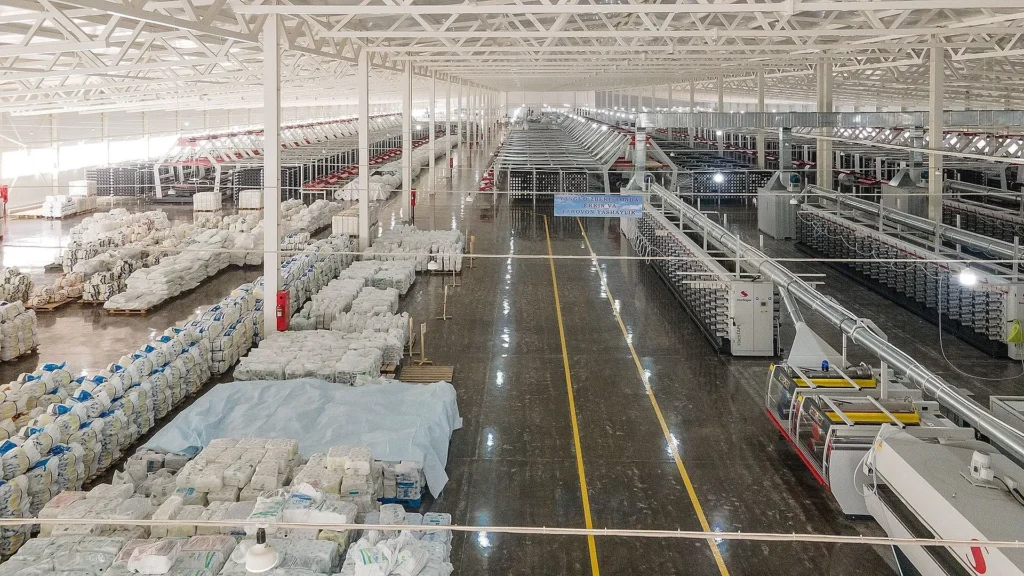
VidePak has grown into a global packaging supplier. Founded in Shanghai in 2008 (after years as a local PP woven bag distributor), the company now designs and produces a full line of industrial bags. Its products include multiwall Kraft paper sacks, sewn and valve style, as well as PP and laminated woven sacks and FFS films. VidePak’s products are used across agriculture, building materials, chemicals, and food industries in Japan, Korea, Europe, the Americas, Middle East, Africa, and beyond[1]. In just over a decade, VidePak expanded its capacity with 100+ circular looms and 16 extrusion lines (for woven PP tube and films), plus 30+ high-speed printing/lamination lines. This translates to multi-shift, 24/7 operations on dozens of production lines – a factory that never sleeps in order to fulfill large, urgent orders. Crucially, VidePak sources only top-tier raw materials: premium polypropylene and polyethylene resins from BASF, Sinopec, and Yangzi Chemical, as well as mill-certified virgin kraft paper from leading paper mills. By locking in long-term contracts with these petrochemical giants, VidePak ensures consistency and purity in each bag (e.g. every polyethylene batch meets tight melt flow and tensile specs under ASTM/ISO testing). Such strategic sourcing means each bag’s performance is predictable, batch after batch.
VidePak’s Multiwall Bag Production
Premium Raw Materials
VidePak’s multiwall sacks begin with virgin kraft paper and polymer films: 100% virgin fibers (bleached or natural) of carefully chosen basis weight (typically 60–150 g/m²) form the plies. The kraft papers come from major mills in Asia/Europe known for consistent quality. Polymer liners and coatings use high-purity PE/PP resins from Sinopec Yangzi Chemical, BASF, and other tier-1 producers. For example, HDPE from Sinopec might be extruded as a flat bottom liner, while high-tenacity PP filament yarn (from BASF/Sinopec) is woven into the bag fabric. Industrial adhesives and coatings are also sourced from these chemical leaders – Sinopec adhesives for hot-melt pinch seals, BASF polymers for water-based barrier coatings, etc. All inks, inks, pigments and additives come from reputable suppliers and are food-contact compliant where needed. The result: no cutting corners on materials. This exhaustive vetting (“four-tier supplier program”) and incoming QC means every resin lot and paper roll enters the plant with certificates and passes a 10–15 parameter inspection (melt index, density, moisture content, tear strength, etc.). Only proven, chemically certified batches are released to production.
Advanced Equipment & Capacity
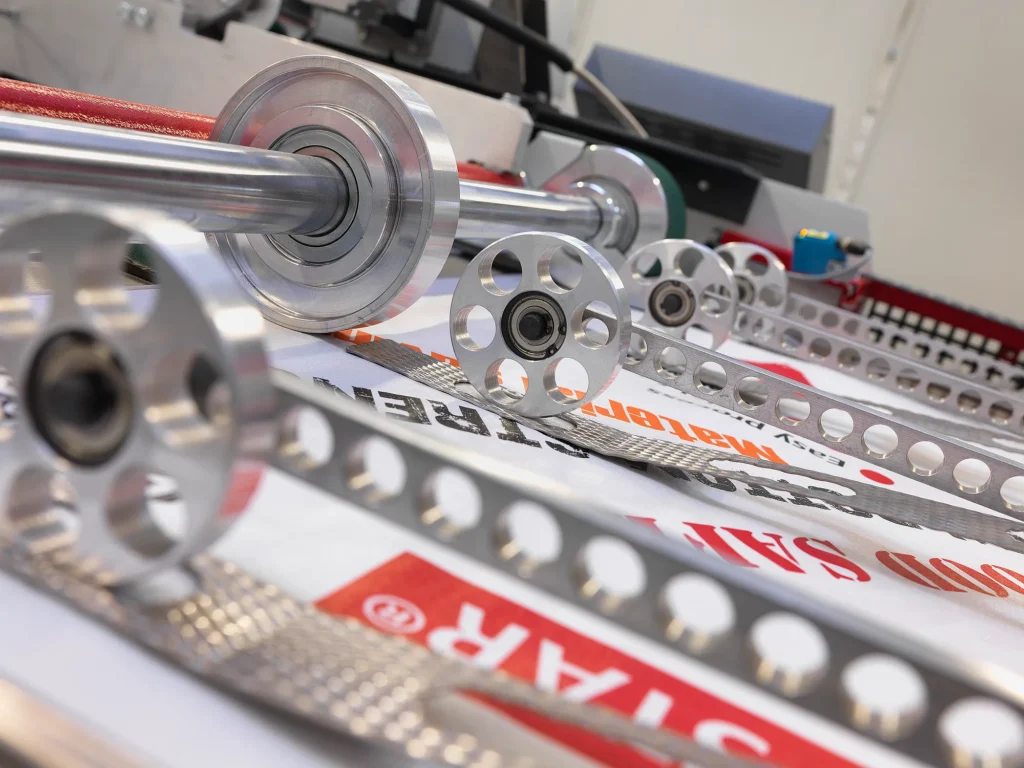
At the core of VidePak’s efficiency are its European machines. The company operates dozens of Starlinger extrusion and weaving lines: circular looms weaving heavy-denier PP fabric for woven sacks, and blown-film extruders casting PE/PP films (for lamination or liners). Parallel to these, VidePak runs high-speed W&H bag-making and printing lines: multi-color flexo presses (8+ stations) print high-res graphics, while W&H baggers fold, glue, and seal paper and PP fabrics into finished bags. Inline seamers apply pinch-seal or chain-stitch closures as needed. The assembly is fully integrated – material flows from resin hoppers and paper rolls through all steps on one site. Thanks to this integration, VidePak scales throughput easily: multiple extruders and looms run simultaneously feeding several baggers in parallel. In practice, VidePak’s plant runs 24/7 (3 shifts) with preventive maintenance between shifts to minimize downtime.
This robust setup yields immense output: VidePak can produce ~600 million multiwall (PBOM-style) bags per year. For example, multiple parallel lines dedicated to 25 kg multiwall bags run in one zone, so a custom order for hundreds of thousands of bags can be filled in days. Large warehousing for raw materials and finished stock further helps – popular SKUs are kept in inventory to cut lead times. In short: VidePak has both the bandwidth and the backup to meet large-volume, fast-turn orders with high reliability.
International Standards & Quality Control
Meeting global performance standards is non-negotiable at VidePak. All products (including multiwall sacks) are designed to comply with ASTM, ISO, JIS, and EN methods. The in-house lab and process control apply rigorous ASTM/ISO testing at every stage: paper grammage and moisture are checked to ISO 536/535 (Cobb), strength of plies via ISO 1924 and ISO 1974, and filled bag drop tests to ISO 2233 or ASTM D642. Seal and seam integrity are verified with ASTM F88 peel and F2054 burst tests on closures. Specialized barrier tests (WVTR, OTR) use ASTM F1249/F1927 to ensure moisture and oxygen protection for laminated bags. During production, in-process QC monitors critical dimensions: web width lasers (±0.05 mm), glue coverage sensors (≥95% coverage target), and register cameras flag any print defects. At line end, final inspection occurs: sample bags are pulled each shift for destructive tests, edges and seals are visually examined, liner layers are leak-tested, and heat-seal bonds are verified. Only after passing all these checks does a batch get approved for shipment.
VidePak’s commitment to quality is certified: the management system is ISO 9001:2015 (many food-contact lines add ISO 22000/BRC). Documentation travels with every order – lot numbers, COAs, and QC reports – so customers have full traceability. The outcome is consistency: a pallet of VidePak multiwall bags will hold the claimed weight, survive distribution handling, and meet the project’s barrier and safety requirements without surprises.
Our Multiwall Paper Bag Products
VidePak offers a versatile multiwall Kraft paper sack product line built around best practices. These bags are multi-ply paper containers (typically 2–5 plies) optionally lined or coated, designed for heavy-duty packaging. They are used worldwide for products that need strong, moisture-resistant shipping containers. Below we detail their manufacture, specifications, tests, and uses.
Production Process
The making of a VidePak multiwall bag follows a multi-step process (Figure 1):
- Paper selection & preparation: Designers specify the number of plies and paper grade (e.g. a 3‑ply bag might have a 70 g/m² outer bleached Kraft ply, plus two 50 g/m² inner unbleached plies). The chosen kraft rolls (white or natural) are unwound for laminating or forming.
- Barrier/liner integration (if used): For extra protection, a plastic film (like an HDPE or LDPE layer) can be extruded and laminated onto one of the inner plies. Often VidePak co-extrudes a thin PE film between paper plies or coats paper with a moisture barrier. These lamination steps use the same Starlinger extruders that make their woven products, ensuring tight control of film weight (e.g. 12–25 g/m²).
- Printing and slitting: If printing is required, the paper web (with or without film) passes through W&H flexographic presses. Up to 8 colors can be printed, with high registration accuracy. After printing, the wide paper roll is slit into gusseted webs or tubes of the desired width.
- Bag forming (machine folding/gluing): The slit paper web goes to a W&H bag-making line. For a typical Pasted Valve bag, the process is: fold bottom plies into a block shape, apply pre-glued tapes (for pinch seal bottoms) and apply the valve insert, then cut and fold top layers in preparation for filling. W&H machines fold and glue each bottom seam (block or pinch style) according to the bag style. Glue patterns are optimized so that glue spreads evenly under compression.
- Closure application: Depending on the bag type, the machine either applies hot-melt along the top fold (for pre-sealed styles like PBOM or valve bags) or leaves the top open for filling and later sewn closure. (VidePak also has sewing stations on-line for optional chain-stitch closing.)
- Quality inspection & packing: Finished bags are transported by conveyor to inspection stations. Cameras check print quality, and weight gauging ensures consistency. Bags are cut to length and either palletized or bagged, then moved to warehouse. Samples from each production run undergo strength and leak tests before final acceptance.
This integrated process – from selecting certified paper and resin, through lamination, printing, forming, and inspection – ensures VidePak’s multiwall bags are repeatable and high-performance. Each ply’s role is engineered (outer ply resists abrasion and prints clearly, middle plies add tear resistance, inner ply negotiates powders/dust), and adhesives are tuned to activate reliably under the heat-seal of the line. In summary, VidePak turns raw materials from BASF/Sinopec/Yangzi into finished sacks in a controlled, scalable assembly line.
Specifications
The key dimensions and features of our multiwall bags can be customized within broad ranges. Typical pasted-valve multiwall bags from VidePak have the following parameters (see Table 1):
| Parameter | Range/Detail |
| Bag Width | 180 – 740 mm |
| Bag Length | 250 – 1310 mm |
| Bottom Gusset/Height | 70 – 250 mm |
| Number of Plies | 1 – 6 (standard 2–5 ply for heavy duty) |
| Printing Colors | Up to 8-color flexo printing |
| Load Capacity | 10 – 110 lbs (approx. 5–50 kg) |
| Base Paper Types | Bleached (white) or unbleached (kraft) |
| Closure Type | Pasted valve, self-sealing, tape, etc. |
| Coatings/Liners | Optional HDPE/LDPE film liners or coating for moisture barrier |
Table 1: Typical specifications for VidePak multiwall paper bags (pasted valve style). Ranges depend on design requirements.
VidePak supports both white (bleached) and natural brown (unbleached) kraft options for outer plies. Bleached Kraft provides a clean, printable surface, whereas unbleached Kraft is cost-effective and suited for industrial uses. For food or chemical contact, we also offer FDA/EU-compliant PE film liners or internal barrier coatings. The number of plies is chosen to match the bag’s duty: more plies and heavier paper for ultra-heavy loads or abrasive minerals, fewer for lighter loads or retail goods.
Table: Dimensional & Material Ranges
| Dimension / Feature | Min. | Max. |
| Width (flat) | 180 mm | 740 mm |
| Length | 250 mm | 1310 mm |
| Bottom Gusset/Height | 70 mm | 250 mm |
| Paper Grammage (ply) | 50 g/m² | 170 g/m² |
| Number of Plies | 1 | 6 |
| Color | Kraft | White |
| Printing Colors | 0 | 8 |
| Load Capacity | 5 kg | 50 kg |
Table 2: Example dimensional ranges for multiwall bags. Exact dimensions tailored per order.
Testing & Quality Assurance
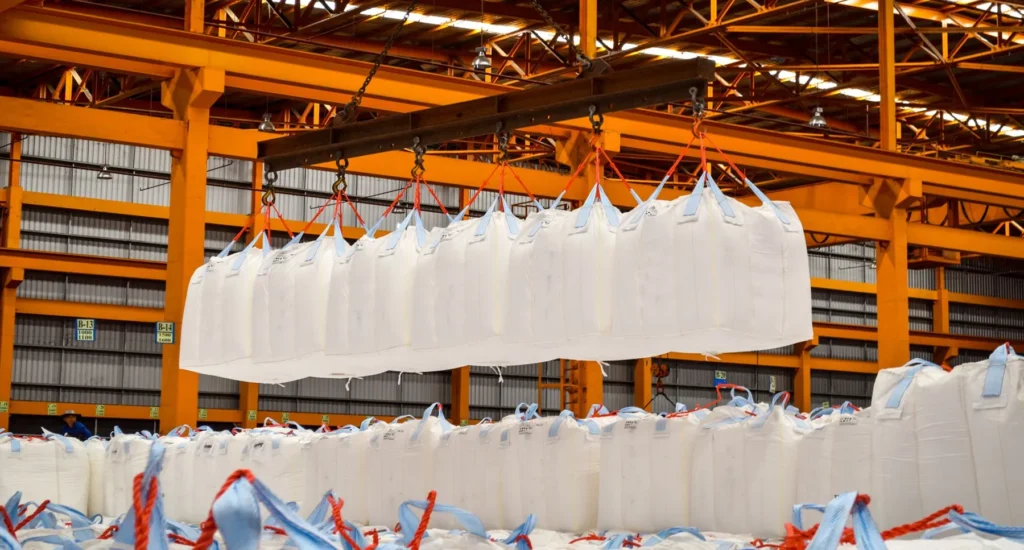
Every VidePak multiwall bag undergoes stringent quality control throughout and after production. Incoming raw materials already meet ASTM/ISO specs (e.g. kraft paper tensile and tear to ISO 1924/1974, resin melt index to ASTM D1238). During manufacturing, electronic controls monitor critical tolerances (e.g. web width ±2 mm, gusset folds ±0.5 mm, glue presence ≥95%).
After completion, we subject bags to standard performance tests, some of which are shown in Table 3. These tests verify that the bag will hold its rated load and protect contents under real-world conditions.
| Test / Parameter | Standard | Purpose / Criteria |
| Bag Tensile Strength | ISO 1924-2 | Ensures plies hold weight (target > 2× safety factor) |
| Tear Resistance | ISO 1974 | Measures resistance to propagation tearing |
| Drop Test (filled bag) | ISO 2233 / ASTM D642 | Verifies bag survives drops/falls (face/edge) |
| Seam/Seal Strength | ASTM F88 (peel) / F2054 (burst) | Ensures sewn or glued seams won’t open (min. 2.5–4.0 N/mm) |
| Moisture Barrier (WVTR) | ASTM F1249 | For laminated bags, checks moisture ingress (< 10 g/m²·day) |
| Air Permeability | TAPPI T557 or ISO 5636 | (for vented bags) ensures proper air flow |
Table 3: Example tests and standards used to validate VidePak multiwall bags.
In practice, VidePak’s QC lab runs these tests on samples from each batch. For instance, drop tests are performed at face, edge, and corner to simulate handling shocks. If a bag is valve-style, the internal peel strength of the valve is tested. Liner integrity is checked by pressurizing a bag half-submerged in water (looking for bubbles). We also measure wall thickness and paper grammage to confirm consistency. Batches only ship once all criteria are met or exceeded. This end-to-end testing regime, based on international methods, is why customers trust that “VidePak bags do what they promise” – be it holding 50 kg of grain on a forklift or surviving ocean transit of powdered chemicals.
Applications & Uses
VidePak multiwall paper bags serve diverse industries. They are especially common in agriculture, building materials, and chemicals. Typical uses include:
- Fertilizers & Seeds: Strong Kraft bags hold sacks of dry fertilizer or seed blends, protecting from dust and moisture during transport.
- Animal Feed & Pet Food: Multiwall bags (with or without liners) package animal nutrition products; the paper resists tears and keeps feed fresh.
- Cement, Sand & Minerals: Cement and similar bulk powders use Valve or Pinch-Bottom bags. The sturdy multi-ply construction resists the abrasiveness of cement and mortar, and customized valves allow high-speed filling.
- Grains & Flour: In food processing, multiwall sacks safely ship grains, flour, sugar or spices. FDA-grade liner films can be added for direct food contact.
- Chemicals & Minerals: Dry chemicals, additives, pigments, and minerals often require dustproof bags. A Valve bag with an HDPE liner keeps reactive or hygroscopic powders contained.
- Coffee, Dairy, & Food Ingredients: Specialized multiwall bags are used in the coffee and dairy industries, where sanitary, moisture-proof packaging is needed. (For example, valve bags with easy-open strips are popular for bagged flour, starch, or powdered milk.)
- Industrial Materials & Retail: Even non-food goods like plastic pellets, sand, charcoal, or sports turf seed use multiwall sacks for bulk packaging.
Whether for heavy-duty construction materials or consumer retail products, VidePak’s multiwall bags deliver strength, moisture protection, and stackability. Their combination of functionality and timely delivery makes them a dependable choice across sectors. In fact, industry experience shows that customers keep coming back to multiwall bags because “you don’t just get a bag, you get a packaging system that survives forklifts, humidity swings, and keeps pallets square”.
Bag Styles and Closure Types
VidePak manufactures multiple multiwall bag styles, each optimized for different filling methods and end uses. Key types include:
| Bag Type | Description / Use Case |
| Sewn Open Mouth (SOM): Closed end is stitched; top remains open for filling, then sewn. This classic style is a mainstay for granular or large-particle products. | |
| Pinch-Bottom Open Mouth: Both bottom and top have folded, glued “pinch” seals. The double-sealed ends make these bags ideal for keeping contents dry or moist as required. | |
| Block-Bottom (Pasted Open Mouth): The bottom is a glued block (no pinch fold), giving a flat base. This style (also called block-bottom) serves as a robust master container for many materials. | |
| Pasted Valve Bag: Has an integrated paper valve for automatic filling. Widely used in cement, seeds, food, and other powders. Offers the fastest filling rate and optional features (easy-open tape, sonic-seal sleeve, under-valve perforations, anti-slip). | |
| Self-Opening Sack: A pre-creased bag that automatically “pops” open on the filler (like a grocery sack). Despite a simple design, multiwall SOS bags have the strength to stand empty and fill easily, suitable for products like salt, charcoal, or animal feed. |
Table 4: VidePak multiwall bag styles and their typical applications.
All these styles can be produced with different closure options: chain-stitch sewing (for SOM), heat-sealed top folds, or simple tape closures. Closure choice balances cost vs. barrier: for example, a sewn bag has needle holes (okay for coarse goods), while a heat-sealed pinch-top is essentially airtight (needed for fine chemicals). VidePak can equip bags with hot-melt adhesives (pinch sealing) or prepare them for machine sewing after filling.
The five categories above cover the vast majority of multiwall needs. (Other specialized forms exist, but the above list – SOM, PBOM, block-bottom, valve, self-opening – constitutes most orders.) Each type can be customized further (e.g. with vents, tapered shapes, or handle options) depending on customer requirements.
Material Colors and Finishes
By default, our multiwall bags use natural (brown) Kraft paper, which has a rustic look and high tensile strength due to long fibers. White (bleached) Kraft is also available for a clean appearance or print contrast. Both options can be textured or embossed on the surface to enhance strength and visual appeal. In addition to paper coloration, we offer laminated finishes (BOPP or foil) for moisture/UV barrier if requested. In essence, customers choose between the classic brown look or a high-end white finish, and VidePak tailors the paper chemistry accordingly.
Product Tables and Customization
Below is a sample comparison table summarizing typical features of different multiwall bag variants:
| Feature | Sewn Open Mouth | Pinch-Bottom (PBOM) | Block-Bottom | Valve Bag | Self-Opening |
| Closure | Thread sewing | Glue pinch at bottom/top | Glue block bottom, open top | Paper valve (hot-melt bottom) | Pre-creased, open top |
| Typical Use | Grains, seeds, coarse powders | Export, moisture-sensitive goods | Master bag, heavy loads | Cement, seeds, animal feed, food | Retail, ice cream salt, feed |
| Barrier Integrity | Low (need sift-proof tape if dustproof needed) | High (airtight when heat-sealed) | Moderate | High (airtight, fast-fill) | Moderate |
| Speed of Filling | Medium (requires sewing) | Medium (fast if heat-sealed) | Medium | Fast (pneumatic filling) | Fast (bag pops open) |
| Form Factor | Squarish after sewing | Rectangular (pinched base) | Flat, boxy bottom | Tapered top with cylinder valve | Tapered bottom, flat base |
This table gives an idea of how design choices affect performance. VidePak can produce each variant across the full spec ranges in Tables 1–3. Customization is always possible: extra plies for heavy abrasives, special inks for branding, anti-slip surface coating, reinforcement tapes, etc. Whatever the application – be it building materials, chemicals, or food – VidePak advises on the right bag architecture to maximize shelf life and handling reliability.
Conclusion
In summary, VidePak stands out as a one-stop manufacturer for multiwall Kraft paper bags. We source materials from BASF, Sinopec and Yangzi Chemical, use advanced W&H/Starlinger production lines, and adhere to ASTM/ISO/JIS standards. Our facility’s full equipment complement (100+ looms, extrusion lines, baggers) and rigorous quality control ensure that every bag meets its specs before shipping. With a yearly output around 600 million pieces, VidePak can serve both large-scale industrial needs and custom orders.
Whether it’s an open-mouth sack for animal feed or a valve bag for cement, VidePak’s multiwall offerings cover the spectrum: sewn and unsewn, natural or white, coated or plain – all made with consistency and performance in mind. At every turn, we combine the latest engineering with time-tested craftsmanship. The result is multiwall paper packaging you can count on.