
What Is Jumbo Bag Packaging?
Scale matters. Jumbo Bag Packaging—also known as FIBC bulk bags or super sacks—handles one-to-two-tonne payloads without pallets or inner drums. Each bag is a four-loop polypropylene cube that folds flat for shipment, then blossoms into a self-standing container ready for cranes, forklifts, or hoists. VidePak engineers infuse the traditional FIBC with advanced techniques—anti-bulge baffles, Type-C grounding yarns, and data-scannable labels—turning a simple sack into a smart logistics module.
Key Features of Jumbo Bag Packaging
- Monumental Capacity – Safe Working Load (SWL) ranges from 1 000 kg to 2 000 kg at a 5:1 or 6:1 safety factor (ISO 21898).
- Form Stability – Cross-baffle or Q-bag designs curb bulge to < 5 %, improving container fill by up to 20 %.
- Static Safety – Type-C fabrics with carbon filaments maintain loop-to-loop resistance < 10⁷ Ω, shielding explosive powders from ignition.
- Weather Armor – UV stabilisers rated ≥ 350 kLy (ASTM G154) and optional PE liners repel sun and moisture on open yards.
- Smart Tracking – QR and NFC tags embed batch IDs and load weights, feeding ERP dashboards for real-time inventory.
| Parameter | Typical Value | Test / Standard |
|---|---|---|
| Safe Load (SWL) | 1 000 – 2 000 kg | ISO 21898 |
| Safety Factor | 5:1 / 6:1 | SGS tensile 2024 |
| Fabric Weight | 170 – 220 gsm | VidePak lab TDS |
| Dimensional Bulge | < 5 % @ SWL | Drop test 0.8 m |
| UV Resistance | ≥ 350 kLy | ASTM G154 cycle B |
| Conductivity (Type-C) | < 10⁷ Ω | IEC 61340-4-4 |
How Jumbo Bag Packaging Is Produced
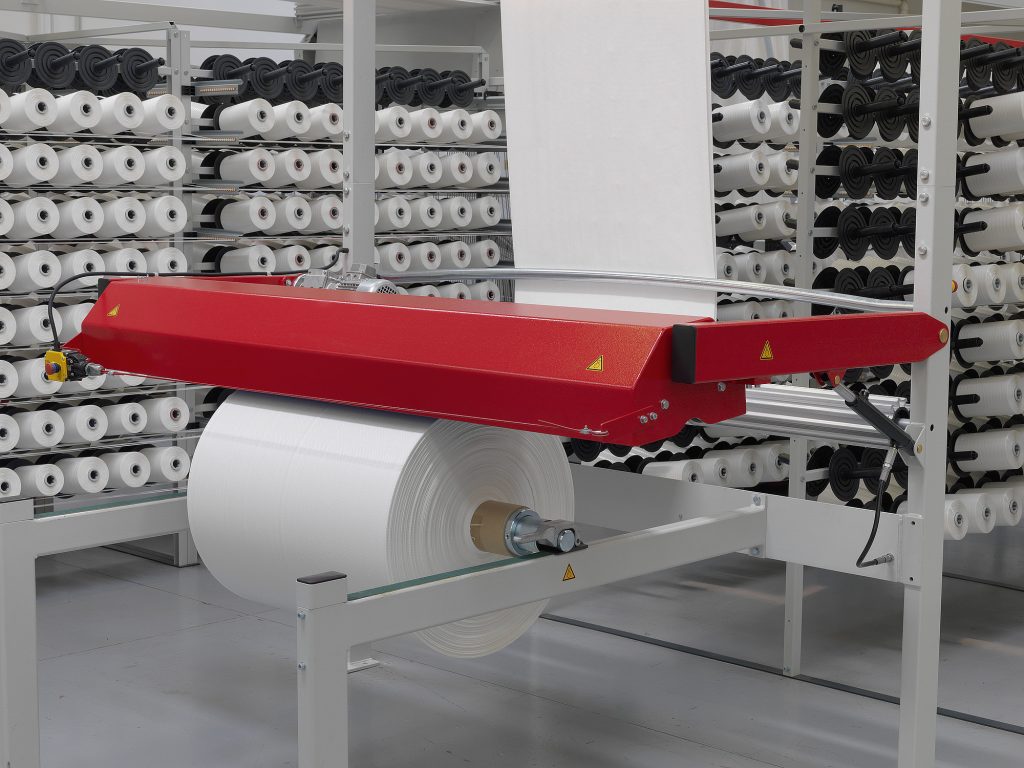
VidePak starts with virgin PP pellets on Austrian Starlinger FX 6.0 extruders; tapes draw at 1 : 6.8 for maximal tensile alignment. Over 100 high-speed looms weave 190 gsm panels; optical sensors reject tapes beyond ±12 µm width variance. German W&H coaters add 25 µm PP lamination for dust control. CNC cutters slice panels ±2 mm; computerised sewing rigs insert cross-baffles in a 220 mm lattice, ensuring cubic stability. For static-sensitive cargos, carbon-infused yarns weave directly into the base cloth. Every Jumbo Bag Packaging unit endures:
- Top-lift test at 6 × SWL
- Drop test from 0.8 m with SWL weight
- Tilt test at 27°
Test data uploads to VidePak’s QMS, informing predictive maintenance on the production line.
Where Jumbo Bag Packaging Excels
Fertiliser terminals appreciate five-high racking without pallet bow; cocoa exporters load 20 % more tonnes per TEU thanks to shape-stable Q-bags; pigment plants praise the 12 % faster discharge via cone-bottom spouts. In harsh MENA deserts, UV-proof Jumbo Bag Packaging stores salt for nine months without fabric chalking, while EU chemical distributors meet ADR transport rules using Type-C grounded variants. When payload is measured in tonnes and every logistics dollar counts, VidePak’s Jumbo Bag Packaging delivers efficiency innovations at industrial scale.
—
Founded in 2008, VidePak wields 16 extrusion lines, 100+ looms, and 30 lamination & print stations from W&H and Starlinger. With a 568-strong team and USD 80 million annual revenue, we customise Jumbo Bag Packaging for clients across the Americas, Europe, Asia, and Africa—elevating bulk logistics through advanced techniques and cost-wise design.
- What Is Jumbo Bag Packaging?
- Key Features of Jumbo Bag Packaging
- How Jumbo Bag Packaging Is Produced
- Where Jumbo Bag Packaging Excels
- 1. Extrusion: The Foundation of Strong and Durable Bags
- 2. Weaving: The Key to Strength and Durability
- 3. Coating and Lamination: Protecting Against Moisture
- 4. Printing: Adding Branding and Product Information
- 5. Bag Making and Sealing: Ensuring Security and Leak-Proof Packaging
- 6. Automation: Streamlining Production and Reducing Costs
- Product Parameter Comparison Table
- FAQs
- Conclusion
In today’s fast-paced industrial world, efficiency in packaging is crucial for both quality and cost control. Jumbo bags, or FIBCs (Flexible Intermediate Bulk Containers), are widely used for transporting bulk products like cement, chemicals, grains, and food ingredients. These bags must meet specific requirements, such as strength, durability, and moisture resistance. To achieve these goals, manufacturers must leverage advanced techniques in extrusion, weaving, coating, printing, and bag-making. In this article, we’ll explore how innovative technologies, particularly from leading suppliers like Starlinger and W&H, optimize each step of jumbo bag production.
1. Extrusion: The Foundation of Strong and Durable Bags
The production of jumbo bags begins with extrusion, where raw polypropylene (PP) pellets are melted and formed into filaments. These filaments are the foundation of the woven fabric, and their quality directly impacts the bag’s overall strength and durability.
- Why It Matters: High-quality extrusion ensures that the filaments are uniform in thickness, which makes the final product stronger and more reliable. Advanced extrusion systems like Starlinger’s high-performance extruders are known for creating uniform filaments that can handle heavy loads. This consistency is crucial in industries like construction, where bags are required to hold up to 2000 kg of material.
- Example: In the construction industry, jumbo bags used to transport cement must be able to withstand extreme pressure without tearing. The advanced extrusion technology from Starlinger ensures that these bags maintain their integrity even under heavy loads.
2. Weaving: The Key to Strength and Durability
After extrusion, the filaments are woven into fabric, forming the structure of the bag. The quality of the weave is critical for ensuring the bag’s strength and load-bearing capacity.
- Why It Matters: The tightness and pattern of the weave directly affect how well the fabric can handle weight and resist abrasions. W&H’s weaving machines are engineered for precision, producing fabric that can bear heavy loads while being resistant to wear and tear.
- Example: For products like grains, which need to be transported in bulk, the fabric must be both strong and breathable. W&H’s machines create a weave that not only supports up to 1500 kg of weight but also allows air circulation to prevent spoilage during transport.
3. Coating and Lamination: Protecting Against Moisture
Many bulk products, especially chemicals, fertilizers, and cement, require moisture resistance to prevent product degradation. To address this need, the woven fabric is often coated or laminated with an additional layer, usually polyethylene (PE), to enhance its durability.
- Why It Matters: Coating or lamination adds a protective barrier that prevents moisture from seeping into the bag, ensuring that products remain dry and intact. Starlinger’s advanced lamination technology, which applies a PE film over the fabric, not only ensures moisture resistance but also provides protection from UV damage, which can weaken the fabric over time.
- Example: In the case of cement packaging, the laminated bags are crucial for keeping the contents dry during transport, preventing clumping or hardening, which can ruin the product.
4. Printing: Adding Branding and Product Information
Jumbo bags are not only functional; they also serve as a valuable marketing tool. Printing logos, handling instructions, and product information on the bags can significantly enhance brand visibility and improve customer experience.
- Why It Matters: High-quality printing ensures that logos and product details are clearly visible and long-lasting. W&H’s flexographic printing technology enables precise, high-quality prints that can withstand the harsh conditions the bags are exposed to during transportation.
- Example: A company transporting grains can use vibrant printing on the bags to showcase their brand while also displaying essential product details, such as storage instructions and expiry dates. This makes the product more recognizable and adds to its professional image.
5. Bag Making and Sealing: Ensuring Security and Leak-Proof Packaging
Once the fabric is ready, the next step is bag-making and sealing. A secure seal is essential to prevent leaks and maintain the structural integrity of the bag during transport.
- Why It Matters: Proper sealing ensures that the bag can hold the product without leaking or breaking. Starlinger’s bag-making machines offer precision stitching and automatic folding, while ultrasonic sealing provides a strong, leak-proof closure.
- Example: For hazardous chemicals, leak-proof sealing is non-negotiable. Using Starlinger’s advanced sealing methods ensures that the bags are secure and that there is no risk of leakage during transportation, which could lead to contamination or safety hazards.
6. Automation: Streamlining Production and Reducing Costs
Automation is key to improving production efficiency. By integrating automated systems into the production line, manufacturers can reduce human error, increase production speed, and minimize waste.
- Why It Matters: Automated systems help ensure that every step of the production process is optimized. W&H’s automation systems monitor each phase of the process, adjusting parameters like speed and temperature to maximize efficiency and reduce defects.
- Example: In a high-demand environment, such as the food packaging industry, automation ensures that each bag is produced to the correct specifications without delays. By integrating quality checks throughout the process, manufacturers can catch potential issues before they become problems, leading to higher overall production efficiency.
Product Parameter Comparison Table
| Parameter | Construction Materials | Food Packaging | Agricultural Products | Chemicals |
|---|---|---|---|---|
| Material | Woven PP + PE Liner | Woven PP + PE | Woven PP + PE Liner | Woven PP |
| Tensile Strength (kg) | 1500 – 2000 | 1000 – 1200 | 1200 – 1500 | 1000 – 1500 |
| Moisture Resistance | High | Medium | High | High |
| Coating | PE Coating | PE Coating | PE Coating | PE Coating |
| UV Resistance | High | Medium | Medium | High |
| Sealing Technology | Ultrasonic Sealing | Heat Sealing | Ultrasonic Sealing | Heat Sealing |
FAQs
Q1: Why is extrusion so important in jumbo bag production? Extrusion forms the filaments that make up the fabric. The quality of extrusion affects the bag’s strength and durability. High-quality extrusion ensures uniform filaments that can handle heavy loads.
Q2: How does lamination improve the bag’s performance? Lamination provides a protective barrier that enhances moisture resistance and UV protection, ensuring that the bag’s contents remain dry and safe during transport.
Q3: What benefits does automation bring to the production process? Automation reduces human error, increases production speed, and ensures consistent quality. It also helps optimize every step of the production process, resulting in cost savings and fewer defects.
Q4: Can jumbo bags be customized with logos? Yes, modern printing technologies allow for clear, high-quality prints on jumbo bags. This not only enhances brand visibility but also provides essential product information.
Conclusion
Optimizing the efficiency of jumbo bag packaging involves adopting advanced technologies across the entire production process, from extrusion and weaving to coating, printing, and sealing. By incorporating equipment from leading suppliers like Starlinger and W&H, manufacturers can ensure that their bags are strong, durable, and fit for purpose. Whether for construction, agriculture, or chemicals, the right technology can significantly enhance both performance and cost-effectiveness.
For more details on industrial woven packaging bags, check out Industrial Woven Packaging Bags: Aligning with Policies and ESG Standards. Additionally, explore advanced production processes for laminated woven bags at Laminated Woven Bags: Advanced Production Processes and Videpak’s Expertise.