
VidePak’s PBOM bags (Pinch Bottom Open Mouth Bags) – also known as PBCT bags (Pinch Bottom Cut Top Bags)– are heavy-duty industrial sacks engineered for secure, stable packaging of powders, granules, and granular goods. These multiwall kraft paper or woven polypropylene bags feature a distinctive tapered, pinch-folded base and a top opening designed for heat-sealing. When filled, the open top is folded over and closed (usually with a pre-applied adhesive and heat sealer) to create an airtight, sift-proof seal. This pinch-bottom design yields a nearly flat, brick-like base for stable stacking on pallets and a neat profile on retail shelves. VidePak’s PBOM bags combine this proven structural design with top-quality materials, advanced machinery, and rigorous testing to meet the demands of global bulk packaging.
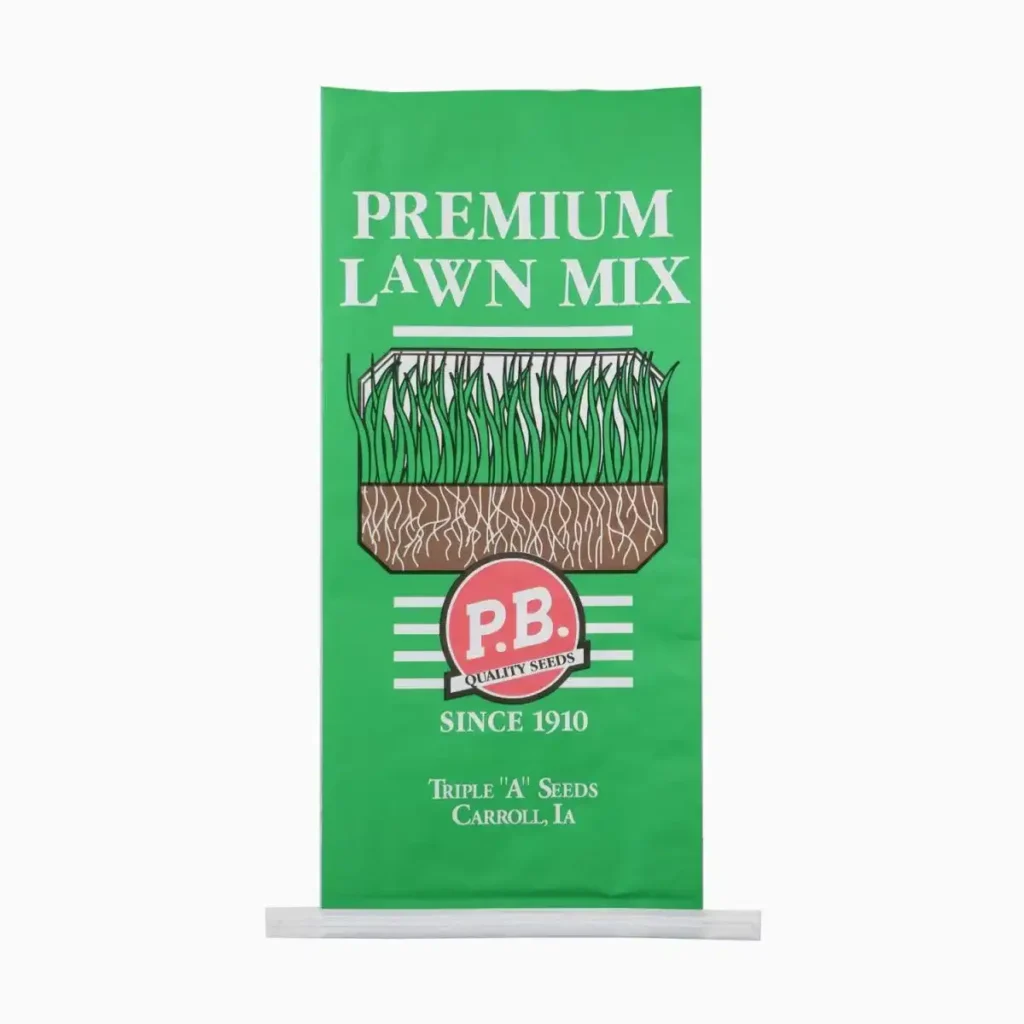
Figure: Example of a multiwall PBOM (Pinch Bottom Open Mouth) bag used for agricultural packaging. The bag’s base is factory-folded and pasted into a stable block, and the open top is folded and heat-sealed to form an airtight, sift-proof closure.
- What Is a Pinch Bottom Open Mouth (PBOM) Bag?
- VidePak Multiwall Kraft Paper PBOM Bags
- VidePak PP Woven PBOM Bags
- VidePak’s PBOM vs. Other Bag Types
- Top-Tier Raw Materials
- Advanced Production Equipment (Starlinger & W&H)
- Production Standards and Quality Assurance
- Full-Scale Production Capability
- Finished Product Inspection and Guarantee
- Applications and Benefits of PBOM Bags
- Typical PBOM Bag Specifications
- Quality Control and Inspection
- Comparative Analysis: PBOM vs. Other Bottom Types
- Conclusion
What Is a Pinch Bottom Open Mouth (PBOM) Bag?
A PBOM bag is a type of multi-ply bag whose bottom is factory-sealed (pasted or heat-bonded) and whose top remains open for filling. After filling, the operator closes the top by pinching it together and activating a heat-sensitive adhesive or sealing tape to lock the closure. Because the base has been pre-pasted during manufacturing, the bag stands up with a flat bottom panel and well-creased gussets. The tapered sides (resulting from the pinch fold) give it a trapezoidal silhouette, which improves stability on a pallet and presentation on a shelf. In practice, PBOM bags provide an ideal balance of speed, protection, and stackability: they fill quickly through wide-opening spouts or hoppers (often at rates up to thousands of bags per hour on automated lines) and then achieve a near-hermetic seal to protect the contents. Key features of PBOM bags include:
- Factory-pasted bottom: Each bag’s base is sealed and reinforced in production, ensuring a strong, flat footing and minimizing bottom failures.
- Pinch-fold closure: A pre-applied hot-melt adhesive or heat-seal tape on the top flap allows the bag to be sealed quickly after filling, yielding a dust-tight and tamper-evident finish.
- Multiwall structure: Typically 3–5 plies of heavy kraft paper (70–100 g/m² per ply) provide tensile strength and tear resistance for heavy loads (commonly 25 kg, 50 lb, or more). High-performance papers and wet-strength resins can be used for demanding applications.
- Optional liners and coatings: Film or foil liners (PE, HDPE, EVOH, etc.) can be bonded inside for moisture, oxygen or aroma barriers. External coatings (water-based dispersion or PE extrusion) reduce porosity and improve splash resistance.
- Custom printing: Large flat surfaces on the front and back allow high-resolution flexographic printing (4–8 colors) for branding, product information or regulatory labeling. Food-grade inks and coatings ensure safety for edible goods.
VidePak’s PBOM bags are versatile by design. They are engineered to handle a wide array of products – from fine powders to coarse grains – while maintaining a clean, professional appearance. The combination of a square bottom panel and a tightly sealed top makes these bags well-suited to applications where pallet stability, contents protection, and retailer appeal are important.
VidePak Multiwall Kraft Paper PBOM Bags
VidePak’s multiwall kraft paper PBOM bags use multiple layers of virgin kraft paper laminated into one strong container. These bags often consist of 2 to 5 plies of heavy unbleached or bleached kraft paper (each ply usually 70–100 g/m²) bonded with water-based adhesives. The outer ply can be made of bright white or natural brown kraft paper, chosen for strength and printability. An inner ply may be a moisture-resistant or greaseproof grade if needed. Between paper plies VidePak can insert a polyethylene film liner (20–80 µm thick) or a coextruded film with EVOH core (for oxygen barrier) to protect moisture- or aroma-sensitive products.
Each multiwall bag is converted by folding and gluing the bottom into a flat, sealed base before printing. This pasted base holds a square shape when filled. VidePak applies pre-applied hot-melt adhesive tape or coating on the topmost inner ply. After filling, a pinch sealer (hot-air or ultrasonic) activates this adhesive to weld the folded top flaps into a sift-proof closure. Because the top seals are flat and tight, any escaping air and fines are minimized – a critical advantage for dust-producing materials like cement or flour.
Multiwall PBOM bags from VidePak are especially popular for food ingredients and consumer products because paper has a clean, recyclable image. They can handle products such as:
- Bakery and grain products: Flour, semolina, rice, starch, sugar, cake mixes.
- Food ingredients: Spices, powdered dairy products (milk powder, whey), seasoning blends, coffee, cocoa.
- Pet food and seed: Dry dog/cat food, birdseed, pet treats – anywhere aroma and shelf appearance matter.
- Chemicals and minerals: Agricultural products, fine chemicals, pigments, fertilizers (urea, NPK), salt – often with an inner liner for extra protection.
- Building materials: Dry mortar, gypsum, plaster, lime – where paper’s tear resistance and coating options prevent moisture ingress.
By choosing premium kraft grades and combining them with optional polymer liners/coatings, VidePak’s multiwall PBOM bags achieve a balance of strength, barrier, and aesthetics. The bags can support heavy weights (25–50 kg and beyond) while still being printable and relatively lightweight. The kraft surface takes flexo inks well, so brands can display colorful logos and product info on both front and back panels. VidePak’s in-house printing can apply up to 8 colors, enabling rich graphics for retail display or commodity packaging alike.
VidePak PP Woven PBOM Bags
In addition to paper, VidePak offers PBOM bags made from woven polypropylene (PP). These bags are constructed from sturdy PP fabric – typically woven on circular looms – which may be laminated or coated for extra barrier. PP woven PBOM bags are often called “poly-valve” when combined with a fill spout, but in PBOM style the emphasis is on the sealed top closure rather than a sewn valve.
PP woven PBOM bags start as a tubular PP web (often reinforced with a laminated film layer). Multiple tubes can be slit for gusseted bag bodies. The pinch-bottom base is formed by folding the fabric into a square base and welding or stitching it closed – creating a block-like bottom similar to a FIBC (jumbo bag) style, but on a smaller scale. The top of the woven bag remains open for filling. VidePak’s lines then apply a heat-sealable tape or hot-melt onto the inner top flap. After filling, the top is folded and a pinch sealer fuses the tape, yielding a robust seal akin to the paper version.
Key properties of PP woven PBOM bags include: higher tear and puncture resistance compared to paper bags, excellent tensile strength (PP fiber can withstand high loads), and inherent moisture resistance. Because PP is a plastic, these bags do not rot or degrade when damp; they also resist chemical attack better than paper. VidePak’s PP woven bags often use 100% virgin PP (no recycled content) for consistent quality. The woven fabric can be laminated with an outer film (BOPP or PE) for printing or with an inner film (LLDPE/LDPE) for barrier, much like FIBC liners.
These woven PBOM bags are chosen for the toughest jobs. Common applications include:
- Agricultural chemicals and fertilizers: Granular fertilizers, coated seeds, herbicides. PP woven walls keep out rain and soil.
- Animal feed and grains: Livestock feed pellets, corn, soybean meal, animal feed premixes – heavy loads where extra strength is needed.
- Construction & minerals: Cement, sandblasting media, mineral powders – especially where bag puncture could be a concern.
- Coal, charcoal, salt, and aggregates: Abrasive or gritty products that might tear paper bags.
Despite their plastic nature, VidePak’s PP woven PBOM bags are designed for compliance too. The inner surfaces that contact product can be food-grade polymer if required, and inks/coatings are chosen to meet regulatory standards. The printability of the woven bags (often with a laminated film on one side) allows vibrant graphics similar to paper bags. Overall, the PP woven PBOM option provides a heavy-duty alternative for customers who need extra durability or moisture toughness beyond what paper can offer.
VidePak’s PBOM vs. Other Bag Types
When specifying bulk bags, it is important to choose the right bottom style for the product and process. Below we compare PBOM bags to other common multiwall bag bottoms, to highlight why a PBOM might be the best choice for many users:
PBOM vs. Pasted Valve (PV)
- Structure: A Pasted Valve (PV) bag has a round filling valve pre-glued into one corner. The bottom of a PV bag is fully pasted, and after filling the valve itself is often folded or heat-sealed shut. In contrast, a PBOM bag has no valve – it is filled through the full open mouth and then pinch-sealed at the top.
- Filling Process: PV bags excel on high-speed automatic fillers for fine powders (cement, minerals) because material flows through the valve spout, which directs the product inside. PBOM bags work well on gravity or auger fillers; they can also be used on impeller systems but require manual or machine handling to fold and seal the top.
- Dust Control: Both can be made dust-tight. PV bags control dust at the valve interface; PBOM bags use a solid heat-seal closure. In practice, PBOM and PV both achieve low dust emissions, but PV filling can be faster (often 2000–3000 bags/hour per fill pipe).
- Stacking and Stability: PBOM bases are essentially square (the pinched sides are glued), giving good pallet stability. PV bags have flat ends too, so pallet strength is similar. However, after filling a PV bag often has a folded top valve, whereas a PBOM’s flat top can be supported by other bags on the pallet, improving cube efficiency.
- Use Cases: VidePak’s PBOM is favored when a hermetic top seal is needed (food powders, hygiene products) or when customers prefer a smooth front surface. PV is chosen for ultra-high-speed cement/chemical lines where filling throughput is paramount.
PBOM vs. Block Bottom Open Mouth (BBOM/POM)
- Structure: A Block Bottom Open Mouth (BBOM) bag (also called Pasted Open Mouth) has a flat, square “box” bottom (all plies glued in layers) and an open top. The BBOM stands on its flat base easily, and the sides are all the same width from top to bottom. A PBOM bag’s bottom is formed by two pinch folds – technically it has a narrower “tapered” foot that expands into a square when filled. The PBOM is not as boxy at the very bottom but still forms a flat base.
- Top Closure: BBOM bags usually close with a sewn stitch, tape or heat-seal. Unless a hot-melt line is added, standard BBOMs are not fully sift-proof (needle holes or tape can leak). PBOM uses a hot-melt pinch seal by default, giving a stronger barrier. If a BBOM is needed with hermetic seal, it requires an inner liner and heat-seal or it is known as “pasted” BBOM (closed by separate sealing machine).
- Cube Efficiency: BBOM has one minor advantage in cubic utilization: its sides are perfectly vertical, which can make it slightly more regular in stack. PBOM sides pinch in at the very bottom but then straighten out – in practice both pack very well. The main difference is at the top of the bag: a BBOM is open and needs space for sewn closure, whereas a PBOM’s sealed top allows a tighter stack height.
- Strength: Both styles provide excellent load support. Because the entire bottom of a BBOM is literally a pasted block, it can handle high compressive loads. The PBOM’s glued “pinch” folds are also very strong – VidePak designs the glue pattern so that under compression the pinch bottom spreads load evenly.
- Applications: BBOM is often used for heavy granular goods (feed, seeds, pet food) especially when an easy open-and-close top is acceptable. PBOM is chosen when the extra seal integrity is valued (fine chemicals, bakery mixes). Both can have liners; however, PBOM’s closure is inherently more sift-proof without extra tapes.
PBOM vs. Self-Opening Satchel (SOS)
- Structure: A Self-Opening Satchel (SOS) bag is pre-creased so that when it is slid onto the filling funnel it “pops” open into a square base. SOS bags stand by themselves once filled, similar to PBOM. The bottom of an SOS is flat and square, like BBOM, but it is made by folding the paper in a special way so no glue is needed (the folds hold it open). PBOM bottoms are glued rather than creased, but both end up block-like.
- Filling and Closure: SOS bags have a full-width top opening (like PBOM) and are often closed by taping or folding (they can be heat-sealed if lined). PBOM’s pinch-closure is typically more airtight. SOS bags are very convenient in manual or semi-auto lines because they open themselves, saving operator setup time. PBOM bags require the same filling step but since the top is factory-glued they may need only one fold and heat-seal after filling.
- Usage: SOS is popular in retail packaging (flour, sugar, animal feeds up to about 10 kg) because shelf presence and operator ergonomics matter. PBOM is more common in industrial ranges (20–50 kg and up) where fully sealing the bag is important for export. SOS can be made multiwall heavy-duty as well, but it competes more on convenience than on moisture barrier.
PBOM vs. Sewn Open Mouth (SOM)
- Structure: A Sewn Open Mouth (SOM) bag has no hot-melt adhesives pre-applied. After filling, the open top is sewn shut (usually through a crepe paper tape) with a chain stitch. The bottom of a SOM can be pinch-bottom (pasted) or block-bottom, but typically it is block. The key difference is the top: SOM is closed by thread, whereas PBOM uses adhesive/heat.
- Barrier and Dust: PBOM bags with heat seal are virtually airtight; SOM bags allow minute leaks around the needle holes (unless special sift-proof tape is used). For coarse, non-dusting products (grains, charcoal, salt) SOM is often acceptable. For fine or sanitary goods, PBOM has the advantage.
- Equipment Needs: Many filling facilities already have sewing heads, so SOM bags are easy to implement. To run PBOM, a heat-sealer must be used (which may require additional investment). PBOM lines may have a slightly slower cycle because the sealer dwell time must be respected, whereas sewing can be very fast.
- Applications: SOM remains the lowest-cost solution for commodity goods and coarse granules. PBOM is chosen when customers need enhanced cleanliness, moisture protection or a consumer-friendly tape closure.
Top-Tier Raw Materials
A core strength of VidePak’s PBOM bags is the use of premium raw materials from world-class suppliers. VidePak maintains long-term partnerships with chemical and pulp industry leaders to source the base components of each bag:
- High-Quality Virgin Kraft Paper: The kraft paper used in multiwall bags is 100% virgin fiber (no post-consumer recycled content) for maximum strength and purity. Grade and basis weight are selected per application – for example, 70–100 g/m² unbleached kraft for heavy-duty bases, smoother bleached kraft for high-end food packs. These papers come from major paper mills in Asia and Europe known for consistent fiber quality and wet-strength sizing.
- Polymer Resins and Films: For PP woven bags and polymer liners/coatings, VidePak sources virgin polyethylene (PE) and polypropylene (PP) resins from top petrochemical companies. Major suppliers such as Sinopec Yangzi Chemical, BASF, and other tier-1 producers provide the pellets and granules. These brand-name polymers (LLDPE, LDPE, MDPE, HDPE, BOPP) have predictable melt properties and purity, resulting in uniform film thickness and good sealing. For example, Bayer BASF and Sinopec HDPE might go into an internal PE film liner, while high-tenacity PP fibers from Sinopec feed the weaving looms.
- Adhesives and Coatings: VidePak uses industrial adhesives and hot-melts from leading formulators. Some adhesives may come from Sinopec’s specialty chemical lines or from BASF’s adhesive raw material portfolio. These glues are selected for strong bonding of paper-to-paper and paper-to-film layers, and they must reliably reactivate under heat to seal the top flaps. Water-based dispersion coatings (for paper porosity control) are similarly sourced from reputable chemical makers.
- Printing Inks and Additives: All ink formulations for high-speed flexo printing are 100% compliant with food-contact regulations (BRC/FDA/EU). Pigments and additives come from established ink manufacturers and are chosen to resist abrasion. Anti-slip embossing powders or surface finishes (for PP woven bags) are also sourced through quality suppliers.
By insisting on brand-name inputs, VidePak ensures consistency and safety. For instance, PE resin fluctuations (like softening point or melt index) can affect seam strength; using prime Sinopec/BASF resin removes that uncertainty. Likewise, reliable adhesives mean every pinch seal cures fully without unsealed gaps. For procurement engineers, the benefit is clear: VidePak’s reliance on BASF, Sinopec Yangzi, and similar suppliers translates to homogeneous bag performance across millions of units, with minimal lot-to-lot variation.
Advanced Production Equipment (Starlinger & W&H)
VidePak’s factory is outfitted with state-of-the-art machinery from Europe’s leading manufacturers. This equipment underpins the precision and efficiency of every PBOM bag produced:
- Starlinger Extrusion & Weaving Lines: Starlinger machines are used for making woven PP fabrics and extruded films. VidePak operates dozens of Starlinger circular looms to weave heavy-denier PP tube material. These looms produce a uniform, tightly woven fabric with consistent yarn tension. In parallel, Starlinger blown-film extruders cast PE or PP films that can be laminated onto paper (for laminating paper sacks) or laminated onto PP fabric (for laminated woven bags). Starlinger’s precision extruders ensure exact film thickness (e.g. 12–25 g/m² for lamination) and minimal scrap during color changes. The result is a stable web of material with tight tolerances.
- W&H (Windmöller & Hölscher) Bag Converting Lines: For turning raw materials into PBOM bags, VidePak uses W&H’s high-speed bag-making and printing machines. Flexo Printing Presses: W&H flexo presses (up to 8 color stations) apply high-resolution graphics on the paper or film surfaces. They maintain tight register even at high speed, enabling clear, multi-color branding on each bag. Bag-Making Machines: After printing, dedicated W&H bag machines fold and glue the tubes into multiwall bags. W&H’s “K-range” baggers handle everything from forming the bottom to applying the pre-glue tapes for sealing. For PP woven PBOM, W&H side-seam welders and bottom welders create the block base and main seams. Pinch Sealers & Sewing Stations: Inline W&H seaming units apply the appropriate closure (hot-air pinch seal for PBOM; optional chain-stitch sewing for alternative closures).
- Supporting Equipment: The facility also includes automatic slitting machines (to cut reels into gusseted tubes), rewinding machines, sample bag inspection units, and other auxiliary lines. All major conveyors and unwinders are from Schneider or Windmöller, ensuring smooth material flow at high speeds.
Together, these Starlinger and W&H systems give VidePak a fully integrated production line. Material flows seamlessly from resin to film to paper tube to finished PBOM bag within the plant. This vertical integration means VidePak can maintain close control at every stage. For example, web alignment and glue application can be fine-tuned on W&H machines to avoid any misregister or weak spots. It also means VidePak can scale up quickly: the company can run multiple printing presses and bag lines in parallel, multiplying its output and offering backup capacity if one line is serviced. In practice, VidePak’s cutting-edge equipment translates to high throughput and tight quality – bags come off the line with consistent weight, exact dimensions, and crisp print, with very few rejects.
Production Standards and Quality Assurance
VidePak manufactures PBOM bags to international specifications and testing standards, ensuring each batch meets global quality requirements. The company applies rigorous in-house quality control (QC) protocols aligned with ASTM, ISO and ISO-approved test methods:
- ASTM/ISO Testing: Key material properties are measured by standard methods. For example, paper grammage and coating weight are checked to ISO 536 and ISO 535 to verify moisture resistance (Cobb test). Tensile strength and tear resistance of the bag plies follow ISO 1924-2 and ISO 1974, confirming the paper can handle rated loads. Filled bag performance is validated by drop tests (ISO 2233, ASTM D642 or ISO 7965) in multiple orientations (face, edge, corner). Seam and seal strength are tested via ASTM F88 (peel test) or F2054 (burst test) to ensure closures exceed target thresholds (typically 2.5–4.0 N/15 mm or higher, depending on application). For barrier bags, WVTR (water vapor) and OTR (oxygen) are measured with ASTM F1249 and F1927; VidePak can hit WVTR <10 g/m²·day and OTR <5 cm³/m²·day with the right liners/coatings. Each lot of raw materials also comes with Certificates of Analysis confirming chemical compliance and physical properties.
- Tolerance and Dimensional Control: VidePak keeps tight converting tolerances on bag dimensions. For a given bag width and gusset, each tube is measured within ±2 mm. Glue coverage on seams is monitored (aiming for ≥95% coverage). Valve lengths (if used) are cut to ±3 mm. Slit widths and fold accuracy are checked with digital sensors. Deviations trigger immediate adjustments. This precision ensures that bags run properly on customer filling lines without jamming or misalignment.
- In-Process and Final QC: During production, cameras and laser gauges check print registration and detect any defects (color streaks, misprints, tears). A sample of bags from each shift is set aside for destructive testing. Technicians visually inspect each finished bag for clean seals and edges. They measure wall thickness (both paper and film) at random points, check liner integrity (by submerging a specimen in water or using an air-pressure leak test), and ensure the heat seal activation fully welded the flap (no unbonded areas). Only when a batch passes all checks is it approved for shipment.
- Certifications and Compliance: VidePak’s quality management system is certified to ISO 9001 (and often ISO 22000/BRC for food contact lines). All adhesives, inks, and liners comply with relevant FDA 21 CFR and EU 1935/2004 regulations if used for food. Documentation is provided for each order, including lot numbers, material certificates and QC reports, so that customers have traceability.
By adhering to these standards, VidePak ensures that its PBOM bags are consistent and reliable. Procurement engineers and QC teams can trust that a pallet of bags will perform as advertised: holding the specified weight, surviving distribution stresses, and protecting the product inside. VidePak’s thorough testing regime also means that any issue (e.g. unexpected humidity or fine powder behavior) is caught and addressed long before shipment.
Full-Scale Production Capability
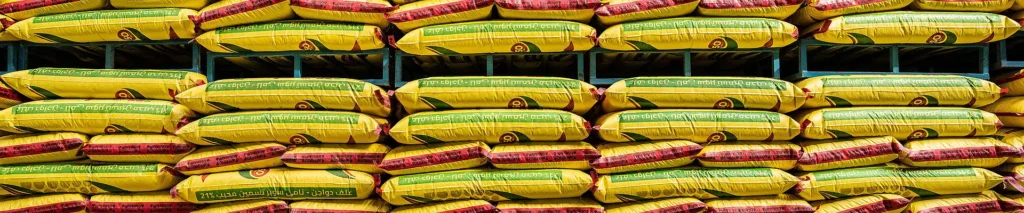
VidePak’s manufacturing is built for high-volume production and large orders. The company operates multiple multiwall and woven bag lines that run day and night. The combined annual capacity for PBOM-style bags alone reaches around 600 million pieces per year. This immense throughput comes from:
- Multiple Parallel Lines: Several bag-making lines and extruders run in parallel. For example, the facility might have 4–6 bag convertors dedicated to PBOM and a dozen circular looms for PP tubes. Lines are grouped in production zones to optimize efficiency (e.g. all 25 kg multiwall lines in one area).
- 24/7 Operations: VidePak uses multi-shift manufacturing. By running three shifts every day, the plant maximizes output. Preventive maintenance is scheduled between shifts to minimize downtime.
- In-House Integration: Because VidePak can produce its own films, woven fabrics, and bags on site, it avoids transfer delays. Raw materials move directly from resin to film to bag within the same complex.
- Large Storage and Logistics: The factory includes ample warehousing for raw materials (paper rolls, polymer pellets) and finished goods. This allows VidePak to accumulate stock of popular bag sizes and raw materials in advance of demand. As a result, lead times for standard PBOM orders can be as short as a few weeks.
- Rapid Changeover and Custom Runs: Although volumes are large, VidePak also accommodates custom or small-batch orders efficiently. Its quick-register printing presses and cassette-based bag formers enable relatively fast changeovers to different bag dimensions or designs. This flexibility benefits importers who may need multiple SKUs.
- Scale Economies: The huge production scale spreads out fixed costs. VidePak can offer competitive pricing on massive contracts because the cost per bag drops when millions are made. Large buyers often find VidePak’s per-unit cost attractive especially on volume purchases.
For procurement engineers and importers, this scale means supply reliability. VidePak can fulfill ongoing contracts for hundreds of thousands or millions of bags annually without risk of running out of stock. Whether it is a one-time project or a recurring order, VidePak’s capacity ensures orders are delivered on schedule. Moreover, having ample capacity also gives VidePak the freedom to do extra quality checks without impacting delivery dates, since spare production time can cover retesting.
Finished Product Inspection and Guarantee
Before any bags leave the VidePak factory, they undergo a final inspection regimen to guarantee conformance:
- Batch Sampling: From each production lot, sample bags are filled with standard test load and dropped from prescribed heights. For example, a 25 kg PBOM bag will typically survive five drops from 80 cm (the ISO 2233 guideline) on concrete before any failure. Passing this drop test verifies seam and base strength. VidePak also performs corner-drop and stack-compression tests (ASTM D642) to simulate pallet stresses.
- Seal Integrity Check: Every sample bag’s pinch-sealed top is examined to ensure a complete bond. A peel test (ASTM F88) might be done to confirm the hot-melt adhesive yielded a strong inner-to-outer ply weld. For lined bags, an inflation or vacuum test verifies no leaks in the liner or the seal.
- Barrier and Sifting Test: If a bag has an internal liner, its moisture barrier performance is checked by WVTR (ASTM F1249) if required. For dry products, a sift test is done: the bag is turned upside down or shaken to see if any fine particles escape through seams or closure. A proper PBOM seal will show zero sift.
- Print and Label Check: Every package’s printed areas are reviewed for registration and clarity. Lot numbers, barcodes, and any customer-specific labels are confirmed to be accurate and legible. Color accuracy (e.g. brand logo color) is visually checked against a proof.
- Documentation: Once the samples pass, VidePak compiles an inspection report. This report, along with certificates of raw material analysis (from BASF/Sinopec) and a certificate of conformity, is sent to the customer. The finished goods are only certified if every quality metric is met.
This thorough final QA means that each shipment is guaranteed. If a batch of bags were to fail in the field (which is rare given these controls), VidePak would be able to trace the issue back through its lot records. More importantly, customers gain confidence: they can issue letters of credit or place large orders knowing VidePak stands behind its product quality with documented evidence.
Applications and Benefits of PBOM Bags
VidePak’s PBOM bags serve a wide range of industries. Thanks to their sturdy construction and reliable seal, they are especially common in sectors such as:
- Building Materials: Cement, plaster, gypsum, mortar mixes and similar construction powders are frequently packed in PBOM bags. The bags can handle the heavy weight and abrasiveness, and the sealed top minimizes dust at the job site.
- Mining and Minerals: Iron ore concentrates, pigments (titanium dioxide, carbon black), fly ash, and lime – granular minerals that must stay dry – are often packed in multiwall PBOMs with plastic liners.
- Chemicals and Additives: Dry chemicals like industrial catalysts, soda ash, silica, zeolites, pigments and polymer additives are safely shipped in PBOM bags. When sealed at the top, the bag provides a controlled environment, important for hygroscopic or reactive powders.
- Food and Nutrition: Flour, sugar, starch, baking mixes, dried milk, and similar dry food ingredients use PBOM bags to preserve freshness. The food-grade variants include a polyethylene liner or coating to prevent moisture ingress. In retail or wholesale settings, the printed PBOM bag also serves as a shelf-ready package.
- Animal Feed and Pet Food: Protein meal, birdseed, cat/dog food, and aquaculture feeds are prime applications. Here, PBOM bags deliver a neat, branded package that stays closed. The flat bottom means bags can stand on store shelves without external support.
- Agriculture and Garden Products: Fertilizers (NPK, urea, potash), seeds, lawn mixtures and horticultural soils are often delivered in PBOM sacks. The bags protect against moisture in transit and allow secure pallet loads that can go directly to farms.
- Charcoal and Fuel Pellets: Bulk charcoal briquettes and wood pellets for heating are packed in PBOM bags (usually 10–25 kg). The pinch closure prevents spillage of these coarse granules and makes handling cleaner.
- Industrial Goods: Salt, drywall joint compound, plasterboard filler and similar commodity goods use PBOM packaging to facilitate automated filling and safe transport.
In each of these applications, PBOM bags offer distinct benefits. The strength and stiffness of the multiwall/PP construction means bags hold their shape under load, improving pallet stability (no bulging pillow shapes). The sealed closure dramatically reduces product loss, making the line cleaner and handling more sanitary. From the customer’s viewpoint, the predictable form factor and reliable barrier lead to fewer claims, less rework, and smoother production runs on filling lines.
In summary, PBOM bags stand out for their sealed integrity and stable form. They combine the fully pasted bottom of a block bag with a folded-and-glued top. While each bottom type has its niche, VidePak’s PBOM is engineered to excel whenever a sift-proof, moisture-resistant bag is required. The versatility of closure options (hot-melt pinch, optional valve, easy-open tear strip) allows PBOM to bridge between bulk industrial use and retail-oriented markets.
Typical PBOM Bag Specifications
| Specification Item | Typical Range / Options | Technical Notes & Procurement Considerations |
|---|---|---|
| Bag Width (Layflat) | 300–600 mm (customizable wider sizes available) | Width affects filling speed, palletization efficiency, and stack stability. Wider bags are often selected for higher bulk density or faster filling lines. |
| Bag Length | 450–1,000+ mm | Determined by target net weight and product bulk density. Longer bags are used for low-density powders or higher weight requirements. |
| Gusset (Depth) | 80–200 mm per side | Larger gussets increase internal volume and improve standing performance. Common for 25 kg and above applications. |
| Ply Count | 2–5 plies (or more for heavy-duty use) | 25 kg bags typically use 3–4 plies (including liner if applicable). 50 kg+ industrial bags may require 5+ plies for drop and stack strength. |
| Outer Ply Basis Weight | 70–100 g/m² kraft paper | Higher basis weight improves tear resistance and rack strength. Virgin unbleached kraft is standard; bleached kraft is available for premium appearance and print quality. |
| Inner Liner Type | LDPE / HDPE (20–80 µm); Co-ex PE/EVOH/PE (40–90 µm); Metallized film; Greaseproof paper | Liner selection depends on moisture, oxygen, grease, or aroma barrier needs. Liner coverage can range from partial (25%) to full internal coverage (100%). |
| Barrier Performance (Optional) | Oxygen, moisture, grease, light barriers | EVOH liners can achieve OTR < 5 for sensitive products such as milk powder or specialty food ingredients. |
| Valve / Venting Options | No valve (standard PBOM); Optional corner valve; Micro-perforation | Laser micro-perforations (approx. 60–150 holes / 100 cm²) allow air release during high-speed filling and improve seal quality. |
| Closure Method | Hot-melt pinch seal (20–35 mm tab/tape); Tear-open tape; Sewing; Ultrasonic sealing | Heat-activated hot-melt adhesive is standard for dust-tight sealing. Alternative closures are selected based on end-user handling or special logistics needs. |
| Printing Capability | Flexographic printing up to 8 colors | Water-based, food-grade inks available. Supports logos, regulatory markings, barcodes, and traceability information. |
| Standards Compliance | ASTM, ISO, industry-specific standards | Example: 25 kg cement PBOM bags typically pass 5–6 drops at 80 cm per ISO 2233. FDA / EU compliance available for food-contact materials. |
| Quality & Documentation | Full BOM documentation per specification | Each design includes documented paper weights, liner structure, adhesive type, and sealing parameters to ensure repeatability across production batches. |
Quality Control and Inspection
Ensuring that every PBOM bag is fit-for-purpose is a top priority for VidePak. The company maintains a full laboratory and inspection regime:
- Dimensional Checks: Each roll of paper or fabric is measured (width, weight per area) as it is loaded. Each converted bag is sampled to confirm flat width, gusset depth, and closed-top height all meet the tolerance (±2–3 mm).
- Glue and Seal Inspection: VidePak uses automated sensors to check that 100% of the bottom seams have full adhesive coverage (no dry spots). Color sensors on the pinch sealer verify that the heat-seal tape is present and active. Samples are peeled to see that the hot-melt has fully bonded.
- Physical Testing: From each production batch (e.g. each shift or each truckload of bags), sample bags are pulled aside for testing. Typical tests include: the drop test (per ISO 2233) to confirm the bag won’t burst under handling; the burst or burst-extensometer test to quantify maximum pressure; and a stack compression test (ASTM D642) to simulate long-term pallet loads. Pass/fail criteria are often set to exceed industry minimums.
- Barrier Verification: If the bag design includes a film or foil barrier, samples are tested for moisture ingress (Cobb60 test) and oxygen transmission. Moisture-sensitive goods might require the test results to show <10 g/m²·day WVTR under standard conditions.
- Visual and Print Quality: Trained inspectors look at the finished bags for any surface defects – tears, pinholes, misprints, color bleed or registration errors. Print quality is compared to approved proofs (Pantone or Pantone-like standards). Only bags with crisp, undamaged graphics are accepted.
- Batch Certification: Every lot of bags is assigned a lot number. VidePak maintains detailed lot records linking raw material batches (paper roll ID, resin batch number) to machine settings. A Certificate of Compliance (CoC) accompanies shipments, affirming that the batch passed all QC tests. Customers can request specific test reports or certificates (e.g. “This batch’s break strength was X N”).
This depth of inspection ensures that no defective bag reaches the customer. By catching anomalies early – such as a machine running out of glue, or a slight variation in paper weight – VidePak minimizes waste and rejections. For buyers, it means confidence: if they order 100,000 bags, 100,000 bags meeting spec will be delivered, backed by documentation.
Comparative Analysis: PBOM vs. Other Bottom Types
To illustrate why PBOM bags are often the preferred choice, consider how they compare in a systems context:
- Mechanical Integrity: PBOM bags have a fully-pasted bottom seam, giving them high drop-drop and vibration resistance. In lab tests (ISO 2233), a typical 25 kg PBOM easily withstands 5–6 drops from 80 cm when conditioned. In contrast, a similar sewn-open mouth (SOM) bag might show stress at the needle holes or valve. The pinch-bottom design distributes corner stress well on impact. Against BBOM, PBOM is similar in bottom strength, since both have full glued bottoms, but BBOM’s square base edge may offer slightly higher crush resistance (e.g. measured by ASTM D4577 creep). VidePak ensures its PBOM bottom glue coverage is ≥95% to meet or exceed these industry benchmarks.
- Barrier Performance: With an inner liner and heat-sealed top, PBOM bags can achieve near-hermetic seals. In fact, ASTM tests often show a PBOM heat seal >3.0 N/15 mm (good seal strength) and WVTR/OTR values improved by an order of magnitude over unsealed paper. A PV bag (with valve) has good sealing at the top valve and often uses thick liners, but its bottom joint may not be sealed by heat. A sewn bag (SOM) usually fails to meet airtightness (oxygen and moisture can seep at needle holes). PBOM offers one of the cleanest closures short of a complete film valve – making it ideal for moisture-sensitive foods. VidePak’s QC labs routinely confirm that sealed PBOM tops show zero sift when subjected to vacuum tests.
- Line Compatibility: PBOM requires a pinch sealer (hot air, ultrasonic or heated rollers) after filling. This adds a step compared to SOM (which only needs a sewing machine) but provides better closure. On modern auger or impeller fillers, VidePak PBOM achieves efficient throughput since the seals are fast (just a brief heat cycle). Compared to PV (valved), PBOM may run slightly slower per bag but avoids the need for calibrated spout fittings. The engineering trade-off is clear: PBOM sacrifices a small amount of fill speed for a big gain in seal integrity.
- Stacking and Pallet Stability: PBOM’s taped ends and square bottom lead to very flat pallet faces. This improves container cube utilization. Compared to SOS, PBOM bags are more compact at the top (SOS often has extra height for opening). Compared to BBOM, PBOM’s bottom is virtually flat – any difference in pallet stability is negligible. In drop tests and real-world stacking (ASTM D642 and ISTA D4169 simulations), PBOM stacks are robust; VidePak customers routinely use corner boards and straps to achieve safe 40–50 bag-high loads on pallets.
- Retail Presentation: A printed PBOM bag offers a clean, modern look on store shelves. Its straight panels give a large canvas for graphics. Compared to a bulk SOS (which may look more like a plain flour sack with simple graphics) or a poly sling bag, PBOM looks premium. VidePak often prints retail-grade PBOM bags with glossy coatings or special varnishes to enhance shelf appeal.
In sum, choosing PBOM means prioritizing sealing and stability. It is often described as the “hermetic square bag” – offering the secure seal of a valve bag and the box-like stacking of a block bag. For products where product protection and cube efficiency matter most, VidePak’s PBOM is engineered to be the superior solution.
Conclusion
VidePak’s Pinch Bottom Open Mouth (PBOM/PBCT) bags represent a high-performance packaging solution for industrial and consumer products. By combining multiwall kraft or PP woven structures, top-grade raw materials from BASF, Sinopec Yangzi, and others, and precision machinery (Starlinger & W&H), VidePak delivers PBOM bags with exceptional strength, consistency, and barrier properties.
Key takeaways for procurement engineers and importers:
- Proven Design: The PBOM style is a packaging workhorse. VidePak’s bags are engineered for this format: a firmly glued square bottom plus a tightly sealed pinch-top. This design minimizes spillage and maximizes pallet space.
- High Capacity & Reliability: With a ~600 million bag/year capacity and vertically integrated production, VidePak can handle large and urgent orders. Consistent output and inventory of key sizes mean short lead times.
- Stringent Quality: VidePak follows international ASTM/ISO standards in every phase. Rigorous in-line monitoring and final lab testing (drop, seal, moisture tests) ensure every shipment meets spec. Customers receive QC certificates and traceability documentation with each lot.
- Customization: Whether it’s a 25 kg multiwall flour bag with full-color branding, or a 50 kg PP woven fertilizer bag with extra-thick lamination, VidePak can tailor the PBOM to exact needs – dimensions, plies, liners, printing, and special features (easy-open tear strips, anti-slip embossing, etc.).
- Global Compliance: Foods, chemicals or pharmaceuticals can be packed in VidePak PBOM bags. The materials and inks conform to FDA and EU 1935/2004 requirements when needed. Certificates of food-contact safety and batch analyses are available.
In operation, customers find that VidePak’s PBOM bags reduce line downtime (fewer bag tears and dust leaks), cut claims (product stays inside the bag), and improve handling (pallets load neatly). All of this leads to lower total cost of packaging. The end result is a packaging solution that delivers reliable performance across the supply chain.
By choosing VidePak PBOM bags, importers and packers gain a packaging partner who understands the complete system – from raw fiber to final pallet. The combination of high-quality inputs, advanced equipment, and exhaustive quality checks means each PBOM bag is a robust container ready for the real world. In short, VidePak PBOM (PBCT) bags are built to perform – keeping your product safe, dry, and presented at its best.