
PP Fabric Bags: Engineering the Future of Industrial Packaging
The Anatomy of Choice: Why PP Fabric Bags Dominate
The selection of PP Fabric Bags involves a tripartite calculus: material properties, environmental exposure, and workflow dynamics. Unlike generic packaging, these bags demand engineering synergy between microscopic fiber architecture and macroscopic logistical systems.
Cross-Industry Parallels:
- Agriculture: UV-stabilized 800D bags (12μm thickness) protect organic fertilizers during 18-month storage—a feat requiring crystalline structures resistant to 40°C summers and monsoon humidity.
- Chemicals: Aluminum-laminated 1200D variants withstand corrosive materials, their gas barriers achieving <0.05g/m²/24hr oxygen transmission—far surpassing BOPP’s 2-4g/m²/24hr in retail applications.
- Construction: 140μm aluminum liners in cement transport bags reduce dust emissions by 92%, meeting EPA standards while enabling 22% higher payloads.
Case Study: A Nigerian cement producer’s upgrade to 1200D bags with 8×8 weave density cut breakage from 4.7% to 0.9%. This required reengineering palletization patterns—a logistical ballet where 23% thicker fabric demanded 15% larger pallets.
The Manufacturing Symphony: From Resin to Revolution
The birth of PP Fabric Bags involves three acts of molecular alchemy:
- Extrusion: ISO 1133-certified PP pellets melt at 220°C into flat yarns (3-15mm width), their melt flow index dictating viscosity and strength.
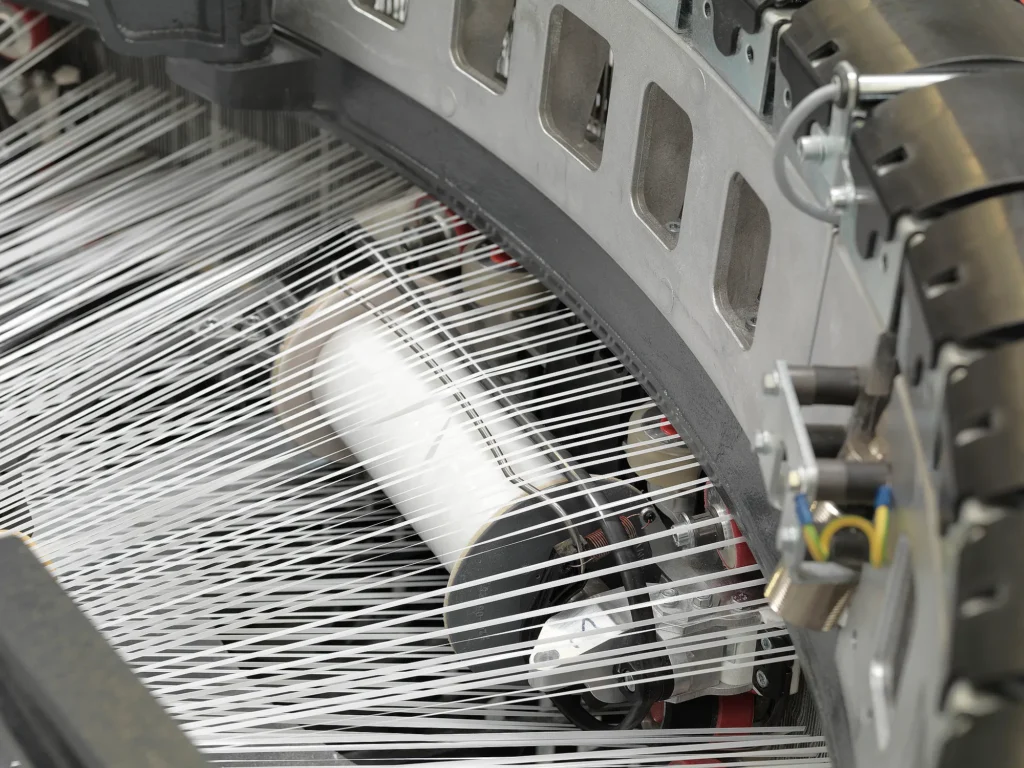
- Weaving: Circular looms spin these yarns at 180RPM, creating tubular fabric where weave density (7×7 to 18×18 weaves/inch) determines burst resistance.
- Finishing: UV stabilizers (ASTM G155) and anti-static treatments transform raw fabric into industrial-grade armor.
Automotive Analogy: This process mirrors carbon fiber weaving for car bodies—both require precision temperature control and tensile strength optimization. Yet PP Fabric Bags achieve comparable durability at 60% lower cost.
The Spindle Motor Metaphor: Handling Dynamics
In packaging systems, the “spindle motor” concept manifests as:
- Load Capacity: From 5kg (retail) to 2000kg (industrial) SWL
- Speed: Valve filling systems achieving 80 bags/min
- Precision: ±2mm dimensional tolerance for robotic palletization
Upgrade Path: Retrofitting lines with servo-driven filling heads (8,500−12,000) and VFD-optimized conveyors can boost throughput by 40%—akin to upgrading a CNC machine’s spindle from 10k RPM to 15k RPM.
Downtime Demons: Prevention Through Innovation
Unplanned停机 costs $2,500/hour. Key antidotes include:
- Digital Temperature Controllers: $1,200 upgrades that reduce heat-sealing errors by 73%
- Micro-Perforation Dies: Laser-cut plates ($45,000) enabling precise ventilation for rice storage
- IoT Sensors: Monitoring fill levels with ±2% accuracy, preventing overfilling-induced tears
ROI Reality: A Thai rice exporter’s switch to heat sealing from manual sewing yielded 217% ROI over three years—proof that $18/hr labor savings and 12kWh energy reductions compound exponentially.
The Certification Crucible: Third-Party Validation
PP Fabric Bags earn their stripes through rigorous testing:
- Material Testing: ASTM D1577 denier verification ($250/sample) ensures fiber consistency
- Seam Strength: ISO 13937-2 grab tests confirm ≥160N resistance—critical for FCL shipments
- Compliance: UN certification for hazardous materials demands 18-month stability testing
Case Study: Genox Recycling Tech’s wash line certification enabled a Nigerian producer to recycle 92% of used bags, blending 15% reprocessed resin into new fabric without compromising strength.
The Spare Parts Ecosystem: Beyond the Bag
While PP Fabric Bags themselves are disposable, their ecosystem requires:
- Sealing Elements: Teflon-coated heat bars ($450/set) lasting 18-24 months
- Lamination Films: BOPP rolls (720mm width, $0.38/m) providing high-resolution printability
- Ventilation Dies: Laser-cut plates ($1,200) enabling 0.5mm micro-perforations
Inventory Insight: Maintaining 3-month safety stock of critical components reduces downtime by 83%—a principle borrowed from JIT manufacturing but adapted for packaging’s unique demands.
Future-Proofing: The Next Wave of Innovation
Anticipating 2030’s packaging landscape requires:
- Biodegradable Blends: PLA-infused PP resins reducing carbon footprints by 15%
- Smart Tags: NTSC-compliant QR codes enabling blockchain traceability
- Circular Systems: Genox GRD-3000 wash lines achieving 18:1 input-output ratios
Roadmap:
- Phase 1 (2025-2027): Deploy IoT sensors for real-time fill monitoring
- Phase 2 (2028-2030): Integrate RFID-enabled bags with blockchain ledgers
- Phase 3 (2031+): Launch AI-driven predictive maintenance systems
PP Fabric Bags represent a paradigm shift—where molecular engineering meets supply chain pragmatism. By harmonizing denier selection with load dynamics, integrating advanced barrier technologies, and embracing Industry 4.0 upgrades, manufacturers achieve 18-35% cost reductions while advancing sustainability. These bags are not just packaging; they are precision instruments calibrated to the demands of a resource-constrained world.
For more information about PP Fabric bags, visit https://www.pp-wovenbags.com/pp-woven-bags/.
- PP Fabric Bags: Engineering the Future of Industrial Packaging
- The Anatomy of Choice: Why PP Fabric Bags Dominate
- The Manufacturing Symphony: From Resin to Revolution
- The Spindle Motor Metaphor: Handling Dynamics
- Downtime Demons: Prevention Through Innovation
- The Certification Crucible: Third-Party Validation
- The Spare Parts Ecosystem: Beyond the Bag
- Future-Proofing: The Next Wave of Innovation
- Molecular Architecture: The Foundation of Performance
- Denier Dynamics: Precision Engineering for Specific Demands
- Barrier Technologies: Moisture, Light, and Oxygen Control
- Liner Materials: Creating Micro-Environments
- Closure Systems: Sealing Efficiency and Cost Dynamics
- Cross-Industry Applications: From Farms to Factories
- Sustainability: Circular Economy Integration
- Strategic Implementation Framework
- Conclusion: The Future of Packaging Engineering
Polypropylene (PP) Fabric bags have transcended their humble origins as basic packaging materials to become indispensable tools in modern industrial ecosystems. These engineered textiles, woven from high-density polypropylene resin, embody a fusion of molecular precision and practical functionality. Their crystalline polymer structure—formed through extrusion, circular weaving, and thermal stabilization—creates a material matrix that outperforms traditional alternatives like jute or HDPE in critical metrics. Imagine a fabric so robust it can withstand 800kPa of burst pressure yet remains lightweight enough for aerial cargo transport—this is the paradoxical genius of PP Fabric bags.
Molecular Architecture: The Foundation of Performance
The manufacturing journey of PP Fabric bags begins with ISO-certified polypropylene resin pellets, melted at 220°C into flat yarns measuring 3-15mm in width. Circular looms operating at 180RPM transform these yarns into tubular fabric, where weave densities ranging from 7×7 to 18×18 weaves per inch determine structural integrity. The resulting material exhibits 35-45% crystallinity—a molecular arrangement that grants it:
- Tensile strength of 380N/5cm (warp/weft)
- Elongation capacity up to 25% before rupture
- Thermal resistance maintaining integrity from -40°C to 167°C
This unique configuration delivers a strength-to-weight ratio 3.2 times superior to jute and 1.8 times better than HDPE alternatives. Consider the automotive sector, where PP Fabric bags protect engine components during transcontinental shipping—their ability to absorb vibrations while resisting chemical degradation makes them irreplaceable.
Denier Dynamics: Precision Engineering for Specific Demands
The denier metric (D)—defining fiber thickness as grams per 9000 meters—creates distinct performance tiers:
| Denier Tier | Fiber Characteristics | Industrial Applications |
|---|---|---|
| 600D-800D | 7-9μm diameter, 22kN/m tear strength | Retail packaging (5-50kg), cost-optimized |
| 900D-1100D | 9-11μm diameter, 30kN/m tear strength | FCL shipments, balanced durability |
| 1200D-1700D | 11-14μm diameter, 42kN/m tear strength | Cement transport, heavy machinery |
A Nigerian cement producer’s experience epitomizes denier optimization. By upgrading to 1200D bags with 8×8 weave density, they reduced breakage from 4.7% to 0.9%—though this required reengineering palletization patterns to accommodate 23% thicker fabric. Such cases reveal a fundamental truth: PP Fabric bags demand engineering synergies between material properties and logistical constraints.
Barrier Technologies: Moisture, Light, and Oxygen Control
The choice between laminated and unlaminated PP Fabric bags hinges on environmental exposure:
- Unlaminated bags offer base-level protection (12-18g/m²/24hr MVTR)
- PE-laminated variants reduce moisture transmission to 2-4g/m²/24hr
- Aluminum-laminated solutions achieve near-hermetic seals (0.05g/m²/24hr MVTR)
Economic analyses reveal nuanced trade-offs. While BOPP lamination requires $220,000 in capital investment, Malaysian palm oil exporters recovered this outlay within 18 months through reduced spoilage. Contrast this with aluminum coatings—though 30% more expensive upfront, their gas barrier properties justify costs for pharmaceutical packaging.
Liner Materials: Creating Micro-Environments
Inner liners transform PP Fabric bags into controlled ecosystems:
- PE liners (40-200μm) dominate agricultural packaging, offering FDA-approved food safety and moisture resistance
- Aluminum foil liners excel in electronics packaging, blocking 99.9% of UV/A radiation while withstanding -40°C to 120°C extremes
A Thai rice exporter’s innovation illustrates this potential. By combining 700D BOPP-laminated bags with 80μm PE liners featuring oxygen scavengers, they maintained 98.2% germination rates during monsoon storage—outperforming competitors by 15% in oxygen transmission resistance.
Closure Systems: Sealing Efficiency and Cost Dynamics
Sealing technologies for PP Fabric bags present operational paradoxes:
- Heat sealing (120 bags/hr) offers rapid ROI for food processors but demands precise temperature control
- Sewing (85 bags/hr) suits heavy industrial use yet incurs higher labor costs
- Valve systems (200 bags/hr) maximize throughput but require $15,000+ equipment
The solution? Contextual adaptation. A Thai rice exporter processing 800,000 bags annually achieved 217% ROI over three years by upgrading to heat sealing—a classic case of capital expenditure yielding exponential returns.
Cross-Industry Applications: From Farms to Factories
PP Fabric bags demonstrate remarkable versatility:
- Agriculture: UV-treated 800D bags extend organic fertilizer shelf life to 18 months
- Construction: 1200D valve bags with aluminum liners reduce cement waste by 40% during rail transport
- Food Processing: Micro-perforated 700D BOPP bags prevent rice caking while maintaining aerobic balance
Each application demands tailored engineering. Cement transport, for instance, requires not just high denier but also polyester cord-reinforced valve closures to withstand 22% higher payloads.
Sustainability: Circular Economy Integration
Modern PP Fabric bags align with planetary boundaries:
- Recycling protocols achieve 94% material yield through Genox GRD-3000 wash lines
- Carbon footprints (1.8kg CO₂e/kg) undercut paper bags by 67%
- Energy efficiency consumes 30% less production energy than HDPE alternatives
These metrics position PP Fabric bags as linchpins in the circular economy. Imagine a closed-loop system where used bags return to production lines after washing—this is no longer utopian vision but industrial reality.
Strategic Implementation Framework
Adopting PP Fabric bags requires holistic decision-making:
- Load Analysis: Calculate SWL + 20% safety margin
- Exposure Assessment: Quantify UV indices, humidity, and temperature swings
- Infrastructure Alignment: Match bag dimensions to conveyor/pallet systems
- Compliance Verification: Confirm UN certification for hazardous materials
- Lifecycle Costing: Include acquisition, transport, and disposal expenses
Pilot testing remains critical. A 500-unit trial with accelerated aging (Q-SUN Xe-3) can reveal hidden vulnerabilities before full-scale deployment.
Conclusion: The Future of Packaging Engineering
PP Fabric bags represent more than mere containers—they are precision instruments calibrated to industrial demands. By harmonizing denier selection, barrier technologies, and closure systems, manufacturers unlock 18-35% cost reductions while advancing sustainability. As recycling infrastructures mature and smart packaging (RFID-enabled variants) evolves, these materials will solidify their role as cornerstones of global supply chains.
For more information about PP Fabric bags, visit https://www.pp-wovenbags.com/pp-woven-bags/.
References:
- Genox Recycling Tech (2025). PP Woven Bags Washing System Specifications. Made-in-China.com
- Sinopec (2023). Polypropylene Resin Applications Guide. China Petrochemical Corporation
- ISO 13934-1 (2017). Textiles – Tensile properties of fabrics
- FDA (2024). Indirect Food Additives: Polymers. 21 CFR Part 177.1520
- QYResearch (2025). Global PP Nonwoven Fabric Market Report 2025-2030
- ICIS (2025). Life Cycle Assessment of Polymer Packaging Solutions
- UNCTAD (2024). Guidelines for Hazardous Materials Packaging