
What are Printed BOPP Woven Bags? Definitions, Scope, and Aliases
Printed BOPP Woven Bags are composite sacks created by laminating a reverse‑printed biaxially oriented polypropylene film onto a structural woven polypropylene fabric and converting the laminate into open‑mouth, gusseted, valve, or block‑bottom formats. The architecture merges photographic print fidelity with an industrial backbone: tensile strength from tapes, puncture resistance against angular loads, and reliable stack geometry for distribution. In manufacturing floors where clamps bite, conveyors accelerate, and pallets compress, the film‑fabric synergy turns fragile graphics into rugged signage while preserving the load‑bearing skeleton of raffia.
Aliases you will encounter in tenders, catalogs, and plant SOPs often point to the same format with minor variants in finish or closure. Common alternatives include: (1) BOPP Laminated Woven Bags, (2) BOPP PP Woven Sacks, (3) Printed PP Woven Bags, (4) BOPP Printed Polypropylene Sacks, (5) BOPP Laminated Raffia Bags, (6) Printed BOPP Valve Bags. Differences typically involve film finish (gloss/matte), visibility windows, or whether the top is open‑mouth or fitted with a valve sleeve.
Position on the packaging spectrum? Imagine a line from ultra‑clear monolayer films (excellent visibility, limited tear resistance) to heavy industrial sacks (excellent strength, zero visibility). Printed BOPP Woven Bags live in the productive middle: stronger than film pouches, more visually persuasive than non‑laminated fabric, ideally sized for 5–50 kg products across pet food, fertilizers, construction chemicals, resins, grains, and promotional retail goods. The result is not a compromise but a combination: clarity that sells, structure that protects, and geometry that stacks.
The Materials of Printed BOPP Woven Bags: Resins, Films, Inks, Tie‑Layers, and Additives
A Printed BOPP Woven Bag is a tuned stack. Each layer exists to solve a measurable problem—strength, print fidelity, barrier, machinability—so the bill of materials becomes a set of levers for cost and performance. Below, each component is detailed with its role, common ranges, and the trade‑offs that matter when you own a filling line or a brand P&L.
Woven Polypropylene Fabric (Structural Backbone)
PP pellets are slit‑film extruded into tapes, oriented to build tensile, then woven on circular or flat looms. Typical fabric mass: 65–120 g/m² for 10–50 kg applications; tape denier in the 700–1400D band. The woven matrix shoulders vertical load, resists puncture from angular granules (fertilizer prills, mineral aggregates, kibble), and holds dimensions for automated handling. White masterbatch improves print pop; natural tapes can support translucent windows. UV‑stabilized grades protect outdoor stacks.
BOPP Film (Print Face and Barrier Contributor)
Biaxially Oriented Polypropylene at ~18–25 μm, supplied as gloss, matte, or dual‑finish. Reverse printing positions inks on the underside so the film protects graphics against scuff and solvent rubs. BOPP smoothness supports high line‑screen artwork and QR codes, while metallized variants can raise barrier for light‑sensitive or aroma‑sensitive contents. Gauge, finish, corona level, and color count are the practical levers balancing cost and impact.
Tie‑Layers and Lamination Route
Two mainstream routes dominate. Extrusion lamination uses a PP‑based melt to bond BOPP to coated fabric—simple stack, robust bonds, and straightforward supply. Adhesive lamination (solvent or solventless PU) opens temperature flexibility and specialty film options but adds cure time, bond audits, and migration checks. The selection hinges on temperature windows, food‑adjacent needs, and the plant’s QA maturity.
Coatings, Inks, and Varnishes
Clear PP coating at 18–35 μm seals fabric porosity, lifts moisture discipline, and stabilizes print holdout. Inksets for reverse printing prioritize adhesion under film, solvent resistance, and tight ΔE control. Matte or soft‑touch varnishes craft tactile contrast; UV‑blocking over‑varnish supports outdoor exposure for yard‑stored SKUs.
Valves, Liners, and Performance Additives
PP‑coated or PE valve sleeves let gravity or air‑pack nozzles fill fast and clean; self‑closure under back‑pressure minimizes leak. LDPE/LLDPE liners in the 25–60 μm band reach very low MVTR for hygroscopic goods. UV stabilizers enable 6–12 months outdoor storage; antistatic agents aid powder handling; anti‑slip coats tune outer COF to avoid pallet creep.
Systemic takeaway: the stack combines a mechanical lattice (woven tapes), a visual shield (BOPP), a barrier membrane (coating/liner), and interfaces (valves). Small parameter shifts—coating gauge, valve stiffness, vent pattern—can swing line speed or damage rate more than a larger change in fabric GSM. That is why specification by numbers beats specification by habit.
Key Features of Printed BOPP Woven Bags: From Print Science to Pallet Physics
High‑Fidelity Graphics Under Abuse
Reverse‑printed BOPP shelters inks beneath film, so conveyor rubs, clamp‑truck handling, and yard friction do not erase the message. Codes remain readable and brand colors remain consistent far from the pressroom.
Load‑Bearing Strength at Low Mass
Woven tapes yield tear and puncture resistance disproportionate to weight. For 10–50 kg SKUs, that means fewer breakages, fewer reworks, and fewer claims.
Moisture and Dust Discipline
Coatings, films, and optional liners lower moisture ingress and dust egress, trimming housekeeping time and protecting formulas with hygroscopic binders.
Machine Compatibility and Fast Filling
Valves are tuned for gravity or air‑pack fillers, while vent patterns evacuate trapped air. The bags stand, couple, fill, and discharge cleanly—fewer stoppages, fewer manual touches.
Compliance and Traceability Surface
A scuff‑safe canvas supports warnings, transport icons, QR/lot codes, and localized labeling. Audits run smoother because the information survives the journey.
Recovery Pathways
Mono‑polyolefin stacks (PP fabric + PP/BOPP) fit polypropylene recovery where available. Even before end‑of‑life, lower damage rates already cut hidden environmental cost.
A practical question to sharpen focus: do you prefer pallets that lean, stacks that slide, and labels that smear—or layers that cube up, friction in the sweet spot, and artwork that sells? The difference is specification, not luck.
Production of Printed BOPP Woven Bags: Front‑End Selection, Line Stages, and Back‑End Release
VidePak designs for repeatability. Equipment pedigree is purposeful: Austrian Starlinger for tape extrusion, weaving, coating/lamination, and block‑bottom formation; German W&H (Windmöller & Hölscher) for web handling and printing. Register and geometry are the quiet foundations of speed and quality.
Front‑End: Raw Material Selection and Incoming Inspection
- PP resins: choose homopolymer for stiffness/tensile, impact‑copolymer for cold routes. Verify MFI, density, moisture, ash, pellet contamination.
- BOPP films: check gauge, haze, gloss, and surface energy; inspect edges and winding to avoid telescoping.
- Tie‑layers/adhesives: audit bond strength after cure and heat aging; monitor residuals for food‑adjacent SKUs.
- Inks/varnishes: validate viscosity, adhesion, and color ΔE to proofs; run scuff rubs and solvent resistance.
- Valve/liner components: confirm stiffness window, seal temperatures, and gauge uniformity.
- Documentation: match COAs to ISO/ASTM/EN/JIS references where relevant; allocate traceable lot codes.
Core Manufacturing Stages
- Tape extrusion & orientation (Starlinger): extrude, slit, draw PP tapes; lock draw ratio, chill‑roll temperature, and edge‑trim refeed to hit tensile/elongation windows and keep visual cleanliness.
- Weaving (Starlinger circular/flat looms): set warp tension and picks per inch; maintain looms; control humidity to tame static and reduce ends‑down events.
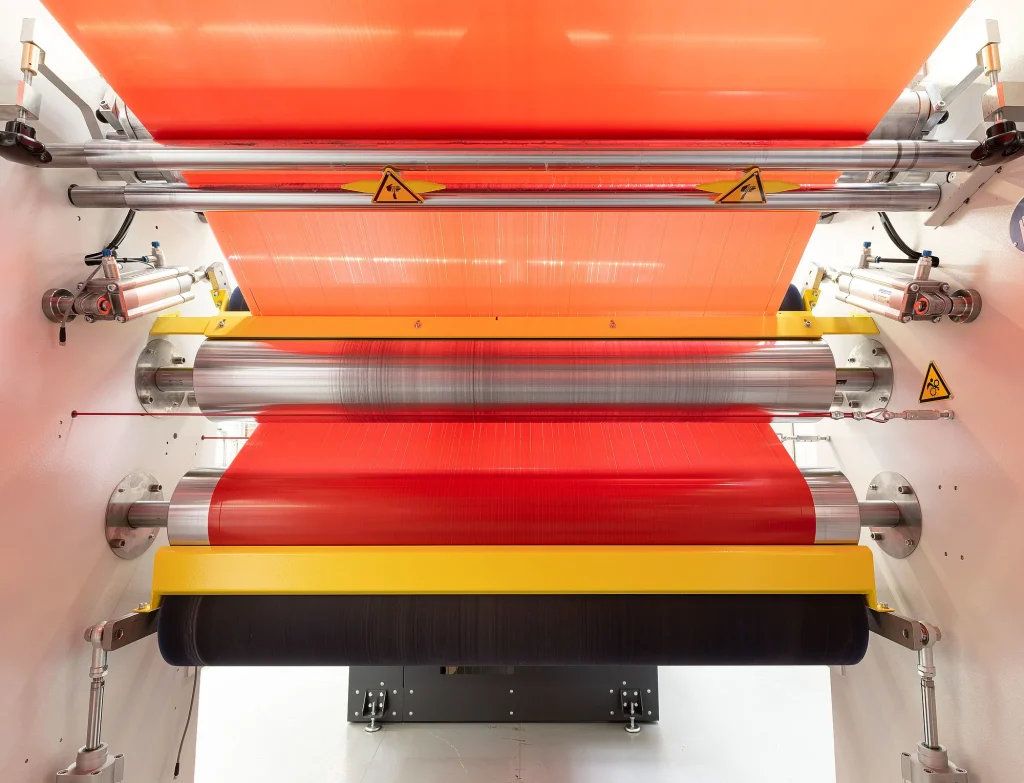
- Coating / Film lamination: apply clear PP coating or laminate reverse‑printed BOPP; tune corona, nip pressure, and thermal profile; add micro‑perfs if the filler traps air.
- Printing (W&H gravure/flexo): reverse print BOPP with 6–8 colors; control viscosity, drying, and register; inline vision holds ΔE and barcode readability.
- Tube forming & cutting: convert laminate into tubes; cut programmable lengths to hit weight targets after settling.
- Valve construction & insertion: install PP‑coated or PE sleeves; optional inner flaps yield self‑closure under back‑pressure.
- Bottom formation: fold and seal (heat or ultrasonic); crease corners; cool under pressure to square the footprint and seal gusset turns.
- Final trim, counting, palletizing: optical counters prevent off‑counts; alignment fences keep stacks square; wrap containment force is specified to halt layer creep.
Back‑End: Quality Control and Release Tests
- Dimensions & geometry: length/width/gusset; valve dimensions; bottom square.
- Seam/seal integrity: peel/shear, corner fusion strength, pinhole counts at gusset turns.
- Mechanical fabric tests: tensile, tear, burst per ISO/ASTM; outer COF for conveyors and pallets.
- Print/optical: color ΔE tolerance, registration, scuff rubs, barcode/QR readability.
- Barrier: MVTR for moisture‑sensitive goods; liner integrity where applicable.
- Aging & abuse: UV exposure windows; cold‑drop; vibration table for transport simulation.
Applications: Where Performance and Presentation Meet
Pet Food and Animal Nutrition
High‑graphics faces differentiate SKUs at a glance while woven strength resists clawing and stack abrasion. Liners maintain aroma and crunch; valves keep filling predictable and clean.
Agriculture and Staples
Rice, flour, sugar, pulses. Windowed designs allow shoppers and inspectors to verify grade; films resist moisture pickup and repeated handling across wholesale channels.
Fertilizers and Soil Amendments
Granular loads impose puncture stress and demand outdoor resilience. Anti‑slip exteriors prevent pallet slides; UV‑stabilized stacks survive yard conditions.
Construction Chemicals and Minerals
Mortar, grout, gypsum, calcium carbonate. Moisture discipline and strong corners deliver cleaner job sites and fewer returns; scuff‑safe warnings remain legible on arrival.
Resins and Industrial Additives
Granules and powders retain identity with abrasion‑safe artwork and lot codes that remain scannable after intermodal hops.
Retail and Promotional
Charcoal, pellets, birdseed: photo‑quality panels lift conversion while woven bodies keep the promise through delivery and storage.
How VidePak Controls and Guarantees Quality
Quality is a loop—design, run, measure, improve—not a poster. VidePak’s model rests on four pillars that convert intention into predictable tons.
- Standards‑aligned design, production, and testing: acceptance criteria reference ISO/ASTM/EN/JIS as applicable. Documented setpoints—draw ratios, PPI, coating weight, lamination pressure, seal temperatures—are held through SPC and verified by lot‑release audits (dimensions, mechanicals, MVTR, COF, color ΔE, barcodes).
- 100% virgin raw materials from tier‑1 suppliers: PP, masterbatch, BOPP, inks, and liners arrive with auditable COAs. Random sampling confirms MFI, haze, bond, and contamination limits. Any internal regrind is controlled and confined to non‑critical layers when allowed by spec.
- Equipment pedigree: Starlinger governs tape uniformity, loom stability, and block‑bottom forming; W&H secures register stability and consistent color across long runs.
- Comprehensive inspection & sampling: incoming verification; in‑process fabric/bond/seal checks; finished‑goods audits; AQL‑based sampling. Periodic transport simulations (random pallets) expose vibration and stacking weaknesses before field failures. Non‑conformities trigger CAPA with root cause, corrective action, and SOP/tooling updates.
System Thinking: From Sub‑Problems to a Winning Specification
A strong specification translates behavior into numbers the factory can hold. Use the following frame to decompose choices, then recombine them into a holistic bill of materials for Printed BOPP Woven Bags.
Material Behavior → Venting & Liner Strategy
- Fine powders trap air: micro‑perforations or vent patches shorten fill time.
- Hygroscopic goods: raise coating gauge or add liners; specify MVTR targets.
- Abrasive blends: increase GSM, reinforce corners, and audit drop performance.
Filler Capability → Valve Geometry & Stiffness
- Gravity vs. air‑pack vs. impeller nozzles call for different sleeve widths and stiffness windows.
- Target line speed determines venting aggressiveness and cut‑off strategy.
Logistics → Cube, COF, and UV
- Fit length × width × gusset to pallet pattern; minimize overhang and voids.
- Tune outer COF (0.35–0.60) to conveyors and floors to prevent slides or snags.
- Define UV months for outdoor storage to avoid brittle failures.
Brand & Compliance → Substrate and Code Plan
- Reverse‑printed BOPP protects graphics; place batch/QR codes away from fold and impact zones.
- Verify barcode readability after simulated scuffing and stretch‑wrap cycles.
Recombination rule: freeze GSM, lamination route, valve design, venting pattern, and bottom fold only after a live line trial measures fill time, weight variance, leak rate, and stack tilt. Two pallets of data beat a dozen meetings.
Specification Cheat Sheet
| Parameter | Typical Options / Targets | Why It Matters |
|---|---|---|
| Nominal fill weight | 5 / 10 / 20 / 25 / 40 / 50 kg | Defines bag size, fabric GSM, bottom geometry |
| Fabric GSM | 65–120 g/m² | Balance strength and abrasion resistance vs. weight/cost |
| Tape denier | 700–1400D | Drives tensile/tear and loom stability |
| Coating thickness | 18–35 μm (clear PP) | Dust/moisture control, print holdout |
| BOPP film | 18–25 μm; gloss/matte/metallized | Graphics clarity, scuff resistance, barrier |
| Printing | Gravure or flexo; 6–8 colors typical | Brand impact; color discipline; throughput |
| Valve sleeve | PP‑coated fabric or PE; self‑closing option | Clean, fast fills; leak prevention |
| Venting | None / micro‑perfs / vent patches | Shortens fill time; controls dust |
| Liner | LDPE/LLDPE 25–60 μm | Low MVTR for hygroscopic contents |
| Outer COF | 0.35–0.60 (specify) | Pallet and conveyor stability |
| UV stabilization | 6–12 months (specify) | Outdoor yard resilience |
| Compliance marks | QR/lot/SDS references | Recall readiness; export compliance |
Failure Modes and Line Controls: A Targeted Mini‑FMEA
- Extrusion & drawing: gauge bands, gels, fibrillation → hold MFI window; clean die lips; control chill roll; manage edge‑trim refeed.
- Weaving: mis‑picks, broken tapes, loom marks → stabilize warp tension, PPI, and humidity; deploy ends‑down monitors.
- Coating/lamination: poor adhesion, curl, haze → verify corona; hold nip/temperature; align webs; audit bond.
- Printing: color drift, ghosting, scuffing → control viscosity and cylinder pressure; add inline ΔE/barcode vision.
- Valve & bottom: weak corners, open valves, pinholes at gusset turns → tune seal temperature/pressure/dwell; refine corner geometry.
- Packout: off‑count, skewed stacks → optical counting; alignment fences; specified wrap containment force.
Test Matrix and Sampling Plan
| Stage | Test | Intent |
|---|---|---|
| Incoming | MFI, moisture, surface energy, film gauge/haze | Confirm processability and optical potential |
| In‑process | Fabric GSM, tape tensile, bond strength, seal pull | Ensure strength is built, not assumed |
| Finished | Dimensions, COF, drop/vibration, MVTR, ΔE/barcode | Verify performance in use |
| Audit | UV aging, cold‑drop, valve leak, print abrasion | Validate storage and transport extremes |
Adopt AQL‑based sampling keyed to defect severity (critical/major/minor). For large orders, send random pallets through vibration and compression tests to catch stacking weaknesses before the market does.
Cost and ROI Modeling for Printed BOPP Woven Bags
Credible cases go beyond unit price. System variables determine what you truly pay and what you quietly save.
- Throughput: tuned venting and valve geometry remove seconds per bag; labor per ton falls and capital amortizes faster.
- Damage/returns: scuff‑safe art and stronger corners cut claims and rebagging costs.
- Freight: cuboid layers with correct COF lift pallet counts without risking collapse; freight per ton drops.
- Inventory: one design scaled across SKUs reduces obsolescence; durable codes simplify recall management.
- Brand: high‑fidelity panels lift conversion and enable price premiums.
Run a two‑pallet trial on your own line and route. Measure fill time, weight variance, dust index, color drift, and stack tilt. Those numbers will defend the bill of materials more convincingly than adjectives.
Comparative Lens: Printed BOPP Woven Bags Versus Alternatives
| Alternative | Strengths | Where Printed BOPP Woven Bags Win |
|---|---|---|
| Multiwall paper sacks | Breathability; premium paper feel | Humidity resilience, puncture/tear resistance, scuff‑safe graphics |
| Monolayer film bags | Clarity; easy sealing | Superior tear/puncture at similar mass; better ergonomics for 10–50 kg |
| Opaque woven sacks | Strong and inexpensive | Same backbone plus premium branding and faster visual QA |
| PE FFS tubular film | Sealing dust; high automation | Lower filler capital; better cube in many pallet patterns; simpler manual handling |
Implementation Plan: From RFQ to First Truckload
- Requirements workshop: product behavior, fill weight, target speed, storage climate, pallet pattern, artwork and compliance needs.
- DFM & proposal: VidePak recommends GSM, film finish, lamination route, valve geometry, venting, and liner options; validates within Starlinger/W&H windows.
- Pre‑production samples: printed or white; run on customer fillers; gather baseline data.
- Line trials: tune venting, sleeve stiffness, and seals; evaluate color ΔE, barcode readability, fill time, and stack stability.
- Spec sign‑off: freeze parameters; issue golden samples and QC checklists.
- First mass run: full QC plus transport simulation; ship with traceable lot records.
- Continuous improvement: KPI reviews, artwork refreshes, controlled change management.
Frequently Asked Questions
- Can these bags run on gravity and air‑pack fillers? Yes. Sleeve dimensions and stiffness are tuned to nozzle dynamics; vent patterns control trapped air.
- Are they recyclable? In many regions, yes, as mono‑polyolefin (PP fabric + PP/BOPP). Verify local recovery streams.
- Do we always need a liner? No. Use liners for very low MVTR targets or specific regulatory contexts; otherwise the laminate stack suffices.
- How many colors can we print? Six to eight are common on gravure/flexo with tight color tolerances.
- What drives lead time? Artwork approval, cylinder/plate prep, and film procurement. Disciplined onboarding shortens the cycle.
Extended Keyword Map and Internal Learning Pathways
Primary phrase repeated intentionally: Printed BOPP Woven Bags. Related long‑tails employed throughout: BOPP Laminated Woven Bags, Printed PP Woven Bags, BOPP Printed Polypropylene Sacks, BOPP Laminated Raffia Bags, Printed BOPP Valve Bags, BOPP PP Woven Sacks for Pet Food, BOPP Laminated Woven Bags for Fertilizer, High‑graphics PP Woven Bags, Photo‑quality BOPP Woven Packaging.
Further reading within the same knowledge ecosystem can accelerate specification work across adjacent formats and markets:
- Versatility insights for SOM polypropylene bags in food channels
- BOPP laminated options tailored to building materials
- Optimizing fertilizer packaging with multiwall laminated solutions
- Poly‑paper bags and their role in recovery programs
- Valve bag families and the impact of fine‑yarn technology
- Anti‑bulge FIBC trends shaping industrial logistics
- Evolution of form‑fill‑seal woven formats in modern lines
November 27, 2025
- What are Printed BOPP Woven Bags? Definitions, Scope, and Aliases
- The Materials of Printed BOPP Woven Bags: Resins, Films, Inks, Tie‑Layers, and Additives
- Key Features of Printed BOPP Woven Bags: From Print Science to Pallet Physics
- Production of Printed BOPP Woven Bags: Front‑End Selection, Line Stages, and Back‑End Release
- Applications: Where Performance and Presentation Meet
- How VidePak Controls and Guarantees Quality
- System Thinking: From Sub‑Problems to a Winning Specification
- Specification Cheat Sheet
- Failure Modes and Line Controls: A Targeted Mini‑FMEA
- Test Matrix and Sampling Plan
- Cost and ROI Modeling for Printed BOPP Woven Bags
- Comparative Lens: Printed BOPP Woven Bags Versus Alternatives
- Implementation Plan: From RFQ to First Truckload
- Frequently Asked Questions
- Extended Keyword Map and Internal Learning Pathways
**In this article, we answer a critical question for modern packaging buyers: *How can businesses achieve sustainability goals while optimizing logistics efficiency?* The solution lies in three pillars: [1] *eco-conscious material engineering*, [2] *ergonomic design innovations*, and [3] **globally validated certifications. Backed by VidePak’s 17 years of expertise and ISO-certified manufacturing, we present data-driven insights, technical benchmarks, and real-world applications to transform your supply chain.
1. Sustainable Material Science: The Core of BOPP Woven Bags
1.1 Recycled Polypropylene Integration
VidePak’s printed BOPP woven bags incorporate 30% post-industrial recycled PP (UL ECOLOGO certified), reducing virgin plastic consumption by 25% while maintaining tensile strength ≥35 MPa (ASTM D638).
Case Study: A German chemical distributor reduced its carbon footprint by 18% annually by switching to VidePak’s 30% recycled BOPP bags for fertilizer packaging.
1.2 Solar-Powered Production
- Energy Efficiency: VidePak’s 2 MW rooftop solar array powers 65% of production, cutting CO₂ emissions by 1,500 tons/year.
- Water Conservation: Closed-loop systems recycle 95% of process water, aligning with UN SDG 6.
2. Ergonomic Design: Valve and Block Bottom Innovations
2.1 Valve Bag Engineering
VidePak’s pasted valve bags feature:
- High-Speed Filling: 1,200 bags/hour with ≤0.1% spillage (ISO 21898).
- Dust-Free Sealing: Ultrasonic welding achieves peel strength ≥4 N/15mm (ASTM D1876).
| Parameter | VidePak Standard | Industry Average |
|---|---|---|
| Valve Diameter | 80–150 mm | 70–130 mm |
| Filling Accuracy | ±0.5% (25–50 kg range) | ±1.2% |
| Print Durability | Grade 5 (ISO 2836) | Grade 3 |
2.2 Block Bottom Structural Advantages
- Stacking Stability: Flat-bottom designs withstand 2.5m pallet heights (safety factor 6:1).
- Automated Handling: Compatible with robotic arms, reducing labor costs by 30% in a Brazilian cement plant case study.
3. Global Compliance and Customization
3.1 Regional Adaptations
- EU Markets: REACH SVHC compliance and EN 13432 biodegradability for organic sectors.
- North America: ASTM D5264-certified UV resistance for outdoor storage.
- Asia-Pacific: Cost-effective uncoated variants with 500 kg SWL for SMEs.
3.2 Printing Precision
- 8-Color Rotogravure: Pantone-matched inks (ΔE ≤1.5) with ≤0.1% VOC emissions.
- Anti-Counterfeit Features: QR code integration reduces gray market incidents by 40%.
4. Health and Safety: Beyond Basic Compliance
4.1 Food-Grade Safety
- FDA 21 CFR: Migration limits ≤0.01 mg/kg for heavy metals (Pb, Cd).
- Non-Toxic Inks: Phthalate-free formulations (EU 10/2011 compliant).
4.2 Mechanical Safety
- Seam Integrity: Double-stitched seams withstand ≥80 N/cm (EN ISO 13935-2).
- Anti-Static Options: Surface resistance ≤10⁹ Ω (IEC 61340) for explosive dust environments.
5. FAQs: Addressing Critical Buyer Concerns
Q1: How do valve bags reduce filling time?
A1: VidePak’s valve designs enable 40% faster filling speeds vs. open-mouth bags, with automated systems achieving 1,200 bags/hour.
Q2: Are block bottom bags reusable?
A2: Yes. Our 90 g/m² BOPP bags withstand 5+ reuse cycles (ISO 2244 testing), reducing per-use costs by 60%.
Q3: What certifications validate your sustainability claims?
A3: ISO 14001 (Environmental Management), UL ECOLOGO, and EU Ecolabel certifications.
6. Conclusion
Printed BOPP woven bags are redefining sustainable packaging through material innovation and ergonomic design. VidePak’s Starlinger-powered production and global certification portfolio ensure unparalleled performance. For bulk orders or technical consultations, contact info@pp-wovenbags.com.
References
- VidePak Sustainability Report (2025).
- ASTM International Standards for Polypropylene Testing.
- ISO 21898:2020 FIBC Certification Guidelines.
External Links
- Discover our valve bag solutions for efficient filling systems.
- Explore block bottom bag innovations in construction logistics.
Contact
Website: https://www.pp-wovenbags.com/
Email: info@pp-wovenbags.com
Data validated as of July 2024. Specifications subject to customization.