

What is Printed BOPP Woven Bags? definition, adjacent names, and why the format keeps winning
Printed BOPP Woven Bags are rugged, graphics-forward flexible packages created by laminating biaxially oriented polypropylene (BOPP) film onto woven polypropylene (PP) fabric, then converting the composite into open‑mouth or valve formats with flat, gusseted, or block‑bottom geometries. In everyday procurement and on plant floors, you will also hear adjacent names—BOPP‑laminated PP woven sacks, printed PP woven bags, block‑bottom BOPP sacks, laminated woven poly bags, and for certain geometries AD*STAR‑type PP sacks. Nomenclature varies by region; the essence does not: a woven PP chassis that yields strength, a BOPP skin that delivers print fidelity and abrasion resistance, and a bag architecture that cubes efficiently and runs cleanly on high‑speed filling lines.
Why did the last twelve months amplify the visibility of Printed BOPP Woven Bags? Because they sit at the sweet intersection of three unforgiving demands. Logistics teams need stable pallets and clean handling; marketing teams ask for photographic graphics and consistent color; sustainability and compliance teams push for mono‑material pathways, lower VOCs, and verifiable documentation. Properly specified, the BOPP‑on‑PP laminate answers each of those demands without exotic chemistries or brittle processes. The result is not only a bag that carries product; it is a container that carries proof.
The material of Printed BOPP Woven Bags — architecture, properties, and cost levers
Designing Printed BOPP Woven Bags is less a shopping list and more a score: each layer plays a part—structure, printability, barrier, sealability, static control, de‑aeration, hygiene. The bill of materials below explains what each component is, why it matters, where it goes, and how it moves the cost needle.
Woven polypropylene fabric (structural backbone)
PP pellets are melted, slit into tapes, drawn to align chains, and woven on circular or flat looms. Typical fabric weights: ~55–110 g/m² for mid‑duty foods/retail, 90–140 g/m² for minerals. Orientation provides high tensile per gram; weave openness tunes breathability for rapid de‑aeration or tight sifting control.
Cost levers: resin index (linked to propylene and energy), draw ratio (yield vs. tape breaks), loom uptime and waste, fabric gsm. UV packages add cost but preserve retained strength for outdoor storage.
BOPP film (printable, protective skin)
Biaxially oriented films in the 15–35 µm range, corona‑treated or primed for ink anchorage, in matte or gloss finishes. The surface gives rotogravure or HD flexo a low‑porosity canvas, while stiffness and low haze protect graphics and improve shelf cues.
Trade‑offs: Metallized BOPP boosts oxygen barrier but complicates recyclability; matte costs more but conveys natural, premium cues favored in rice and pet food.
Adhesives & tie layers (the invisible performance)
Extrusion lamination (PP/PE melt) or adhesive lamination (solvent‑free PU, water‑borne acrylics). Tie layers (anhydride‑modified polyolefins) couple BOPP to polyolefin coatings. Cure windows control bond strength and odor—a sensitive variable for food and pet categories.
Cost levers: coatweight, chemistry, oven energy, cure time; solvent‑free systems cut VOCs yet demand tighter process discipline.
Liners & closures (customizable protection)
Loose or form‑fit LDPE/LLDPE liners (60–120 µm) add moisture/grease control; optional EVOH coex supports aroma‑sensitive foods. Closures include pinch‑bottom hotmelt, heat‑seal, sewn with crepe tape, or ultrasonic tacks in small SKUs.
Line impact: closure choice sets dust levels and fill rate; form‑fit liners prevent folds that trap product or print.
Anti‑slip & protective varnishes
Micro‑embossed films and clear anti‑slip coats raise the static/dynamic friction angles between bags, stabilizing pallets. Over‑varnishes shield high‑rub print zones at corners and forklift interfaces.
Micro‑perforation & venting
Laser or mechanical micro‑perfs balance de‑aeration with barrier goals—critical in valve‑filled cement and minerals to prevent “pillowing” while keeping dust under control.
What are the features of Printed BOPP Woven Bags? translate specs into outcomes
Features matter when they change outcomes—fewer returns, faster lines, safer lifts, cleaner aisles, better shelf conversion. Below, attributes are reframed as operational results that buyers and auditors can measure.
Cube & pallet integrity
- Block‑bottom/gusseted geometries reduce bulging, raising pallet fill and lowering stretch wrap.
- Anti‑slip exteriors cut collapse incidents during braking and cornering in transit.
Strength‑to‑weight efficiency
- Oriented tapes deliver high tensile per gram; woven lattices resist punctures from pallet splinters and granules.
- Reinforced bases and mouth patches tolerate repeated drops and forklift contact.
Shelf impact & print durability
- Rotogravure/HD flexo on BOPP renders photographic graphics; matte/gloss modulation signals premium tiers.
- Wet‑rub and scuff resistance preserve regulatory icons and branding through distribution cycles.
Hygiene & food‑contact hygiene
- Low‑migration inks/adhesives and compliant liners support edible goods and pet categories.
- Wipe‑clean exteriors maintain appearance in showrooms and retail aisles.
Fill & discharge velocity
- Valve options for powders; wide open‑mouths for retail foods; micro‑perfs tune de‑aeration.
- Conical bases speed discharge of cohesive powders, reducing heel and labor.
Traceability surfaces
- Generous print real estate for hazard icons, batch IDs, QR‑linked certificates, and disposal guidance.
- Serialization makes audits faster and recalls narrower.
What is the production process of Printed BOPP Woven Bags? choreography with measurable consequences
From resin to pallet, the sequence is unforgiving: early variability becomes late failure. Each station below includes the control points that most reliably predict field performance for Printed BOPP Woven Bags.
- Tape extrusion & drawing. Pellets melt, cast sheets slit into tapes, reheated and drawn. Additives include antioxidants, UV stabilizers, and slip.
Controls: tape width/thickness, draw ratio, shrink/anneal, gel count, coefficient of variation. - Weaving & fabric inspection. Circular/flat looms set warp/weft densities for gsm and permeability; sensors flag broken ends and missed picks.
Controls: gsm, pick count, dimensional stability, airflow for de‑aeration. - Film surface prep & printing. BOPP is corona‑treated or primed; rotogravure for long runs, HD flexo for agility. Color libraries reduce ink inventory and speed approvals.
Controls: dyne level pre/post print, cross‑hatch adhesion, rub resistance, register and trapping. - Lamination. Extrusion lamination drops a PP/PE melt curtain; adhesive lamination applies solvent‑free PU or water‑borne acrylic. Nip load and chill roll control bond without curl.
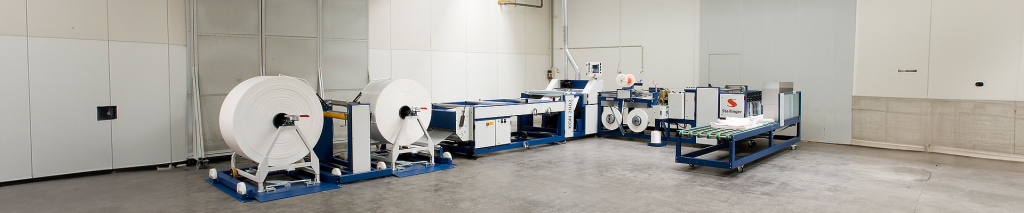
Controls: bond strength, coatweight uniformity, residual solvent (if any), flatness. - Slitting, tubing, and bottoming. Laminates slit to width; tubers form side seams; bottomers create pinch or block bottoms; valves inserted for industrial SKUs.
Controls: seam shear/t‑peel, squareness, valve insertion tolerance. - Features & finishes. Micro‑perfs, anti‑slip coats, easy‑open notches, reclose zippers, protective varnishes at high‑rub zones.
Controls: perforation density map, CoF (static/dynamic), varnish cure and rub index. - Final QA & documentation. Dimensional checks, drop tests, bond/seam data, print legibility, food‑contact or electrostatic documentation as applicable.
Controls: acceptance sampling, retained-sample policy, CoA content tied to lot codes.
What is the application of Printed BOPP Woven Bags? sectors, physics, and selection logic
Applications follow physics first (particle size, cohesion, bulk density, moisture/oxygen sensitivity), line realities next (fill method, rate, de‑aeration, seal), and context last (sun, rain, retail scuff, reuse ambitions). Patterns emerge across sectors.
Rice, grains, and staples
Matte BOPP with tactile varnish conveys natural quality; internal liners secure moisture control. Optional windows exist but must be reconciled with recyclability goals and seal integrity.
Pet food and animal nutrition
Grease resistance, puncture tolerance, and photo‑grade graphics rule. Reclose features increase home convenience; anti‑scuff varnish protects high‑touch brand zones.
Seeds and fertilizers
Abrasion‑prone fertilizers demand robust exteriors; coated seeds appreciate low‑dust valves and controlled venting. UV‑stabilized PP extends life in seasonal outdoor storage.
Cement and mineral powders
Valve designs plus micro‑perfs enable clean, fast filling and de‑aeration; block‑bottoms improve pallet cube and stability through intermodal routes.
Chemicals and additives
When moisture is the primary threat, a simple BOPP skin suffices; where aroma/oxygen matters, a liner is justified—paired with disciplined claims on end‑of‑life.
E‑commerce and retail logistics
Scuff‑resistant exteriors and anti‑slip stacks reduce damages during last‑mile handling; QR‑enabled labels streamline returns and batch tracing.
Printed BOPP Woven Bags: innovations and future trends in the Chinese market
The Chinese market blends huge domestic demand for staples, world‑class converting capacity, rapid brand segmentation, and a policy climate that rewards circularity and safer production. The past year revealed four arcs of change that directly touch Printed BOPP Woven Bags.
Arc 1 — Design‑for‑recycling and mono‑material bias
Spec writers increasingly prefer mono‑PP builds: BOPP + PP fabric + PP tie layer, avoiding mixed polymers that perplex sorting. Inks and primers shift toward de‑inkable, wash‑off systems validated in hot‑wash trials. Claims are geographically scoped to reflect the current patchwork of flexible PP collection.
Arc 2 — Short‑run agility with HD flexo and digital accents
SKU proliferation in rice, pet food, and specialty agriculture drives HD flexo adoption and late‑stage digital over‑print for regional or seasonal marks. The upshot: faster design refreshes, less plate waste, lower obsolescence.
Arc 3 — Instrumented lines and capability‑driven downgauging
Inline cameras map pinholes and print defects; coatweight sensors cut variation. With capability proven, converters thin films and lighten fabrics without sacrificing outcomes—an efficiency and carbon win.
Arc 4 — Cleaner chemistries and integrated management systems
Solvent‑free PU lamination and high‑solids water‑based inks reduce VOCs and odors. Plants align ISO 9001 (quality) with ISO 14001 (environment) and, for food‑adjacent SKUs, FSSC 22000/ISO 22000 (food‑safety). Audits emphasize chemical inventory control, PPE, and exhaust handling.
System thinking for Printed BOPP Woven Bags — decompose, solve, recombine
A resilient program treats performance, compliance, cost, and brand experience as interacting subsystems. Below each subsystem is parsed into a problem, an analysis, and a solution pattern—and then recombined into a portfolio you can scale.
Subsystem A — Functional performance (barrier, strength, machinability)
- Problem: Meet moisture/grease targets and cube stability without over‑engineering.
- Analysis: Moisture‑only threats favor BOPP skin + optional thin coatings; oxygen‑sensitive SKUs justify liners; baffles and anti‑slip often beat heavier fabrics for pallet stability.
- Solution: Three platforms—mono‑PP for minerals; liner‑assisted food‑grade for staples; enhanced‑barrier only with shelf‑life data.
Subsystem B — Compliance and auditability
- Problem: Align food‑contact, labeling, and recyclability claims across domestic and export markets.
- Analysis: Keep declarations mapped to EU 10/2011 with EN 1186 testing and to FDA 21 CFR 177.1520/175.105 where applicable; scope recyclability claims to collection realities.
- Solution: Maintain a per‑SKU dossier (drawings, BoMs, migration reports, test data) accessible via on‑bag QR.
Subsystem C — Cost and carbon
- Problem: Lower delivered cost while showing emissions progress.
- Analysis: Downgauging saves resin if process capability is proven; solvent‑free laminations reduce oven energy; block‑bottoms raise pallet density and trim transport emissions per tonne.
- Solution: Track kg CO₂e per bag and per tonne moved; make BOM choices with those numbers present at the table.
Subsystem D — Brand and user experience
- Problem: Achieve shelf differentiation without fragile finishes and enable intuitive opening/closing.
- Analysis: Matte + tactile varnish for a paper‑like feel; selective gloss for premium cues; tear notches and zippers reduce tool dependence.
- Solution: Standardize finish libraries and iconography; validate rub and opening forces in field pilots.
Integration principle: Let physics, the filling line, and local waste systems vote with equal weight when choosing Printed BOPP Woven Bags architectures.
Professional standards, certifications, and test identifiers
Credible programs reference specific, current identifiers. While sack‑specific standards vary by buyer, the following appear routinely in RFQs, audits, and certificates of analysis for Printed BOPP Woven Bags supply chains.
- ISO 9001 — quality management in converting plants.
- ISO 14001 — environmental management, capturing aspects/impacts and legal compliance.
- FSSC 22000 / ISO 22000 — food‑safety management where liners and cleanroom controls apply.
- ISO 21898 — performance envelopes for flexible bulk containers; drop/cyclic tests inspire sack test plans.
- ASTM F1249 and ASTM D3985 — WVTR and OTR for barrier liners where used.
- IEC 61340‑4‑4 — electrostatic behavior where combustible dusts are relevant and static‑managed sacks are requested.
- EU 10/2011 with EN 1186; FDA 21 CFR 177.1520/175.105 — food‑contact declarations for liners/inks/adhesives as applicable.
| Dimension | Typical Method | Indicative Target / Notes |
|---|---|---|
| Fabric weight | Gravimetric (gsm) | 55–140 g/m² depending on duty cycle and abrasion |
| Film gauge | Micrometer (µm) | 15–35 µm; matte at higher gauges for stiffness and scuff control |
| Bond strength | Peel (e.g., ASTM F88 surrogate) | > 2.0 N/15 mm typical; tuned by geometry and varnish plan |
| WVTR / OTR (liners) | ASTM F1249 / ASTM D3985 | Set by shelf‑life targets; avoid over‑specification where unnecessary |
| CoF (anti‑slip) | Static/Dynamic friction | Raise to reduce pallet collapse; verify with filled‑bag tests |
Comparative specification table for Printed BOPP Woven Bags platforms
Values are indicative starting points; validate in lab and line trials.
| Parameter | Standard mono‑PP (BOPP//PP) | Liner‑assisted food grade | Enhanced‑barrier variant |
|---|---|---|---|
| Fabric weight (g/m²) | 70–100 | 80–110 | 90–120 |
| BOPP film (µm) | 15–25 | 20–30 (matte/gloss) | 25–35 (often matte) |
| Liner (µm) | — | 60–120 LDPE/LLDPE | 80–120 with optional EVOH |
| Closure | Pinch/heat seal/sew | Pinch hotmelt + heat seal | Heat seal + valve or reclose |
| Anti‑slip | Optional | Recommended | Recommended |
| WVTR target (g/m²·day, 38°C/90%RH) | 5–15 | 2–8 | 0.5–5 |
| OTR target (cc/m²·day, 23°C/50%RH) | N/A (no oxygen barrier) | 500–1,500 (liner dependent) | 2–10 (with EVOH) |
| Typical uses | Minerals, fertilizers | Rice, grains, pet feed | Aroma‑sensitive foods |
Worked examples — align requirements with Printed BOPP Woven Bags architectures
10 kg premium basmati rice (retail)
Goal: premium shelf presence, clean handling, six‑month moisture control. Build: 85 g/m² fabric; 25 µm matte BOPP; internal 80 µm LDPE form‑fit liner; pinch‑bottom hotmelt; easy‑open notch. Why: matte signals quality; liner secures moisture; pinch geometry curbs sifting.
25 kg white cement (export)
Goal: fast valve filling, low dusting, cube‑stable pallets. Build: 100 g/m² fabric; 20 µm gloss BOPP; micro‑perfs; block‑bottom valve; anti‑slip varnish. Why: micro‑perfs and valve speed fill and de‑air; anti‑slip protects stacks in intermodal chains.
15 kg dry dog food (grease/aroma)
Goal: grease resistance and controlled aroma with durable matte print. Build: 95 g/m² fabric; 25 µm matte BOPP; 90 µm LLDPE liner; zipper reclose; anti‑scuff varnish at print zones. Why: liner secures seals and grease barrier; varnish preserves brand legibility.
Procurement and qualification checklist
- Define physics. Particle size, bulk density, cohesion/abrasiveness, moisture/oxygen sensitivity.
- Map the line. Fill method and rate, de‑aeration, sealing, pallet pattern.
- Pick the platform. Mono‑PP, liner‑assisted, or enhanced‑barrier; specify baffles and anti‑slip.
- Demand the stack. Layer‑by‑layer structure with gauges and coatweights; include valve materials.
- Request proof. Bond/seam tests, drop tests, WVTR/OTR (if relevant), rub resistance, CoF, migration reports for food SKUs.
- Pilot. Run on actual lines; measure fill time, dust loss, discharge completeness, pallet stability, scuffing.
- Lock and monitor. Freeze drawings and BoMs; set KPIs (returns, breakage, complaints); enforce change control.
Risk register and mitigations
- Delamination under thermal/mechanical stress. Verify dyne levels; hold adhesive cure windows; run routine bond tests.
- Pallet slip. Specify anti‑slip exteriors; confirm static/dynamic friction with filled‑bag tests.
- Scuffing/print loss. Protect with over‑varnish at high‑rub zones; validate wet‑rub indices.
- Valve dust leakage. Tighten dimensional tolerance; trial self‑sealing valves; tune micro‑perfs for de‑airing without dusting.
- Over‑claiming recyclability. Constrain claims to regions with flexible PP collection; publish disassembly guidance where liners are used.
- Food‑contact non‑conformance. Maintain substance registers; perform migration tests; link declarations to lot codes.
Internal reference link
For format context and adjacent constructions, see Printed BOPP Woven Bags in a broader catalog of laminated BOPP woven options. This single internal link anchors the keyword and keeps navigation simple.
- What is Printed BOPP Woven Bags? definition, adjacent names, and why the format keeps winning
- The material of Printed BOPP Woven Bags — architecture, properties, and cost levers
- What are the features of Printed BOPP Woven Bags? translate specs into outcomes
- What is the production process of Printed BOPP Woven Bags? choreography with measurable consequences
- What is the application of Printed BOPP Woven Bags? sectors, physics, and selection logic
- Printed BOPP Woven Bags: innovations and future trends in the Chinese market
- System thinking for Printed BOPP Woven Bags — decompose, solve, recombine
- Professional standards, certifications, and test identifiers
- Comparative specification table for Printed BOPP Woven Bags platforms
- Worked examples — align requirements with Printed BOPP Woven Bags architectures
- Procurement and qualification checklist
- Risk register and mitigations
- Internal reference link
- 1. Technical Challenges and Solutions in Fertilizer Packaging
- 2. Regulatory Compliance and Parameter Selection
- 3. VidePak’s Competitive Edge
- FAQs: Printed BOPP Woven Bags
“Printed BOPP woven bags are no longer just packaging—they’re a strategic tool for brand differentiation and chemical safety,” asserts Ray, CEO of VidePak, during a factory tour. “By integrating UV-resistant additives, multi-layer lamination, and IoT-enabled quality control, we’ve reduced moisture-related spoilage by 40% for fertilizer clients while achieving 10-color CMYK printing precision at 1440 dpi.” This report explores the technical advancements, regulatory landscapes, and market strategies shaping China’s printed BOPP woven bag industry, with a focus on chemical fertilizer applications and VidePak’s 17-year expertise in high-performance packaging solutions.
1. Technical Challenges and Solutions in Fertilizer Packaging
1.1 Core Performance Requirements
Chemical fertilizers demand packaging that balances durability and functionality:
- Moisture Resistance: PE-coated BOPP bags achieve water vapor transmission rates (WVTR) <0.5 g/m²/day, critical for ammonium nitrate storage in humid regions like Guangdong.
- Corrosion Resistance: Anti-static carbon black additives (1.5–2.0% concentration) reduce surface resistivity to 10⁶–10⁸ Ω/sq, preventing ignition risks in explosive environments.
- Thermal Management: Laser-perforated microvents (0.3 mm diameter) enable 0.5 CFM/ft³ airflow, preventing heat buildup in urea granules during storage.
VidePak’s AgriShield Pro series combines 90 g/m² BOPP fabric with 20 µm PE liners, achieving 2,800 N/5 cm tensile strength while complying with China’s GB/T 8946-2013 standard for chemical packaging.
1.2 Material Innovations
| Additive | Function | Concentration | Standard Compliance |
|---|---|---|---|
| Hindered Amine Light Stabilizers (HALS) | Extends UV resistance from 500 to 2,000 hours | 0.3–0.5% | ISO 4892-3 |
| Irganox 1010 | Reduces oxidative degradation by 70% at 200°C | 0.1–0.2% | FDA 21 CFR 178.2010 |
| Calcium Carbonate Fillers | Enhances stiffness and reduces cost by 15% | 10–15% | EU REACH |
Case Study: A Shandong-based fertilizer producer reduced spoilage losses by 28% using VidePak’s SolarGuard bags, which incorporate TiO₂-coated BOPP layers to reflect 90% UV radiation.
2. Regulatory Compliance and Parameter Selection
2.1 Global Standards Comparison
- EU REACH: Limits heavy metal migration to <0.1% and mandates ≥65% recyclability.
- US FDA 21 CFR 177.1520: Requires melt flow rates (MFR) of 2–4 g/10 min for thermal stability.
- China GB/T 8946-2013: Specifies tensile strength ≥2,500 N/5 cm and oxidation induction time (OIT) >30 minutes.
VidePak’s EcoFlex 5500 resin meets all three standards, with an OIT of 45 minutes and MFR of 3.2 g/10 min, optimized for Starlinger’s CX6 extrusion lines.
2.2 Customization by Application
- Compound Fertilizers: Require 3-layer BOPP/PE/Aluminum structures for moisture and gas barrier protection.
- Potash: Use anti-static coatings and block-bottom designs to prevent dust explosions during transport.
3. VidePak’s Competitive Edge
3.1 Production Capabilities
With 100+ circular looms and 30 lamination machines, VidePak achieves:
- Precision Printing: 10-color CMYK+Pantone customization at 450 bags/hour, ideal for branded agrochemical packaging.
- Lean Manufacturing: AI-guided cutting reduces PP waste to 1.8% (industry average: 8%).
Case Study: A 2024 partnership with a Jiangsu fertilizer brand utilized RFID-enabled FIBC bags to automate inventory tracking, reducing logistics errors by 25%.
3.2 Sustainability Initiatives
- Recycled PP Blends: 30% post-industrial recycled content reduces carbon footprint by 22% (ISO 14044-certified).
- Solar-Powered Facilities: 2MW rooftop photovoltaic systems offset 15% of energy costs.
FAQs: Printed BOPP Woven Bags
Q1: How to prevent seam failure in high-humidity environments?
A: VidePak’s ultrasonic sealing technology achieves 98% airtightness, validated by ISO 2233 testing.
Q2: What’s the cost difference between PE-lined and aluminum-laminated bags?
A: Aluminum laminates cost $0.50–0.80/m² vs. $0.18–0.25/m² for PE, but offer 10x lower WVTR.
Q3: How do UV stabilizers impact bag lifespan?
A: HALS additives extend outdoor usability from 6 to 24 months under 500 kWh/m² UV exposure.
Conclusion
The future of printed BOPP woven bags lies in smart materials and circular economies. VidePak’s R&D pipeline includes graphene-enhanced barriers and blockchain-tracked recycling systems, positioning it to lead China’s $8.2 billion agrochemical packaging market. As Ray emphasizes: “In a market driven by ESG, quality isn’t an expense—it’s your license to operate.”
External Links:
- Explore moisture-proof innovations: Moisture-Proof Woven Bags: Versatile Solutions for Diverse Applications.
- Learn about global regulatory compliance: Polypropylene Bags: Meeting Regulatory Standards and ESG Commitments.