
What is **Printed Woven Bags: Innovation in Waste Management and Recycling Solutions**?
In municipalities, on construction sites, across campus events, and throughout private hauling fleets, a quiet transformation is underway: collection containers are becoming information surfaces. This is the signature of Printed Woven Bags: Innovation in Waste Management and Recycling Solutions. At its core, the product is a durable woven polymer sack—most often polypropylene—that carries legible, abrasion‑resistant messages rendered by flexographic, gravure, or digital printing. In everyday usage you may hear aliases such as printed PP woven sacks, printed poly woven bags, printed laminated woven bags, or—when the format grows to bulk dimensions—printed big bags and printed totes. The common thread is not only the fabric; it is the ambition. Containers must carry weight, but they also must carry meaning: sorting rules, safety notices, quick‑response codes, even dynamic identifiers for route optimization.
Why does this matter now? Because policy, technology, and behavior are converging. Standardized labeling schemes are spreading. Trials of digital watermarks and large QR codes continue to scale. Packaging rules in multiple jurisdictions now ask not merely for recyclability in theory, but for proof of recyclability in practice. In this climate, Printed Woven Bags: Innovation in Waste Management and Recycling Solutions stands out by pairing rugged mechanics with robust communication.
The material system behind **Printed Woven Bags: Innovation in Waste Management and Recycling Solutions**
These bags are not monolithic; they are layered systems. Each layer contributes a function—load, print, seal, signal—and each choice carries implications for cost and end‑of‑life. Understanding the bill of materials allows engineers and buyers to adjust variables without breaking recyclability or durability.
1) Woven base fabric
Isotactic polypropylene tapes, extruded, slit, and drawn to 5–7× orientation, are woven into fabric. Fabric weight (e.g., 70–130 gsm for smaller sacks, 140–220 gsm for heavy‑duty reuse), tape denier (600–1800D), and picks per inch (10–16) define the mechanical envelope: tear resistance, seam efficiency window, and stack behavior. UV stabilizers extend life during outdoor dwell.
“Strength per kilogram is the decisive metric when you carry tonnes across seasons.”
2) Surfaces for print
Two dominant routes exist. (a) Coating: a thin PP extrusion coating (20–40 g/m²) closes the weave and accepts ink. (b) Lamination: a BOPP film (15–35 µm) is extrusion‑ or adhesive‑laminated onto the fabric, enabling photo‑quality graphics and superior rub resistance. The first is simpler for recycling; the second maximizes legibility and brand fidelity.
3) Inks & varnishes
Solvent flexo and gravure remain workhorses; water‑based systems and digital inkjet/UV are growing where emissions/variability or variable data matter. Targets include rub resistance (e.g., Sutherland or ISO 2836), outdoor lightfastness, and scan reliability for QR/linear barcodes after abrasion.
4) Adhesives & tie layers
Lamination may require tie layers; their chemistry influences recyclability (wash‑off behavior, ash, gel formation). Buyers increasingly request low‑ash, polyolefin‑compatible systems to protect melt‑filter uptime at recyclers.
5) Threads, hems, reinforcements
PP or polyester threads, binding tapes, reinforced bottoms, and handle patches turn a printed sheet into a route‑ready container. The cheapest place to fail is the stitch; SPI and thread/fabric compatibility matter.
6) Optional liners
PE or PP liners manage moisture/odour for organics. To preserve mono‑polyolefin recyclability, prefer separable liners and put removal cues on‑bag.
Put together, these elements create a balanced stack: the fabric bears weight; the surface carries graphics; the ink carries meaning; the adhesive binds layers; the stitches finish the geometry. The art is trade‑offs: a slightly heavier coating may save a lamination and simplify recycling; a lamination may prevent rub‑off and keep instructions readable after months of rain.
Characteristic strengths of **Printed Woven Bags: Innovation in Waste Management and Recycling Solutions**
Not all bags behave the same on a wet curb or in a crowded MRF. The following attributes separate this category in day‑to‑day operations.
Durability and reuse
High tenacity at modest tare supports repeated curb‑to‑truck cycles. With UV stabilization and robust print layers, many programs achieve multi‑season life, cutting unit waste and labour disruptions.
Information persistence
Bold color fields, icons, multilingual text, and scannable codes remain legible after abrasion. Where watermarks or large QR codes are used, placement outside stitch‑heavy and high‑scuff zones preserves scan rates.
Policy alignment
Mono‑polyolefin designs, low‑residue inks, and compatible tie layers support claims of recyclability in practice—vital as regulators move from aspiration to audit.
Safety & ergonomics
Handle geometry, anti‑slip textures, and optional reflective strips improve crew control and nighttime visibility. Closure choices (drawstrings, fold‑and‑strap) limit litter escape without fighting gloves.
Civic identity
Color systems and succinct slogans turn the bag into moving signage, aiding wayfinding and boosting program participation.
How **Printed Woven Bags: Innovation in Waste Management and Recycling Solutions** are produced
Manufacturing converts commodity pellets and blank films into legible infrastructure. Each step creates a lever for performance, cost, and end‑of‑life outcomes.
Extrusion & drawing
PP film extruded ~220–250 °C → slit → drawn 5–7× to raise tenacity and reduce creep. Chill‑roll 25–35 °C helps gauge control. UV/antioxidant packages tuned to outdoor dwell.
Weaving & heat‑setting
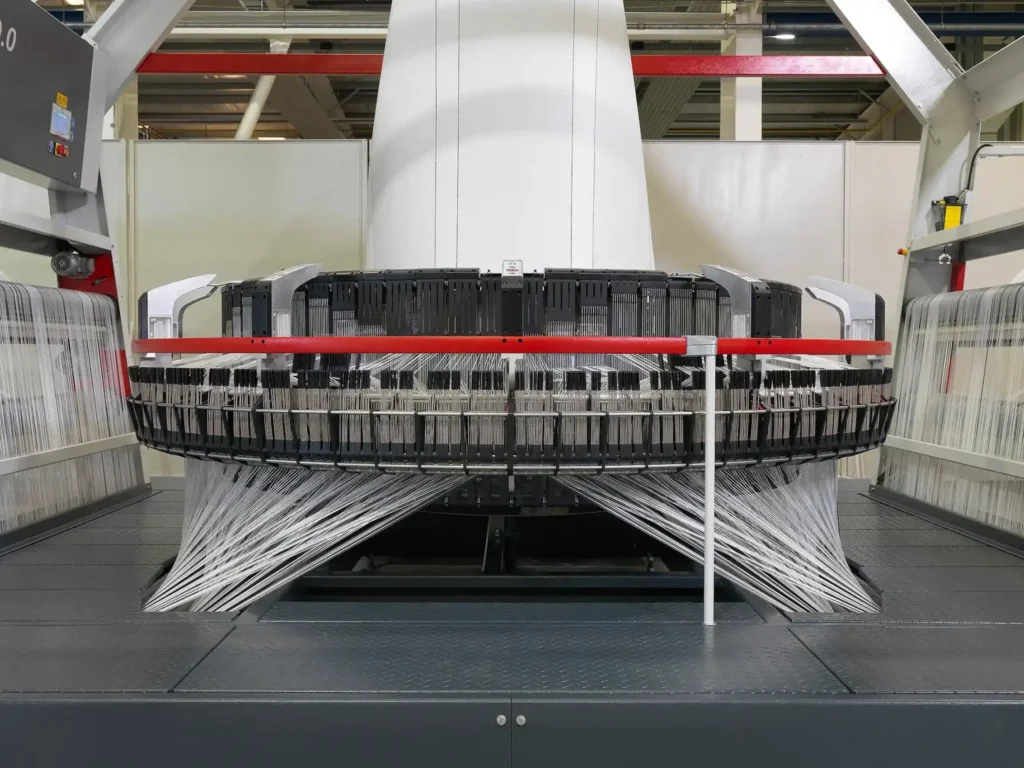
Flat/circular looms interlace tapes; ppi and denier set strength and surface. Heat‑setting stabilizes dimensions pre‑lamination.
Coating/lamination + surface prep
PP extrusion coating (20–40 g/m²) or BOPP lamination (15–35 µm). Corona treatment raises surface energy for ink anchorage. Adhesive choice steers recyclability.
Printing
Flexo/gravure for large runs; digital for variable data. Ink recipes balance rub resistance, UV stability, and recyclability. Machine‑readable marks use explicit module sizes and quiet zones.
Conversion & finishing
Cutting, hemming, handle/loop attachment, gusseting. Reinforced bottoms protect against pallet edges. Closures tuned for gloved hands.
Quality assurance
Panel/ seam tests; Sutherland/ISO 2836 rub; UV exposure targets; dimensional checks; scanner tests at set angles/distances to simulate field use.
Where **Printed Woven Bags: Innovation in Waste Management and Recycling Solutions** are used
- Curbside recycling: plastics, metals, and glass with clear stream colors and QR‑aided guidance.
- Organics & yard waste: puncture‑resistant sacks with weight‑limit prints and moisture‑tolerant surfaces.
- Construction & demolition micro‑streams: rubble bags with icons for permitted contents and QR booking for pickups.
- Textile and e‑waste take‑back: durable sacks with iconography for battery safety and contact channels.
- Campus & events: color‑coded containers serving double duty as wayfinding under crowd pressure and rain.
A systems view of **Printed Woven Bags: Innovation in Waste Management and Recycling Solutions**
The headline promises innovation on two fronts: waste management and recycling solutions. Achieving both requires four subsystems that reinforce each other: information, mechanics, end‑of‑life, and assurance.
Information subsystem
Goal: raise correct set‑out and sorting. Moves: standard color/icon systems, readable type at 2–5 m, QR layout rules, watermark‑safe zones. Measure: scan success after abrasion, resident comprehension, contamination deltas.
Mechanical subsystem
Goal: survive handling with low failure. Moves: tune gsm/denier; reinforce handles; select closures for gloves; add reflectivity. Measure: failure rate per 1,000 lifts; crew near‑misses; tear incidents.
End‑of‑life subsystem
Goal: recyclability in practice. Moves: mono‑PP stack; low‑residue inks; compatible tie layers; separable non‑PP components. Measure: wash yield, melt‑filter uptime, ash content, market acceptance.
Assurance subsystem
Goal: audit‑ready compliance. Moves: current QMS/EMS certificates, recyclability language per 2025 rules, clear Declarations for inks/films. Measure: audit findings, tender acceptance, documentation cycle time.
Integration turns four lists into one specification. It defines numbers—not vibes—for gsm, denier, ppi, SPI, UV hours, rub class, QR contrast, and recyclability tests. It binds responsibilities across suppliers and routes, so the bag you validated is the bag you receive.
Standards, identifiers, and third‑party signals relevant to **Printed Woven Bags: Innovation in Waste Management and Recycling Solutions**
The last 12 months have reinforced a practical toolkit of references that procurement and QA teams can cite without hand‑waving:
- ISO 21898:2024 (flexible containers for non‑dangerous goods) — a vocabulary and testing backbone for woven container mechanics, particularly stacking and seam logic in heavy reusable sacks.
- ISO 18604 (material recycling) — framework for evaluating packaging against material recycling pathways; useful when documenting mono‑PP designs.
- BRCGS Packaging Materials, Issue 6 (position statements current through 2024/2025) — hygiene/quality scaffolding for converters, particularly where clean conversion areas and ink management matter.
- EU Packaging & Packaging Waste Regulation (entered into force 2025) — anchors claims around recyclability “in practice and at scale”; pushes liner/seal choices toward separable, mono‑material logic.
- Printing ink industry guidance — low‑odor, low‑migration systems for environmental profiles; durability remains the driver for waste‑system bags.
Parameter tables for **Printed Woven Bags: Innovation in Waste Management and Recycling Solutions**
The following color tables are starting points, not commandments. Use them to frame pilot trials, then tighten ranges once your own data replaces assumptions.
structureprintreadabilityrecyclability
| Parameter | Light‑duty collection | Standard curbside | Heavy‑duty reuse |
|---|---|---|---|
| Fabric gsm | 70–90 | 90–120 | 120–160 |
| Tape denier | 600–900D | 800–1200D | 1000–1500D |
| Weave (ppi) | Plain, 10–12 | Plain/Twill, 12–14 | Plain/Twill, 14–16 |
| Coating (PP) | 20–30 g/m² | 25–35 g/m² | 30–40 g/m² |
| Lamination (BOPP) | Optional 15–25 µm | Optional 20–30 µm | Optional 25–35 µm |
| UV stabilization | ≥ 200 h equiv. | ≥ 300 h equiv. | ≥ 500 h equiv. |
| Seam SPI | 7–8 | 8–10 | 9–11 |
| Handle reinforcement | Single tape | Double tape | Double + patch |
| Print/Readability | Light‑duty | Standard | Heavy‑duty |
|---|---|---|---|
| Print method | Flexo (2–3 colors) | Flexo/Gravure (≤6 colors) | Gravure/Digital hybrid |
| Ink system | Solvent or water‑based | Solvent low‑odor | Solvent + over‑varnish |
| Rub resistance | ≥ Medium | High | Very high |
| QR module | ≥ 6 mm | ≥ 8 mm | ≥ 8 mm |
| Contrast ratio | ≥ 60% | ≥ 70% | ≥ 70% |
| Recyclability element | Preferred choice | Rationale |
|---|---|---|
| Material stack | PP fabric + PP coating/BOPP | Mono‑polyolefin supports mechanical recycling yields |
| Adhesives | Compatible tie layers; low‑ash | Protects melt‑filter uptime; avoids gels |
| Inks | Low‑residue, wash‑compatible | Reduces specking; preserves melt quality |
| Closures | PP‑based, removable | Mono‑material or separable non‑PP |
| Labels/Tags | PP or removable | Avoids contamination |
Ninety‑day action plan for **Printed Woven Bags: Innovation in Waste Management and Recycling Solutions**
- Run a mini DOE on gsm and SPI. Four‑week pilot; correlate failures with load and weather; tune gsm rather than reflexively adding weight.
- Validate print after abrasion. Tumble tests; measure QR/barcode readability pre/post; adjust ink/varnish if contrast dips below thresholds.
- Instrument the bag. Use batch‑level QR to capture set‑out issues, contamination notes, and route feedback—turn the container into a data surface.
- Harden recyclability language. Require ≤12‑month evidence that materials pass practical recycling criteria; avoid legacy, generic claims.
- Train crews. One‑pagers on handle use, closures, and visibility features; many failures are behavioral, not material.
FAQ for **Printed Woven Bags: Innovation in Waste Management and Recycling Solutions**
Are these better than rigid crates? Sometimes. Bags win where space is constrained, collapsibility matters, and vehicles benefit from flexible packing. Crates win in highly standardized, mechanized routes with minimal contamination.
Can heavy PP coating replace BOPP for recyclability? Often yes. Coating can provide adequate print adhesion and scuff resistance while keeping structures simpler for recycling. When photorealism or ultra‑high contrast is mandatory, BOPP still leads.
Do digital watermarks work? Trials show promise, especially when watermarks sit away from stitch lines and high‑scuff zones. The layout discipline is as important as the technology.
Do food‑contact rules apply? Typically no, since direct food contact is not the intended use. Still, low‑odor inks and good manufacturing practice reduce nuisance complaints and expand repurposing options.
How do we keep print readable for months outdoors? Specify UV‑stable inks, consider over‑varnish, and set minimum UV stabilization hours for the fabric. Verify using accelerated weathering before large tenders.
Are these bags recyclable in practice? In many regions, yes—when designed as mono‑PP, with low‑residue inks/adhesives, and when collections accept woven PP. Provide sorting instructions so they do not slip into incompatible streams.
One internal reference for **Printed Woven Bags: Innovation in Waste Management and Recycling Solutions**
For a closely related format that often underpins high‑fidelity print, see Printed Woven Bags: Innovation in Waste Management and Recycling Solutions. Treat it as a nearby category map rather than a substitute for testing.
Case vignette — a coastal city’s plastics stream with **Printed Woven Bags: Innovation in Waste Management and Recycling Solutions**
Situation. A coastal municipality faced high contamination in its plastics stream and frequent splits during wet, windy months. Existing sacks were thin‑coated woven PP with faded print and no standardized color system.
Intervention. Upgraded to PP coating at 30 g/m² and solvent low‑odor inks with over‑varnish; introduced high‑contrast icons and large QR codes to a multi‑language micro‑site; raised fabric from 85→105 gsm; doubled handle reinforcement; added reflective strips.
Results (10 weeks). Near‑misses fell; tear incidents dropped by 60%; plastics contamination declined by 18%. Resident survey uptake via QR hit 23%, surfacing route‑level tweaks for set‑out rules.
Lesson. Treat the container as both infrastructure and communication; printing and mechanics succeed together or fail together.
- What is **Printed Woven Bags: Innovation in Waste Management and Recycling Solutions**?
- The material system behind **Printed Woven Bags: Innovation in Waste Management and Recycling Solutions**
- Characteristic strengths of **Printed Woven Bags: Innovation in Waste Management and Recycling Solutions**
- How **Printed Woven Bags: Innovation in Waste Management and Recycling Solutions** are produced
- Where **Printed Woven Bags: Innovation in Waste Management and Recycling Solutions** are used
- A systems view of **Printed Woven Bags: Innovation in Waste Management and Recycling Solutions**
- Standards, identifiers, and third‑party signals relevant to **Printed Woven Bags: Innovation in Waste Management and Recycling Solutions**
- Parameter tables for **Printed Woven Bags: Innovation in Waste Management and Recycling Solutions**
- Ninety‑day action plan for **Printed Woven Bags: Innovation in Waste Management and Recycling Solutions**
- FAQ for **Printed Woven Bags: Innovation in Waste Management and Recycling Solutions**
- One internal reference for **Printed Woven Bags: Innovation in Waste Management and Recycling Solutions**
- Case vignette — a coastal city’s plastics stream with **Printed Woven Bags: Innovation in Waste Management and Recycling Solutions**
H1: Introduction
“Printed woven bags are not just packaging—they’re a critical enabler of efficient waste segregation and recycling,” asserts Ray, CEO of VidePak, during a 2025 sustainability summit. The success of these bags hinges on three pillars: high-precision printing for clear waste categorization, robust material engineering for durability, and compliance with global environmental standards. This report explores how VidePak’s 30+ years of expertise and Starlinger-driven production lines address these demands, focusing on applications in municipal waste collection, recycling programs, and industrial scrap management.
H2: The Role of Printed Woven Bags in Waste Management
Printed woven bags serve as frontline tools for waste segregation, enabling municipalities and industries to streamline recycling processes. Key applications include:
- Municipal Waste Collection: Color-coded bags for paper, plastics, and organic waste, reducing cross-contamination by 60%.
- Industrial Scrap Storage: Heavy-duty PP bags (150–200 g/m²) with UV-resistant prints for metal shavings or construction debris, withstanding 8-meter stacking heights per JIS Z 1539.
- E-Waste Transport: Anti-static laminated bags to prevent electrostatic damage during electronics recycling.
VidePak’s Starlinger circular looms produce fabrics with 12×12 strands per inch, minimizing pore sizes to <0.1 mm—critical for containing fine particulates like concrete dust or biomass residues.
H2: Technical Specifications and Customization
H3: Material and Printing Parameters
| Parameter | Standard Bags | Premium Bags | Compliance |
|---|---|---|---|
| Grammage | 90–120 g/m² | 150–200 g/m² | ASTM D5265 (burst ≥350 kPa) |
| Print Technology | CMYK screen printing | BOPP lamination + digital | ISO 2846-1 color standards |
| Lamination | None | 20–25 µm PE/BOPP | EN 277 (moisture ≤5 g/m²/day) |
| UV Resistance | 500-hour exposure | 1,000-hour exposure | AS 2074 (Australia) |
H3: Cost-Benefit Analysis
- Economy Grade: $0.15–0.25 per unit (uncoated PP, ideal for dry waste).
- Premium Grade: $0.35–0.50 per unit (BOPP-laminated, 30% longer lifespan in humid climates).
H2: Quality Control and Compliance
H3: Supplier and Material Vetting
VidePak’s supply chain adheres to ISO 9001 protocols, sourcing PP resins exclusively from BASF and Sinopec. Key checks include:
- MFI Testing: Ensures melt flow consistency (12±0.5 g/10 min) for uniform extrusion.
- Tensile Strength: ≥35 MPa via ASTM D638, validated by third-party labs like SGS.
- Chemical Safety: REACH-compliant, phthalate-free formulations for EU markets.
H3: Case Study: Urban Recycling Program in Germany
A 2024 project required color-coded bags for Berlin’s zero-waste initiative:
- Design: 120 g/m² PP + 20 µm BOPP, with QR codes for waste tracking.
- Outcome: 40% improvement in sorting efficiency, achieving DIN CERTCO certification.
H2: FAQs on Printed Woven Bags
Q1: How does grammage affect moisture resistance?
Higher grammage (e.g., 150 g/m²) reduces water vapor transmission by 50% but increases material costs by 20%.
Q2: Are laminated bags recyclable?
Yes. VidePak’s BOPP-PE laminates are compatible with standard PP recycling streams, per ISO 15270 guidelines.
Q3: What certifications apply to US recycling programs?
ASTM D5265 for strength and FTC Green Guides for recyclability claims are mandatory.
H2: Sustainability and Future Trends
- Smart Labels: RFID tags for real-time waste volume monitoring (piloted in 2026).
- Bio-Based Inks: Soy/water-based inks reducing VOC emissions by 70%.
- Circular Design: 30% post-consumer recycled PP by 2027, cutting carbon footprint by 1.5 kg per bag.
H2: Conclusion
Printed woven bags are evolving into intelligent, sustainable tools for waste management. VidePak’s Starlinger-powered automation and ISO-certified processes position it as a global leader. For municipalities and industries, prioritizing parameters like lamination, UV resistance, and regulatory alignment is critical to achieving recycling targets.
External Links:
- Explore high-precision printing techniques for waste categorization.
- Learn how sustainable materials reduce environmental impact.
This report synthesizes data from ASTM, EN, and JIS standards, alongside VidePak’s operational insights, to guide waste management authorities and ESG officers.