
What are Sewn Open Mouth Bags?
Sewn Open Mouth Bags—also referred to as SOM bags, sewn open‑mouth PP woven sacks, or sewn OM polywoven sacks—are heavy‑duty packages filled through a fully open throat and traditionally closed by stitching. Their newest evolution layers in ultrasonic sealing as a complementary or alternative closure, forming a hybrid “sewn‑plus‑sealed” architecture that curbs product sifting, elevates hygiene, and protects line speed. Put simply: the wide mouth makes filling fast; the fabric skeleton keeps structures intact; the hybrid closure keeps fines where they belong.
From a systems perspective, Sewn Open Mouth Bags integrate four subsystems into one coherent solution: (1) a textile skeleton for mechanical strength, (2) a surface program for graphics, friction, and scuff control, (3) a closure program that can combine stitching, tape, heat, and ultrasound, and (4) a governance layer of testing, documentation, and certifications. Tune all four, and plants see fewer split‑bag incidents, cleaner fillers, tighter pallets, and more predictable audits.
Because powders and granules are getting more diverse, dust KPIs stricter, and labor windows tighter. Sewn Open Mouth Bags answer with shovel‑friendly loading and upgraded, ultrasonic‑assisted sealing that cuts sifting without sacrificing pace.
What is the feature set of Sewn Open Mouth Bags?
We examine features as a system of four coupled pillars: mechanical integrity, product protection & hygiene, closure productivity (with ultrasonic sealing), and brand & compliance. Optimizing one pillar affects the others; the winning specification balances them against product risk, filling hardware, and logistics reality.
Pillar 1 — Mechanical Integrity
Background. Real supply chains are blunt instruments: conveyor edges, pallet corners, forklift tines. Strength must be measurable and repeatable, not hypothetical. Sewn Open Mouth Bags built on oriented PP tapes deliver that toughness with sensible mass.
- Fabric skeleton: Oriented polypropylene tapes around 700D–1200D, woven roughly 8×8 to 12×12 picks/inch, provide high strip tensile and puncture resistance for 10–50 kg fills.
- Seam architecture: Overlock/chain‑stitch programs with double‑turned bottoms distribute impact energy; a reinforced drag zone mitigates seam peel when bags are pulled across rough floors.
- Stack stability: Anti‑slip overprints target bag/bag COF ≈ 0.4–0.6, calming pallets on smooth decks and during vibration.
- Tensile/elongation: ISO 13934‑1 or ASTM D5035
- Tear propagation: ISO 13937
- Drop orientation: ISO 2206 / ISO 2248 (0.8–1.2 m typical for 25 kg)
- Compression: ASTM D642 (pallet top‑load)
- COF: ASTM D1894
A feed mill upgraded to Sewn Open Mouth Bags with 900D tapes and double‑turned bottoms. Edge‑drop failures dropped ~22% across a humid quarter with no change to pallet wrap settings.
Versus multiwall paper sewn sacks, PP woven SOM retains wet strength and resists puncture in coastal routes. Against valve sacks, SOM’s wide throat accepts coarse granules and mixed particle sizes with fewer jams.
Pillar 2 — Product Protection & Hygiene
Background. Hygroscopic powders and dusty blends expose closure weaknesses first: stitch holes and mis‑aligned crepe tape. The spec must moderate moisture and manage dust without choking filler speed.
- Liner strategy: Optional PE tubular liners (30–70 µm) narrow moisture variability for flour, sugar, and mineral premixes.
- Cleanable faces: Light PE coatings enable wipe‑down and heat/ultrasonic compatibility; matte print zones protect regulatory readability.
- Air management: Micro‑perfs above headspace vent trapped air on fast fills while protecting WVTR targets where liners are used.
- WVTR of film/liner: ASTM F1249
- Print rub resistance: ASTM D5264
- COF for pallet behavior: ASTM D1894
A premix packer added 40 µm liners and reduced perf count on dusty SKUs. Housekeeping minutes per shift fell; coastal‑lane caking complaints narrowed over two months.
Plain woven SOM bags breathe but can dust along stitch lines; liner‑equipped SOMs trade small airflow reduction for cleaner warehouses; laminated pouches can beat barrier yet often lose on 20–50 kg drop robustness.
Pillar 3 — Closure Productivity with Ultrasonic Sealing
Background. Sewing remains fast and forgiving. Ultrasonic sealing adds energy‑directed polymer fusion that closes needle paths, activates tapes, or replaces stitching entirely on coated fabrics. The point is not to dethrone sewing; the point is to upgrade it where dust, hygiene, or leak‑tightness define success.
- Stitch‑path sealing: A narrow ultrasonic pass after stitching fuses coating around needle holes, reducing sifting while preserving familiar seam geometry.
- Tape activation: With crepe or PP tapes, ultrasound bonds layers without stringing hot‑melt, cutting stray adhesive and lint.
- Stitch‑free option (coated fabrics): A full ultrasonic top seal yields a flatter, dust‑tight finish and removes thread as a variable for sensitive lines.
- Seal/peel strength: ASTM D903
- Dust capture at filler: plant SOP gravimetric before/after ultrasound
- Throughput timing: cycle‑time comparison vs. stitch‑only
A gypsum additive line retrofitted an inline ultrasonic bar after the sewing head. Sifter alarms fell by double digits; rework tickets declined; operators reported less thread dust on guides. Net pack time per bag remained effectively flat.
Sew‑only: lowest capex, universal, but more dust risk at needle holes. Ultrasonic‑only: best dust/hygiene on coated fabrics, tighter process control needed. Hybrid sew + ultrasonic: universal filling, near‑seal cleanliness—often the pragmatic optimum.
Pillar 4 — Brand & Compliance
On the shop floor, print is not decoration; it is navigation. Barcode readability, hazard clarity, and stable color are operational advantages.
- Readability: Matte panels preserve GS1 barcode grades (ISO/IEC 15416 ≥ 3.0 typical targets) under warehouse lighting and dust film.
- Color governance: ISO 12647 process control prevents SKU color drift across suppliers/seasons; ΔE SPC locks palettes.
- Documentation discipline: Stitched pockets protect DoCs and hazard labels through rub cycles and rain.
- Frameworks: ISO 9001:2015 (quality), ISO 14001:2015 (environment), ISO 22000:2018 / FSSC 22000 (where feed/food adjacency exists); material statements per FDA 21 CFR 177.1520 (PP) and EU 1935/2004 with (EU) 10/2011; EU 94/62/EC heavy‑metals total < 100 ppm; REACH (EC) 1907/2006 SVHC non‑intent.
What is the production process of Sewn Open Mouth Bags?
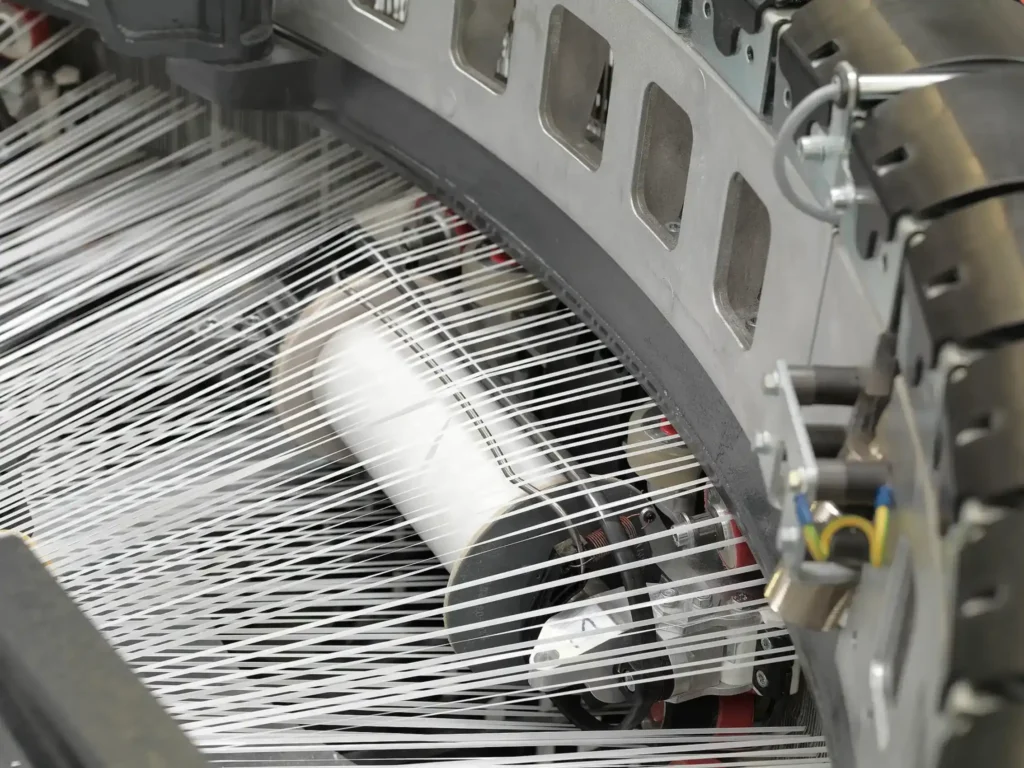
From resin to qualified bag, performance emerges from a linked chain: resin → tape extrusion & orientation → weaving → stabilization → printing/coating → cutting & stitching → optional ultrasonic sealing → finishing & QA. Each step sets constraints the next must respect.
- Resin & masterbatch
PP with antioxidant and UV packages; color masterbatches documented for REACH and EU 94/62/EC. - Tape extrusion & orientation
Cast film, slit, and draw to target denier (700D–1200D). Rounded tape edges reduce nick initiation at seams. - Weaving
Flat or circular looms build ~8×8 to 12×12 picks/inch fabrics. Tighter weave → higher burst & smoother print; looser weave → more venting at fill. - Stabilization
Heat setting locks dimensions and mitigates shrink near any heat/ultrasonic stations. - Printing & coatings
Flexo on treated fabric; optional light PE coating for wipe‑down and ultrasonic compatibility; matte zones for codes to reduce glare. - Cutting & stitching
Heat‑cut tops reduce fray; overlock/chain‑stitch seams; double‑turn bottoms for drag‑heavy routes. Stitch density and thread tex recorded on the spec sheet. - Ultrasonic sealing (where specified)
Narrow bar seals along the stitch path, or full‑width seal on coated fabrics. Parameters (amplitude, pressure, dwell) become part of the production router. - Finishing & QA
Routine tests: tensile/tear (ISO 13934‑1 / ISO 13937), drop (ISO 2206/2248), compression (ASTM D642), COF (ASTM D1894), peel/seal (ASTM D903), WVTR for any liner (ASTM F1249), rub (ASTM D5264), barcode grading (ISO/IEC 15416). Retained samples and batch CoAs per ISO 9001.
Typical T‑peel for tape/crepe interfaces after ultrasonic activation: ≥ 1.5–2.0 N/15 mm. Barcode grade targets: ≥ 3.0 after 200 Sutherland rub cycles.
Where stitch‑only closures leaked dusty premix, an ultrasonic “stitch‑path” pass cut visible plume while preserving stitch speed, avoiding capex for valve conversion.
Extrusion lamination yields the strongest bonds and best moisture continuity; adhesive lamination lowers heat exposure/odor for sensitive graphics. Either path pairs well with sew + ultrasonic closures when validated by peel/WVTR/drop matrices.
What is the application of Sewn Open Mouth Bags?
Sewn Open Mouth Bags shine wherever wide‑throat filling, rugged handling, and balanced dust control must coincide. They are a pragmatic choice for 10–50 kg SKUs across food/feed ingredients, minerals, agriculture, and industrial additives.
Food & Feed Ingredients
Flour, sugar, pellets: matte panels for legibility; optional liners; sew + ultrasonic for cleaner warehouses; micro‑perfs above headspace to maintain fill speed.
Minerals & Construction Powders
Calcium carbonate, gypsum: reinforced bottoms; localized perfs; stitched pockets for hazard panels; hybrid closure to tame dust at stitch line.
Agriculture & Seeds
Strong seams and anti‑slip faces for barn handling; tracer yarns for grade coding; liners for hygroscopic hybrids.
Industrial Additives
Mixed granules that resist valve spouts; SOM throats accept shovels/belts; ultrasonic sealing reduces housekeeping beneath fillers.
Common fills: 10/20/25/40/50 kg (validated at 0.8–1.2 m drops). Typical sizes: 45×75 cm and 50×80 cm for 25–50 kg (measured flat; tolerance ±10 mm). COF target ~0.4–0.6 on bag/corrugate; UV target ≈200–300 kLy for outdoor staging.
A coastal distributor specified liner‑equipped Sewn Open Mouth Bags with ultrasonic stitch‑path sealing. Moisture variance at intake narrowed; caking claims fell through monsoon months; operators reported less cleanup at the filler.
Valve sacks excel on ultra‑fine powders at high speed; FIBCs dominate 500–1000 kg bulk. For 10–50 kg, shovel‑friendly loads and mixed particle sizes, Sewn Open Mouth Bags—especially with ultrasonic sealing—offer the best blend of speed, cost, and cleanliness.
Typical Specifications & Test Methods (reference ranges)
Ranges reflect values commonly cited across peer supplier datasheets and marketplace listings. Always validate on your line and lanes.
Integrated Solution Blueprint (system synthesis)
- Map risk → choose closure. Dust‑prone premix: sew + ultrasonic stitch‑path sealing. Hygroscopic feed: add 40–60 µm liner + reduced micro‑perfs. Coarse granules: sew‑only with reinforced bottom for speed.
- Engineer for the lane. Validate COF on real pallet films (target ≈ 0.5). Run drops at 0.8–1.2 m across orientations. Time filler cycles before/after ultrasonic retrofit.
- Assure compliance. Maintain DoCs (FDA/EU), REACH SVHC non‑intent, EU 94/62/EC heavy‑metals totals, and retained samples per ISO 9001. Record ultrasonic parameters (amplitude/pressure/dwell) in the router.
- Control variation. SPC on denier, picks/inch, stitch density, peel/seal strength, coating weight, and ΔE color. First‑article approval for stitch path, ultrasonic bead, and label pocket placement.
- Prioritize sustainability. Prevent product loss via seam design and dust reduction; right‑weight denier and liner thickness; prefer mono‑polyolefin stacks aligned with available recycling streams.
Professional Knowledge Reinforcement (standards & certifications)
- Quality & environment: ISO 9001:2015; ISO 14001:2015
- Food/feed adjacency (when relevant): ISO 22000:2018 or FSSC 22000; HACCP practice; GMP cleaning & pest control with documented SOPs
- Materials & stewardship: FDA 21 CFR 177.1520 (PP); EU 1935/2004 & (EU) 10/2011; EU 94/62/EC (<100 ppm heavy‑metals total); REACH (EC) 1907/2006 SVHC non‑intent
- Performance anchors: ISO 13934‑1 / ASTM D5035 (tensile), ISO 13937 (tear), ISO 2206/2248 (drop), ASTM D642 (compression), ASTM D1894 (COF), ASTM D5264 (rub), ASTM F1249 (WVTR for liners), ASTM D903 (peel/seal)
Why VidePak
Engineering‑first: We design Sewn Open Mouth Bags as configurable systems—fabric, closures, liners—matched to powder behavior, climate, and filler hardware. Operator‑centric: Closures and EZ‑open features are tuned for gloved hands, fast shifts, and real pallets. Audit‑ready: Documentation packs (DoCs, CoAs, retained samples, change control) align with ISO and FDA/EU frameworks so audits are predictable.
Call to Action
Share your product, dust profile, moisture window, and route conditions. We will return a Sewn Open Mouth Bags specification—fabric density, denier, bottom program, closure method (sew/ultrasonic/hybrid), liner plan, anti‑slip target, and print strategy—plus a validation matrix (drop/compression/WVTR/COF/peel & dust) your team can run on the current line without halting production.
- What are Sewn Open Mouth Bags?
- What is the feature set of Sewn Open Mouth Bags?
- What is the production process of Sewn Open Mouth Bags?
- What is the application of Sewn Open Mouth Bags?
- Typical Specifications & Test Methods (reference ranges)
- Integrated Solution Blueprint (system synthesis)
- Professional Knowledge Reinforcement (standards & certifications)
- Why VidePak
- Call to Action
- 1. Introduction: The Shift Toward Ultrasonic Sealing in Packaging
- 2. Technological Superiority: Ultrasonic Sealing in Action
- 3. Sustainability at the Core: VidePak’s Green Initiatives
- 4. Market Differentiation and Competitive Edge
- 5. Industry Trends and Future Innovations
- 6. Conclusion: Redefining Packaging Through Innovation
“Why are sewn open mouth bags increasingly replacing traditional heat-sealed alternatives in industries like agriculture and construction?”
The answer lies in their unmatched sealing integrity, reduced material waste, and energy-efficient production enabled by ultrasonic technology. VidePak, a global leader in woven bag manufacturing, leverages advanced ultrasonic systems to deliver sewn open mouth bags that combine durability, sustainability, and cost-effectiveness.
1. Introduction: The Shift Toward Ultrasonic Sealing in Packaging
Sewn open mouth bags, traditionally reliant on heat-sealing or adhesives, are undergoing a paradigm shift with ultrasonic sealing. This technology uses high-frequency vibrations to fuse polypropylene (PP) layers at a molecular level, creating hermetic seals without thermal degradation or chemical adhesives. For industries handling hygroscopic or abrasive materials—such as cement, fertilizers, and grains—this innovation ensures leak-proof performance and extended shelf life.
Key Insight:
“Ultrasonic sealing eliminates the need for additional adhesives, reduces energy consumption by 40%, and cuts production time per bag by 30%. It’s not just a process upgrade—it’s a sustainability imperative.”
— Ray, CEO of VidePak
2. Technological Superiority: Ultrasonic Sealing in Action
VidePak’s adoption of ultrasonic systems, including machinery from industry leaders like Rainbow Ultrasonics, ensures precision and scalability.
2.1 How Ultrasonic Sealing Works
- Mechanism: Ultrasonic horns vibrate at 20–40 kHz, generating localized heat (80–120°C) that melts PP fibers. The pressure applied during vibration creates a seamless bond, achieving tensile strengths of 45–50 N/cm²—35% higher than conventional heat-sealing.
- Case Study: VidePak’s sewn open mouth bags for cement packaging reduced leakage incidents by 92% in humid environments, as tested by third-party labs.
2.2 Environmental and Operational Benefits
- Energy Efficiency: Ultrasonic systems consume 0.5–1.2 kWh per 1,000 bags, compared to 2.5 kWh for heat-sealing.
- Material Savings: By eliminating adhesive layers, VidePak reduces PP usage by 15%, saving 120 tons of material annually.
| Parameter | Ultrasonic Sealing | Traditional Heat-Sealing |
|---|---|---|
| Energy Consumption | 0.8 kWh/1,000 bags | 2.5 kWh/1,000 bags |
| Seal Strength | 48 N/cm² | 32 N/cm² |
| Production Speed | 120 bags/min | 85 bags/min |
| CO2 Emissions | 12 kg/ton of output | 28 kg/ton of output |
3. Sustainability at the Core: VidePak’s Green Initiatives
VidePak’s commitment to sustainability extends beyond ultrasonic technology:
3.1 Solar-Powered Manufacturing
- 2MW Rooftop PV System: Installed in 2023, this system generates 2.8 GWh annually, covering 70% of the factory’s energy needs. Excess energy is sold to the grid, offsetting 1,200 tons of CO2 yearly—equivalent to planting 50,000 trees.
- Circular Economy: 98% of production scraps are recycled into raw materials, aligning with EU Circular Economy Action Plan standards.
3.2 Certifications and Compliance
- Global Standards: BRCGS AA+ certification for food-grade bags; ISO 14001 for environmental management.
- Case Study: A client in the Netherlands achieved a 25% reduction in supply chain emissions by switching to VidePak’s ultrasonic-sealed bags.
4. Market Differentiation and Competitive Edge
With $80 million in annual revenue, VidePak’s success is driven by:
- Customization: 20+ ink colors and bespoke printing for brand visibility.
- Scalability: 24/7 operations with 30 lamination machines and 100 circular looms.
- Global Reach: Exports to 50+ countries, including LEED-certified projects in the U.S. and EU.
FAQs:
- How does ultrasonic sealing improve supply chain efficiency?
Faster production (120 bags/min) and reduced downtime for adhesive curing cut lead times by 40%. - Are ultrasonic-sealed bags recyclable?
Yes—100% PP construction allows full recyclability, meeting EPBP and APR guidelines.
5. Industry Trends and Future Innovations
The global sustainable packaging market is projected to grow at 7.1% CAGR, driven by regulatory pressures and consumer demand. VidePak’s R&D focuses on:
- Smart Packaging: Integrating QR codes for traceability via ultrasonic-embossed tags.
- Bio-Based PP: Partnering with resin suppliers to develop 30% plant-based materials by 2026.
For deeper insights, explore our guides on ultrasonic seaming technology and sustainable packaging solutions.
6. Conclusion: Redefining Packaging Through Innovation
VidePak’s sewn open mouth bags exemplify how ultrasonic technology can harmonize efficiency and sustainability. By eliminating adhesives, slashing energy use, and leveraging solar power, the company sets a benchmark for the industry.
Final Perspective:
“The future of packaging isn’t just about containing products—it’s about preserving resources. Ultrasonic sealing is our bridge to that future.”
— Journal of Sustainable Materials, 2024