
Definition, Identity, and Industry Context
In modern industrial packaging, Sewn Open Mouth Bags embody a pragmatic convergence of material science, production engineering, and brand communication. The format is deceptively simple: an open-mouth tube of paper or woven poly that is filled, then secured by a sewn closure. Simple does not mean simplistic. The format’s modularity makes it an adaptable platform for powders, granulates, and pellets, where flow behavior, moisture sensitivity, and mechanical abrasion dictate structure and seam design. Common aliases—SOM sacks, sewn open mouth sacks, pillow bags—reflect the shape and closure rather than a single material family, which is precisely why Sewn Open Mouth Bags remain ubiquitous from building materials to food ingredients.
Why do manufacturers continue to choose Sewn Open Mouth Bags? Because they reconcile conflicting priorities: high-speed manual or semi-automated fill; closure robustness without expensive valve or FFS retrofits; wide printable faces for brand equity; and a toolkit of liners, tapes, and stitch variants to control sift, moisture ingress, and opening experience. If packaging design is the art of practical compromise, SOM is the classic case study.
How Structure Meets Function: A Multi-Disciplinary Lens
The performance of Sewn Open Mouth Bags unfolds at the intersection of disciplines. Materials science addresses tear propagation and water vapor transmission; mechanical engineering governs seam strength and load transfer; printing science modulates ink adhesion and rub resistance; logistics engineering optimizes palletization and compression under stacking. Are these domains separate? They look separate; they act connected. A seam’s needle pitch influences leak paths; varnish selection changes friction on conveyor guides; liner thickness affects deaeration speed; micro-perforation improves venting but raises dust control obligations. Every adjustment pushes or pulls a neighboring variable. Understanding the web of interactions is the only way to specify SOM that performs in the plant, on the truck, and on the shelf.
Kraft plies (≈70–100 gsm each), woven PP (≈65–100 gsm), optional PE/PP film (20–80 μm) or foil liners targeting barrier, stiffness, and print response.
Chain vs. lock stitch, over-tape, hem reinforcement; bottom folded-and-sewn or glued-and-sewn to drive burst resistance and sift control.
Fit to gravity or screw fillers, tuning micro-perforation for deaeration, governing rub resistance and anti-slip for pallet stability.
Features Reframed: Appearance, Protection, and Human Factors
Features lists are helpful; analysis is essential. Consider the classical triad for Sewn Open Mouth Bags: appearance, product protection, and human factors.
Appearance is not vanity. It is a risk control function that stabilizes brand recognition across dusty plants and abrasive logistics. Wide printable faces enable 1–6 color flexographic graphics; line screens often sit between 60–120 lpi; varnishes tune gloss and abrasion behavior.
Protection is dual: keeping water out and powder in. That means lining strategy (PE/PP liners at ≈30–60 μm when needed), stitched seam integrity, and—where fine powders are involved—sift proofing with tighter needle gauges or over-taped seams.
Human factors govern filling ergonomics and opening experience. Tear-tape allows tool-free access; chain stitch reduces sewing head torque fluctuations; anti-slip varnish improves grip for warehouse staff handling 20–25 kg bags.
From Fibers and Films to Bag Bodies: A Process Walkthrough
Production steps for Sewn Open Mouth Bags map directly to failure modes engineers try to prevent. The substrate stage controls stiffness and tear growth; forming introduces potential longitudinal seams; bottom construction manages leak paths; printing impacts rub resistance and curing; top preparation defines stitch track stability; sewing sets the seal that maintains integrity through load cycles. Any shortcut here reappears later as product loss or complaint.
- Substrate preparation: kraft calendaring and sheet cutting, or PP tape extrusion followed by weaving; lamination adds barrier and scuff resistance. Choice of adhesive or extrusion lamination changes recyclability and heat resistance.
- Tubing and forming: multi-wall paper plies or laminated PP are converted to tubes; side seams (if present) must be designed to avoid stress concentrations at folds.
- Bottom construction: folded-and-sewn or glued-and-sewn; powders demand leak checks (talc test) and burst testing; glued options may improve sift-proofing for ultra-fines but change end-of-life pathways.
- Printing: inline or offline flexo; registration control keeps brand assets crisp; over-varnish selection governs scuff and coefficient of friction.
- Top preparation: crepe tape or tear-tape application, edge hemming, and reinforcement ensure needles don’t tear the substrate during high-speed sewing.
- Sewing and finishing: chain or lock stitch; optional over-tape; inspection regimes verify seam integrity and print quality; bundles are palletized with slipsheets and corner protection where necessary.
Each station preempts a different failure: lamination—delamination and pinholes; bottom construction—sift; printing—rub-off; sewing—seam integrity under drop and compression. Designing forward saves redesign later.
ASTM D882 (tensile), D1709 (dart impact), F88 (seal/seam strength) and rub tests give quantitative guardrails to specification compromises.
Material Choices Under Constraints: Paper, Poly, and Hybrids
Should Sewn Open Mouth Bags be paper, poly, or hybrid? The answer starts with product rheology and ends with waste streams. Paper multi-wall highlights print feel and communicates sustainability; woven PP laminated with film resists moisture ingress and tear propagation; hybrid designs use paper for exterior brand and a film liner for barrier. Consider the constraints: humidity in transit, pallet compression in warehouses, the abrasiveness of minerals, or food-contact requirements. What matters more—recyclability signals, or performance in tropical humidity? Either/or is a false dichotomy; it is usually a both/and problem balanced by data.
| Structure Type | Strengths | Limits | Best-fit Scenarios |
|---|---|---|---|
| Paper multi‑wall (2–4 plies) | Premium print feel; good stiffness; mainstream fiber-recycling acceptance (where available) | Moisture sensitivity; edge wear; limited wet strength without treatment | Food ingredients (sugar, flour) with dry chains; brand-forward consumer channels |
| Woven PP + film lamination | Moisture resistance; tear propagation control; high color saturation; robust rub performance | Design-for-recycling depends on mono-material intent; higher surface slip if unvarnished | Cement, mortar, fertilizers, resin pellets, pet food in humid climates |
| Hybrid paper + inner liner | Exterior brand feel plus interior barrier; flexible sift-proofing strategies | Adhesive choice affects recycling and heat; heavier mass per unit | Very fine powders, humidity-sensitive goods with retail visibility needs |
Stitching, Seams, and Sift-Proofing: The Small Details That Decide Outcomes
The closure is a system: needle size, pitch, thread, over-tape, and substrate reinforcement all interact. Chain stitch is forgiving at speed; lock stitch is compact and neat; both can be over-taped to reduce leakage and improve finger safety. What is the goal? To create a discontinuity-free path along the stitch line and to maintain tensile retention when a bag is dropped on its sewn end. The paradox: the very act of stitching creates holes that can become leak channels; engineering the stitch is engineering the exception.
- Needle & pitch: finer needles and tighter pitch reduce leak cross-section but increase heat and wear on threads and substrate; optimal settings balance wear with sift goals.
- Over-tape: crepe or PP tape bridges stitch perforations, protects graphics at the top margin, and standardizes opening behavior when combined with tear-tape.
- Hems & reinforcements: pre-hemmed tops distribute stress and keep thread from tearing through paper or fabric when dynamic loads spike.
Brand Surfaces, Inks, and Varnishes: More Than Aesthetics
Graphics in Sewn Open Mouth Bags serve persuasion and prevention. Persuasion, by consistent color and typography at shelf or trade counter. Prevention, by resisting rub-off that confuses identification in warehouses. Flexographic ink systems on paper or BOPP films require different surface energies and primers. Varnishes alter gloss, raise or lower the coefficient of friction, and protect against pallet-to-pallet abrasion. The better the finish, the fewer the complaints about scuffing; the fewer the complaints, the higher the effective brand equity. Is an over-varnish only a visual choice? Not when a forklift rub turns your color brand into dust.
Porous, good ink holdout; matte or satin varnish extends rub life but can reduce slip. Ideal when brand tactility matters.
Higher color density; needs corona treatment or primer; gloss varnish gives “wet look” but may require anti-slip patching on pallets.
Pallet Patterns, Compression, and Warehouse Realities
Designing Sewn Open Mouth Bags ends at the pallet. The bag’s “pillow” geometry stacks well, but compression at bottom layers raises burst-risk if edges are underfilled or corners are too sharp. Anti-slip varnish can lower inter-layer shear and reduce tie-sheet reliance; corner protection mitigates strap pressure points; micro-perforation balances deaeration at fill with dust control during transport. All this is less theory and more cause-and-effect. Product returns often start here, on the pallet, not in the lab.
| Variable | Packaging Action | Operational Effect |
|---|---|---|
| Underfill vs. overfill | Target density window; use weigh feedback | Prevents low-corner burst or stitching strain |
| Varnish slip properties | Select anti-slip or matte finishes strategically | Improves pallet stability; reduces wrap consumption |
| Corner protection | Add edge guards under straps | Reduces strap marks and puncture initiation |
Compliance and Test Culture: Documentation That De-risks
Packaging risk shrinks in proportion to documentation quality. For Sewn Open Mouth Bags, that means conformance to management systems (ISO 9001 for process discipline; ISO 14001 for environmental governance; ISO 22000/HACCP where food-contact applies), material declarations (REACH SVHC screening), and performance testing (ASTM D882/D1709/F88 along with drop, rub, and compression tests). Why emphasize documentation? Because claims without numbers become disputes without end. A tidy file with test reports is cheaper than a truckload claim.
- Certificates: ISO 9001, ISO 14001, and ISO 22000/HACCP if applicable.
- Declarations: REACH SVHC and food-contact letters (e.g., FDA 21 CFR 177.1520 for polyolefins).
- Performance tests: D882 tensile, D1709 dart, F88 seam strength, plus drop and pallet compression protocols.
- Process records: sewing head settings (needle, pitch, tension), lamination parameters, ink/varnish specifications.
Applications by Industry: One Format, Many Behaviors
The same format does not behave the same everywhere. Sewn Open Mouth Bags adapt to sector-specific constraints by tuning substrates, seams, and graphics. Consider the following industries.
Cement, mortar, tile adhesive, gypsum. High bulk weights, abrasive flow. Poly-laminated woven structures resist tear; micro-perforation balances venting with dust control; anti-slip varnish stabilizes pallets in high-friction yards.
Seeds, grains, animal feed. Breathability and print clarity matter; tear-tape opening improves end-user experience; chain stitch offers robust closure without specialized valves.
Sugar, flour, starch, salt. Hygiene in converting and food-contact compliance are non-negotiable. Paper multi-wall projects brand trust; inner liners manage humidity events.
Resins, pigments, fertilizers. Sift-proofing and ESD considerations surface; woven PP with film lamination offers ruggedness; stitched seams are over-taped to contain fines.
Cost, Value, and Trade-offs: A Practical Economics View
The price of a bag is never the total cost. For Sewn Open Mouth Bags, the economic value occurs across the value chain: line speed, changeover time, complaint rate, damage in transit, and return logistics. A varnish upgrade can lower stretch-wrap usage; an inner liner can shrink product loss due to moisture caking; standardized stitch parameters can save labor minutes that compound over millions of units. Should we chase unit price or system price? The latter, if we want fewer surprise costs.
| Decision | Immediate Effect | Downstream Impact |
|---|---|---|
| Add anti-slip varnish | Slight cost increase | Fewer pallet shifts; less wrap; lower damage claims |
| Specify inner PE liner | Improved moisture barrier | Reduced caking; less product loss; better customer experience |
| Tighten stitch pitch | Lower sift risk | Lower housekeeping costs; cleaner warehouses |
Risk Management and Quality Gates
Good specifications anticipate bad days. Sewn Open Mouth Bags benefit from explicit risk registers and quality gates: incoming substrate checks (basis weight, tensile), in-process lamination temperature windows, print register tolerances, seam pull tests by shift, and pallet compression monitoring. Do these steps slow production? They speed profitability by reducing rework. There is a lesson here: quality gates are cheaper than gatekeepers at the returns dock.
- Substrate certificates of analysis for each lot; random tensile sampling to D882.
- Seam strength sampling per hour to F88; record needle, pitch, and thread tension.
- Rub resistance swatches retained per print run; annotate varnish and curing conditions.
- Drop tests from specified heights on sewn end; compression monitoring under palletization scenarios.
Human-Centered Design: Ergonomics and Openability
A bag that fills quickly but opens poorly is still a poor bag. Sewn Open Mouth Bags can incorporate tear-tape systems that deliver intuitive, tool-free opening without spraying fines; printed opening cues reduce misuse; thread tails trimmed to <10 mm avoid snagging during handling. Ergonomics are not a footnote; they are a frontline safety and satisfaction driver. Successful brands reduce micro-frustrations that never appear on the spec sheet but dominate the user’s memory.
Sustainability Without Slogans
Sustainability claims invite scrutiny. The credible path for Sewn Open Mouth Bags is design-for-recycling where infrastructure permits, mass reduction that preserves performance, and documentation rather than declarations. Paper-forward structures align with fiber streams but require moisture prudence; mono-PP woven plus PP film moves toward a single-polymer path; hybrids should disclose adhesive choices and liner gauges. Nothing is universal. Everything is local. That is not a compromise; it is realism.
Integration With Filling Lines and Maintenance Realities
Sewn Open Mouth Bags succeed when they match the filler’s reality. Gravity fillers dislike excessive back pressure from liners; screw fillers require consistent tube stiffness; sewing heads thrive on predictable stitch tracks and minimal dust ingress. Maintenance teams prefer standardized, documented settings they can trust. Good packaging isn’t just manufactured— it is maintained. The stitch, the varnish, the liner gauge: each is a maintenance variable wearing the clothes of a design decision.
Case Narratives: When Small Tweaks Solve Big Problems
Real-world examples bring the variables to life:
- Tile adhesive in humid summers: switching to woven PP with film lamination and adding micro-perforation improved venting during fill; an inner PE liner at 40 μm prevented caking during monsoon shipments.
- Feed mill opening frustrations: adopting tear-tape plus over-tape standardized opening forces and reduced tool use; trimming thread tails cut snag events along conveyors.
- Sugar branding and scuff: paper multi-wall with satin over-varnish preserved tactile brand cues while improving rub resistance in pallet transit.
Specification Blueprint: From Inputs to Signed-Off Files
A practical path to a reliable SOM spec looks like this:
- Product mapping: bulk density, particle size (d50, d90), oil/fat content, and moisture sensitivity.
- Environment mapping: humidity and temperature ranges across storage and transit; pallet patterns and compression expectations.
- Structure selection: paper multi-wall vs. woven PP lamination vs. hybrid with liner; align with local end-of-life systems.
- Seam package: chain vs. lock, pitch, needle, thread material, over-tape type, and tear-tape for openability.
- Graphics system: ink technology, line screen, varnish type, rub targets; anti-slip needs balanced against conveyor friction.
- Test plan and documentation: D882/D1709/F88 targets; drop, rub, and compression—plus certificates and declarations.
Frequently Asked Questions (Operations-Focused)
- How can I minimize sift for fine powders? Specify tighter stitch pitch with smaller needles, add over-tape, and consider an inner liner; validate with talc tests and F88 seam pull.
- Will high-gloss graphics slip on pallets? Potentially. Use anti-slip areas or varnish blends; test pallet stability before wide rollout.
- Can I meet food-contact rules? Yes—use food-grade films and inks and document with FDA 21 CFR 177.1520 letters; implement ISO 22000/HACCP controls in converting.
- Definition, Identity, and Industry Context
- How Structure Meets Function: A Multi-Disciplinary Lens
- Features Reframed: Appearance, Protection, and Human Factors
- From Fibers and Films to Bag Bodies: A Process Walkthrough
- Material Choices Under Constraints: Paper, Poly, and Hybrids
- Stitching, Seams, and Sift-Proofing: The Small Details That Decide Outcomes
- Brand Surfaces, Inks, and Varnishes: More Than Aesthetics
- Pallet Patterns, Compression, and Warehouse Realities
- Compliance and Test Culture: Documentation That De-risks
- Applications by Industry: One Format, Many Behaviors
- Cost, Value, and Trade-offs: A Practical Economics View
- Risk Management and Quality Gates
- Human-Centered Design: Ergonomics and Openability
- Sustainability Without Slogans
- Integration With Filling Lines and Maintenance Realities
- Case Narratives: When Small Tweaks Solve Big Problems
- Specification Blueprint: From Inputs to Signed-Off Files
- Frequently Asked Questions (Operations-Focused)
- 1. Introduction: The Dual Promise of Aesthetics and Durability
- 2. VidePak’s Quality Control Framework: Precision at Every Stage
- 3. Technological Edge: Starlinger and W&H Machinery
- 4. Customization and Market Adaptability
- 5. Future Innovations: Sustainability and Smart Packaging
- 6. Conclusion: Engineering Excellence for Global Demands
“Why are sewn open mouth bags increasingly favored for industries ranging from agriculture to construction?”
The answer lies in their adaptability to diverse product requirements, reinforced structural integrity, and VidePak’s industry-leading quality control systems that ensure compliance with global standards like ASTM and ISO. As a global leader in woven bag manufacturing, VidePak combines advanced Austrian Starlinger machinery with rigorous testing protocols to deliver bags that balance aesthetic customization and functional durability.
1. Introduction: The Dual Promise of Aesthetics and Durability
Sewn open mouth bags, characterized by their stitched closures and customizable designs, are critical for industries requiring both visual branding and robust material protection. From fertilizers to construction aggregates, these bags must withstand mechanical stress, environmental exposure, and logistical challenges. VidePak’s $80M annual revenue and global market presence reflect its ability to meet these demands through precision engineering and comprehensive quality assurance.
Key Insight:
“A bag’s strength isn’t just about threads—it’s about science. Our Starlinger systems and 16 extrusion lines ensure every gram of PP resin is optimized for performance.”
— Ray, CEO of VidePak
2. VidePak’s Quality Control Framework: Precision at Every Stage
VidePak’s 30+ years of expertise are embedded in its multi-layered quality assurance process, covering raw materials, production, and final product validation.
2.1 Material Testing: The Foundation of Reliability
- Virgin PP Resins: Sourced from certified suppliers, tested for melt flow index (MFI: 8–12 g/10 min) and ash content (<0.1%) to ensure consistency.
- Tape Production: Starlinger extruders maintain ±0.02mm thickness tolerance, reducing weak spots in woven fabrics.
2.2 Key Performance Tests
- Tensile Strength: ASTM D5034 tests validate tape tensile strength (>45 N/cm²) and elongation (>15%) using universal testing machines.
- Tear Resistance: Elmendorf tear testers (ASTM F1922) measure resistance to propagation, critical for abrasive materials like cement.
- Heat Seal Integrity: Seams are subjected to 0.5 bar pressure tests for 30 seconds to detect leaks.
- UV Resistance: Accelerated weathering tests (500 hrs at 85°C) ensure colorfastness and polymer stability.
| Test Parameter | Standard | VidePak Benchmark |
|---|---|---|
| Tensile Strength | ASTM D5034 | >45 N/cm² |
| Tear Resistance | ASTM F1922 | >12 N/mm |
| Heat Seal Strength | ISO 13937-2 | >40 N/cm² |
| UV Stability | ASTM D4329 | <5% strength loss |
| Thickness Tolerance | ISO 4593 | ±0.03mm |
2.3 Secondary Quality Metrics
- Color Consistency: Spectrophotometers ensure ΔE <1.5 for brand uniformity.
- Edge Smoothness: Laser scanners detect burrs (>0.1mm) to prevent fiber shedding.
- Grammage Verification: Samples are weighed (±2g/m² tolerance) to optimize material usage.
3. Technological Edge: Starlinger and W&H Machinery
VidePak’s production leverages:
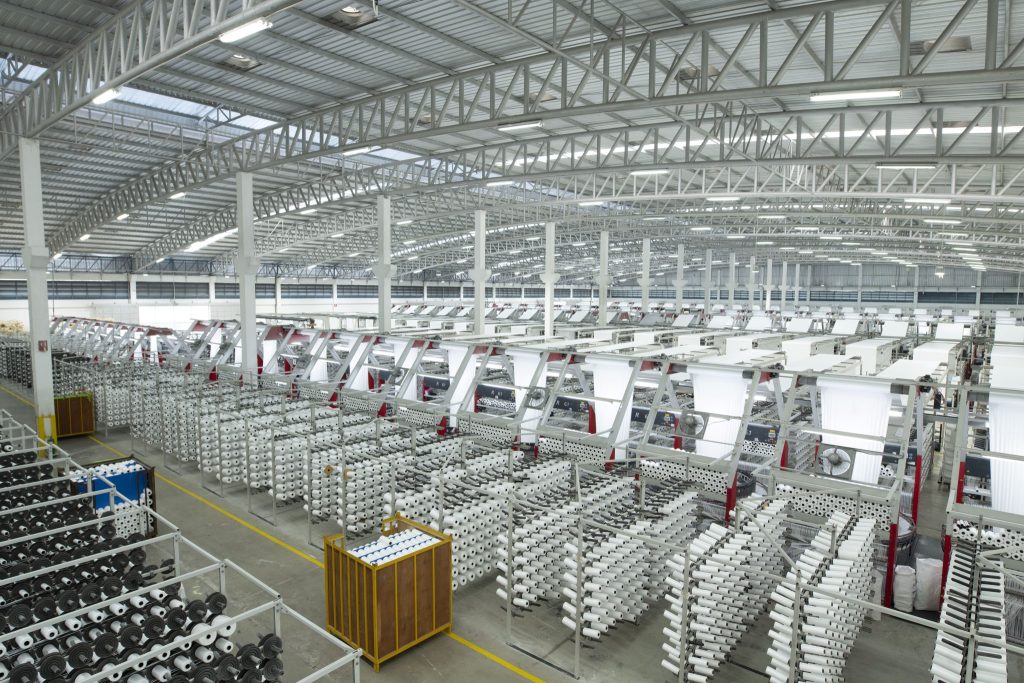
- Extrusion Lines: 16 W&H lines with closed-loop temperature control (200–250°C) to prevent polymer degradation.
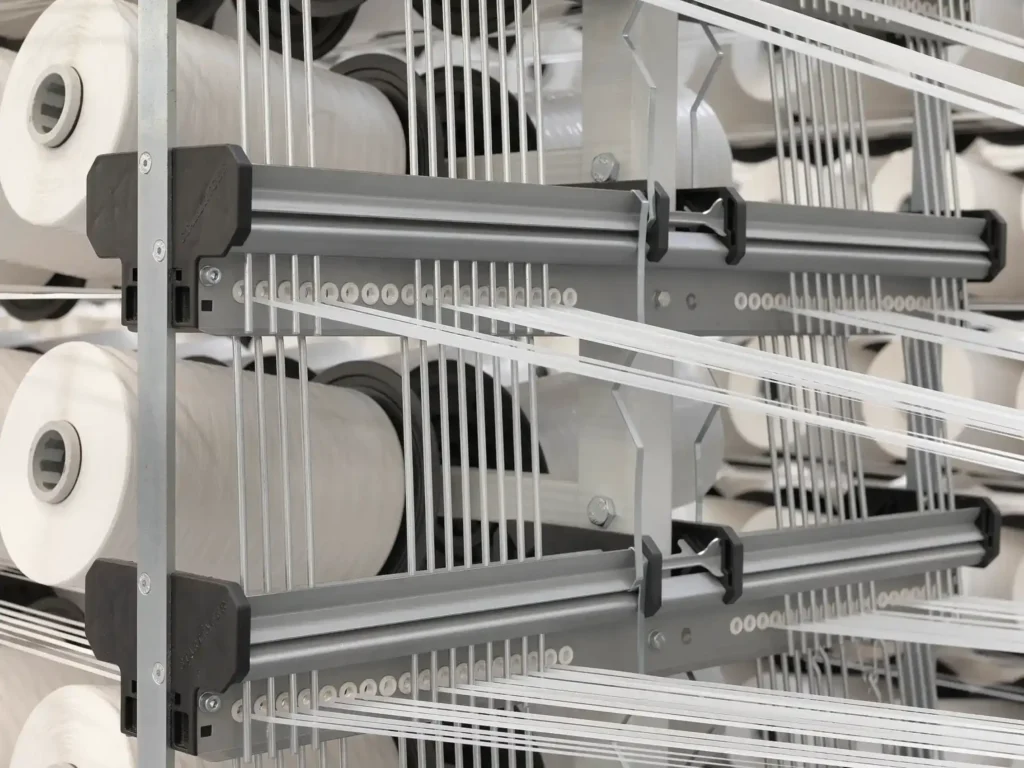
- Circular Looms: 100+ Starlinger looms weaving 12×12 strands/inch for heavy-duty applications.
- Printing Systems: 30 machines offering 20+ Pantone colors and UV-resistant inks.
Case Study: A Southeast Asian rice exporter reduced spillage by 25% using VidePak’s PE-coated bags, validated by third-party lab tests.
4. Customization and Market Adaptability
VidePak’s bags cater to niche demands:
- Agriculture: Breathable weaves (8×8 strands/inch) for seed storage.
- Chemicals: Anti-static linings to prevent dust explosions.
- Retail: High-definition prints with QR codes for traceability.
FAQs:
- How do I choose between sewn and heat-sealed bags?
Sewn bags offer higher seam strength (40 N/cm² vs. 30 N/cm²), ideal for sharp-edged materials. - Are VidePak’s bags recyclable?
Yes—100% PP construction allows full recycling per EPBP guidelines.
5. Future Innovations: Sustainability and Smart Packaging
- Bio-PP Blends: Trials with 30% plant-based resins aim to reduce carbon footprint by 2030.
- IoT Integration: RFID tags for real-time humidity monitoring, piloted with EU pharmaceutical clients.
For deeper insights into sustainable practices, explore our guides on advanced PP recycling systems and high-speed production techniques.
6. Conclusion: Engineering Excellence for Global Demands
Sewn open mouth bags exemplify how form and function can coexist in industrial packaging. By integrating cutting-edge technology, rigorous testing, and ESG-driven innovation, VidePak not only meets but redefines market expectations.
Final Perspective:
“In packaging, every stitch tells a story of precision. VidePak’s commitment to quality ensures that story ends with reliability.”
— Journal of Industrial Materials, 2025