
What is Square Bottom Valve Bags: Engineering Quality Through Rigorous Material Control?
Imagine a container that stands straight, fills fast, seals itself clean, travels safely, and speaks clearly. That is the promise of Square Bottom Valve Bags: Engineering Quality Through Rigorous Material Control. In discipline and in detail, this category of industrial sacks—also known as block‑bottom valve sacks, square‑base valve bags, or simply square valve bags—brings a self‑standing base together with a purpose‑built valve sleeve so powders and granules enter quickly and dust stays where it belongs.
Unlike open‑mouth sacks that require sewing or folding after fill, these bags complete themselves: the product head encourages closure, and a heat or ultrasonic step at the valve sleeve finalizes the seal. The result is a tidy, tamper‑evident package with fewer operators touching fewer surfaces. In real supply chains, the geometry matters as much as the materials. A square base raises pallet efficiency, resists toppling, and simplifies stretch‑wrap routines; a consistent valve controls blowback and weighs accurately on modern packers. Names vary across regions and industries, but the job does not: move dry flowables—from cement to calcium carbonate, from fertilizers to feed premixes, from pigments to specialty chemicals—at speed and with control.
The material system behind Square Bottom Valve Bags: Engineering Quality Through Rigorous Material Control
Every layer plays a role. The outer fabric or paper shell carries the load. Coatings or laminations tune barrier and print adhesion. The valve sleeve manages velocity and dust. Optional liners prevent moisture ingress long after the pallet leaves the line. Adhesives and fold patterns hold the base like a locked joint in a truss. When you specify this system, you are orchestrating properties—tensile, tear, WVTR, seal peel, rub resistance—not picking colors in a catalog.
Woven polypropylene (PP) fabric
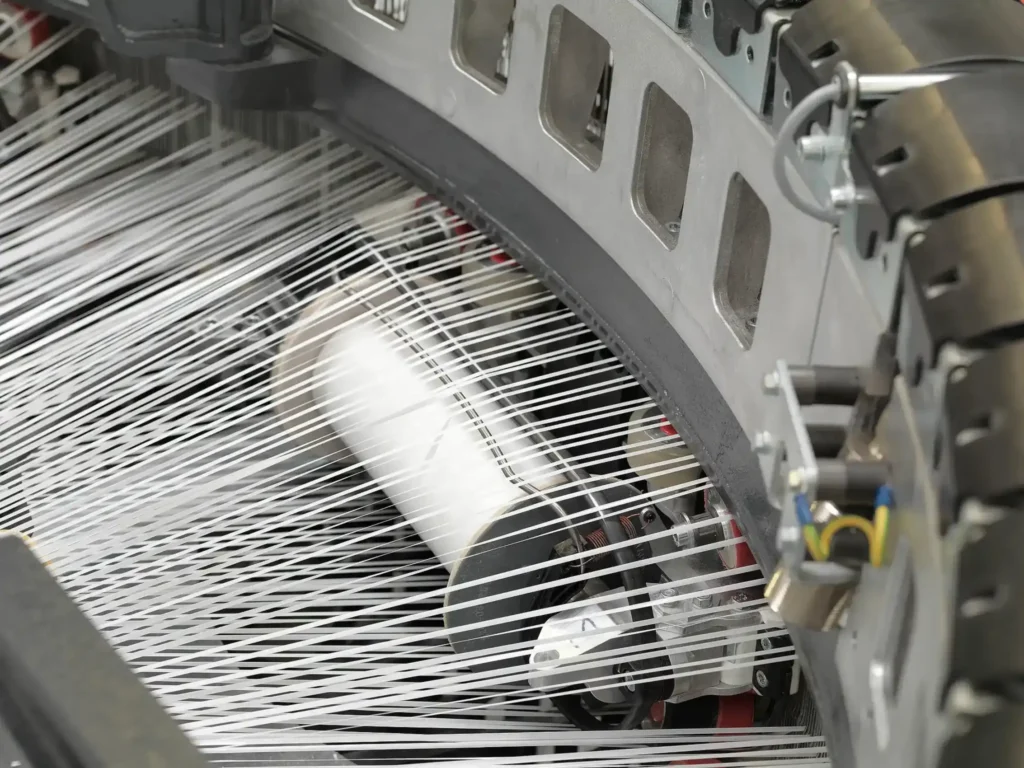
Extruded, slit, and drawn PP tapes (5–7× orientation) woven into fabric give a high strength‑to‑weight shell. Typical bodies run 70–120 gsm for 10–25 kg duties and 90–140 gsm for 25–50 kg. Deniers from 700 to 1400D and 10–14 picks per inch establish the balance between flexibility and puncture resistance. PP thrives around minerals and salts; it shrugs at abrasion that would destroy paper in the same context.
“Strength per kilogram is the decisive metric when pallets travel far and forklifts are not gentle.”
Multi‑wall kraft paper
Where breathability and print naturality dominate, extensible or semi‑extensible kraft plies (70–100 g/m² each) form tubes that square up beautifully. The paper route vents air during fast fill yet risks scuff on rough concrete unless protected by coatings. Regional fiber quality and weather conditioning govern performance—a reminder that material control begins before the first fold.
Hybrid laminates (BOPP on PP)
BOPP films (15–35 µm) laminated to woven PP produce glossy or matte canvases for high‑contrast graphics and abrasion resistance. Mono‑polyolefin stacks (PP on PP) simplify recycling where PP streams are viable. Adhesive chemistry matters: low‑ash, polyolefin‑compatible tie layers protect melt‑filter uptime in reclaim operations.
Barrier/contact layers
PE sleeves or liners (40–120 µm) counter humidity in hygroscopic powders. LDPE/LLDPE blends seal easily and flex; HDPE edges the barrier upward. A 10–20 µm step in gauge often trades pennies for fewer claims. Coatings—PP extrusion at 20–40 g/m² or specialty dispersions—tighten the weave and anchor ink.
Valve sleeves & closures
Paper sleeves breathe; film sleeves seal. Geometry—angle and length—controls blowback and accuracy. Internal film petals can auto‑close. Ultrasonic or thermal steps bring consistency; in some lines, the product head alone is enough.
Identification surface
Flexo or gravure inks on coatings/BOPP; water‑based options with primers; digital for variable data. Specify rub resistance (Sutherland or ISO 2836), lightfastness, and scannability after abrasion. QR and linear codes satisfy traceability; NFC or RFID appears in high‑value powders.
A note on cost: PP tracks propylene; paper tracks fiber markets and regional logistics. Hybrid laminates carry premiums but preserve legibility through long vibrations on highways. Your cheapest lever that still respects performance is often gsm or ply count—not magic inks, not slogans, not hope.
Characteristic strengths of Square Bottom Valve Bags: Engineering Quality Through Rigorous Material Control
A container either survives the week or it doesn’t. The following properties separate winners from warranties.
Self‑standing stability
The block bottom forms a footprint that stands during filling, guides conveyors, and stacks like bricks. Pallet cubes tighten; lean decreases. The geometry also calms operator choreography: fewer hands chasing soft tubes, more time watching the scale.
Fast, clean filling
Valve sleeves harmonize with impeller, screw, or air packers. A sleeve dimension off by 3–5 mm can drop fill rates and spike rejects—proof that millimeters are money. Auto‑closing petals or a light heat step keep powder inside and housekeeping costs outside the conversation.
Tunable barrier vs. breathability
Choose paper plies, coatings, and liners not by tradition but by sorption curves and storage climates. Evacuate air during fill; block moisture during dwell. This is design, not superstition.
Readable communication
Large panels carry hazard pictograms, lot codes, and instructions in multiple languages. Laminated BOPP resists rub when pallets grind through miles; coatings offer a simpler, lighter route when graphics are basic.
Automation‑friendly
Consistent sleeve geometry and base dimensions please automatic bag placers and checkweighers. Predictability is throughput; throughput is margin.
Recyclability pathways
Mono‑PP stacks route to polyolefin streams where infrastructure exists; paper‑only stacks route to paper streams. Dual‑material designs require clear end‑of‑life instructions or take‑back plans. Either way, design with the real system you will use, not the ideal system you wish existed.
How Square Bottom Valve Bags: Engineering Quality Through Rigorous Material Control are produced
From pellet or reel to pallet or route, production is a choreography. Precision upstream simplifies life downstream.
Substrate preparation
Woven PP route: PP film → slit tapes → draw 5–7× → weave 10–14 ppi → heat‑set. Stabilizers align with expected UV exposure. Paper route: select extensible kraft grades, condition reels, and pre‑print if required for registration‑sensitive artwork.
Coating & lamination
PP extrusion coating (20–40 g/m²) closes the weave and accepts ink. For BOPP laminates, film (15–35 µm) meets fabric under an extrusion or adhesive nip; corona treatment lifts surface energy for anchorage. Paper plies may add dispersion coats or PE spot films at the valve for heat seals.
Printing
Flexo/gravure apply brand, regulatory, and traceability content. Keep anilox BCM, ink viscosity, and dryer curves in spec; check registration on folded panels. Digital handles variable data and short campaigns—just verify rub and weathering performance.
Tube formation & valve insertion
Make the tube, set the sleeve. Sleeve angle and length are not opinions; they are parameters. Fix by adhesive or heat; include film petals when auto‑close is desired.
Base formation
Block bottoms depend on glue grammage and pattern geometry. Patterns distribute stress and resist peel during drops; dwell and pressure tell whether the base earns its name.
Final conversion & QA
Die‑cut hand holes, add corner reinforcements, consider micro‑perfs if the packer traps air. Then measure: seam and base peel, drop behavior, valve dimensions, print rub, WVTR for liners, dimensional accuracy. Trust data over anecdotes.
Where Square Bottom Valve Bags: Engineering Quality Through Rigorous Material Control are used
- Cement & dry building materials: Portland and blended cements, grouts, mortars, gypsum compounds—fast fill, low dust, stable pallets.
- Minerals & fillers: calcium carbonate, TiO₂, talc, silica; laminated exteriors protect graphics in abrasive environments.
- Fertilizers & agri‑inputs: urea and NPK blends; sleeves and coatings guard against caking along humid coasts.
- Food & feed ingredients: sugar, salt, starches, flour, premixes—print clarity and hygiene documents matter.
- Specialty chemicals: resins, pigments, flame retardants; consider ESD handling environments and valve compatibility with the chosen packer.
Reasoning from the headline of Square Bottom Valve Bags: Engineering Quality Through Rigorous Material Control
The title is a blueprint. “Engineering quality” demands targets and tests; “rigorous material control” demands bills of materials and change discipline. The smartest teams begin with hazards, map them to materials, pick constructions by segment, then validate with methodical tests and current documents. The logic below mirrors that cadence.
Define hazards
Powder or granule? Hygroscopic or indifferent? Abrasive or soft? What’s the bulk density? What’s the ambient humidity and storage term? Which packer—impeller, screw, air? Questions are design tools. Ask them early, answer them in numbers.
Map hazards to materials
Moisture → PE sleeve gauge and seal recipe; dust/abrasion → woven gsm and BOPP choice; stacking → base glue pattern and height rules; compliance → food‑contact DoCs and site certificates.
Choose constructions by segment
Building materials favor laminated woven PP with heat‑sealable sleeves; fertilizers lean on coated PP plus heavier sleeves; food/feed splits between paper multi‑wall and PP+liner with hygiene documents.
Validate & document
Drop, peel, compression; WVTR and dart impact for liners; OEE effects during line trials; DoCs for polymers, ISO 9001 and BRCGS where relevant; UN/IATA markings if dangerous goods apply.
Standards and identifiers that frame Square Bottom Valve Bags: Engineering Quality Through Rigorous Material Control
Use references as tools, not trophies. Cite editions and clauses; request evidence dated within 12 months. Precision reduces friction at audits and borders.
- ISO 9001:2015 — quality management scaffolding.
- BRCGS Packaging Materials, Issue 6 — hygiene and GMP for packaging plants; position statements current through 2024–2025.
- ISO 18604 — packaging and material recycling; sharpen your recyclability claims.
- ASTM F1249 / ISO 15106‑2 — WVTR testing for liners.
- ASTM D1709 — dart impact for film toughness.
- UN Model Regulations Rev. 24 (2025) — sack codes 5H1/5H2 (woven plastics) and 5M1/5M2 (paper) where DG applies; design type testing rules.
- IATA DGR 66th (2025) — keep multimodal chains aligned when air legs appear.
Color tables for Square Bottom Valve Bags: Engineering Quality Through Rigorous Material Control
structurevalve geometrybarrierprintrecyclability
| Parameter | PP laminated valve bag | PP coated valve bag | Multi‑wall paper valve bag |
|---|---|---|---|
| Body substrate | Woven PP 90–120 gsm | Woven PP 80–110 gsm | 2–4 plies kraft 70–100 g/m² |
| Lamination/coating | BOPP 20–30 µm | PP coat 25–35 g/m² | PE patch at valve (optional) |
| Valve sleeve | PE film 70–100 µm | Paper/PE hybrid | Paper sleeve with heat‑seal zone |
| Base glue grammage | 30–60 g/m² | 30–60 g/m² | 30–60 g/m² |
| Micro‑perforation | 50–200 holes/100 cm² | 50–200 holes/100 cm² | 50–200 holes/100 cm² |
| Flexo/gravure ≤ 6 colors | Flexo 2–4 colors | Flexo 2–4 colors |
| Performance test | Method | Indicative target |
|---|---|---|
| Drop (filled) | Company SOP (ASTM D5276 logic) | 5–10 drops @ 0.8–1.2 m, no rupture |
| Base peel | Internal (N/25 mm) | ≥ 20–35 N/25 mm |
| Valve seal peel | Internal (N/15 mm) | 12–18 N/15 mm (peel mode) |
| WVTR (liner) | ASTM F1249 / ISO 15106‑2 | ≤ 2–5 g/m²·day @ 38 °C/90% RH |
| Dart impact | ASTM D1709 | ≥ 200–400 g |
| Print rub | Sutherland rub | ≥ program class (e.g., 200 cycles, legible) |
Ninety‑day action plan for Square Bottom Valve Bags: Engineering Quality Through Rigorous Material Control
- DOE on gsm and base glue patterns. Four weeks, three patterns, two gsm tiers; read out failure modes and pallet lean.
- Valve geometry tuning. Adjust sleeve angle/length in 2–3 mm increments; record blowback, fill rate, and reject fraction.
- Liner gauge pilot. +20 µm on PE sleeve in humid routes; measure caking complaints and WVTR.
- Print durability check. Tumble test pallets; verify QR/barcode contrast; adjust ink/varnish if legibility drops.
- Document refresh. Collect ≤12‑month certificates, DoCs, and testing; introduce a change‑control calendar.
FAQ for Square Bottom Valve Bags: Engineering Quality Through Rigorous Material Control
Are laminated woven sacks always better than paper? No. Laminates dominate where abrasion and moisture punish paper, but paper shines with breathability and paper‑stream recycling—if loads and handling allow.
Can heavy PP coatings replace PE sleeves? Sometimes for moderate moisture defense, not for truly hygroscopic powders. Sealed sleeves still out‑perform on WVTR and seal reliability.
Do micro‑perfs risk moisture ingress? Yes. Use them only to manage trapped air on the packer; then balance with liner gauge and storage controls.
How tight must valve tolerances be? Tight. Millimeters change fill rates. Lock specs and measure incoming sleeves.
Which inks survive job sites? Solvent gravure/flexo on BOPP generally lead; water‑based flexo can perform with primers and over‑varnish.
One internal link about Square Bottom Valve Bags: Engineering Quality Through Rigorous Material Control
See Square Bottom Valve Bags: Engineering Quality Through Rigorous Material Control for a related category snapshot that often underpins the valve‑sack family; treat it as directional context rather than a substitute for testing in your product and climate.
Troubleshooting matrix for Square Bottom Valve Bags: Engineering Quality Through Rigorous Material Control
| Symptom | Likely cause | Corrective action |
|---|---|---|
| Base opens during drop | Low glue grammage; weak pattern; poor fold geometry | Increase grammage; change pattern; verify fold sequence and dwell |
| Dust at valve | Sleeve angle too short/steep; weak auto‑close; poor seal | Adjust angle/length; add film petals; validate heat‑seal recipe |
| Moisture caking | Thin sleeve; leaky seal; humid storage | Raise gauge; double‑fin seal; enforce RH bands |
| Print rub‑off | Low adhesion; under‑cured inks | Increase corona; add over‑varnish; adjust dryer profile |
| Puncture at pallet edges | Low gsm; no corner protection | Increase gsm; add corner boards; revise pallet pattern |
| Pallet instability | Excess fill height; weak base; dimensional drift | Set height rule; strengthen base; tighten tolerances |
Procurement template for Square Bottom Valve Bags: Engineering Quality Through Rigorous Material Control
scope materials dimensions performance print compliance change control
Title: Square bottom valve sack, 25–50 kg, laminated woven PP, heat‑sealable valve sleeve
Scope: Dry mineral powder; indoor storage ≤ 60 days; palletized 5×5; forklift handling
Materials: Woven PP 100 gsm; BOPP 25 µm; PP coating (back) 30 g/m²; PE valve sleeve 90 µm; optional micro‑perforations
Dimensions: 550 × 900 mm flat; base 100 mm; valve sleeve 140 mm length at 30°
Performance: Drop 10× @ 1.0 m (no rupture); base peel ≥ 25 N/25 mm; valve peel 14–18 N/15 mm; WVTR per product target
Print: 4‑color flexo; rub ≥ class; barcode/QR contrast ≥ 70%
Compliance: ISO 9001 site; BRCGS Packaging Materials as applicable; polymer DoCs per jurisdiction
Change control: 60‑day notice for resin/additive/geometry changes; first‑article on critical shifts
Traceability: Lot/date/line code; optional QR for internal tracking
Two short field cases using Square Bottom Valve Bags: Engineering Quality Through Rigorous Material Control
Gypsum finishing compound (25 kg). Dust at valve forced frequent cleanup. Sleeve length +12 mm and angle −5° with film petals cut dust 63% and lifted OEE 2.4%.
NPK fertilizer (40 kg). Caking after 45‑day coastal storage. Sleeve 70→100 µm; double‑fin seals; RH policy < 65%; corner boards on pallets. Complaints dropped from 1.8% to 0.4%.

- What is Square Bottom Valve Bags: Engineering Quality Through Rigorous Material Control?
- The material system behind Square Bottom Valve Bags: Engineering Quality Through Rigorous Material Control
- Characteristic strengths of Square Bottom Valve Bags: Engineering Quality Through Rigorous Material Control
- How Square Bottom Valve Bags: Engineering Quality Through Rigorous Material Control are produced
- Where Square Bottom Valve Bags: Engineering Quality Through Rigorous Material Control are used
- Reasoning from the headline of Square Bottom Valve Bags: Engineering Quality Through Rigorous Material Control
- Standards and identifiers that frame Square Bottom Valve Bags: Engineering Quality Through Rigorous Material Control
- Color tables for Square Bottom Valve Bags: Engineering Quality Through Rigorous Material Control
- Ninety‑day action plan for Square Bottom Valve Bags: Engineering Quality Through Rigorous Material Control
- FAQ for Square Bottom Valve Bags: Engineering Quality Through Rigorous Material Control
- One internal link about Square Bottom Valve Bags: Engineering Quality Through Rigorous Material Control
- Troubleshooting matrix for Square Bottom Valve Bags: Engineering Quality Through Rigorous Material Control
- Procurement template for Square Bottom Valve Bags: Engineering Quality Through Rigorous Material Control
- Two short field cases using Square Bottom Valve Bags: Engineering Quality Through Rigorous Material Control
H1: Introduction
“In the packaging industry, the reliability of square bottom valve bags starts long before production—it begins with the meticulous selection and validation of raw materials,” asserts Ray, CEO of VidePak, during a 2025 global sustainability conference. VidePak’s leadership in this sector hinges on four pillars: ISO-certified supplier vetting, strategic partnerships with global resin giants, long-term supply agreements for cost efficiency, and a data-driven quality management system (QMS) enforcing ASTM/EN standards. This report explores how these strategies ensure VidePak’s square bottom valve bags meet the highest demands of industries like construction, agriculture, and chemicals, while aligning with global sustainability goals.
H2: Supplier Qualification: Building a Foundation of Trust
H3: ISO-Certified Audits and Technical Capability
VidePak’s supplier selection process prioritizes certifications, production capacity, and market reputation. Key criteria include:
- ISO 9001/14001 Compliance: Ensures suppliers adhere to international quality and environmental management systems. For example, VidePak’s PP resin suppliers must demonstrate defect rates ≤0.5% in batch testing.
- Production Capacity Verification: On-site audits assess extrusion technology and defect control. A 2024 audit of Sinopec’s facilities confirmed their ability to produce 12 g/10 min MFI PP resins, critical for uniform weaving on Starlinger circular looms.
- Market Feedback: Suppliers must maintain ≤1% return rates in key markets like the EU and Japan, validated by third-party platforms like Alibaba Supplier Ratings.
H3: Strategic Partnerships with Resin Leaders
| Supplier | Key Material | Certifications | Cost Advantage |
|---|---|---|---|
| BASF | UV-stabilized PP | ASTM D5265, EN 277 | 10–15% bulk discount |
| Sinopec | High-tenacity PP | JIS Z 1539, GB/T 17685-2021 | Long-term price locking |
| Yangzi Petrochem | Recycled PP (30% PCR) | REACH SVHC limits | ESG incentives |
These partnerships enable VidePak to achieve tensile strengths exceeding 35 MPa while reducing material costs by 12% through volume commitments.
H2: Incoming Material Inspection: Precision in Practice
H3: Testing Protocols and QMS Integration
Every resin batch undergoes a 7-point inspection aligned with ISO 2859-1 sampling protocols:
- Visual Inspection: Rejects discolored or contaminated pellets (e.g., black speck counts <5 per kg).
- MFI Testing: Ensures melt flow consistency (12±0.5 g/10 min) for extrusion stability.
- Tensile Strength: Validated via ASTM D638, targeting ≥30 MPa for heavy-duty applications like cement packaging.
- Moisture Content: ≤0.02% (per ISO 62:2008) to prevent weaving defects.
- UV Resistance: 1,000-hour accelerated weathering tests (ASTM G154) for outdoor storage compliance.
- Chemical Safety: Phthalate-free certification for EU REACH compliance.
- Data Logging: Results uploaded to SAP QMS for traceability and predictive analytics.
VidePak’s QMS reduces inspection time by 40% while maintaining a 99.9% defect detection rate.
H2: Case Study: High-Performance Bags for Hazardous Waste
A 2024 project with a German chemical firm required bags compliant with EN 277 (moisture barrier ≤5 g/m²/day) and REACH SVHC limits:
- Design: 3-layer PP weave (140 g/m²) + 50-µm PE liner.
- Material: BASF UV-stabilized PP + Sinopec adhesive film.
- Outcome: 0.3% moisture infiltration (vs. 2.5% industry average), achieving BRCGS AA certification and a 3-year supplier contract.
H2: FAQs on Material Selection and Quality Control
Q1: Why prioritize ISO 9001-certified suppliers?
ISO 9001 ensures systematic quality management, reducing batch variability by 70% and aligning with VidePak’s zero-defect target.
Q2: How does MFI affect production efficiency?
Higher MFI (e.g., 12 g/10 min) improves extrusion speed but requires precise temperature control (±1°C) to prevent brittleness. VidePak’s Starlinger lines use IoT sensors for real-time adjustments.
Q3: Are recycled PP resins durable enough for industrial use?
Yes. Advanced compatibilizers ensure 95% tensile strength retention, while reducing carbon footprint by 1.8 kg per bag.
H2: Future Trends: Automation and Sustainability
- AI-Driven Defect Detection: Piloting computer vision systems to reduce inspection labor by 50% by 2026.
- Circular Economy: Targeting 50% recycled content via Sinopec’s closed-loop PP recycling tech, cutting CO₂ emissions by 2.1 kg per bag.
H2: Conclusion
Square bottom valve bags are more than packaging—they are engineered systems where material quality dictates performance. VidePak’s Starlinger-powered production and partnerships with BASF/Sinopec set a global benchmark. For industries demanding moisture-proof, UV-resistant solutions, aligning with suppliers that merge ISO rigor and innovation is non-negotiable.
External Links:
- Explore advanced material strategies for industrial applications.
- Learn how global compliance enhances market competitiveness.
This report synthesizes data from ASTM, EN, and JIS standards, alongside VidePak’s operational insights, to guide procurement and quality teams in high-stakes industries.