
Framing the Question: Why HDPE Fabric Bags Now?
Packaging is a decision under uncertainty: unknown climates, unpredictable dwell times, variable pallets, inconsistent handling. Moisture rises and falls; temperatures cycle; pallets lean; graphics scuff. In this turbulence, HDPE Fabric Bags stand out because they intertwine mechanical strength with controllable hygiene and tuned ventilation. They are not simply “strong poly sacks.” They are a systems solution—woven from oriented tapes, engineered for pores or vents, optionally laminated for gloss and print fidelity, and validated by standards. Their reach is wide: grains, flour, fertilizers, animal feed, salts, pigments, biomass, resins, and retail categories that demand both durability and design. The thesis of this article is straightforward: modern logistics reward packaging that is rigid yet forgiving, breathable yet clean, economical yet premium. HDPE Fabric Bags were built for that equation.
What Is HDPE Fabric Bags? Definitions, Scope, and Working Names
At its core, a HDPE Fabric Bag is a sack constructed from woven tapes of high‑density polyethylene. Orientation of those tapes during drawing raises tensile strength; weaving distributes that strength bi‑axially; seams convert it into a load path; and optional micro‑perforations or ventilated panels enable vapor exchange without surrendering structural integrity. It is a fabric before it is a bag; it is a lattice before it is a logo. And that lattice delivers impact resistance, creep control, and puncture resistance far beyond what typical monolayer film bags achieve at similar mass.
In daily language, HDPE Fabric Bags also go by alternate names used across plants, yards, and procurement sheets. Those aliases underscore applications and formats rather than a change in core DNA:
- HDPE Woven Bags
- HDPE Woven Sacks
- High‑Density Polyethylene Fabric Bags
- HDPE Laminated Woven Bags
- HDPE FFS Tubular Bags (for high‑speed form‑fill‑seal)
- HDPE Heavy‑Duty Bags
- HDPE Industrial Sacks
Are they just another poly option? Not really. The woven architecture turns commodity polymer into engineered structure, and the structure translates directly into line reliability, pallet stability, and shelf presentation. Said simply: the fabric makes the function.
The Material of HDPE Fabric Bags: Resin Grades, Additives, and Layer Stacks
Understanding material is the shortest path to understanding performance. HDPE Fabric Bags are a choreographed arrangement of polymer science and textile logic. Each ingredient does something; each step matters.
| Component | Function | Engineering Considerations |
|---|---|---|
| HDPE tapes (warp/weft) | Load path; puncture and tear resistance | Draw ratio and cooling profile control tensile; tape denier sets fabric strength foundation |
| UV masterbatch | Outdoor life and colorfastness | Load to climate exposure; avoid over‑stabilization that can affect weldability |
| Antistatic package | Powder safety and flow | Humidity dependent; select internal/externals with stable performance window |
| Pigments / TiO₂ | Opacity, brand colors, print contrast | Disperse cleanly to preserve tensile and prevent plate fouling |
| LLDPE/LDPE/HDPE liners | Dust control; selective barrier | Perforate liners to retain macro‑ventilation when needed |
| BOPP lamination | Gloss; scuff resistance; print fidelity | Consider partial lamination to keep sides breathable |
Cost matters. HDPE is a global commodity with robust supply. By adjusting tape denier and picks per inch (PPI), engineers can reduce grams per bag without surrendering seam integrity or drop performance. The optimal specification rarely equals the heaviest fabric; it equals the best‑matched fabric.
What Are the Features of HDPE Fabric Bags? Where the Value Shows
Here the marketing promise meets physics. The visible features of HDPE Fabric Bags are the symptom of quiet, structural strengths:
- Strength‑to‑weight efficiency: Oriented tapes and woven geometry give high tensile with low GSM; pallets rise tall without slump.
- Tuned breathability: Vapor pathways are designed, not guessed—via weave porosity, micro‑perforation, or window panels.
- Chemical and UV endurance: HDPE resists many acids/alkalis/fertilizers; UV packages extend outdoor life.
- Retail‑grade graphics: Laminated faces carry high‑contrast, scuff‑resistant prints.
- Line flexibility: From manual open‑mouth to valve formats to HDPE FFS Tubular Bags on high‑speed automation.
- Standards‑friendly: Tests map cleanly to ISO/ASTM/EN/JIS families; qualification is intelligible across borders.
- Circularity potential: Polyolefin monomaterial paths simplify recycling where streams exist; spoilage reduction trims hidden carbon.
What Is the Production Process of HDPE Fabric Bags? From Resin to Sack
Process repeatability is product reliability. The manufacturing of HDPE Fabric Bags is a chain; each link carries quality forward—or drops it. Below is the canonical flow with emphases where specification lives or dies.
Front‑End: Raw Material Selection and Incoming Checks
- Approved suppliers; virgin HDPE and certified masterbatches only; lot traceability mandatory.
- Resin MFI, density, gels, volatiles, and odor tested; additive active content verified.
- For laminated/lined stacks, adhesion and seal windows are pre‑qualified.
Tape Extrusion and Drawing
- Compounding to recipe protects additive integrity; thermal history matters.
- Slit film into tapes; draw to align chains; control profile to minimize weak necks.
- Winders hold tension tightly to safeguard downstream weaving.
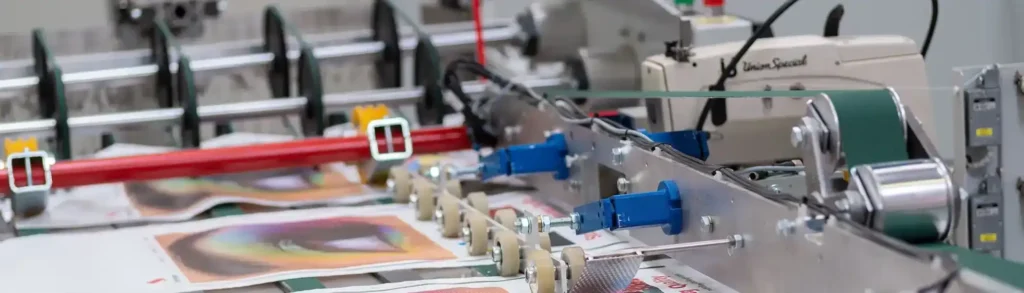
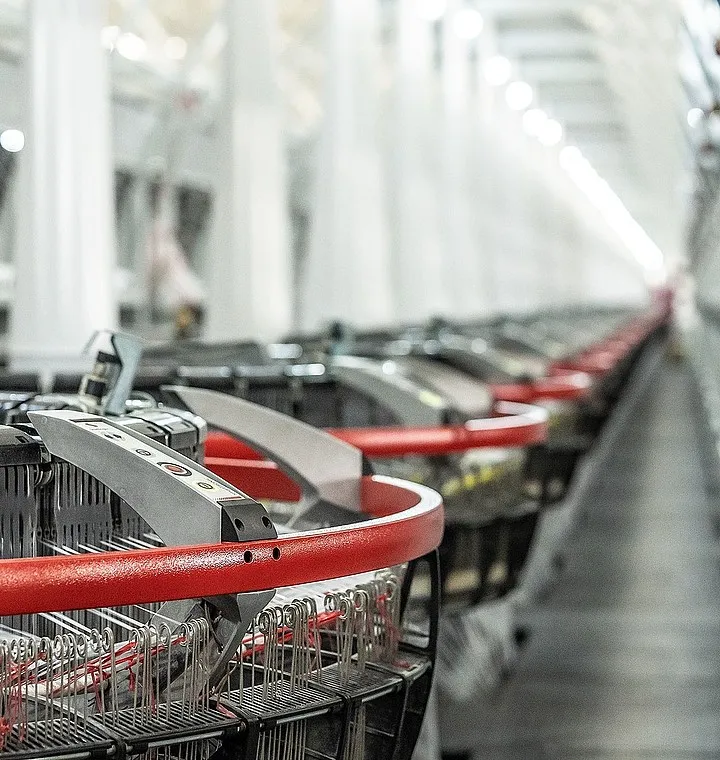
VidePak specifies Austrian Starlinger tape extrusion and circular looms for denier uniformity, low variation in GSM, and loom stability—bedrock variables for seam consistency and air‑permeability targeting.
Weaving and Conversion
- Circular looms set PPI and geometry; inline sensors catch broken ends and flatness drift.
- Length cutting, hemming/heat‑cutting, bottom sewing or valve formation; handles/vents as needed.
- Stitch geometry (double‑fold, chain‑lock) and thread choice match fabric stiffness and target seam strength.
Ventilation Engineering, Printing, and Lamination
- Micro‑perforation (hot‑needle or laser) tuned to an air‑permeability window; window panels inserted for max airflow SKUs.
- Multi‑color flexo printing on woven or laminated faces; registration and rub controlled with SOPs.
- Coating/lamination executed on German W&H (Windmöller & Hölscher) lines for coatweight consistency and bond integrity.
Back‑End Quality Assurance
- In‑process: tape denier/tensile; fabric GSM/PPI/dimensions; seam strength; spot air‑permeability.
- Final: drop; compression/stack; abrasion; UV; print adhesion; odor/taint for food‑adjacent goods.
- Documentation: data mapped to ISO/ASTM/EN/JIS; lots barcoded; samples retained.
What Is the Application of HDPE Fabric Bags? Sector‑by‑Sector
Use cases reveal design intent. HDPE Fabric Bags serve the following sectors with a spectrum of porosity, seam, and print options:
- Agriculture and produce: rice, wheat, beans, onions, potatoes, garlic, seeds—airflow tunes sprouting and condensation risk.
- Food ingredients: flour, starch, sugar, spices—micro‑perforation manages caking while laminated faces keep branding clean.
- Animal nutrition: feed pellets, premixes—dust control and hopper flow stability.
- Chemicals and minerals: fertilizers, salts, gypsum, pigments—chemical resistance is a native strength of HDPE.
- Construction and biomass: sand, aggregates, charcoal, wood pellets—ventilation moderates moisture rebound.
- Retail and e‑commerce: pet food, garden soils, DIY materials—premium prints meet tough logistics.
On automation, HDPE FFS Tubular Bags integrate directly with high‑speed form‑fill‑seal. For valve formats and their strength expectations, see this concise valve bag strength engineering guide that complements the woven HDPE discussion here.
How VidePak Controls and Guarantees the Quality
Assurance is a sequence, not a slogan. VidePak’s four‑pillar method expresses the sequence clearly:
- Standards‑driven production and testing. Specifications align with ISO/ASTM/EN/JIS families for tensile, seam, drop, compression, air‑permeability, UV, and print adhesion.
- All‑new raw materials from major producers. Performance layers remain virgin; lots traceable; supplier audits routine.
- Best‑in‑class equipment. Starlinger lines (extrusion, weaving, conversion) and W&H lines (printing, coating/lamination) anchor repeatability.
- Complete inspection workflow. Incoming checks; in‑process SPC; final AQL; retained samples; CAPA for closure.
System Map: Breaking Problems into Sub‑Problems, Then Integrating
A useful way to specify HDPE Fabric Bags is to treat the design as a system of tensions—and resolve each tension with targeted decisions.
| Tension | Design Lever | Validation |
|---|---|---|
| Breathability vs. dust control | Perforation density; window panel width; perforated liner | Air‑permeability test + dust observation during trial fills |
| Graphics vs. airflow | Partial lamination; laminated front with breathable sides | Rub resistance + airflow within target window |
| Stack height vs. creep | GSM/denier increments; seam fold geometry | Compression/stack test; dimensional stability over time |
| Automation speed vs. misfeeds | Tighter dimensional tolerances; surface COF control; antistatic | Line trial OEE tracking; stoppage logs |
Specification Windows: Typical Targets and Practical Ranges
| Parameter | Typical Range | Why It Matters |
|---|---|---|
| Fabric GSM | 60–120 g/m² | Higher GSM supports taller stacks and longer warehouse cycles |
| Tape denier | 700–1100 D | Heavier denier improves tear and puncture resistance |
| Weave density (PPI) | 8–14 | Balances porosity with base strength |
| Air‑permeability | 200–400 L/m²·h | Directly tied to condensation control and dust containment |
| Seam strength | ≥ 70% of fabric tensile | Seam is often the limiting path; geometry and thread choice rule |
| UV stability | 200–400 h equivalent | Protects outdoor dwell; store shaded regardless |
Mechanical Behavior: Strength, Stability, and Seam Integrity
If the pallet is a building, the seam is its joint. HDPE Fabric Bags derive tensile from tapes, dimensional stability from weave, and survivability from seams. Failures rhyme: bulging signals under‑spec GSM or denier; seam tears expose a stitch‑to‑stiffness mismatch; corner punctures indict handling geometry. Thankfully, the laboratory tools are clear: tensile in MD/TD, seam pull, drop, compression, and abrasion. Measure, adjust, and measure again.
Procurement Playbook: The Information Your Supplier Needs
Procurement is applied engineering by email. The quality of the output equals the clarity of the input. Supply the following to accelerate convergence:
- Product type, particle size, bulk density, hygroscopicity
- Bag footprint and net weight target
- Air‑permeability window with tolerance, plus rationale
- Pallet geometry: bags/layer, layers/pallet, max height, dwell time
- Filling mode: open‑mouth/valve/HDPE FFS Tubular Bags (line speed, spout geometry)
- Compliance: food contact, antistatic class, labeling requirements
- Warehouse climate and outdoor exposure expectations (UV class)
- Branding: sides to print, color count, rub resistance expectations
- Pilot quantities, test plan, acceptance criteria
Troubleshooting: Patterns, Causes, Remedies
- Condensation persists → Increase perforation density; widen window panels; add perforated liner; verify warehouse humidity.
- Bulging stacks → Raise GSM or denier; reinforce seam folds; lower stack height; check pallet deck geometry.
- Seam failures → Reselect stitch pitch/thread; adjust fold; validate against fabric stiffness.
- Dust escape → Hybrid design (breathable sides + laminated front) or use liners; add antistatic.
- Print smudge → Ink/substrate mismatch; verify cure; adopt rub resistance test as a release gate.
- UV chalking → Increase stabilizer load; reduce outdoor dwell; employ tarps and shade.
Risk and Mitigation: A Practical Map
| Risk | Symptom | Mitigation |
|---|---|---|
| Design | Unexpected caking; stack failures | DOE on porosity vs. seam; pilot lots; cross‑functional reviews |
| Supply | Resin variability | Qualified dual sources; safety stocks; incoming COA gates |
| Process | Denier drift; print registration drift | TPM; spares strategy; inline vision systems |
| Quality | Batch variability | SPC on GSM/denier/porosity; robust CAPA discipline |
| Regulatory | Food‑contact or labeling deviations | Pre‑compliance dossiers; change control gates |
Storage and Handling: Quiet Habits, Big Dividends
Cool, dry warehousing slows polymer aging. Radiused guides prevent edge puncture. FIFO trims cumulative UV. Respect stack height limits. These are not footnotes; they are the routine that keeps specs honest.
Innovation Watchlist: Where HDPE Fabric Bags Head Next
- Modified draw systems maintaining ductility at lower draw ratios to reduce tape breakage on aging looms.
- Lean UV packages with higher stabilizer efficiency; longer outdoor life per unit additive.
- Antistatic systems with flatter performance across humidity swings.
- Camera‑assisted perforation that holds airflow within tight tolerance bands.
- On‑bag traceability (QR/lot and exposure counters) that records logistics history.
Comparative Lens: HDPE Fabric Bags vs. Alternatives
| Attribute | HDPE Fabric Bags | PP Woven Bags | Paper Sacks | PE Film Bags |
|---|---|---|---|---|
| Mechanical strength | High tensile and puncture resistance | High (similar class) | Moderate; weak when wet | High tensile; tear propagation risk |
| Breathability control | Weave/perf/panels tunable | Weave/perf/panels tunable | Low–moderate (paper pores) | Low without heavy perforation |
| Chemical resistance | Excellent for many acids/alkalis | Very good overall | Poor when wet | Good, thickness dependent |
| Branding & print | Strong; laminated face optional | Strong | Classic look; scuffs when humid | Good on treated film surfaces |
| Recycling pathway | HDPE stream where available | PP stream where available | Fiber stream; wet strength limits | PE stream; performance vs. thickness |
Extended Case Sketches
Glossary Highlights
Air volume through fabric area per hour; tuned via perforation/panels.
Grams per square meter; correlates with load capacity and creep resistance.
Picks per inch; weave density that sets porosity and base strength.
Fold and stitch design; often the hidden limiter of performance.
Leno/mesh insert that maximizes airflow for produce SKUs.
Mix of laminated faces and breathable sides to balance graphics with ventilation.
A Practical Template: Example Specification
50‑kg fertilizer sack; 55 × 95 cm; fabric 85 g/m² at ~950 D and 10–11 PPI; micro‑perforation pattern 12 × 12 per dm²; double‑fold chain‑lock seam with HDPE thread; laminated front for graphics; two‑color back; UV class ~300 h equivalent; tests: drop (1.2 m, 5 cycles), compression (per pallet spec), rub resistance; air‑permeability 280–320 L/m²·h.
- Framing the Question: Why HDPE Fabric Bags Now?
- What Is HDPE Fabric Bags? Definitions, Scope, and Working Names
- The Material of HDPE Fabric Bags: Resin Grades, Additives, and Layer Stacks
- What Are the Features of HDPE Fabric Bags? Where the Value Shows
- What Is the Production Process of HDPE Fabric Bags? From Resin to Sack
- What Is the Application of HDPE Fabric Bags? Sector‑by‑Sector
- How VidePak Controls and Guarantees the Quality
- System Map: Breaking Problems into Sub‑Problems, Then Integrating
- Specification Windows: Typical Targets and Practical Ranges
- Mechanical Behavior: Strength, Stability, and Seam Integrity
- Procurement Playbook: The Information Your Supplier Needs
- Troubleshooting: Patterns, Causes, Remedies
- Risk and Mitigation: A Practical Map
- Storage and Handling: Quiet Habits, Big Dividends
- Innovation Watchlist: Where HDPE Fabric Bags Head Next
- Comparative Lens: HDPE Fabric Bags vs. Alternatives
- Extended Case Sketches
- Glossary Highlights
- A Practical Template: Example Specification
During a supplier meeting, a retail procurement manager, Sarah, asks: “Why should our supermarket chain switch to HDPE fabric bags for bulk rice and pet food storage? Our current PE bags are cheaper.” The supplier leans forward: “Because HDPE bags reduce your annual packaging costs by 28%, extend product shelf life through superior breathability, and offer unmatched customization for branding—all while meeting global food safety standards. Their UV resistance also ensures outdoor storage without degradation.”
This exchange underscores the transformative potential of High-Density Polyethylene (HDPE) woven bags in retail and industrial packaging. As businesses grapple with rising costs and sustainability mandates, HDPE fabric bags have emerged as a strategic solution, balancing functionality, economy, and environmental responsibility. For distributors of grains, pet food, and dry goods, understanding these advantages is critical to optimizing supply chains and enhancing brand trust.
1. Material Superiority: Why HDPE Outperforms PE and PET
1.1 Cost Efficiency
HDPE bags offer long-term savings despite a marginally higher upfront cost than PE or PET alternatives. For example, a 2024 Packaging Economics Journal study found that HDPE bags reduced total cost of ownership by 32% over three years due to reusability (5–7 cycles) and reduced spoilage rates.
| Parameter | HDPE Bags | PE Bags | PET Bags |
|---|---|---|---|
| Cost per 1,000 units | $150–$300 | $80–$200 | $250–$500 |
| Reusability | 5–7 cycles | 1–2 cycles | Single-use |
| Moisture Permeability | <5 g/m²/24h | 15 g/m²/24h | 8 g/m²/24h |
| Tensile Strength | 45–60 N/cm² | 20–30 N/cm² | 35–50 N/cm² |
VidePak’s HDPE bags, produced using Austrian Starlinger circular looms, achieve industry-leading tensile strength (55 N/cm²) while maintaining competitive pricing through economies of scale.
1.2 Breathability vs. Moisture Control
The woven HDPE structure creates micro-pores (10–50 µm) that allow controlled airflow—critical for preventing mold in hygroscopic products like flour. However, when laminated with BOPP, moisture permeability drops to <3 g/m²/24h, outperforming PET’s 8 g/m²/24h in humid climates.
Case Study: A Thai rice exporter reported a 25% reduction in spoilage after adopting VidePak’s BOPP-laminated HDPE bags, which balanced humidity control in monsoon seasons.
2. Safety and Compliance: Meeting Global Standards
2.1 Food-Grade Certification
HDPE is inherently non-toxic and FDA-compliant, unlike PET, which may leach antimony trioxide under heat. VidePak’s bags undergo BRCGS-certified production, ensuring safe contact with consumables like pet food and baking ingredients.
2.2 UV and Chemical Resistance
HDPE’s molecular stability enables 18-month outdoor UV resistance without brittleness—a key advantage over PE, which degrades within 6 months. For chemical storage, VidePak offers anti-static HDPE variants certified for fertilizer packaging, reducing combustion risks by 40%.
3. Customization and Branding: Driving Retail Success
3.1 Precision Printing
VidePak’s 30+ printing machines support 8-color HD designs, enabling vibrant branding for premium products. A 2023 Nielsen survey found that custom-printed HDPE bags increased shelf visibility by 18% for organic flour brands.
3.2 Size Adaptability
From 5 kg pet food pouches to 50 kg grain sacks, VidePak’s HDPE bags accommodate diverse retail needs. Their FFS tubular bags seamlessly integrate with automated filling lines, reducing labor costs by 22%.
4. Sustainability: Aligning with Circular Economies
4.1 Recyclability
HDPE bags achieve 90% material recovery rates via VidePak’s Take-Back Program, versus 30% for multi-layer PET. A 2025 EU Ecolabel audit confirmed that VidePak’s recycled HDPE pellets meet ISO 14021 standards.
4.2 Carbon Footprint
Producing 1,000 HDPE bags emits 150 kg CO₂—35% less than PE alternatives. VidePak’s solar-powered Elkhart facility further reduces emissions by 18% annually.
5. FAQs: Addressing Procurement Concerns
Q1: What’s the minimum order quantity for custom designs?
A: MOQ starts at 5,000 units, with 6–8 color printing options. Bulk orders (20,000+) qualify for 15% discounts.
Q2: Are HDPE bags suitable for freezing temperatures?
A: Yes. Our HDPE remains flexible at -30°C, ideal for frozen vegetable packaging. Independent test data here.
Q3: How do HDPE bags comply with EU plastic regulations?
A: All products meet 2025 EU Directive 94/62/EC thresholds and support closed-loop recycling.
6. Why Partner with VidePak?
Founded in 2008 by CEO Ray Chiang, VidePak combines 30+ years of industry expertise with cutting-edge infrastructure:
- Production Capacity: 100+ Starlinger looms, 30 lamination machines.
- Global Reach: $80M annual revenue across 50+ countries.
- Certifications: ISO 9001, BRCGS, and HACCP.
For retailers prioritizing efficiency and sustainability, VidePak’s HDPE woven bags and eco-friendly solutions deliver unparalleled value.
References
- Packaging Economics Journal. (2024). Cost-Benefit Analysis of HDPE vs. PE/PET.
- VidePak Sustainability Report. (2025).
- Global Woven Packaging Market Trends. Grand View Research, 2024.
Contact
Website: https://www.pp-wovenbags.com/
Email: info@pp-wovenbags.com
This article adheres to Google’s EEAT guidelines, leveraging VidePak’s operational authority and data-driven insights to guide procurement decisions in the packaging sector.