
Lightweight Woven Bags have become an essential component in various industries, known for their strength, flexibility, and adaptability. Their rise to prominence, however, is deeply rooted in the evolution of the textile and chemical industries. Understanding the history and origins of Lightweight Woven sacks offers valuable insights into how these bags have expanded their applications over time, particularly in the global market. Moreover, the story of how this industry developed in China and its subsequent growth provides a blueprint for how manufacturers can navigate modern challenges through sustainability, branding, and quality enhancement.
What are Lightweight Woven Bags? Definitions, synonyms, and why the format matters now
In straightforward terms, Lightweight Woven Bags are woven polyolefin sacks engineered to deliver the functional strength of conventional woven packaging with fewer grams of material. They are made by interlacing oriented polypropylene (PP) or polyethylene (PE) tapes into a fabric that is then formed into an open‑mouth or valve bag and finished by sewing, heat sealing, or pinch adhesives. In the market you will also hear: lightweight woven polypropylene bags, lightweight WPP sacks, raffia bags, downgauged woven bags, and high‑draw tape sacks. Different names, same intention—use orientation, architecture, and smart closures to maintain performance while shedding mass.
If the idea sounds incremental, the impact is not. By substituting orientation and weave geometry for sheer thickness, brands unlock a triple benefit: fewer kilograms of resin per million bags, lower freight emissions per pallet, and lower exposure to resin price swings. At the shelf, the format remains a billboard. With reverse‑printed film options, the outer face can still carry photo‑grade imagery. At the packline, familiar open‑mouth filling and sewing/heat‑seal stations keep change management sane. One link speaks for the wider family: Lightweight Woven Bags.
Material system of Lightweight Woven Bags: resins, tapes, weave geometry, laminations, liners, closures, and cost anatomy
Every gram must work. That is the first law of Lightweight Woven Bags. The structure is a stack—woven backbone, print face, barrier/liner, and closure interface—where each layer contributes measurable value. If a gram does not add strength, sealability, shelf allure, or compliance, it is a candidate for removal.
PP homopolymer dominates for its crisp draw and high tensile at low density (≈0.90 g/cm³). Random copolymer PP improves low‑temperature impact and stitch friendliness; HDPE blends stiffen tapes but can embrittle if draw windows are loose. Additives—antioxidants for thermal history, slip/anti‑block for handling, UV stabilizers for outdoor storage—are not cosmetic; they are insurance. Tape extrusion converts a thin cast film into ribbons drawn 5–10× to align chains. Lower denier (≈600–900) plus higher draw ratio yields strength without bloat. Edge stability is critical: wavy edges become weak seams.
Fabric gram weight (gsm) and pick density (tapes per inch) are the paired levers. Lightweight programs often run 60–70 gsm at 10×10 or 11×11 tapes/in for 10–25 kg bags; 80–90 gsm remains for harsh duty. Because warp ≠ weft in strength, seams and bottoms redistribute stress: double‑fold or block‑bottom formats, reinforced mouth zones, and stitch density tuning protect against tear paths that otherwise exploit anisotropy.
Two routes: (1) surface‑print on corona‑treated fabric with water‑ or solvent‑based flexo, then protect with an overprint varnish; or (2) bond a reverse‑printed BOPP film (20–30 μm) to the fabric by extrusion or solventless adhesive lamination. The latter shelters inks beneath film, adding gloss and scuff resistance; the former breathes and trims cost. Lightweight thinking applies to adhesives too—meet bond targets (≥3 N/15 mm on 180° peel) without over‑application.
Not every product needs barrier. When it does—fat‑bearing kibbles, hygroscopic powders—choose the lightest effective path. Slip‑in LDPE liners (25–45 μm) give a clean heat‑seal and aroma lock; adhered coextrusions like PE/EVOH/PE (40–80 μm) add oxygen resistance and can eliminate separate liners. A thin sealant extrusion may suffice where oxygen is not a driver. The golden rule: upgrade barrier quality, not thickness.
Sewn tops—thread + crepe tape + filler cord—fight sifting by sealing needle paths; stitch density must rise carefully as fabric mass falls. Pinch tops employ pre‑applied hot‑melt; activation and dwell, not more adhesive, are the lever. Heat‑seal closures prefer slightly wider jaws and tuned dwell to deliver seal strength at lower mass. Optional handles and easy‑open scores add usability but require disciplined mouth reinforcement to avoid tear starts.
| Layer | Primary role | Typical materials | Cost sensitivity |
|---|---|---|---|
| Print face | Shelf appeal; abrasion shield | BOPP 20–30 μm; treated PE; OPV | High (inks, plates/cylinders) |
| Woven core | Tensile/tear; puncture arrest | PP tapes 600–900 denier; 10×10–11×11 | Medium (gsm, pick density) |
| Barrier/liner | Moisture/O2; sealability | LDPE 25–45 μm; PE/EVOH/PE | Medium–High (EVOH costs) |
| Closures | Sift control; UX | Thread/tape/cord; hot‑melt; sealant | Low–Medium |
Upgrade barrier quality rather than thickness; raise pick density before adding gsm; widen seals before adding film; reinforce local stress points before adding global mass. That is how Lightweight Woven Bags stay honest.
Feature set of Lightweight Woven Bags: mechanics, barrier, shelf presence, line speed, sustainability
Why choose the format? Because it balances what plants need, what brands want, and what regulations require. The features below are not aspirational; they are measurable when specified and tested.
- Tensile/elongation preserved via higher draw ratios and tighter weaves
- Puncture resistance increased by laminated skins even as fabric drops grams
- Drop survival protected by seam geometry (double fold, block bottom) and stitch tuning
- Slip‑in liners deliver clean seals and aroma lock at modest gauges
- Coex films with thin EVOH cores add oxygen control with minimal mass
- Seal initiation temperatures, solvent retention, and bond strength are tuned as a system
- Reverse‑printed BOPP shelters inks from scuff and moisture
- Extended‑gamut (CMYKOGV) reduces spot inks while preserving vibrancy
- ΔE00 thresholds make color fidelity a number, not a negotiation
- Mouth stiffness and gusset pre‑breaks preserve spout entry and speed
- Anti‑slip lacquers deliver pallet stability without bulk
- Handles, tear tapes, and reclose features improve end‑user experience
Reduce grams, not confidence. Lightweight Woven Bags make sustainability visible in mass and transport, while protecting the very cues—gloss, color, texture—that sell at first glance.
Production of Lightweight Woven Bags: from pellets and masterbatch to printed, sewn, sealed sacks
The manufacturing path mirrors classic woven bag making, but the control limits are tighter. The goal is not simply to make a bag; it is to make a lighter bag predictable at scale.
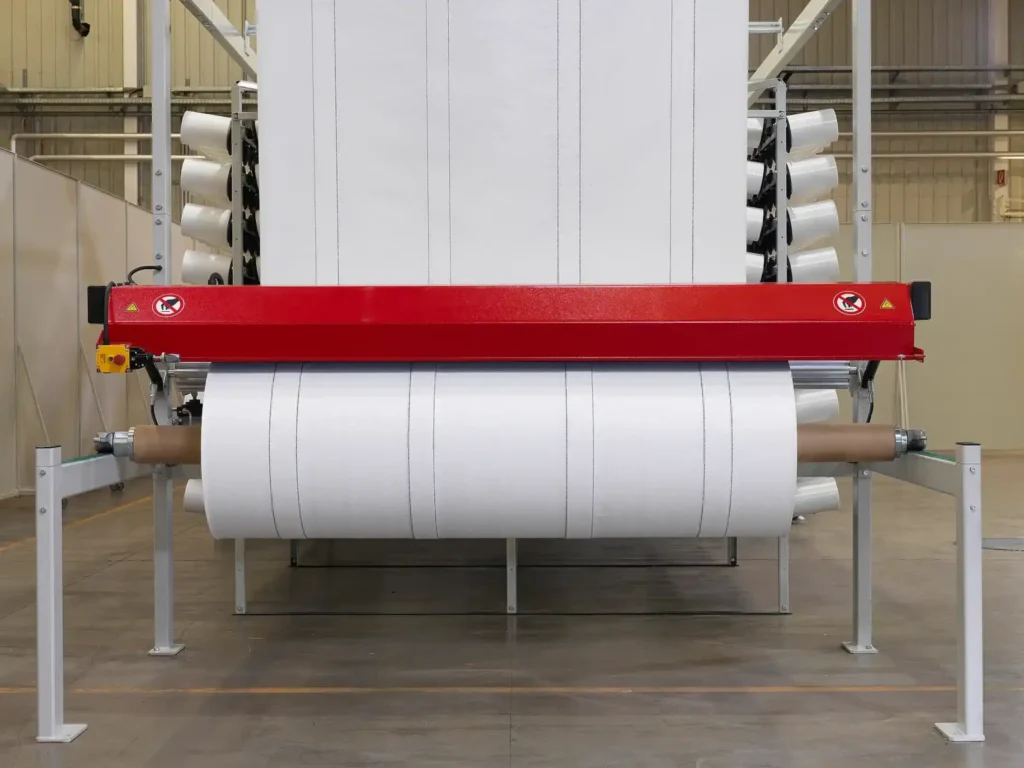
- Compounding and tape extrusion. Pellets and masterbatches are dosed, melted, cast into a thin film, slit into tapes, and drawn through heated zones to align chains. Lightweight runs monitor tape width dispersion, draw ratio, and tensile inline; edge cameras catch instability before weaving.
- Weaving. Circular looms create tubular cloth; tension balance prevents skew. Pick density rises slightly in light‑mass paths to tighten the mesh; defect counters flag miss‑picks and broken ends so a weak lane does not propagate to seam failures.
- Surface treatment. Corona discharge raises surface energy (>38 dynes/cm typical) to accept inks and adhesives. Over‑treating embrittles the surface; under‑treating risks ink pick‑off or lamination failure.
- Printing and lamination. Gravure or CI‑flexo reverse‑prints BOPP, which is then laminated via extrusion or solventless adhesive. On unlaminated paths, stack‑flexo prints directly to treated fabric, protected with an overprint varnish.
- Tubing, cutting, forming. Fabrics are tubed and hot‑knife cut; gussets are formed; bottoms are folded (single/double) or constructed as block bottoms depending on drop targets and palletization.
- Liner insertion and seal prep. Slip‑in liners are tacked at the bottom; heat‑seal jaws are sized wider and tuned for dwell to reach seal targets at lower mass; pinch adhesive weights are kept lean but consistent.
- Quality assurance and packing. Dimensional checks, seam and seal strength (ASTM F88), drop (ASTM D5276), dart (ASTM D1709) for films, WVTR (ASTM F1249) and OTR (ASTM D3985) for barrier claims, CoF (ASTM D1894) for pallet stability, and lamination bond (180° peel). ISO 12647‑6 governs print control; ISTA 3A/3E validates distribution robustness.
- Seal strength ≥ 25–40 N/15 mm (structure dependent)
- Drop performance: 5 × 1.2 m (15–25 kg) without rupture
- Dart impact ≥ 300 g for films at chosen gauges
- Lamination bond ≥ 3 N/15 mm (BOPP/WPP)
- CoF static ≥ 0.5 for pallet stability
Applications of Lightweight Woven Bags: where the format fits and why it wins
Use cases sort themselves by the stress they impose and by the story brands want to tell. The format’s versatility is not theoretical; it translates into clear pairings of product physics and bag architecture.
| Use case | Dominant risks | Recommended structure | Closure |
|---|---|---|---|
| Pet food (5–25 kg) | Abrasive kibble, aroma loss, scuff | WPP 60–70 gsm + 25 μm BOPP + LDPE liner 35–40 μm | Sewn outer + liner heat‑seal |
| Value feed (20–50 kg) | Cost, breathability, stack stability | Unlaminated WPP 65–70 gsm; OPV; anti‑slip pattern | Sewn SOM |
| Rice and pulses | Moisture ingress; premium shelf look | WPP + BOPP reverse print; matte/gloss registration | Sewn or hot‑cut |
| Fertilizers & soil | UV, puncture, pallet friction | UV‑stabilized WPP; OPV + anti‑slip | Sewn |
| Salts, resins, minerals | Clean sealing; dust control | WPP + PE sealant film 45–55 μm (mono‑PE inner) | Heat‑seal |
“Lightweight Woven Bags: The Evolution and Growth in the Modern Market” — a structured reading of the moment
The phrase captures both a technological story and an economic one. Evolution is the how; growth is the why. The last year has seen higher draw ratios stabilized by better thermal control on tape lines, defect‑tracking looms pushing scrap lower, and lamination stations that meter adhesive with gram‑level precision. The economic backdrop—resin price volatility, freight costs that punish mass, retailer scorecards that demand lighter packaging—explains adoption. But a third thread matters: consumer perception. Laminated woven faces carry photography and tactile contrasts that help commodities read as premium without heavy, multi‑material builds. In this triangulation—technology, economics, perception—Lightweight Woven Bags find their lane.
Wave one: simple downgauging hit walls fast. Wave two: orientation discipline + weave tuning delivered durable −10–15% mass. Wave three (now): localized reinforcements, leaner laminations, and smarter sealant layers unlock −15–25% while raising scuff resistance.
Real‑time defect monitoring on looms, inline tensile on tape lines, and closed‑loop color on presses reduce variability—the enemy of lightweighting. Stable processes let you cut grams without cutting corners.
EPR fees, design‑for‑recycling guidance, and retailer packaging KPIs move the goalposts. Lighter mono‑polyolefin builds with clear labels and fewer layers are simply easier to defend.
System thinking for Lightweight Woven Bags: decompose, analyze, recombine
When decisions feel tangled, break the system into subsystems with explicit levers and targets. Only then recombine into a single, testable specification.
Levers: resin MFR/impact; draw ratio; denier; pick density; UV package; lamination gauge; barrier type. Targets: fabric gsm ±2; BOPP 20–30 μm; bond ≥3 N/15 mm; CoF ≥0.5; WVTR/OTR per need.
Levers: gravure vs CI‑flexo vs stack flexo; anilox volume; ICC profiles; varnish type. Targets: ΔE00 ≤2.0 (spots), ≤3.0 (process); 100–133 lpi; barcode grade A/B.
Levers: stitch density; filler cord; tape width; pinch activation; seal jaw width/temperature/dwell. Targets: F88 ≥25–40 N/15 mm; drop 5×1.2 m; seam efficiency ≥70% of fabric tensile.
Levers: spout fit; forming shoulder; anti‑slip pattern; pallet pattern; top‑sheet strategy. Targets: throughput ≥ baseline; stoppage rate ≤ baseline; stable stacks on tilt/vibration.
Cut mass without tightening process windows and you buy problems: color drift, seam failures, pallet slippage. Make the levers explicit, assign owners, and track capability (Cp/Cpk) on widths, gussets, and seals.
Compliance map for Lightweight Woven Bags: identifiers you can put in a spec
Materials and plants operate under well‑understood rules. Listing the identifiers clarifies expectations and speeds audits.
- FDA 21 CFR 177.1520 (olefin polymers) for PP/PE in food‑contact layers or liners
- EU Framework (EC) 1935/2004 and Plastics (EU) No 10/2011 with DoC and migration testing where applicable
- EC 2023/2006 Good Manufacturing Practice for food‑contact materials
- FSSC 22000 v6 and/or ISO 22000:2018 for converter food‑safety systems
- BRCGS Packaging Materials Issue 6 for site certification
- ASTM D5276 (drop), D1709 (dart), F88 (seal), F1249 (WVTR), D3985 (OTR), D1894 (CoF), ISO 12647‑6 (flexo control), ISTA 3A/3E (distribution)
- REACH SVHC declarations for chemical stewardship; optional heavy‑metal screens aligned with retailer policies
Technical tables for Lightweight Woven Bags: structures, print controls, QA, and cost
| Structure | Fabric (gsm) | Pick density | Print face | Barrier/liner | Closure | Primary use |
|---|---|---|---|---|---|---|
| Unlaminated lightweight WPP | 60–70 | 10×10–11×11 | Surface flexo + OPV | None or LDPE 25–35 μm | Sewn SOM | Value feed, grains, minerals |
| WPP + BOPP (reverse print) | 60–70 + 20–25 μm | 10×10–12×12 | Gravure/CI‑flexo | Optional LDPE 30–40 μm | Sewn or hot‑cut | Pet food retail, rice |
| WPP + PE sealant film | 65–75 + 40–60 μm | 10×10–12×12 | Surface flexo on PE | Built‑in heat‑seal | Heat‑seal | Salts, chemicals |
| WPP + coex barrier (PE/EVOH/PE) | 65–75 + 50–70 μm | 10×10–12×12 | Reverse print on film | O2 barrier | Heat‑seal | Aroma‑sensitive goods |
| Topic | Practical target |
|---|---|
| Critical spot colors | ΔE00 ≤ 2.0 vs master chip on press proofs |
| Process imagery | 100–133 lpi linescreen; ICC profiles per press/substrate |
| Anilox selection (flexo) | 3.0–5.0 cm³/m² for solids; 2.0–3.5 for process |
| Rub resistance | Pass specified cycles with chosen varnish |
| Property | Method | Typical acceptance |
|---|---|---|
| Seal strength | ASTM F88 | ≥25–40 N/15 mm (structure dependent) |
| Drop resistance | ASTM D5276 | 5 × 1.2 m (15–25 kg) without rupture |
| Dart impact (film) | ASTM D1709 | ≥300 g (gauge dependent) |
| WVTR | ASTM F1249 | <2 g/m²·day for barrier builds (example) |
| OTR | ASTM D3985 | <5 cc/m²·day with EVOH (example) |
| Lamination bond | 180° peel | ≥3 N/15 mm (BOPP/WPP) |
| Coefficient of friction | ASTM D1894 | Static ≥0.5 for pallet stability |
| Component | Share of converted cost |
|---|---|
| Substrate mass (fabric + films) | 45–65% |
| Printing & lamination | 20–35% |
| Closures & features | 5–15% |
| QA, compliance, audits | 3–8% |
Scenario playbooks for Lightweight Woven Bags: converting ambition into specifications
WPP 65–70 gsm + BOPP 25 μm (reverse print) + LDPE liner 35–40 μm; sewn outer + liner heat‑seal; lam bond ≥3 N/15 mm; seal ≥25 N/15 mm; drop 5 × 1.2 m; ΔE00 ≤2.0 for brand spots; barcode grade A/B; certificates: FDA 21 CFR 177.1520; EU 10/2011; EC 2023/2006; FSSC 22000 v6 or BRCGS Issue 6.
Unlaminated WPP 65–70 gsm; surface flexo 2–3 colors + OPV; sewn SOM with filler cord; stitch density +10% vs baseline; CoF tuned via light anti‑slip; drop 1.0–1.2 m.
WPP 70 gsm + PE sealant 45–55 μm; surface flexo on PE; heat‑sealed top/bottom with wider jaws and longer dwell; F88 ≥30 N/15 mm; WVTR to spec; pallet stability validated.
Risk controls for Lightweight Woven Bags: five predictable failure modes and fixes
- Color drift. Lock ICC profiles and ΔE00 specs; keep Golden Samples; audit anilox/cylinder wear; implement closed‑loop spectro checks.
- Sifting at sewn tops. Increase stitch density within fabric limits; add filler cord + crepe tape; migrate to pinch or inner liner heat‑seal for fines.
- Ink adhesion loss on film. Verify surface energy (>38 dynes/cm); use primers and proper ink families; enforce solvent retention limits before slitting.
- Drop bursts or corner failures. Reinforce bottom folds; widen seal/pinch area; rebalance denier/pick count; verify heater calibration and dwell.
- Pallet slip. Specify anti‑slip lacquer; set CoF targets; adjust pallet patterns and add top sheets; validate with tilt/vibration tests.
Total cost and sustainability modeling for Lightweight Woven Bags: beyond unit price
Unit cost is the loudest number, not the most truthful. The real ledger includes scrap from color rework, downtime from mouth deformation, claims from leakage or burst, retailer penalties for unclear recyclability, and slow changeovers. Lightweight Woven Bags make sense when mass reduction coexists with steady throughput and stable complaint rates. Demand a joint converter–brand trial plan with statistically sound lots, full QA matrices, and post‑distribution pallet inspections. If KPIs hold, grams removed become dollars saved rather than headaches shifted.
Spec template for Lightweight Woven Bags: copy into your RFQ
Product & net weight: [e.g., 15 kg dog kibble]
Format: Lightweight Woven Bags — [SOM / PBOM / hot‑cut; with or without liner]
Target mass reduction vs baseline: [e.g., −12%]
Dimensions: Width [mm] × Gusset [mm] × Cut‑off [mm]
Fabric: PP woven [gsm], pick density [tapes/in], denier [range], UV package [Y/N]
Print face: [BOPP 20–25 μm reverse gravure / surface flexo on treated fabric + OPV]
Barrier/liner: [LDPE μm / PE/EVOH/PE μm]; WVTR/OTR targets
Closure: [Sewn (thread/tape/filler cord) / Pinch (hot‑melt) / Heat‑seal]; stitch density or jaw width/temperature/dwell
Graphics: PMS references; ΔE00 targets; linescreen; varnish; barcode grade and quiet zones
QA matrix: F88 ≥ [N/15 mm]; D1709 ≥ [g]; D5276 [drops × height]; lam bond ≥ [N/15 mm]; CoF ≥ [ ]
Compliance: FDA 21 CFR 177.1520; EU 1935/2004; EU 10/2011; EC 2023/2006; FSSC 22000 v6/BRCGS Issue 6; REACH SVHC
Sustainability: Material ID; mono‑polyolefin claim (where applicable); region‑specific recycling labels; PCR usage plan (if any)
First‑article plan: Lot size; tests; acceptance criteria; corrective‑action loop
Roadmap for the next year: practical pilots for Lightweight Woven Bags
- Adopt extended‑gamut inksets (CMYKOGV) to shrink changeovers as SKU counts rise.
- Push mono‑polyolefin builds that keep billboard graphics with protective varnish while simplifying sortation.
- Trial localized reinforcements (mouth stiffeners, corner patches) to cut global gsm further.
- Implement on‑press color automation with spectrophotometer feedback to protect brand tones with less waste.
- Deploy QA dashboards capturing seal strength, CoF, and drop performance in real time, turning lightweight from a project into a capability.
Origins in Modern Textile and Chemical Industries
The development of Lightweight Woven Bags can be traced back to the transformation of the textile industry in the 19th century and the later revolution brought about by advancements in plastic chemistry during the 20th century. Woven fabrics have been used for centuries to create durable materials, but it was the industrialization of textile production that set the stage for the invention of more specialized products like Lightweight Woven sacks.
In the mid-20th century, the rise of synthetic polymers—particularly polypropylene (PP)—brought about a new era in materials science. The invention of polypropylene, a plastic polymer known for its strength and versatility, opened the door for creating more durable and lightweight woven products. By weaving thin strands of polypropylene, manufacturers were able to produce Lightweight PP Bags, which combined the strength of traditional woven materials with the flexibility and light weight of plastic. This innovation not only allowed for more efficient production but also expanded the potential applications of woven bags across industries.
Expansion of Applications and Market Adaptation
Initially, Lightweight Woven Bags were primarily used in agricultural and industrial sectors. Their robust design made them ideal for storing and transporting bulk products such as grains, flour, and fertilizers. However, as the market evolved, so did the applications for these bags. Market forces, particularly the need for packaging solutions that were both durable and cost-effective, spurred manufacturers to experiment with different designs, materials, and applications.
In this process of market exploration, the product lines diversified. The original Lightweight Woven sacks were refined to meet the specific needs of various industries, from construction and mining to food packaging and retail. The versatility of polypropylene allowed manufacturers to produce bags in different sizes, weights, and strengths. For example, Lightweight PP Bags found their place in retail as shopping bags, where the lightweight feature was valued for its convenience, and the durability ensured repeated use.
One of the significant turning points in the expansion of woven bags was the introduction of laminated versions, which improved the water resistance and printability of the bags. This innovation allowed Lightweight Woven Bags to enter markets like pet food packaging, flour, and sugar industries, where moisture resistance and branding opportunities were crucial. Manufacturers also began to produce smaller, more consumer-friendly versions of these bags, adapting them for packaging individual food products like rice, salt, and seeds.
Another major development was the rise of jumbo bags or FIBC (Flexible Intermediate Bulk Containers), which extended the use of woven polypropylene into even more demanding sectors, such as chemical and mineral industries. This gradual diversification from simple bulk bags to highly specialized products reflected the industry’s ability to adapt to shifting market demands and a growing emphasis on sustainability and customizability.
The Rise of Lightweight Woven Bags in China
China has played a pivotal role in the growth and global expansion of Lightweight Woven Bags. The country’s manufacturing sector, known for its ability to scale production rapidly, embraced the woven bag industry in the late 20th century. A crucial factor in the growth of Lightweight PP Bags in China was the entrepreneurial spirit of Wenzhou merchants, who recognized the potential of woven polypropylene in the global market. Their success in scaling production while maintaining competitive pricing allowed Chinese manufacturers to dominate the industry.
Chinese manufacturers, such as those from Wenzhou, not only scaled production but also innovated in terms of customization and quality. They introduced a wide variety of Lightweight Woven sacks to cater to different market segments, from high-end branded bags used for pet food to large-scale industrial applications. This ability to adapt quickly to both global and local market needs has been key to the sustained growth of the industry.
However, as the global economy evolved, Chinese manufacturers faced new challenges. Increasingly stringent environmental regulations, rising labor costs, and growing competition from other countries forced the industry to shift its focus. To remain competitive, manufacturers had to prioritize sustainable development and quality control. This shift marked a new phase in the development of Lightweight Woven Bags in China, where companies had to invest in cleaner production processes, better quality materials, and more efficient recycling techniques.
As a result, sustainability has become a focal point in the industry. Many Chinese manufacturers now emphasize eco-friendly production methods, offering Lightweight PP Bags made from recycled materials. Additionally, the concept of reusable bags gained traction, with consumers and businesses alike demanding more sustainable packaging solutions. Chinese manufacturers are now producing bags that not only meet strict international standards but also reflect the global shift towards environmentally conscious packaging.
Challenges and the Path Forward
Today, the global market for Lightweight Woven Bags is highly competitive. Manufacturers from countries like India, Vietnam, and Bangladesh have emerged as significant players, challenging China’s dominance in the field. These countries offer competitive pricing and, in some cases, lower labor costs, which has led to a reshuffling of the global supply chain for woven bags.
To remain ahead of the competition, Chinese manufacturers must continue to innovate. Emphasizing quality, sustainability, and branding will be essential. For instance, companies like VidePak have already invested in high-end machinery and advanced production techniques to offer a wide range of customizable options, catering to diverse industry needs. In the face of rising consumer expectations, especially in terms of environmental responsibility, Lightweight Woven sacks must be positioned not only as a functional solution but also as an eco-friendly alternative to traditional packaging materials.
Moreover, as markets become more segmented, manufacturers will need to further refine their product offerings. Customization will play a key role in this evolution, as businesses across industries—from agriculture to fashion—demand specialized packaging solutions. Meeting these needs requires a commitment to innovation and a willingness to adapt to rapidly changing consumer preferences.
Conclusion
The story of Lightweight Woven Bags is one of innovation, adaptation, and resilience. From their humble beginnings in the textile industry to their current status as a global packaging solution, these bags have continually evolved to meet the demands of various markets. With China leading the charge, Lightweight PP Bags have grown into a vital product in industries ranging from agriculture to retail, thanks to their durability, flexibility, and sustainability. As competition intensifies, Chinese manufacturers must continue to prioritize quality and sustainability while exploring new market segments and customization options to ensure continued success in the years to come.